STATISTICAL
DEMOGRAPHY
 Statistical Demography is a branch of statistics that
deals with the study of population change or growth
of a nation in terms of various socio-economic and
health factors.
 The main causes of population change are :
1. Births
2. Deaths
3. Migration
Fertility :
In demography fertility can be defined as
the actual birth performance by a group of women
or some specified frequency of women that leads to
birth in the total population.
Mortality :
In demography mortality can defined as
the deaths occurred in a group of population or
some specified frequency of population.
MEASURES OF FERTILITY
 There are the following measures of fertility. They are:
1. Crude Birth Rate (CBR)
2. General Fertility Rate (GFR)
3. Age Specific Birth Rate (ASFR)
4. General Marital fertility Rate (GMFR)
5. Total Fertility Rate (TFR)
6. Gross Reproductive Rate (GRR)
7. Net Reproduction Rate (NRR)
Why do we study these measures?
 Tracking fertility rates allows for more efficient and beneficial planning and
resource allocation within a particular region or a country.
 Fertility is also studied over time to give measures showing the number and
spacing of births to cohorts of women as they pass through the life cycle.
This is known as cohort analysis.
 The Crude Birth Rate is important because of its place in the demographic
balancing equation, from which population growth can be calculated.
 Age-specific fertility rates are important because they allow us to
see patterns of fertility, which give us a good idea of both traditional and
modern/early and late patterns of fertility.
 The Total Fertility Rate (TFR) is very important because it is so widely used
and quoted which allows international comparisons.
2001 Andhra Pradesh Census Data:
Total
Present
Age
Total
Women
population
Total
Currently
Married
Women
Number of births Order of last year's birth
TOTAL
BIRTHS
Males Females
1 2 3 4 5 6 7+
Total
Less than
15 1,19,17,038 73,629 759 750 1,174 335 0 0 0 0 0 1,509
Total 15-19 36,25,840 11,49,213 92,109 88,297 1,39,213 35,589 4,451 1,153 0 0 0 1,80,406
Total 20-24 34,58,609 28,27,863 2,61,068 2,47,055 2,28,947 2,06,161 57,854 10,840 2,066 604 1,651 5,08,123
Total 25-29 35,33,013 32,94,847 1,62,529 1,52,823 77,126 1,20,051 76,793 28,046 8,358 2,543 2,435 3,15,352
Total 30-34 27,68,308 25,75,932 56,365 53,502 17,802 30,871 28,922 17,263 8,352 3,679 2,978 1,09,867
Total 35-39 28,51,782 26,30,491 30,102 29,146 7,994 11,937 14,444 10,995 6,345 3,513 4,020 59,248
Total 40-44 20,09,705 17,59,315 17,999 17,666 4,315 6,007 8,658 7,156 4,320 2,344 2,865 35,665
Total 45-49 18,43,012 15,58,823 19,763 19,291 4,472 6,271 9,612 8,334 4,775 2,690 2,900 39,054
Total 50+ 56,16,080 31,20,324 5,491 5,905 2,105 2,055 2,229 1,913 1,284 787 1,023 11,396
Total All ages 3,76,82,5941,90,07,9496,46,185 6,14,435 4,83,1484,19,277 2,02,963 85,700 35,500 16,160 17,872 12,60,620
2011 Andhra Census Data:
Total/
Rural/
Urban
Present
Age
Total
Women
Total
Currently
Married
Women
Number of Births
Last Year
Last year’s Births of Order
TOTAL
BIRTHS
Males Females 1 2 3 4 5 6 7+
Total Less than
15
10585623 95,912 2,079 2,013 2,216 1,876 0 0 0 0 0
4,092
Total 15-19 38,97,440 8,01,013 53,841 52,348 82,034 19,685 2,837 1,633 0 0 0
1,06,189
Total 20-24 40,76,397 28,63,485 2,65,727 2,52,701 2,70,301 1,99,797 37,403 6,484 1,443 597 2,403
5,18,428
Total 25-29 39,89,149 35,61,952 1,73,130 1,60,505 1,16,142 1,43,467 53,338 14,178 3,562 1,037 1,911
3,33,635
Total 30-34 32,83,964 29,88,189 57,418 51,866 30,004 43,561 21,786 8,530 3,105 1,147 1,151
1,09,284
Total 35-39 33,08,827 29,75,160 25,864 22,168 12,971 14,488 11,169 5,367 2,196 985 856
48,032
Total 40-44 26,05,075 22,47,983 22,461 18,257 8,381 9,636 11,564 6,526 2,598 1,055 958
40,718
Total 45-49 22,82,636 18,99,320 31,359 23,928 9,157 11,714 16,645 10,179 4,113 1,807 1,672
55,287
Total 50+ 77,25,775 44,26,434 5,523 5,146 1,427 2,418 2,597 2,149 1,090 483 505
10,669
Total All Ages 42138631 22052019 6,37,402 5,88,932 5,32,6334,46,642 1,57,339 55,046 18,107 7,111 9,456
12,26,334
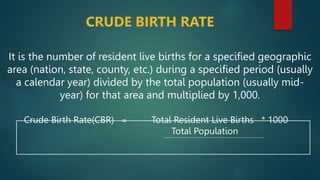
CRUDE BIRTH RATE
It is the number of resident live births for a specified geographic
area (nation, state, county, etc.) during a specified period (usually
a calendar year) divided by the total population (usually mid-
year) for that area and multiplied by 1,000.
Crude Birth Rate(CBR) = Total Resident Live Births * 1000
Total Population
GRAPHICAL
REPRESENTATION
OF CBR
13
13.5
14
14.5
15
15.5
16
16.5
17
2001 2011
CRUDE BIRTH RATE
GROSS FERTILITY RATE
GENERAL FERTILITY RATE is the number of resident live births for a
specified geographic area during a specified period divided by the
female population age 15-44 for that area, and the resulting fraction
multiplied by a 1,000
Gross Fertility Rate(GFR) = Number of Resident Live Births * 1,000
Number of females age 15-44 years
GRAPHICAL
REPRESENTATION
OF GFR
0
0.01
0.02
0.03
0.04
0.05
0.06
0.07
2001 2011
GROSS FERTILITY RATE
AGE SPECIFIC FERTILITY RATE
The number of births occurring during a given year or reference period
1000 women of reproductive age classified in single-or-five-year age
groups
ASFR = ∑
GRAPHICAL
REPRESENTATION OF
ASFR
0
0.5
1
1.5
2
2.5
3
3.5
2001 2011
AGE SPECIFIC FERTILITY RATE
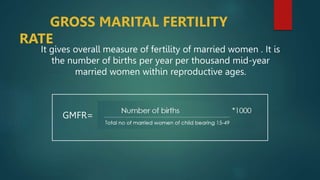
GROSS MARITAL FERTILITY
RATE
It gives overall measure of fertility of married women . It is
the number of births per year per thousand mid-year
married women within reproductive ages.
GMFR=
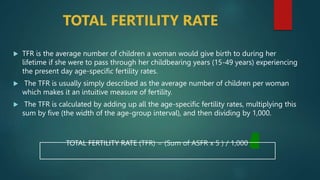
TOTAL FERTILITY RATE
 TFR is the average number of children a woman would give birth to during her
lifetime if she were to pass through her childbearing years (15-49 years) experiencing
the present day age-specific fertility rates.
 The TFR is usually simply described as the average number of children per woman
which makes it an intuitive measure of fertility.
 The TFR is calculated by adding up all the age-specific fertility rates, multiplying this
sum by five (the width of the age-group interval), and then dividing by 1,000.
TOTAL FERTILITY RATE (TFR) = (Sum of ASFR x 5 ) / 1,000
GRAPHICAL
COMPARISON
OF TFR
0
0.001
0.002
0.003
0.004
2001 2011
TOTAL FERTILITY RATE
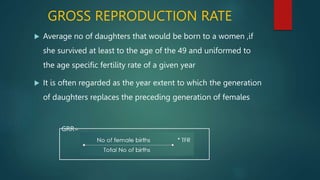
GROSS REPRODUCTION RATE
 Average no of daughters that would be born to a women ,if
she survived at least to the age of the 49 and uniformed to
the age specific fertility rate of a given year
 It is often regarded as the year extent to which the generation
of daughters replaces the preceding generation of females
GRR=
GRAPHICAL
COMPARISION
OF GRR
0.0000000
0.0002000
0.0004000
0.0006000
0.0008000
0.0010000
0.0012000
0.0014000
0.0016000
2001 2011
GROSS REPRODUCTIVE RATE
Conclusion of overall comparison

demo project[1] (2).pptx

  • 1.
  • 2.
     Statistical Demographyis a branch of statistics that deals with the study of population change or growth of a nation in terms of various socio-economic and health factors.  The main causes of population change are : 1. Births 2. Deaths 3. Migration
  • 3.
    Fertility : In demographyfertility can be defined as the actual birth performance by a group of women or some specified frequency of women that leads to birth in the total population. Mortality : In demography mortality can defined as the deaths occurred in a group of population or some specified frequency of population.
  • 4.
    MEASURES OF FERTILITY There are the following measures of fertility. They are: 1. Crude Birth Rate (CBR) 2. General Fertility Rate (GFR) 3. Age Specific Birth Rate (ASFR) 4. General Marital fertility Rate (GMFR) 5. Total Fertility Rate (TFR) 6. Gross Reproductive Rate (GRR) 7. Net Reproduction Rate (NRR)
  • 5.
    Why do westudy these measures?  Tracking fertility rates allows for more efficient and beneficial planning and resource allocation within a particular region or a country.  Fertility is also studied over time to give measures showing the number and spacing of births to cohorts of women as they pass through the life cycle. This is known as cohort analysis.  The Crude Birth Rate is important because of its place in the demographic balancing equation, from which population growth can be calculated.  Age-specific fertility rates are important because they allow us to see patterns of fertility, which give us a good idea of both traditional and modern/early and late patterns of fertility.  The Total Fertility Rate (TFR) is very important because it is so widely used and quoted which allows international comparisons.
  • 6.
    2001 Andhra PradeshCensus Data: Total Present Age Total Women population Total Currently Married Women Number of births Order of last year's birth TOTAL BIRTHS Males Females 1 2 3 4 5 6 7+ Total Less than 15 1,19,17,038 73,629 759 750 1,174 335 0 0 0 0 0 1,509 Total 15-19 36,25,840 11,49,213 92,109 88,297 1,39,213 35,589 4,451 1,153 0 0 0 1,80,406 Total 20-24 34,58,609 28,27,863 2,61,068 2,47,055 2,28,947 2,06,161 57,854 10,840 2,066 604 1,651 5,08,123 Total 25-29 35,33,013 32,94,847 1,62,529 1,52,823 77,126 1,20,051 76,793 28,046 8,358 2,543 2,435 3,15,352 Total 30-34 27,68,308 25,75,932 56,365 53,502 17,802 30,871 28,922 17,263 8,352 3,679 2,978 1,09,867 Total 35-39 28,51,782 26,30,491 30,102 29,146 7,994 11,937 14,444 10,995 6,345 3,513 4,020 59,248 Total 40-44 20,09,705 17,59,315 17,999 17,666 4,315 6,007 8,658 7,156 4,320 2,344 2,865 35,665 Total 45-49 18,43,012 15,58,823 19,763 19,291 4,472 6,271 9,612 8,334 4,775 2,690 2,900 39,054 Total 50+ 56,16,080 31,20,324 5,491 5,905 2,105 2,055 2,229 1,913 1,284 787 1,023 11,396 Total All ages 3,76,82,5941,90,07,9496,46,185 6,14,435 4,83,1484,19,277 2,02,963 85,700 35,500 16,160 17,872 12,60,620
  • 7.
    2011 Andhra CensusData: Total/ Rural/ Urban Present Age Total Women Total Currently Married Women Number of Births Last Year Last year’s Births of Order TOTAL BIRTHS Males Females 1 2 3 4 5 6 7+ Total Less than 15 10585623 95,912 2,079 2,013 2,216 1,876 0 0 0 0 0 4,092 Total 15-19 38,97,440 8,01,013 53,841 52,348 82,034 19,685 2,837 1,633 0 0 0 1,06,189 Total 20-24 40,76,397 28,63,485 2,65,727 2,52,701 2,70,301 1,99,797 37,403 6,484 1,443 597 2,403 5,18,428 Total 25-29 39,89,149 35,61,952 1,73,130 1,60,505 1,16,142 1,43,467 53,338 14,178 3,562 1,037 1,911 3,33,635 Total 30-34 32,83,964 29,88,189 57,418 51,866 30,004 43,561 21,786 8,530 3,105 1,147 1,151 1,09,284 Total 35-39 33,08,827 29,75,160 25,864 22,168 12,971 14,488 11,169 5,367 2,196 985 856 48,032 Total 40-44 26,05,075 22,47,983 22,461 18,257 8,381 9,636 11,564 6,526 2,598 1,055 958 40,718 Total 45-49 22,82,636 18,99,320 31,359 23,928 9,157 11,714 16,645 10,179 4,113 1,807 1,672 55,287 Total 50+ 77,25,775 44,26,434 5,523 5,146 1,427 2,418 2,597 2,149 1,090 483 505 10,669 Total All Ages 42138631 22052019 6,37,402 5,88,932 5,32,6334,46,642 1,57,339 55,046 18,107 7,111 9,456 12,26,334
  • 8.
    CRUDE BIRTH RATE Itis the number of resident live births for a specified geographic area (nation, state, county, etc.) during a specified period (usually a calendar year) divided by the total population (usually mid- year) for that area and multiplied by 1,000. Crude Birth Rate(CBR) = Total Resident Live Births * 1000 Total Population
  • 9.
  • 10.
    GROSS FERTILITY RATE GENERALFERTILITY RATE is the number of resident live births for a specified geographic area during a specified period divided by the female population age 15-44 for that area, and the resulting fraction multiplied by a 1,000 Gross Fertility Rate(GFR) = Number of Resident Live Births * 1,000 Number of females age 15-44 years
  • 11.
  • 12.
    AGE SPECIFIC FERTILITYRATE The number of births occurring during a given year or reference period 1000 women of reproductive age classified in single-or-five-year age groups ASFR = ∑
  • 13.
  • 14.
    GROSS MARITAL FERTILITY RATE Itgives overall measure of fertility of married women . It is the number of births per year per thousand mid-year married women within reproductive ages. GMFR=
  • 15.
    TOTAL FERTILITY RATE TFR is the average number of children a woman would give birth to during her lifetime if she were to pass through her childbearing years (15-49 years) experiencing the present day age-specific fertility rates.  The TFR is usually simply described as the average number of children per woman which makes it an intuitive measure of fertility.  The TFR is calculated by adding up all the age-specific fertility rates, multiplying this sum by five (the width of the age-group interval), and then dividing by 1,000. TOTAL FERTILITY RATE (TFR) = (Sum of ASFR x 5 ) / 1,000
  • 16.
  • 17.
    GROSS REPRODUCTION RATE Average no of daughters that would be born to a women ,if she survived at least to the age of the 49 and uniformed to the age specific fertility rate of a given year  It is often regarded as the year extent to which the generation of daughters replaces the preceding generation of females GRR=
  • 18.
  • 19.