SEMINAR PRESENTATION ON
JET PUMP
SUBMITTED BY:
NAME:
CONTENT
 INTRODUCTION
 FIGURE
 TYPES OF JET PUMP
 ADVANTAGES
DISADVANTAGES
 CONCLUSION
JET PUMP
• Jet pump is used to transfer momentum from a high velocity
primary stream to a secondary stream that gets entrained. It is
packaged with the advantage of geometrical simplicity without
any moving parts.
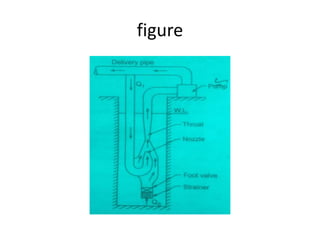
• A jet pump essentially comprises a nozzle and a diffuser assembly.
• The pressure energy of water converted into kinetic energy and
accordingly the pressure gets reduced
• Water and air have been used as fluids in the primary and
secondary streams respectively. Nozzle profiles selected is conical.
The mean diameter of nozzles are kept to be 4mm and 6mm.
• A stream of high pressure water from delivery pipe of the pump or
from an independent supply reservoir is allowed to flow through
the nozzle section.
figure
TYPES OF JET PUMP
• There are four main types of jet pumps, which vary based
on application and size.
• Deep well-Jet pumps are used in high volume applications,
such as oil wells, which range from 800-15,000 feet in
depth. The ejectors in these pumps are put down the well.
• Shallow well-Pumps are used in applications where the media
is close to the surface, such as residential wells. The ejectors
in these pumps are bolted to the nose of the pump.
• Convertible-Jet pumps are "convertible", meaning they can
be set up to be used for either deep or shallow well
applications.
• Miniature-Jet pumps are used for smaller (typically
commercial) applications, such as aquariums.
ADVANTAGES
• Higher speed before the onset of cavitation because of
the raised internal dynamic pressure
• High power density (with respect to volume) of both the
propulsor and the prime mover (because a smaller,
higher-speed unit can be used)
• Protection of the rotating element, making operation
safer around swimmers and aquatic life
• Improved shallow-water operations, because only the
inlet needs to be submerged
• Increased maneuverability, by adding a steerable nozzle
to create vectored thrust
DISADVANTAGE
• Can be less efficient than a propeller at low speed
• More expensive
• The intake grill can become clogged with debris; e.g.,
seaweed. The effects of this can be mitigated by having a
reversing gearbox between the engine and the water jet.
APPLICATION
• In Marine applications, jet pumps are used to transfer
seawater.
• 2.In Home applications, they are used to move wastewater up
to the sewer line.
Thank you for your
attention…!!!

Presentation on JET PUMP

  • 1.
    SEMINAR PRESENTATION ON JETPUMP SUBMITTED BY: NAME:
  • 2.
    CONTENT  INTRODUCTION  FIGURE TYPES OF JET PUMP  ADVANTAGES DISADVANTAGES  CONCLUSION
  • 3.
    JET PUMP • Jetpump is used to transfer momentum from a high velocity primary stream to a secondary stream that gets entrained. It is packaged with the advantage of geometrical simplicity without any moving parts. • A jet pump essentially comprises a nozzle and a diffuser assembly. • The pressure energy of water converted into kinetic energy and accordingly the pressure gets reduced • Water and air have been used as fluids in the primary and secondary streams respectively. Nozzle profiles selected is conical. The mean diameter of nozzles are kept to be 4mm and 6mm. • A stream of high pressure water from delivery pipe of the pump or from an independent supply reservoir is allowed to flow through the nozzle section.
  • 4.
  • 5.
    TYPES OF JETPUMP • There are four main types of jet pumps, which vary based on application and size. • Deep well-Jet pumps are used in high volume applications, such as oil wells, which range from 800-15,000 feet in depth. The ejectors in these pumps are put down the well. • Shallow well-Pumps are used in applications where the media is close to the surface, such as residential wells. The ejectors in these pumps are bolted to the nose of the pump. • Convertible-Jet pumps are "convertible", meaning they can be set up to be used for either deep or shallow well applications. • Miniature-Jet pumps are used for smaller (typically commercial) applications, such as aquariums.
  • 6.
    ADVANTAGES • Higher speedbefore the onset of cavitation because of the raised internal dynamic pressure • High power density (with respect to volume) of both the propulsor and the prime mover (because a smaller, higher-speed unit can be used) • Protection of the rotating element, making operation safer around swimmers and aquatic life • Improved shallow-water operations, because only the inlet needs to be submerged • Increased maneuverability, by adding a steerable nozzle to create vectored thrust
  • 7.
    DISADVANTAGE • Can beless efficient than a propeller at low speed • More expensive • The intake grill can become clogged with debris; e.g., seaweed. The effects of this can be mitigated by having a reversing gearbox between the engine and the water jet.
  • 8.
    APPLICATION • In Marineapplications, jet pumps are used to transfer seawater. • 2.In Home applications, they are used to move wastewater up to the sewer line.
  • 9.
    Thank you foryour attention…!!!