IWM 411: Pumps and Wells
Course Teacher
Ajoy Kumar Saha
Assistant Professor
Dept of Irrigation and water management
Co-course Teacher
Md. Suruj Mia
Assistant Professor
Dept of Irrigation and water management
Sylhet Agricultural University, Sylhet
2
Outline of this Course
Pumps and Pumping Plants
Deep Well Turbine and Submersible Pumps
Water Wells
Tubewells and their Design
Tubewell Construction
Tubewell Development and Testing
Tubewell Failure and Rehabilitation
3
Aim of this course
How hydraulic principle applied into pump
Design, Construction and Maintenance pump
Design Irrigation Project
1. Irrigation - Theory and Practice - by A. M. Michael; Vikas
Publishing House Pvt. Ltd. New Delhi.
2. Water Well and Pump Engineering - by A. M Michael et al.
S D Khepar, Tata McGraw Hill Publishing Co. Ltd. New Delhi.
3. Groundwater Hydrology - by D. K. Todd; Wiles and Sons.
4
Text Books:
• First mid term: 10 Marks
• Second mid term: 10 Marks
• Attendance: 10 Marks
• Final Exam: 70 Marks
Total = 100 Marks
5
How to Evaluate you?
***Please mind it, Pass Marks = 50
6
Attendance marks
Chapter 01:
Pumps and Pumping Plants
7
8
Out line of this chapter
What is pump?
Indigenous water lifting devices
Pump classification
Characteristics and selection of Pump
Pump-pipe line system design
Power requirements
Efficiency and economics of pumping plants
Pump installation, operation and maintenance
• Device used to move liquid from one to another place
• Pump convert mechanical energy to hydraulic energy
• Usually, move water from lower to higher elevation with a
required discharge and pressure
• Generally, pump used to lift water at higher elevation
9
What is pump?
10
What is pump?
Definition of Pump:
A pump is a mechanical device which use to increase
the pressure energy of liquid in order to lift it from
lower level to higher level. This is usually achieve by
creating low pressure at the inlet and high pressure at
outlet.
11
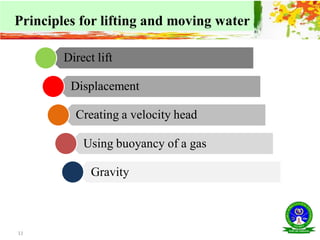
Principles for lifting and moving water
Direct lift
Displacement
Creating a velocity head
Using buoyancy of a gas
Gravity
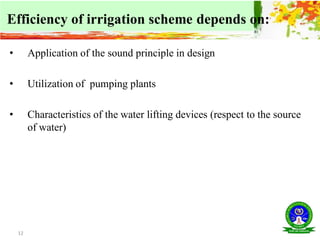
• Application of the sound principle in design
• Utilization of pumping plants
• Characteristics of the water lifting devices (respect to the source
of water)
12
Efficiency of irrigation scheme depends on:
13
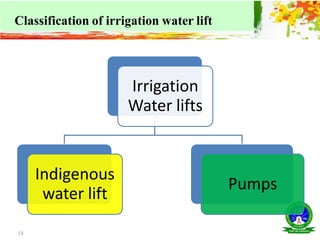
Classification of irrigation water lift
Irrigation
Water lifts
Indigenous
water lift
Pumps
14
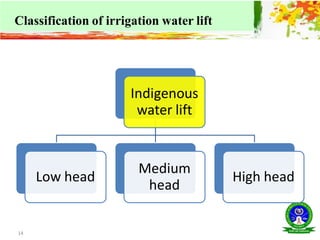
Classification of irrigation water lift
Indigenous
water lift
Low head
Medium
head
High head
15
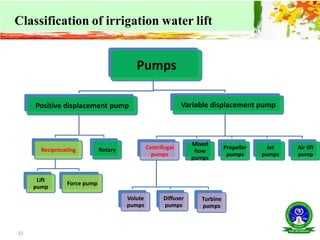
Classification of irrigation water lift
Pumps
Positive displacement pump
Reciprocating
Lift
pump
Force pump
Rotary
Variable displacement pump
Centrifugal
pumps
Volute
pumps
Diffuser
pumps
Turbine
pumps
Mixed
flow
pumps
Propeller
pumps
Jet
pumps
Air lift
pump
16
Classification of irrigation water lift
Reciprocating
Lift pump
Single acting Double acting
Force pump
Single acting Double acting
17
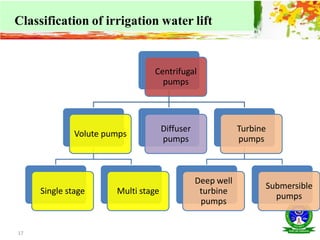
Classification of irrigation water lift
Centrifugal
pumps
Volute pumps
Single stage Multi stage
Diffuser
pumps
Turbine
pumps
Deep well
turbine
pumps
Submersible
pumps
18
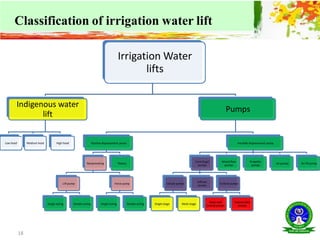
Classification of irrigation water lift
Irrigation Water
lifts
Indigenous water
lift
Low head Medium head High head
Pumps
Positive displacement pump
Reciprocating
Lift pump
Single acting Double acting
Force pump
Single acting Double acting
Rotary
Variable displacement pump
Centrifugal
pumps
Volute pumps
Single stage Multi stage
Diffuser
pumps
Turbine pumps
Deep well
turbine pumps
Submersible
pumps
Mixed flow
pumps
Propeller
pumps
Jet pumps Air lift pump
19
Selection of Irrigation water lifting device depends on:
• Source of water and methods to lift irrigation water
• Amount of water to be lifted
• Depth of pumping water level
• Type and amount of water available
• Economic status of the farmer
20
Indigenous Water lifting device
21
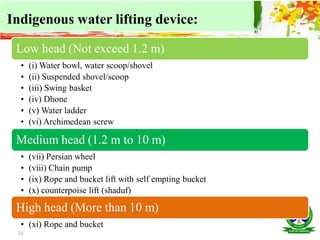
Indigenous water lifting device:
Low head (Not exceed 1.2 m)
• (i) Water bowl, water scoop/shovel
• (ii) Suspended shovel/scoop
• (iii) Swing basket
• (iv) Dhone
• (v) Water ladder
• (vi) Archimedean screw
Medium head (1.2 m to 10 m)
• (vii) Persian wheel
• (viii) Chain pump
• (ix) Rope and bucket lift with self empting bucket
• (x) counterpoise lift (shaduf)
High head (More than 10 m)
• (xi) Rope and bucket
22
Low Head
Head limit: 0.2 m to 1.2 m
Indigenous water lifting device:
23
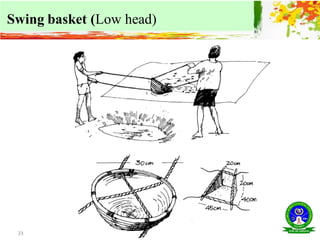
Swing basket (Low head)
24
Swing basket (Low head)
• Most ancient water lifting device
• Consist of a basket or shovel with attached rope in four corner
• Usually operate by two person
• Directly supply water to the field channel or field
• Optimum capacity to lift: 0.3 to 0.5 m
• Average discharge capacity:14000-19000 litre/hr
25
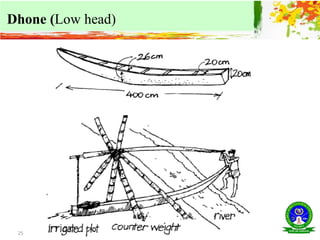
Dhone (Low head)
26
Dhone (Low head)
• Manually operating device, a single man can operate it
• Boat shaped, one side open but other end closed
• Close end is tied with a rope on a long wooden bar which is
pivoted on a lever
• Optimum capacity to lift: 0.5 to 1 m
• Average discharge capacity: 9000-13000 litre/hr
27
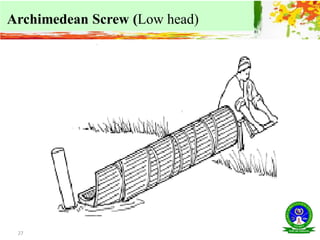
Archimedean Screw (Low head)
28
Archimedean Screw (Low head)
• Manually operating, one or two man required to operate
• Wood or metal wheel drum, interior shape like a screw
• Rotated by handle which is fixed to a central spindle
• Drum is placed at an angle of less than 30
• Optimum capacity to lift: 0.5 to 1.2 m
• Average discharge capacity:14000 to 19000 litre/h
• Efficiency maximum when lower end of drum in half submerged
• More efficient device compare to swing basket or dhone
29
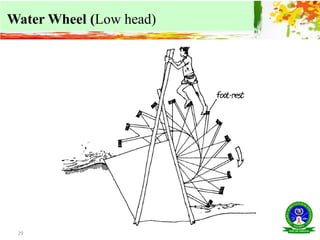
Water Wheel (Low head)
30
Water Wheel (Low head)
• Shaft is driven by animal
• Optimum capacity to lift: 1 to 1.2 m
• Average discharge capacity: 40000 to 50000 litre/h
31
Indigenous water lifting device
Limitation of low head device:
• Manually or animal Operated
• Used only when depth of water does not exceed 1.2 m
• Slow process and inefficient
32
Medium Head
Head limit: 1.2 m to 10 m
Indigenous water lifting device:
33
Persian Wheel (Medium head)
34
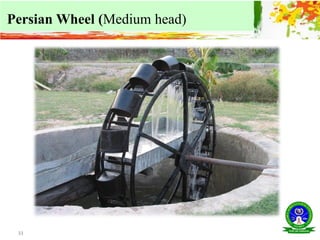
Persian Wheel (Medium head)
35
Persian Wheel (Medium head)
• Normally animal operated
• Consist of a chain and buckets mounted on a open spoket drum
• Capacity of a single bucket is 7-14 litre
• Optimum capacity to lift: up to 10 m
• Average discharge capacity: 14000 to 19000 litre/h
• Not use in Bangladesh, usually use in Northern part of India
36
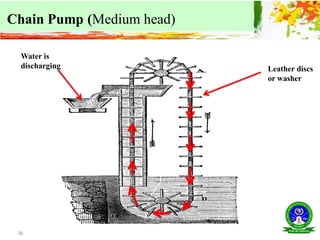
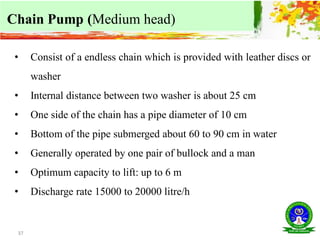
Chain Pump (Medium head)
Leather discs
or washer
Water is
discharging
37
Chain Pump (Medium head)
• Consist of a endless chain which is provided with leather discs or
washer
• Internal distance between two washer is about 25 cm
• One side of the chain has a pipe diameter of 10 cm
• Bottom of the pipe submerged about 60 to 90 cm in water
• Generally operated by one pair of bullock and a man
• Optimum capacity to lift: up to 6 m
• Discharge rate 15000 to 20000 litre/h
38
Rope and bucket lift with self empting bucket (Medium head)
39
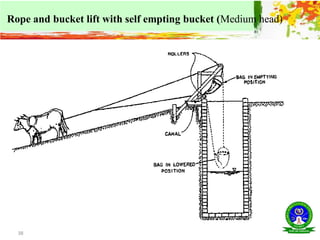
Rope and bucket lift with self empting bucket (Medium head)
• Generally operated by one pair of bullock and a man
• Capacity of the bucket 100 to 15o litre
• Optimum capacity to lift: up to 4 m to 6 m
• Average discharge capacity: 10000 to 15000 litre/h
• Generally used in South India
40
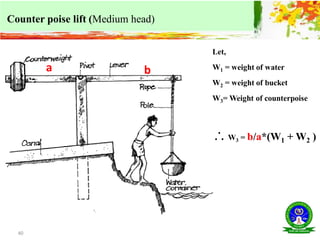
Counter poise lift (Medium head)
Let,
W1 = weight of water
W2 = weight of bucket
W3= Weight of counterpoise
W3 = b/a*(W1 + W2 )
a b
41
Counter poise lift (Medium head)
• Manually operated, single man can operate it
• Optimum capacity to lift: 1.2 to 4 m
• Average discharge capacity: 8000 to 11000 litre/h
• Used in South India and Northern part of Bangladesh
42
High Head
Head limit: above 10 m
Indigenous water lifting device:
43
Rope and Bucket lift (High head)
• Suitable for deep wells, locally called Charasa
• Generally operated by one pair of bullock
• Bullock walk in earthen ram having sloped of 5 to 10
• Capacity of the bucket 100 to 150 litre
• Optimum capacity to lift: 10 to 30 m
• Average discharge capacity: 6000 to 10000 litre/h
• Usually use in Rajasthan
44
A pump is used to irrigate wheat field of 1 ha, with average
discharge 250 l/h for 80 hours for whole period. So what is the
irrigation depth for this crop?
To solve: 5 minutes time, from now…..
Two marks declared as bonus for class test
Unexpected Test: (For recall concept)
45
Modern water lifting device:
Pump
46
Definition of Pump:
A pump is a mechanical device used to increase the
pressure energy of liquid in order to lift liquid from
lower level to higher level. This is usually achieved by
creating low pressure at the inlet and high pressure at
outlet.
47
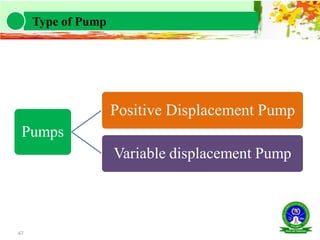
Type of Pump
Pumps
Positive Displacement Pump
Variable displacement Pump
48
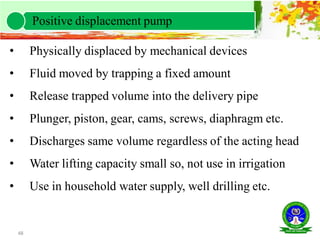
• Physically displaced by mechanical devices
• Fluid moved by trapping a fixed amount
• Release trapped volume into the delivery pipe
• Plunger, piston, gear, cams, screws, diaphragm etc.
• Discharges same volume regardless of the acting head
• Water lifting capacity small so, not use in irrigation
• Use in household water supply, well drilling etc.
Positive displacement pump
49
Positive Displacement Pump
Reciprocating Pump
Rotary Pump
50
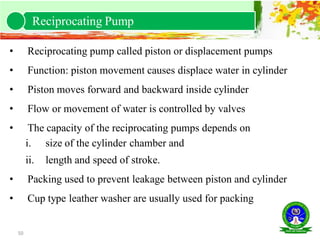
• Reciprocating pump called piston or displacement pumps
• Function: piston movement causes displace water in cylinder
• Piston moves forward and backward inside cylinder
• Flow or movement of water is controlled by valves
• The capacity of the reciprocating pumps depends on
i. size of the cylinder chamber and
ii. length and speed of stroke.
• Packing used to prevent leakage between piston and cylinder
• Cup type leather washer are usually used for packing
Reciprocating Pump
51
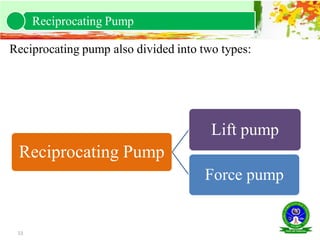
Reciprocating pump also divided into two types:
Reciprocating Pump
Reciprocating Pump
Lift pump
Force pump
52
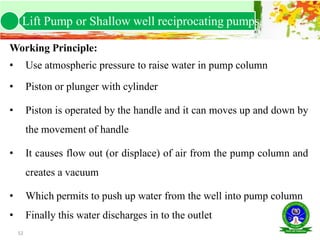
Working Principle:
• Use atmospheric pressure to raise water in pump column
• Piston or plunger with cylinder
• Piston is operated by the handle and it can moves up and down by
the movement of handle
• It causes flow out (or displace) of air from the pump column and
creates a vacuum
• Which permits to push up water from the well into pump column
• Finally this water discharges in to the outlet
Lift Pump or Shallow well reciprocating pumps.
53
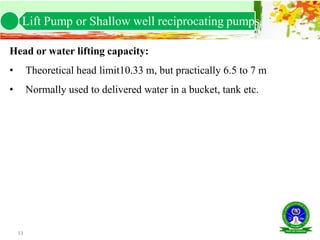
Head or water lifting capacity:
• Theoretical head limit10.33 m, but practically 6.5 to 7 m
• Normally used to delivered water in a bucket, tank etc.
Lift Pump or Shallow well reciprocating pumps.
54
Working Principle:
• Pump cylinder with plunger and valves stay into the water well
• The plunger is connected to the pump handle, or other operating
device like a mechanically powered crank shaft
• As the plunger in which the upper valve is located moves upward,
the water on the top of the valve is forced upward through the
delivery pipe and another charge of water fills the space between
the valves.
• Cycle is repeated in each upward stroke
Force Pump or Deep well reciprocating pumps.
55
Head or water lifting capacity:
• May be manually or mechanically operated
• Manual operation suitable only for lifts up to 45 m
• More lift increases the weight of water column and connecting
rod, then manual operation become impossible
• For mechanical operation, engine or motor placed at top of well
• Need to change the rotating motion to reciprocating motion
• Water can be lifted in any height required in practical use
Force Pump or Deep well reciprocating pumps.
56
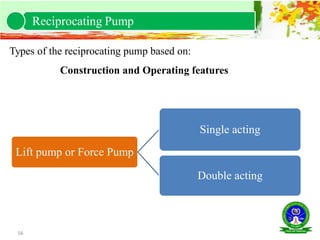
Types of the reciprocating pump based on:
Construction and Operating features
Reciprocating Pump
Lift pump or Force Pump
Single acting
Double acting
57
• One discharge stroke for every two strokes of the piston
• Water delivered for the alternate strokes of the piston
• Thus flow intermittent
• To get a continuous flow ‘air vessel’ can be fixed over or near the
delivery valve
• During the suction stroke, the pressure of the air in the vessel
maintains the flow or water through the delivery pipe
Single acting reciprocating pumps
58
• Water pumped for both inward and outward movement of piston
• Arrangement of the piston and valves create this possible
• Mostly it is a suction lift pumps but are also available for pressure
intake installation in wells
• This arrangement is more commonly used in lift pumps
• It is also sometimes incorporated in force pumps
Double acting reciprocating pumps
59
• The force require to lift the piston will be the summation
(i) the weight of the piston and piston rod
(ii) plus the weight of the column of the water
• Generally weight of the piston and connecting rod is neglected
• The column of water displaced means the swept volume
Force required for operating a reciprocating pump:
60
Let,
a = area of the cylinder in m2
l = length of the stroke in m
h = total head to which the water is to be lift in m
P = force is required to lift the piston (neglecting friction and the
weight of the piston and connecting rod) in kg
w = sp. weight of water or unit weight of water, 1000 kg/m3
Force required for operating a reciprocating pump:
61
Swept volume=cross sectional area of the piston×length of cylinder
= a × l
Weight of the water raise in the one stroke
= w × a × l = 1000 a l
= Force require to lift piston (P)
Finally force required or work done in one upstroke, H. P.
= Force × distance
= P × h
= 1000 a l × h
Force required for operating a reciprocating pump:
62
Example problem 1:
A single acting reciprocating pump has its piston diameter 15 cm and
stroke 25 cm. The piston makes 50 double strokes per minute.
The suction and delivery heads are 5 m and 15 m, respectively.
Find:
a) the discharge capacity of the pump in litres per minute
b) the force required to work the piston during the suction and
delivery strokes if the efficiency of suction and delivery
strokes are 60% and 75%, respectively and
c) the H. P. required by the pump for its operation
Single acting Reciprocating Pump
63
Example problem 2:
A double acting reciprocating pump has a piston of 25 cm diameter
and a piston rod of 5 cm diameter which is one side of the piston
only. The length of the piston stroke is 35 cm and the speed of
the crank moving piston is 60 rpm. The suction and delivery
heads are 4.5 m and 18 m, respectively.
Determine:
a) the discharge capacity of the pump in litres per minute and
b) the H. P. required to operate the pump
Doouble acting Reciprocating Pump

01 pumps and pumping plants

  • 1.
    IWM 411: Pumpsand Wells Course Teacher Ajoy Kumar Saha Assistant Professor Dept of Irrigation and water management Co-course Teacher Md. Suruj Mia Assistant Professor Dept of Irrigation and water management Sylhet Agricultural University, Sylhet
  • 2.
    2 Outline of thisCourse Pumps and Pumping Plants Deep Well Turbine and Submersible Pumps Water Wells Tubewells and their Design Tubewell Construction Tubewell Development and Testing Tubewell Failure and Rehabilitation
  • 3.
    3 Aim of thiscourse How hydraulic principle applied into pump Design, Construction and Maintenance pump Design Irrigation Project
  • 4.
    1. Irrigation -Theory and Practice - by A. M. Michael; Vikas Publishing House Pvt. Ltd. New Delhi. 2. Water Well and Pump Engineering - by A. M Michael et al. S D Khepar, Tata McGraw Hill Publishing Co. Ltd. New Delhi. 3. Groundwater Hydrology - by D. K. Todd; Wiles and Sons. 4 Text Books:
  • 5.
    • First midterm: 10 Marks • Second mid term: 10 Marks • Attendance: 10 Marks • Final Exam: 70 Marks Total = 100 Marks 5 How to Evaluate you? ***Please mind it, Pass Marks = 50
  • 6.
  • 7.
    Chapter 01: Pumps andPumping Plants 7
  • 8.
    8 Out line ofthis chapter What is pump? Indigenous water lifting devices Pump classification Characteristics and selection of Pump Pump-pipe line system design Power requirements Efficiency and economics of pumping plants Pump installation, operation and maintenance
  • 9.
    • Device usedto move liquid from one to another place • Pump convert mechanical energy to hydraulic energy • Usually, move water from lower to higher elevation with a required discharge and pressure • Generally, pump used to lift water at higher elevation 9 What is pump?
  • 10.
    10 What is pump? Definitionof Pump: A pump is a mechanical device which use to increase the pressure energy of liquid in order to lift it from lower level to higher level. This is usually achieve by creating low pressure at the inlet and high pressure at outlet.
  • 11.
    11 Principles for liftingand moving water Direct lift Displacement Creating a velocity head Using buoyancy of a gas Gravity
  • 12.
    • Application ofthe sound principle in design • Utilization of pumping plants • Characteristics of the water lifting devices (respect to the source of water) 12 Efficiency of irrigation scheme depends on:
  • 13.
    13 Classification of irrigationwater lift Irrigation Water lifts Indigenous water lift Pumps
  • 14.
    14 Classification of irrigationwater lift Indigenous water lift Low head Medium head High head
  • 15.
    15 Classification of irrigationwater lift Pumps Positive displacement pump Reciprocating Lift pump Force pump Rotary Variable displacement pump Centrifugal pumps Volute pumps Diffuser pumps Turbine pumps Mixed flow pumps Propeller pumps Jet pumps Air lift pump
  • 16.
    16 Classification of irrigationwater lift Reciprocating Lift pump Single acting Double acting Force pump Single acting Double acting
  • 17.
    17 Classification of irrigationwater lift Centrifugal pumps Volute pumps Single stage Multi stage Diffuser pumps Turbine pumps Deep well turbine pumps Submersible pumps
  • 18.
    18 Classification of irrigationwater lift Irrigation Water lifts Indigenous water lift Low head Medium head High head Pumps Positive displacement pump Reciprocating Lift pump Single acting Double acting Force pump Single acting Double acting Rotary Variable displacement pump Centrifugal pumps Volute pumps Single stage Multi stage Diffuser pumps Turbine pumps Deep well turbine pumps Submersible pumps Mixed flow pumps Propeller pumps Jet pumps Air lift pump
  • 19.
    19 Selection of Irrigationwater lifting device depends on: • Source of water and methods to lift irrigation water • Amount of water to be lifted • Depth of pumping water level • Type and amount of water available • Economic status of the farmer
  • 20.
  • 21.
    21 Indigenous water liftingdevice: Low head (Not exceed 1.2 m) • (i) Water bowl, water scoop/shovel • (ii) Suspended shovel/scoop • (iii) Swing basket • (iv) Dhone • (v) Water ladder • (vi) Archimedean screw Medium head (1.2 m to 10 m) • (vii) Persian wheel • (viii) Chain pump • (ix) Rope and bucket lift with self empting bucket • (x) counterpoise lift (shaduf) High head (More than 10 m) • (xi) Rope and bucket
  • 22.
    22 Low Head Head limit:0.2 m to 1.2 m Indigenous water lifting device:
  • 23.
  • 24.
    24 Swing basket (Lowhead) • Most ancient water lifting device • Consist of a basket or shovel with attached rope in four corner • Usually operate by two person • Directly supply water to the field channel or field • Optimum capacity to lift: 0.3 to 0.5 m • Average discharge capacity:14000-19000 litre/hr
  • 25.
  • 26.
    26 Dhone (Low head) •Manually operating device, a single man can operate it • Boat shaped, one side open but other end closed • Close end is tied with a rope on a long wooden bar which is pivoted on a lever • Optimum capacity to lift: 0.5 to 1 m • Average discharge capacity: 9000-13000 litre/hr
  • 27.
  • 28.
    28 Archimedean Screw (Lowhead) • Manually operating, one or two man required to operate • Wood or metal wheel drum, interior shape like a screw • Rotated by handle which is fixed to a central spindle • Drum is placed at an angle of less than 30 • Optimum capacity to lift: 0.5 to 1.2 m • Average discharge capacity:14000 to 19000 litre/h • Efficiency maximum when lower end of drum in half submerged • More efficient device compare to swing basket or dhone
  • 29.
  • 30.
    30 Water Wheel (Lowhead) • Shaft is driven by animal • Optimum capacity to lift: 1 to 1.2 m • Average discharge capacity: 40000 to 50000 litre/h
  • 31.
    31 Indigenous water liftingdevice Limitation of low head device: • Manually or animal Operated • Used only when depth of water does not exceed 1.2 m • Slow process and inefficient
  • 32.
    32 Medium Head Head limit:1.2 m to 10 m Indigenous water lifting device:
  • 33.
  • 34.
  • 35.
    35 Persian Wheel (Mediumhead) • Normally animal operated • Consist of a chain and buckets mounted on a open spoket drum • Capacity of a single bucket is 7-14 litre • Optimum capacity to lift: up to 10 m • Average discharge capacity: 14000 to 19000 litre/h • Not use in Bangladesh, usually use in Northern part of India
  • 36.
    36 Chain Pump (Mediumhead) Leather discs or washer Water is discharging
  • 37.
    37 Chain Pump (Mediumhead) • Consist of a endless chain which is provided with leather discs or washer • Internal distance between two washer is about 25 cm • One side of the chain has a pipe diameter of 10 cm • Bottom of the pipe submerged about 60 to 90 cm in water • Generally operated by one pair of bullock and a man • Optimum capacity to lift: up to 6 m • Discharge rate 15000 to 20000 litre/h
  • 38.
    38 Rope and bucketlift with self empting bucket (Medium head)
  • 39.
    39 Rope and bucketlift with self empting bucket (Medium head) • Generally operated by one pair of bullock and a man • Capacity of the bucket 100 to 15o litre • Optimum capacity to lift: up to 4 m to 6 m • Average discharge capacity: 10000 to 15000 litre/h • Generally used in South India
  • 40.
    40 Counter poise lift(Medium head) Let, W1 = weight of water W2 = weight of bucket W3= Weight of counterpoise W3 = b/a*(W1 + W2 ) a b
  • 41.
    41 Counter poise lift(Medium head) • Manually operated, single man can operate it • Optimum capacity to lift: 1.2 to 4 m • Average discharge capacity: 8000 to 11000 litre/h • Used in South India and Northern part of Bangladesh
  • 42.
    42 High Head Head limit:above 10 m Indigenous water lifting device:
  • 43.
    43 Rope and Bucketlift (High head) • Suitable for deep wells, locally called Charasa • Generally operated by one pair of bullock • Bullock walk in earthen ram having sloped of 5 to 10 • Capacity of the bucket 100 to 150 litre • Optimum capacity to lift: 10 to 30 m • Average discharge capacity: 6000 to 10000 litre/h • Usually use in Rajasthan
  • 44.
    44 A pump isused to irrigate wheat field of 1 ha, with average discharge 250 l/h for 80 hours for whole period. So what is the irrigation depth for this crop? To solve: 5 minutes time, from now….. Two marks declared as bonus for class test Unexpected Test: (For recall concept)
  • 45.
  • 46.
    46 Definition of Pump: Apump is a mechanical device used to increase the pressure energy of liquid in order to lift liquid from lower level to higher level. This is usually achieved by creating low pressure at the inlet and high pressure at outlet.
  • 47.
    47 Type of Pump Pumps PositiveDisplacement Pump Variable displacement Pump
  • 48.
    48 • Physically displacedby mechanical devices • Fluid moved by trapping a fixed amount • Release trapped volume into the delivery pipe • Plunger, piston, gear, cams, screws, diaphragm etc. • Discharges same volume regardless of the acting head • Water lifting capacity small so, not use in irrigation • Use in household water supply, well drilling etc. Positive displacement pump
  • 49.
    49 Positive Displacement Pump PositiveDisplacement Pump Reciprocating Pump Rotary Pump
  • 50.
    50 • Reciprocating pumpcalled piston or displacement pumps • Function: piston movement causes displace water in cylinder • Piston moves forward and backward inside cylinder • Flow or movement of water is controlled by valves • The capacity of the reciprocating pumps depends on i. size of the cylinder chamber and ii. length and speed of stroke. • Packing used to prevent leakage between piston and cylinder • Cup type leather washer are usually used for packing Reciprocating Pump
  • 51.
    51 Reciprocating pump alsodivided into two types: Reciprocating Pump Reciprocating Pump Lift pump Force pump
  • 52.
    52 Working Principle: • Useatmospheric pressure to raise water in pump column • Piston or plunger with cylinder • Piston is operated by the handle and it can moves up and down by the movement of handle • It causes flow out (or displace) of air from the pump column and creates a vacuum • Which permits to push up water from the well into pump column • Finally this water discharges in to the outlet Lift Pump or Shallow well reciprocating pumps.
  • 53.
    53 Head or waterlifting capacity: • Theoretical head limit10.33 m, but practically 6.5 to 7 m • Normally used to delivered water in a bucket, tank etc. Lift Pump or Shallow well reciprocating pumps.
  • 54.
    54 Working Principle: • Pumpcylinder with plunger and valves stay into the water well • The plunger is connected to the pump handle, or other operating device like a mechanically powered crank shaft • As the plunger in which the upper valve is located moves upward, the water on the top of the valve is forced upward through the delivery pipe and another charge of water fills the space between the valves. • Cycle is repeated in each upward stroke Force Pump or Deep well reciprocating pumps.
  • 55.
    55 Head or waterlifting capacity: • May be manually or mechanically operated • Manual operation suitable only for lifts up to 45 m • More lift increases the weight of water column and connecting rod, then manual operation become impossible • For mechanical operation, engine or motor placed at top of well • Need to change the rotating motion to reciprocating motion • Water can be lifted in any height required in practical use Force Pump or Deep well reciprocating pumps.
  • 56.
    56 Types of thereciprocating pump based on: Construction and Operating features Reciprocating Pump Lift pump or Force Pump Single acting Double acting
  • 57.
    57 • One dischargestroke for every two strokes of the piston • Water delivered for the alternate strokes of the piston • Thus flow intermittent • To get a continuous flow ‘air vessel’ can be fixed over or near the delivery valve • During the suction stroke, the pressure of the air in the vessel maintains the flow or water through the delivery pipe Single acting reciprocating pumps
  • 58.
    58 • Water pumpedfor both inward and outward movement of piston • Arrangement of the piston and valves create this possible • Mostly it is a suction lift pumps but are also available for pressure intake installation in wells • This arrangement is more commonly used in lift pumps • It is also sometimes incorporated in force pumps Double acting reciprocating pumps
  • 59.
    59 • The forcerequire to lift the piston will be the summation (i) the weight of the piston and piston rod (ii) plus the weight of the column of the water • Generally weight of the piston and connecting rod is neglected • The column of water displaced means the swept volume Force required for operating a reciprocating pump:
  • 60.
    60 Let, a = areaof the cylinder in m2 l = length of the stroke in m h = total head to which the water is to be lift in m P = force is required to lift the piston (neglecting friction and the weight of the piston and connecting rod) in kg w = sp. weight of water or unit weight of water, 1000 kg/m3 Force required for operating a reciprocating pump:
  • 61.
    61 Swept volume=cross sectionalarea of the piston×length of cylinder = a × l Weight of the water raise in the one stroke = w × a × l = 1000 a l = Force require to lift piston (P) Finally force required or work done in one upstroke, H. P. = Force × distance = P × h = 1000 a l × h Force required for operating a reciprocating pump:
  • 62.
    62 Example problem 1: Asingle acting reciprocating pump has its piston diameter 15 cm and stroke 25 cm. The piston makes 50 double strokes per minute. The suction and delivery heads are 5 m and 15 m, respectively. Find: a) the discharge capacity of the pump in litres per minute b) the force required to work the piston during the suction and delivery strokes if the efficiency of suction and delivery strokes are 60% and 75%, respectively and c) the H. P. required by the pump for its operation Single acting Reciprocating Pump
  • 63.
    63 Example problem 2: Adouble acting reciprocating pump has a piston of 25 cm diameter and a piston rod of 5 cm diameter which is one side of the piston only. The length of the piston stroke is 35 cm and the speed of the crank moving piston is 60 rpm. The suction and delivery heads are 4.5 m and 18 m, respectively. Determine: a) the discharge capacity of the pump in litres per minute and b) the H. P. required to operate the pump Doouble acting Reciprocating Pump