Copyright
Andy Horbal
Presentation to Professor Paoletti’s
AMST 428E/628F class
March 23, 2015
Outline
• Introduction
• When/how is it appropriate to use a pop song from
1975 in a video or illustrated online exhibit?
• Basics of copyright
• In-Class Exercises:
• Captain & Tennille – “Love Will Keep Us
Together”
• Photograph of fall of Saigon
• Clip from Jaws
• Contact info/slides
“Fame”
David Bowie - “Fame”
• Recorded by David Bowie in 1975; composed by
Bowie, John Lennon, and Carlos Alomar
• What I want to do with it:
• Create a video using “Fame” as the soundtrack
• Turn it in to my professor for credit
• Post the video on YouTube after the semester is
over
• Question: Am I allowed to do this?
Copyright Basics
• Included in U.S. Constitution to “promote Progress”:
enabling artists to make a living from their work
encourages them to keep creating new things
• What’s protected = “original works of authorship
fixed in any tangible medium of expression”
• What isn’t = “any idea, procedure, process, system,
method of operation, concept, principle, or
discovery”
• The long version
Idea vs. Expression
• Example = recipe on www.marthastewart.com
• Recipe *isn’t* protected (“any idea, procedure,
process, system, method of operation, concept,
principle, or discovery”)
• Picture + description *is*
Six Exclusive Rights
If you want to do any of these things, you need to ask for
permission!
• Reproduce the copyrighted work
• Prepare “derivative works” based on it (e.g. make a movie based
on a book)
• Distribute copies to the public
• Perform the work publicly
• Display the work publicly
• Perform sound recordings publicly by means of a digital audio
transmission
Copyright Coverage
• Term of copyright = life of author + 70 years (in most
instances)
• Created before 1923 = in “public domain”
• Created 1923-1978 = might be in public domain,
might be protected by copyright
• Created since 1978 = protected by copyright
©
• Long story short: you don’t need it!
Summary
• Assume all creative works made since 1923 =
protected by copyright
• If you want to do anything with a copyrighted work,
you need permission, even if you don’t see ©
symbol
Back to “Fame”
• Is it protected by copyright?
• Original work of authorship? Yes.
• Fixed in a tangible medium of expression? Yes.
• “Idea, procedure, process, system, method of
operation, concept, principle, or discovery?” No.
• When was it created? 1975 = might or might not
be protected by copyright (It is.)
• So:
• It *is* protected by copyright
• If I want to use it in my project, I need permission
How to obtain permission
• Locate copyright holder
• Sound recording: Amazon.com  Digital Music
 “Copyright”
• Composition: Allmusic.com
• Warning: it can be hard to get permission from a big
company like a record label
• May not be an issue if you’re dealing directly
with an artist, though
• Always worth a try!
Exceptions to Copyright:
Fair Use
• What is it?
• Category of uses which don’t require permission
• The long version
• Exists because sometimes “progress” is better when
people *don’t* have to ask for permission
• Example = allowing teachers to use copyrighted
material in PowerPoint presentations!
• Example = media criticism
Four Fair Use Factors
• Purpose + character of use = what are you using the
work for?
• Nature of copyrighted work = what do you want to
use?
• Amount = how much are you using?
• Effect of use on potential market for copyrighted
work = are you hindering the artist’s ability to profit
from their work?
Codes of Best Practices
• Documentary Filmmakers'
Statement of Best Practices in
Fair Use
• Code of Best Practices in Fair
Use for Online Video
The Short Version
• Four factors boil down to two main questions:
1. Did the unlicensed use "transform" the
material taken from the copyrighted work by
using it for a different purpose than that of the
original?
2. Was the material taken appropriate in kind and
amount?
• Acceptable uses:
1. Employing copyrighted material as the object of
social, political, or cultural critique
2. Quoting copyrighted works of popular culture
to illustrate an argument or point
Fair Uses of “Fame”
1. If “Fame” = subject of your project, it is okay to use limited
portions of it to make an argument about it as long as you:
• Don’t use so much that you create a “substitute”
• Include attribution
2. If you are using “Fame” to illustrate an argument or point
about 1975, it is okay to use enough (but only enough) of it
as you need to make that point
3. If no one other than your professor will ever see your project,
you don’t need to worry about fair use since you cannot be
hurting the market for the work
What To Do If Your Use Isn’t
“Fair”
• Ask for permission!
• Use a different song
• Anything created before 1923 = in the “public
domain” (but this probably won’t help you)
• What *will* help you = CC Search
• Notes on CC Search
• Some platforms contain both CC and non-CC
works, so make sure you research permissions
Now it’s your turn!
Exercise 1: “Love Will Keep
Us Together”
Captain & Tennille - “Love Will Keep Us Together”
• Is it protected by copyright?
• Original work of authorship?
• Fixed in a tangible medium of expression?
• “Idea, procedure, process, system, method of operation,
concept, principle, or discovery?”
• When was it created?
• ©?
• What—if anything--can we do with it without permission?
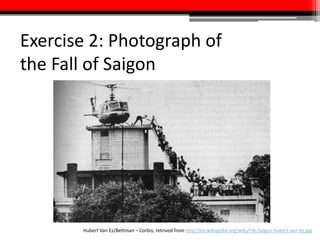
Exercise 2: Photograph of
the Fall of Saigon
Hubert Van Es/Bettman – Corbis; retrieved from http://en.wikipedia.org/wiki/File:Saigon-hubert-van-es.jpg
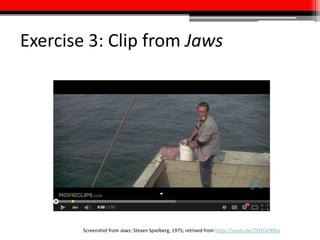
Exercise 3: Clip from Jaws
Screenshot from Jaws; Steven Spielberg, 1975; retrieved from https://youtu.be/2I91DJZKRxs
Summary
• If it’s a song, photograph, movie or any other
creative work, and if it was created since 1923, it’s
probably protected by copyright
• This means you need to ask for permission to use it,
UNLESS:
• Yours is a “fair use”
• You’re making an argument about it or with it
• You’re only using as much as you need
• You’re including proper attribution
• AND you’re not creating a “substitute” for the
original work
• Or the work is in the public domain or available
through a Creative Commons license
Don’t Be Afraid to Ask For
Help!
Andrew Horbal
Head of Learning Commons
1101 McKeldin Library
University of Maryland
College Park, MD 20742
(301) 405-9227
ahorbal@umd.edu
Slides
http://www.slideshare.net/horbal125/presentation-on-
copyright

Presentation on copyright

  • 1.
    Copyright Andy Horbal Presentation toProfessor Paoletti’s AMST 428E/628F class March 23, 2015
  • 2.
    Outline • Introduction • When/howis it appropriate to use a pop song from 1975 in a video or illustrated online exhibit? • Basics of copyright • In-Class Exercises: • Captain & Tennille – “Love Will Keep Us Together” • Photograph of fall of Saigon • Clip from Jaws • Contact info/slides
  • 3.
    “Fame” David Bowie -“Fame” • Recorded by David Bowie in 1975; composed by Bowie, John Lennon, and Carlos Alomar • What I want to do with it: • Create a video using “Fame” as the soundtrack • Turn it in to my professor for credit • Post the video on YouTube after the semester is over • Question: Am I allowed to do this?
  • 4.
    Copyright Basics • Includedin U.S. Constitution to “promote Progress”: enabling artists to make a living from their work encourages them to keep creating new things • What’s protected = “original works of authorship fixed in any tangible medium of expression” • What isn’t = “any idea, procedure, process, system, method of operation, concept, principle, or discovery” • The long version
  • 5.
    Idea vs. Expression •Example = recipe on www.marthastewart.com • Recipe *isn’t* protected (“any idea, procedure, process, system, method of operation, concept, principle, or discovery”) • Picture + description *is*
  • 6.
    Six Exclusive Rights Ifyou want to do any of these things, you need to ask for permission! • Reproduce the copyrighted work • Prepare “derivative works” based on it (e.g. make a movie based on a book) • Distribute copies to the public • Perform the work publicly • Display the work publicly • Perform sound recordings publicly by means of a digital audio transmission
  • 7.
    Copyright Coverage • Termof copyright = life of author + 70 years (in most instances) • Created before 1923 = in “public domain” • Created 1923-1978 = might be in public domain, might be protected by copyright • Created since 1978 = protected by copyright © • Long story short: you don’t need it!
  • 8.
    Summary • Assume allcreative works made since 1923 = protected by copyright • If you want to do anything with a copyrighted work, you need permission, even if you don’t see © symbol
  • 9.
    Back to “Fame” •Is it protected by copyright? • Original work of authorship? Yes. • Fixed in a tangible medium of expression? Yes. • “Idea, procedure, process, system, method of operation, concept, principle, or discovery?” No. • When was it created? 1975 = might or might not be protected by copyright (It is.) • So: • It *is* protected by copyright • If I want to use it in my project, I need permission
  • 10.
    How to obtainpermission • Locate copyright holder • Sound recording: Amazon.com  Digital Music  “Copyright” • Composition: Allmusic.com • Warning: it can be hard to get permission from a big company like a record label • May not be an issue if you’re dealing directly with an artist, though • Always worth a try!
  • 11.
    Exceptions to Copyright: FairUse • What is it? • Category of uses which don’t require permission • The long version • Exists because sometimes “progress” is better when people *don’t* have to ask for permission • Example = allowing teachers to use copyrighted material in PowerPoint presentations! • Example = media criticism
  • 12.
    Four Fair UseFactors • Purpose + character of use = what are you using the work for? • Nature of copyrighted work = what do you want to use? • Amount = how much are you using? • Effect of use on potential market for copyrighted work = are you hindering the artist’s ability to profit from their work?
  • 13.
    Codes of BestPractices • Documentary Filmmakers' Statement of Best Practices in Fair Use • Code of Best Practices in Fair Use for Online Video
  • 14.
    The Short Version •Four factors boil down to two main questions: 1. Did the unlicensed use "transform" the material taken from the copyrighted work by using it for a different purpose than that of the original? 2. Was the material taken appropriate in kind and amount? • Acceptable uses: 1. Employing copyrighted material as the object of social, political, or cultural critique 2. Quoting copyrighted works of popular culture to illustrate an argument or point
  • 15.
    Fair Uses of“Fame” 1. If “Fame” = subject of your project, it is okay to use limited portions of it to make an argument about it as long as you: • Don’t use so much that you create a “substitute” • Include attribution 2. If you are using “Fame” to illustrate an argument or point about 1975, it is okay to use enough (but only enough) of it as you need to make that point 3. If no one other than your professor will ever see your project, you don’t need to worry about fair use since you cannot be hurting the market for the work
  • 16.
    What To DoIf Your Use Isn’t “Fair” • Ask for permission! • Use a different song • Anything created before 1923 = in the “public domain” (but this probably won’t help you) • What *will* help you = CC Search • Notes on CC Search • Some platforms contain both CC and non-CC works, so make sure you research permissions
  • 17.
  • 18.
    Exercise 1: “LoveWill Keep Us Together” Captain & Tennille - “Love Will Keep Us Together” • Is it protected by copyright? • Original work of authorship? • Fixed in a tangible medium of expression? • “Idea, procedure, process, system, method of operation, concept, principle, or discovery?” • When was it created? • ©? • What—if anything--can we do with it without permission?
  • 19.
    Exercise 2: Photographof the Fall of Saigon Hubert Van Es/Bettman – Corbis; retrieved from http://en.wikipedia.org/wiki/File:Saigon-hubert-van-es.jpg
  • 20.
    Exercise 3: Clipfrom Jaws Screenshot from Jaws; Steven Spielberg, 1975; retrieved from https://youtu.be/2I91DJZKRxs
  • 21.
    Summary • If it’sa song, photograph, movie or any other creative work, and if it was created since 1923, it’s probably protected by copyright • This means you need to ask for permission to use it, UNLESS: • Yours is a “fair use” • You’re making an argument about it or with it • You’re only using as much as you need • You’re including proper attribution • AND you’re not creating a “substitute” for the original work • Or the work is in the public domain or available through a Creative Commons license
  • 22.
    Don’t Be Afraidto Ask For Help! Andrew Horbal Head of Learning Commons 1101 McKeldin Library University of Maryland College Park, MD 20742 (301) 405-9227 ahorbal@umd.edu
  • 23.