New Wine in Old Bottles:
“Films without Celluloid” +
Making the Most of the
Spaces You’ve Got
Andy Horbal
University of Maryland
The Innovative Library Classroom
May 12, 2015
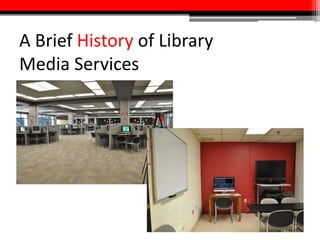
A Brief History of Library
Media Services
The Problems
• Current spaces not ideal for multimedia
production instruction
• Designed for media consumption, not production
• No instruction lab
• Not enough cameras to go around
• No money for new equipment or
construction
Assets
• Plenty of software options
• Adobe Premiere, Final Cut Pro, iMovie, etc.
• Expertise
• Film Studies/Media Resources Librarian
• Full-time Multimedia Production Specialist
• Enthusiasm!
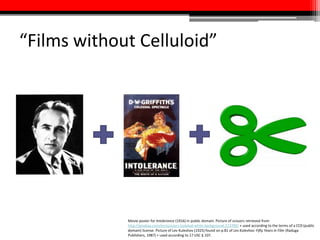
“Films without Celluloid”
Movie poster for Intolerance (1916) in public domain. Picture of scissors retrieved from
http://pixabay.com/en/scissors-isolated-white-background-213700/ + used according to the terms of a CC0 (public
domain) license. Picture of Lev Kuleshov (1925) found on p.81 of Lev Kuleshov: Fifty Years in Film (Raduga
Publishers, 1987) + used according to 17 USC § 107.
Lessons
• You don’t need a camera to plan a film
shoot
• You don’t need a camera to experiment
with filmmaking
• Experimentation is the key to media
literacy
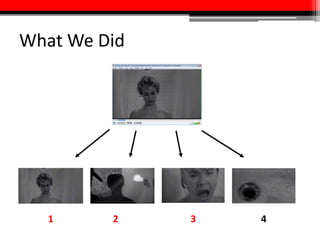
What We Did
1 2 3 4
Benefits
• Active learning!
• Shifts focus to core media literacy
concepts
• Less pressure to produce a polished finished
product
• Production software = means to an end
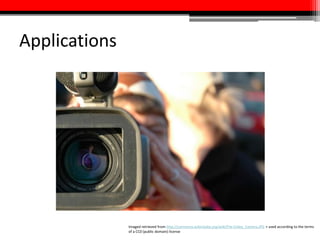
Applications
Imaged retrieved from http://commons.wikimedia.org/wiki/File:Video_Camera.JPG + used according to the terms
of a CC0 (public domain) license
Contact
Andy Horbal
Head of Learning Commons
1101 McKeldin Library
University of Maryland
College Park, MD 20742
(301) 405-9227
ahorbal@umd.edu
http://www.slideshare.net/horbal125/new-wine-in-
old-bottles

New Wine in Old Bottles: “Films without Celluloid” and Making the Most of the Spaces You’ve Got

  • 1.
    New Wine inOld Bottles: “Films without Celluloid” + Making the Most of the Spaces You’ve Got Andy Horbal University of Maryland The Innovative Library Classroom May 12, 2015
  • 2.
    A Brief Historyof Library Media Services
  • 3.
    The Problems • Currentspaces not ideal for multimedia production instruction • Designed for media consumption, not production • No instruction lab • Not enough cameras to go around • No money for new equipment or construction
  • 4.
    Assets • Plenty ofsoftware options • Adobe Premiere, Final Cut Pro, iMovie, etc. • Expertise • Film Studies/Media Resources Librarian • Full-time Multimedia Production Specialist • Enthusiasm!
  • 5.
    “Films without Celluloid” Movieposter for Intolerance (1916) in public domain. Picture of scissors retrieved from http://pixabay.com/en/scissors-isolated-white-background-213700/ + used according to the terms of a CC0 (public domain) license. Picture of Lev Kuleshov (1925) found on p.81 of Lev Kuleshov: Fifty Years in Film (Raduga Publishers, 1987) + used according to 17 USC § 107.
  • 6.
    Lessons • You don’tneed a camera to plan a film shoot • You don’t need a camera to experiment with filmmaking • Experimentation is the key to media literacy
  • 7.
  • 8.
    Benefits • Active learning! •Shifts focus to core media literacy concepts • Less pressure to produce a polished finished product • Production software = means to an end
  • 9.
    Applications Imaged retrieved fromhttp://commons.wikimedia.org/wiki/File:Video_Camera.JPG + used according to the terms of a CC0 (public domain) license
  • 10.
    Contact Andy Horbal Head ofLearning Commons 1101 McKeldin Library University of Maryland College Park, MD 20742 (301) 405-9227 ahorbal@umd.edu http://www.slideshare.net/horbal125/new-wine-in- old-bottles

Editor's Notes

  • #3 Instruction history focused on finding materials in collection Mandate to move “from being containers for information toward platforms for learning”
  • #7 Media literacy = defined by ACRL as “a set of abilities that enables an individual to effectively find, interpret, evaluate, use, and create images and visual media”
  • #8 Show a short film clip (Psycho as example) Hand out paper versions of the same clip (one page for each shot) Exercise which varies by class a. Tell a different story using these same shots b. Tell the same story using 1/2 or 1/3 the number of shots b. Storyboarding exercise: what additional info would you have need to *shoot* this scene? (camera placement, movement, etc.) 4. “Film festival” 5. Generally followed by group production or post-production work, time permitting
  • #9 Drawbacks = If there *is* a media production assignment, must be supplemented with one-on-one support
  • #10 What’s your “camera”?