Lecture No. 2
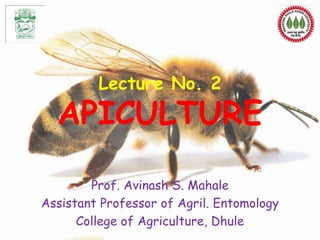
APICULTURE
Prof. Avinash S. Mahale
Assistant Professor of Agril. Entomology
College of Agriculture, Dhule
INTRODUCTION
 Beekeeping:- The practice of rearing bee is called as
beekeeping or apiculture.
 The word apiculture derived from Latin word apiscultura. Apis
means "bee" and cultura denotes "cultivation through
education."
 It is a high profit enterprise.
 It can be taken up both as subsidiary industry as well as a
whole time profession.
 Beekeeping has an edge over the other agro-based subsidiary
enterprises as it involves low initial expenditure and does not
need elaborate infrastructure.
 It does not interfere with other agricultural activities and
provides handsome income.
 It plays a great role in agricultural diversification by producing
various kinds of bee products and pollination of crop.
 We can manage some hive at our backyard. Thus, at any stage
we may sell the honey and earn some amount for our livelihood.
HISTORY OF BEEKEEPINGG - WORLD
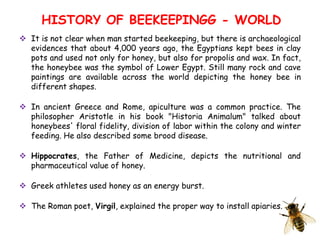
 It is not clear when man started beekeeping, but there is archaeological
evidences that about 4,000 years ago, the Egyptians kept bees in clay
pots and used not only for honey, but also for propolis and wax. In fact,
the honeybee was the symbol of Lower Egypt. Still many rock and cave
paintings are available across the world depicting the honey bee in
different shapes.
 In ancient Greece and Rome, apiculture was a common practice. The
philosopher Aristotle in his book "Historia Animalum" talked about
honeybees' floral fidelity, division of labor within the colony and winter
feeding. He also described some brood disease.
 Hippocrates, the Father of Medicine, depicts the nutritional and
pharmaceutical value of honey.
 Greek athletes used honey as an energy burst.
 The Roman poet, Virgil, explained the proper way to install apiaries.
HISTORY OF BEEKEEPINGG - WORLD
 The writer, Varro, who was called by the Romans "the most learned of
all the Romans," discussed the business and profit opportunities derived
from apiculture.
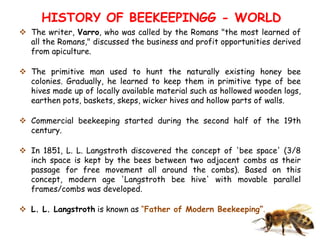
 The primitive man used to hunt the naturally existing honey bee
colonies. Gradually, he learned to keep them in primitive type of bee
hives made up of locally available material such as hollowed wooden logs,
earthen pots, baskets, skeps, wicker hives and hollow parts of walls.
 Commercial beekeeping started during the second half of the 19th
century.
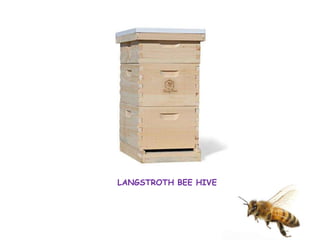
 In 1851, L. L. Langstroth discovered the concept of 'bee space' (3/8
inch space is kept by the bees between two adjacent combs as their
passage for free movement all around the combs). Based on this
concept, modern age 'Langstroth bee hive' with movable parallel
frames/combs was developed.
 L. L. Langstroth is known as “Father of Modern Beekeeping”.
LANGSTROTH BEE HIVE
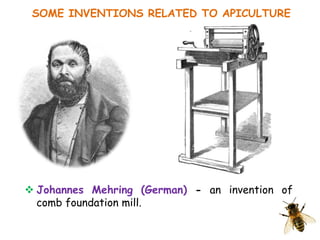
SOME INVENTIONS RELATED TO APICULTURE
 Johannes Mehring (German) - an invention of
comb foundation mill.
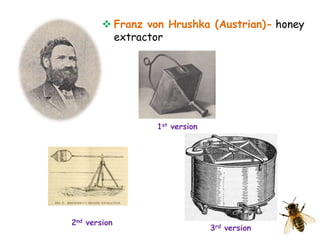
 Franz von Hrushka (Austrian)- honey
extractor
1st version
3rd version
2nd version
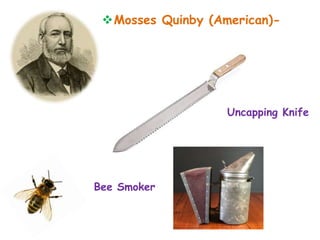
Mosses Quinby (American)-
Bee Smoker
Uncapping Knife
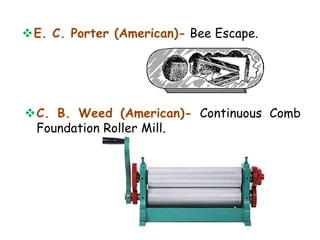
E. C. Porter (American)- Bee Escape.
C. B. Weed (American)- Continuous Comb
Foundation Roller Mill.
HISTORY OF BEEKEEPING - INDIA
 Bees and honey were known to human being in India since time
immemorial as their references are mentioned in epics, on murals,
sculptures, etc.
 Vaishali Stupas in Muzaffarpur (Bihar) were built in commemoration of
offering of honey to Lord Buddha by king of monkeys and his people
whenever Lord Buddha visited the place.
 Several references of bees have been made in the oldest scripture of
India, the Rig Veda.
 First attempt to keep honey bees in movable frame hive was made in
early 1880s in pre-partition Bengal and Punjab.
 1880:- high yielding European bees, Apis mellifera, were introduced in
our country.
 1910:- Commercial beekeeping in India started in South when Rev.
Newton devised a movable frame hive suitable for Asiatic hive bee, Apis
cerana. This hive was named after him as 'Newton Hive'. This hive is
still popular for keeping the indigenous hive bee, Apis cerana.
 1911-17:- Newton also trained a large number of beekeepers in
Southern India.
HISTORY OF BEEKEEPING - INDIA
 1928:- The Royal Commission on Agriculture recommended
development of beekeeping as a cottage industry in India.
 1938-39:- The All India Beekeepers' Association (AlBA) was
established. This association started publishing the Indian Bee Journal
(IBJ).
 1920 to 1951:- sizable quantity of Apis mellifera was imported in the
states of Maharashtra, Kerala, Karnataka, Tamil Nadu, West Bengal,
Punjab and Kashmir but none succeeded to establish this exotic honey
bee species in the country.
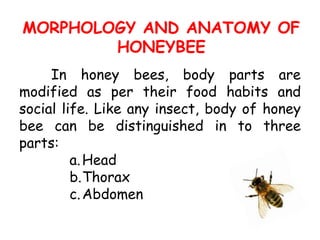
MORPHOLOGY AND ANATOMY OF
HONEYBEE
In honey bees, body parts are
modified as per their food habits and
social life. Like any insect, body of honey
bee can be distinguished in to three
parts:
a.Head
b.Thorax
c.Abdomen
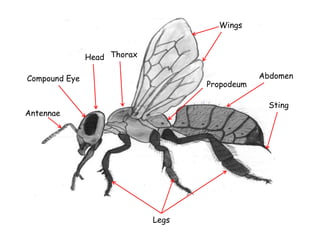
Head Thorax
Abdomen
Wings
Legs
Compound Eye
Antennae
Sting
Propodeum
a. Head
 A pair of geniculate antennae
 Two compound eyes on lateral side of head. Bees can
distinguish different colours but are red blind and
can perceive ultraviolet rays
 3 ocelli (simple eyes) on top portion which perceive
degree of light
 Two mandibles are attached to ventro-lateral part
of head capsule. Mandibles differ in shape in three
castes. Workers use mandibles for grasping and
scrapping pollen from anthers, feeding of pollen and
in manipulation of wax scales during comb building
 Mouth parts of worker bees are modified
for sucking and lapping. Tongue or proboscis
(formed by medium labium and two lateral
maxillae) is used for ingesting liquids. Labium
has long median glossa and spoon shaped lobe
(flabellum) at the end
 Inside the head there are long coiled strings
of small lobes known as hypopharyngeal
glands which secrete glandular food known
as royal jelly that is fed to queen and young
larvae.
b. Thorax
 Consists of three segments: prothorax , mesothorax and
metathorax, each bears a pair of legs. Meso and metathorax,
each bears a pair of wings. In addition to locomotion legs in
honey bees are also modified to perform following functions:
i. Prothoracic legs - Serve as antenna cleaner. It is found in all
the three castes.
ii. Mesothoracic legs - bushy tarsi serve as brushes for cleaning
of thorax. Long spine at end of middle tibia is used for loosening
pellets of pollen from pollen basket of hind leg and also for
cleaning wings and spiracles. Wax scales are also removed from
wax pockets of abdomen by these legs.
iii. Metathoracic legs - larger in size and with broad flattened
form of tibia and basitarsus. In worker bees, smooth somewhat
concave outer surface of hind tibia is fringed with long curved
hairs and forms pollen basket or corbicula.
 Two pairs of wings arise from sides of
meso and metathorax.
 Fore wings are stronger than hind
wings. Series of upturned hooks
(hamuli) are present on front margin
of each hind wing. Decurved fold on
rear margin of fore wing works as
coupling apparatus for holding hamuli
and this result in unity of action of
the wings in flight.
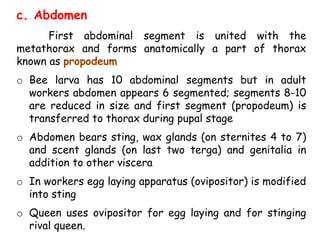
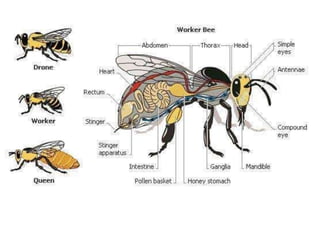
c. Abdomen
First abdominal segment is united with the
metathorax and forms anatomically a part of thorax
known as propodeum
o Bee larva has 10 abdominal segments but in adult
workers abdomen appears 6 segmented; segments 8-10
are reduced in size and first segment (propodeum) is
transferred to thorax during pupal stage
o Abdomen bears sting, wax glands (on sternites 4 to 7)
and scent glands (on last two terga) and genitalia in
addition to other viscera
o In workers egg laying apparatus (ovipositor) is modified
into sting
o Queen uses ovipositor for egg laying and for stinging
rival queen.
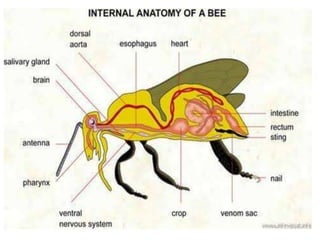
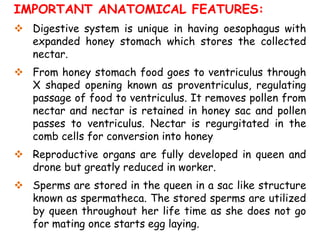
IMPORTANT ANATOMICAL FEATURES:
 Digestive system is unique in having oesophagus with
expanded honey stomach which stores the collected
nectar.
 From honey stomach food goes to ventriculus through
X shaped opening known as proventriculus, regulating
passage of food to ventriculus. It removes pollen from
nectar and nectar is retained in honey sac and pollen
passes to ventriculus. Nectar is regurgitated in the
comb cells for conversion into honey
 Reproductive organs are fully developed in queen and
drone but greatly reduced in worker.
 Sperms are stored in the queen in a sac like structure
known as spermatheca. The stored sperms are utilized
by queen throughout her life time as she does not go
for mating once starts egg laying.
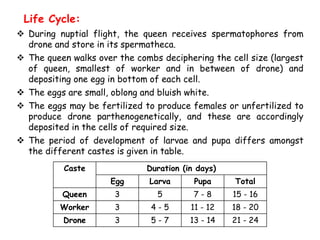
Life Cycle:
 During nuptial flight, the queen receives spermatophores from
drone and store in its spermatheca.
 The queen walks over the combs deciphering the cell size (largest
of queen, smallest of worker and in between of drone) and
depositing one egg in bottom of each cell.
 The eggs are small, oblong and bluish white.
 The eggs may be fertilized to produce females or unfertilized to
produce drone parthenogenetically, and these are accordingly
deposited in the cells of required size.
 The period of development of larvae and pupa differs amongst
the different castes is given in table.
Caste Duration (in days)
Egg Larva Pupa Total
Queen 3 5 7 - 8 15 - 16
Worker 3 4 - 5 11 - 12 18 - 20
Drone 3 5 - 7 13 - 14 21 - 24
 The transformation of 3 castes depends upon the
amount of ‘Brood food’ or ‘Royal jelly’ produced by
pharyngeal salivary glands of worker fed to larvae.
 The cells of queen, worker and drone are sealed, i.e.
capped with wax on 8, 9, 10 day of emergence,
respectively.
 The cap of drone cell is convex with a central hole,
and those of worker, queen, honey and pollen are
flat.
Apiculture

Apiculture

  • 1.
    Lecture No. 2 APICULTURE Prof.Avinash S. Mahale Assistant Professor of Agril. Entomology College of Agriculture, Dhule
  • 2.
    INTRODUCTION  Beekeeping:- Thepractice of rearing bee is called as beekeeping or apiculture.  The word apiculture derived from Latin word apiscultura. Apis means "bee" and cultura denotes "cultivation through education."  It is a high profit enterprise.  It can be taken up both as subsidiary industry as well as a whole time profession.  Beekeeping has an edge over the other agro-based subsidiary enterprises as it involves low initial expenditure and does not need elaborate infrastructure.  It does not interfere with other agricultural activities and provides handsome income.  It plays a great role in agricultural diversification by producing various kinds of bee products and pollination of crop.  We can manage some hive at our backyard. Thus, at any stage we may sell the honey and earn some amount for our livelihood.
  • 3.
    HISTORY OF BEEKEEPINGG- WORLD  It is not clear when man started beekeeping, but there is archaeological evidences that about 4,000 years ago, the Egyptians kept bees in clay pots and used not only for honey, but also for propolis and wax. In fact, the honeybee was the symbol of Lower Egypt. Still many rock and cave paintings are available across the world depicting the honey bee in different shapes.  In ancient Greece and Rome, apiculture was a common practice. The philosopher Aristotle in his book "Historia Animalum" talked about honeybees' floral fidelity, division of labor within the colony and winter feeding. He also described some brood disease.  Hippocrates, the Father of Medicine, depicts the nutritional and pharmaceutical value of honey.  Greek athletes used honey as an energy burst.  The Roman poet, Virgil, explained the proper way to install apiaries.
  • 4.
    HISTORY OF BEEKEEPINGG- WORLD  The writer, Varro, who was called by the Romans "the most learned of all the Romans," discussed the business and profit opportunities derived from apiculture.  The primitive man used to hunt the naturally existing honey bee colonies. Gradually, he learned to keep them in primitive type of bee hives made up of locally available material such as hollowed wooden logs, earthen pots, baskets, skeps, wicker hives and hollow parts of walls.  Commercial beekeeping started during the second half of the 19th century.  In 1851, L. L. Langstroth discovered the concept of 'bee space' (3/8 inch space is kept by the bees between two adjacent combs as their passage for free movement all around the combs). Based on this concept, modern age 'Langstroth bee hive' with movable parallel frames/combs was developed.  L. L. Langstroth is known as “Father of Modern Beekeeping”.
  • 5.
  • 6.
    SOME INVENTIONS RELATEDTO APICULTURE  Johannes Mehring (German) - an invention of comb foundation mill.
  • 7.
     Franz vonHrushka (Austrian)- honey extractor 1st version 3rd version 2nd version
  • 8.
    Mosses Quinby (American)- BeeSmoker Uncapping Knife
  • 9.
    E. C. Porter(American)- Bee Escape. C. B. Weed (American)- Continuous Comb Foundation Roller Mill.
  • 10.
    HISTORY OF BEEKEEPING- INDIA  Bees and honey were known to human being in India since time immemorial as their references are mentioned in epics, on murals, sculptures, etc.  Vaishali Stupas in Muzaffarpur (Bihar) were built in commemoration of offering of honey to Lord Buddha by king of monkeys and his people whenever Lord Buddha visited the place.  Several references of bees have been made in the oldest scripture of India, the Rig Veda.  First attempt to keep honey bees in movable frame hive was made in early 1880s in pre-partition Bengal and Punjab.  1880:- high yielding European bees, Apis mellifera, were introduced in our country.  1910:- Commercial beekeeping in India started in South when Rev. Newton devised a movable frame hive suitable for Asiatic hive bee, Apis cerana. This hive was named after him as 'Newton Hive'. This hive is still popular for keeping the indigenous hive bee, Apis cerana.  1911-17:- Newton also trained a large number of beekeepers in Southern India.
  • 11.
    HISTORY OF BEEKEEPING- INDIA  1928:- The Royal Commission on Agriculture recommended development of beekeeping as a cottage industry in India.  1938-39:- The All India Beekeepers' Association (AlBA) was established. This association started publishing the Indian Bee Journal (IBJ).  1920 to 1951:- sizable quantity of Apis mellifera was imported in the states of Maharashtra, Kerala, Karnataka, Tamil Nadu, West Bengal, Punjab and Kashmir but none succeeded to establish this exotic honey bee species in the country.
  • 12.
    MORPHOLOGY AND ANATOMYOF HONEYBEE In honey bees, body parts are modified as per their food habits and social life. Like any insect, body of honey bee can be distinguished in to three parts: a.Head b.Thorax c.Abdomen
  • 13.
  • 14.
    a. Head  Apair of geniculate antennae  Two compound eyes on lateral side of head. Bees can distinguish different colours but are red blind and can perceive ultraviolet rays  3 ocelli (simple eyes) on top portion which perceive degree of light  Two mandibles are attached to ventro-lateral part of head capsule. Mandibles differ in shape in three castes. Workers use mandibles for grasping and scrapping pollen from anthers, feeding of pollen and in manipulation of wax scales during comb building
  • 15.
     Mouth partsof worker bees are modified for sucking and lapping. Tongue or proboscis (formed by medium labium and two lateral maxillae) is used for ingesting liquids. Labium has long median glossa and spoon shaped lobe (flabellum) at the end  Inside the head there are long coiled strings of small lobes known as hypopharyngeal glands which secrete glandular food known as royal jelly that is fed to queen and young larvae.
  • 16.
    b. Thorax  Consistsof three segments: prothorax , mesothorax and metathorax, each bears a pair of legs. Meso and metathorax, each bears a pair of wings. In addition to locomotion legs in honey bees are also modified to perform following functions: i. Prothoracic legs - Serve as antenna cleaner. It is found in all the three castes. ii. Mesothoracic legs - bushy tarsi serve as brushes for cleaning of thorax. Long spine at end of middle tibia is used for loosening pellets of pollen from pollen basket of hind leg and also for cleaning wings and spiracles. Wax scales are also removed from wax pockets of abdomen by these legs. iii. Metathoracic legs - larger in size and with broad flattened form of tibia and basitarsus. In worker bees, smooth somewhat concave outer surface of hind tibia is fringed with long curved hairs and forms pollen basket or corbicula.
  • 17.
     Two pairsof wings arise from sides of meso and metathorax.  Fore wings are stronger than hind wings. Series of upturned hooks (hamuli) are present on front margin of each hind wing. Decurved fold on rear margin of fore wing works as coupling apparatus for holding hamuli and this result in unity of action of the wings in flight.
  • 18.
    c. Abdomen First abdominalsegment is united with the metathorax and forms anatomically a part of thorax known as propodeum o Bee larva has 10 abdominal segments but in adult workers abdomen appears 6 segmented; segments 8-10 are reduced in size and first segment (propodeum) is transferred to thorax during pupal stage o Abdomen bears sting, wax glands (on sternites 4 to 7) and scent glands (on last two terga) and genitalia in addition to other viscera o In workers egg laying apparatus (ovipositor) is modified into sting o Queen uses ovipositor for egg laying and for stinging rival queen.
  • 21.
    IMPORTANT ANATOMICAL FEATURES: Digestive system is unique in having oesophagus with expanded honey stomach which stores the collected nectar.  From honey stomach food goes to ventriculus through X shaped opening known as proventriculus, regulating passage of food to ventriculus. It removes pollen from nectar and nectar is retained in honey sac and pollen passes to ventriculus. Nectar is regurgitated in the comb cells for conversion into honey  Reproductive organs are fully developed in queen and drone but greatly reduced in worker.  Sperms are stored in the queen in a sac like structure known as spermatheca. The stored sperms are utilized by queen throughout her life time as she does not go for mating once starts egg laying.
  • 22.
    Life Cycle:  Duringnuptial flight, the queen receives spermatophores from drone and store in its spermatheca.  The queen walks over the combs deciphering the cell size (largest of queen, smallest of worker and in between of drone) and depositing one egg in bottom of each cell.  The eggs are small, oblong and bluish white.  The eggs may be fertilized to produce females or unfertilized to produce drone parthenogenetically, and these are accordingly deposited in the cells of required size.  The period of development of larvae and pupa differs amongst the different castes is given in table. Caste Duration (in days) Egg Larva Pupa Total Queen 3 5 7 - 8 15 - 16 Worker 3 4 - 5 11 - 12 18 - 20 Drone 3 5 - 7 13 - 14 21 - 24
  • 23.
     The transformationof 3 castes depends upon the amount of ‘Brood food’ or ‘Royal jelly’ produced by pharyngeal salivary glands of worker fed to larvae.  The cells of queen, worker and drone are sealed, i.e. capped with wax on 8, 9, 10 day of emergence, respectively.  The cap of drone cell is convex with a central hole, and those of worker, queen, honey and pollen are flat.