SERICULTURE
SILK hasbeen under use by human beings for
various purposes.
It is known as “the queen of fibres”
High scale production of silk in world.
Rearing, developing and looking of silk insects is termed as
SERICULTURE
4.
HISTORY
Lotzu empressof kwang-Ti discovered the origin
of silk worm in the form of thread. But its
technique was kept in secret.
The sericulture technique was known to only
china, and one who tried to open it, hanged to
death.
Then this secrecy was opened when two spies
from EUROPE were sent to CHINA.
5.
Silk moth
Thesilk producing machine is an insect called as
SILK MOTH(resham ka kira).
Types of silk
Mulberry silk
Tasar silk
Eri silk
Muga silk
6.
Mulberry silk
This issupposed
to be the superior
in quality to other
types due to its
shiny and creamy
color.
It is secreted by
caterpillar of
Bombyx mori
which feed on
mulberry leaves.
7.
Tasar silk
Antheraea
paphia ,common
in India, china
and sri lanka.
Catterpillar feed
on ber, oak, and
fig plant.
Cocoon is hard
and hen’s egg size
which produces
brown colored
silk.
Physical characteristics
Itis pale, cream or ashy white in color.
2.5 to 3 cm long and covered with small color.
Body is divided into head thorax and abdomen.
Head is big having large compound eyes and a
pair of antennae.
Thorax is strong muscular three segmented
structure provided with spiracles 2 pair of
wings(4-6cm long) and 3 pair of legs.
13.
Physical characteristics
Abdomenis covered with scales and highly
extended in females whereas narrow in males.
Sexes are seperate, sexual dimorphism exist.
Males small in size than females
Females live for 2-3 days but males sometimes
die during copulation, once females copulate
they lay eggs(all fertilized) till she dies.
One moth lay eggs 400-500 eggs depending upon
climatic conditions and nutrition.
14.
Stages of lifecycle
Eggs
eggs are rounded and white. With increase in
time egg become darker day by day.
Two types of eggs are present:-
Diapause : eggs are laid by silk worm inhabiting
in temperate regions, all vital activities are
ceased.
Non- diapause : silk worm belong to sub tropical
region like india.
caterpillar
Hatches fromegg are 5-7mm in length ,body is
rough, wrinkled and greyish in color.
Have 12 segments, distinct into 3 parts i.e head,
thorax, abdomen
Head is mandibulate mouth parts ,feed on leaves.
Thorax has 3 segments bear a pair of true jointed
legs.
17.
caterpillar
Abdomen has10 segments.
Larva feed on mulberry leaves and grow very quickly.
Stop feeding, become inactive after 4 to 5 days then 1st
molting occur. 2nd
stage larva is similar to 1st
one but
slightly larger., eat for 7 days and 2nd
molt occur. And 3rd
larva formed. Larva repeats this process four times .
18.
caterpillar
Maturity isachieved in 45 days since time of
hatching. And matured catterpillars are now 7-
10cm.
By this time formation of a pair of salivary gland
is completed. Salivary glands secrete silk that are
also called as silk glands.
pupa
Fully formedinstar larva undergo physiological
changes and become restless.
Due to intrinsic hormonal reasons.
Moves its head in whirling position, constantly
and rapidly rotates head at its axis & in mean
time saliva comes out through a small pore
known as SPINNERET.
Located on tip of hypopharynx in mouth. There
is continous flow of saliva through this pore.
cocoon
White colorbed of pupa whose outer thread are
irregular and inner threads are regular.
Thread’s length is 1000-1200m, in concentric
manner.
Binding of threads round cocoon is very quick
i.e 65 times/min
Now silk worm pupa is covered with thick, oval
white or yellow silken cocoon.
24.
emergence of imago
Active metamorphic changes take place during
pupation in which abdominal prolegs disappear,
thorax develop two pairs of wings.
Pupa is metamorphosed into young adult moth
in 12-15 days called as IMAGO
It secrets alkaline fluid that soften one end of
cocoon and come out
sericulture
This ismultivoltine(having several broods within
year)
They are of domestic types and can b reared
indoors
Large and healthy cocoons are selected, kept in
vantilated cages emerge after few days
Males and females are distinguishable.
Kept in pairs in coupling jar for 24 hours
copulate
females transferred to egg laying boxes
made of cardboard
28.
Tools and materials
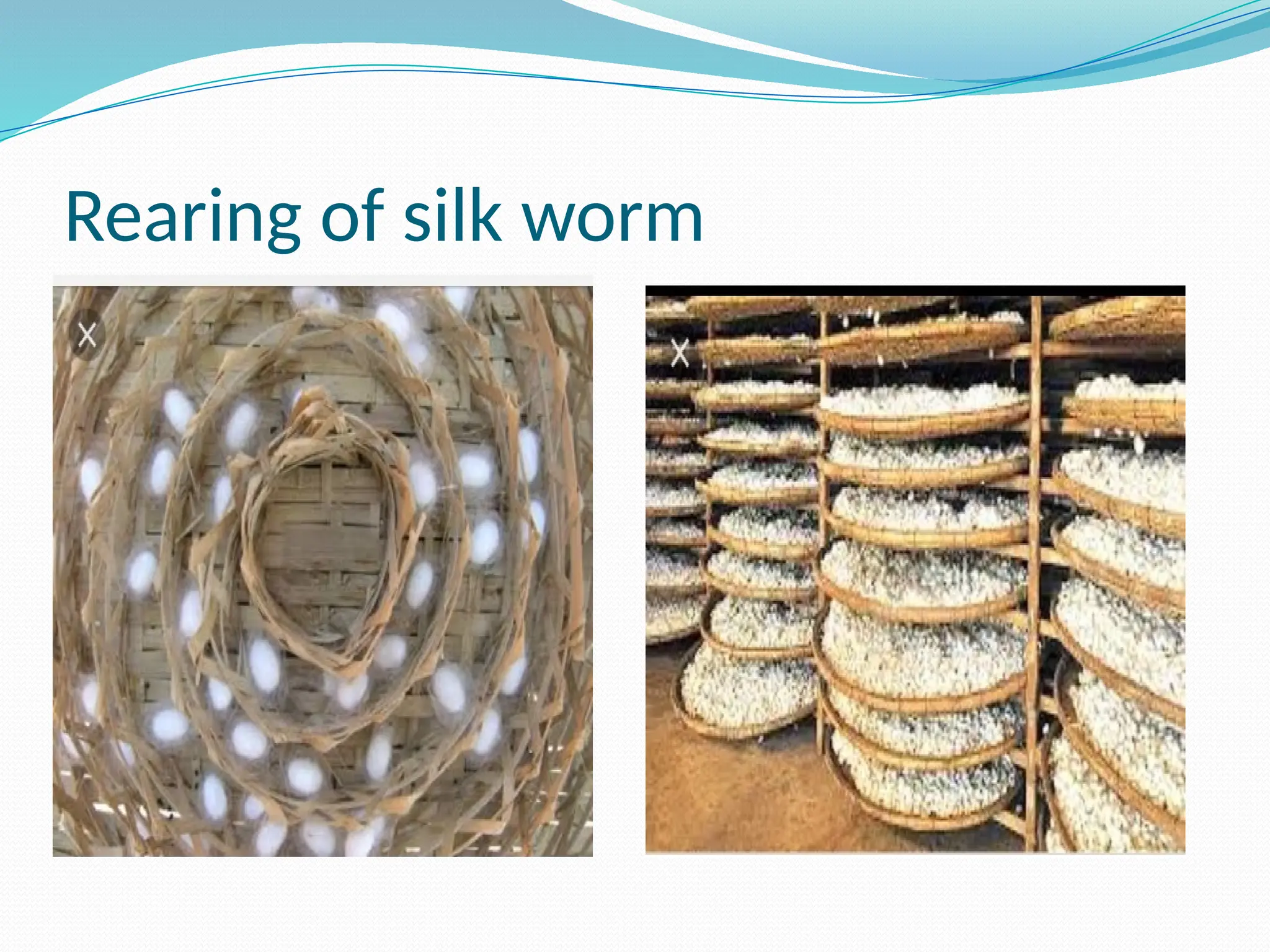
Machana : proper place for rearing silk worm
Rearing trays: for keeping laid eggs along
mulberry leaves
Spining tray: for keeping caterpillars at time of
full grown stage ready for pupation.
Dalas: for fetching mulberry leaves
Chopping knife: cut mulberry leaves
Baskets: distribute mulberry leaves
Hygrometer, thermometer oven and freezers are
also used.
30.
Rearing of silkworm
5 stages for rearing
1. Supply of eggs: quality of seeds is important,
only those eggs are given that has been
produced in a well recognised grainage( where
eggs are made)
2. Incubation of eggs: incubation conditions
should be optimum. For uni voltine eggs 73.5-
77*F, 77*F for bi voltine and 80*F for multi
voltine.
Humidity 75-80%
For incubation seeds are spread on piece of
paper In rearing tree.
31.
3. Brushing ofworms: to separate newly hatched
worms from shells of their eggs by means of a
feather
The process of brushing is spreading finely
chopped mulberry leaves on the egg sheet after
95% eggs are hatched. The newly emerged
worms crawl on top of feed. & then transferred
to rearing tray
4. Rearing of worms: it requires following
Rearing room: ventilated, protect against direct
sun rays, well disinfectant with 2% formalin.
32.
Rearing appliances:wooden racks, chopping
knifes, leaf storing basket, gunny cloth pieces,
door curtain etc
Leaves & their preservation: harvested by cutting
and plucking of leaves, preserved by keeping in
basket covered with gunny cloth.
Feeding: feed with mulberry leaves at different
intervals, different staged larvae need different
amount of food.
33.
Cleaning: cleaningof trees is necessary to
remove excreta.
Spacing: necessary to give proper spacing,
avoiding over crowdedness & spread of disease
providing high temp. at first two stages(80-85F) &
in 3rd
4th
stage 10 degree lower. With humidity 85-
90%.
Mounting & harvesting: when worm is fully
grown & appitite fails become restless and start
spining out of cocoon. Put in cocoonages
34.
5. Spinning ofcocoon: period in which worm stop
feeding and start secreting a pasty substance
from silk gland.
Worms picked up and put in spinning tray & kept
in position of slope to the sun for short period.
Within 3 days spinning is done
Cocoon formed
Last stage of rearing
35.
6. quality ofcocoon: depend on raw silk, filament
length ,reliability & splitting.
7. Marketing of cocoon: price of cocoon is fixed by
govt.
8. Post cocoon processing: the method of
obtaining silk from cocoon is called as post
cocoon processing. It includes stifling & reeling
Stifling: “killing of cocoon”
8-10 days cocoon selected. Dropped in hot
water(helps in unwinding), sun exposure to 3
days
36.
Reeling: processof removing threads from killed
cocoon
Threads are transferred to large wheel then to
spools called as reeled silk.
Waste outer layer & damaged cocoon & threads
are separated and filaments are spun. This
spuned silk is called as spun silk.
Raw silk is further boiled, stretched and purified
by acid or by fermentation carefully washed
again & again.
Diseases and enemyof silk worm
Grasserie disease: viral, formation of polyhedral
bodies in body fluid, hypodermic infection.
Control is difficult. Preventions include
sterilization of tools, optimum temp., cleaning
and proper spacing.
Pebrine: most serious one, protozoan
parasite(Nosema bombycis), effect young larva by
loss of appitite, irregular moulting and growth.
Muscardine disease: fungal, lose of appitite,
specks appear on skin, body become limp,
elasiticity loose & movement stop, death,
40.
predators
Tricoliga bombycis:parasite fly lay eggs near
body of catterpillar larva upon hatching feed on
tissue of caterpillar that dies.
Canthecona fincellatta & tanchid fly: have long
rostrum with the help of which penetrate body
of silk worm, hemolymph oozes out & worm die.
Ants, hornets, bats, kites atc feed on it.
41.
Properties of silk
Pasty secretion of silk gland; modified salivary
gland
When contact with air become hard and form
strong silk strand.
Secretion form 2 cores of fibroin( 1) tough elastic
insoluble protein cemented together with sericin
(2) gelatinous easily soluble in warm water.
Wax & carotenoids are also detected.
42.
Uses of silk
Silk clothes
Synthetic fibers
For military purposes
Fishing fibers
Parachutes
Tyres of racing cars
Insulation coils of telephones
Medical dresses & suture material.




![Economic value of products of silkworm [autosaved]](https://cdn.slidesharecdn.com/ss_thumbnails/economicvalueofproductsofsilkwormautosaved-190111161735-thumbnail.jpg?width=640&height=640&fit=bounds)


