DFLP 2008 Project:  Creating digital audio Date:  July 27 th  2008 Organisation:  Otago Polytechnic contact details:  susanmellis@gmail.com
to offer a flexible design and construction of audio for OER course materials Methodology was to adapt a universal instructional design together with a self-instructional materials for this context. Due to competing ways to create and produce digital  audio, implementation of the methodology was intended to keep it simple and do-able. Assessment of the capability to learn different generic, technical and academic capabilities associated with Open Educational Resources, sharing content with collaborative content development, learner generated content/work.   Susan Ellis  PROPOSAL : Executive Summary   This course is designed as a tertiary college module includes an introduction to educational audio resources and evaluates facilitaties  how to  use digital tools to record and edit and design audio for instructional course materials .  Other objectives of the course were
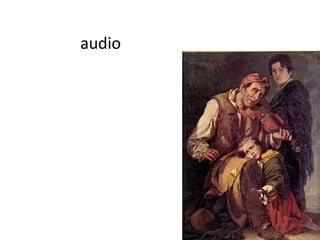
audio
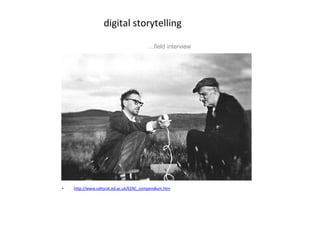
digital storytelling http://www.celtscot.ed.ac.uk/EERC_compendium.htm … field interview
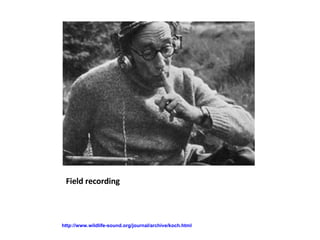
Field recording   http://www.wildlife-sound.org/journal/archive/koch.html
Audio Content  …..   An instructional design which features audio resources can enhance content, and foster diversity.  By increasing and varying learning experiences  within  specific learning context s, this can help with   uptake and assimilation of information, and have specific advantages for students with a disability or numeracy and literacy needs.
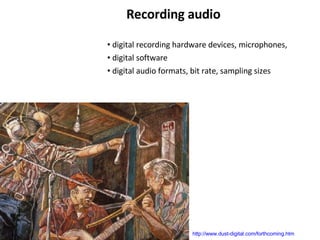
Recording audio   digital recording hardware devices, microphones,  digital software  digital audio formats, bit rate, sampling sizes http://www.dust-digital.com/forthcoming.htm
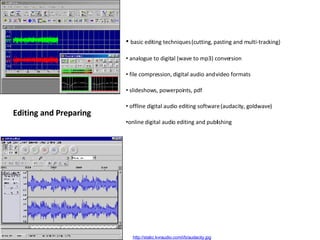
Editing and Preparing basic editing techniques (cutting, pasting and multi-tracking) analogue to digital (wave to mp3) conversion  file compression, digital audio and video formats  slideshows, powerpoints, pdf offline digital audio editing software (audacity, goldwave) online digital audio editing and publishing http://static.kvraudio.com/i/b/audacity.jpg
Publishing audio archiving, sourcing audio within copyright license restrictions sharing and reusing audio with creative commons attribution
rss feeds ( podcasting ) Blended  Collaborative Social networks Weblogs & wikispaces archiving, embedding audio wikis- wikieducator Open educational resources
  Given that both student and teachers are able to enrole  course resources will be supplemented by particpants over successive times and hence become a more comprehensive and flexible list: is treated as a requirement of the universal instructional and self-instruction design harnesses and fosters diversity Flexible learning  content   The learning content and learning outcomes are expected to be general allowing that  Participants can and will have diverse cultural background  a wide range digital information literacy skills
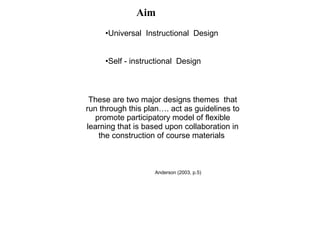
Aim These are two major designs themes  that run through this plan…. act as guidelines to promote participatory model of flexible learning that is based upon collaboration in  the construction of course materials  Universal  Instructional  Design Self - instructional  Design Anderson (2003, p.5)
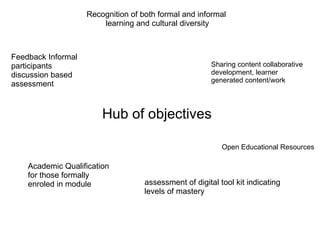
Hub of objectives  Academic Qualification for those formally enroled in module Recognition of both formal and informal  learning and cultural diversity Feedback Informal participants discussion based assessment Sharing content collaborative development, learner generated content/work Open Educational Resources  assessment of  digital tool kit indicating levels of mastery
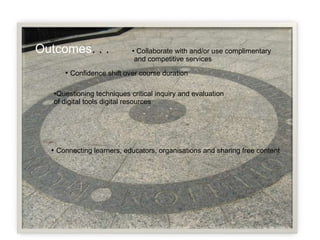
Outcomes . . .  Connecting learners, educators, organisations and sharing free content Questioning techniques critical inquiry and evaluation of digital tools digital resources  Confidence shift over course duration Collaborate with and/or  use complimentary and competitive services
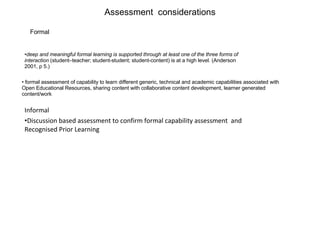
Informal  Discussion based assessment to confirm formal capability assessment  and Recognised Prior Learning Assessment  considerations formal assessment of capability to learn different generic, technical and academic capabilities associated with Open Educational Resources, sharing content with collaborative content development, learner generated content/work deep and meaningful formal learning is supported through at least one of the three forms of interaction  (student–teacher; student-student; student-content) is at a high level. (Anderson 2001, p 5.) Formal
 
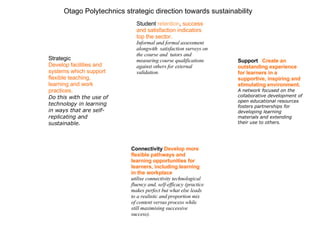
Strategic Develop facilities and systems which support flexible teaching, learning and work practices. Do this with the use of technology in learning in ways that are self-replicating and sustainable.  Student  retention ,  success and satisfaction indicators top the sector.  Informal and formal assessment alongwith  satisfaction surveys on the course and  tutors and measuring course qualifications against others for external validation. Support  Create an outstanding experience for learners in a supportive, inspiring and stimulating environment.   A network focused on the collaborative development of open educational resources fosters partnerships for developing learning materials and extending their use to others. Otago Polytechnics strategic direction towards sustainability Connectivity  Develop more flexible pathways and learning opportunities for learners, including learning in the workplace utilise connectivity technological fluency and, self-efficacy (practice makes perfect but what else leads to a realistic and proportion mix of content versus process while still maximising successive success).
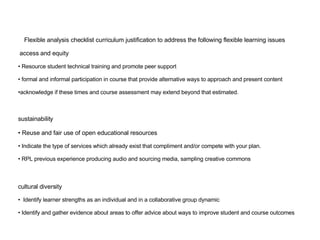
Flexible analysis checklist curriculum justification to address the following flexible learning issues access and equity  Resource student technical training and promote peer support formal and informal participation in course that provide alternative ways to approach and present content  acknowledge if these times and course assessment may extend beyond that estimated. sustainability Reuse and fair use of open educational resources Indicate the type of services which already exist that compliment and/or compete with your plan.   RPL previous experience producing audio and sourcing media, sampling creative commons cultural diversity Identify learner strengths as an individual and in a collaborative group dynamic Identify and gather evidence about areas to offer advice about ways to improve student and course outcomes

Presentation Of Dfl Plan 2003 Compatability

  • 1.
    DFLP 2008 Project: Creating digital audio Date: July 27 th 2008 Organisation: Otago Polytechnic contact details: susanmellis@gmail.com
  • 2.
    to offer aflexible design and construction of audio for OER course materials Methodology was to adapt a universal instructional design together with a self-instructional materials for this context. Due to competing ways to create and produce digital audio, implementation of the methodology was intended to keep it simple and do-able. Assessment of the capability to learn different generic, technical and academic capabilities associated with Open Educational Resources, sharing content with collaborative content development, learner generated content/work.   Susan Ellis PROPOSAL : Executive Summary This course is designed as a tertiary college module includes an introduction to educational audio resources and evaluates facilitaties how to use digital tools to record and edit and design audio for instructional course materials . Other objectives of the course were
  • 3.
  • 4.
  • 5.
    Field recording  http://www.wildlife-sound.org/journal/archive/koch.html
  • 6.
    Audio Content ….. An instructional design which features audio resources can enhance content, and foster diversity. By increasing and varying learning experiences within specific learning context s, this can help with uptake and assimilation of information, and have specific advantages for students with a disability or numeracy and literacy needs.
  • 7.
    Recording audio  digital recording hardware devices, microphones, digital software digital audio formats, bit rate, sampling sizes http://www.dust-digital.com/forthcoming.htm
  • 8.
    Editing and Preparingbasic editing techniques (cutting, pasting and multi-tracking) analogue to digital (wave to mp3) conversion file compression, digital audio and video formats slideshows, powerpoints, pdf offline digital audio editing software (audacity, goldwave) online digital audio editing and publishing http://static.kvraudio.com/i/b/audacity.jpg
  • 9.
    Publishing audio archiving,sourcing audio within copyright license restrictions sharing and reusing audio with creative commons attribution
  • 10.
    rss feeds (podcasting ) Blended Collaborative Social networks Weblogs & wikispaces archiving, embedding audio wikis- wikieducator Open educational resources
  • 11.
      Given thatboth student and teachers are able to enrole course resources will be supplemented by particpants over successive times and hence become a more comprehensive and flexible list: is treated as a requirement of the universal instructional and self-instruction design harnesses and fosters diversity Flexible learning content The learning content and learning outcomes are expected to be general allowing that Participants can and will have diverse cultural background a wide range digital information literacy skills
  • 12.
    Aim These aretwo major designs themes that run through this plan…. act as guidelines to promote participatory model of flexible learning that is based upon collaboration in the construction of course materials Universal Instructional Design Self - instructional Design Anderson (2003, p.5)
  • 13.
    Hub of objectives Academic Qualification for those formally enroled in module Recognition of both formal and informal learning and cultural diversity Feedback Informal participants discussion based assessment Sharing content collaborative development, learner generated content/work Open Educational Resources assessment of digital tool kit indicating levels of mastery
  • 14.
    Outcomes . .. Connecting learners, educators, organisations and sharing free content Questioning techniques critical inquiry and evaluation of digital tools digital resources Confidence shift over course duration Collaborate with and/or use complimentary and competitive services
  • 15.
    Informal Discussionbased assessment to confirm formal capability assessment and Recognised Prior Learning Assessment considerations formal assessment of capability to learn different generic, technical and academic capabilities associated with Open Educational Resources, sharing content with collaborative content development, learner generated content/work deep and meaningful formal learning is supported through at least one of the three forms of interaction (student–teacher; student-student; student-content) is at a high level. (Anderson 2001, p 5.) Formal
  • 16.
  • 17.
    Strategic Develop facilitiesand systems which support flexible teaching, learning and work practices. Do this with the use of technology in learning in ways that are self-replicating and sustainable. Student retention , success and satisfaction indicators top the sector. Informal and formal assessment alongwith satisfaction surveys on the course and tutors and measuring course qualifications against others for external validation. Support Create an outstanding experience for learners in a supportive, inspiring and stimulating environment. A network focused on the collaborative development of open educational resources fosters partnerships for developing learning materials and extending their use to others. Otago Polytechnics strategic direction towards sustainability Connectivity Develop more flexible pathways and learning opportunities for learners, including learning in the workplace utilise connectivity technological fluency and, self-efficacy (practice makes perfect but what else leads to a realistic and proportion mix of content versus process while still maximising successive success).
  • 18.
    Flexible analysis checklistcurriculum justification to address the following flexible learning issues access and equity Resource student technical training and promote peer support formal and informal participation in course that provide alternative ways to approach and present content acknowledge if these times and course assessment may extend beyond that estimated. sustainability Reuse and fair use of open educational resources Indicate the type of services which already exist that compliment and/or compete with your plan. RPL previous experience producing audio and sourcing media, sampling creative commons cultural diversity Identify learner strengths as an individual and in a collaborative group dynamic Identify and gather evidence about areas to offer advice about ways to improve student and course outcomes