
Opportunities and challenges
for academic library services
Prof. Dr. Khalid Mahmood
Department of Information Management
University of the Punjab
What does an academic library do?
and
How?
Changes in academic landscape
 Changing scholarly communication
 Intensified contextual pressures (Political, economic,
social, legal, environmental, etc.)
 Rethinking library spaces
 Shifting from collections to services
 Changing definitions of ‘reading’ and ‘reading
material’
 New service platforms
 Focusing research and publications
 Increasing user-centric approach
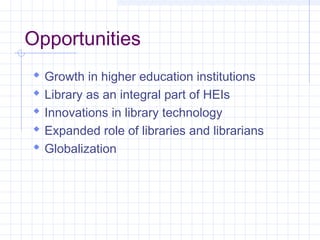
Opportunities
 Growth in higher education institutions
 Library as an integral part of HEIs
 Innovations in library technology
 Expanded role of libraries and librarians
 Globalization
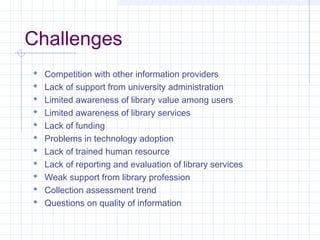
Challenges
 Competition with other information providers
 Lack of support from university administration
 Limited awareness of library value among users
 Limited awareness of library services
 Lack of funding
 Problems in technology adoption
 Lack of trained human resource
 Lack of reporting and evaluation of library services
 Weak support from library profession
 Collection assessment trend
 Questions on quality of information
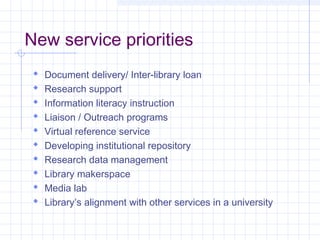
 Document delivery/ Inter-library loan
 Research support
 Information literacy instruction
 Liaison / Outreach programs
 Virtual reference service
 Developing institutional repository
 Research data management
 Library makerspace
 Media lab
 Library’s alignment with other services in a university
New service priorities
THANKS A LOT

Opportunities and challenges for academic library services

  • 1.
    Opportunities and challenges foracademic library services Prof. Dr. Khalid Mahmood Department of Information Management University of the Punjab
  • 2.
    What does anacademic library do? and How?
  • 3.
    Changes in academiclandscape  Changing scholarly communication  Intensified contextual pressures (Political, economic, social, legal, environmental, etc.)  Rethinking library spaces  Shifting from collections to services  Changing definitions of ‘reading’ and ‘reading material’  New service platforms  Focusing research and publications  Increasing user-centric approach
  • 4.
    Opportunities  Growth inhigher education institutions  Library as an integral part of HEIs  Innovations in library technology  Expanded role of libraries and librarians  Globalization
  • 5.
    Challenges  Competition withother information providers  Lack of support from university administration  Limited awareness of library value among users  Limited awareness of library services  Lack of funding  Problems in technology adoption  Lack of trained human resource  Lack of reporting and evaluation of library services  Weak support from library profession  Collection assessment trend  Questions on quality of information
  • 6.
     Document delivery/Inter-library loan  Research support  Information literacy instruction  Liaison / Outreach programs  Virtual reference service  Developing institutional repository  Research data management  Library makerspace  Media lab  Library’s alignment with other services in a university New service priorities
  • 7.