COLLABORATIVE PRACTICES
ON ORGANIZATIONAL
INNOVATION IN HIGH
TECNOLOGY INDUSTRIES
Fernando Sousa, Ph.D.
President of Apgico (fernando.sousa@apgico.pt)

Ileana Monteiro, Ph.D.
Apgico; University of Algarve (imontei@ualg.pt)

WLICSMB 2010
Zhejiang Small&Medium Business Institute,
Hangzou , 24-26 October, 2010
Research Objectives
• Provide a benchmarking list of initiatives
  dealing with the development
  organizational creativity and innovation
• Understand the companies’ specific
  strategies in three domains:
     creative management
     creative people management
     creativity management
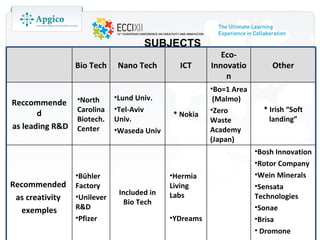
SUBJECTS
                                                          Eco-
                 Bio Tech    Nano Tech        ICT      Innovatio        Other
                                                           n
                                                       •Bo=1 Area
                 •North      •Lund Univ.                (Malmo)
Reccommende
                 Carolina    •Tel-Aviv                 •Zero          * Irish “Soft
       d                                    * Nokia
                 Biotech.    Univ.                     Waste            landing”
as leading R&D   Center      •Waseda Univ              Academy
                                                       (Japan)
                                                                    •Bosh Innovation
                                                                    •Rotor Company
                 •Bühler                    •Hermia                 •Wein Minerals
Recommended      Factory                    Living                  •Sensata
                              Included in   Labs                    Technologies
 as creativity   •Unilever
                                Bio Tech
  exemples       R&D                                                •Sonae
                 •Pfizer                    •YDreams                •Brisa
                                                                    • Dromone
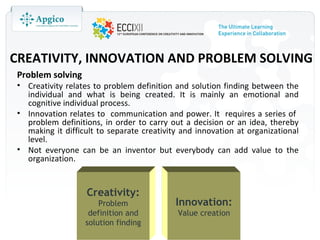
CREATIVITY, INNOVATION AND PROBLEM SOLVING
Problem solving
• Creativity relates to problem definition and solution finding between the
  individual and what is being created. It is mainly an emotional and
  cognitive individual process.
• Innovation relates to communication and power. It requires a series of
  problem definitions, in order to carry out a decision or an idea, thereby
  making it difficult to separate creativity and innovation at organizational
  level.
• Not everyone can be an inventor but everybody can add value to the
  organization.


                   Creativity:
                      Problem              Innovation:
                   definition and          Value creation
                  solution finding
EUROPEAN EVOLUTION
• The 2009 Scoreboard, refers to the “neglected indicators” as
  (…)R&D is not the only method of innovating. Other methods (…) are
  likely to lead to productivity improvements, improved
  competitiveness, and to new or improved products and processes
  that could have wider impacts on the economy. For these reasons,
  the activities of firms that innovate without performing R&D are of
  interest to policy.

• The EU overall Lisbon Strategy cannot cope well with the financial
  crisis, and is changing from technology based priorities to
  encompass other priorities, especially service innovation and
  workforce development
  (European Services Innovation Memorandum; Reviewing Community innovation policy in a changing world, from
  EU Commission, 2009; Challenges for EU support to innovation in services – Fostering new markets and jobs
  through innovation, from EU Commission, 2009).
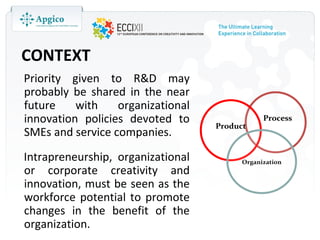
CONTEXT
Priority given to R&D may
probably be shared in the near
future    with    organizational
innovation policies devoted to     Product
                                               Process
SMEs and service companies.
Intrapreneurship, organizational         Organization
or corporate creativity and
innovation, must be seen as the
workforce potential to promote
changes in the benefit of the
organization.
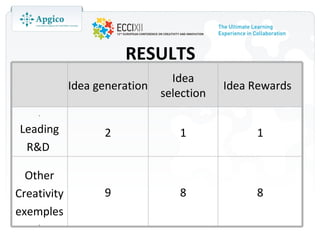
RESULTS
                                 Idea
             Idea generation               Idea Rewards
                               selection
    .

Leading            2              1             1
 R&D
    .

  Other
Creativity         9              8             8
exemples
    .
CASE STUDY

IMPROVE SALES & CUSTOMER
          SERVICE
Problem Statements

• Customer survey results indicated issues with poor level of
  customer service

• Poor communication internally between departments in the
  company

• Engineering Department were disjoint and not accountable
  to our customers directly or indirectly

• The selection of a suitable training programme was proving
  difficult for the company
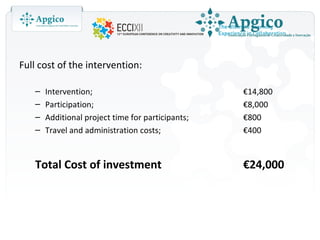
Full cost of the intervention:

   –   Intervention;                               €14,800
   –   Participation;                              €8,000
   –   Additional project time for participants;   €800
   –   Travel and administration costs;            €400


   Total Cost of investment                        €24,000
Results
•   Sales increased by 21% in 2009 versus 2008

•   Increased customer facing people in the company from 2 to 12

•   Facilitated much needed diversification in the company. This
    diversification was initiated in innovation management workshops,
    product, industry and geography

•   Improved brand reputation with customers that were asked to
    participate in the customer survey annually

•   Implemented company team brief and newsletter that was also used
    for customer communication
THE FUTURE OF
ORGANIZATIONAL
INNOVATION
EXAMPLES OF COMPANIES THAT GET TILL 20% OF
THEIR FINAL RESULTS FROM IDEAS AND PROJECTS
        SUGGESTED BY THEIR EMPLOYEES
• Nokia
• Toyota
• IBM
• Procter & Gamble
• 3M
• Walt Disney
• HP
• Google
•Apple
ORGANIZATIONAL INNOVATION
• It must rely on top management orientation to
  innovation and in COLLABORATIVE project teams,
  supported by idea finding and problem solving
  methodologies, together with value and return on
  investment analysis.

• Client or market requirements seem to be the best
  inspiration for projects, and fluid decision making (flat
  hierarchy) the best guarantee that the system may
  work.

• To be effective, organizational innovation has to cope
  with power sharing and a climate of mutual trust
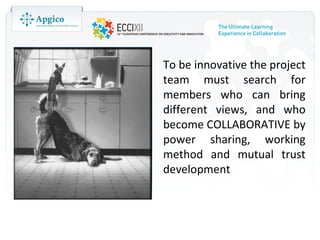
To be innovative the project
team must search for
members who can bring
different views, and who
become COLLABORATIVE by
power sharing, working
method and mutual trust
development
International Workshop on Collaborative Public Networks
PRO-VE'09
10th IFIP Working Conference on
Virtual Enterprises
Thessaloniki, GREECE, 7-9 October 2009 www.pro-ve.org
Region near the university


Ria formosa
Saint Vicente Cape - Sagres


Places to visit
WHO WE ARE
The Portuguese Association of Creativity and Innovation -
APGICO, was created in 2007, and aims at promoting
knowledge and experience in the area of creativity and
innovation management in organizations, helping to create
conditions for competitiveness of companies and
effectiveness in organizations.
22
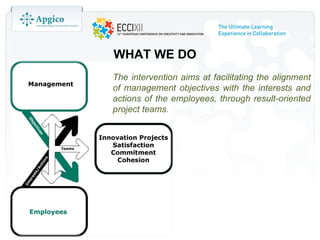
     WHAT WE DO
     The intervention aims at facilitating the alignment
     of management objectives with the interests and
     actions of the employees, through result-oriented
     project teams.
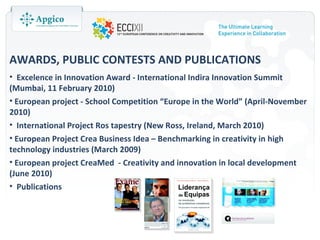
AWARDS, PUBLIC CONTESTS AND PUBLICATIONS
• Excelence in Innovation Award - International Indira Innovation Summit
(Mumbai, 11 February 2010)
• European project - School Competition “Europe in the World” (April-November
2010)
• International Project Ros tapestry (New Ross, Ireland, March 2010)
• European Project Crea Business Idea – Benchmarking in creativity in high
technology industries (March 2009)
• European project CreaMed - Creativity and innovation in local development
(June 2010)
• Publications
THANK YOU!

Presentation hangzou

  • 1.
    COLLABORATIVE PRACTICES ON ORGANIZATIONAL INNOVATIONIN HIGH TECNOLOGY INDUSTRIES Fernando Sousa, Ph.D. President of Apgico (fernando.sousa@apgico.pt) Ileana Monteiro, Ph.D. Apgico; University of Algarve (imontei@ualg.pt) WLICSMB 2010 Zhejiang Small&Medium Business Institute, Hangzou , 24-26 October, 2010
  • 2.
    Research Objectives • Providea benchmarking list of initiatives dealing with the development organizational creativity and innovation • Understand the companies’ specific strategies in three domains: creative management creative people management creativity management
  • 3.
    SUBJECTS Eco- Bio Tech Nano Tech ICT Innovatio Other n •Bo=1 Area •North •Lund Univ. (Malmo) Reccommende Carolina •Tel-Aviv •Zero * Irish “Soft d * Nokia Biotech. Univ. Waste landing” as leading R&D Center •Waseda Univ Academy (Japan) •Bosh Innovation •Rotor Company •Bühler •Hermia •Wein Minerals Recommended Factory Living •Sensata Included in Labs Technologies as creativity •Unilever Bio Tech exemples R&D •Sonae •Pfizer •YDreams •Brisa • Dromone
  • 4.
    CREATIVITY, INNOVATION ANDPROBLEM SOLVING Problem solving • Creativity relates to problem definition and solution finding between the individual and what is being created. It is mainly an emotional and cognitive individual process. • Innovation relates to communication and power. It requires a series of problem definitions, in order to carry out a decision or an idea, thereby making it difficult to separate creativity and innovation at organizational level. • Not everyone can be an inventor but everybody can add value to the organization. Creativity: Problem Innovation: definition and Value creation solution finding
  • 5.
    EUROPEAN EVOLUTION • The2009 Scoreboard, refers to the “neglected indicators” as (…)R&D is not the only method of innovating. Other methods (…) are likely to lead to productivity improvements, improved competitiveness, and to new or improved products and processes that could have wider impacts on the economy. For these reasons, the activities of firms that innovate without performing R&D are of interest to policy. • The EU overall Lisbon Strategy cannot cope well with the financial crisis, and is changing from technology based priorities to encompass other priorities, especially service innovation and workforce development (European Services Innovation Memorandum; Reviewing Community innovation policy in a changing world, from EU Commission, 2009; Challenges for EU support to innovation in services – Fostering new markets and jobs through innovation, from EU Commission, 2009).
  • 6.
    CONTEXT Priority given toR&D may probably be shared in the near future with organizational innovation policies devoted to Product Process SMEs and service companies. Intrapreneurship, organizational Organization or corporate creativity and innovation, must be seen as the workforce potential to promote changes in the benefit of the organization.
  • 7.
    RESULTS Idea Idea generation Idea Rewards selection . Leading 2 1 1 R&D . Other Creativity 9 8 8 exemples .
  • 8.
    CASE STUDY IMPROVE SALES& CUSTOMER SERVICE
  • 9.
    Problem Statements • Customersurvey results indicated issues with poor level of customer service • Poor communication internally between departments in the company • Engineering Department were disjoint and not accountable to our customers directly or indirectly • The selection of a suitable training programme was proving difficult for the company
  • 10.
    Full cost ofthe intervention: – Intervention; €14,800 – Participation; €8,000 – Additional project time for participants; €800 – Travel and administration costs; €400 Total Cost of investment €24,000
  • 11.
    Results • Sales increased by 21% in 2009 versus 2008 • Increased customer facing people in the company from 2 to 12 • Facilitated much needed diversification in the company. This diversification was initiated in innovation management workshops, product, industry and geography • Improved brand reputation with customers that were asked to participate in the customer survey annually • Implemented company team brief and newsletter that was also used for customer communication
  • 12.
  • 13.
    EXAMPLES OF COMPANIESTHAT GET TILL 20% OF THEIR FINAL RESULTS FROM IDEAS AND PROJECTS SUGGESTED BY THEIR EMPLOYEES • Nokia • Toyota • IBM • Procter & Gamble • 3M • Walt Disney • HP • Google •Apple
  • 14.
    ORGANIZATIONAL INNOVATION • Itmust rely on top management orientation to innovation and in COLLABORATIVE project teams, supported by idea finding and problem solving methodologies, together with value and return on investment analysis. • Client or market requirements seem to be the best inspiration for projects, and fluid decision making (flat hierarchy) the best guarantee that the system may work. • To be effective, organizational innovation has to cope with power sharing and a climate of mutual trust
  • 15.
    To be innovativethe project team must search for members who can bring different views, and who become COLLABORATIVE by power sharing, working method and mutual trust development
  • 17.
    International Workshop onCollaborative Public Networks PRO-VE'09 10th IFIP Working Conference on Virtual Enterprises Thessaloniki, GREECE, 7-9 October 2009 www.pro-ve.org
  • 19.
    Region near theuniversity Ria formosa
  • 20.
    Saint Vicente Cape- Sagres Places to visit
  • 21.
    WHO WE ARE ThePortuguese Association of Creativity and Innovation - APGICO, was created in 2007, and aims at promoting knowledge and experience in the area of creativity and innovation management in organizations, helping to create conditions for competitiveness of companies and effectiveness in organizations.
  • 22.
    22 WHAT WE DO The intervention aims at facilitating the alignment of management objectives with the interests and actions of the employees, through result-oriented project teams.
  • 23.
    AWARDS, PUBLIC CONTESTSAND PUBLICATIONS • Excelence in Innovation Award - International Indira Innovation Summit (Mumbai, 11 February 2010) • European project - School Competition “Europe in the World” (April-November 2010) • International Project Ros tapestry (New Ross, Ireland, March 2010) • European Project Crea Business Idea – Benchmarking in creativity in high technology industries (March 2009) • European project CreaMed - Creativity and innovation in local development (June 2010) • Publications
  • 24.