


Ideation & Product Innovation
Dr Alok Nikhil Jha
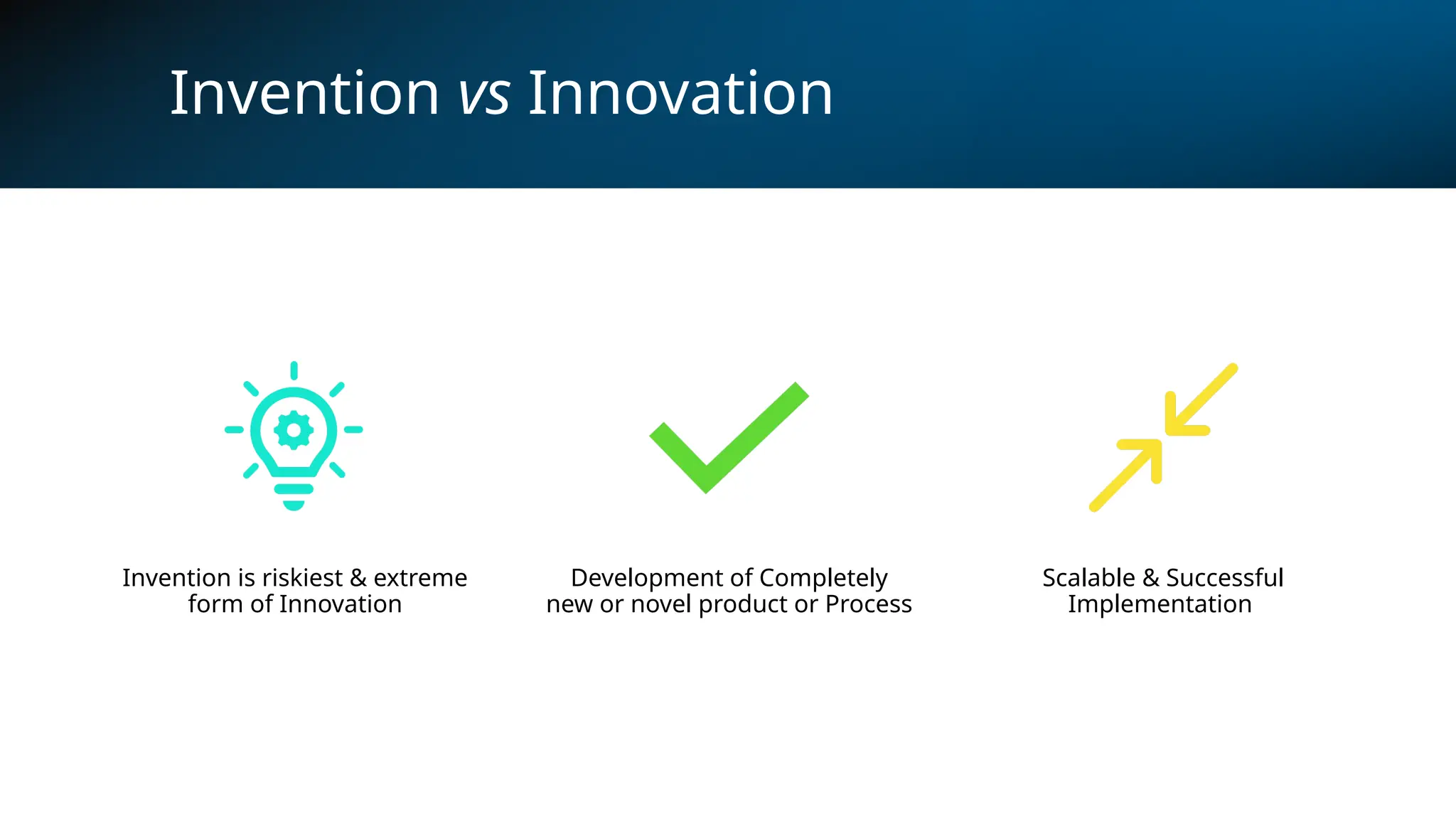
Invention vs Innovation
Invention is riskiest & extreme
form of Innovation
Development of Completely
new or novel product or Process
Scalable & Successful
Implementation
“Innovation is seeing what everybody has seen and thinking what no body has thought.”
–Dr. Albert Szent-Gyorgyi
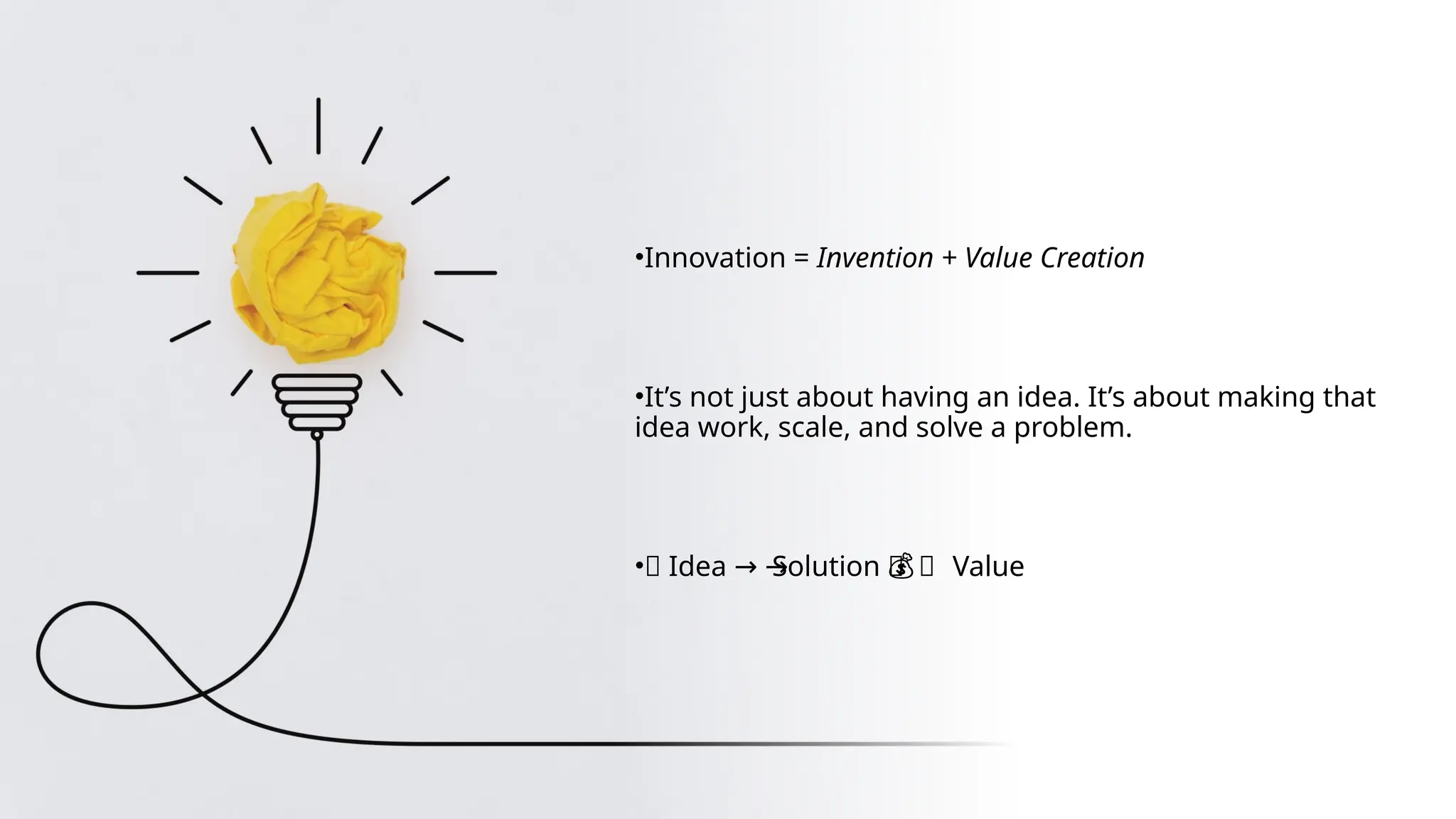
•Innovation = Invention + Value Creation
•It’s not just about having an idea. It’s about making that
idea work, scale, and solve a problem.
•🧠 Idea Solution → 💰 Value
→ → 💰
Sustaining Innovation
An incremental innovation that enables an existing product without major affect on market.
Evolutionary Innovation : Improves a product in an existing market based on customers feedback
Fuel Injection instead of carburettors | Apple Products | Razor blades
Revolutionary Innovation : New, unexpected, but may not affect existing markets.
Automobiles in 19th
Century | Xerox Mouse | Cane Based Prosthetic Legs
Disruptive Innovation
The innovation that disrupts an existing market and value network and creates a new market by
providing a different set of values.
Internet of Things (IoT) | Cloud | Mobile Internet | 3D printing
Apple using the Xerox technology in MAC machines
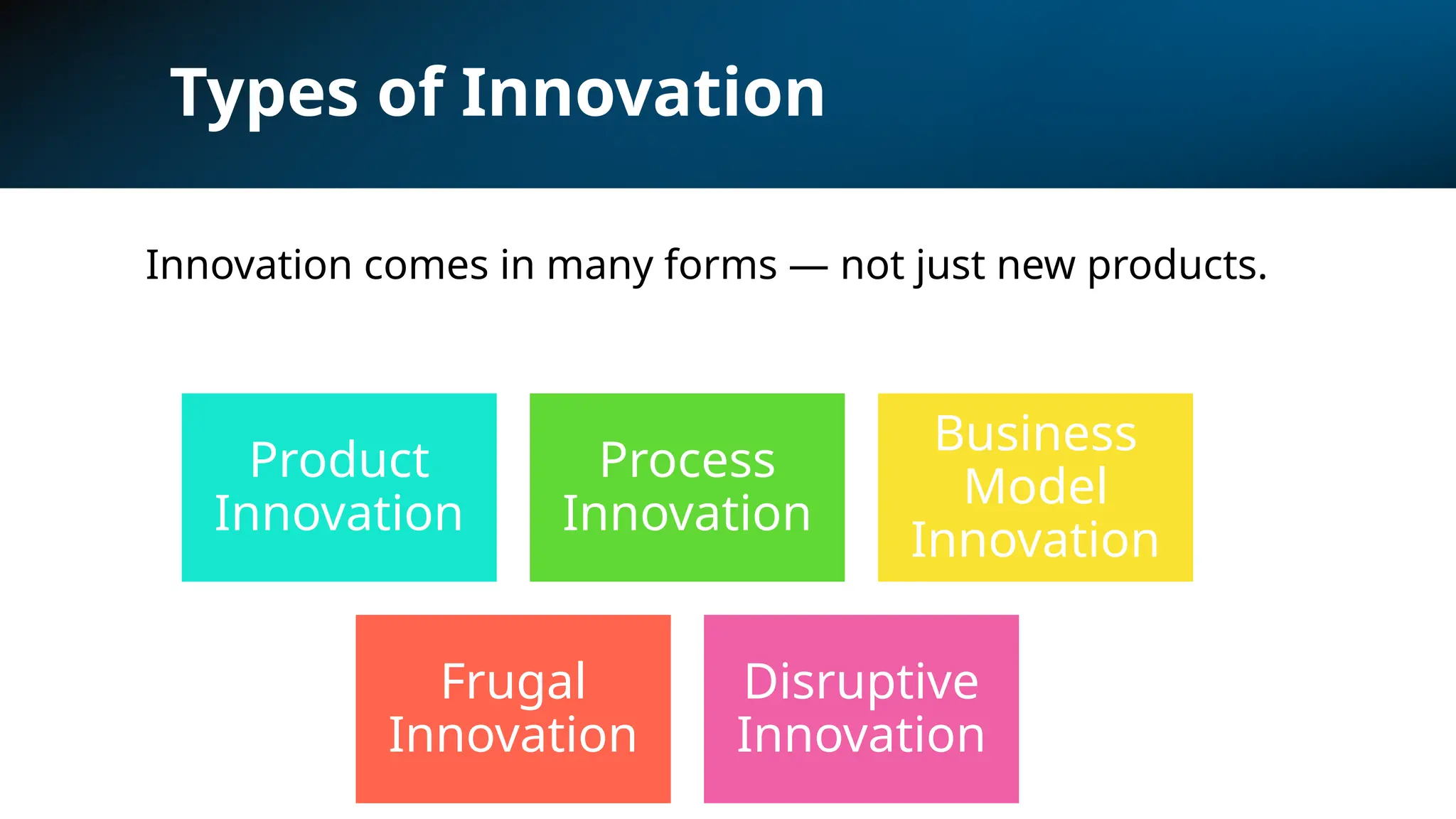
Types of Innovation
Product
Innovation
Process
Innovation
Business
Model
Innovation
Frugal
Innovation
Disruptive
Innovation
Innovation comes in many forms — not just new products.
Product Innovation
Creating new or significantly improved products.
📌 Examples:
• Apple iPhone: Combined phone, camera, and internet into one
product.
• Dyson Vacuum: Reinvented suction tech.
💡 "What new feature or combination makes the product stand out?"
Process Innovation
Improving internal operations or delivery processes.
📌 Examples:
• Domino’s 30-min Delivery: Re-engineered supply chain and kitchen
operations.
• Toyota’s Lean Manufacturing: Reduced waste, improved quality.
💡 "How can we do what we do — better, faster, cheaper?"
Business Model Innovation
Changing how a company creates, delivers, or captures value.
📌 Examples:
• Netflix: Rental to subscription streaming.
• PayTm: Simplified digital payments .
💡 "Can we innovate the way money flows or value is delivered?"
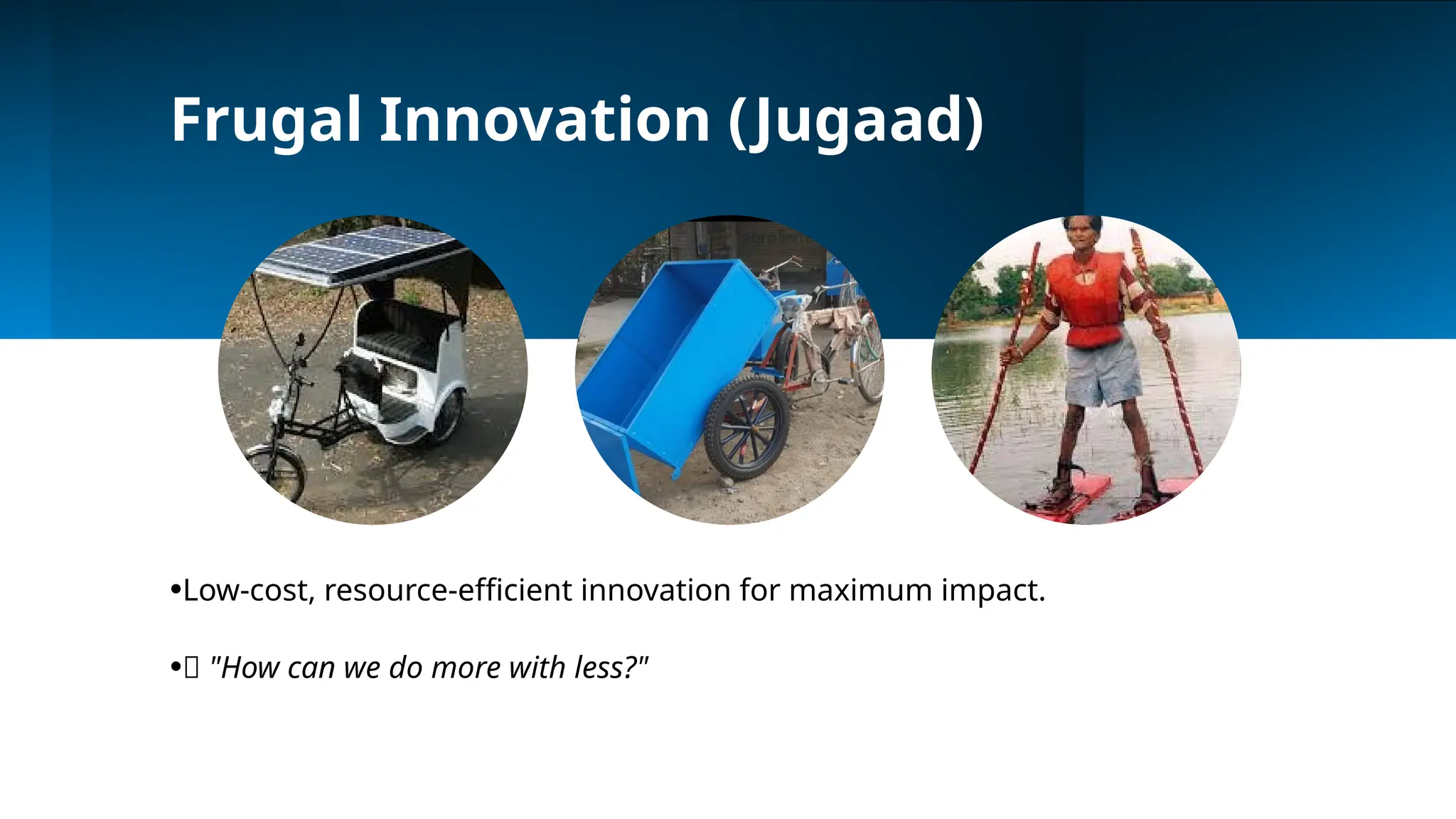
Frugal Innovation (Jugaad)
•Low-cost, resource-efficient innovation for maximum impact.
•💡 "How can we do more with less?"
Disruptive Innovation
• Creating simple, affordable products that reshape industries.
📌 Examples:
• Internet of Things (IoT) | Cloud | Mobile Internet | 3D printing
• Uber: Disrupted traditional taxis.
• Google Docs: Replaced MS Office for many startups.
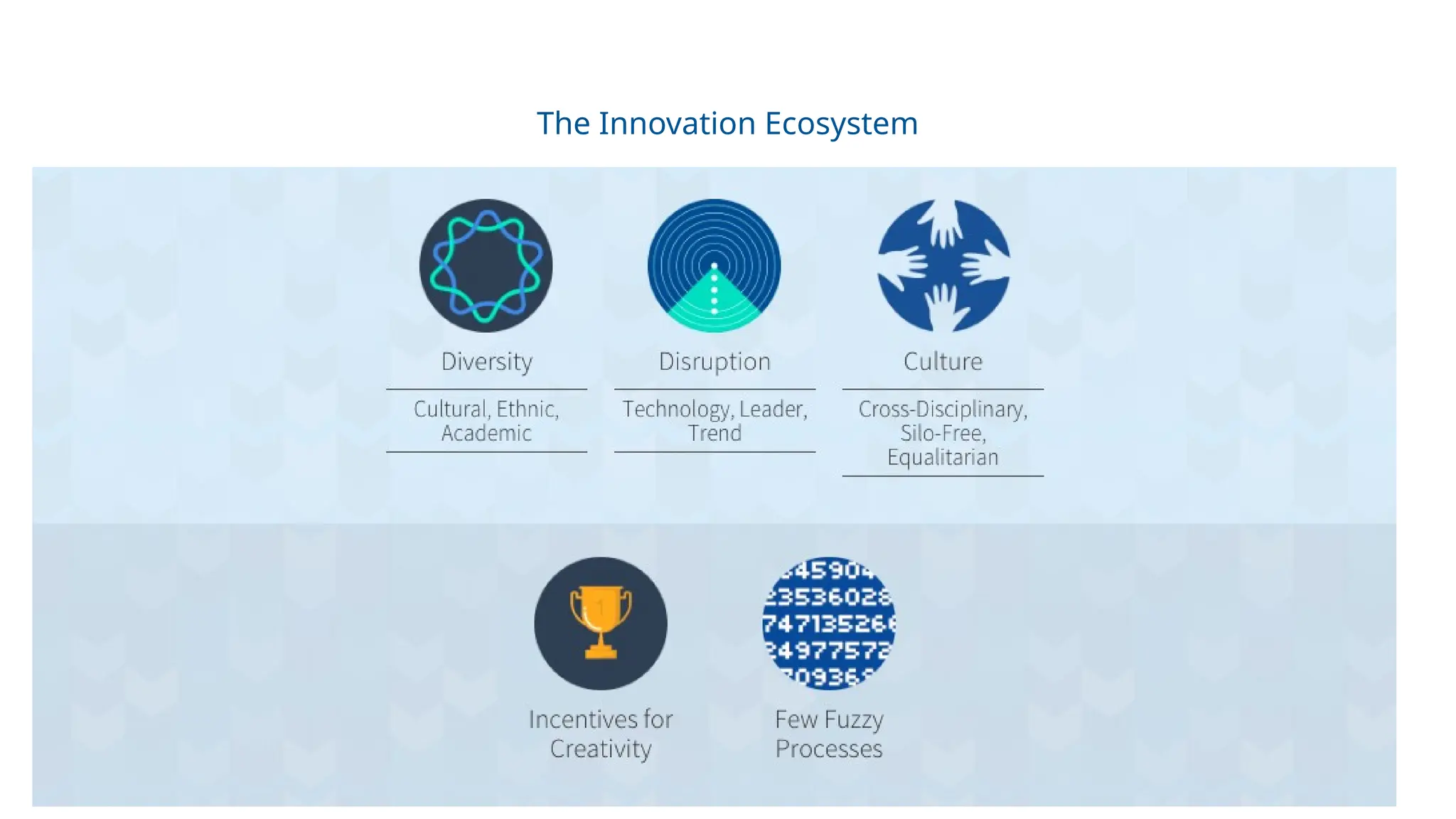
The Innovation Ecosystem
–by Ask Yourself
“Are We Innovative”
Innovation vs Startup
From Idea to Innovation
Validation - Commercialisation – Startup
Research & IPR
Commercialisation | Licensing | Profile Building
How to Start?
How to Start
Observe, Think, Question, Find
Value Addition, Opportunities
and Improvement Areas
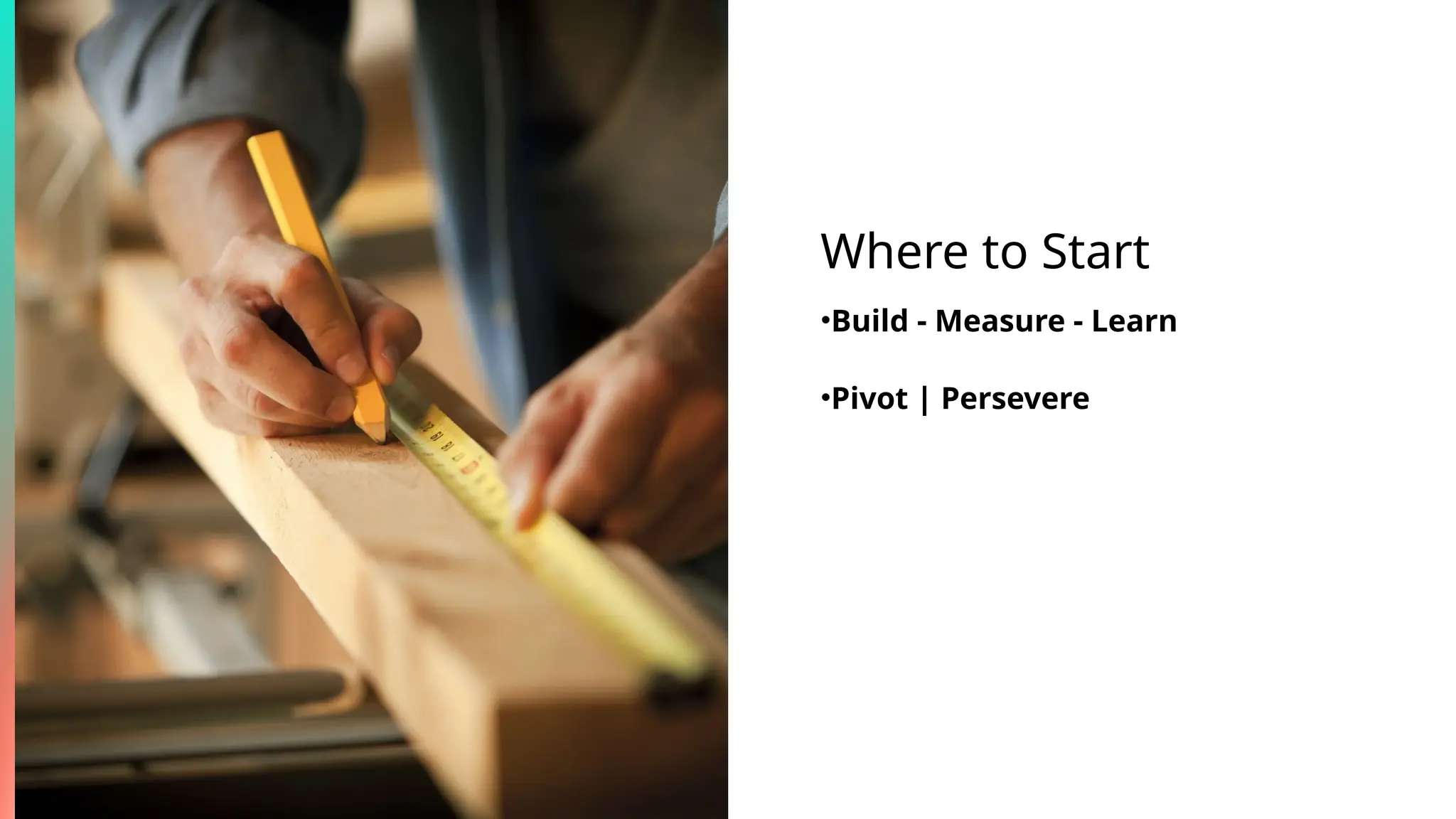
Where to Start
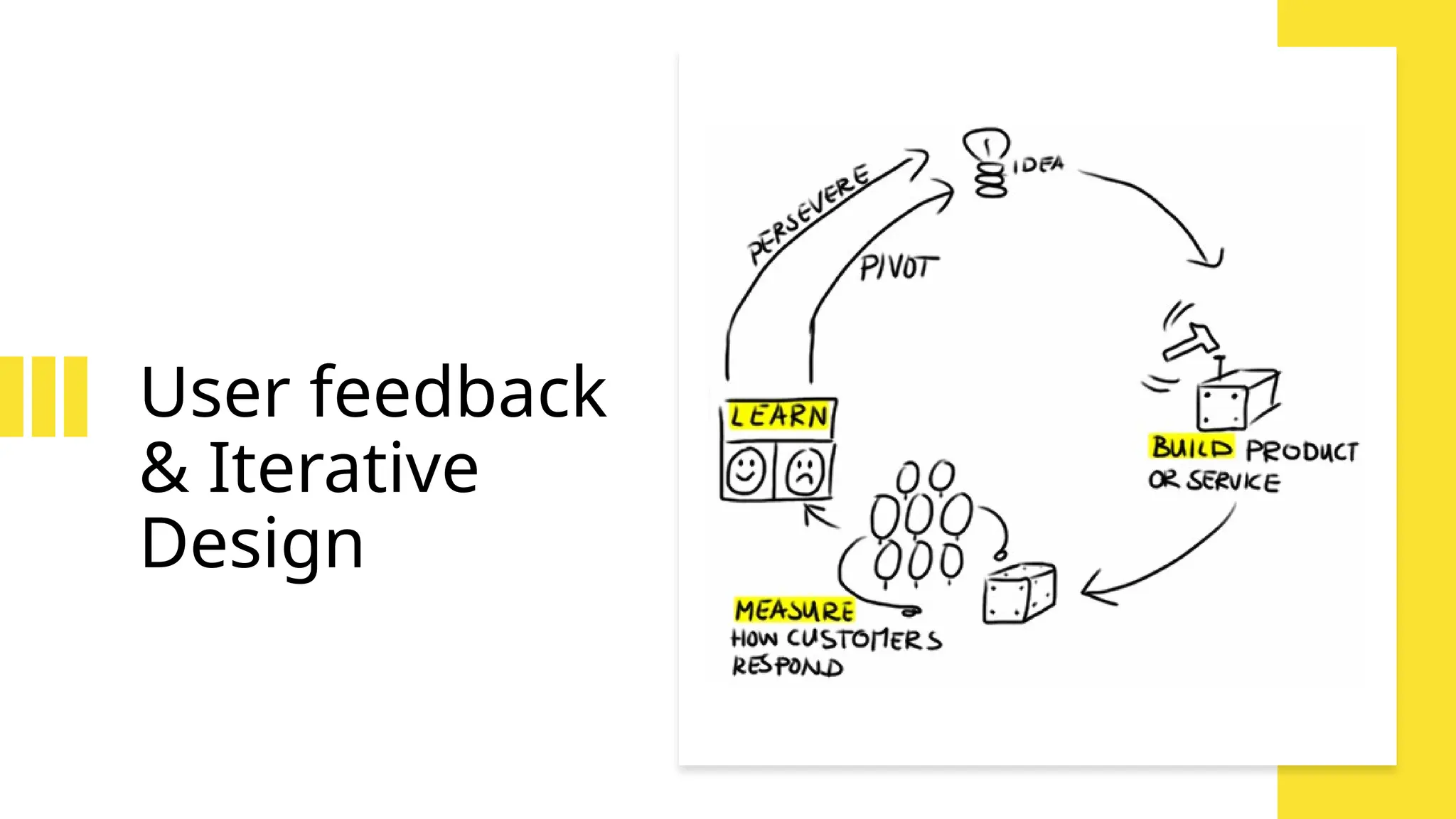
•Build - Measure - Learn
•Pivot | Persevere
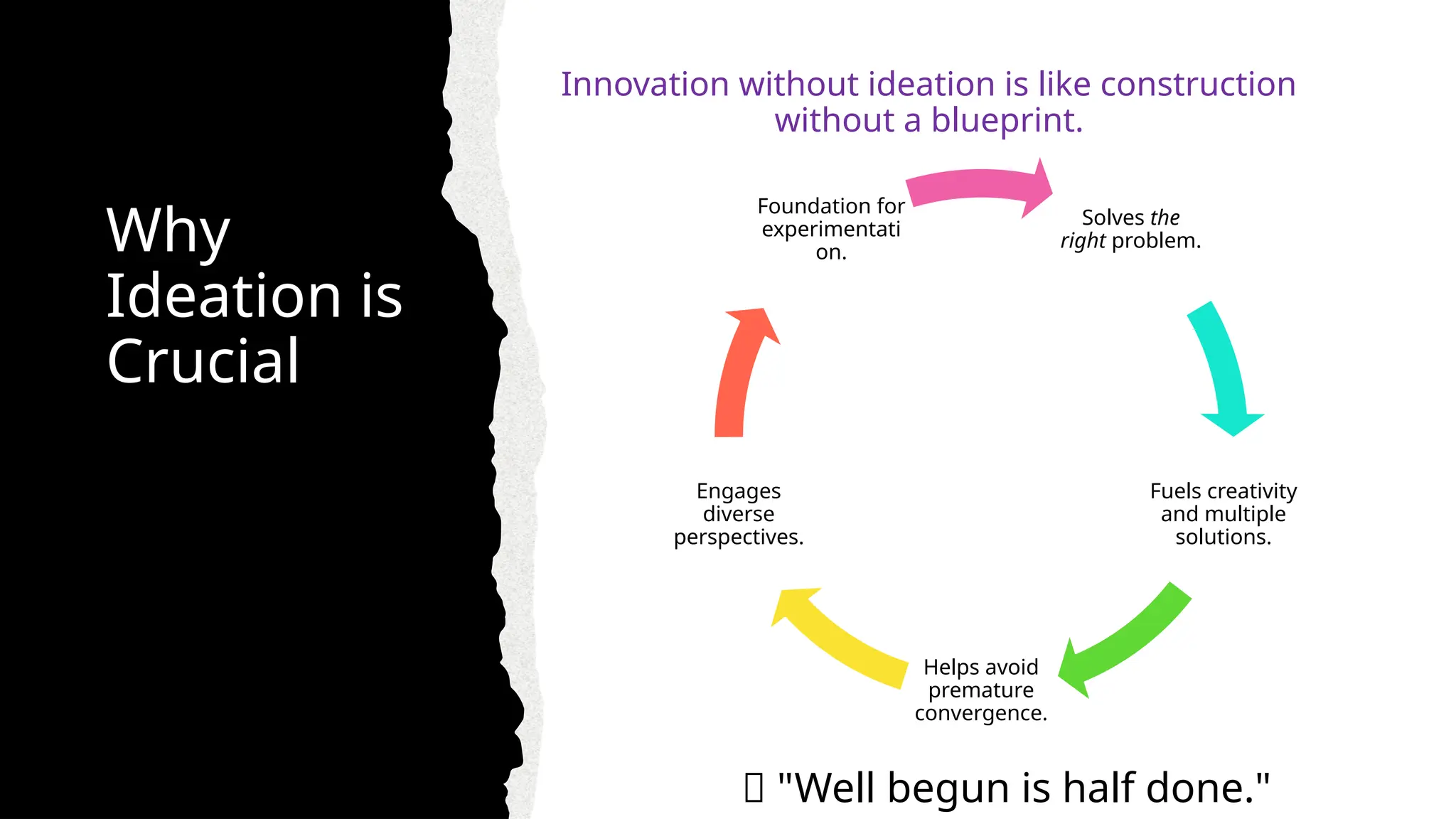
Why
Ideation is
Crucial
Solves the
right problem.
Fuels creativity
and multiple
solutions.
Helps avoid
premature
convergence.
Engages
diverse
perspectives.
Foundation for
experimentati
on.
Innovation without ideation is like construction
without a blueprint.
🧠 "Well begun is half done."
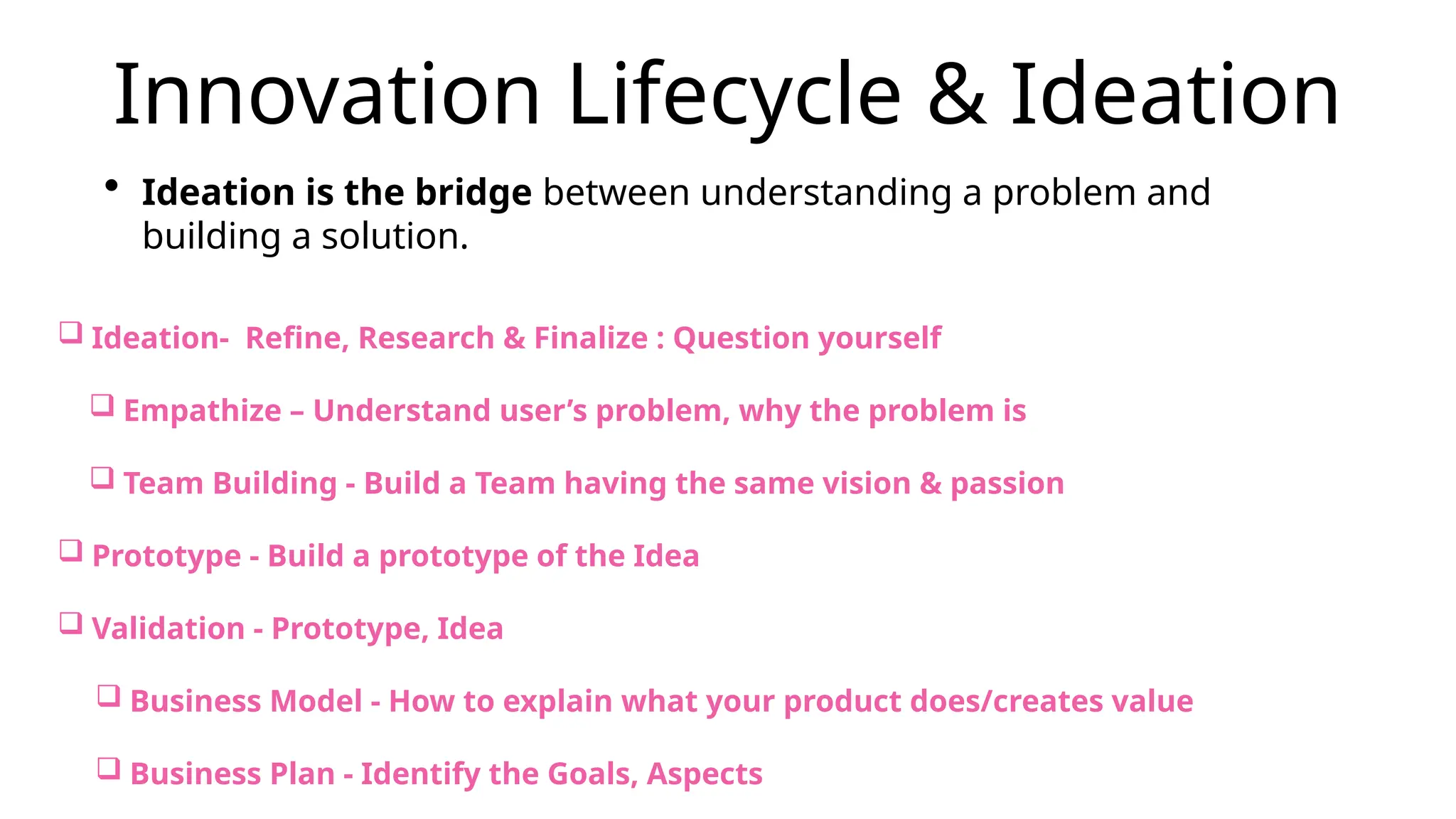
Innovation Lifecycle & Ideation
• Ideation is the bridge between understanding a problem and
building a solution.
 Ideation- Refine, Research & Finalize : Question yourself
 Empathize – Understand user’s problem, why the problem is
 Team Building - Build a Team having the same vision & passion
 Prototype - Build a prototype of the Idea
 Validation - Prototype, Idea
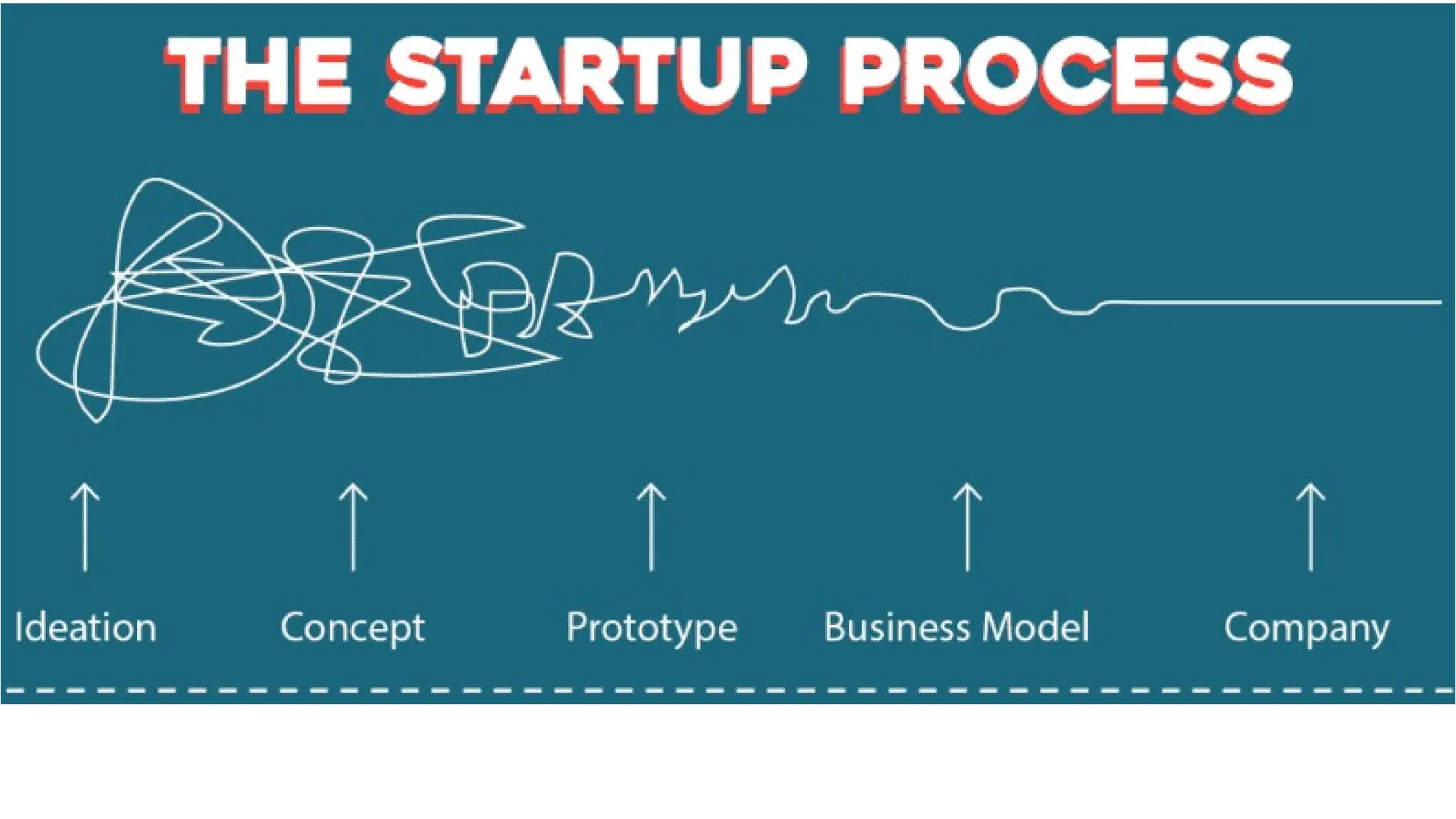
 Business Model - How to explain what your product does/creates value
 Business Plan - Identify the Goals, Aspects
ToiFi: The Life of Pee
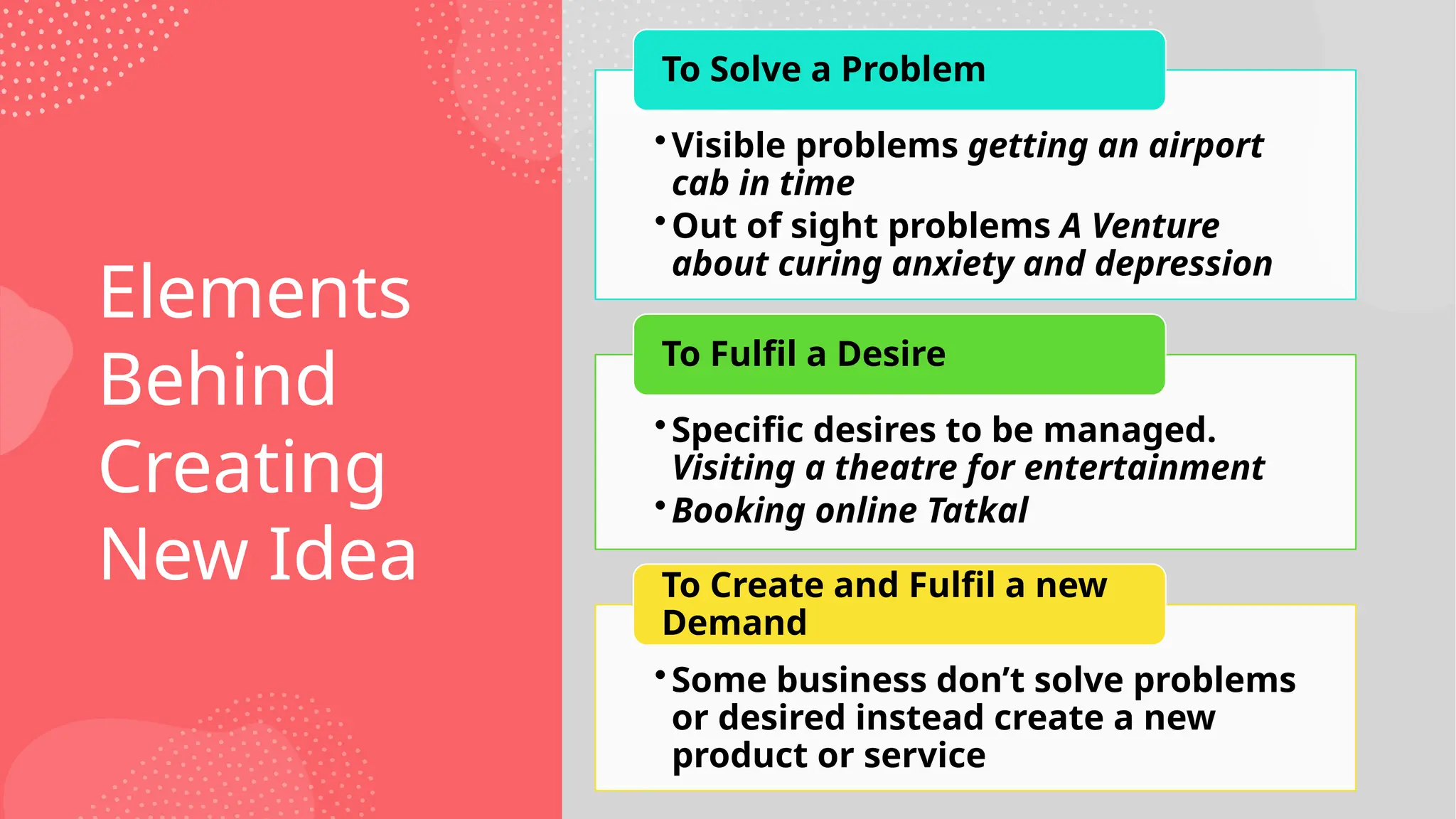
Elements
Behind
Creating
New Idea
•Visible problems getting an airport
cab in time
•Out of sight problems A Venture
about curing anxiety and depression
To Solve a Problem
•Specific desires to be managed.
Visiting a theatre for entertainment
•Booking online Tatkal
To Fulfil a Desire
•Some business don’t solve problems
or desired instead create a new
product or service
To Create and Fulfil a new
Demand
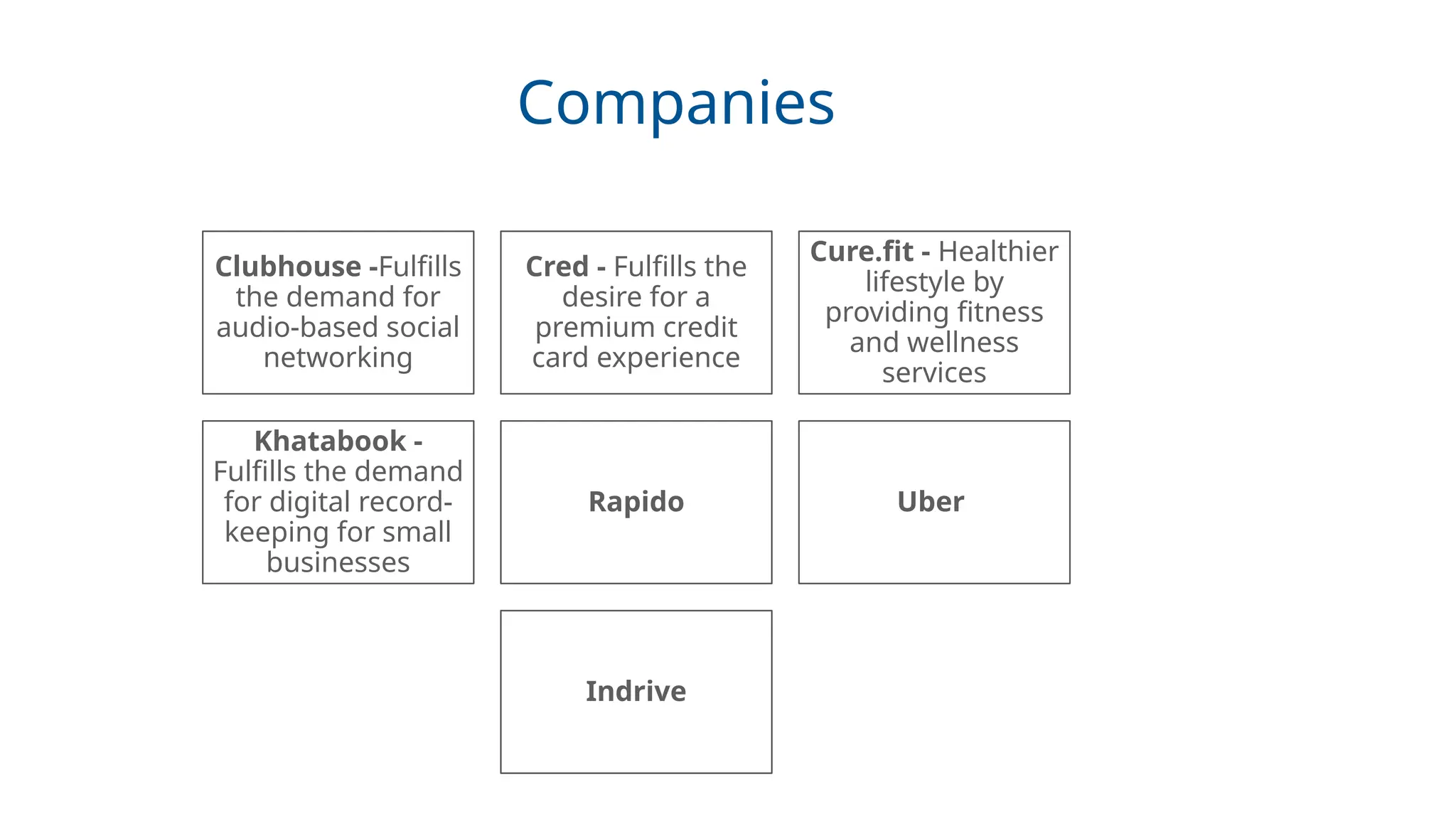
Companies
Clubhouse -Fulfills
the demand for
audio-based social
networking
Cred - Fulfills the
desire for a
premium credit
card experience
Cure.fit - Healthier
lifestyle by
providing fitness
and wellness
services
Khatabook -
Fulfills the demand
for digital record-
keeping for small
businesses
Rapido Uber
Indrive
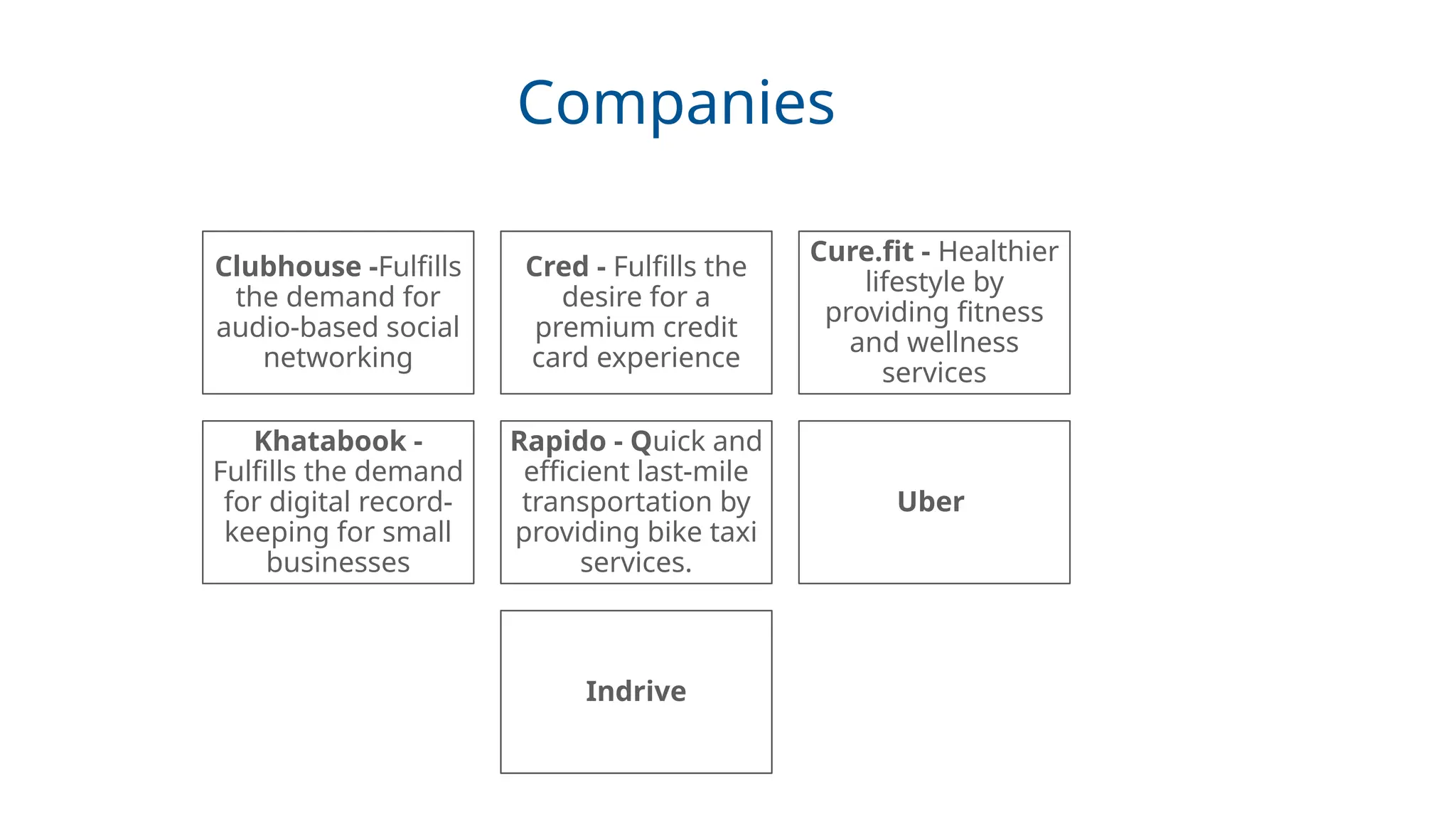
Companies
Clubhouse -Fulfills
the demand for
audio-based social
networking
Cred - Fulfills the
desire for a
premium credit
card experience
Cure.fit - Healthier
lifestyle by
providing fitness
and wellness
services
Khatabook -
Fulfills the demand
for digital record-
keeping for small
businesses
Rapido - Quick and
efficient last-mile
transportation by
providing bike taxi
services.
Uber
Indrive
Inspiring Ideas
• Howard Schultz was in Italy for the
houseware tradeshow.
• He observed Espresso Bars, mini
cafes in Milan.
• Discovered unique coffee culture
Inspiring Ideas
• For Dating, there is always a risk
for rejection
• If you don’t ask you never know of
your chances
• Sean Rad asked this before setting
up Tinder
Inspiring Creative Ideas – Entrepreneurial
mindset
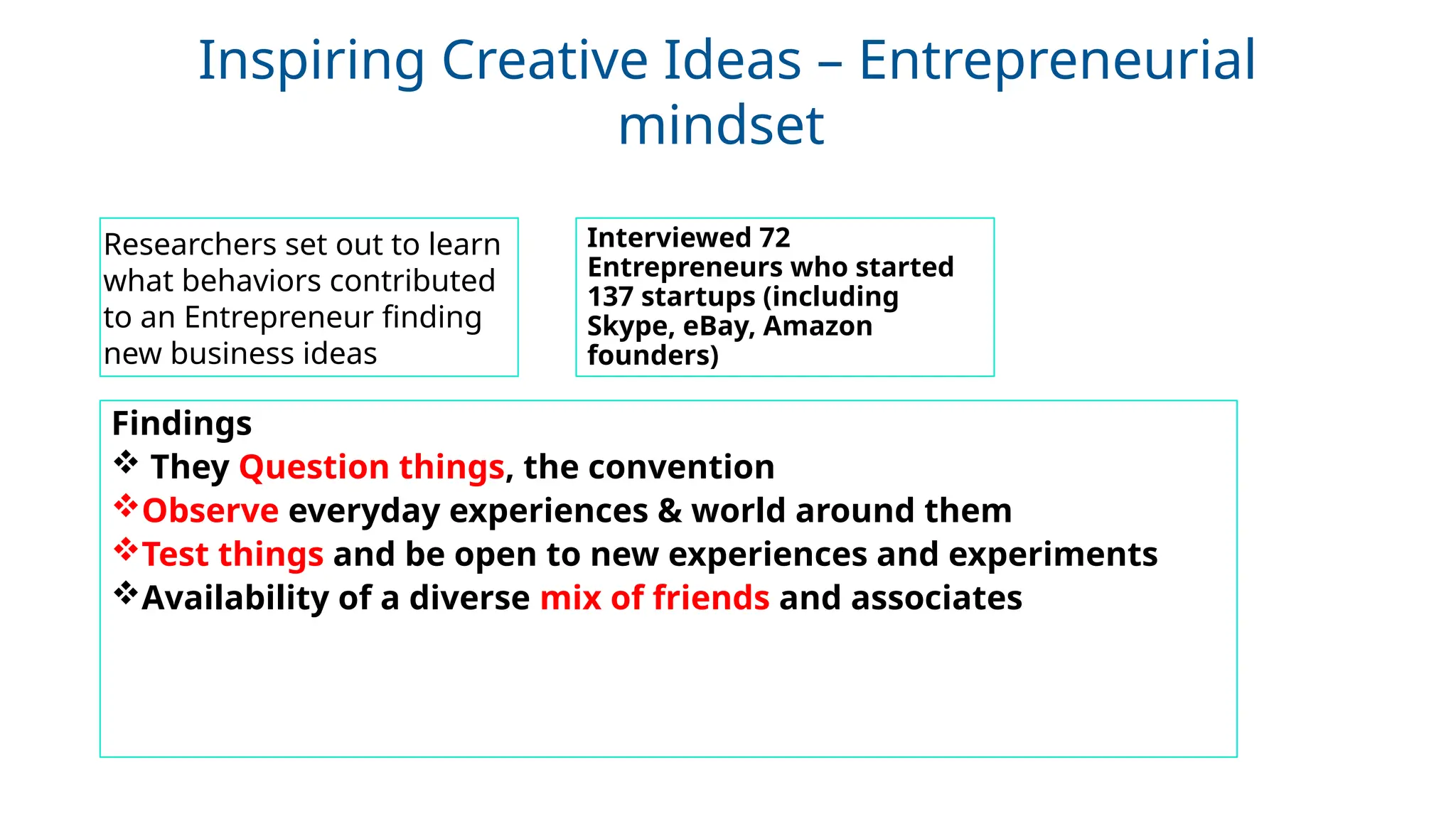
Researchers set out to learn
what behaviors contributed
to an Entrepreneur finding
new business ideas
Interviewed 72
Entrepreneurs who started
137 startups (including
Skype, eBay, Amazon
founders)
Findings
 They Question things, the convention
Observe everyday experiences & world around them
Test things and be open to new experiences and experiments
Availability of a diverse mix of friends and associates
Why do we need P..P..I..I…
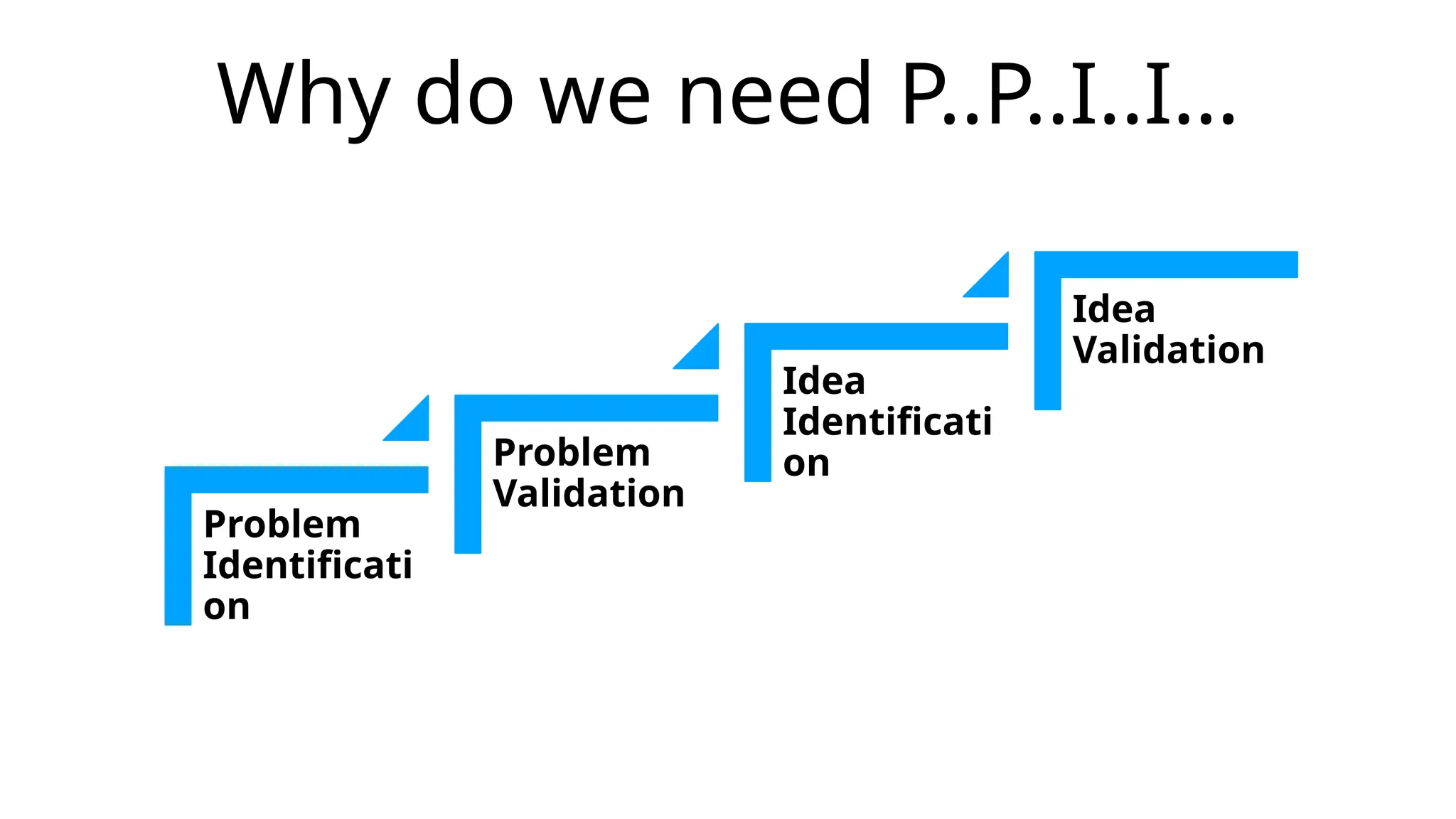
Problem
Identificati
on
Problem
Validation
Idea
Identificati
on
Idea
Validation
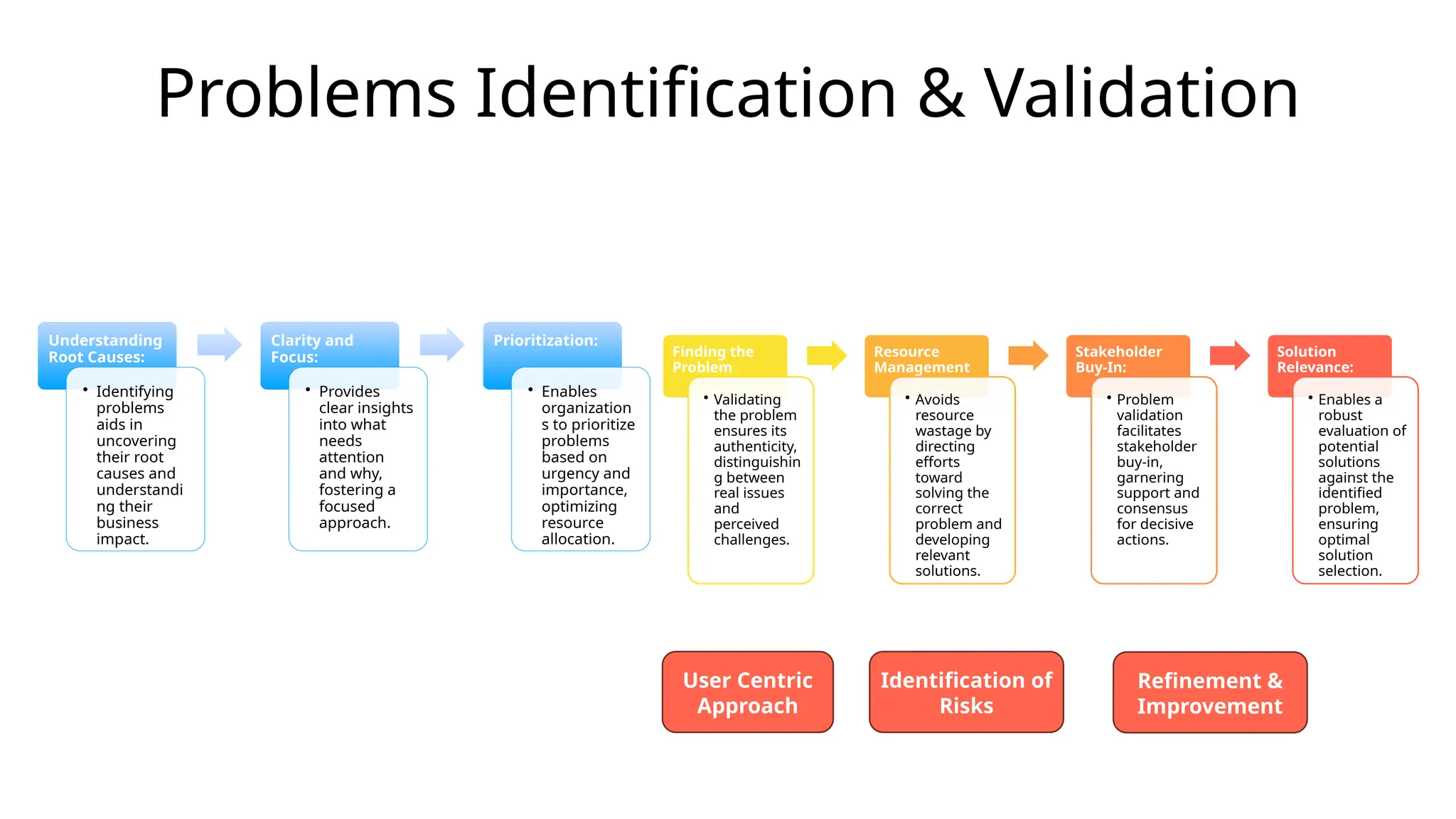
Problems Identification & Validation
Understanding
Root Causes:
• Identifying
problems
aids in
uncovering
their root
causes and
understandi
ng their
business
impact.
Clarity and
Focus:
• Provides
clear insights
into what
needs
attention
and why,
fostering a
focused
approach.
Prioritization:
• Enables
organization
s to prioritize
problems
based on
urgency and
importance,
optimizing
resource
allocation.
Finding the
Problem
• Validating
the problem
ensures its
authenticity,
distinguishin
g between
real issues
and
perceived
challenges.
Resource
Management
• Avoids
resource
wastage by
directing
efforts
toward
solving the
correct
problem and
developing
relevant
solutions.
Stakeholder
Buy-In:
• Problem
validation
facilitates
stakeholder
buy-in,
garnering
support and
consensus
for decisive
actions.
Solution
Relevance:
• Enables a
robust
evaluation of
potential
solutions
against the
identified
problem,
ensuring
optimal
solution
selection.
User Centric
Approach
Identification of
Risks
Refinement &
Improvement
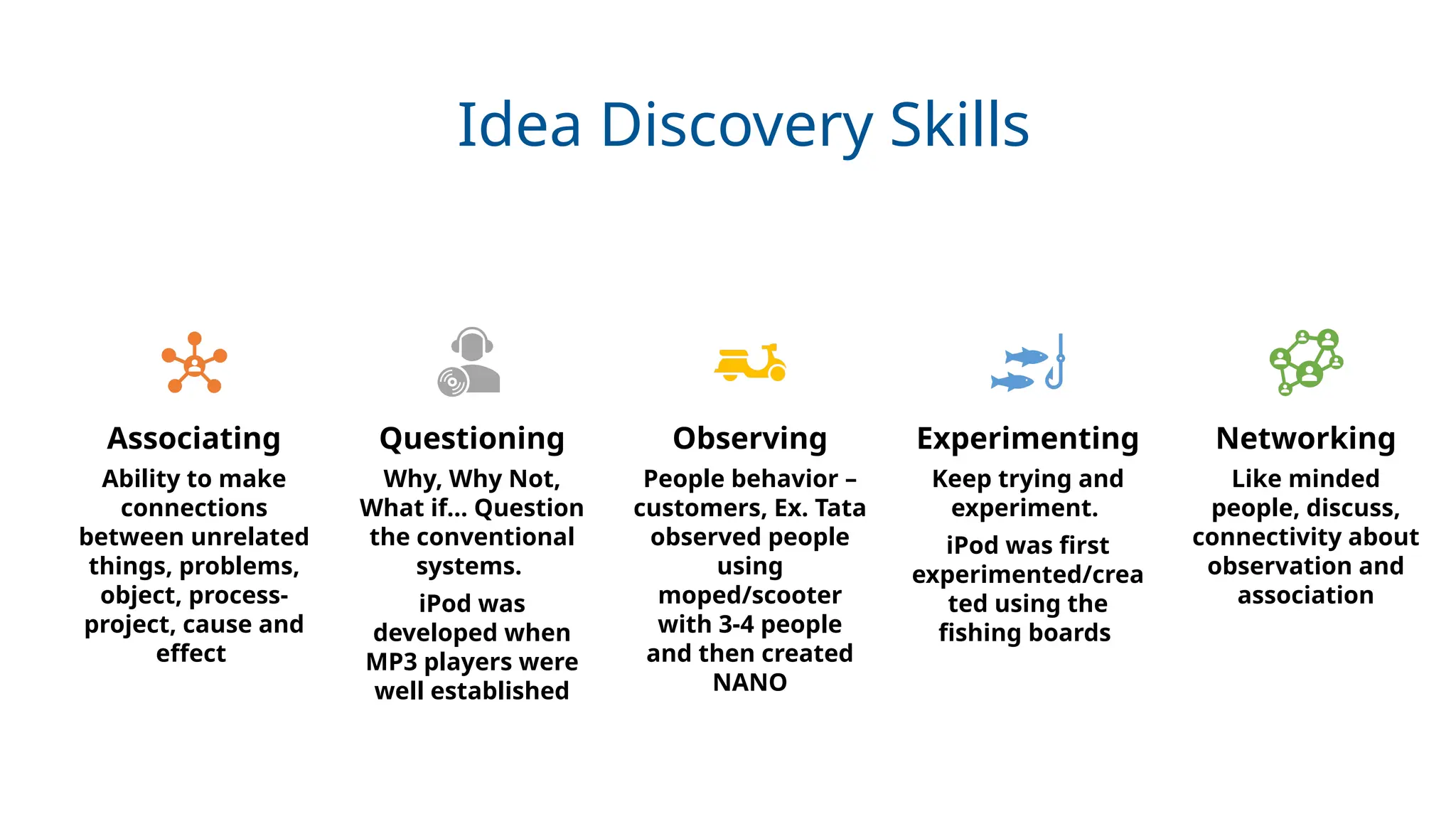
Idea Discovery Skills
Associating
Ability to make
connections
between unrelated
things, problems,
object, process-
project, cause and
effect
Questioning
Why, Why Not,
What if… Question
the conventional
systems.
iPod was
developed when
MP3 players were
well established
Observing
People behavior –
customers, Ex. Tata
observed people
using
moped/scooter
with 3-4 people
and then created
NANO
Experimenting
Keep trying and
experiment.
iPod was first
experimented/crea
ted using the
fishing boards
Networking
Like minded
people, discuss,
connectivity about
observation and
association
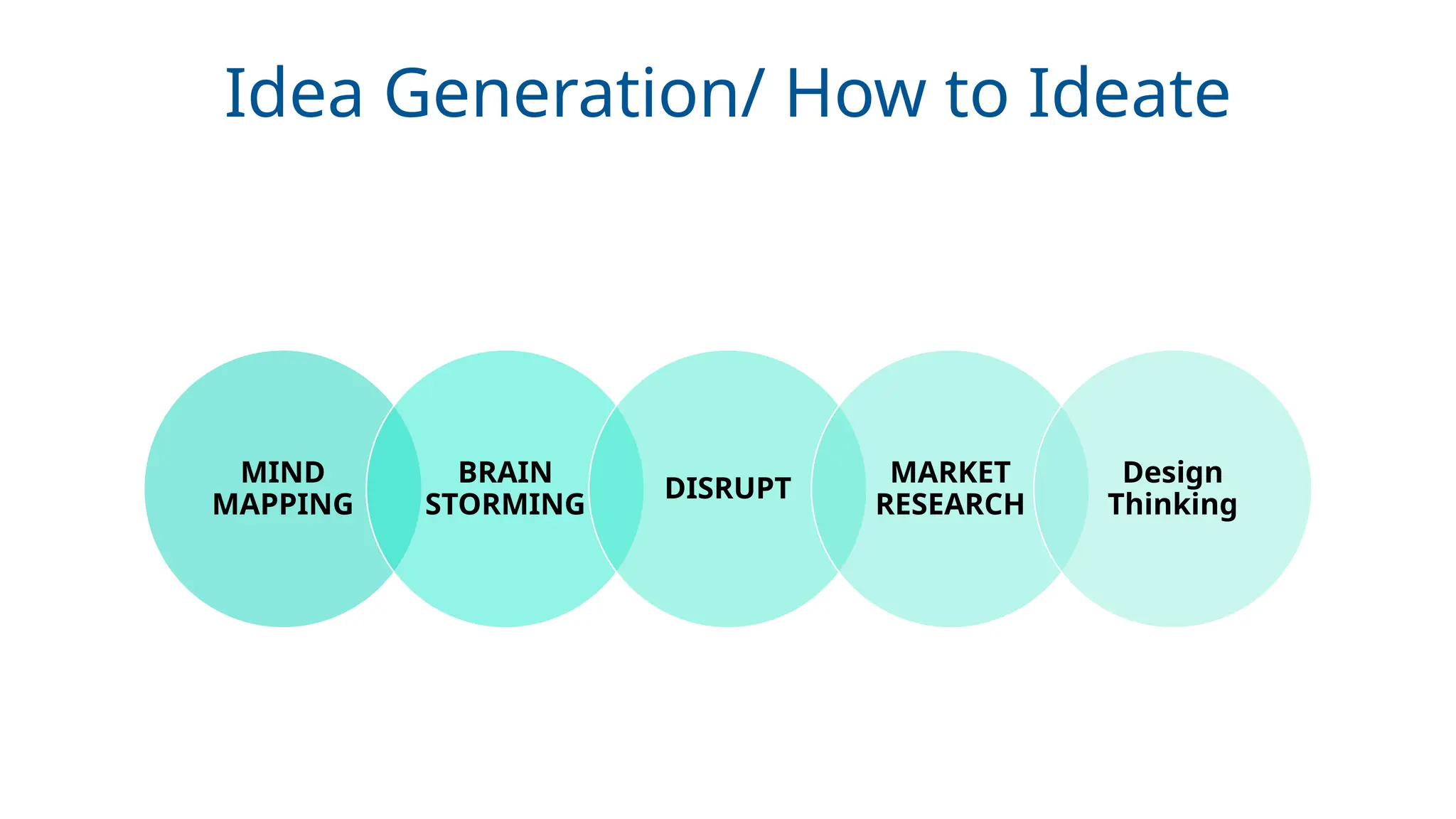
Idea Generation/ How to Ideate
MIND
MAPPING
BRAIN
STORMING
DISRUPT
MARKET
RESEARCH
Design
Thinking
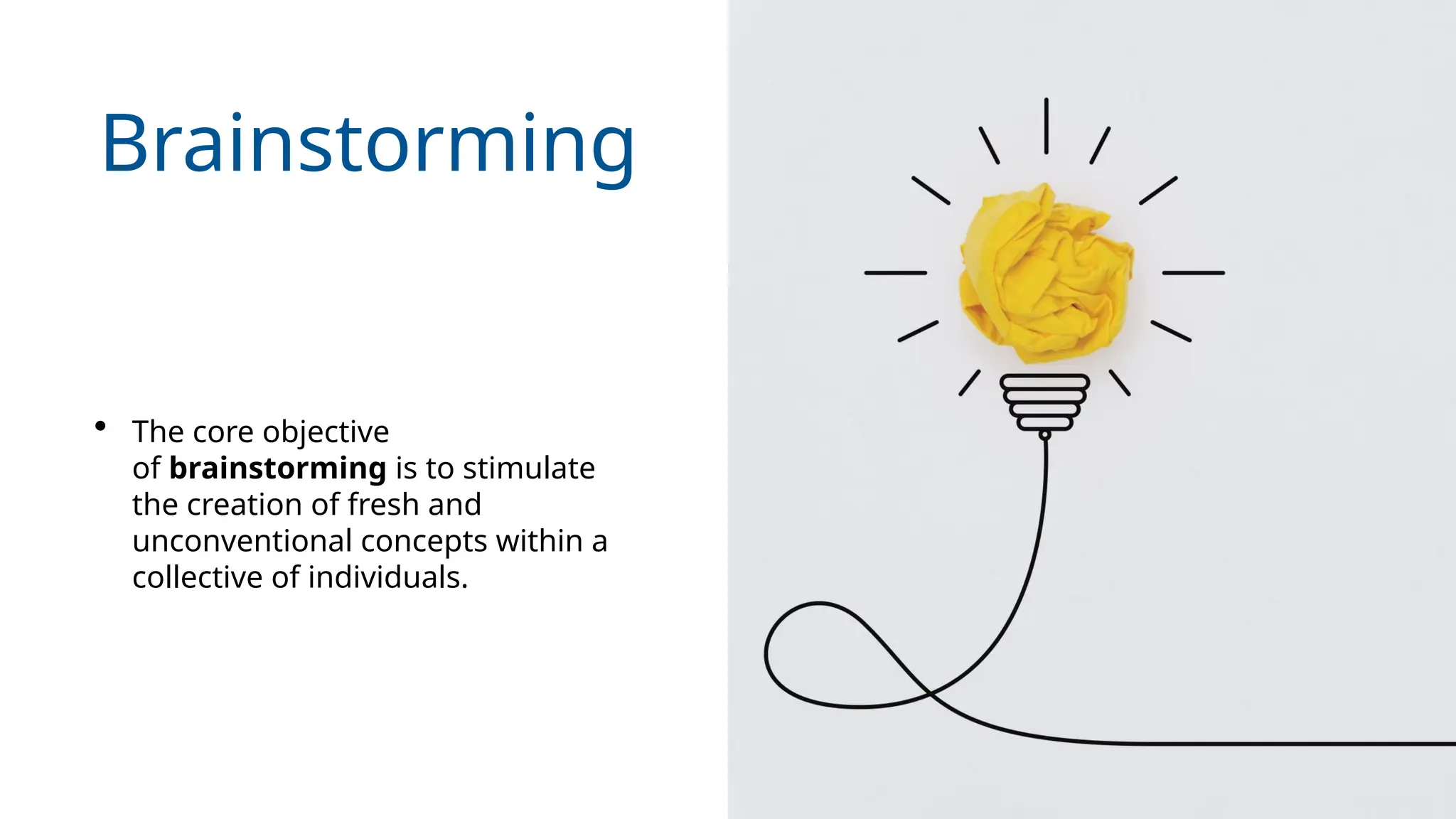
Brainstorming
• The core objective
of brainstorming is to stimulate
the creation of fresh and
unconventional concepts within a
collective of individuals.
Mind mapping
• A visual diagram used to represent words, ideas, tasks, or other
items linked to and arranged around a central key word or idea.
Design Thinking
Cases
• Google Glass
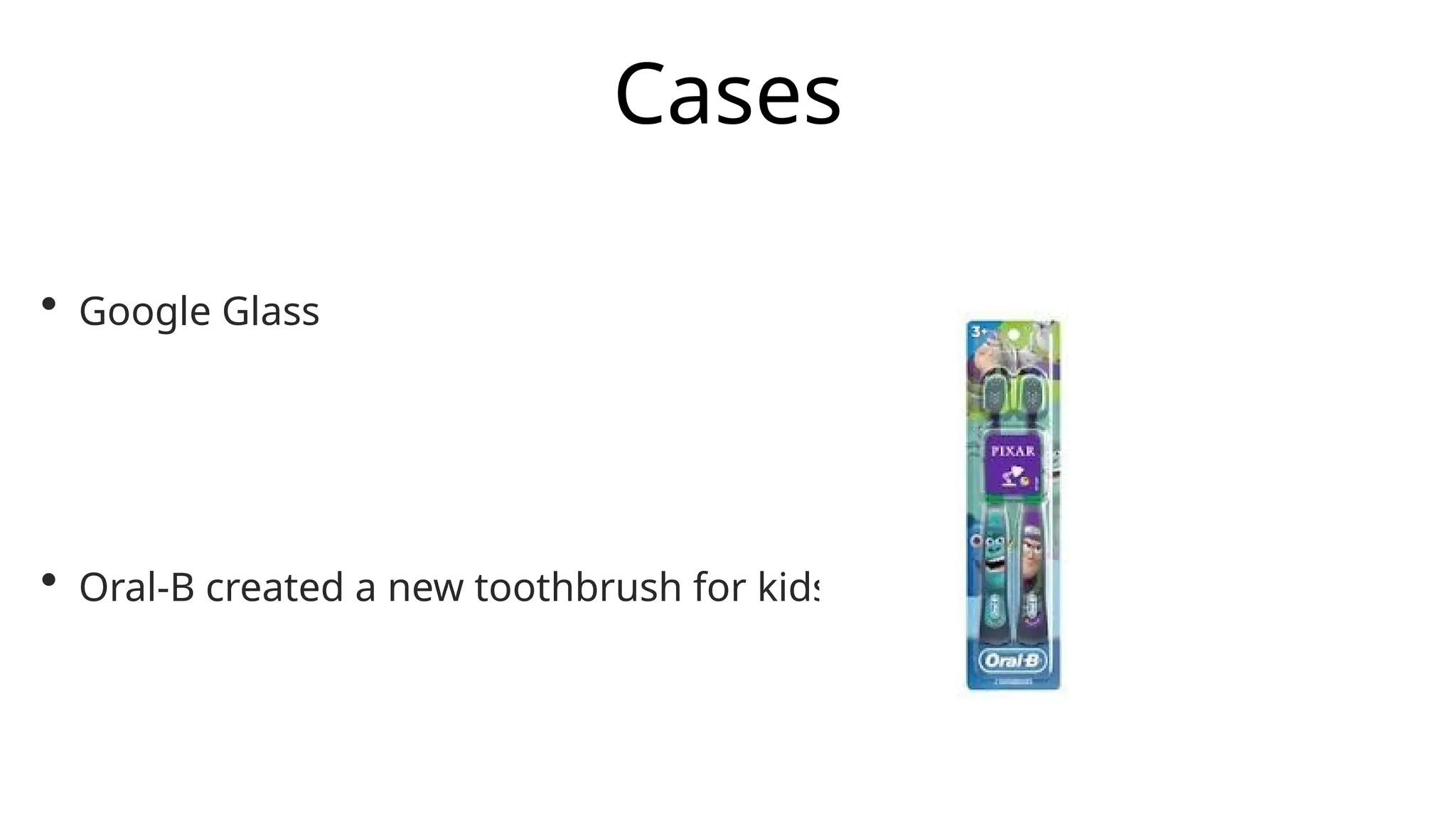
• Oral-B created a new toothbrush for kids
Google Glass: Computer in your spectacles
• Cool idea in 2013 which we only see in movies.
• Yet, the idea failed.
• People did not want to give voice commands in public. Also, the camera on the
glass raised privacy concerns too.
Oral B – Kids Toothbrush
• The design team observed hundreds of kids brushing their teeth and found
that kids have a unique way of holding their brush.
• The new product is a hit, and kids loved to brush with them—Empathy paid
off.
• Oral B – Electric Toothbrush ?
D – Derive
I – Include
S – Separate
R – Repurpose
U – Unite
P – Personalize
T – Transplant
DISRUPT
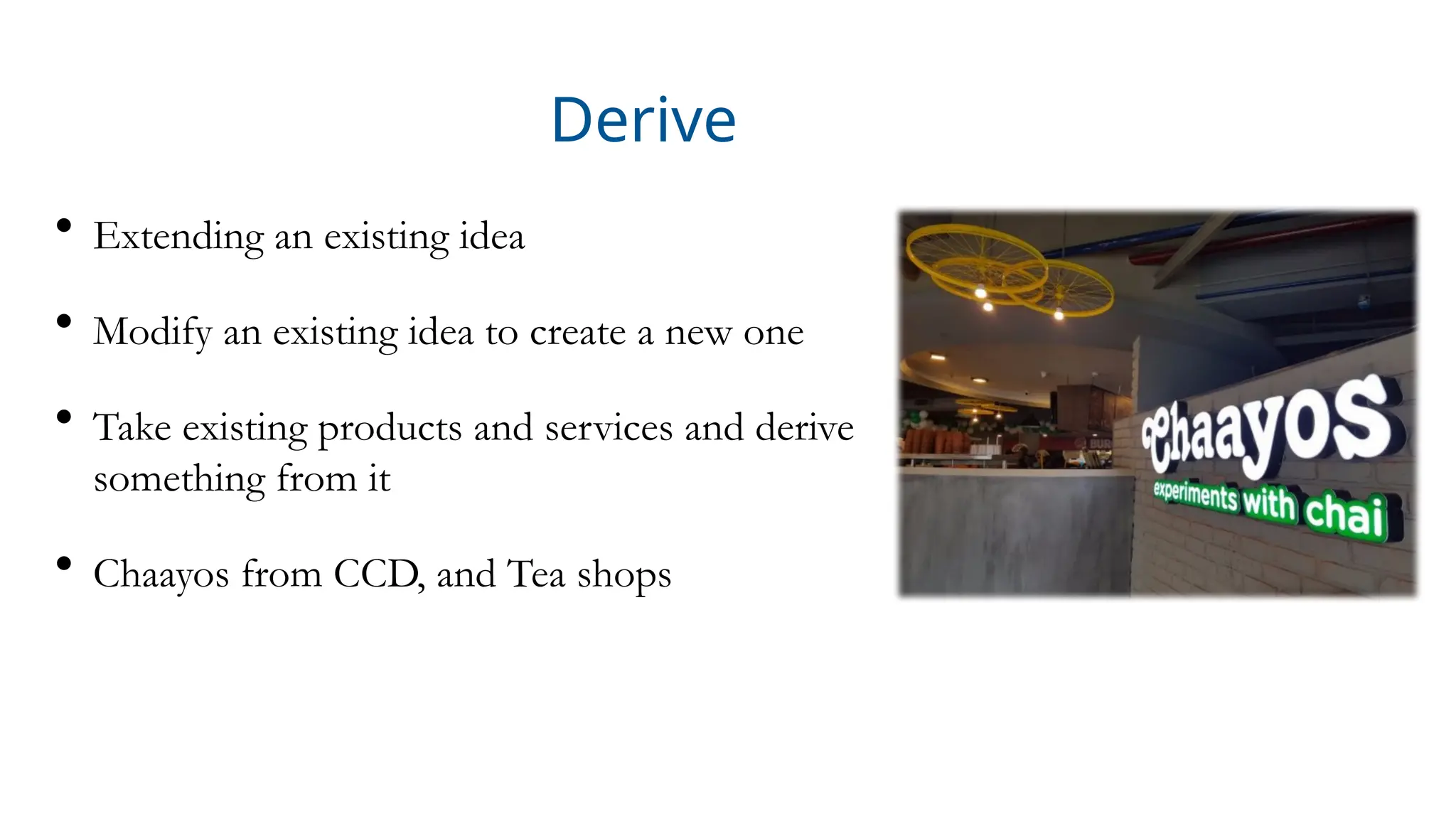
Derive
• Extending an existing idea
• Modify an existing idea to create a new one
• Take existing products and services and derive
something from it
• Chaayos from CCD, and Tea shops
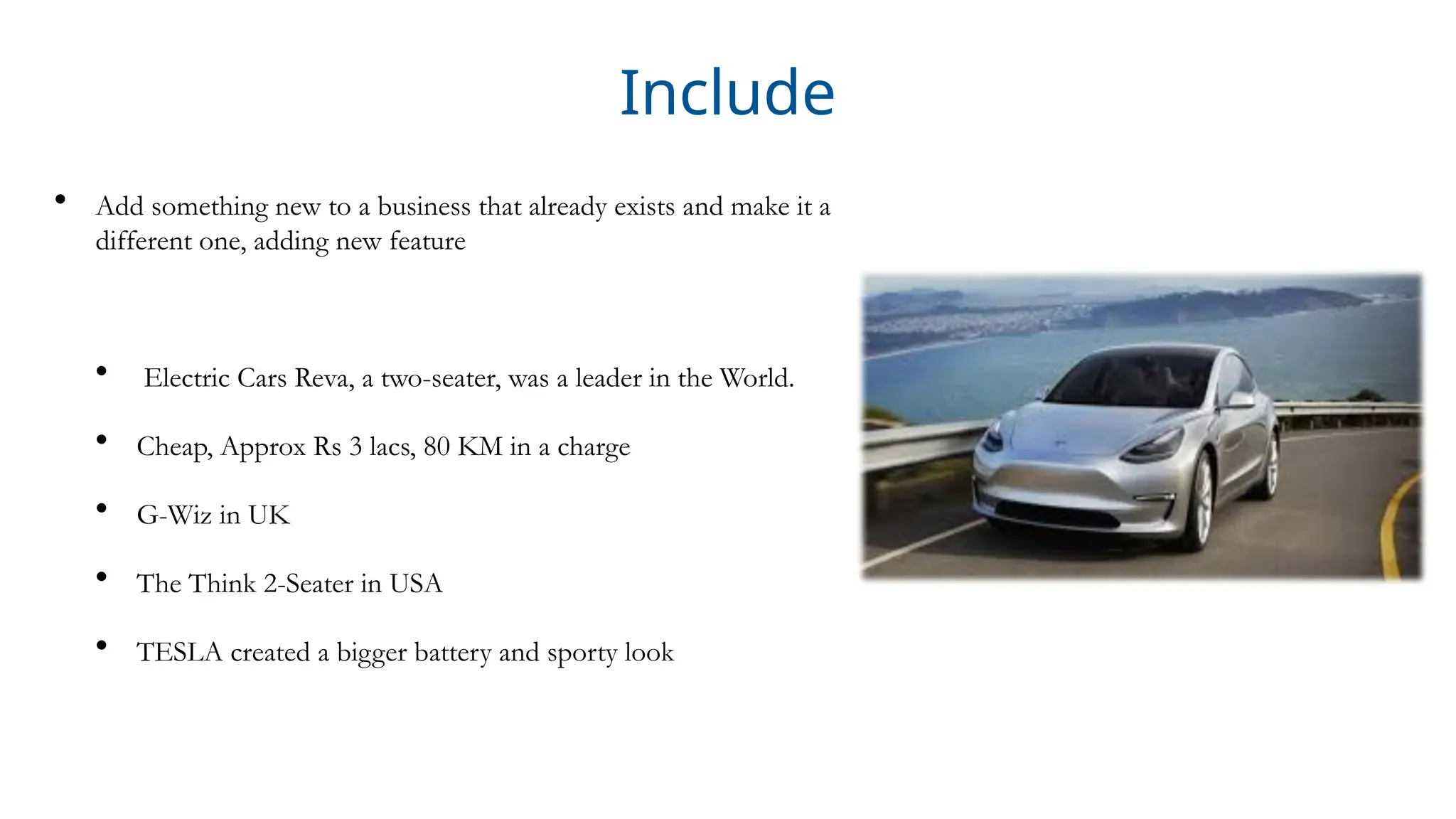
Include
• Add something new to a business that already exists and make it a
different one, adding new feature
• Electric Cars Reva, a two-seater, was a leader in the World.
• Cheap, Approx Rs 3 lacs, 80 KM in a charge
• G-Wiz in UK
• The Think 2-Seater in USA
• TESLA created a bigger battery and sporty look
Separate
• Separate some specific thing from a product
• Make that single feature the main idea and offering
with your Idea
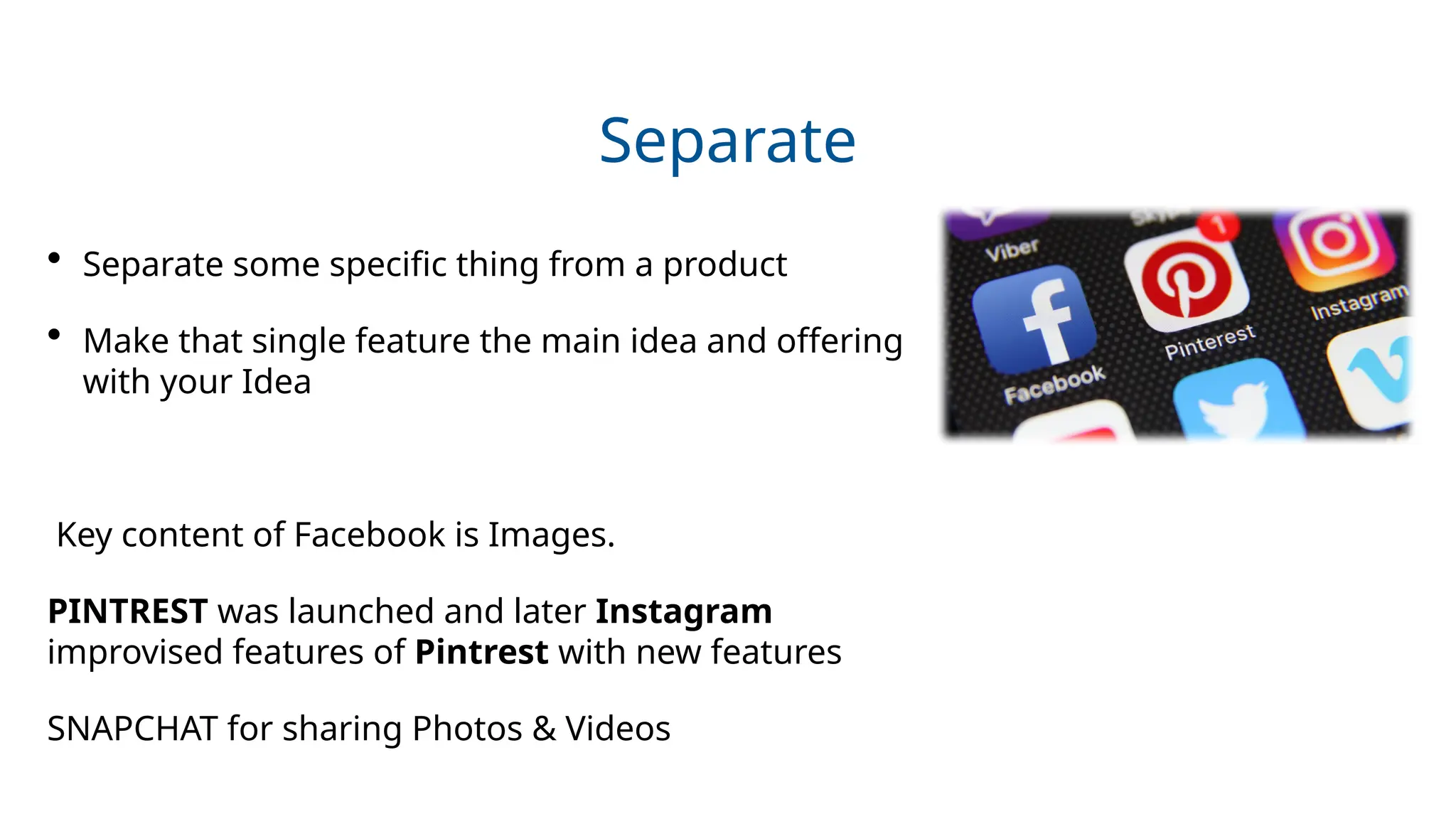
Key content of Facebook is Images.
PINTREST was launched and later Instagram
improvised features of Pintrest with new features
SNAPCHAT for sharing Photos & Videos
Re-Purpose
• Change something in Product or Service
so that it can be used for different Use
Case
• Slideshare : Founders planned for a
“Youtube” of Presentations and launched
Sideshare
Unite
• Combine two products to create a
new products
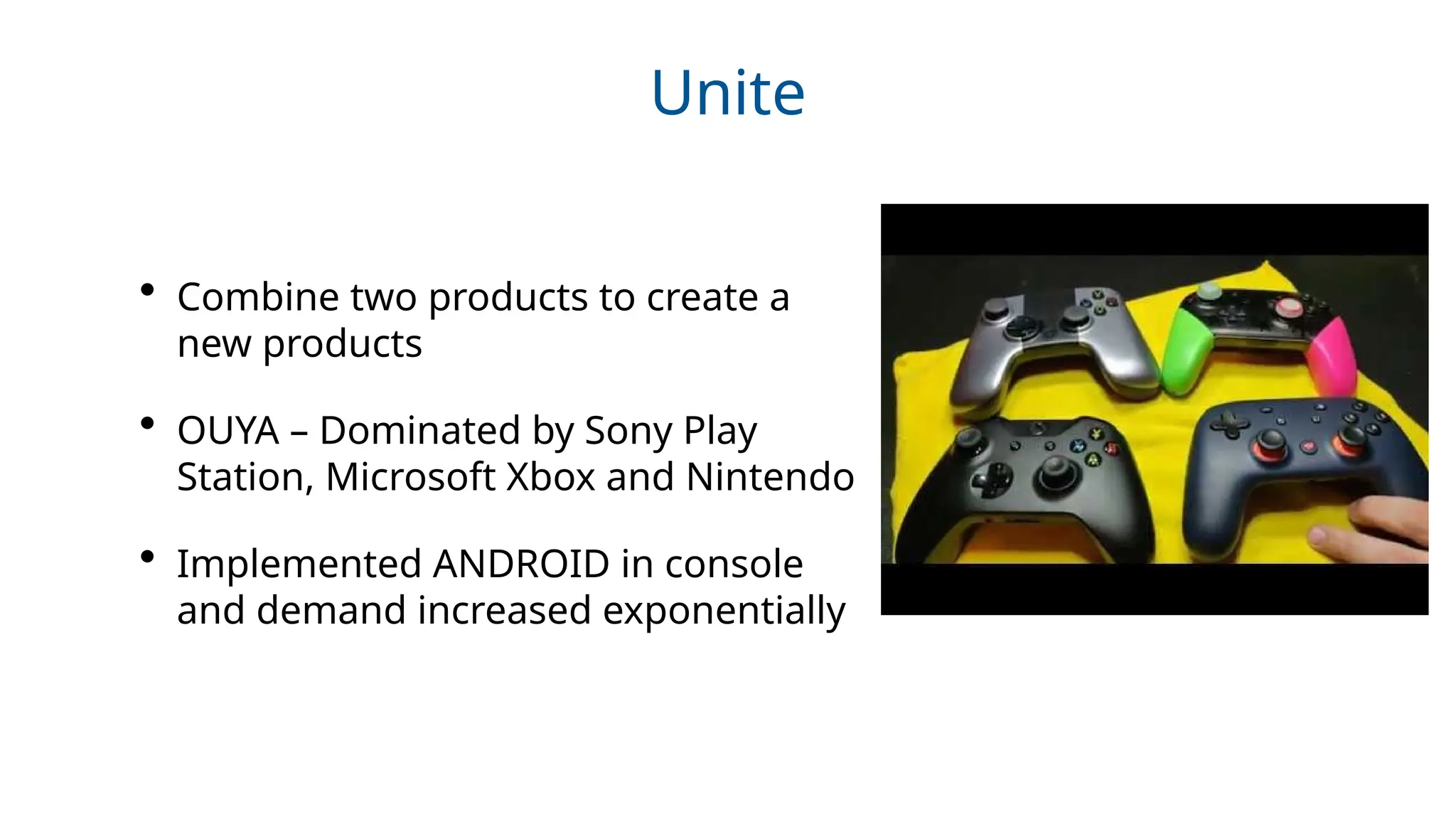
• OUYA – Dominated by Sony Play
Station, Microsoft Xbox and Nintendo
• Implemented ANDROID in console
and demand increased exponentially
Personalize
• Design product or service for a focused
users or personalized users
• Example , Go Colors, an Apparel company
only for Girls
Transplant
• Take an idea from one place
and introduce to another place
• Replicate the Model in different
country
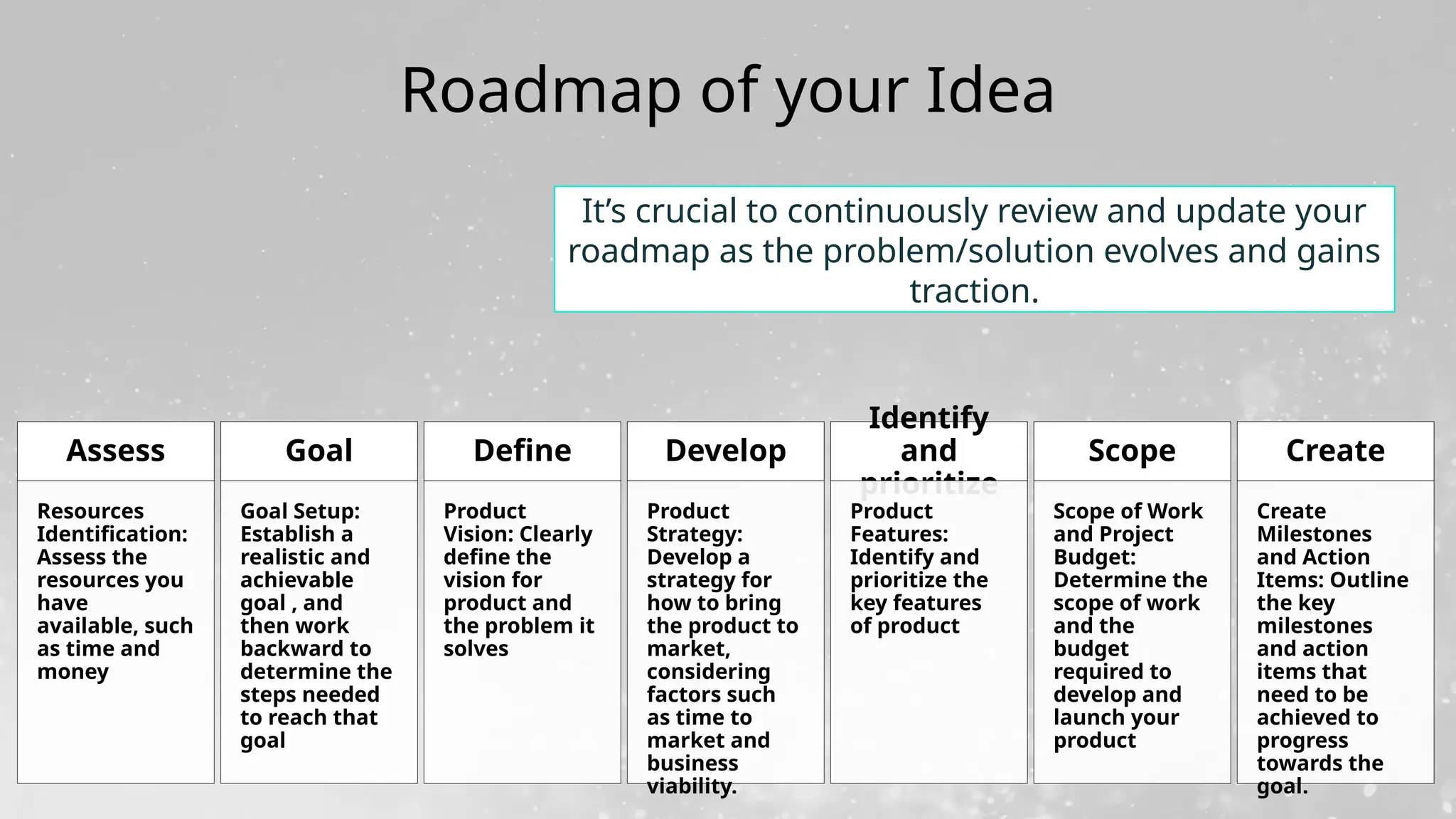
Roadmap of your Idea
It’s crucial to continuously review and update your
roadmap as the problem/solution evolves and gains
traction.
Assess
Resources
Identification:
Assess the
resources you
have
available, such
as time and
money
Goal
Goal Setup:
Establish a
realistic and
achievable
goal , and
then work
backward to
determine the
steps needed
to reach that
goal
Define
Product
Vision: Clearly
define the
vision for
product and
the problem it
solves
Develop
Product
Strategy:
Develop a
strategy for
how to bring
the product to
market,
considering
factors such
as time to
market and
business
viability.
Identify
and
prioritize
Product
Features:
Identify and
prioritize the
key features
of product
Scope
Scope of Work
and Project
Budget:
Determine the
scope of work
and the
budget
required to
develop and
launch your
product
Create
Create
Milestones
and Action
Items: Outline
the key
milestones
and action
items that
need to be
achieved to
progress
towards the
goal.
Value props: Create a Product
People will Actually Buy or solve their
problems
Define the Problem
Problems with 4Us
• Unworkable (how painful)
• Unavoidable (how necessary)
• Urgent (how time sensitive)
• Underserved (how many alternatives)
Unworkabl
e
It is going to cause a problem, consequences are painful or
costly. Who gets fired if this doesn’t work?
It can have a potential loss of revenue, loss of customers, loss of
reputation, or some other significant loss that the unworkable
problem causes.
Does your solution fix a broken business process where there are
real, measurable consequences to inaction?
E.g.
 Broken business process
 Security risk
 consequences?
 Impractical or far too expensive?
Unavoidable
Is the problem so fundamental you can’t avoid it
and just have to comply?
A problem is unavoidable if there is something
compelling people to address the problem or act
Is it driven by some mandate or key requirement of
governance or compliance?
e.g. education
Taxes
Covid
Urgent
Are you on top 3-list of urgency or on top
lists?
• Urgency is relative to other needs
• Priority, which determines resources
allocated or choice consumers have to
spend their money
• E.g. cyber security, finding a job,
vaccination for covid
Underserved
• You are competing for finite resources:
• Money | Time | People | Attention
• Are there many competitors and alternatives in
existence or are there a scant few?
• Is there a conspicuous absence of valid solutions to
the problem you’re looking to solve
• If you’re looking to create a product or solution, you
don’t want to enter an already crowded
market, unless you have a novel and differentiated
way of addressing the problem.
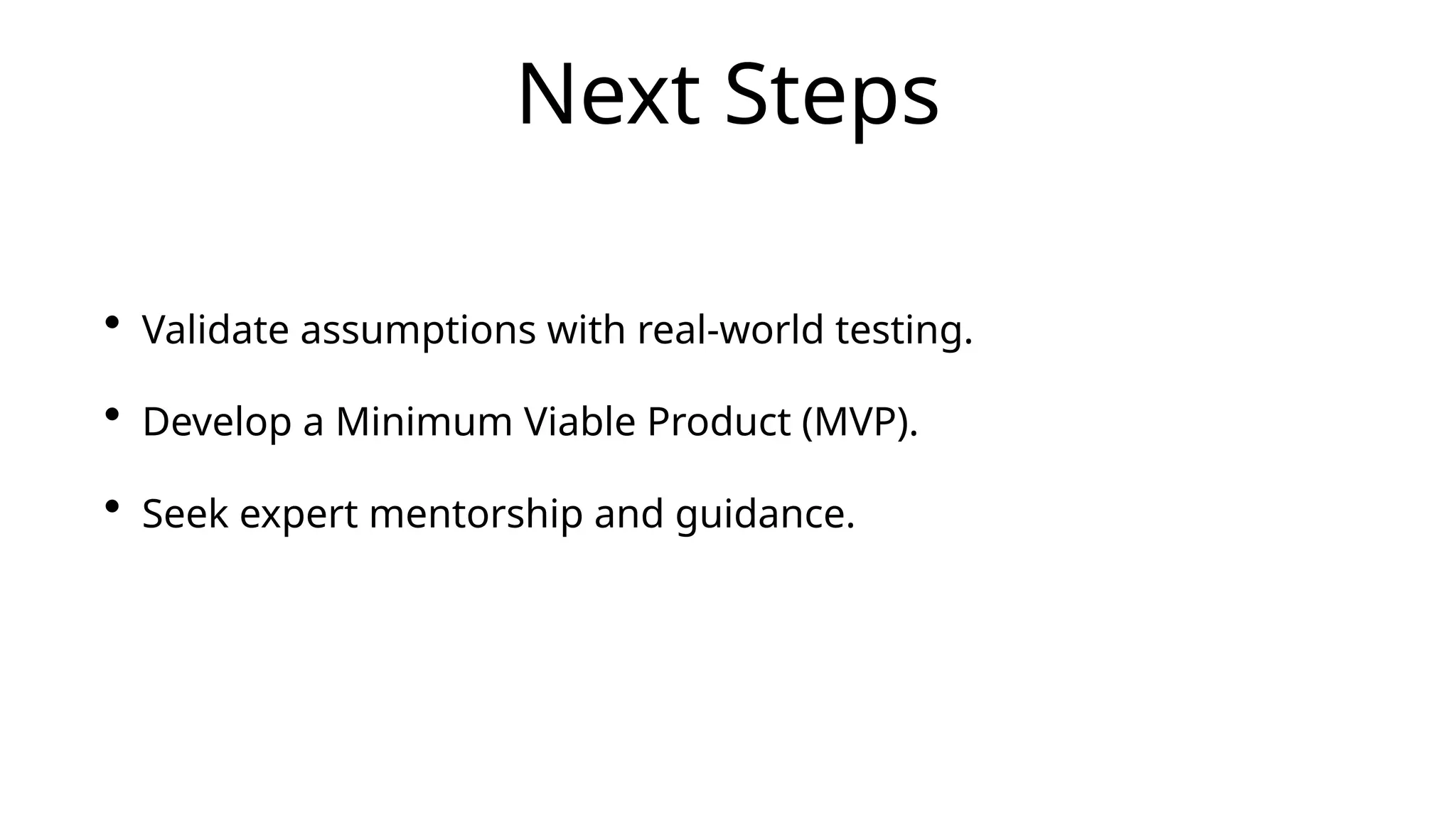
Next Steps
• Validate assumptions with real-world testing.
• Develop a Minimum Viable Product (MVP).
• Seek expert mentorship and guidance.
Product
Innovatio
n Insights What makes an idea
productizable?
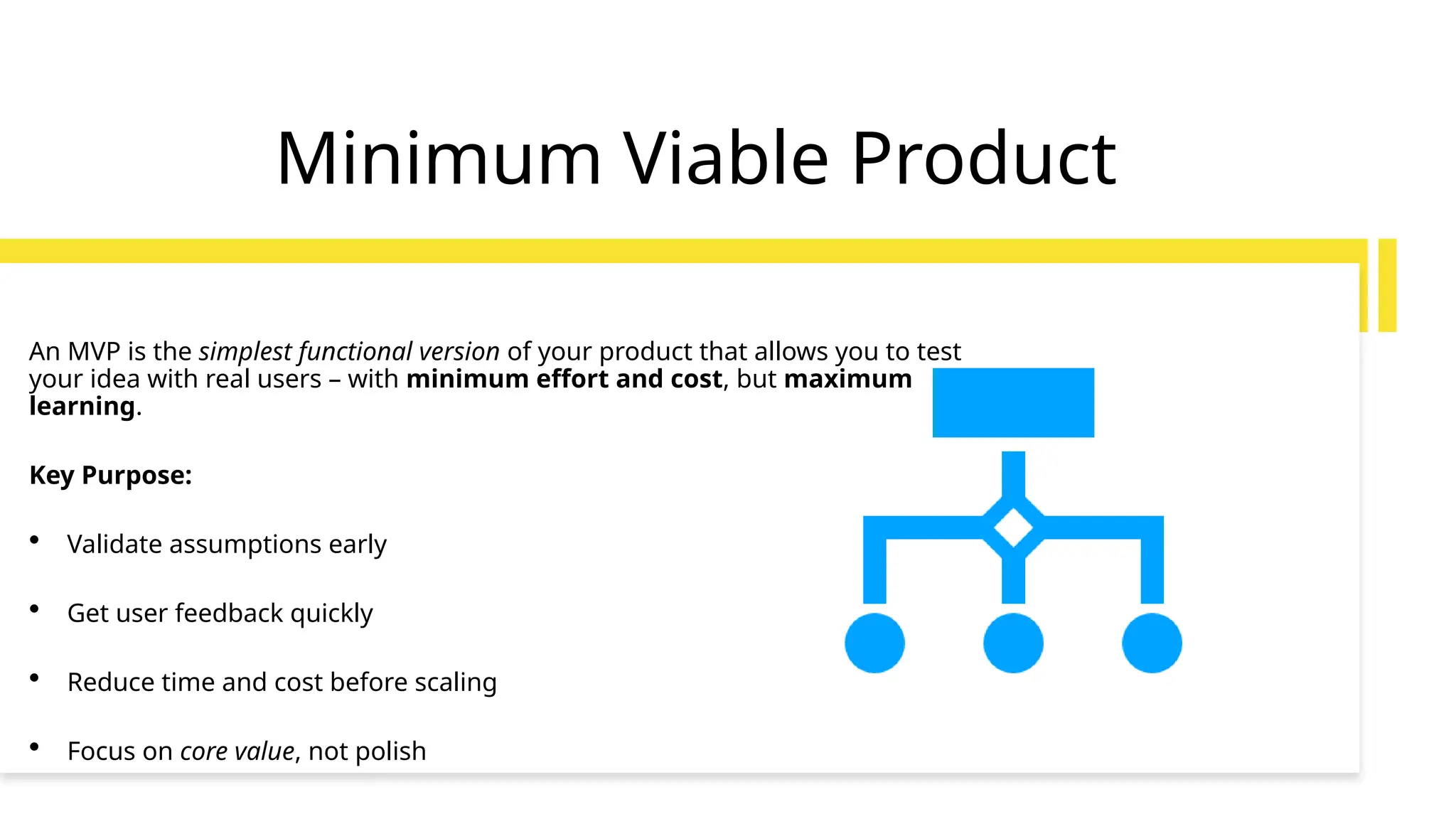
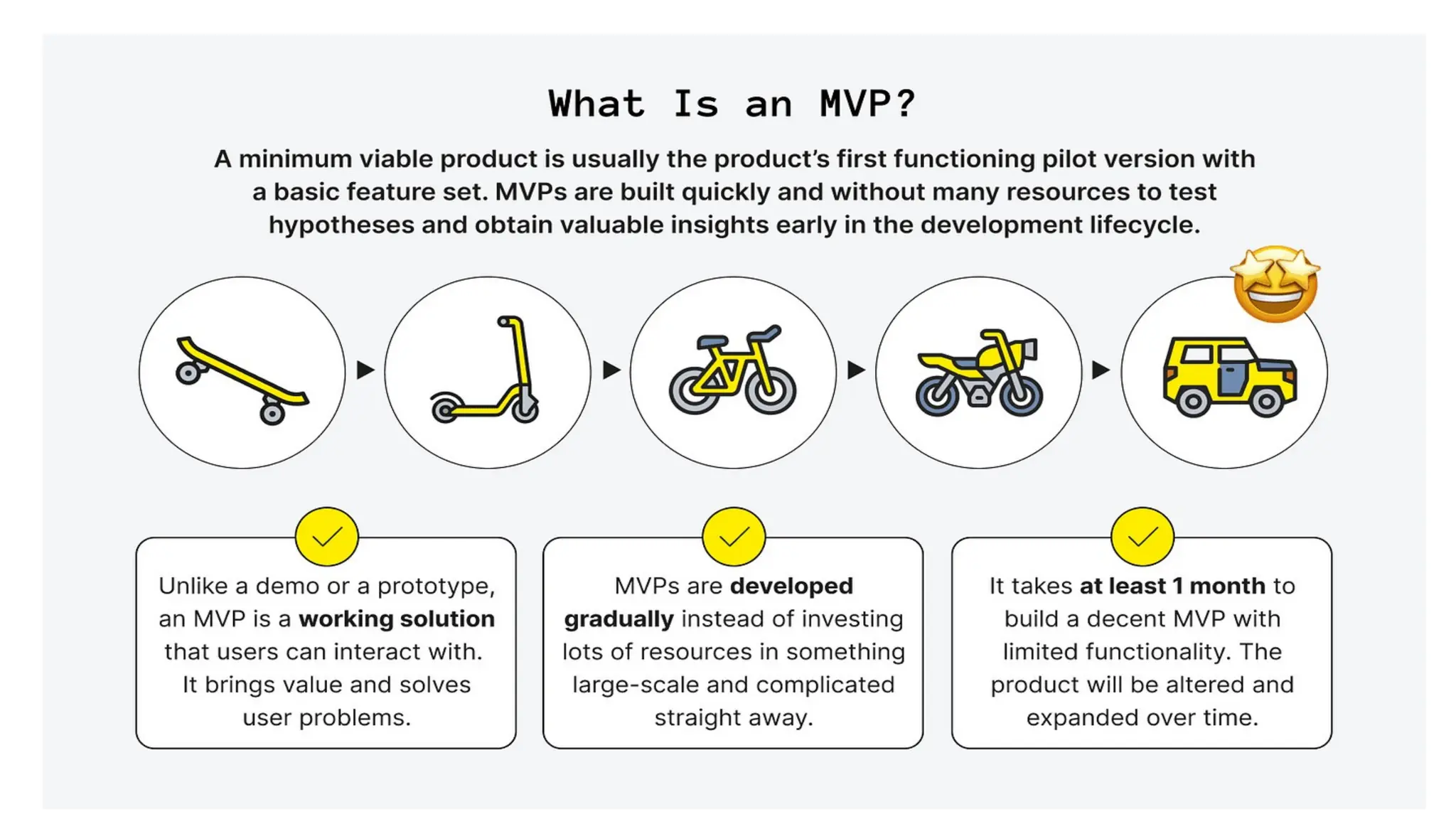
Minimum Viable Product
An MVP is the simplest functional version of your product that allows you to test
your idea with real users – with minimum effort and cost, but maximum
learning.
Key Purpose:
• Validate assumptions early
• Get user feedback quickly
• Reduce time and cost before scaling
• Focus on core value, not polish
Examples
•Dropbox MVP: A demo video to test interest before building the product.
•Zappos MVP: Founder manually bought shoes from local stores to validate
demand.
•Ola/Uber MVP: Single-city launch with basic booking via WhatsApp or webform.
User feedback
& Iterative
Design
IP protection and early prototyping
• Patents
• Copyrights
• Trademarks
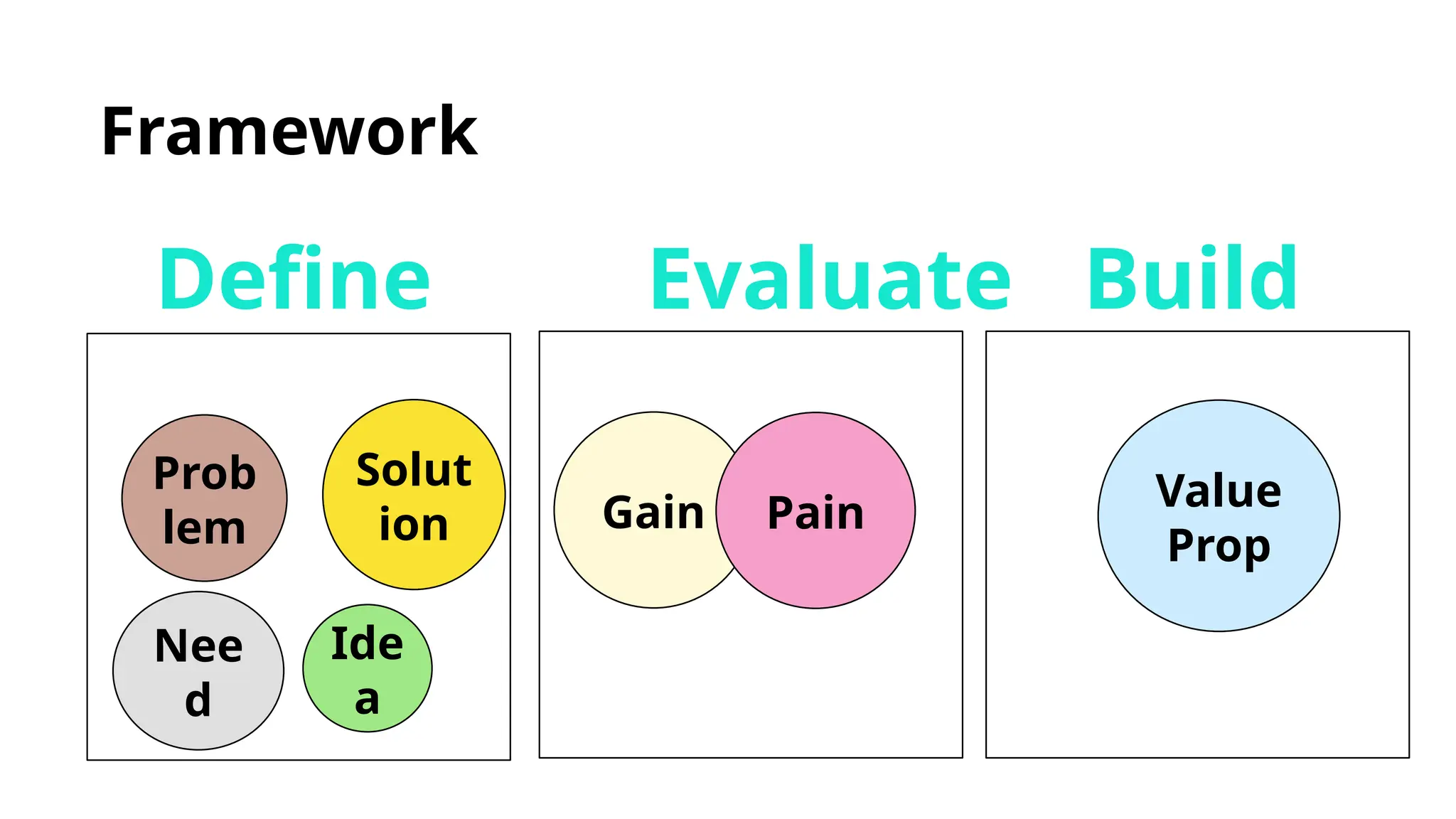
Define Evaluate Build
Framework
Prob
lem
Nee
d
Solut
ion Gain Pain Value
Prop
Ide
a
Business
lens: Can it
scale, solve,
and sustain?
• Evaluate
• Assess
• Interact
• Measure
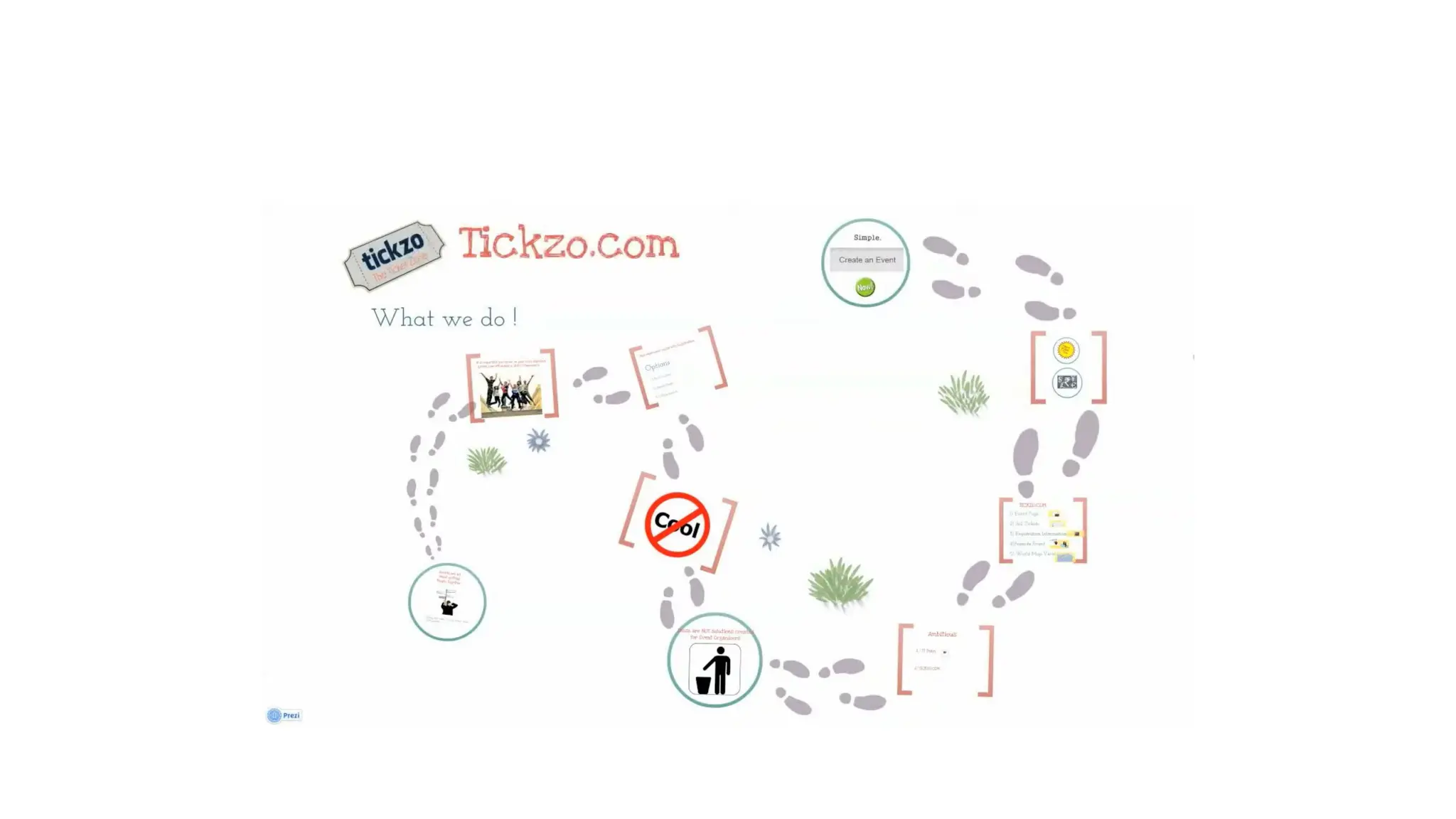
TickZo
Thank you
alok@iiitd.ac.n +91-989 989
8670

Ideation and Product Innovation: Solving Problems

  • 1.
    Ideation & ProductInnovation Dr Alok Nikhil Jha
  • 2.
    Invention vs Innovation Inventionis riskiest & extreme form of Innovation Development of Completely new or novel product or Process Scalable & Successful Implementation
  • 3.
    “Innovation is seeingwhat everybody has seen and thinking what no body has thought.” –Dr. Albert Szent-Gyorgyi
  • 4.
    •Innovation = Invention+ Value Creation •It’s not just about having an idea. It’s about making that idea work, scale, and solve a problem. •🧠 Idea Solution → 💰 Value → → 💰
  • 5.
    Sustaining Innovation An incrementalinnovation that enables an existing product without major affect on market. Evolutionary Innovation : Improves a product in an existing market based on customers feedback Fuel Injection instead of carburettors | Apple Products | Razor blades Revolutionary Innovation : New, unexpected, but may not affect existing markets. Automobiles in 19th Century | Xerox Mouse | Cane Based Prosthetic Legs
  • 6.
    Disruptive Innovation The innovationthat disrupts an existing market and value network and creates a new market by providing a different set of values. Internet of Things (IoT) | Cloud | Mobile Internet | 3D printing Apple using the Xerox technology in MAC machines
  • 7.
  • 8.
    Product Innovation Creating newor significantly improved products. 📌 Examples: • Apple iPhone: Combined phone, camera, and internet into one product. • Dyson Vacuum: Reinvented suction tech. 💡 "What new feature or combination makes the product stand out?"
  • 9.
    Process Innovation Improving internaloperations or delivery processes. 📌 Examples: • Domino’s 30-min Delivery: Re-engineered supply chain and kitchen operations. • Toyota’s Lean Manufacturing: Reduced waste, improved quality. 💡 "How can we do what we do — better, faster, cheaper?"
  • 10.
    Business Model Innovation Changinghow a company creates, delivers, or captures value. 📌 Examples: • Netflix: Rental to subscription streaming. • PayTm: Simplified digital payments . 💡 "Can we innovate the way money flows or value is delivered?"
  • 11.
    Frugal Innovation (Jugaad) •Low-cost,resource-efficient innovation for maximum impact. •💡 "How can we do more with less?"
  • 12.
    Disruptive Innovation • Creatingsimple, affordable products that reshape industries. 📌 Examples: • Internet of Things (IoT) | Cloud | Mobile Internet | 3D printing • Uber: Disrupted traditional taxis. • Google Docs: Replaced MS Office for many startups.
  • 13.
  • 14.
    –by Ask Yourself “AreWe Innovative”
  • 15.
    Innovation vs Startup FromIdea to Innovation Validation - Commercialisation – Startup Research & IPR Commercialisation | Licensing | Profile Building
  • 17.
  • 18.
    How to Start Observe,Think, Question, Find Value Addition, Opportunities and Improvement Areas
  • 19.
    Where to Start •Build- Measure - Learn •Pivot | Persevere
  • 20.
    Why Ideation is Crucial Solves the rightproblem. Fuels creativity and multiple solutions. Helps avoid premature convergence. Engages diverse perspectives. Foundation for experimentati on. Innovation without ideation is like construction without a blueprint. 🧠 "Well begun is half done."
  • 21.
    Innovation Lifecycle &Ideation • Ideation is the bridge between understanding a problem and building a solution.  Ideation- Refine, Research & Finalize : Question yourself  Empathize – Understand user’s problem, why the problem is  Team Building - Build a Team having the same vision & passion  Prototype - Build a prototype of the Idea  Validation - Prototype, Idea  Business Model - How to explain what your product does/creates value  Business Plan - Identify the Goals, Aspects
  • 22.
  • 23.
    Elements Behind Creating New Idea •Visible problemsgetting an airport cab in time •Out of sight problems A Venture about curing anxiety and depression To Solve a Problem •Specific desires to be managed. Visiting a theatre for entertainment •Booking online Tatkal To Fulfil a Desire •Some business don’t solve problems or desired instead create a new product or service To Create and Fulfil a new Demand
  • 24.
    Companies Clubhouse -Fulfills the demandfor audio-based social networking Cred - Fulfills the desire for a premium credit card experience Cure.fit - Healthier lifestyle by providing fitness and wellness services Khatabook - Fulfills the demand for digital record- keeping for small businesses Rapido Uber Indrive
  • 25.
    Companies Clubhouse -Fulfills the demandfor audio-based social networking Cred - Fulfills the desire for a premium credit card experience Cure.fit - Healthier lifestyle by providing fitness and wellness services Khatabook - Fulfills the demand for digital record- keeping for small businesses Rapido - Quick and efficient last-mile transportation by providing bike taxi services. Uber Indrive
  • 26.
    Inspiring Ideas • HowardSchultz was in Italy for the houseware tradeshow. • He observed Espresso Bars, mini cafes in Milan. • Discovered unique coffee culture
  • 27.
    Inspiring Ideas • ForDating, there is always a risk for rejection • If you don’t ask you never know of your chances • Sean Rad asked this before setting up Tinder
  • 28.
    Inspiring Creative Ideas– Entrepreneurial mindset Researchers set out to learn what behaviors contributed to an Entrepreneur finding new business ideas Interviewed 72 Entrepreneurs who started 137 startups (including Skype, eBay, Amazon founders) Findings  They Question things, the convention Observe everyday experiences & world around them Test things and be open to new experiences and experiments Availability of a diverse mix of friends and associates
  • 29.
    Why do weneed P..P..I..I… Problem Identificati on Problem Validation Idea Identificati on Idea Validation
  • 30.
    Problems Identification &Validation Understanding Root Causes: • Identifying problems aids in uncovering their root causes and understandi ng their business impact. Clarity and Focus: • Provides clear insights into what needs attention and why, fostering a focused approach. Prioritization: • Enables organization s to prioritize problems based on urgency and importance, optimizing resource allocation. Finding the Problem • Validating the problem ensures its authenticity, distinguishin g between real issues and perceived challenges. Resource Management • Avoids resource wastage by directing efforts toward solving the correct problem and developing relevant solutions. Stakeholder Buy-In: • Problem validation facilitates stakeholder buy-in, garnering support and consensus for decisive actions. Solution Relevance: • Enables a robust evaluation of potential solutions against the identified problem, ensuring optimal solution selection. User Centric Approach Identification of Risks Refinement & Improvement
  • 31.
    Idea Discovery Skills Associating Abilityto make connections between unrelated things, problems, object, process- project, cause and effect Questioning Why, Why Not, What if… Question the conventional systems. iPod was developed when MP3 players were well established Observing People behavior – customers, Ex. Tata observed people using moped/scooter with 3-4 people and then created NANO Experimenting Keep trying and experiment. iPod was first experimented/crea ted using the fishing boards Networking Like minded people, discuss, connectivity about observation and association
  • 32.
    Idea Generation/ Howto Ideate MIND MAPPING BRAIN STORMING DISRUPT MARKET RESEARCH Design Thinking
  • 33.
    Brainstorming • The coreobjective of brainstorming is to stimulate the creation of fresh and unconventional concepts within a collective of individuals.
  • 35.
    Mind mapping • Avisual diagram used to represent words, ideas, tasks, or other items linked to and arranged around a central key word or idea.
  • 36.
  • 37.
    Cases • Google Glass •Oral-B created a new toothbrush for kids
  • 38.
    Google Glass: Computerin your spectacles • Cool idea in 2013 which we only see in movies. • Yet, the idea failed. • People did not want to give voice commands in public. Also, the camera on the glass raised privacy concerns too.
  • 39.
    Oral B –Kids Toothbrush • The design team observed hundreds of kids brushing their teeth and found that kids have a unique way of holding their brush. • The new product is a hit, and kids loved to brush with them—Empathy paid off. • Oral B – Electric Toothbrush ?
  • 40.
    D – Derive I– Include S – Separate R – Repurpose U – Unite P – Personalize T – Transplant DISRUPT
  • 41.
    Derive • Extending anexisting idea • Modify an existing idea to create a new one • Take existing products and services and derive something from it • Chaayos from CCD, and Tea shops
  • 42.
    Include • Add somethingnew to a business that already exists and make it a different one, adding new feature • Electric Cars Reva, a two-seater, was a leader in the World. • Cheap, Approx Rs 3 lacs, 80 KM in a charge • G-Wiz in UK • The Think 2-Seater in USA • TESLA created a bigger battery and sporty look
  • 43.
    Separate • Separate somespecific thing from a product • Make that single feature the main idea and offering with your Idea Key content of Facebook is Images. PINTREST was launched and later Instagram improvised features of Pintrest with new features SNAPCHAT for sharing Photos & Videos
  • 44.
    Re-Purpose • Change somethingin Product or Service so that it can be used for different Use Case • Slideshare : Founders planned for a “Youtube” of Presentations and launched Sideshare
  • 45.
    Unite • Combine twoproducts to create a new products • OUYA – Dominated by Sony Play Station, Microsoft Xbox and Nintendo • Implemented ANDROID in console and demand increased exponentially
  • 46.
    Personalize • Design productor service for a focused users or personalized users • Example , Go Colors, an Apparel company only for Girls
  • 47.
    Transplant • Take anidea from one place and introduce to another place • Replicate the Model in different country
  • 48.
    Roadmap of yourIdea It’s crucial to continuously review and update your roadmap as the problem/solution evolves and gains traction. Assess Resources Identification: Assess the resources you have available, such as time and money Goal Goal Setup: Establish a realistic and achievable goal , and then work backward to determine the steps needed to reach that goal Define Product Vision: Clearly define the vision for product and the problem it solves Develop Product Strategy: Develop a strategy for how to bring the product to market, considering factors such as time to market and business viability. Identify and prioritize Product Features: Identify and prioritize the key features of product Scope Scope of Work and Project Budget: Determine the scope of work and the budget required to develop and launch your product Create Create Milestones and Action Items: Outline the key milestones and action items that need to be achieved to progress towards the goal.
  • 49.
    Value props: Createa Product People will Actually Buy or solve their problems
  • 50.
    Define the Problem Problemswith 4Us • Unworkable (how painful) • Unavoidable (how necessary) • Urgent (how time sensitive) • Underserved (how many alternatives)
  • 51.
    Unworkabl e It is goingto cause a problem, consequences are painful or costly. Who gets fired if this doesn’t work? It can have a potential loss of revenue, loss of customers, loss of reputation, or some other significant loss that the unworkable problem causes. Does your solution fix a broken business process where there are real, measurable consequences to inaction? E.g.  Broken business process  Security risk  consequences?  Impractical or far too expensive?
  • 52.
    Unavoidable Is the problemso fundamental you can’t avoid it and just have to comply? A problem is unavoidable if there is something compelling people to address the problem or act Is it driven by some mandate or key requirement of governance or compliance? e.g. education Taxes Covid
  • 53.
    Urgent Are you ontop 3-list of urgency or on top lists? • Urgency is relative to other needs • Priority, which determines resources allocated or choice consumers have to spend their money • E.g. cyber security, finding a job, vaccination for covid
  • 54.
    Underserved • You arecompeting for finite resources: • Money | Time | People | Attention • Are there many competitors and alternatives in existence or are there a scant few? • Is there a conspicuous absence of valid solutions to the problem you’re looking to solve • If you’re looking to create a product or solution, you don’t want to enter an already crowded market, unless you have a novel and differentiated way of addressing the problem.
  • 55.
    Next Steps • Validateassumptions with real-world testing. • Develop a Minimum Viable Product (MVP). • Seek expert mentorship and guidance.
  • 56.
    Product Innovatio n Insights Whatmakes an idea productizable?
  • 57.
    Minimum Viable Product AnMVP is the simplest functional version of your product that allows you to test your idea with real users – with minimum effort and cost, but maximum learning. Key Purpose: • Validate assumptions early • Get user feedback quickly • Reduce time and cost before scaling • Focus on core value, not polish
  • 59.
    Examples •Dropbox MVP: Ademo video to test interest before building the product. •Zappos MVP: Founder manually bought shoes from local stores to validate demand. •Ola/Uber MVP: Single-city launch with basic booking via WhatsApp or webform.
  • 60.
  • 61.
    IP protection andearly prototyping • Patents • Copyrights • Trademarks
  • 62.
  • 63.
    Business lens: Can it scale,solve, and sustain? • Evaluate • Assess • Interact • Measure
  • 65.
  • 66.

Editor's Notes

  • #51 Iphone when launched the icloud doesnot work
  • #52 What are two unavoidable problems