Final conference InnoWork:
INNOVATION: PAST AND PRESENT
Sheraton Sofia Hotel Balkan, Sofia, 14 October 2016
Fernando Sousa – fernando.sousa@apgico.pt
THE CONCEPT OF INNOVATION
Creation of value
with impact on the
national economy,
over a consistent
period of time
1-KNOWLEDGE
The one the company itself can generate –
SCHOOL OF KNOWLEDGE
Tacit and explicit
2-PROJECTS
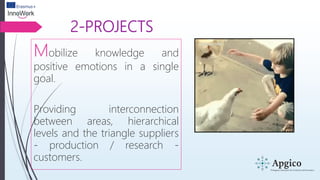
Mobilize knowledge and
positive emotions in a single
goal.
Providing interconnection
between areas, hierarchical
levels and the triangle suppliers
- production / research -
customers.
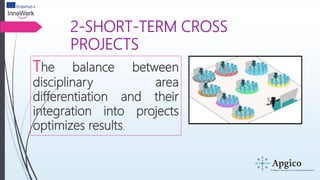
The balance between
disciplinary area
differentiation and their
integration into projects
optimizes results.
2-SHORT-TERM CROSS
PROJECTS
3-MANAGEMENT
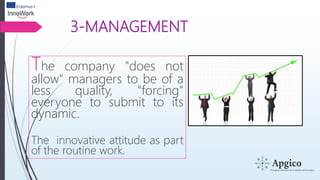
The company "does not
allow" managers to be of a
less quality, "forcing"
everyone to submit to its
dynamic.
The innovative attitude as part
of the routine work.
3- LEADERSHIP
Management has to be close
to the collaborators,
developing initiatives that will
increase their satisfaction and
commitment.
In order to innovate, people
need to work harder and
better.
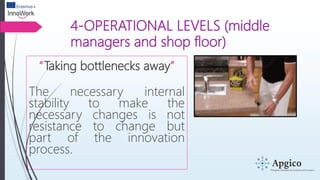
4-OPERATIONAL LEVELS (middle
managers and shop floor)
“Taking bottlenecks away”
The necessary internal
stability to make the
necessary changes is not
resistance to change but
part of the innovation
process.
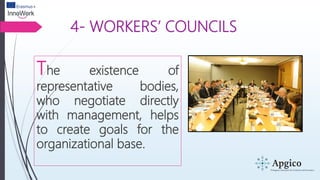
4- WORKERS’ COUNCILS
The existence of
representative bodies,
who negotiate directly
with management, helps
to create goals for the
organizational base.
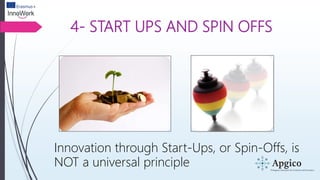
4- START UPS AND SPIN OFFS
Innovation through Start-Ups, or Spin-Offs, is
NOT a universal principle
5 - R&D
Innovation achieved in
R & D centers, may
have a secondary
character as to
innovation originated in
production.
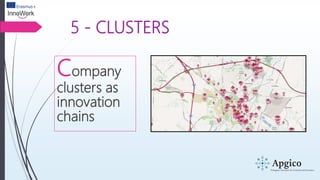
5 - CLUSTERS
Company
clusters as
innovation
chains
6 -ENVIRONMENTAL VARIABLES
Major
European and
world events
and their
influence on
companies
Fernando Sousa –fernando.sousa@apgico.pt
Address:
Rua José Fernandes Guerreiro, nº. 28, 1º. Dtº., 8100-598 Loulé.
Tel: (+351) 289 093 327
apgico@apgico.pt
www.apgico.pt
www.facebook.com@associacaoapgico

Innovations past and present