

Remote Sensing Applications in
the Coastal Environment
By Matthew Brigley and Natasha Fee
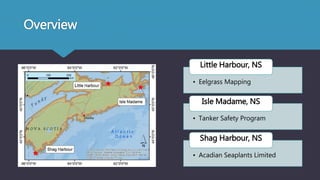
Overview
• Eelgrass Mapping
Little Harbour, NS
• Tanker Safety Program
Isle Madame, NS
• Acadian Seaplants Limited
Shag Harbour, NS
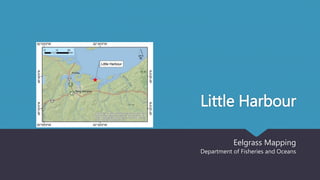
Little Harbour
Eelgrass Mapping
Department of Fisheries and Oceans
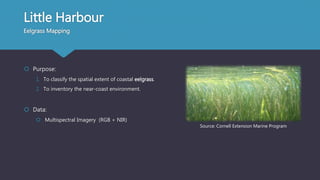
Little Harbour
Eelgrass Mapping
 Purpose:
1. To classify the spatial extent of coastal eelgrass.
2. To inventory the near-coast environment.
 Data:
 Multispectral Imagery (RGB + NIR)
Source: Cornell Extension Marine Program
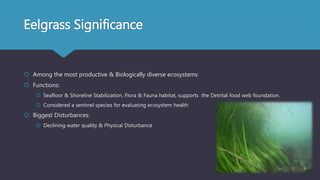
Eelgrass Significance
 Among the most productive & Biologically diverse ecosystems
 Functions:
 Seafloor & Shoreline Stabilization, Flora & Fauna habitat, supports the Detrital food web foundation.
 Considered a sentinel species for evaluating ecosystem health
 Biggest Disturbances:
 Declining water quality & Physical Disturbance
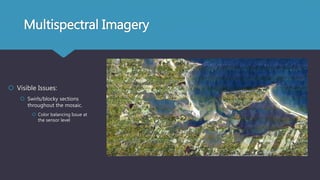
Multispectral Imagery
 Visible Issues:
 Swirls/blocky sections
throughout the mosaic.
 Color balancing Issue at
the sensor level
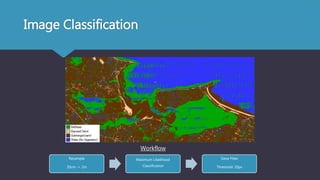
Image Classification
Resample
20cm -> 2m
Maximum Likelihood
Classification
Sieve Filter
Threshold: 20px
Workflow
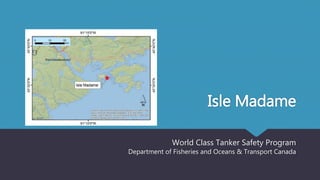
Isle Madame
World Class Tanker Safety Program
Department of Fisheries and Oceans & Transport Canada
Isle Madame
World Class Tanker Safety Program
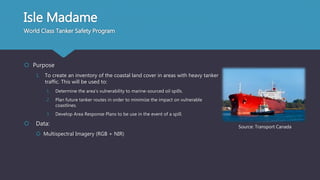
 Purpose
1. To create an inventory of the coastal land cover in areas with heavy tanker
traffic. This will be used to:
1. Determine the area’s vulnerability to marine-sourced oil spills.
2. Plan future tanker routes in order to minimize the impact on vulnerable
coastlines.
3. Develop Area Response Plans to be use in the event of a spill.
 Data:
 Multispectral Imagery (RGB + NIR)
Source: Transport Canada
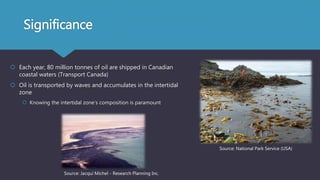
Significance
 Each year, 80 million tonnes of oil are shipped in Canadian
coastal waters (Transport Canada)
 Oil is transported by waves and accumulates in the intertidal
zone
 Knowing the intertidal zone’s composition is paramount
Source: National Park Service (USA)
Source: Jacqui Michel - Research Planning Inc.
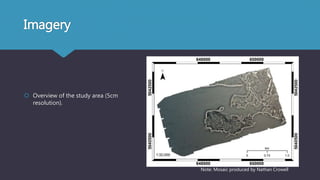
Imagery
 Overview of the study area (5cm
resolution).
Note: Mosaic produced by Nathan Crowell
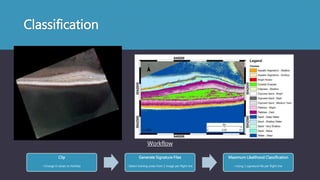
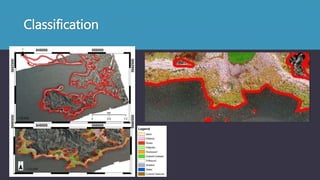
Classification
Clip
•Change 0 values to NoData
Generate Signature Files
•Select training areas from 1 image per flight line
Maximum Likelihood Classification
•Using 1 signature file per flight line
Workflow
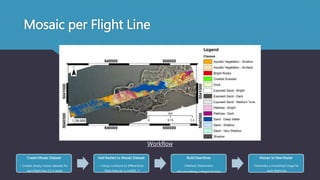
Mosaic per Flight Line
Create Mosaic Dataset
• Creates empty mosaic datasets for
each flight line (11 in total)
Add Rasters to Mosaic Dataset
• Using a wildcard to differentiate
flight lines (ie. o_ims001_*)
Build Seamlines
•Method: Radiometric
•No smoothing (categorical data)
Mosaic to New Raster
•Generates a mosaicked image for
each flight line
Workflow
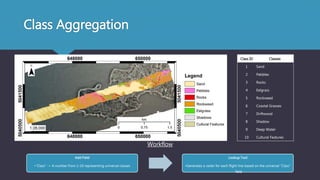
Class Aggregation
Add Field
•“Class” -> A number from 1-10 representing universal classes
Lookup Tool
•Generates a raster for each flight line based on the universal “Class”
field
Class ID Classes
1 Sand
2 Pebbles
3 Rocks
4 Eelgrass
5 Rockweed
6 Coastal Grasses
7 Driftwood
8 Shadow
9 Deep Water
10 Cultural Features
Workflow
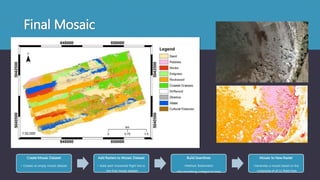
Final Mosaic
Create Mosaic Dataset
• Creates an empty mosaic dataset
Add Rasters to Mosaic Dataset
• Adds each mosaicked flight line to
the final mosaic dataset
Build Seamlines
•Method: Radiometric
•No smoothing (categorical data)
Mosaic to New Raster
•Generates a mosaic based on the
composite of all 11 flight lines
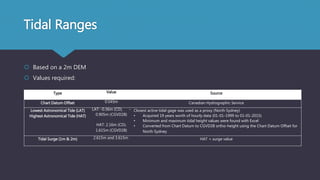
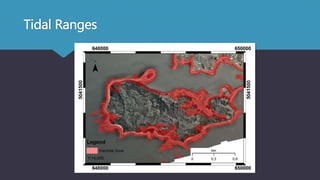
Tidal Ranges
 Based on a 2m DEM
 Values required:
Type Value Source
Chart Datum Offset 0.545m Canadian Hydrographic Service
Lowest Astronomical Tide (LAT)
Highest Astronomical Tide (HAT)
LAT: -0.36m (CD), -
0.905m (CGVD28)
HAT: 2.16m (CD),
1.615m (CGVD28)
Closest active tidal gage was used as a proxy (North Sydney)
• Acquired 19 years worth of hourly data (01-01-1999 to 01-01-2015)
• Minimum and maximum tidal height values were found with Excel
• Converted from Chart Datum to CGVD28 ortho-height using the Chart Datum Offset for
North Sydney
Tidal Surge (1m & 2m) 2.615m and 3.615m HAT + surge value
Tidal Ranges
Classification
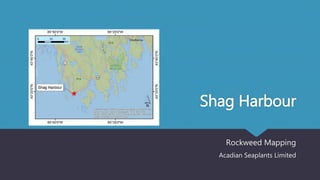
Shag Harbour
Rockweed Mapping
Acadian Seaplants Limited
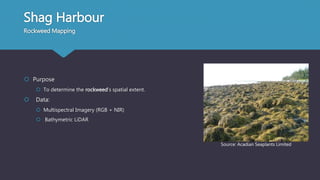
Shag Harbour
Rockweed Mapping
 Purpose
 To determine the rockweed’s spatial extent.
 Data:
 Multispectral Imagery (RGB + NIR)
 Bathymetric LiDAR
Source: Acadian Seaplants Limited
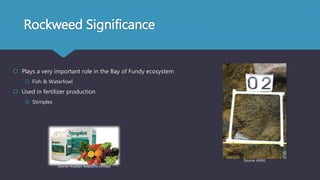
Rockweed Significance
 Plays a very important role in the Bay of Fundy ecosystem
 Fish & Waterfowl
 Used in fertilizer production
 Stimplex
Source: Acadian Seaplants Limited
Source: AGRG
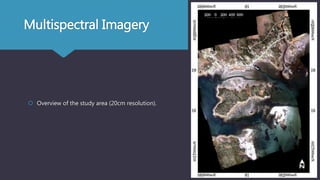
Multispectral Imagery
 Overview of the study area (20cm resolution).
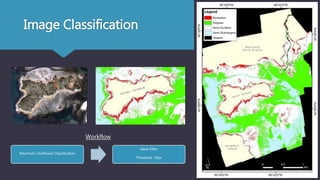
Image Classification
Maximum Likelihood Classification
Sieve Filter
Threshold: 20px
Workflow
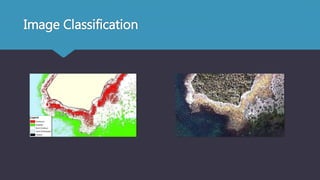
Image Classification
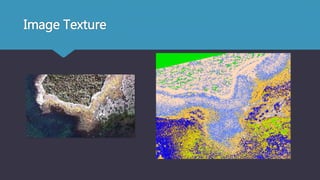
Image Texture
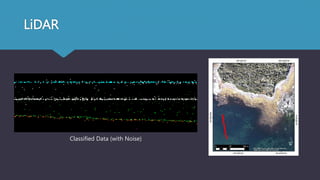
LiDAR
Classified Data (with Noise)
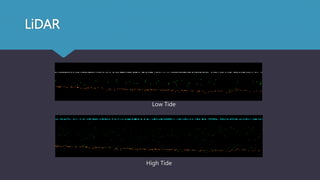
LiDAR
Low Tide
High Tide
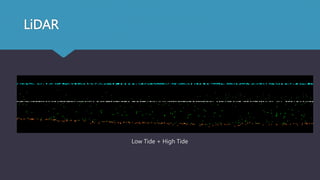
LiDAR
Low Tide + High Tide
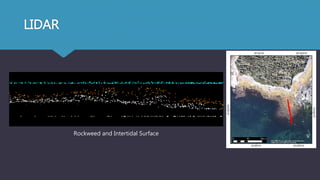
LIDAR
Rockweed and Intertidal Surface
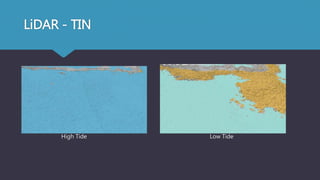
LiDAR - TIN
High Tide Low Tide
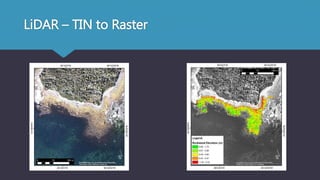
LiDAR – TIN to Raster
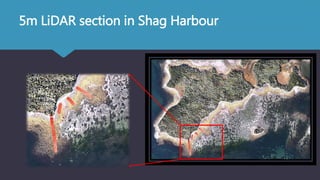
5m LiDAR section in Shag Harbour
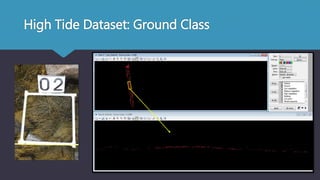
High Tide Dataset: Ground Class
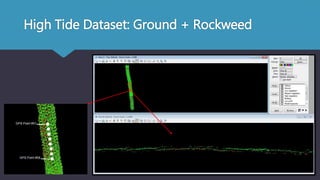
High Tide Dataset: Ground + Rockweed
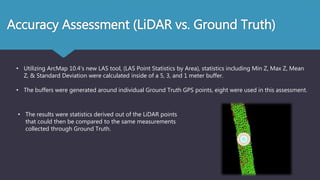
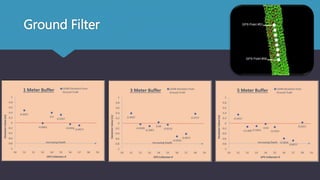
Accuracy Assessment (LiDAR vs. Ground Truth)
• Utilizing ArcMap 10.4’s new LAS tool, (LAS Point Statistics by Area), statistics including Min Z, Max Z, Mean
Z, & Standard Deviation were calculated inside of a 5, 3, and 1 meter buffer.
• The buffers were generated around individual Ground Truth GPS points, eight were used in this assessment.
• The results were statistics derived out of the LiDAR points
that could then be compared to the same measurements
collected through Ground Truth.
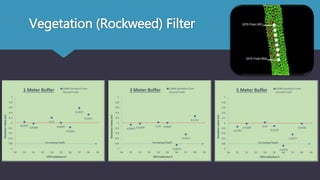
Vegetation (Rockweed) Filter
Ground Filter
Conclusions
 High resolution multispectral imagery can be a valuable asset to decision-makers
 Allows for the acquisition of surface data on a large scale
 More efficient than ground-based techniques
 Based off of the results comparing the Ground Truthing to the LiDAR collected:
 It’s plausible that just flying a high tide scan could provide the user with enough information to map the
inventory of coastal vegetation.
 More transects would have to be evaluated on accuracy and the ground class would have to be a bit more
refined.
Acknowledgement
 Special thanks to:
 AGRG for the opportunity, data, and guidance
 Canadian Hydrographic Service

Presentation: Fee & Brigley

  • 1.
    Remote Sensing Applicationsin the Coastal Environment By Matthew Brigley and Natasha Fee
  • 2.
    Overview • Eelgrass Mapping LittleHarbour, NS • Tanker Safety Program Isle Madame, NS • Acadian Seaplants Limited Shag Harbour, NS
  • 3.
  • 4.
    Little Harbour Eelgrass Mapping Purpose: 1. To classify the spatial extent of coastal eelgrass. 2. To inventory the near-coast environment.  Data:  Multispectral Imagery (RGB + NIR) Source: Cornell Extension Marine Program
  • 5.
    Eelgrass Significance  Amongthe most productive & Biologically diverse ecosystems  Functions:  Seafloor & Shoreline Stabilization, Flora & Fauna habitat, supports the Detrital food web foundation.  Considered a sentinel species for evaluating ecosystem health  Biggest Disturbances:  Declining water quality & Physical Disturbance
  • 6.
    Multispectral Imagery  VisibleIssues:  Swirls/blocky sections throughout the mosaic.  Color balancing Issue at the sensor level
  • 7.
    Image Classification Resample 20cm ->2m Maximum Likelihood Classification Sieve Filter Threshold: 20px Workflow
  • 8.
    Isle Madame World ClassTanker Safety Program Department of Fisheries and Oceans & Transport Canada
  • 9.
    Isle Madame World ClassTanker Safety Program  Purpose 1. To create an inventory of the coastal land cover in areas with heavy tanker traffic. This will be used to: 1. Determine the area’s vulnerability to marine-sourced oil spills. 2. Plan future tanker routes in order to minimize the impact on vulnerable coastlines. 3. Develop Area Response Plans to be use in the event of a spill.  Data:  Multispectral Imagery (RGB + NIR) Source: Transport Canada
  • 10.
    Significance  Each year,80 million tonnes of oil are shipped in Canadian coastal waters (Transport Canada)  Oil is transported by waves and accumulates in the intertidal zone  Knowing the intertidal zone’s composition is paramount Source: National Park Service (USA) Source: Jacqui Michel - Research Planning Inc.
  • 11.
    Imagery  Overview ofthe study area (5cm resolution). Note: Mosaic produced by Nathan Crowell
  • 12.
    Classification Clip •Change 0 valuesto NoData Generate Signature Files •Select training areas from 1 image per flight line Maximum Likelihood Classification •Using 1 signature file per flight line Workflow
  • 13.
    Mosaic per FlightLine Create Mosaic Dataset • Creates empty mosaic datasets for each flight line (11 in total) Add Rasters to Mosaic Dataset • Using a wildcard to differentiate flight lines (ie. o_ims001_*) Build Seamlines •Method: Radiometric •No smoothing (categorical data) Mosaic to New Raster •Generates a mosaicked image for each flight line Workflow
  • 14.
    Class Aggregation Add Field •“Class”-> A number from 1-10 representing universal classes Lookup Tool •Generates a raster for each flight line based on the universal “Class” field Class ID Classes 1 Sand 2 Pebbles 3 Rocks 4 Eelgrass 5 Rockweed 6 Coastal Grasses 7 Driftwood 8 Shadow 9 Deep Water 10 Cultural Features Workflow
  • 15.
    Final Mosaic Create MosaicDataset • Creates an empty mosaic dataset Add Rasters to Mosaic Dataset • Adds each mosaicked flight line to the final mosaic dataset Build Seamlines •Method: Radiometric •No smoothing (categorical data) Mosaic to New Raster •Generates a mosaic based on the composite of all 11 flight lines
  • 16.
    Tidal Ranges  Basedon a 2m DEM  Values required: Type Value Source Chart Datum Offset 0.545m Canadian Hydrographic Service Lowest Astronomical Tide (LAT) Highest Astronomical Tide (HAT) LAT: -0.36m (CD), - 0.905m (CGVD28) HAT: 2.16m (CD), 1.615m (CGVD28) Closest active tidal gage was used as a proxy (North Sydney) • Acquired 19 years worth of hourly data (01-01-1999 to 01-01-2015) • Minimum and maximum tidal height values were found with Excel • Converted from Chart Datum to CGVD28 ortho-height using the Chart Datum Offset for North Sydney Tidal Surge (1m & 2m) 2.615m and 3.615m HAT + surge value
  • 17.
  • 18.
  • 19.
  • 20.
    Shag Harbour Rockweed Mapping Purpose  To determine the rockweed’s spatial extent.  Data:  Multispectral Imagery (RGB + NIR)  Bathymetric LiDAR Source: Acadian Seaplants Limited
  • 21.
    Rockweed Significance  Playsa very important role in the Bay of Fundy ecosystem  Fish & Waterfowl  Used in fertilizer production  Stimplex Source: Acadian Seaplants Limited Source: AGRG
  • 22.
    Multispectral Imagery  Overviewof the study area (20cm resolution).
  • 23.
    Image Classification Maximum LikelihoodClassification Sieve Filter Threshold: 20px Workflow
  • 24.
  • 25.
  • 26.
  • 27.
  • 28.
  • 29.
  • 30.
    LiDAR - TIN HighTide Low Tide
  • 31.
    LiDAR – TINto Raster
  • 32.
    5m LiDAR sectionin Shag Harbour
  • 33.
    High Tide Dataset:Ground Class
  • 34.
    High Tide Dataset:Ground + Rockweed
  • 35.
    Accuracy Assessment (LiDARvs. Ground Truth) • Utilizing ArcMap 10.4’s new LAS tool, (LAS Point Statistics by Area), statistics including Min Z, Max Z, Mean Z, & Standard Deviation were calculated inside of a 5, 3, and 1 meter buffer. • The buffers were generated around individual Ground Truth GPS points, eight were used in this assessment. • The results were statistics derived out of the LiDAR points that could then be compared to the same measurements collected through Ground Truth.
  • 36.
  • 37.
  • 38.
    Conclusions  High resolutionmultispectral imagery can be a valuable asset to decision-makers  Allows for the acquisition of surface data on a large scale  More efficient than ground-based techniques  Based off of the results comparing the Ground Truthing to the LiDAR collected:  It’s plausible that just flying a high tide scan could provide the user with enough information to map the inventory of coastal vegetation.  More transects would have to be evaluated on accuracy and the ground class would have to be a bit more refined.
  • 39.
    Acknowledgement  Special thanksto:  AGRG for the opportunity, data, and guidance  Canadian Hydrographic Service