REMOTE SENSING 
APPLIED TO 
SEISMIC PLANNING
GENERAL INFORMATION REMOTE SENSING O&G STUDY 
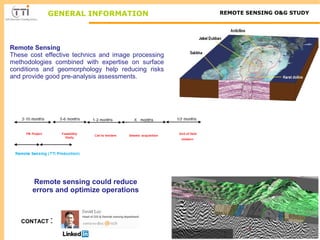
Remote Sensing 
These cost effective technics and image processing 
methodologies combined with expertise on surface 
conditions and geomorphology help reducing risks 
and provide good pre-analysis assessments. 
Remote sensing could reduce 
errors and optimize operations 
CONTACT :
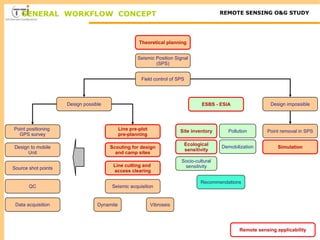
GENERAL WORKFLOW CONCEPT REMOTE SENSING O&G STUDY 
Theoretical planning 
Seismic Position Signal 
(SPS) 
Field control of SPS 
Design possible Design impossible 
Point positioning 
GPS survey 
Design to mobile 
Unit 
Source shot points 
QC 
Data acquisition 
Point removal in SPS 
Simulation 
Line pre-plot 
pre-planning 
Scouting for design 
and camp sites 
Line cutting and 
access clearing 
Seismic acquisition 
Dynamite Vibroseis 
ESBS - ESIA 
Site inventory 
Ecological 
sensitivity 
Socio-cultural 
sensitivity 
Pollution 
Demobilization 
Recommendations 
Remote sensing applicability
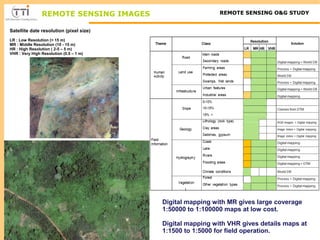
REMOTE SENSING IMAGES REMOTE SENSING O&G STUDY 
Satellite date resolution (pixel size) 
LR : Low Resolution (> 15 m) 
MR : Middle Resolution (10 - 15 m) 
HR : High Resolution ( 2-5 – 5 m) 
VHR : Very High Resolution (0.5 – 1 m) 
Digital mapping with MR gives large coverage 
1:50000 to 1:100000 maps at low cost. 
Digital mapping with VHR gives details maps at 
1:1500 to 1:5000 for field operation.
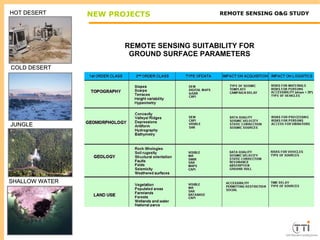
HHOOTT DDEESSEERRTT NEW PROJECTS REMOTE SENSING O&G STUDY 
CCOOLLDD DDEESSEERRTT 
JJUUNNGGLLEE 
SSHHAALLLLOOWW WWAATTEERR 
REMOTE SENSING SUITABILITY FOR 
GROUND SURFACE PARAMETERS
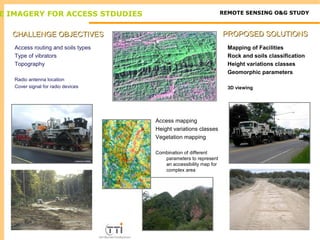
SATELLITE IMAGERY FOR ACCESS STDUDIES REMOTE SENSING O&G STUDY 
CCHHAALLLLEENNGGEE OOBBJJEECCTTIIVVEESS PPRROOPPOOSSEEDD SSOOLLUUTTIIOONNSS 
Access routing and soils types 
Type of vibrators 
Topography 
Radio antenna location 
Cover signal for radio devices 
Mapping of Facilities 
Rock and soils classification 
Height variations classes 
Geomorphic parameters 
3D viewing 
Access mapping 
Height variations classes 
Vegetation mapping 
Combination of different 
parameters to represent 
an accessibility map for 
complex area
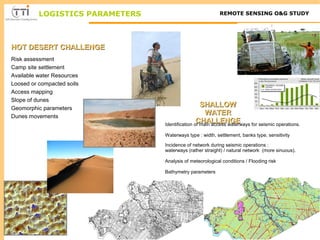
LOGISTICS PARAMETERS REMOTE SENSING O&G STUDY 
HHOOTT DDEESSEERRTT CCHHAALLLLEENNGGEE 
SSHHAALLLLOOWW 
WWAATTEERR 
CCHHAALLLLEENNGGEE 
Risk assessment 
Camp site settlement 
Available water Resources 
Loosed or compacted soils 
Access mapping 
Slope of dunes 
Geomorphic parameters 
Dunes movements 
Identification of main access waterways for seismic operations. 
Waterways type : width, settlement, banks type, sensitivity 
Incidence of network during seismic operations : 
waterways (rather straight) / natural network (more sinuous). 
Analysis of meteorological conditions / Flooding risk 
Bathymetry parameters
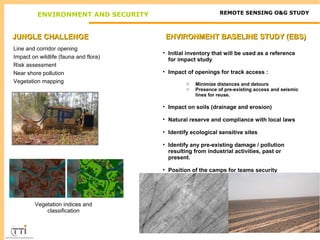
ENVIRONMENT AND SECURITY REMOTE SENSING O&G STUDY 
JJUUNNGGLLEE CCHHAALLLLEENNGGEE 
Line and corridor opening 
Impact on wildlife (fauna and flora) 
Risk assessment 
Near shore pollution 
Vegetation mapping 
Vegetation indices and 
classification 
EENNVVIIRROONNMMEENNTT BBAASSEELLIINNEE SSTTUUDDYY ((EEBBSS)) 
• Initial inventory that will be used as a reference 
for impact study 
• Impact of openings for track access : 
o Minimize distances and detours 
o Presence of pre-existing access and seismic 
lines for reuse. 
• Impact on soils (drainage and erosion) 
• Natural reserve and compliance with local laws 
• Identify ecological sensitive sites 
• Identify any pre-existing damage / pollution 
resulting from industrial activities, past or 
present. 
• Position of the camps for teams security
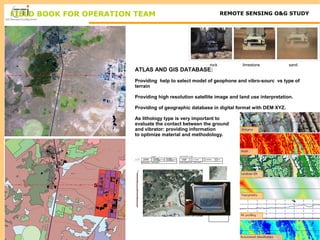
FIELD BOOK FOR OPERATION TEAM REMOTE SENSING O&G STUDY 
rock limestone sand 
ATLAS AND GIS DATABASE: 
Providing help to select model of geophone and vibro-sourc vs type of 
terrain 
Providing high resolution satellite image and land use interpretation. 
Providing of geographic database in digital format with DEM XYZ. 
As lithology type is very important to 
evaluate the contact between the ground 
and vibrator: providing information 
to optimize material and methodology.
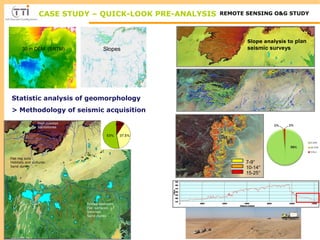
CASE STUDY – QUICK-LOOK PRE-ANALYSIS REMOTE SENSING O&G STUDY 
Statistic analysis of geomorphology 
> Methodology of seismic acquisition 
Flat reg soils 
Habitats and cultures 
Sand dunes 
Folded bedrocks 
Flat surfaces 
Sebkhas 
Sand dunes 
7-9° 
10-14° 
15-25° 
30 m DEM (SRTM) Slopes 
High cuestas 
Sandstones 
Slope analysis to plan 
seismic surveys
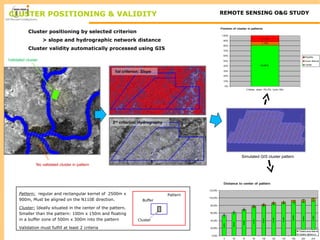
CLUSTER POSITIONING & VALIDITY REMOTE SENSING O&G STUDY 
Cluster positioning by selected criterion 
> slope and hydrographic network distance 
Cluster validity automatically processed using GIS 
1st criterion: Slope 
2nd criterion: Hydrography 
Pattern: regular and rectangular kernel of 2500m x 
900m, Must be aligned on the N110E direction. 
Cluster: Ideally situated in the center of the pattern. 
Smaller than the pattern: 100m x 150m and floating 
in a buffer zone of 500m x 300m into the pattern 
Validation must fulfill at least 2 criteria 
Simulated GIS cluster pattern 
Validated cluster 
No validated cluster in pattern 
Buffer 
Pattern 
Cluster
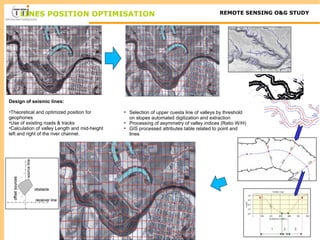
LINES POSITION OPTIMISATION REMOTE SENSING O&G STUDY 
Design of seismic lines: 
•Theoretical and optimized position for 
geophones 
•Use of existing roads & tracks 
•Calculation of valley Length and mid-height 
left and right of the river channel. 
• Selection of upper cuesta line of valleys by threshold 
on slopes automated digitization and extraction 
• Processing of asymmetry of valley indices (Ratio W/H) 
• GIS processed attributes table related to point and 
lines
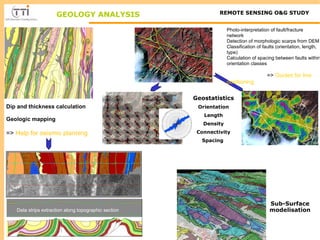
GEOLOGY ANALYSIS REMOTE SENSING O&G STUDY 
Dip and thickness calculation 
Geologic mapping 
=> Help for seismic planning 
Photo-interpretation of fault/fracture 
network 
Detection of morphologic scarps from DEM 
Classification of faults (orientation, length, 
type) 
Calculation of spacing between faults within 
orientation classes 
Geostatistics 
Orientation 
Length 
Density 
Connectivity 
Spacing 
Data strips extraction along topographic section 
=> Guides for line 
Sub-Surface 
modelisation 
positioning
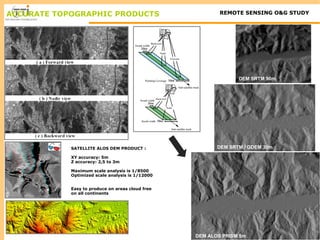
ACCURATE TOPOGRAPHIC PRODUCTS REMOTE SENSING O&G STUDY 
DEM SRTM 90m 
DEM SRTM / GDEM 30m 
DEM ALOS PRISM 5m 
SATELLITE ALOS DEM PRODUCT : 
XY accuracy: 5m 
Z accuracy: 2,5 to 3m 
Maximum scale analysis is 1/8500 
Optimized scale analysis is 1/12000 
Easy to produce on areas cloud free 
on all continents
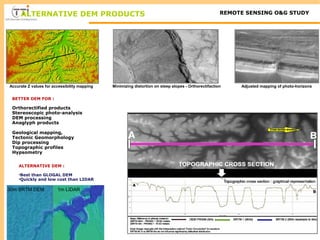
ALTERNATIVE DEM PRODUCTS REMOTE SENSING O&G STUDY 
Accurate Z values for accessibility mapping Minimizing distortion on steep slopes - Orthorectifaction Adjusted mapping of photo-horizons 
BETTER DEM FOR : 
Orthorectified products 
Stereoscopic photo-analysis 
DEM processing 
Anaglyph products 
Geological mapping, 
Tectonic Geomorphology 
Dip processing 
Topographic profiles 
Hypsometry 
ALTERNATIVE DEM : 
•Best than GLOGAL DEM 
•Quickly and low cost than LIDAR 
30m SRTM DEM 1m LIDAR
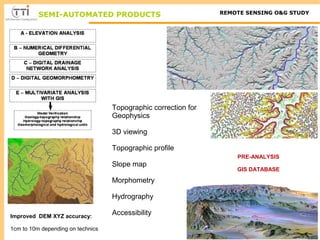
SEMI-AUTOMATED PRODUCTS REMOTE SENSING O&G STUDY 
Topographic correction for 
Geophysics 
3D viewing 
Topographic profile 
Slope map 
Morphometry 
Hydrography 
Improved DEM XYZ accuracy: Accessibility 
1cm to 10m depending on technics 
PRE-ANALYSIS 
GIS DATABASE
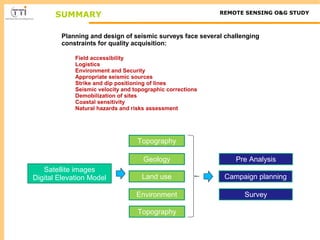
SUMMARY REMOTE SENSING O&G STUDY 
Planning and design of seismic surveys face several challenging 
constraints for quality acquisition: 
Field accessibility 
Logistics 
Environment and Security 
Appropriate seismic sources 
Strike and dip positioning of lines 
Seismic velocity and topographic corrections 
Demobilization of sites 
Coastal sensitivity 
Natural hazards and risks assessment 
Satellite images 
Digital Elevation Model 
Topography 
Geology 
Land use 
Environment 
Pre Analysis 
Topography 
Campaign planning 
Survey

Remote sensing applications for seismic planning

  • 1.
    REMOTE SENSING APPLIEDTO SEISMIC PLANNING
  • 2.
    GENERAL INFORMATION REMOTESENSING O&G STUDY Remote Sensing These cost effective technics and image processing methodologies combined with expertise on surface conditions and geomorphology help reducing risks and provide good pre-analysis assessments. Remote sensing could reduce errors and optimize operations CONTACT :
  • 3.
    GENERAL WORKFLOW CONCEPTREMOTE SENSING O&G STUDY Theoretical planning Seismic Position Signal (SPS) Field control of SPS Design possible Design impossible Point positioning GPS survey Design to mobile Unit Source shot points QC Data acquisition Point removal in SPS Simulation Line pre-plot pre-planning Scouting for design and camp sites Line cutting and access clearing Seismic acquisition Dynamite Vibroseis ESBS - ESIA Site inventory Ecological sensitivity Socio-cultural sensitivity Pollution Demobilization Recommendations Remote sensing applicability
  • 4.
    REMOTE SENSING IMAGESREMOTE SENSING O&G STUDY Satellite date resolution (pixel size) LR : Low Resolution (> 15 m) MR : Middle Resolution (10 - 15 m) HR : High Resolution ( 2-5 – 5 m) VHR : Very High Resolution (0.5 – 1 m) Digital mapping with MR gives large coverage 1:50000 to 1:100000 maps at low cost. Digital mapping with VHR gives details maps at 1:1500 to 1:5000 for field operation.
  • 5.
    HHOOTT DDEESSEERRTT NEWPROJECTS REMOTE SENSING O&G STUDY CCOOLLDD DDEESSEERRTT JJUUNNGGLLEE SSHHAALLLLOOWW WWAATTEERR REMOTE SENSING SUITABILITY FOR GROUND SURFACE PARAMETERS
  • 6.
    SATELLITE IMAGERY FORACCESS STDUDIES REMOTE SENSING O&G STUDY CCHHAALLLLEENNGGEE OOBBJJEECCTTIIVVEESS PPRROOPPOOSSEEDD SSOOLLUUTTIIOONNSS Access routing and soils types Type of vibrators Topography Radio antenna location Cover signal for radio devices Mapping of Facilities Rock and soils classification Height variations classes Geomorphic parameters 3D viewing Access mapping Height variations classes Vegetation mapping Combination of different parameters to represent an accessibility map for complex area
  • 7.
    LOGISTICS PARAMETERS REMOTESENSING O&G STUDY HHOOTT DDEESSEERRTT CCHHAALLLLEENNGGEE SSHHAALLLLOOWW WWAATTEERR CCHHAALLLLEENNGGEE Risk assessment Camp site settlement Available water Resources Loosed or compacted soils Access mapping Slope of dunes Geomorphic parameters Dunes movements Identification of main access waterways for seismic operations. Waterways type : width, settlement, banks type, sensitivity Incidence of network during seismic operations : waterways (rather straight) / natural network (more sinuous). Analysis of meteorological conditions / Flooding risk Bathymetry parameters
  • 8.
    ENVIRONMENT AND SECURITYREMOTE SENSING O&G STUDY JJUUNNGGLLEE CCHHAALLLLEENNGGEE Line and corridor opening Impact on wildlife (fauna and flora) Risk assessment Near shore pollution Vegetation mapping Vegetation indices and classification EENNVVIIRROONNMMEENNTT BBAASSEELLIINNEE SSTTUUDDYY ((EEBBSS)) • Initial inventory that will be used as a reference for impact study • Impact of openings for track access : o Minimize distances and detours o Presence of pre-existing access and seismic lines for reuse. • Impact on soils (drainage and erosion) • Natural reserve and compliance with local laws • Identify ecological sensitive sites • Identify any pre-existing damage / pollution resulting from industrial activities, past or present. • Position of the camps for teams security
  • 9.
    FIELD BOOK FOROPERATION TEAM REMOTE SENSING O&G STUDY rock limestone sand ATLAS AND GIS DATABASE: Providing help to select model of geophone and vibro-sourc vs type of terrain Providing high resolution satellite image and land use interpretation. Providing of geographic database in digital format with DEM XYZ. As lithology type is very important to evaluate the contact between the ground and vibrator: providing information to optimize material and methodology.
  • 10.
    CASE STUDY –QUICK-LOOK PRE-ANALYSIS REMOTE SENSING O&G STUDY Statistic analysis of geomorphology > Methodology of seismic acquisition Flat reg soils Habitats and cultures Sand dunes Folded bedrocks Flat surfaces Sebkhas Sand dunes 7-9° 10-14° 15-25° 30 m DEM (SRTM) Slopes High cuestas Sandstones Slope analysis to plan seismic surveys
  • 11.
    CLUSTER POSITIONING &VALIDITY REMOTE SENSING O&G STUDY Cluster positioning by selected criterion > slope and hydrographic network distance Cluster validity automatically processed using GIS 1st criterion: Slope 2nd criterion: Hydrography Pattern: regular and rectangular kernel of 2500m x 900m, Must be aligned on the N110E direction. Cluster: Ideally situated in the center of the pattern. Smaller than the pattern: 100m x 150m and floating in a buffer zone of 500m x 300m into the pattern Validation must fulfill at least 2 criteria Simulated GIS cluster pattern Validated cluster No validated cluster in pattern Buffer Pattern Cluster
  • 12.
    LINES POSITION OPTIMISATIONREMOTE SENSING O&G STUDY Design of seismic lines: •Theoretical and optimized position for geophones •Use of existing roads & tracks •Calculation of valley Length and mid-height left and right of the river channel. • Selection of upper cuesta line of valleys by threshold on slopes automated digitization and extraction • Processing of asymmetry of valley indices (Ratio W/H) • GIS processed attributes table related to point and lines
  • 13.
    GEOLOGY ANALYSIS REMOTESENSING O&G STUDY Dip and thickness calculation Geologic mapping => Help for seismic planning Photo-interpretation of fault/fracture network Detection of morphologic scarps from DEM Classification of faults (orientation, length, type) Calculation of spacing between faults within orientation classes Geostatistics Orientation Length Density Connectivity Spacing Data strips extraction along topographic section => Guides for line Sub-Surface modelisation positioning
  • 14.
    ACCURATE TOPOGRAPHIC PRODUCTSREMOTE SENSING O&G STUDY DEM SRTM 90m DEM SRTM / GDEM 30m DEM ALOS PRISM 5m SATELLITE ALOS DEM PRODUCT : XY accuracy: 5m Z accuracy: 2,5 to 3m Maximum scale analysis is 1/8500 Optimized scale analysis is 1/12000 Easy to produce on areas cloud free on all continents
  • 15.
    ALTERNATIVE DEM PRODUCTSREMOTE SENSING O&G STUDY Accurate Z values for accessibility mapping Minimizing distortion on steep slopes - Orthorectifaction Adjusted mapping of photo-horizons BETTER DEM FOR : Orthorectified products Stereoscopic photo-analysis DEM processing Anaglyph products Geological mapping, Tectonic Geomorphology Dip processing Topographic profiles Hypsometry ALTERNATIVE DEM : •Best than GLOGAL DEM •Quickly and low cost than LIDAR 30m SRTM DEM 1m LIDAR
  • 16.
    SEMI-AUTOMATED PRODUCTS REMOTESENSING O&G STUDY Topographic correction for Geophysics 3D viewing Topographic profile Slope map Morphometry Hydrography Improved DEM XYZ accuracy: Accessibility 1cm to 10m depending on technics PRE-ANALYSIS GIS DATABASE
  • 17.
    SUMMARY REMOTE SENSINGO&G STUDY Planning and design of seismic surveys face several challenging constraints for quality acquisition: Field accessibility Logistics Environment and Security Appropriate seismic sources Strike and dip positioning of lines Seismic velocity and topographic corrections Demobilization of sites Coastal sensitivity Natural hazards and risks assessment Satellite images Digital Elevation Model Topography Geology Land use Environment Pre Analysis Topography Campaign planning Survey