Emotional design
Design for emotions in the end user

Flin Nortier
We, as interaction designers,
are the future of expressivity
of organisations. This will be
more and more digital.
Interaction design
Interaction design

Concept

image: Koos Looijesteijn
Interaction design
Wireframes

Concept

image: Koos Looijesteijn
Interaction design
Wireframes

Graphic design +
copywriting
Interaction design
Graphic design +
copywriting

Programming
Interaction design
design
decisions

Concept

Wireframes

Graphic design
+ copy writing

Programming
The blind spot
•

From function to experience

Fulfilling functional needs

Fulfilling emotional needs
Functional needs
End users:
•

„I need a way to record audio”

•

„I need to buy this product”

•

„I need an overview of the creative industry in
Amsterdam”
Emotional needs
End users:
•

„I need to feel safe”

•

„I want to feel loved”

•

„I want to feel like a rich person”
Emotional needs
•

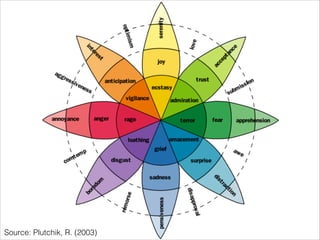
Basic human needs are pretty easy to predict

But emotions can be tricky:
•

Emotions are often complex and layered!
„Sad & hopeful”/„happy & surprised”/„grief & joy”

•

They can be hidden or latent
Source: Plutchik, R. (2003)
Emotional design
examples

Flitsmeister
Emotional design
examples

or?

Thriffty

Uber
Experience design
what is it?
Jared Spool says:

Aspired experience

Current experience
Experience design
why (financially)?
Pine & Gilmore say:
Experience design
how?

image: customerexperienceplanning.com
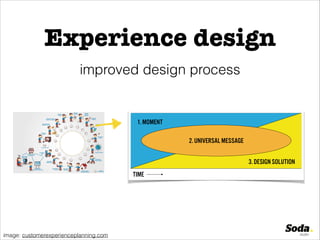
Missing step in the design
process: the message
1. MOMENT
2. UNIVERSAL MESSAGE
3. DESIGN SOLUTION
TIME
Model created by: Flin Nortier & Marco van Hout
Experience design
improved design process

1. MOMENT
2. UNIVERSAL MESSAGE
3. DESIGN SOLUTION
TIME

image: customerexperienceplanning.com
Emotional design
meeting the needs
1. Moment:

customer is awaiting delivery
of mobile phone

Details

Customer is anticipative/enthusiastic
about the product

Need: „I’m anxious to get hands-on”
Time until delivery is +- 2 weeks

Need: „I’m impatient”

image: customerexperienceplanning.com
Emotional design
meeting the needs
1 Moment: Customer is awaiting delivery of mobile phone
2. Response (universal message): 

attend: „have an appetizer”

confirm: „it’s underway”
3. Design solutions:

Send a confirmation / status update e-mail, show package status when
customer logs in.
Offer access to free sms service, premium content, online interactive
demo of mobile phone.
Customer Journey

image: customerexperienceplanning.com
Customer Journey

l needs
motiona
E
change

image: customerexperienceplanning.com
Emotional design
meeting the needs
1. Moment:

customer lost her mobile phone

2. Response: „we’re sorry for your loss”

„how can we help?”

„here’s a special offer for a
replacement”
3. Design solutions:

Send a heart warming e-mail/give a call and offer
options to help out.
!
image: customerexperienceplanning.com
Emotional Design Model
1. MOMENT
2. UNIVERSAL MESSAGE
3. DESIGN SOLUTION
TIME
Model created by: Flin Nortier & Marco van Hout
Emotional Design Model
before
1. Moment! 

describe the moment!
2. Design solutions

convert your responses to concrete design solutions
Emotional Design Model
after
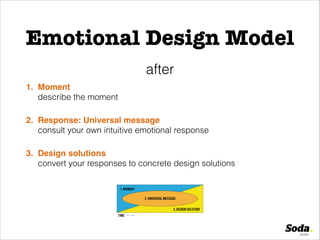
1. Moment! 

describe the moment
2. Response: Universal message

consult your own intuitive emotional response!
3. Design solutions

convert your responses to concrete design solutions
1. MOMENT
2. UNIVERSAL MESSAGE
3. DESIGN SOLUTION
TIME
Emotional Design Model

Message 1
Message 2
Message 3

2. Universal message

1. Moment

3. Design solution
1. MOMENT
2. UNIVERSAL MESSAGE
3. DESIGN SOLUTION
TIME
How?
1. Pick a moment in the customer journey
2. Explore this moment carefully!
•

via market-/usability research, role play, …

3. Formulate a universal message!
•

Look at your own intuitive emotional reaction!

•

Then discuss the universal message and refine for brand/
organisational values with the client.!

4. Create design solutions
Flin Nortier
flin@sodastudio.nl
www.sodastudio.nl
Click to feel

Emotional Design Presentation @ Design by Fire Café, Utrecht (English translation)