EMOTIONAL
   PRODUCT
       DESIGN
Why the difference in
      liking ???
It is no longer sufficient for a
product to function properly, to
  be usable and efficient or to
     have an aesthetic appeal
A product
  called
Telephone
Initially….
Just a means to
communicate through
    long distance
A few years later…
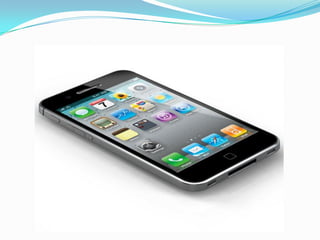
Then came the need
     for mobile
  communication
Today!!!

A phone means…
Why do we
LOVE or HATE
  things???
EMOTIONS
•   In customer behaviour there is a degree of
    emotional response to objects
•   Markets become flooded with products,
    consumers are overwhelmed with choice
•   In an effort to maximise their market potential
    company’s have to satisfy the user’s inner emotions
    to provide an increased likelihood of product
    purchase
•   Whiteley - “This is to decrease the wasteful nature
    of today’s ‘throw away’ society”
Influence of emotions in product
 design
•   Purchase
     • Why people desire a certain product
•   Use
     • Why attractive things work better
•   Attachment
     • How personalization affects the product
The X-factor : “I want it and I don’t know why”

•   Desire of consequence : appraisal of motive compliance
•   Desire of presence : appraisal of appealingness
•   Desire of identity : appraisal of legitimacy

All these three desires exert the “buy now” or “X-factor”
  influence

Desmet – “The product resonates with what we want to be or
 become, want to experience or own, and want to achieve or
 obtain”
Why attractive things work better???
As Norman states –

              “When we are happy your thought process
 expand, becoming more creative, more imaginative. i.e.
 attractive thing make you feel good”

              “Negative emotions kick in when there is a lack
 of understanding, when people feel frustrated and out of
 control – first uneasiness, then irritation, and, if the lack of
 control and understanding persists, even anger.”
Personalization
As Desment states –

     “Emotional attachment to products can
 encourage people not to discard a product”


Example – Apple offering free engravings on i-pods
 an i-phones
People can respond in a variety of ways to the same design
Design
  for
EMOTION
How do you establish and
  measure emotions ???


      THEORIES
Norman’s
three levels of design
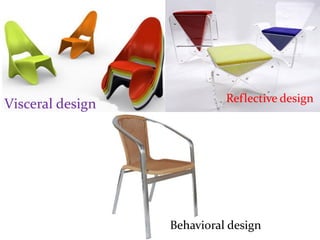
Visceral design
  Behavioral design
Reflective design
Visceral design
•   Visceral layer : pre-wired layer
•   Concerns itself with appearance
•    Customer says “I want it” before asking
    “how much it costs?” or “what does it do?”
•   Visceral level is incapable of reasoning
Behavioral design
•   Behavioral layer : layer that controls
    everyday behavior
•   Concerns with pleasure and effectiveness of
    use (functionality) of the product
•   Deals with experience ( function,
    performance, usability ) with the product
Reflective design
•   Reflective layer : contemplative layer
•   Concerns with the rationalization and
    intellectualization of the product , i.e. the
    self image and personal satisfaction the
    product provides
The three levels of design are interwoven
Reflective design
Visceral design


                  Behavioral design
Visceral design        Reflective design


   Behavioral design
Visceral design               Reflective design


          Behavioral design
Visceral design            Reflective design


       Behavioral design
A product
                called
              Telephone
( http://www.youtube.com/watch?v=jhoII3VzHZ0 )
Many other theories :
 •   Desmet’s model of product emotions
 •   Jordan’s pleasure model
 •   Forlizzi’s model
Measuring emotions ( PrEmo )
•   Desmet created a tool : PrEmo ( Product
    Emotional Measurement Instrument ) ,
    specifically for measuring the emotions
    elicited for a product appearance
•   Tool will be able to
    •   Work in different cultures
    •   Not require extensive equipment or technical
        expertise
    •   Measure product appearance emotions
    •   Measure mixed emotions
PrEmo comprises of 14 emotions :
  •   7 pleasant
  •   7 unpleasant
Participants rate emotions felt in 3 point scale :
  •   I do not feel the emotion expressed (lower part of the
      scale)
  •   I somehow feel the emotion expressed (middle part of
      the scale)
  •   I do feel the emotion expressed (upper part of the scale)
Facial expressions, movements and sounds
  produced help focus and objectify emotions
How can designers apply this knowledge?
•   To understand the concerns and focus of the user,
    designers must increase their user understanding;
    this methodology is known as user-centered design
•   Steve Jobs – “It’s really hard to design products by
    focus groups. A lot of times, people don’t know what
    they want until you show it to them”
•   User-centered methodology and a product emotion
    toolset helps designer’s move towards an aspiration
    to add emotional value to a product
References
•   The structure, influence and application of
    emotion in product design – Luke Woolfson
•   The field of design and emotion: Concepts,
    arguments, tools, and Current issues - Erdem
    Demir
•    Special Issue Editorial: Design & Emotion - Pieter
    M. A. Desmet and Paul Hekkert
•   Emotional design : why we love or hate things? –
    Donald A. Norman
Thank you !!!


   P. VAZAHAT FATIMA
     M.Des (Electronic Systems)
IIITD&M, Kancheepuram, TN, INDIA

Emotional design

  • 1.
    EMOTIONAL PRODUCT DESIGN
  • 4.
    Why the differencein liking ???
  • 5.
    It is nolonger sufficient for a product to function properly, to be usable and efficient or to have an aesthetic appeal
  • 6.
    A product called Telephone
  • 7.
  • 8.
    Just a meansto communicate through long distance
  • 9.
    A few yearslater…
  • 11.
    Then came theneed for mobile communication
  • 13.
  • 19.
    Why do we LOVEor HATE things???
  • 20.
  • 21.
    In customer behaviour there is a degree of emotional response to objects • Markets become flooded with products, consumers are overwhelmed with choice • In an effort to maximise their market potential company’s have to satisfy the user’s inner emotions to provide an increased likelihood of product purchase • Whiteley - “This is to decrease the wasteful nature of today’s ‘throw away’ society”
  • 22.
    Influence of emotionsin product design • Purchase • Why people desire a certain product • Use • Why attractive things work better • Attachment • How personalization affects the product
  • 23.
    The X-factor :“I want it and I don’t know why” • Desire of consequence : appraisal of motive compliance • Desire of presence : appraisal of appealingness • Desire of identity : appraisal of legitimacy All these three desires exert the “buy now” or “X-factor” influence Desmet – “The product resonates with what we want to be or become, want to experience or own, and want to achieve or obtain”
  • 24.
    Why attractive thingswork better??? As Norman states – “When we are happy your thought process expand, becoming more creative, more imaginative. i.e. attractive thing make you feel good” “Negative emotions kick in when there is a lack of understanding, when people feel frustrated and out of control – first uneasiness, then irritation, and, if the lack of control and understanding persists, even anger.”
  • 25.
    Personalization As Desment states– “Emotional attachment to products can encourage people not to discard a product” Example – Apple offering free engravings on i-pods an i-phones
  • 26.
    People can respondin a variety of ways to the same design
  • 27.
  • 28.
    How do youestablish and measure emotions ??? THEORIES
  • 29.
  • 30.
    Visceral design Behavioral design Reflective design
  • 31.
    Visceral design • Visceral layer : pre-wired layer • Concerns itself with appearance • Customer says “I want it” before asking “how much it costs?” or “what does it do?” • Visceral level is incapable of reasoning
  • 32.
    Behavioral design • Behavioral layer : layer that controls everyday behavior • Concerns with pleasure and effectiveness of use (functionality) of the product • Deals with experience ( function, performance, usability ) with the product
  • 33.
    Reflective design • Reflective layer : contemplative layer • Concerns with the rationalization and intellectualization of the product , i.e. the self image and personal satisfaction the product provides
  • 35.
    The three levelsof design are interwoven
  • 36.
  • 37.
    Visceral design Reflective design Behavioral design
  • 38.
    Visceral design Reflective design Behavioral design
  • 39.
    Visceral design Reflective design Behavioral design
  • 40.
    A product called Telephone ( http://www.youtube.com/watch?v=jhoII3VzHZ0 )
  • 41.
    Many other theories: • Desmet’s model of product emotions • Jordan’s pleasure model • Forlizzi’s model
  • 42.
    Measuring emotions (PrEmo ) • Desmet created a tool : PrEmo ( Product Emotional Measurement Instrument ) , specifically for measuring the emotions elicited for a product appearance • Tool will be able to • Work in different cultures • Not require extensive equipment or technical expertise • Measure product appearance emotions • Measure mixed emotions
  • 43.
    PrEmo comprises of14 emotions : • 7 pleasant • 7 unpleasant Participants rate emotions felt in 3 point scale : • I do not feel the emotion expressed (lower part of the scale) • I somehow feel the emotion expressed (middle part of the scale) • I do feel the emotion expressed (upper part of the scale) Facial expressions, movements and sounds produced help focus and objectify emotions
  • 45.
    How can designersapply this knowledge? • To understand the concerns and focus of the user, designers must increase their user understanding; this methodology is known as user-centered design • Steve Jobs – “It’s really hard to design products by focus groups. A lot of times, people don’t know what they want until you show it to them” • User-centered methodology and a product emotion toolset helps designer’s move towards an aspiration to add emotional value to a product
  • 46.
    References • The structure, influence and application of emotion in product design – Luke Woolfson • The field of design and emotion: Concepts, arguments, tools, and Current issues - Erdem Demir • Special Issue Editorial: Design & Emotion - Pieter M. A. Desmet and Paul Hekkert • Emotional design : why we love or hate things? – Donald A. Norman
  • 47.
    Thank you !!! P. VAZAHAT FATIMA M.Des (Electronic Systems) IIITD&M, Kancheepuram, TN, INDIA