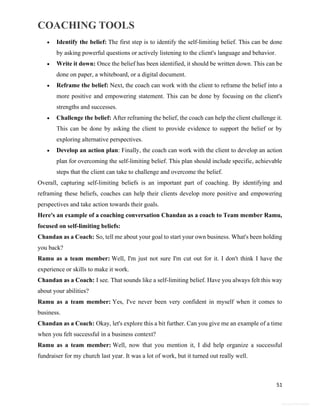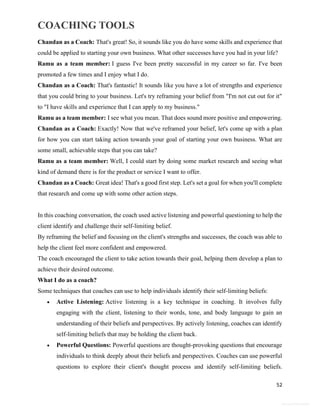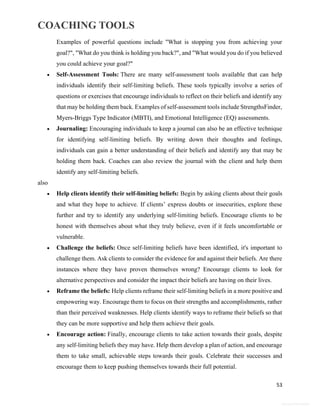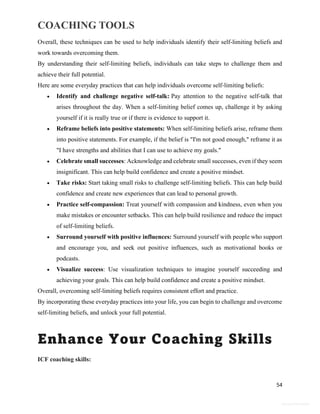
COACHING TOOLS
1
General Information
25 - Coaching
Tools for
Business
Transformation
By
Chandan Lal Patary
COACHING TOOLS
2
General Information
1.Appreciative Inquiry as a Coaching Tool
2.NLP Rapport as a Coaching Tool: How to use?
3.Affirmation as a Coaching Tool
4.Observation log as a Coaching Tool
5.Systems Thinking as a Coaching Tool
6.Reframing as a Coaching Tool!!
7.Thinking Error - A Coaching Tool
8.Hypothesis a Product Coaching Tool
9.Pain-gain Analysis a Product Coaching Tool
10. Heuristics a Tool for Product Coaching
11. Probing Question as a Coaching Tool
12. Ontological Coaching a Coaching Tool?
13. Coaching Tool - Self Limiting Belief
14. Growth Mindset — A Coaching Tool
15. Storytelling as a Coaching Tool
16. Inverted Drama Triangle as a Coaching Tool
17. Finding Purpose: A Coaching Tool
18. Force field Analysis a Product Coaching Tool
COACHING TOOLS
3
General Information
19. Knowing the constraints of the Coaching
context is an excellent Coaching tool!
20. Solution-Oriented questioning A coaching
Tool
21. The Ladder of Inference a Coaching Tool
22. Metaphor as a Coaching Tool
23. Psychological Safety a Coaching Tool
24. Mental Model as a coaching Tool
25. Virtual Whiteboards as a Coaching Tool
COACHING TOOLS
4
General Information
Appreciative Inquiry as a
Coaching Tool
[ Coaching Tools]
Appreciative Inquiry was used in a coaching feedback session:
July is a team leader who recently attended a coaching session with her coach, Samuel. During
the session, Samuel used Appreciative Inquiry to provide feedback to July on her leadership style.
Discovery Stage: Samuel started the session by asking July about her recent successes as a team
leader. July shared some recent examples of how she had successfully managed a project and
helped her team achieve their goals. Samuel listened carefully and asked open-ended questions to
help July identify the strengths and positive qualities that contributed to her success.
Dream Stage: Based on July's successes, Samuel then asked her to imagine what a perfect day as
a team leader would look like. July described a day where she would be able to communicate
effectively with her team, delegate tasks confidently, and achieve her goals while maintaining a
positive and supportive team culture.
Design Stage: Samuel then asked July to identify the strategies she could use to make her perfect
day a reality. July identified specific actions she could take to improve her communication with
her team, delegate tasks more effectively, and foster a positive team culture.
Destiny Stage: In the final stage, Samuel encouraged July to implement the strategies and plans
developed in the previous stages. He also helped her set up accountability measures, such as
progress tracking and regular check-ins to ensure that she was making progress towards her goals.
Using Appreciative Inquiry, Samuel was able to provide feedback to July in a positive and
empowering way.
By focusing on her strengths and successes, he was able to help her identify the qualities and
behaviors that contributed to her success and create a plan to build on those strengths to achieve
her goals.
While Appreciative Inquiry can be a valuable coaching tool, there are some challenges that coaches
may face when using this approach:
COACHING TOOLS
5
General Information
Limited scope: Appreciative Inquiry focuses on strengths and positive qualities, which may not
always be sufficient to address all the issues that a coaching client is facing. Sometimes, a more
balanced approach that also addresses weaknesses and challenges may be necessary.
Overemphasis on positivity: Similar to the organizational context, there can be a risk of
overemphasizing positivity in coaching sessions. While it's important to focus on strengths and
positive qualities, it's also important to acknowledge and address areas that need improvement.
Resistance to change: Clients may resist change, even when the focus is on strengths and positive
qualities. It's important for coaches to acknowledge and address this resistance while also
providing support and encouragement for the change process.
Lack of clarity: Like in organizational settings, the Appreciative Inquiry process can sometimes
be vague or abstract, and clients may struggle to understand how it can be applied to their specific
situations. It's important for coaches to provide clear guidance and support throughout the process.
Time and resource-intensive: Appreciative Inquiry can be a time and resource-intensive process,
especially in coaching sessions with limited time. Coaches may need to be creative in how they
use the process and may need to adapt it to fit the client's needs and situation.
Overall, while there may be challenges with using Appreciative Inquiry as a coaching tool, it can
be an effective approach to help clients identify and build on their strengths to achieve positive
change.
Coaches can overcome these challenges by adapting the process to fit the client's needs, providing
clear guidance and support, and balancing positivity with a realistic assessment of challenges and
weaknesses.
To apply Appreciative Inquiry in coaching conversations, coaches should prepare by taking the
following steps:
Identify the coaching goals: Before using Appreciative Inquiry, coaches should clarify the
coaching goals with their clients. This will help them understand what the client wants to achieve
and how Appreciative Inquiry can be used to support their goals.
Define the topic for inquiry: Coaches should help their clients define the specific topic for
inquiry. This will help them focus the inquiry process and ensure that it is relevant to the client's
goals.
COACHING TOOLS
6
General Information
Conduct research: Coaches should conduct research on the topic to identify relevant examples of
strengths and positive qualities related to the topic. This research can include interviews, surveys,
and other sources of information.
Plan the inquiry process: Coaches should plan the inquiry process, including the questions to be
asked, the format of the conversation, and the desired outcomes. They should also prepare to
handle any challenges that may arise during the process.
Set the stage: Coaches should set the stage for the inquiry process by creating a positive and safe
environment for the conversation. This can include setting ground rules, creating a comfortable
physical space, and establishing trust and rapport with the client.
Facilitate the conversation: During the conversation, coaches should use open-ended questions
to encourage the client to share their experiences, strengths, and positive qualities related to the
topic. They should listen actively and provide positive feedback to reinforce the client's positive
qualities and achievements.
Help the client create an action plan: Based on the insights gained from the inquiry process,
coaches should help their clients create an action plan to achieve their coaching goals. This plan
should be focused on building on the client's strengths and positive qualities.
By following these steps, coaches can effectively apply Appreciative Inquiry in coaching
conversations and help their clients achieve positive change.
Here's an example of a coaching conversation related to implementing Appreciative Inquiry in
real-time:
Coach: Hi, how are you today?
Coachee: I'm feeling a bit stuck with my team. We've been having trouble collaborating
effectively.
Coach: I see. Have you considered using Appreciative Inquiry to address this issue?
Coachee: No, I'm not familiar with that approach. Can you explain it to me?
Coach: Sure. Appreciative Inquiry is a method of organizational development that focuses on
identifying and building on the strengths of individuals and organizations, rather than fixing
weaknesses. It involves asking positive, open-ended questions to encourage a shift in mindset from
problem-focused to solution-focused.
Coachee: That sounds interesting. How can we apply it to our team?
COACHING TOOLS
7
General Information
Coach: Well, we could start by asking questions that focus on what's working well within the team.
For example, we could ask everyone to share a time when they felt most engaged and motivated
while working with the team.
Coachee: Okay, I see. So, we're trying to focus on the positive aspects of our team and build on
those?
Coach: Yes, exactly. By identifying what's already working well, we can build on those strengths
and find ways to improve collaboration and communication.
Coachee: That makes sense. How can we keep this approach going beyond just one conversation?
Coach: One way to do this is to identify specific action items that can be taken based on the positive
aspects we've identified. For example, if we find that communication is a strength within the team,
we can identify ways to further improve communication and ensure that it continues to be a
strength.
Coachee: Okay, I think I understand. So, we're not just talking about our strengths, but actually
taking action to build on them.
Coach: Yes, exactly. By focusing on what's working well and building on those strengths, we can
create a more positive and effective team dynamic.
NLP Rapport as a Coaching
Tool: How to use?
In one of the huge programs, he is involved with, James was finding it difficult to collaborate with
so many different team members.
He should intensively practice NLP Rapport, according to his coach Charu.
Rapport is a term used to describe the sense of connection or understanding that occurs between
people in communication. It is the ability to establish and maintain a positive and productive
relationship with others, based on mutual trust and respect.
Rapport involves matching and mirroring the other person's communication style, such as
their tone of voice, body language, and language patterns, to establish a sense of familiarity and
trust.
COACHING TOOLS
8
General Information
This technique can help create a sense of harmony and mutual understanding, which can improve
the quality of communication and ultimately lead to better outcomes.
NLP Rapport is a valuable tool for anyone looking to build better relationships, whether in
personal or professional contexts.
James intended to practice rapport in one of the upcoming interviews with Sagar who is an
Architect for the program.
James realized that by matching Sagar's communication style, he could establish a connection
with him and build rapport. He began to prepare for the interview by practicing her mirroring
skills, paying attention to his tone of voice, body language, and language patterns.
As soon as James met Sagar, he started matching his communication style. He mirrored his
confident tone of voice, his relaxed posture, and his use of industry jargon. He also listened
carefully to what he said and used similar language and terminology to show that he understood
his perspective.
Throughout the interview, James and Sagar had an excellent rapport. They spoke freely and
openly, and James felt that they were on the same page. He left the interview feeling positive and
confident about the work.
James realized that rapport is the foundation of all successful communication and that it is
essential for building trust and understanding between people.
James further applies mirror and match the communication style of his clients to establish a
connection with them and build rapport.
James mirrored their body language, tone of voice, and language patterns, and he listened
carefully to what they said.
To his surprise, the client responded positively to James's approach. They seemed more engaged
and open, and they even shared some personal details about their life.
James felt that he had built a strong rapport with the client, and he left the meeting feeling
optimistic about his chances of closing the deal.
In order to use NLP Rapport effectively, James realized that it is important to prepare and practice
these skills. Here are some steps he shared with his other colleagues:
 Study NLP: Learn the basics of NLP and how it can be used to build rapport. There are
many resources available online or in books that can teach you the fundamentals of NLP.
COACHING TOOLS
9
General Information
 Observe Others: Start paying attention to the communication styles of others. Observe
their body language, tone of voice, and language patterns.
 Practice Mirroring: Practice mirroring the communication style of others. This involves
matching their body language, tone of voice, and language patterns. You can practice with
friends or family members or even by watching videos of others speaking.
 Listen Carefully: Listen carefully to what others are saying. Pay attention to their choice
of words, phrases, and expressions. This will help you to match their communication style
more effectively.
 Be Authentic: Remember to be authentic in your communication. NLP Rapport is not
about mimicking others but rather about building a connection based on understanding and
respect. It is important to be true to yourself while also matching the communication style
of others.
While NLP Rapport can be a powerful tool for building strong connections and achieving success
in personal and professional settings, there are also some challenges that come with it. Here are a
few common challenges to keep in mind:
 Over-reliance on Mirroring: Some people may focus too much on mirroring the
communication style of others and forget to be authentic in their own communication. It is
important to find a balance between matching the communication style of others and being
true to yourself.
 Cultural Differences: Different cultures have different communication styles, and what
works in one culture may not work in another. It is important to be aware of cultural
differences and to adapt your communication style accordingly.
 Misinterpretation: NLP Rapport involves listening carefully to others and matching their
communication style. However, there is always the risk of misinterpreting what someone
is saying or misunderstanding their communication style. It is important to clarify and
confirm your understanding to avoid miscommunication.
 Resistance: Some people may resist attempts to build rapport, either because they are not
comfortable with the approach or because they are skeptical of the intent. It is important to
respect others' boundaries and to adapt your communication style to build trust and
understanding.
COACHING TOOLS
10
General Information
Overall, NLP Rapport can be a powerful tool for building strong connections and achieving
success, but it requires practice, patience, and adaptability. By being aware of the challenges and
working to overcome them, we can use NLP Rapport effectively and build meaningful
relationships with others.
Rapport will not help us when we try to
Control Others: Building rapport does not give you control over others. It is important to respect
others' autonomy and to use rapport to build mutual trust and understanding, rather than to
manipulate or control them.
Guarantee Positive Outcomes: Building rapport is not a guarantee of success in all situations.
There are many factors that contribute to success, and building rapport is just one of them. It is
important to approach each situation with a clear goal and a flexible mindset.
Fix Deep-seated Conflicts: Building rapport can help to improve communication and build
understanding, but it may not be enough to resolve deep-seated conflicts or long-standing issues.
In some cases, it may be necessary to seek professional help or to take other steps to address the
underlying issues.
Replace Authenticity: Building rapport should not come at the expense of authenticity. It is
important to be true to yourself and to communicate in a way that feels natural and genuine.
Focusing too much on mirroring others' communication styles can lead to inauthentic
communication and may actually harm rapport-building efforts.
Affirmation as a coaching tool
[Coaching Tool]
Affirmations are positive statements that are repeated to oneself in order to reprogram one's
thought patterns and beliefs.
They can be used to help overcome limiting beliefs, increase self-confidence, and develop a more
positive mindset.
By repeating affirmations regularly, you can rewire your brain to think more positively and
develop a growth mindset.
Affirmations can help you focus on your strengths and capabilities, rather than your weaknesses
and limitations.
COACHING TOOLS
11
General Information
Both negative and positive affirmations can influence us, but research suggests that negative
affirmations can have a stronger impact on our thoughts, feelings, and behaviors.
Negative affirmations are statements that reinforce negative beliefs and self-talk, such as "I can't
do this," "I'm not good enough," or "I always mess things up."
These affirmations can create self-doubt, lower self-esteem, and contribute to a negative mindset.
Positive affirmations, on the other hand, are statements that reinforce positive beliefs and self-
talk, such as "I am capable," "I am worthy of success," or "I am loved." These affirmations can
promote self-confidence, self-esteem, and a positive mindset.
While both types of affirmations can impact us, negative affirmations can be more powerful and
pervasive.
This is because our brains are wired to focus on negative stimuli as a way of protecting us from
potential threats.
This means that negative affirmations can have a stronger impact on our thoughts, emotions, and
behavior.
However, with consistent practice, positive affirmations can help counteract negative self-talk and
reprogram our brains to focus on the positive.
By using positive affirmations regularly, we can cultivate a more positive mindset, increase self-
confidence, and achieve our goals more easily.
Here are some tips for using affirmations as a coaching tool for self-development:
· Choose affirmations that resonate with you and align with your goals.
· Repeat your affirmations daily, ideally multiple times per day.
· Use visualization techniques to help you connect with the feeling of your affirmations.
· Use affirmations to reframe negative self-talk and limiting beliefs.
· Be patient and persistent - it can take time to see the benefits of using affirmations.
What we can do is....
Choose positive affirmations: The affirmations you choose should be positive, present tense, and
in the first person. For example, instead of saying "I will be successful", say "I am successful".
Believe in your affirmations: You must believe in the affirmations you use. You need to feel that
they are true and achievable. If you don't believe in them, they won't be effective.
Repeat affirmations often: Repeat your affirmations every day, ideally several times a day.
Repetition is key to programming your subconscious mind.
COACHING TOOLS
12
General Information
Use affirmations to overcome negative self-talk: When negative thoughts pop up, use
affirmations to counter them. For example, if you start thinking "I'm not good enough", use an
affirmation like "I am capable and confident".
Visualize your affirmations: Imagine yourself living out the affirmations you've chosen.
Visualize yourself as the person you want to be, doing the things you want to do.
Monitor your progress: Keep track of your progress and celebrate your successes. Seeing the
progress, you're making will help reinforce the power of affirmations and motivate you to continue
using them.
How team have used this technique
Once upon a time, there was a team of software developers working on a complex project. The
team had been struggling with communication issues and missed deadlines, which led to low
morale and frustration among team members.
The team leader, John, decided to try using affirmations to help boost team morale and improve
communication. He encouraged team members to choose positive affirmations that resonated with
them, such as "I am a valuable team member" and "I communicate effectively with my team".
At first, some team members were skeptical of the idea. However, John encouraged them to give
it a try, emphasizing the power of positive thinking and the impact it could have on team dynamics.
The team started incorporating affirmations into their daily routines. They would repeat their
affirmations individually and as a group during team meetings. They even created a wall where
they posted their affirmations to serve as a visual reminder of their goals and intentions.
Over time, the team began to notice a shift in their dynamics. Communication improved, and team
members started collaborating more effectively. They started celebrating each other's successes
and supporting each other during challenging times.
The team's productivity increased, and they were able to meet their deadlines. As a result, morale
and job satisfaction among team members improved significantly.
John was delighted to see the positive impact that affirmations had on his team. He continued to
encourage their use, and eventually, other teams in the company started adopting the practice as
well.
Thanks to the power of affirmations, the software development team was able to overcome their
communication challenges and work together effectively. Their story serves as a reminder of the
benefits of positive thinking and the impact it can have on team dynamics and productivity.
COACHING TOOLS
13
General Information
Using affirmations for software product development can be a helpful way to focus your
mindset and stay motivated.
Here are some tips on how to use affirmations for software product development:
Choose affirmations that align with your software product goals: Your affirmations should be
specific to your software product development goals.
For example, if you want to create a user-friendly product, you might use affirmations like "I
create user-friendly designs" or "I prioritize the user experience in my product development".
Repeat affirmations often: Repeat your affirmations daily, ideally several times a day. This will
help reinforce the positive mindset and keep you motivated.
Use affirmations to overcome obstacles: Use affirmations to help you overcome obstacles and
challenges in your software product development. For example, if you're struggling with a coding
challenge, you might use an affirmation like "I am a problem solver and I can overcome this
challenge".
Visualize your affirmations: Visualize your product development goals and imagine yourself
achieving them. This can help you stay focused and motivated.
Share affirmations with your team: Share affirmations with your development team to create a
positive and supportive environment. This can help keep everyone motivated and working towards
the same goals.
Celebrate progress: Celebrate the progress you make towards your software product
development goals. This can help reinforce the positive mindset and motivate you to continue
using affirmations.
Using affirmations in these ways can help you and your team stay focused and motivated during
the software product development process. With consistent practice, affirmations can help you
achieve your software development goals and create a successful product
Here are some questions we can ask yourself to maximize the usage of affirmations:
· Are my affirmations specific to my goals? - Make sure that your affirmations are specific to
the goals you want to achieve.
· Are my affirmations positive and in the present tense? - Your affirmations should be positive
and in the present tense. This reinforces the belief that you already possess the qualities you want
to develop.
COACHING TOOLS
14
General Information
· Do my affirmations resonate with me? - Your affirmations should feel true and resonate with
you on a deep level. If they don't, consider changing them.
· Am I using my affirmations consistently? - Consistent use of affirmations is key to their
effectiveness. Make sure you are using them regularly, even if it's just a few minutes a day.
· Am I visualizing my affirmations? - Visualization can enhance the effectiveness of
affirmations. Picture yourself achieving your goals while repeating your affirmations.
· Am I tracking my progress? - Keep track of your progress towards your goals. Celebrate your
successes and use setbacks as opportunities to adjust and refine your affirmations.
· Am I using affirmations in combination with other techniques? - Affirmations work best
when used in combination with other techniques such as visualization, goal-setting, and positive
self-talk.
By asking yourself these questions, you can maximize the effectiveness of your affirmations and
achieve your goals more quickly and easily.
Observation log as a Coaching
tool
Using an observation log as a coaching tool can be an effective way to track progress and provide
targeted feedback to individuals or teams.
An observation log is a document that outlines specific areas or skills that need improvement, and
it is used to record observations of a person's behavior or performance over time.
As a coaching tool, an observation log can be used to identify areas of strength and weakness, set
goals for improvement, and track progress over time. The coach or manager can observe the
individual or team in action and provide feedback on specific behaviors or actions that need to be
improved.
By using an observation log, the coach or manager can provide more targeted and actionable
feedback that is specific to the individual's or team's needs. This can help to improve performance,
increase motivation, and build confidence.
COACHING TOOLS
15
General Information
Additionally, an observation log can be used as a tool for self-reflection. Individuals can use the
log to track their own progress and identify areas where they need to improve. This can help to
increase self-awareness and promote self-directed learning.
Overall, an observation log can be a powerful coaching tool when used effectively. It can help to
identify areas of strength and weakness, set goals for improvement, and track progress over time.
Observation logs can be a powerful tool for enhancing a team's productivity through group
coaching.
Here are some ways that observation logs can be used to achieve this goal:
Identify areas of improvement: By using an observation log, the coach can identify specific areas
where the team needs to improve. This can be based on observations of the team's performance,
as well as feedback from other team members or stakeholders. Once these areas have been
identified, the coach can work with the team to develop targeted strategies to improve performance.
Promote accountability: Observation logs can help to promote accountability among team
members. By tracking progress over time, team members can see how their performance is
improving and take ownership of their own development. This can also help to foster a sense of
shared responsibility among team members, as they work together to achieve common goals.
Encourage collaboration: By using observation logs as a group coaching tool, the coach can
encourage collaboration among team members. The coach can facilitate group discussions around
areas of improvement, allowing team members to share their own observations and insights. This
can help to promote a culture of open communication and collaboration, which can enhance
productivity.
Set goals: Observation logs can be used to set specific goals for the team. These goals can be based
on areas of improvement identified through the observation log and can be tailored to the team's
specific needs. By setting goals, the team can work together towards a common objective, which
can enhance motivation and productivity.
Track progress: Finally, observation logs can be used to track the team's progress over time. This
can help the coach to evaluate the effectiveness of the coaching strategies being used, and to make
adjustments as needed. By tracking progress, the team can see how their performance is improving
and stay motivated to continue working towards their goals.
Overall, observation logs can be a powerful tool for enhancing a team's productivity through group
coaching.
COACHING TOOLS
16
General Information
By identifying areas of improvement, promoting accountability, encouraging collaboration, setting
goals, and tracking progress, coaches can help teams to achieve their full potential.
How this tool has been used in a team setup? an example
A software development team was struggling to meet their project deadlines. The team's coach
noticed that the team was spending a lot of time on meetings and emails, which was taking away
from their coding time. The coach decided to use an observation log to track the team's activities
over a two-week period.
After reviewing the observation log, the coach noticed that the team was spending a significant
amount of time in meetings that were not directly related to their project work. Additionally, team
members were spending a lot of time on email communication, which often led to lengthy and
unnecessary discussions.
Based on these observations, the coach suggested several changes to the team. First, the coach
recommended that the team prioritize project-related meetings over other meetings. Second, the
coach suggested that team members limit their email communication and use instant messaging
or phone calls instead, when appropriate.
The coach worked with the team to implement these changes and tracked their progress over time
using the observation log. The team was initially hesitant to change their habits, but after seeing
the benefits of the new approach, they quickly adapted. The team was able to significantly increase
their coding time, and as a result, they were able to complete their project on time.
Through the use of the observation log, the coach was able to identify areas for improvement and
provide targeted feedback to the team. By implementing the suggested changes, the team was able
to improve their productivity and achieve their project goals. The coach's use of the observation
log was instrumental in bringing about positive change for the team.
Some of the challenges that can arise when using observation logs for coaching:
Bias: The coach's personal bias can influence their observations and feedback. It is important for
the coach to remain objective and focused on the behavior being observed, rather than making
assumptions or judgments based on their own beliefs or experiences.
Incomplete data: Observation logs are based on the coach's observations, which may not capture
all aspects of the behavior being observed. There may be additional factors or behaviors that the
coach is not aware of, which can impact the accuracy of the observations.
COACHING TOOLS
17
General Information
Resistance: The person being observed may feel uncomfortable or resistant to the process, which
can affect the accuracy and usefulness of the observations. They may also feel defensive or
unwilling to accept feedback, which can hinder the coaching process.
Time-consuming: Observation logs require a significant amount of time and effort to maintain,
especially if the coach is observing multiple behaviors or individuals. This can be challenging for
coaches who have limited time or resources.
Limited context: Observation logs may not provide a complete picture of the behavior being
observed, as they may not capture the context or underlying factors that are contributing to the
behavior. This can make it difficult for coaches to provide targeted feedback and suggestions for
improvement.
Overall, observation logs can be a valuable coaching tool, but they require careful planning and
execution to be effective.
Coaches need to be aware of the potential challenges and work to minimize bias, gather complete
data, address resistance, manage time effectively, and consider the context of the behaviors being
observed.
Some general guidelines and elements that could be included:
· Date and time: Record the date and time of the observation.
· Description of the behavior: Write a brief description of the behavior being observed. Be as
specific as possible and use clear language.
· Context: Record any relevant contextual information, such as the location or setting where the
behavior occurred, the people involved, and any external factors that may be influencing the
behavior.
· Frequency and duration: Record the frequency and duration of the behavior being observed.
· Observations: Write down your observations of the behavior. Be objective and focus on what
you see and hear, rather than making assumptions or judgments.
· Triggers: Record any triggers or cues that may be influencing the behavior, such as stress or
workload.
· Feedback: Provide feedback to the person being observed based on your observations. Be
specific and focus on the behavior being observed, rather than the person's character.
· Action plan: Work with the person being observed to develop an action plan for improving the
behavior. Identify specific steps and strategies for making the desired changes.
COACHING TOOLS
18
General Information
· Follow-up: Schedule a follow-up meeting to track progress and provide additional feedback and
support as needed.
Some additional tips for creating an effective coaching observation log:
· Use a clear and consistent format to make it easy to read and reference.
· Use language that is clear, concise, and non-judgmental.
· Be consistent in your observations and record them as soon as possible after the behavior occurs.
· Use the observation log as a tool for ongoing reflection and improvement, both for the person
being observed and for the coach.
Systems Thinking as a
Coaching tool
Systems Thinking tool can help coaches and their clients gain a deeper understanding of complex
problems and identify effective solutions.
How?
Understanding the interconnectedness of issues: Systems thinking encourages individuals to
see issues and challenges as part of a larger system or network of interrelated factors. This helps
coaches and their clients identify the root causes of problems and develop more effective solutions.
Analyzing feedback loops: Systems thinking encourages individuals to analyze the feedback
loops that exist within a system or problem. This helps coaches and their clients identify the ways
in which actions and decisions can impact other parts of the system and make more informed
decisions as a result.
Identifying leverage points: Systems thinking helps coaches and their team members to identify
the key leverage points within a system, or the points where a small change can have a big impact.
By focusing on these leverage points, coaches and their clients can develop more effective
strategies for achieving their goals.
Recognizing patterns and trends: Systems thinking encourages individuals to identify patterns
and trends within a system or problem. This helps coaches and their clients identify opportunities
for improvement and make more informed decisions based on data and evidence.
COACHING TOOLS
19
General Information
Facilitating collaboration and communication: Systems thinking emphasizes the importance of
collaboration and communication within a system. This helps coaches and their clients develop
effective strategies for working with others and achieving shared goals.
How to apply?
Give me an example……
Jaya was a coach who worked with a client named John, who was a manager in a manufacturing
company. John had been struggling with low productivity and high turnover rates among his
employees, and he had been unable to identify the root causes of these issues. Jaya suggested that
they use systems thinking to gain a deeper understanding of the situation.
First, Jaya encouraged John to view the issue as part of a larger system, rather than just a problem
within his team. They identified various factors that could be contributing to the problem, such as
the company's overall culture, the performance metrics used by the company, and the quality of
the equipment being used by John's team.
Next, they identified feedback loops within the system. For example, they realized that the low
productivity could be causing employee dissatisfaction, which could then lead to high turnover
rates, which would further decrease productivity. By understanding these feedback loops, John
was able to see how his actions and decisions could impact other parts of the system.
They also identified leverage points within the system, such as improving the equipment used by
John's team or changing the performance metrics used by the company. John was able to see how
making changes in these areas could have a big impact on the overall system and lead to improved
productivity and lower turnover rates.
Finally, Jaya emphasized the importance of collaboration and communication within the larger
system. They discussed ways that John could work more effectively with other departments within
the company and build stronger relationships with his employees.
Through their use of systems thinking, Jaya and John were able to gain a deeper understanding of
the issue and develop more effective solutions. John was able to make changes within his team
and work more collaboratively with others within the company, leading to improved productivity
and lower turnover rates.
How difficult to use this tool? Challenges are
Complexity: Many problems are complex and involve multiple factors and feedback loops,
making it difficult to understand the underlying causes and potential solutions. Applying systems
COACHING TOOLS
20
General Information
thinking requires the ability to break down the problem into smaller parts and identify the
interrelationships between them.
Resistance to change: Some individuals or organizations may be resistant to making changes,
even when it is clear that the current system is not working. This can make it difficult to implement
new strategies or approaches that address the root causes of the problem.
Limited data: In some cases, there may be limited data available on the problem or system being
analyzed, making it difficult to fully understand the issue and identify potential solutions. This can
require creative thinking and the ability to work with incomplete information.
Time and resources: Applying systems thinking can be time-consuming and require significant
resources, such as data analysis tools and expert knowledge. This can be a challenge for individuals
or organizations with limited resources or competing priorities.
Lack of systems thinking skills: Finally, applying systems thinking requires a specific set of skills
and knowledge, such as the ability to identify feedback loops and leverage points. Without these
skills, it can be difficult to fully understand and address complex problems.
What can I do to become better at this tool?
Develop your own systems thinking skills: The first step to becoming a great systems thinking
coach is to develop your own systems thinking skills. This means understanding the concepts of
systems thinking and practicing its application in different scenarios.
Build knowledge in related fields: Systems thinking is often applied in complex fields such as
environmental management, healthcare, and engineering. Gaining knowledge in these fields can
help you develop a deeper understanding of the systems that you will be coaching others on.
Stay current with trends and developments: Systems thinking is an evolving field, and it's
important to stay current with the latest trends and developments. This can involve reading books,
attending conferences and workshops, and participating in online courses.
Practice active listening: As a coach, it's important to be an active listener. This means focusing
on the speaker and fully understanding their perspective, rather than just waiting for your turn to
speak. Active listening is particularly important in systems thinking coaching, as it can help you
identify feedback loops and patterns in the speaker's thinking.
Build strong relationships: Building strong relationships with our team members whom we are
coaching is essential for effective coaching. This involves building trust, showing empathy, and
being supportive.
COACHING TOOLS
21
General Information
Develop coaching strategies that apply systems thinking: Finally, it's important to develop
coaching strategies that apply systems thinking. This may involve using tools such as causal loop
diagrams, mapping out feedback loops, and identifying leverage points. It also involves being able
to communicate complex systems thinking concepts in a clear and accessible way.
An example of a coaching conversation related to implementing system thinking in real-time:
Coach: Hi, how's it going today?
Coachee: I'm feeling a bit overwhelmed with all the different components of this project. I'm not
sure where to start.
Coach: Okay, let's take a step back and talk about system thinking. Do you remember what it
means?
Coachee: Yes, it's the idea of looking at the bigger picture and understanding how all the different
parts of a system are interconnected.
Coach: That's right. So, let's apply that to your project. Can you tell me about some of the different
components you're working on?
Coachee: Sure. There's the marketing strategy, the product development, the supply chain, and the
customer service.
Coach: Great. Now, let's think about how these different components are connected. For example,
how does the marketing strategy affect the supply chain?
Coachee: Well, if we have a successful marketing campaign, it could increase demand for our
product, which would require us to order more supplies from our suppliers.
Coach: Exactly. And how does the customer service component fit into this system?
Coachee: If our customers are happy with the product and the service they receive, they're more
likely to become repeat customers and recommend us to their friends.
Coach: That's right. So, now that we've looked at how these different components are
interconnected, how can you use this understanding to approach your project in a more effective
way?
Coachee: I think I need to make sure that each component is aligned with the others and that they
all work together to achieve our overall goals.
Coach: Great insight. How can you do that specifically?
COACHING TOOLS
22
General Information
Coachee: I can start by mapping out the different components and identifying their relationships.
Then, I can create a plan that takes
Reframing as a Coaching tool!!
Reframing is a technique that involves looking at a situation from a different perspective or
changing the way you think about it.
Reframing is a powerful tool for improving our mindset, problem-solving, and relationships. By
changing the way, we think about a situation, we can find new solutions, reduce stress, and enhance
our creativity.
How can this tool help us?
Changing negative thoughts: Reframing can help change negative thoughts into more positive
ones. For example, instead of thinking "I can't do this," you can reframe it as "I may struggle with
this, but I can learn and improve."
Finding new solutions: Reframing can help you find new solutions to a problem. By looking at
the problem from a different angle, you may discover new options or ideas that you hadn't
considered before.
Reducing stress: Reframing can help reduce stress by changing your perspective on a situation.
By focusing on positive aspects or finding a silver lining, you may feel more optimistic and less
stressed.
Improving relationships: Reframing can also help improve relationships by changing the way
you communicate. By reframing negative comments or criticisms in a more positive light, you can
avoid conflicts and build stronger relationships.
Enhancing creativity: Reframing can enhance creativity by encouraging you to think outside the
box and explore new possibilities. By changing your perspective, you may come up with unique
and innovative ideas.
Reframing can be applied to solve complex issues:
Identify the underlying assumptions: When faced with a complex issue, it can be helpful to
identify the underlying assumptions that are driving your thinking. By examining your
assumptions and questioning their validity, you may be able to identify new ways of thinking about
the issue.
COACHING TOOLS
23
General Information
Look at the issue from multiple angles: Reframing allows you to look at the issue from multiple
angles, which can help you identify new insights and perspectives. This can be particularly helpful
when dealing with complex issues that have many different factors and variables.
Break the issue down into smaller components: Complex issues can be overwhelming, but
reframing can help you break the issue down into smaller components. By focusing on individual
components of the problem, you may be able to identify new solutions or approaches.
Consider different stakeholders: When reframing, it's important to consider the perspectives and
needs of different stakeholders. By taking a broader view of the issue and considering the
perspectives of all stakeholders, you may be able to identify solutions that work for everyone.
Use creative thinking: Reframing can help you think more creatively about the issue. By
challenging assumptions, looking at the issue from different angles, and breaking the issue down
into smaller components, you may be able to identify innovative solutions that you wouldn't have
considered otherwise.
An illustration
Gopal was a successful business owner who had been running his company for over 10 years. One
day, he received news that one of his biggest clients was pulling out of a major contract, leaving
him with a significant loss of revenue. Gopal was devastated and felt like he had failed his company
and his employees.
As Gopal was reflecting on the situation, he remembered a coaching session he had attended
where he learned about the power of reframing. He decided to try reframing the situation by
looking at it from a different perspective.
Instead of seeing the loss of revenue as a failure, Gopal decided to reframe the situation as an
opportunity for growth and change. He realized that losing the client gave him the chance to
explore new markets and diversify his business, which could ultimately lead to greater success in
the long run.
Gopal began brainstorming new ideas and strategies for his business. He reached out to his
network and started exploring new markets that he had previously overlooked. He also began
investing in new technology and training for his employees to help them adapt to the changing
market.
COACHING TOOLS
24
General Information
As a result of Gopal's efforts, his business not only recovered from the loss of the major client, but
it also grew and thrived in new areas. His team became more resilient and adaptable, and his
company became more successful than ever before.
Gopal's story shows how reframing can be a powerful tool for overcoming challenges and
achieving success. By changing the way, he thought about the situation, Gopal was able to see
new opportunities and take decisive action that ultimately led to greater success for his business.
Applying reframing the situation by using
Identify and challenge negative thoughts: One technique is to identify and challenge negative
thoughts and beliefs about a situation. Ask yourself, "Is this thought helpful or unhelpful? Is there
evidence to support it, or is it just an assumption?"
Look for opportunities: Another technique is to look for opportunities in a difficult situation. Ask
yourself, "What can I learn from this? How can I grow or improve as a result of this situation?"
Change the context: You can also try changing the context of a situation to reframe it. For
example, if you are struggling to complete a project, try framing it as an opportunity to learn new
skills or collaborate with others.
Use humor: Humor can be a powerful tool for reframing a situation. Try to find the humor in a
difficult situation and reframe it as a funny or absurd experience.
Practice gratitude: Focusing on what you are grateful for can help reframe a situation in a more
positive light. Take a moment to think about what you are thankful for in the midst of a challenging
situation.
Reframe with a positive intention: Reframe the situation in a way that is aligned with your values
and goals. For example, if you are facing a setback in your career, you could reframe it as an
opportunity to find a job that is more aligned with your values and passions.
Fail story of reframing
Reframing did not work!!
Once upon a time, there was a woman named Jaya who was struggling with a difficult work
project. She had tried several different techniques to reframe the situation, including looking for
opportunities and changing her perspective, but nothing seemed to work. Despite her efforts, she
continued to feel overwhelmed and frustrated.
COACHING TOOLS
25
General Information
One day, Jaya went to see a coach who had helped her in the past. The coach suggested reframing
the situation as an opportunity for growth and learning. Jaya tried this approach, but it didn't
seem to help. In fact, it made her feel even more stressed out and frustrated.
As Jaya continued to work on the project, she realized that reframing wasn't working because she
was ignoring her own emotions and needs. She had been so focused on trying to see the situation
in a more positive light that she hadn't taken the time to acknowledge and address her own feelings
of stress and overwhelm.
With this realization, Jaya decided to take a step back from the project and focus on self-care. She
took some time off from work, practiced meditation and mindfulness, and talked to a therapist
about her feelings. By addressing her own emotions and needs, Jaya was able to come back to the
project with a renewed sense of energy and focus.
In the end, reframing didn't work out for Jaya because she was trying to force a positive
perspective without addressing her underlying emotions and needs. Once she took the time to care
for herself, however, she was able to approach the situation with a clearer and more positive
mindset.
Thinking Error - A Coaching
tool
A thinking error, also known as a cognitive distortion, is a pattern of thought that is inaccurate,
biased, or irrational.
Thinking errors can negatively impact a person's emotions, behaviors, and overall well-being.
Here are some common thinking errors:
All-or-nothing thinking: Seeing things in black and white, and ignoring shades of gray. For
example, thinking "I'm a complete failure" when one thing goes wrong.
Catastrophizing: Blowing things out of proportion and imagining the worst-case scenario. For
example, thinking "If I fail this test, my life is over."
Personalization: Assuming that everything is about oneself and taking things personally. For
example, thinking "My boss gave me negative feedback, so I must be a terrible employee."
COACHING TOOLS
26
General Information
Overgeneralization: Drawing sweeping conclusions based on one or two incidents. For example,
thinking "I made a mistake once, so I'm always going to be a failure."
Emotional reasoning: Believing that one's emotions reflect reality and letting emotions guide
thoughts and behaviors.
For example, thinking "I feel anxious, so there must be something to be afraid of."
Mind reading: Assuming that one knows what others are thinking or feeling, without evidence or
confirmation. For example, thinking "My friend didn't call me back, so she must be mad at me."
It's important to recognize thinking errors and challenge them with more rational, balanced
thinking. This can improve mood, reduce anxiety, and lead to better decision-making.
Here's an example of a coaching conversation for addressing a thinking error:
Coach: Can you describe the situation that led to the negative thought you mentioned earlier?
Client: Sure, I was working on a project, and I received some feedback from my manager that was
less positive than I was hoping for. I immediately thought, "I'm not good enough. I'll never be able
to succeed in this job."
Coach: Thank you for sharing that. Can you identify any thinking errors in that thought?
Client: I think it might be black-and-white thinking. I'm assuming that one piece of feedback
means that I'm not good enough for the entire job, which isn't necessarily true.
Coach: That's a great observation. How else might you interpret the feedback you received?
Client: I could see it as an opportunity to learn and improve, rather than a personal failure.
Coach: Excellent! Now that you've identified the thinking error and a more balanced perspective,
what steps can you take to challenge the negative thought and replace it with a more realistic one?
Client: I could write down the feedback I received and think about it objectively, instead of
immediately jumping to the conclusion that I'm not good enough. I could also remind myself that
one piece of feedback doesn't define my entire performance in the job.
Coach: Those are great strategies. How can you practice this new way of thinking in the future?
Client: I can make a conscious effort to catch myself when I'm engaging in black-and-white
thinking and challenge it with more realistic thoughts. I can also talk to my manager to get more
specific feedback and work on improving in those areas.
Coach: Excellent, it sounds like you have a plan in place. Let's check in at our next session and
see how these strategies are working for you.
COACHING TOOLS
27
General Information
Overcoming thinking errors or cognitive distortions can be challenging, but it is possible with
some effort and practice.
Here are some steps you can take to overcome thinking errors:
Recognize the thinking error: The first step in overcoming a thinking error is to become aware
of it. Pay attention to your thoughts and notice when you are engaging in a cognitive distortion.
Challenge the thought: Once you recognize a thinking error, challenge it with rational and
balanced thinking. Ask yourself questions such as "Is this thought accurate?", "What evidence
supports or contradicts this thought?", or "What would someone else say about this situation?".
Reframe the thought: Once you have challenged the thought, reframe it in a more balanced and
realistic way. Look for alternative perspectives and consider the situation from a different angle.
Practice self-compassion: Be kind to yourself and avoid harsh self-criticism. Remember that
everyone makes mistakes and has flaws, and that you are not defined by your thoughts or
behaviors.
Seek support: If you are struggling to overcome thinking errors on your own, consider seeking
support from a therapist, counselor, or trusted friend or family member. They can provide a safe
and supportive space for you to work through your thoughts and feelings.
Overcoming thinking errors takes time and practice.
Be patient with yourself and celebrate your progress along the way.
With persistence and effort, we can develop more balanced and positive thinking patterns that
support our mental health and well-being.
Another story to share....
Alice was a coach who was working with a client named Mark.
Mark was feeling overwhelmed and stressed at work and had been struggling to keep up with his
responsibilities.
Alice began the coaching session by asking Mark about his current challenges and what he wanted
to work on.
Mark began to describe his workload and how he was struggling to meet his deadlines.
He said, "I just can't keep up. I'm never going to get everything done on time."
Alice noticed that Mark seemed to be engaging in a thinking error, specifically the cognitive
distortion of catastrophizing.
COACHING TOOLS
28
General Information
She asked him, "What evidence do you have that you're never going to get everything done on
time?".
Mark paused for a moment and realized that he didn't have any evidence to support his thought.
Alice helped Mark to challenge his thinking error by asking him to consider alternative
perspectives.
She asked him, "What would someone else say about this situation?".
Mark thought for a moment and realized that a colleague had recently complimented him on his
efficiency and time management skills.
Alice then helped Mark to reframe his thought in a more balanced and realistic way.
She said, "It sounds like you're feeling overwhelmed right now, but that doesn't mean you're never
going to get everything done on time. Let's focus on some strategies that can help you manage
your workload more effectively.".
By helping Mark to recognize and challenge his thinking error, Alice was able to support him in
shifting his perspective and developing a more positive and balanced mindset.
This allowed Mark to approach his challenges at work with more clarity and confidence, and
ultimately led to greater success and fulfillment in his career.
Identifying and challenging thinking errors takes practice but with time and effort, we can develop
a more positive and balanced mindset.
Hypothesis a Product coaching
Tool
Once upon a time, there was a woman named Gowri who worked as a product manager for a
software company. Gowri was responsible for developing new products and features that would
help the company grow and stay competitive in the market.
One day, Gowri had an idea for a new product that would help small businesses manage their
social media presence more effectively. She believed that many small businesses struggled to keep
up with the demands of social media marketing, and that there was a gap in the market for a tool
that could simplify the process and save them time and money.
COACHING TOOLS
29
General Information
To explore this idea further, Gowri decided to use a hypothesis-driven approach. She formulated
a hypothesis that stated:
"If we create a social media management tool that is easy to use and affordable for small
businesses, it will help them save time and money and improve their social media presence, leading
to increased customer engagement and revenue."
Gowri then designed an experiment to test this hypothesis. She recruited a group of small business
owners to try out a beta version of the tool and provide feedback. She also tracked key metrics
such as time spent on social media management, social media engagement, and revenue.
After several weeks of testing and data analysis, Gowri found that her hypothesis was supported
by the evidence. The small business owners who used the tool reported that it was easy to use and
helped them save time and money on social media management. They also saw an increase in
social media engagement and revenue.
Encouraged by these results, Gowri worked with her team to develop the tool further and launch
it as a new product for the company. The product was a hit with small businesses, and it helped
the company grow and stay competitive in the market.
Gowri's use of a hypothesis-driven approach was key to her success in exploring and developing
this new product. By formulating a clear hypothesis and testing it through experiments and data
analysis, she was able to gain valuable insights into the needs and preferences of her target
customers and create a product that met their needs and exceeded their expectations.
To formulate a hypothesis, we typically need two key ingredients: a research question and a
proposed explanation or prediction. Here's an example:
Research question: Does caffeine consumption improve athletic performance?
Proposed explanation or prediction: Consuming caffeine before exercise will increase the
amount of fat used for fuel during exercise, leading to improved endurance and athletic
performance.
Hypothesis: Consuming caffeine before exercise will lead to improved athletic performance by
increasing the amount of fat used for fuel during exercise.
In this example, the research question is whether caffeine consumption improves athletic
performance, and the proposed explanation is that caffeine increases the use of fat for fuel during
exercise, leading to improved endurance and performance.
COACHING TOOLS
30
General Information
The hypothesis is a testable statement that summarizes this proposed explanation, and it predicts
that consuming caffeine before exercise will improve athletic performance.
The hypothesis can be tested through experiments in which some participants consume caffeine
before exercise and others do not, with athletic performance measured in both groups.
The results can then be analyzed to determine whether the hypothesis is supported or refuted by
the evidence.
Overall, a hypothesis should be a clear and testable statement that proposes an explanation or
prediction for a research question.
It should be based on prior knowledge and evidence, and it should guide the design and analysis
of experiments to test the proposed explanation or prediction.
To formulate a hypothesis, you may want to ask yourself the following questions:
1. What is the research question or problem you are trying to solve?
2. What is your proposed explanation or prediction for the research question or problem?
3. What is the underlying theory or prior knowledge that supports your proposed explanation or
prediction?
4. What assumptions are you making about the situation, context, or population?
5. What variables are involved in your proposed explanation or prediction?
6. How will you measure or observe these variables?
7. What is your expected outcome or result if your hypothesis is true?
Once you have formulated your hypothesis, you can test it through experiments or observations.
To validate your hypothesis, you may want to ask yourself the following questions:
1. What is your criteria for success or failure?
2. What data will you collect to measure the variables and outcomes?
3. What statistical analysis or other methods will you use to analyze the data?
4. What potential confounding variables or alternative explanations should you consider?
5. What are the limitations of your study or experiment?
6. How can you generalize your findings to other situations or populations?
By asking these questions, you can ensure that your hypothesis is well-formulated and that your
experiment or observation is designed to test it effectively. You can also ensure that your analysis
is robust and that your findings are valid and reliable.
COACHING TOOLS
31
General Information
There are some limitations to this method:
Limited scope: Hypotheses are based on existing knowledge and assumptions, which can limit
the scope of exploration. If the hypothesis is too narrow or focused, it may overlook important
factors or alternative explanations that could be relevant.
Biases: Hypotheses can be influenced by personal biases, such as confirmation bias or anchoring
bias. These biases can lead to over-reliance on certain ideas or assumptions and may limit
exploration of other possibilities.
Unpredictable outcomes: Hypotheses are based on assumptions that may not always hold true in
practice. As a result, the outcomes of experiments may be unpredictable and can lead to unexpected
results that challenge the original hypothesis.
Time-consuming: Hypothesis-driven approaches can be time-consuming and resource-intensive,
particularly if multiple experiments are required to test different hypotheses. This can be a
limitation in situations where rapid decision-making is required.
Limited applicability: Hypotheses may be specific to a particular context or situation and may
not be generalizable to other settings or populations. This can limit the applicability of the findings
and may require further research to determine whether the results are valid in other contexts.
In summary, while hypothesis-driven approaches can be a valuable tool for exploring new ideas
and developing products, they have some limitations that need to be taken into account.
These limitations include the limited scope, biases, unpredictable outcomes, time-consuming
nature, and limited applicability of hypotheses. It is important to consider these limitations when
using a hypothesis-driven approach and to balance it with other methods and approaches to ensure
a comprehensive exploration and development process.
In summary, using hypotheses as a tool involves identifying a problem, formulating a hypothesis,
designing and conducting experiments, analyzing data, drawing conclusions, and communicating
findings. This process can be used in a variety of contexts to generate new insights and inform
decision-making.
COACHING TOOLS
32
General Information
Pain-gain Analysis a Product
Coaching Tool
How might a coach explain pain-gain analysis to a team?
Coach: "So, today we're going to talk about using pain-gain analysis to help you make better
decisions in your product development process. Have any of you used this approach before?"
Team member 1: "No, I haven't. Can you explain what it is?"
Coach: "Sure! Pain-gain analysis is a tool that helps you evaluate the potential benefits and
drawbacks of different options and weigh them against each other. It's a way of making informed
decisions based on a thorough analysis of the pros and cons of each option."
Team member 2: "How does it work in practice?"
Coach: "Well, first you start by identifying the problem or opportunity you're trying to address.
Then you generate a list of options that could potentially address the problem or opportunity. For
example, in your case, it might be different product features or designs."
Team member 3: "And then what?"
Coach: "Then you identify the potential benefits and costs associated with each option. These
could include financial costs, time commitments, potential risks or drawbacks, as well as potential
positive outcomes such as increased revenue or improved customer satisfaction. You can assign
weights to each benefit and cost, based on their perceived importance or magnitude."
Team member 1: "And how do we decide which option to choose?"
Coach: "You calculate the net gain or pain for each option by subtracting the total cost score from
the total benefit score. This will give you a quantitative measure of the potential benefits and
drawbacks of each option. Then you can evaluate the results and select the option that best aligns
with your goals and objectives."
Team member 2: "Got it! It sounds like a really useful tool for making more informed decisions."
Coach: "Exactly! By using pain-gain analysis, you can avoid making decisions based on
incomplete information or biases and increase your chances of success."
One real-life example of pain-gain analysis being used in product development is the case of
Nike's Flyknit running shoes.
COACHING TOOLS
33
General Information
In the early 2000s, Nike was facing increasing competition in the running shoe market, and they
recognized the need to innovate to stay ahead. They launched a project to create a new type of
shoe that would be more lightweight, comfortable, and customizable than their existing products.
The team started by conducting extensive research on runners' needs and preferences, as well as
on the materials and manufacturing processes that would be required to create the new shoe.
They generated a variety of design concepts and prototypes, but they needed to narrow down their
options and decide which design to pursue.
To do this, they used a pain-gain analysis approach to evaluate the potential benefits and drawbacks
of each design.
They identified the key benefits and costs associated with each design, such as the level of comfort,
flexibility, durability, and weight, as well as the cost and time required for manufacturing.
They then assigned weights to each benefit and cost, based on their importance to the target market
and Nike's business objectives.
They calculated the net gain or pain for each design concept and used this information to select
the final design for the Flyknit shoe.
The Flyknit shoe was a major success for Nike, selling millions of pairs and winning numerous
design awards. It was the result of a rigorous product development process that used pain-gain
analysis to make informed decisions and ensure that the product would meet the needs and
preferences of runners.
Pain-gain analysis components:
Introduction: Explain the context and background of the situation where you attempted to use
pain-gain analysis.
Problem: Describe the problem you were trying to solve or the opportunity you were trying to
pursue.
Options: Explain the options you generated to address the problem or opportunity, and why you
chose them.
Pain-gain analysis: Describe how you conducted the pain-gain analysis, including the benefits
and costs you identified, the weights you assigned, and the net gain/pain calculation.
Outcome: Explain why the pain-gain analysis failed, and what happened as a result. Be honest
and transparent about the outcome, including any negative consequences or unintended
consequences.
COACHING TOOLS
34
General Information
User demographics: Understanding the demographic characteristics of your users, such as age,
gender, education, and income, can help you identify how different groups of users may experience
pain points or gains differently.
Prioritization: Prioritizing pain points and gains involves assessing their impact on user
satisfaction, engagement, and retention, as well as their feasibility and cost to address.
Lessons learned: Reflect on what you learned from this experience, including any mistakes you
made, any assumptions you had that turned out to be incorrect, or any biases that may have
influenced your analysis. Discuss how you could have approached the problem differently to
achieve a better outcome.
Takeaways: Summarize the key takeaways from this failed pain-gain analysis experience, and
how you can apply them in the future to improve your decision-making and product development
process.
Conclusion: End with a message of hope and encouragement and emphasize the importance of
learning from failure and using it as a tool for growth and improvement.
What pain-gain analysis may fail to capture?
Unconscious or unarticulated needs: Pain-gain analysis relies on users being able to articulate
their needs and experiences. However, users may not be able to fully articulate their needs or may
be unaware of certain pain points that they experience unconsciously.
Unique user experiences: Pain-gain analysis may not capture the unique experiences of individual
users or user groups. User experiences may vary based on factors such as personal background,
culture, or familiarity with the technology.
Contextual factors: Pain-gain analysis may not always capture the contextual factors that impact
user experiences. These factors may include the physical environment, the social setting, or the
user's mood or mindset.
Future needs: Pain-gain analysis focuses on users' current pain points and gains but may not
capture future needs or anticipated changes in user behavior or expectations.
External factors: Pain-gain analysis may not capture external factors that impact user experiences,
such as competitors, industry trends, or economic conditions.
There are several challenges to using this approach effectively.
Here are some of the key challenges:
COACHING TOOLS
35
General Information
Bias: Pain-gain analysis may be influenced by the biases of the researchers or participants. For
example, participants may be reluctant to share negative feedback or may overemphasize certain
pain points or gains based on their own experiences.
Limited data: Pain-gain analysis is typically based on user research, surveys, and data analysis,
which may not provide a comprehensive view of user experiences. It is important to gather as
much data as possible to ensure that pain points and gains are accurately identified.
Misinterpretation of data: Pain-gain analysis requires careful interpretation of user data, which
can be complex and challenging. It is important to use appropriate statistical methods and to avoid
making assumptions or drawing conclusions that are not supported by the data.
Implementation challenges: Addressing pain points and enhancing gains may require significant
changes to the product or service, which can be costly and time-consuming. It is important to
prioritize changes based on their impact and feasibility and to develop a clear plan for
implementation.
User engagement: Pain-gain analysis relies on user feedback and engagement, which can be
challenging to obtain. It is important to develop effective strategies for user recruitment, retention,
and feedback to ensure that pain points and gains are accurately identified.
Overall, these challenges highlight the importance of careful planning, data collection, and
interpretation when using pain-gain analysis, as well as the need for ongoing evaluation and
refinement of the approach.
Heuristics a Tool for Product
Coaching
Heuristics are mental shortcuts or rules of thumb that individuals use to make judgments and
decisions quickly and efficiently.
Heuristics allow individuals to make decisions quickly and efficiently without having to consider
every possible option and outcome.
For example, when choosing a restaurant to eat at, a person may use the heuristic of going to a
restaurant that they have enjoyed in the past, rather than researching and considering every
possible option. This saves time and mental effort.
COACHING TOOLS
36
General Information
Heuristics can also be helpful when individuals are faced with complex or ambiguous situations.
In these situations, heuristics can provide a sense of structure and direction, making it easier for
individuals to make decisions.
Developing better heuristics involves a combination of understanding how heuristics work and
practicing their application in different situations.
Here are some tips that may help:
Be aware of your biases: Recognize that your heuristics are influenced by your past experiences
and may not always be accurate or objective. Be aware of any biases you may have and try to
challenge them by considering alternative perspectives.
Gather more information: Heuristics are often used when there is not enough information to
make a fully informed decision. Gathering more information can help to reduce uncertainty and
improve decision-making.
Test your heuristics: Pay attention to how well your heuristics work in different situations. If you
find that they are not effective, try to adjust them or develop new ones.
Practice flexibility: While heuristics can be helpful in many situations, it is important to be
flexible and willing to adapt when necessary. Consider alternative options and be open to changing
your approach if new information becomes available.
Learn from experience: Reflect on past decisions and their outcomes. Identify which heuristics
were effective and which ones were not. Use this knowledge to develop and refine your heuristics
over time.
Seek feedback: Ask others for feedback on your decision-making process. This can help you to
identify blind spots and areas where you may need to improve.
By developing and refining your heuristics over time, you can improve your decision-making skills
and become more effective in a variety of situations.
Product development team members can apply heuristics to their advantage in several ways:
Identifying patterns and trends: Heuristics can help team members to quickly identify patterns
and trends in customer feedback, market data, and other sources of information. This can help to
inform product development decisions and prioritize features and improvements.
Streamlining decision-making: By using heuristics to guide decision-making, team members can
avoid getting bogged down in lengthy analysis and deliberation processes. This can help to speed
up the product development process and reduce time-to-market.
COACHING TOOLS
37
General Information
Anticipating problems: Heuristics can help team members to anticipate potential problems and
identify areas where additional research or testing may be necessary. This can help to prevent
issues from arising later in the development process and reduce the risk of delays or failures.
Balancing trade-offs: Product development often involves trade-offs between different features,
costs, and timelines. Heuristics can help team members to weigh these trade-offs and make
decisions that balance competing priorities.
Facilitating innovation: Heuristics can help team members to think creatively and outside the
box, leading to innovative solutions and approaches to product development challenges.
By applying heuristics to their advantage, product development team members can streamline their
decision-making processes, anticipate potential problems, and identify innovative solutions. This
can lead to faster, more effective product development and ultimately better outcomes for
customers and the business.
There are several key ingredients to developing better heuristics:
Knowledge and experience: Having a strong foundation of knowledge and experience in a
particular field or domain is essential for developing effective heuristics. This allows individuals
to draw on their expertise to develop heuristics that are relevant and applicable.
Curiosity and openness: A willingness to ask questions and challenge assumptions is important
for developing heuristics. By remaining curious and open, individuals can identify new patterns
and approaches that can inform their heuristics.
Creativity and innovation: Developing effective heuristics often requires creativity and
innovation. This involves being willing to think outside the box and to experiment with new
approaches to problem-solving.
Reflection and self-awareness: To develop effective heuristics, individuals must be able to reflect
on their decision-making processes and identify areas for improvement. This requires a high level
of self-awareness and a willingness to take a critical look at one's own thought processes.
Collaboration and feedback: Collaborating with others and seeking feedback on heuristics can
help to refine and improve them. This involves being open to different perspectives and
incorporating feedback into the development process.
By incorporating these ingredients into the development process, individuals can develop
heuristics that are effective, relevant, and adaptable to a variety of situations.
A coaching conversation between a coach and a team to analyze the heuristics applied:
COACHING TOOLS
38
General Information
Coach: So, let's start by reflecting on the last project you worked on. Can you tell me a little bit
about the decision-making process that you went through?
Team Member: Well, we used a variety of heuristics to help guide our decision-making. For
example, we used the "rule of three" to help us organize our ideas and communicate them
effectively. We also used the "premortem" technique to anticipate potential problems and develop
contingency plans.
Coach: That's great. How did these heuristics work for you?
Team Member: I think they were really helpful in guiding our decision-making. The "rule of
three" helped us to focus on the most important points, and the "premortem" technique helped us
to anticipate potential problems and develop plans to mitigate them.
Coach: That's great to hear. Were there any heuristics that you didn't find helpful?
Team Member: I think there were a few instances where we relied too heavily on our past
experiences and assumptions, which led us to overlook important information. In hindsight, we
could have used the "confirmation bias" heuristic to challenge our assumptions and look for
evidence that contradicted them.
Coach: That's a great observation. Going forward, how can you continue to build on these
heuristics and improve your decision-making processes?
Team Member: I think it would be helpful to continue to experiment with different heuristics and
to be more intentional about when and how we use them. It would also be helpful to regularly
reflect on our decision-making processes and identify areas for improvement.
Coach: Excellent. By being intentional and reflective, you can continue to develop your heuristics
and improve your decision-making processes. Thanks for sharing your insights with me today.
One example of a better heuristic is the "premortem" technique. This is a decision-making
strategy that involves imagining that a project or decision has failed, and then working backward
to identify the reasons why. This allows individuals to anticipate potential problems and challenges
before they occur and develop strategies to mitigate or avoid them.
Another example is the "10-10-10" rule, which involves considering the impact of a decision on
three different time frames: 10 minutes, 10 months, and 10 years. By considering the short-term,
medium-term, and long-term consequences of a decision, individuals can make more informed
and well-rounded choices.
COACHING TOOLS
39
General Information
The "rule of three" is another example of a helpful heuristic. This rule suggests that things are
more satisfying, effective, and memorable when presented in groups of three. For example, in a
presentation, highlighting three key points can make the information easier to remember and more
impactful.
Overall, these heuristics are helpful because they provide structure and direction to decision-
making, while also taking into account important factors such as potential risks and consequences.
Here is a story of how the "premortem" technique was used to improve decision-making in
a business setting:
A company was preparing to launch a new product, but the team was concerned about potential
roadblocks and challenges that could arise during the launch process. Instead of relying on
traditional brainstorming, the team decided to use the "premortem" technique to anticipate
potential problems.
The team imagined that the product had already launched and failed, and then worked backward
to identify the reasons why. This exercise revealed several potential challenges, such as
unexpected competition, technical glitches, and poor marketing strategies.
Using this information, the team was able to develop contingency plans and strategies to mitigate
potential risks. For example, they identified potential competitors and developed plans to
differentiate their product from similar offerings. They also ran extensive tests to identify and fix
technical issues before the launch.
Thanks to the premortem technique, the team was able to anticipate and address potential
challenges before they became significant problems.
The product launch was successful, and the company was able to avoid potential pitfalls that could
have derailed the launch process.
The use of this heuristic helped the team to make more informed and well-rounded decisions, and
ultimately led to a better outcome.
COACHING TOOLS
40
General Information
Probing Question as a
Coaching tool
Probing questions are a powerful tool in coaching conversations as they help the coach to gain
deeper insights into the coachee's thoughts, feelings, and motivations.
An example of a coaching conversation where the coach used effective probing questions:
Coach: Hi there, how are you feeling today?
Coachee: I'm feeling pretty stressed out. I have a lot of work to do, and I don't know where to
start.
Coach: That sounds tough. Can you tell me more about what's causing you to feel stressed?
Coachee: Well, I have a big project due next week and I haven't even started on it yet. Plus, I have
a lot of other deadlines coming up and I feel like I can't keep up.
Coach: I see. What specifically about the project is causing you to feel overwhelmed?
Coachee: It's a really complex project and I'm not sure where to begin. I keep putting it off because
I don't even know how to get started.
Coach: Okay, let's explore that further. What are the different components of the project? Can you
break it down into smaller tasks?
Coachee: Well, there's the research phase, the planning phase, and the execution phase. Each of
those has a lot of different tasks involved.
Coach: I see. Which phase do you feel the most comfortable starting with? And what specific
tasks within that phase do you feel most confident in completing?
Coachee: Hmm, I guess I could start with the research phase. I feel pretty confident in my ability
to gather information and analyze data.
Coach: Great. And what resources do you need in order to get started on the research phase? Do
you need any help or support from colleagues or managers?
Coachee: Actually, now that you mention it, I could use some help from my colleagues. They
might have some insights or ideas that I haven't thought of yet.
In this example, the coach used probing questions to help the coachee explore their feelings of
overwhelm and identify specific steps they could take to manage their workload.
COACHING TOOLS
41
General Information
By asking open-ended questions, the coach was able to uncover the root cause of the coachee's
stress and guide them towards a solution that felt manageable and achievable.
To prepare for an effective probing questioning session, here are some things a coach can
do:
Understand the coachee's needs and goals: It's important for coaches to have a clear
understanding of the coachee's needs and goals before starting a probing questioning session. This
will help the coach to tailor their questions and approach to the coachee's specific situation.
Identify the topic or issue to be explored: The coach should also have a clear understanding of
the topic or issue that the coachee wants to explore. This will help the coach to prepare targeted
and focused questions.
Review relevant information: The coach should review any relevant information or materials
related to the topic or issue being explored. This could include reports, feedback, or other
documentation that can provide context for the conversation.
Consider the coachee's emotional state: The coach should also consider the coachee's emotional
state and be prepared to provide emotional support if needed. Probing questions can be
challenging, and the coach should be prepared to help the coachee navigate any difficult emotions
that may arise during the conversation.
Plan the questioning strategy: The coach should plan a questioning strategy that will help the
coachee to explore their thoughts and feelings in more depth. This may involve starting with more
general questions and then moving to more specific or targeted questions as the conversation
progresses.
Practice active listening: Finally, the coach should practice active listening during the
conversation. This means focusing on what the coachee is saying, asking follow-up questions, and
reflecting back what the coachee is saying to ensure that the coach is understanding their
perspective.
By taking these steps, coaches can effectively prepare for a probing questioning session and create
a supportive and productive environment for their coachee.
Here are some parts and parameters of better probing questions:
Open-ended: Probing questions should be open-ended, which means they encourage the coachee
to elaborate and provide more detailed responses. Open-ended questions typically start with
"what," "how," "why," or "tell me more about."
COACHING TOOLS
42
General Information
Non-judgmental: Probing questions should be non-judgmental in nature, which means they don't
contain assumptions or biases. This helps the coachee feel comfortable and encourages them to be
more honest and open.
Focused: Probing questions should be focused on a specific topic or issue that the coachee wants
to explore. This helps the coachee to stay on track and allows the coach to guide the conversation
effectively.
Exploratory: Probing questions should be exploratory, which means they help the coachee to
examine their thoughts and feelings in more depth. Exploratory questions can help the coachee to
gain new insights and perspectives.
Sensitive: Probing questions should be sensitive to the coachee's emotions and needs. The coach
should avoid asking questions that may be too personal or triggering for the coachee.
Challenging: Probing questions can be challenging, which means they can help the coachee to
think critically and come up with new solutions. However, the coach should be careful not to ask
questions that are too difficult or overwhelming for the coachee.
By following these parts and parameters, coaches can create probing questions that are effective
in helping their coachees to explore their thoughts and feelings in more depth, gain new insights,
and develop new strategies and solutions.
An example of a poor probing questioning session with a client:
Coach: So, how are things going for you?
Coachee: I'm feeling pretty stressed out at work.
Coach: Okay, can you tell me more about that?
Coachee: I have a lot of deadlines coming up and I feel like I can't keep up.
Coach: I see. Have you tried working on your time management skills?
Coachee: Yeah, but it's not really helping. I just have too much to do.
Coach: Hmm. Have you considered delegating some of your tasks to others?
Coachee: I don't really have anyone to delegate to.
Coach: Well, have you talked to your supervisor about your workload?
Coachee: Yeah, but they just told me to prioritize my tasks.
In this example, the coach is asking probing questions but is not effectively guiding the
conversation or helping the Coachee to explore their thoughts and feelings in more depth.
COACHING TOOLS
43
General Information
The questions are too general and do not encourage the Coachee to think more deeply about their
situation.
Additionally, the coach is offering suggestions rather than helping the Coachee to come up with
their own solutions.
As a result, the session may not be very helpful for the client in addressing their stress and
workload issues.
While it's important for coaches to tailor their probing questions to the specific needs and goals of
their coachee, here are some general probing questions that can be helpful in many coaching
conversations:
 What do you think are the underlying causes of the situation?
 Can you tell me more about what you're feeling right now?
 How do you think this situation is impacting you and your goals?
 What are your assumptions or beliefs about this situation?
 How have you approached similar situations in the past?
 What options do you see for resolving this situation?
 How do you see yourself moving forward from this situation?
 What are the potential risks or challenges involved in the options you've considered?
 How can you leverage your strengths to help you address this situation?
 What support or resources do you need to effectively address this situation?
Remember, these are just a few examples and coaches should always adjust their questions to the
specific needs and goals of their coachee.
Probing questions may not be effective in certain situations or with certain coachees. Here are
some examples of when probing questions may not be effective:
Coachee is not ready: If the coachee is not ready or willing to explore a particular topic or issue,
probing questions may not be effective. The coachee may feel defensive or shut down, making it
difficult to have a productive conversation.
Limited information: If the coach or coachee has limited information about the topic or issue
being discussed, probing questions may not be effective. It can be difficult to probe for more
information when there is not enough information to begin with.
COACHING TOOLS
44
General Information
Ineffective questioning strategy: If the coach is not using an effective questioning strategy,
probing questions may not be effective. The coach may be asking questions that are too general or
not targeted to the coachee's needs and goals.
Coachee's emotional state: If the coachee is in an emotionally charged state, probing questions
may not be effective. The coachee may be too upset or overwhelmed to engage in a productive
conversation.
Power dynamic: If there is a power dynamic between the coach and coachee, probing questions
may not be effective. The coachee may feel uncomfortable sharing their thoughts and feelings or
may feel that they are being judged or evaluated.
In these situations, the coach may need to adjust their approach or strategy in order to effectively
support the coachee.
This could involve shifting the focus of the conversation, providing more context or information,
or creating a more supportive and collaborative environment.
Ontological Coaching a
Coaching Tool?
Ontological coaching is a type of coaching that focuses on the client's way of being, including their
beliefs, emotions, and language.
It is based on the idea that the way individuals perceive and interact with the world is shaped by
their underlying ontological structures, which includes their personal history, culture, and
environment.
Steps to follow in order to conduct an ontological coaching session:
Build a rapport with the client: Before diving into the coaching session, it is important to
establish a good relationship with the client. This includes creating a safe and supportive
environment where the client feels comfortable sharing their thoughts and emotions.
Explore the client's way of being: In ontological coaching, the coach seeks to understand the
client's way of being, which includes their beliefs, emotions, and language. Through active
listening and questioning, the coach can help the client gain new insights into their current way of
being and identify areas for improvement.
COACHING TOOLS
45
General Information
Identify the client's goals: Once the coach has a better understanding of the client's way of being,
they can help the client identify their goals and aspirations. This involves exploring what the client
wants to achieve and why it is important to them.
Develop a plan: The coach and client work together to develop a plan for achieving the client's
goals. This includes identifying the actions and behaviors that the client needs to change in order
to reach their desired outcomes.
Provide ongoing support: Ontological coaching is a process that takes time and ongoing support.
The coach should provide regular check-ins with the client and help them stay motivated and
accountable.
Several key ingredients that are essential for a successful coaching experience. These include:
Listening skills: A coach needs to be an active and engaged listener, able to pay close attention to
the client's words and body language.
Questioning skills: A coach needs to be able to ask powerful and insightful questions that help
the client gain new insights into their situation.
Empathy: A coach needs to be able to understand and connect with the client's emotions and
experiences, creating a safe and supportive space for them to explore their way of being.
Self-awareness: Ontological coaching is based on the idea that the client's way of being is shaped
by their underlying ontological structures. Therefore, self-awareness is essential for the client to
understand their beliefs, emotions, and language, and how they impact their interactions with the
world.
Language: Language is a powerful tool in ontological coaching. The coach and client work
together to explore the client's language patterns and how they shape their perceptions of
themselves and the world. The coach also helps the client develop new language patterns that
support their goals and aspirations.
Emotions: Emotions play a significant role in shaping the client's way of being. The coach helps
the client explore their emotions and develop strategies for managing them in a healthy and
productive way.
Context: Ontological coaching recognizes that the client's way of being is shaped by their personal
history, culture, and environment. Therefore, understanding the context in which the client
operates is essential for developing a comprehensive coaching plan.
COACHING TOOLS
46
General Information
Coaching models and frameworks: While there are no specific tool or framework required for
ontological coaching, coaches may draw on various models and frameworks to help guide the
coaching process and provide structure for the client's exploration.
Action: Ontological coaching is focused on helping the client achieve their goals and aspirations.
Therefore, taking action is a critical component of the coaching process. The coach helps the client
develop an action plan and provides ongoing support to help them stay motivated and accountable.
When can ontological coaching help?
 A client comes to a coach feeling stuck in their career and unsure of their next steps. The
coach helps the client explore their underlying beliefs and assumptions about work and
career success. Through this exploration, the client gains new insights into their priorities
and values, which leads them to pursue a new career path aligned with their personal goals.
 A leader wants to improve their communication skills with their team. The coach helps the
leader explore their language patterns and how they may be impacting their communication
style. Through this exploration, the leader develops new communication strategies that lead
to more effective communication and better team performance.
 A client is struggling with managing their stress and anxiety. The coach helps the client
explore their emotions and how they are impacting their well-being. The coach also teaches
the client mindfulness techniques that help them manage their stress and anxiety in a
healthy and productive way.
 A team is experiencing conflict and lack of collaboration. The coach helps the team explore
their underlying beliefs and assumptions about teamwork and communication. Through
this exploration, the team gains new insights into their communication styles and develops
strategies for building trust and collaboration.
Coaching conversation
Coach: So, tell me a little bit about what's been on your mind lately.
Coachee: I've been feeling really stressed out at work. I feel like I'm not making any progress and
I'm not sure what to do about it.
Coach: Can you tell me more about what's causing the stress?
Coachee: I just feel like I'm stuck in my career. I've been doing the same thing for years, and I
don't see any opportunities for advancement. It's really frustrating.
COACHING TOOLS
47
General Information
Coach: I understand. Can we explore that a little bit more? What are your beliefs about career
advancement and success?
Coachee: I guess I feel like I need to be constantly moving up the ladder to feel successful. But
the reality is, there's not always room for advancement in every job.
Coach: That's an interesting observation. Can we explore that a little bit more? What are some
other ways you could measure success besides upward mobility?
Coachee: Hmm, I guess I could focus more on the work itself and how I'm making a positive
impact in my role.
Coach: That's a great point. Can we dig a little deeper into that? What does making a positive
impact mean to you?
Coachee: Well, I feel like I'm really good at what I do, and I take pride in doing it well. I just wish
there was more recognition for it.
Coach: I see. Can we explore your language around recognition and appreciation? What would it
mean to you to feel appreciated for your work?
Coachee: I think it would be really nice to know that my work is valued and that I'm making a
difference.
Coach: That's a great goal. What are some steps you can take to feel more valued and appreciated
at work?
Coachee: Maybe I could talk to my manager about my accomplishments and ask for more
feedback on my work. I could also try to be more vocal about my contributions in team meetings.
Coach: Those are great strategies. How do you feel about putting those into action?
Coachee: I feel more optimistic now that I have a plan in place. Thank you for helping me gain a
new perspective on this.
In this story, the coach used ontological coaching techniques such as exploring the Coachee's
underlying beliefs and language patterns to help the Coachee gain new insights into their situation
and develop a plan for moving forward.
By focusing on the client's way of being and helping them shift their perspective, the coach was
able to empower the client to take action and make positive changes in their career.
A story to share ....
Jill was a successful business executive who had recently been promoted to a new role that she
found challenging and overwhelming. She felt like she was constantly working long hours and
COACHING TOOLS
48
General Information
struggling to balance her work and personal life. She sought out the services of an ontological
coach to help her gain a new perspective on her situation and develop new strategies for managing
her workload and stress.
During their first session, Jill and her coach explored her beliefs about work and
success. Jill revealed that she had always been driven by the need to achieve and was constantly
pushing herself to do more and be more. Her coach helped her to see that this way of being was
contributing to her stress and burnout.
Over the course of several coaching sessions, Jill's coach helped her to develop a new way of
thinking about work and success. They focused on developing new habits and strategies for
managing her workload and taking care of herself. Jill learned to prioritize her tasks and set
boundaries around her time and energy, allowing her to be more productive and efficient.
The coach also helped Jill to explore her emotions and beliefs about work-life balance, helping
her to develop a new way of thinking about the relationship between work and personal
life. Jill learned to see herself as a whole person, with needs and desires outside of work, and to
prioritize those needs as much as she did her work.
As a result of her work with the ontological coach, Jill was able to develop a new way of being
that allowed her to be more effective and fulfilled in her work and personal life. She was able to
manage her workload more effectively, set better boundaries around her time, and find more
balance and fulfillment in her life overall.
Ontological coaching is a powerful approach to personal growth and development, but there are
certain things that coaches should avoid ensuring that the coaching relationship is effective and
supportive. Here are some things that coaches should avoid in ontological coaching:
Giving advice: Ontological coaching is not about telling clients what to do or giving them advice.
Instead, coaches should help clients explore their own way of being and develop their own insights
and strategies.
Being judgmental: Coaches should avoid being judgmental or critical of clients, even if they
disagree with their beliefs or behaviors. Instead, coaches should create a safe and supportive space
for clients to explore their own way of being without fear of judgment.
Imposing their own beliefs: Coaches should avoid imposing their own beliefs or values on clients.
Instead, coaches should help clients explore their own beliefs and values and make their own
choices.
COACHING TOOLS
49
General Information
Focusing only on the surface level: Ontological coaching is about exploring the deeper aspects
of a client's way of being. Coaches should avoid focusing only on the surface level or external
behaviors and instead help clients explore their underlying beliefs, emotions, and ways of thinking.
Rushing the process: Ontological coaching is a process that takes time, and coaches should avoid
rushing clients or trying to force insights or changes. Instead, coaches should be patient and
supportive as clients explore their own way of being.
Ontological coaching is about creating a supportive and empowering coaching relationship that
helps clients explore their own way of being and develop new insights and strategies for achieving
their goals.
Coaching Tool - Self Limiting
Belief
Coaching tool - Self Limiting Belief
A conviction that a person has about themselves, their capabilities, or the world around them that
limits their potential or keeps them from accomplishing their goals is known as a self-limiting
belief.
These beliefs might be conscious or unconscious, and they frequently develop as a result of prior
encounters, social indoctrination, or the perceptions of others.
I'm confident that we have all encountered situations like these.
How do we approach this?
Examples of self-limiting beliefs include:
 "I'm not good enough"
 "I can't do it"
 "I'm not smart enough"
 "I don't have enough experience"
 "I'm too old/young"
 "I don't deserve success"
COACHING TOOLS
50
General Information
These beliefs can hold an individual back from pursuing their goals or reaching their full potential.
However, it's important to recognize that these beliefs are not necessarily true or accurate and can
be challenged and overcome through self-reflection, challenging negative thoughts, and taking
action to achieve one's goals.
If we do nothing, there are certain negative effects.
 Reduced self-confidence: Self-limiting beliefs can erode an individual's self-confidence
and self-esteem. This can lead to a lack of motivation, reluctance to take risks, and a fear
of failure.
 Limited potential: When individuals hold onto self-limiting beliefs, they may limit their
potential and underestimate their capabilities. This can prevent them from taking on new
challenges, pursuing new opportunities, or reaching their full potential.
 Self-fulfilling prophecy: Self-limiting beliefs can become self-fulfilling prophecies.
When individuals believe that they can't do something, they may not put in the effort or
take the necessary actions to succeed. This can lead to poor performance, reinforcing the
belief that they can't do it.
 Negative mindset: Self-limiting beliefs can contribute to a negative mindset, which can
make it difficult to see opportunities or take risks. This can limit an individual's ability to
innovate, problem-solve, or adapt to changing circumstances.
 Impacts on relationships: Self-limiting beliefs can also impact an individual's
relationships with others. For example, they may be hesitant to ask for help or support, or
they may avoid taking on leadership roles, which can limit their ability to build strong
connections with others.
Overall, self-limiting beliefs can have a significant impact on an individual's performance, both in
terms of their personal growth and their ability to achieve their goals.
By identifying and challenging these beliefs, individuals can begin to develop more positive and
empowering mindsets, which can help them to unlock their full potential and achieve their desired
outcomes.
Capturing a self-limiting belief can be done in many different formats, depending on the
individual's preference and the coach's style. However, here is a simple format that coaches can
use to capture self-limiting beliefs:
COACHING TOOLS
51
General Information
 Identify the belief: The first step is to identify the self-limiting belief. This can be done
by asking powerful questions or actively listening to the client's language and behavior.
 Write it down: Once the belief has been identified, it should be written down. This can be
done on paper, a whiteboard, or a digital document.
 Reframe the belief: Next, the coach can work with the client to reframe the belief into a
more positive and empowering statement. This can be done by focusing on the client's
strengths and successes.
 Challenge the belief: After reframing the belief, the coach can help the client challenge it.
This can be done by asking the client to provide evidence to support the belief or by
exploring alternative perspectives.
 Develop an action plan: Finally, the coach can work with the client to develop an action
plan for overcoming the self-limiting belief. This plan should include specific, achievable
steps that the client can take to challenge and overcome the belief.
Overall, capturing self-limiting beliefs is an important part of coaching. By identifying and
reframing these beliefs, coaches can help their clients develop more positive and empowering
perspectives and take action towards their goals.
Here's an example of a coaching conversation Chandan as a coach to Team member Ramu,
focused on self-limiting beliefs:
Chandan as a Coach: So, tell me about your goal to start your own business. What's been holding
you back?
Ramu as a team member: Well, I'm just not sure I'm cut out for it. I don't think I have the
experience or skills to make it work.
Chandan as a Coach: I see. That sounds like a self-limiting belief. Have you always felt this way
about your abilities?
Ramu as a team member: Yes, I've never been very confident in myself when it comes to
business.
Chandan as a Coach: Okay, let's explore this a bit further. Can you give me an example of a time
when you felt successful in a business context?
Ramu as a team member: Well, now that you mention it, I did help organize a successful
fundraiser for my church last year. It was a lot of work, but it turned out really well.
COACHING TOOLS
52
General Information
Chandan as a Coach: That's great! So, it sounds like you do have some skills and experience that
could be applied to starting your own business. What other successes have you had in your life?
Ramu as a team member: I guess I've been pretty successful in my career so far. I've been
promoted a few times and I enjoy what I do.
Chandan as a Coach: That's fantastic! It sounds like you have a lot of strengths and experience
that you could bring to your business. Let's try reframing your belief from "I'm not cut out for it"
to "I have skills and experience that I can apply to my business."
Ramu as a team member: I see what you mean. That does sound more positive and empowering.
Chandan as a Coach: Exactly! Now that we've reframed your belief, let's come up with a plan
for how you can start taking action towards your goal of starting your own business. What are
some small, achievable steps that you can take?
Ramu as a team member: Well, I could start by doing some market research and seeing what
kind of demand there is for the product or service I want to offer.
Chandan as a Coach: Great idea! That's a good first step. Let's set a goal for when you'll complete
that research and come up with some other action steps.
In this coaching conversation, the coach used active listening and powerful questioning to help the
client identify and challenge their self-limiting belief.
By reframing the belief and focusing on the client's strengths and successes, the coach was able to
help the client feel more confident and empowered.
The coach encouraged the client to take action towards their goal, helping them develop a plan to
achieve their desired outcome.
What I do as a coach?
Some techniques that coaches can use to help individuals identify their self-limiting beliefs:
 Active Listening: Active listening is a key technique in coaching. It involves fully
engaging with the client, listening to their words, tone, and body language to gain an
understanding of their beliefs and perspectives. By actively listening, coaches can identify
self-limiting beliefs that may be holding the client back.
 Powerful Questions: Powerful questions are thought-provoking questions that encourage
individuals to think deeply about their beliefs and perspectives. Coaches can use powerful
questions to explore their client's thought process and identify self-limiting beliefs.
COACHING TOOLS
53
General Information
Examples of powerful questions include "What is stopping you from achieving your
goal?", "What do you think is holding you back?", and "What would you do if you believed
you could achieve your goal?"
 Self-Assessment Tools: There are many self-assessment tools available that can help
individuals identify their self-limiting beliefs. These tools typically involve a series of
questions or exercises that encourage individuals to reflect on their beliefs and identify any
that may be holding them back. Examples of self-assessment tools include StrengthsFinder,
Myers-Briggs Type Indicator (MBTI), and Emotional Intelligence (EQ) assessments.
 Journaling: Encouraging individuals to keep a journal can also be an effective technique
for identifying self-limiting beliefs. By writing down their thoughts and feelings,
individuals can gain a better understanding of their beliefs and identify any that may be
holding them back. Coaches can also review the journal with the client and help them
identify any self-limiting beliefs.
also
 Help clients identify their self-limiting beliefs: Begin by asking clients about their goals
and what they hope to achieve. If clients’ express doubts or insecurities, explore these
further and try to identify any underlying self-limiting beliefs. Encourage clients to be
honest with themselves about what they truly believe, even if it feels uncomfortable or
vulnerable.
 Challenge the beliefs: Once self-limiting beliefs have been identified, it's important to
challenge them. Ask clients to consider the evidence for and against their beliefs. Are there
instances where they have proven themselves wrong? Encourage clients to look for
alternative perspectives and consider the impact their beliefs are having on their lives.
 Reframe the beliefs: Help clients reframe their self-limiting beliefs in a more positive and
empowering way. Encourage them to focus on their strengths and accomplishments, rather
than their perceived weaknesses. Help clients identify ways to reframe their beliefs so that
they can be more supportive and help them achieve their goals.
 Encourage action: Finally, encourage clients to take action towards their goals, despite
any self-limiting beliefs they may have. Help them develop a plan of action, and encourage
them to take small, achievable steps towards their goals. Celebrate their successes and
encourage them to keep pushing themselves towards their full potential.
COACHING TOOLS
54
General Information
Overall, these techniques can be used to help individuals identify their self-limiting beliefs and
work towards overcoming them.
By understanding their self-limiting beliefs, individuals can take steps to challenge them and
achieve their full potential.
Here are some everyday practices that can help individuals overcome self-limiting beliefs:
 Identify and challenge negative self-talk: Pay attention to the negative self-talk that
arises throughout the day. When a self-limiting belief comes up, challenge it by asking
yourself if it is really true or if there is evidence to support it.
 Reframe beliefs into positive statements: When self-limiting beliefs arise, reframe them
into positive statements. For example, if the belief is "I'm not good enough," reframe it as
"I have strengths and abilities that I can use to achieve my goals."
 Celebrate small successes: Acknowledge and celebrate small successes, even if they seem
insignificant. This can help build confidence and create a positive mindset.
 Take risks: Start taking small risks to challenge self-limiting beliefs. This can help build
confidence and create new experiences that can lead to personal growth.
 Practice self-compassion: Treat yourself with compassion and kindness, even when you
make mistakes or encounter setbacks. This can help build resilience and reduce the impact
of self-limiting beliefs.
 Surround yourself with positive influences: Surround yourself with people who support
and encourage you, and seek out positive influences, such as motivational books or
podcasts.
 Visualize success: Use visualization techniques to imagine yourself succeeding and
achieving your goals. This can help build confidence and create a positive mindset.
Overall, overcoming self-limiting beliefs requires consistent effort and practice.
By incorporating these everyday practices into your life, you can begin to challenge and overcome
self-limiting beliefs, and unlock your full potential.
Enhance Your Coaching Skills
ICF coaching skills:
COACHING TOOLS
55
General Information
Top 5, I have chosen for myself to strengthen in 2023
1. Powerful Questioning:
 I would like to ask questions that expose the information needed for maximum benefit to
the coaching relationship and the team members
 I would like to ask questions that manifest active listening and an understanding of the
team members’ perspectives
 I would like to ask questions that elicit discovery, insight, commitment, or action (e.g.,
those that challenge the team members’ assumptions)
 I would like to inquire open-ended questions that create greater clarity, possibility, or new
learning
 I would like to ask questions that drive the team members toward what they desire, not
questions that ask for the team members to validate or glance backward.
2. Establishing trust and intimacy with team members
 I would like to establish a safe, supportive situation that generates ongoing mutual respect
and trust
 I would like to show sincere concern for the team members’ welfare and future.
 I would like to deliberately demonstrate personal integrity, honesty, and sincerity.
 I would like to establish clear agreements and keep promises.
 I would like to demonstrate respect for team members’ perceptions, learning styles, and
personal being.
 I would like to provide ongoing support for and champion new behaviors and actions,
including those involving risk-taking and fear of failure.
 I would like to ask approval to coach team members in delicate, fresh areas.
3. Designing Actions
COACHING TOOLS
56
General Information
 I would like to set up with the team members opportunities for continuing learning, during
coaching and in work/life situations, and for taking new actions that will considerably
effectively lead to agreed-upon coaching results.
 I would like to brainstorm and support the team members to establish actions that will
enable the team members to demonstrate, practice, and deepen new learning.
 I would like to support the team members to concentrate on and systematically explore
specific concerns and opportunities that are paramount to agreed-upon coaching goals.
 I would like to engage the team members to explore alternative ideas and solutions,
evaluate options, and make related decisions.
 I would like to promote active experimentation and self-discovery, where the team
members apply what has been discussed and learned during sessions immediately
afterward in his/her work or life setting.
 I would like to celebrate team members’ successes and capabilities for subsequent growth.
 I would like to challenge team members’ assumptions and perspectives to bring about new
ideas and find new possibilities for action.
 I would like to advocate or bring forward points of view that are associated with team
members’ goals and, without attachment, engage the team members to consider them.
 I would like to help the team members “Do It Now” during the coaching session, providing
immediate support.
 I would like to encourage stretches and challenges but also a convenient pace of learning.
4. Planning and Goal Setting
 I would like to build up and sustain an effective coaching plan with the team members.
 I would like to consolidate collected information and establish a coaching plan and
development goals with the team members that address concerns and major areas for
learning and development.
 I would like to establish a plan with results that are attainable, measurable, specific, and
have target dates.
 I would like to make plan adjustments as warranted by the coaching process and by changes
in the situation.
COACHING TOOLS
57
General Information
 I would like to help the team members identify and access different resources for learning
(e.g., books, and other professionals).
 I would like to identify and target early successes that are important to the team members.
5. Managing Progress and Accountability
 I would like to maintain attention to what is significant for the team members and leave the
responsibility to the team members to take action
 I would like to precisely request the team members actions that will advance the team
member toward his/her declared goals.
 I would like to demonstrate follow-through by challenging the team members about those
actions that the team members have committed to during the previous discussion(s).
 I would like to acknowledge the team members for what they have done, not done, learned,
or become aware of since the previous coaching discussion(s).
 I would like to effectively prepare, organize and review team members’ information
obtained during discussions.
 I would like to keep the team members on track between sessions by paying attention to
the coaching plan and outcomes, agreed-upon courses of action, and topics for future
discussion(s).
 I would like to concentrate on the coaching plan but am also open to adjusting behaviors
and actions based on the coaching process and shifts in direction during discussions.
 I would like to move back and forth between the big picture of where the team members
are heading, setting a context for what is being discussed and where the team members
wish to go.
 I would like to promote team members’ self-discipline and hold the team members
accountable for what they say they are going to do, for the results of a planned action, or
for a definite plan with analogous time frames.
 I would like to develop the team members’ ability to make decisions, address key concerns,
and develop himself/herself (to get feedback, determine priorities and set the pace of
learning, reflect on and learn from experiences).
COACHING TOOLS
58
General Information
 I would like to emphatically confront the team members with the fact that he/she did not
take agreed-upon actions.
The team whom I am coaching, they are having focuses on the short term, high-priority delivery
assignment.
Tools for Coaches
Coaching,
All these tools I am actively applying for my coaching engagement. The expectations of life
depend upon diligence; the mechanic that would perfect his work must first sharpen his tools. -
Confucius
 Spheres of Influence:
3 part of this tool Subjects we can control Subjects we can influence Subjects we can’t influence,
either right now or at all times
Helping them determine what is within their control, what is in their sphere of influence, and what
cannot be controlled.
Most of the time, I explain this tool to my scrum master to apply this and check if they can do
anything about the situation?
 Journaling:
Having a journal can be advantageous for many diverse reasons as a coaching exercise. Daily
journaling facilitates observation and can stimulate useful brainstorming about how to better strive
toward the objectives. Coaches can help ensure that their clients journaling is essential by
maintaining some guidance.
We as a coach also maintain a journal about our observation about a team and reflect and help the
team to become better.
 The GROW model:
The GROW model is a simple method for goal setting and problem-solving in coaching. It includes
for stages:
G for Goal: The goal is what the client wants to accomplish. It should be defined as clear as
possible. You could combine it with the SMART method described earlier
R for Reality: That’s the status quo, where our client is right now. The client describes her current
COACHING TOOLS
59
General Information
situation and how far she is away from her goal.
O for Obstacles and Options: What are the obstacles (roadblocks) that keep your client from
achieving the goal? Once these obstacles are identified you can find ways to overcome them – the
options.
W for Way forward: Once identified the choices need to be translated into action steps that will
take your client to accomplish her goal. Identifying Limiting Belief:
Compose a list of all your limiting beliefs; the beliefs that stop you from moving forward. You
start questioning your limiting beliefs you will start to create doubt which will lead to you changing
your beliefs questions that you can ask yourself to challenge this belief.
It helps team members to come out with many assumptions which were bothering them.
 Wheel of life and how to balance it is:
All these are the below pillars of the Wheel of life Health Wealth Happiness Spiritual Mental
How balanced they are?
As a result of this exercise, your client will have a visual map – which will look almost like a
spider web. This visual map will give your client a general idea of their desired state of being in
relation to their current state.
 SMART goals:
SMART goals bring structure and accountability into goals. SMART is an acronym that stands for
Specific, Measurable, Achievable, Realistic, and Timely. Therefore, a SMART goal incorporates
all of these criteria to help focus your efforts and increase the chances of achieving that goal.
 Powerful question:
Why, what, How, When and more open-ended questions.
Powerful questions are a reflection of engaged listening and finding out the other person’s
viewpoint that is established through paraphrasing. This offers a progression from listening,
paraphrasing for learning, and then asking powerful questions that provide clarity or mediation of
thinking.
 Personal SWOT Tool.
Help clients analyze their Strengths, Weaknesses, Opportunities, and Threats. A Personal SWOT
helps clients think about careers in terms of their strengths—and identify potentially “transferable”
strengths.
 Working Agreement:
COACHING TOOLS
60
General Information
A Working Agreement is a valuable tool to employ for installing a shared understanding and way
of working for teams. Also called a Social Contract, this practice is an excellent foundation for
building high performing teams.
In coaching engagement, it is essential we form the coaching agreement and contract with the
client.
 Value discovery and Purpose identification:
Identifying your personal core values is an anchor or turning point. When there is conflict or a
boundary issue, it’s possible because someone has stepped on a personal value. Once we are
connected with Value and bigger purpose, we become self-driven and unstoppable.
I share this tool with the scrum masters to use this tool with their team members.
 Socratic Questions:
The Socratic Questioning technique is an effective way to examine ideas in depth. It can be used
at all levels and is a helpful tool for all teachers. Question related to Conceptual clarification
questions, probing assumptions, probing rationale, reasons and evidence, Questioning viewpoints
and perspectives, Probe implications and consequences, Questions about the question.
 Eat the Frog:
As Mark Twain once said “If it’s your job to eat a frog, it’s best to do it first thing in the morning.
And if it’s your job to eat two frogs, it’s best to eat the biggest one first.” Eating the frog means to
just do it, otherwise the frog will eat you meaning that you’ll end up procrastinating it the whole
day. Take the most important item first. A good tool improves the way you work. A great tool
improves the way you think. Jeff Duntemann
 Collaborate or not?
Because no two individuals have exactly the same expectations and desires, conflict is a natural
part of our interactions with others.
The Thomas Kilmann Conflict Mode Instrument is designed to measure a person’s behavior in
conflict situations. “Conflict situations” are those in which the concerns of two people appear to
be incompatible. In such situations, we can describe an individual’s behavior along two
dimensions: (1) assertiveness, the extent to which the person attempts to satisfy his own concerns,
and (2) cooperativeness, the extent to which the person attempts to satisfy the other person’s
concerns. These two basic dimensions of behavior define five different modes for responding to
conflict situations: Competing, Accommodating, Avoiding, Collaborating and Compromising
COACHING TOOLS
61
General Information
 Force Field analysis:
Force Field Analysis was created by Kurt Lewin in the 1940s.The idea behind Force Field Analysis
is that situations are maintained by an equilibrium between forces that drive change and others that
resist change. For change to happen, the driving forces must be strengthened, or the resisting forces
weakened. The tool is useful for making decisions by analyzing the forces for and against a change,
and for communicating the reasoning behind your decision.
I am sure, you are already using these tools or more. Please do share if anything more, we can use.
It is essential to have good tools, but it is also essential that the tools should be used in the right
way. Wallace D. Wattles
Growth Mindset — A coaching
tool
We know in this Digital era, we cannot have a mindset example
Avoiding challenges: People with a fixed mindset may avoid taking on new challenges or tasks
that are outside of their comfort zone. They may fear failure and believe that their abilities are
limited, which can lead to a reluctance to take risks.
Feeling threatened by others’ success: People with a fixed mindset may feel threatened by the
success of others, as it challenges their belief in fixed abilities. They may compare themselves to
others and feel inferior or resentful.
Giving up easily: People with a fixed mindset may give up easily when they encounter obstacles
or setbacks. They may believe that their abilities are fixed, and that failure is a reflection of their
innate limitations, rather than a natural part of the learning process.
Ignoring feedback: People with a fixed mindset may ignore feedback or criticism, as they believe
that their abilities are fixed and cannot be changed. They may be resistant to learning and growth.
Viewing effort as pointless: People with a fixed mindset may view effort as pointless, as they
believe that their abilities are fixed and cannot be changed. They may believe that success is
determined by innate talent, rather than effort or hard work.
Such mindset can limit an individual’s potential and hinder their personal and professional growth.
COACHING TOOLS
62
General Information
By recognizing these symptoms and working to develop a growth mindset, individuals can
overcome these limitations and achieve their full potential.
How can a coach help through coaching conversation?
Coach: Hi, how are you doing today?
Coachee: I’m good, thanks.
Coach: Great, I wanted to talk to you today about your mindset. How do you see yourself in terms
of your ability to grow and learn?
Coachee: I think I have some areas where I could improve, but I also feel like there are certain
things that I’m just not good at.
Coach: Can you give me an example?
Coachee: Well, I’ve always struggled with public speaking. I feel like I’m just not a natural at it.
Coach: I see. So, what if I told you that your ability to become a better public speaker is not fixed
and that you have the potential to improve with practice and effort?
Coachee: I would like to believe that, but I’m not sure I really can.
Coach: That’s understandable. But have you ever seen someone who was a terrible public speaker
become great with practice?
Coachee: Yeah, I guess so.
Coach: Exactly. So, it’s not a matter of innate ability, but rather a matter of practice and effort.
What if we worked together to develop a growth mindset around public speaking? We can start by
setting some specific goals and identifying some actionable steps that you can take to improve
your skills.
Coachee: That sounds like a good idea. But what if I fail?
Coach: Failure is a natural part of the learning process. In fact, I would argue that failure is
necessary for growth.
The key is to view failure not as a reflection of your innate abilities, but rather as an opportunity
to learn and improve.
We can work together to identify what you can learn from each setback and how you can use that
knowledge to continue to grow and develop.
Coachee: Okay, I’m willing to give it a try.
Coach: Great, let’s get started by setting some specific goals and identifying some actionable steps
that you can take to improve your public speaking skills.
COACHING TOOLS
63
General Information
Remember, the key is to embrace challenges, persist through obstacles, and view failure as an
opportunity for learning and growth.
When team members adopt Growth Mindset, they will exhibit
A team member who struggles in work but is determined to improve: The team members
recognizes that their current skills are limited, but they believe that they can improve with practice
and effort. They seek out resources and support, such as tutoring or online tutorials, and persist
through challenges and setbacks.
An entrepreneur who takes risks and learns from failure: The entrepreneur recognizes that
failure is a natural part of the learning process and embraces it as an opportunity to learn and grow.
They take calculated risks, learn from mistakes, and pivot their approach as needed to achieve their
goals.
An athlete who continually sets and achieves new goals: The athlete sets challenging goals for
themselves and works consistently to improve their skills and performance. They view setbacks as
opportunities to learn and adjust their approach, rather than as a reflection of their innate abilities.
A manager who encourages and supports their team’s growth: The manager recognizes that
their team members have the potential for growth and success, and they provide opportunities and
support for their team members to develop new skills and take on new challenges. They value
effort and progress over outcomes and provide constructive feedback to help their team members
improve.
A learner who seeks out new experiences and knowledge: The learner is curious and open-
minded and seeks out new experiences and knowledge to expand their understanding and skills.
They embrace challenges and actively seek feedback and constructive criticism to improve.
Overall, individuals with a growth mindset recognize that their abilities and intelligence are not
fixed, and that they have the potential to continually learn and grow.
They embrace challenges, persist through obstacles, and view failure as an opportunity for learning
and growth.
The components of growth mindset include:
Belief in the potential for growth and change: People with a growth mindset believe that their
abilities and intelligence are not fixed, but can be developed through effort, learning, and practice.
Embracing challenges: People with a growth mindset view challenges as opportunities for growth
and development, rather than as obstacles or threats.
COACHING TOOLS
64
General Information
Persistence and effort: People with a growth mindset are willing to put in the effort and work
necessary to achieve their goals, even in the face of setbacks and obstacles.
Learning from mistakes and failures: People with a growth mindset see mistakes and failures
as opportunities to learn and improve, rather than as a reflection of their innate abilities or
intelligence.
Seeking out feedback: People with a growth mindset actively seek out feedback and constructive
criticism to help them improve and develop.
Embracing change: People with a growth mindset are open to change and willing to adapt their
thinking and behavior in response to new information and experiences.
Valuing progress over outcomes: People with a growth mindset focus on the process of learning
and development, rather than solely on achieving a specific outcome or goal.
By asking such questions, team members can expand the growth mindset
1. What can I learn from this situation?
2. What opportunities for growth and development does this challenge present?
3. What skills or knowledge do I need to develop to achieve my goals?
4. How can I approach this problem from a different perspective?
5. What feedback have I received, and how can I use it to improve?
6. What are some small steps I can take today to move closer to my goals?
7. How can I stay curious and open to new ideas and experiences?
8. What can I do to maintain a positive attitude and mindset, even in the face of setbacks and
obstacles?
9. How can I support and encourage the growth and development of others?
10. What can I do to celebrate my progress and acknowledge my achievements, no matter how
small?
Overall, a growth mindset involves believing in one’s potential for growth and development,
embracing challenges and persisting through setbacks, learning from mistakes and feedback, and
valuing progress over outcomes.
By cultivating a growth mindset, individuals can increase their resilience, creativity, and
adaptability, and achieve greater success in their personal and professional lives.
COACHING TOOLS
65
General Information
Storytelling as a coaching tool
When I wrote my books, I tried to explain through a variety of anecdotes, adhering to the guidelines
provided.
Start with simple stories: Started with simple stories that are easy for readers to understand and
relate to, such as fairy tales, fables, or stories with a clear beginning, middle, and end.
Model storytelling: Model storytelling by telling stories to my team members. Use a clear and
engaging voice, add some sound effects or gestures, and make eye contact to keep the readers
engaged.
Encourage creativity: Encouraged team members' creativity by asking open-ended questions,
such as "What do you think happens next?" or "What would happen if...?" This will help team
members to develop their own ideas and perspectives.
Use prompts: Used prompts such as pictures, props, or story cards to help team members generate
ideas for their own stories.
Break it down: Helped team members break down their story into a clear beginning, middle, and
end. This will help them structure their ideas and ensure their story flows well.
Practice, practice, practice: Encouraged my readers to practice telling their stories multiple
times. This will help them become more confident and fluent in their storytelling.
Give positive feedback: Provided positive feedback and encouragement to readers throughout the
storytelling process. This will help build their confidence and motivation to continue developing
their storytelling skills.
Still improving this process and actively using always
A typical storytelling format includes the following elements:
Setting: The setting establishes the time and place where the story takes place. This helps the
listener visualize the story and understand the context.
Characters: Characters are the people, animals, or creatures that make up the story. It's important
to provide details about the characters, such as their appearance, personality, and motivations, so
the listener can connect with them.
Plot: The plot is the sequence of events that make up the story. It usually includes a problem or
conflict that needs to be resolved, and a series of actions that the characters take to resolve the
problem.
COACHING TOOLS
66
General Information
Conflict: The conflict is the challenge or problem that the characters face. This creates tension
and makes the story more engaging.
Climax: The climax is the point of highest tension or drama in the story. This is where the conflict
is resolved, and the story reaches its peak.
Resolution: The resolution is the ending of the story, where the conflict is resolved, and the
characters' problems are solved.
Theme: The theme is the underlying message or moral of the story. This can be explicitly stated,
or it can be implied through the events and actions of the characters.
By following this storytelling format, we can create a compelling and engaging story that captures
the listener's attention and imagination.
Here's an example of a good small story to tell anyone.
Title: The Ant and the Grasshopper
Once upon a time, in a meadow, there was an ant who worked very hard to collect food and prepare
for the winter. Every day, she would go out and collect food, working tirelessly to store it away in
her home.
One day, a grasshopper saw the ant working and asked her why she was working so hard. "Why
not relax and enjoy the sunshine?" asked the grasshopper.
The ant replied, "I'm preparing for the winter, when food will be scarce. If I don't work hard now,
I won't have enough to eat later."
The grasshopper laughed and continued to play, ignoring the ant's warning.
When winter came, the grasshopper was cold and hungry. He went to the ant's home and asked for
food.
The ant replied, "I'm sorry, but I don't have any extra food to share. You didn't prepare for the
winter, so you'll have to find your own food now."
The grasshopper realized his mistake and learned the importance of hard work and preparation.
The moral of the story: Hard work and preparation are important, and it's always better to be
prepared for the future.
The structure of the story of The Ant and the Grasshopper regarding conflict is as follows:
COACHING TOOLS
67
General Information
Introduction: The story introduces the two main characters, the ant and the grasshopper, and
establishes the setting in a meadow.
Conflict: The conflict arises when the ant is working hard to collect food and prepare for the
winter, while the grasshopper is lazy and doesn't want to work. The conflict is centered around
their different attitudes towards preparation and hard work.
Rising Action: The rising action is a series of events that build tension and escalate the conflict.
The grasshopper continues to play and ignore the ant's warning, while the ant works harder and
harder to prepare for the winter.
Climax: The climax is the point of highest tension or drama in the story. This occurs when winter
comes, and the grasshopper is cold and hungry and realizes he should have listened to the ant's
advice.
Falling Action: The falling action is a series of events that follow the climax and begin to resolve
the conflict. The grasshopper goes to the ant for help, but the ant doesn't have any extra food to
share.
Resolution: The resolution is the ending of the story, where the conflict is resolved, and the
characters' problems are solved. The grasshopper learns the importance of hard work and
preparation, and vows to be more responsible in the future.
By following this structure, the story of The Ant and the Grasshopper creates a compelling
narrative that engages the listener and conveys a valuable lesson about hard work and preparation.
There are several reasons why some people may struggle to write better stories:
Lack of experience: Writing is a skill that requires practice and experience. Those who are new
to writing may struggle to develop good storytelling techniques, pacing, and character
development.
Fear of failure: Many people are afraid to share their writing or put themselves out there, fearing
rejection or criticism. This fear can hinder creativity and make it difficult to write freely.
Lack of inspiration: Some writers may struggle with generating new ideas or finding inspiration
for their writing.
COACHING TOOLS
68
General Information
Writer's block: Writer's block is a common challenge for many writers and can make it difficult
to come up with new ideas or make progress on a story.
Lack of knowledge: Some writers may struggle with the technical aspects of writing, such as
grammar, punctuation, and sentence structure.
Inconsistent writing habits: Writing regularly is important for improving writing skills, but some
writers may struggle with finding the time or motivation to write consistently.
Difficulty with self-editing: Writing is often an iterative process, and many writers struggle with
editing and revising their own work.
It's important to remember that writing is a complex and challenging skill, and it takes time and
effort to develop proficiency. With practice, dedication, and support, anyone can improve their
writing and develop better storytelling abilities.
Writing good stories can be challenging, but some common challenges include:
Developing a compelling plot: Coming up with a plot that is engaging, interesting, and keeps the
reader's attention can be a difficult task.
Creating relatable characters: Characters are the heart of any story and creating well-developed
and relatable characters can be a challenge.
Establishing the setting: The setting of a story is important, as it provides context and can help
create mood and tone. However, creating a vivid and believable setting can be difficult.
Maintaining a consistent narrative voice: Maintaining a consistent narrative voice is important
to keep the reader engaged and avoid confusing them.
Balancing dialogue and description: Balancing dialogue and description can be challenging, as
too much of one or the other can make the story feel unbalanced.
Avoiding clichés: It's important to avoid clichés and predictable plot twists to keep the story fresh
and engaging.
Crafting a satisfying ending: Crafting a satisfying ending that wraps up the story and leaves the
reader feeling fulfilled can be a challenge.
Despite these challenges, writing good stories can be incredibly rewarding, and with practice and
perseverance, it's possible to overcome these obstacles and create compelling and memorable
stories.
Writing is a process, and it takes time and practice to improve. Let us ask for feedback and keep
refining our skills as a writer.
COACHING TOOLS
69
General Information
Inverted Drama Triangle as a
coaching tool
The Inverted Drama Triangle can be a useful model for personal development, coaching, and
leadership.
The Inverted Drama Triangle describes three constructive roles: the Creator, the Challenger,
and the Coach.
The Creator is the person who takes responsibility for their own life and choices. They are
proactive and focused on creating solutions and positive outcomes.
The Challenger is the person who challenges and encourages the Creator to grow and improve.
They may offer constructive feedback, ask tough questions, or provide support and guidance when
needed.
The Coach is the person who helps the Creator develop their skills and abilities. They may provide
training, mentorship, or coaching to help the Creator achieve their goals.
By adopting these roles, people can learn to take responsibility for their lives, challenge themselves
to grow and improve, and seek out support and guidance to achieve their goals.
The Inverted Drama Triangle is focused on empowerment and personal growth. The Creator,
Challenger, and Coach roles are all constructive and empowering, and each role supports the others
in achieving positive outcomes.
The Inverted Drama Triangle can be helpful in several ways:
Encourages personal responsibility: By adopting the role of the Creator, individuals take
responsibility for their own lives and choices. This helps them feel empowered and in control of
their lives, rather than feeling like a helpless Victim.
Facilitates growth and learning: The Challenger role helps individuals to grow and improve by
providing constructive feedback and challenging them to push their boundaries. This can lead to
personal growth, skill development, and increased confidence.
COACHING TOOLS
70
General Information
Provides support and guidance: The Coach role helps individuals to develop their skills and
abilities, providing them with the guidance and support they need to achieve their goals.
Improves relationships: By adopting these constructive roles, individuals can improve their
relationships with others. Instead of playing the Victim, Persecutor, or Rescuer, they can
communicate more effectively and work together to achieve positive outcomes.
A story to share....
A team at a software development company was struggling to complete a project on time. The team
leader noticed that there was a lot of blame-shifting and finger-pointing among team members,
which was creating a toxic work environment and hindering progress on the project.
The team leader decided to introduce the Inverted Drama Triangle to the team and encouraged
them to adopt the roles of the Creator, Challenger, and Coach. The team members were initially
skeptical, but they agreed to give it a try.
The team leader began by taking on the role of the Coach, providing the team members with the
guidance and support they needed to complete the project. They also encouraged team members
to take on the role of the Challenger, providing constructive feedback and asking tough questions
to help the team improve.
As team members began to adopt these roles, the toxic work environment began to shift. Instead
of blaming each other, team members started taking responsibility for their own mistakes and
working together to find solutions to problems.
The team leader also noticed that team members were taking more initiative and being more
proactive in finding solutions to problems. By taking on the role of the Creator, they were able to
take ownership of their work and push themselves to find creative solutions.
Overall, the Inverted Drama Triangle helped the team to shift from a negative, blame-shifting
culture to a more positive, collaborative one. By adopting these constructive roles, team members
were able to take responsibility for their work, provide constructive feedback, and work together
to achieve their goals.
To prepare yourself to use the Inverted Drama Triangle, there are a few key things you can
do:
COACHING TOOLS
71
General Information
Learn about the roles: Take some time to familiarize yourself with the roles of the Creator,
Challenger, and Coach. Understand the traits and behaviors associated with each role and think
about how you can apply them in your own life and relationships.
Practice self-awareness: The Inverted Drama Triangle requires a level of self-awareness and
emotional intelligence. Take some time to reflect on your own behavior and how it may be
contributing to negative dynamics in your relationships.
Be open to feedback: The Challenger role involves providing constructive feedback and asking
tough questions. Be open to receiving feedback from others and be willing to ask questions that
may be difficult or uncomfortable.
Develop coaching skills: If you want to take on the Coach role, consider developing your coaching
skills. This may involve taking a coaching course, reading books on coaching, or finding a mentor
who can help you develop your skills.
Practice, practice, practice: Like any new skill, the Inverted Drama Triangle takes practice. Look
for opportunities to apply the roles in your personal and professional relationships and be patient
with yourself as you learn and grow.
By preparing yourself in these ways, you can start to use the Inverted Drama Triangle to improve
your relationships and achieve your goals.
The Drama Triangle may not add value in situations where it reinforces negative patterns of
behavior and creates a toxic work or personal environment. For example:
Blame game: When team members or individuals repeatedly blame others for problems or
mistakes, it can create a culture of blame and avoidance. Using the Drama Triangle in this situation
may further reinforce the behavior, rather than address the root cause of the issue.
Unhealthy competition: If the drama is rooted in unhealthy competition, such as a culture of one-
upmanship or cutthroat competitiveness, using the Drama Triangle may not be effective in
resolving the underlying issue.
Severe power imbalances: In situations where there are severe power imbalances, such as in cases
of harassment or abuse, using the Drama Triangle may not be appropriate or effective. In these
cases, it may be necessary to involve outside resources, such as HR or law enforcement.
Lack of trust: If there is a significant lack of trust among team members or individuals, it may be
difficult to establish the open communication and collaboration needed to effectively use the
Drama Triangle.
COACHING TOOLS
72
General Information
Overall, while the Drama Triangle can be a helpful tool for addressing negative patterns of
behavior and improving communication, it is not a one-size-fits-all solution. It is important to
consider the specific context and dynamics of the situation before deciding whether or not to use
the Drama Triangle.
Mastering the Inverted Drama Triangle involves developing your ability to take on the roles of
Creator, Challenger, and Coach effectively. Here are some steps you can take to master the
Inverted Drama Triangle:
Practice self-awareness: To become effective at using the Inverted Drama Triangle, you need to
be aware of your own behavior and how it impacts others. Regularly reflect on your behavior and
thought patterns to identify areas where you can improve.
Learn the roles: Familiarize yourself with the traits and behaviors associated with the Creator,
Challenger, and Coach roles. Learn how to recognize these roles in others, as well as in yourself.
Develop your communication skills: Effective communication is key to the Inverted Drama
Triangle. Practice active listening, asking open-ended questions, and providing constructive
feedback to improve your communication skills.
Build trust: Trust is essential for effective communication and collaboration. Work to build trust
among team members or individuals by being honest, transparent, and reliable.
Practice, practice, practice: The more you practice using the Inverted Drama Triangle, the more
effective you will become. Look for opportunities to use the roles in your personal and professional
relationships and seek feedback from others to help you improve.
Seek guidance: Consider working with a coach or mentor to help you master the Inverted Drama
Triangle. A coach can provide you with feedback and guidance to help you improve your skills
and become more effective.
By following these steps, you can develop your ability to use the Inverted Drama Triangle
effectively and become a more effective communicator and collaborator.
While the Inverted Drama Triangle can be a useful tool for addressing conflicts, it may not
always be the best tool for conflict resolution. Here are a few reasons why:
It may not address the underlying issue: The Inverted Drama Triangle is focused on shifting the
dynamic of the conflict and creating a more positive, collaborative environment. However, it may
not necessarily address the underlying issue that is causing the conflict in the first place. To fully
COACHING TOOLS
73
General Information
resolve a conflict, it may be necessary to address the root cause of the issue and find a solution that
meets everyone's needs.
It may not work for all types of conflicts: The Inverted Drama Triangle is designed to address
conflicts where there is a power imbalance or where individuals may be stuck in a particular role.
However, it may not be as effective for conflicts that are more complex or involve multiple parties
with different perspectives and interests.
It may not work if individuals are resistant to the process: The Inverted Drama Triangle relies
on individuals being willing to take on different roles and work together to address the conflict. If
individuals are resistant to the process or are not willing to engage in a collaborative conversation,
it may not be effective in resolving the conflict.
Overall, while the Inverted Drama Triangle can be a useful tool for addressing conflicts, it may
not always be the best tool for conflict resolution. It's important to consider the specific context of
the conflict and choose an approach that is best suited to the situation.
Finding Purpose: A Coaching
Tool
Coaching for purpose is a type of coaching that focuses on helping individuals clarify and align
their goals and values in order to live a more purposeful and meaningful life.
This type of coaching can be beneficial for people who feel stuck or unfulfilled in their current
situation and are looking for guidance on how to achieve greater satisfaction and fulfillment.
To coach for purpose, coaches often use a variety of techniques such as goal setting, values
clarification exercises, and self-reflection. The coach helps the individual explore their passions
and interests, identify their strengths and weaknesses, and set achievable goals that are in
alignment with their values and purpose.
Coaching for purpose can be applied to a range of areas including career development, personal
growth, and relationships.
By focusing on the individual's purpose and values, coaching for purpose can help people make
more intentional and fulfilling decisions in all areas of their life.
COACHING TOOLS
74
General Information
A coaching conversation:
Coach: "So, tell me, what brings you to coaching today?"
Client: "I feel lost and stuck in my career. I'm not sure what I'm meant to be doing, and I'm not
finding fulfillment in my work."
Coach: "I see. Let's explore this further. Can you tell me about a time when you felt most alive
and fulfilled?"
Client: "Well, I remember volunteering at a local animal shelter a few years ago. I felt really
connected to the animals and the cause, and it gave me a sense of purpose."
Coach: "That's great. What was it about that experience that made you feel so fulfilled?"
Client: "I think it was the sense of making a difference and helping others, even if they were
animals. It felt like I was contributing to something bigger than myself."
Coach: "That's a great insight. What other values and passions do you have that you would like to
explore further?"
Client: "I've always been interested in environmental issues and sustainability. I also enjoy
working with people and helping them to improve their lives."
Coach: "Excellent. Let's focus on those interests and explore potential career paths that align with
them. Have you done any research into those areas?"
Client: "Not really, but I've been thinking about it. I just don't know where to start."
Coach: "That's a common challenge. Let's work on creating a plan to explore those areas further,
such as researching potential job opportunities, connecting with professionals in those fields, and
gaining experience through volunteering or internships."
Client: "That sounds like a good plan. I feel more optimistic about my career prospects now."
Coach: "I'm glad to hear that. Remember, finding your purpose is a journey, not a destination. It
takes time and effort, but with a clear vision and intentional action, you can achieve your career
aspirations."
This is just one example of a coaching conversation to discover purpose, but it highlights the
importance of exploring values, passions, and interests to create a clear vision of one's career
path.
To coach someone to discover their purpose, we can follow the following steps:
COACHING TOOLS
75
General Information
Create a safe and supportive environment: Create a safe and supportive environment for the
person to share their thoughts and feelings. Encourage open communication and active listening.
Explore their current situation: Ask the person to describe their current situation and what is
important to them. This can help to identify their values, passions, and interests.
Identify their strengths: Help the person identify their strengths, skills, and talents. This can give
them a sense of what they are naturally good at and what they enjoy doing.
Encourage self-reflection: Encourage the person to reflect on their life experiences, both positive
and negative. Ask them to consider what they have learned from these experiences and how they
can use this knowledge to inform their purpose.
Ask open-ended questions: Ask open-ended questions that encourage the person to think deeply
about their values, goals, and purpose. Some examples of questions you could ask include: What
is most important to you in life? What are your core values? What brings you joy and fulfillment?
Identify potential purpose areas: Based on the person's values, strengths, and interests, help them
identify potential purpose areas. These could be related to their career, personal life, or a specific
cause or passion.
Set goals: Encourage the person to set specific, measurable goals related to their purpose. Help
them create a plan to achieve these goals and provide ongoing support and accountability.
Overall, coaching someone to discover their purpose involves helping them explore their values,
strengths, and interests, and encouraging self-reflection and goal setting.
Here is a template that individuals can use to capture their life purpose:
Define your values: What are the most important things to you in life? Examples might include
honesty, creativity, compassion, freedom, or success.
Identify your passions: What activities or causes do you feel deeply passionate about? Examples
might include art, music, travel, volunteering, or social justice.
Explore your strengths: What are your natural talents and abilities? What do people often
compliment you on? Examples might include problem-solving, communication, leadership, or
creativity.
Determine your unique contribution: How can you use your values, passions, and strengths to
make a difference in the world? What problems do you want to solve or what impact do you want
to make?
COACHING TOOLS
76
General Information
Craft your purpose statement: Based on your answers to the previous questions, write a clear
and concise statement that captures your life purpose. Your purpose statement should inspire and
motivate you and guide your decisions and actions in life.
Example Purpose Statement: "To use my creativity, leadership, and passion for social justice
to inspire and empower others to create positive change in their communities and the world."
Remember, our life purpose may evolve and change over time as we gain new experiences and
insights. This template can be used as a starting point to capture our purpose and guide our journey
towards a more fulfilling and purposeful life.
Force field Analysis a Product
coaching Tool
Force field analysis is a problem-solving tool that helps identify the driving and resisting forces
that affect a specific problem or situation.
The tool involves creating a diagram that includes two columns: one for driving forces and one
for resisting forces.
The driving forces are the factors that support change or progress, while the resisting forces are
the factors that hinder or prevent change.
Let us look into a story….
Once upon a time, there was a team of scientists who were tasked with finding a way to reduce the
amount of plastic waste in the ocean. They had tried various approaches, but nothing seemed to
be working.
One day, the team leader suggested using a technique called force field analysis. She explained to
the team that force field analysis is a tool used to identify the forces that are driving change in a
system and the forces that are resisting change. By identifying these forces, the team could develop
a strategy to overcome the resistance and achieve their goal.
The team decided to give it a try. They started by identifying the driving forces, which included
increasing public awareness about the harmful effects of plastic waste, the availability of
alternative materials, and new government regulations aimed at reducing plastic waste.
COACHING TOOLS
77
General Information
Next, they identified the resisting forces, which included the high cost of alternative materials, the
lack of infrastructure for recycling, and the resistance from some industry stakeholders who were
opposed to change.
The team then developed a plan to address these resisting forces. They worked with government
officials to provide incentives for companies to use alternative materials and invest in recycling
infrastructure. They also reached out to industry stakeholders to educate them about the benefits
of reducing plastic waste and involve them in the development of solutions.
Using force field analysis, the team was able to identify the key drivers and resistors of change
and develop a strategy to overcome the resistance. Over time, their efforts paid off, and they were
able to significantly reduce the amount of plastic waste in the ocean.
From that day on, the team leader made force field analysis a regular part of their problem-
solving process. She knew that by identifying the forces at play in any situation, they could develop
effective strategies to achieve their goals.
When applying force field analysis to a complex problem, it’s important to consider the following
points:
Define the problem clearly: Before starting the analysis, make sure to define the problem clearly
and ensure that all team members have a shared understanding of the issue at hand.
Identify all relevant forces: Identify all the forces that are relevant to the problem, both driving
and resisting. This could include internal and external factors, such as market trends, technological
developments, company culture, government policies, and more.
Prioritize the most important forces: Once all the relevant forces have been identified, prioritize
them based on their strength and impact on the problem. This will help you focus your efforts on
the most critical areas.
Use a structured approach: To ensure that the analysis is comprehensive, it’s helpful to use a
structured approach, such as a checklist or a set of questions. This can help ensure that all relevant
factors are considered.
Involve a diverse team: To ensure that all perspectives are taken into account, involve a diverse
team in the analysis. This could include individuals with different functional backgrounds,
experiences, and perspectives.
Use data to support analysis: To ensure that the analysis is grounded in data and facts, use
relevant data to support the identification and evaluation of the driving and resisting forces.
COACHING TOOLS
78
General Information
Continuously reassess: Complex problems are often dynamic and constantly changing.
Therefore, it’s important to continuously reassess the driving and resisting forces to ensure that
your analysis remains relevant and up to date.
By considering these points, you can ensure that your force field analysis is comprehensive,
thorough, and effective in addressing complex problems.
Let us highlight a coaching conversation ….
Coach: Hi team, congratulations on successfully applying force field analysis in your recent
assignment.
Can you tell me a bit about the problem you were trying to solve and how you used force field
analysis to address it?
Team member 1: Thanks coach. The problem we were trying to solve was a decline in customer
satisfaction ratings for our product.
We used force field analysis to identify the factors that were driving this decline and the factors
that were resisting change.
Team member 2: Yes, we identified factors like changes in customer preferences and increased
competition as driving forces, while things like outdated technology and internal communication
breakdowns were resisting forces.
Coach: That’s great. How did you evaluate the strength and impact of each force?
Team member 3: We used a scale of 1–5 to rate the strength of each force, based on how much
impact it had on customer satisfaction. Then, we used the same scale to rate the impact of each
force on achieving our goal of improving customer satisfaction ratings.
Coach: Excellent. What was the outcome of your force field analysis, and how did you use it to
develop a plan?
Team member 1: We found that the driving forces were stronger than the resisting forces, but not
by a large margin. So, we developed a plan that focused on addressing the resisting forces, like
upgrading our technology and improving internal communication.
Team member 2: We also identified potential new driving forces, like offering more personalized
customer service and partnering with complementary businesses and included those in our plan as
well.
COACHING TOOLS
79
General Information
Coach: It sounds like you did a great job of using force field analysis to identify the factors
affecting customer satisfaction and develop a plan to address them. What did you learn from this
experience that you can apply to future projects?
Team member 3: One thing we learned is that force field analysis is a really useful tool for
understanding complex problems and identifying the factors that are driving change. We also
learned that it’s important to focus on the resisting forces, not just the driving forces, to achieve
our goals.
Coach: Excellent points. Keep up the great work, team, and congratulations again on a successful
project.
Here are a few situations where force field analysis may not be effective:
When the problem is not clearly defined: If the problem is not well-defined or understood, force
field analysis may not be useful. In this case, it may be better to use a different approach, such as
problem framing or root cause analysis, to gain a deeper understanding of the issue.
When the problem is too simple: Force field analysis is designed to tackle complex problems
with multiple forces at play. If the problem is too simple, with only one or two forces at play, force
field analysis may not be necessary or helpful.
When there is no desire or ability to change: If there is no desire or ability to change, force field
analysis may not be useful. This is because the approach is designed to identify forces that are
driving or resisting change. If there is no motivation or ability to change, the analysis may not lead
to any useful insights or actions.
When the analysis is not done properly: Like any problem-solving tool, force field analysis
requires careful planning, execution, and analysis to be effective. If the analysis is not done
properly, it may lead to incorrect conclusions or actions.
In summary, while force field analysis can be a useful tool in many situations, it is not a one-size-
fits-all approach.
It is important to carefully consider the problem at hand and determine whether force field analysis
is the most appropriate approach.
Knowing the constraints of the Coaching
context is an excellent Coaching tool!
COACHING TOOLS
80
General Information
The GROW coaching model is a popular and effective coaching framework used to help
individuals set and achieve goals.
However, like any coaching model, it has its limitations. Here are some of the limitations of the
GROW coaching model:
It can be too structured: The GROW coaching model is a structured framework that can
sometimes feel rigid. This can be limiting for some clients who may require a more flexible
coaching approach that can adapt to their unique needs.
It may not be suitable for complex problems: The GROW coaching model is designed to help
individuals set and achieve specific goals. However, for more complex problems that require a
deeper exploration, the model may not be suitable.
It may not address underlying issues: The GROW coaching model focuses on goal setting and
action planning, which may not address underlying issues that could be hindering the individual's
progress towards their goals.
It may not consider external factors: The GROW coaching model focuses on internal factors
such as beliefs, values, and behaviors. However, external factors such as organizational culture,
economic conditions, or social dynamics can also impact an individual's ability to achieve their
goals.
It requires a certain level of self-awareness: The GROW coaching model assumes that clients
have a certain level of self-awareness to identify their goals and develop action plans. However,
some clients may require additional support to increase their self-awareness.
Overall, while the GROW coaching model is a valuable tool for coaches, it may not be suitable
for all clients or all situations.
The coaching process won't be successful if we as coaches are not aware of all these factors.
Coaches should be mindful of the limitations of the model and be prepared to adapt it or use
other coaching models as needed to meet their clients' unique needs.
A poorly executed GROW coaching model can lead to poor performance if the coach fails to
follow the steps effectively or if the client is not fully engaged in the coaching process. Here is
an example to illustrate this:
Consider a manager who is utilizing the GROW coaching methodology to assist one of their direct
reports who is having trouble managing their time.
COACHING TOOLS
81
General Information
The manager sets up a coaching session and asks the direct report to establish their aim, reality,
options, and course of action while using the GROW coaching model.
However, during the coaching session, the manager does not actively listen to the direct report and
does not offer any specific guidance or support.
The direct report also does not fully engage in the coaching process and does not come up with
any meaningful actions or follow through on any commitments.
As a result, the direct report's time management does not improve, and their overall performance
suffers.
The manager may also become frustrated with the lack of progress and may view coaching as a
waste of time.
In this example, the GROW coaching model was executed poorly because the coach did not
actively listen or offer specific guidance and support.
The direct report also did not fully engage in the coaching process, which resulted in a lack of
progress and poor performance.
To avoid this situation, coaches should ensure that they actively listen to their clients and provide
specific guidance and support to help them achieve their goals.
They should also encourage their clients to fully engage in the coaching process and follow
through on any commitments or actions identified during the coaching session.
One example where the GROW coaching model may not be appropriate is when coaching
someone who is experiencing a significant life crisis, such as a sudden loss of a loved one, a
divorce, or a serious health diagnosis.
In such situations, the client may be overwhelmed with emotions, and setting goals and action
plans may not be the best approach.
For instance, consider the case of a client who is grieving the loss of a loved one. The client may
be struggling with intense emotions, such as sadness, anger, or guilt, and may not be ready to set
specific goals or action plans.
In such cases, the coach may need to adapt their coaching approach to support the client's
emotional processing.
Instead of using the GROW coaching model, the coach could use a more empathetic and
supportive approach that focuses on the client's emotional needs.
COACHING TOOLS
82
General Information
The coach could listen actively to the client's story, validate their emotions, and help them explore
their values and beliefs.
The coach could also help the client identify coping strategies and self-care practices that can
support their emotional well-being.
While the GROW coaching model is a useful tool for setting and achieving specific goals, it may
not be appropriate for clients who require a more holistic approach to personal growth and
development. Clients who are seeking to explore their values, beliefs, and sense of purpose may
require a coaching approach that is more reflective and exploratory, rather than structured and
action-oriented.
If a client is not motivated or committed to making changes, the GROW coaching model may
not be effective. The model relies on the client's willingness to actively engage in the coaching
process, set goals, and take action towards those goals. If the client is not motivated, they may
not be receptive to the coaching approach and may not make progress towards their goals.
Overall, while the GROW coaching model is an effective coaching framework, it may not always
be the most appropriate approach for all coaching situations. Coaches should be flexible in their
coaching approach and adapt to the client's unique needs and circumstances.
In some cases, a more supportive and empathetic approach may be needed to help the client
navigate difficult life situations.
Ineffective coaching conversations can happen within any coaching model, including the GROW
coaching model.
Here are some examples of ineffective coaching conversations that can occur within the GROW
coaching model:
The coach takes center stage: According to the GROW coaching model, the coach's role is to
support the client's self-reflection and action planning. The client might not get a chance to
thoroughly explore their own ideas and opinions if the coach controls the talk and gives all the
answers.
The coach is not actively listening: Regardless of the coaching approach, active listening is a
crucial element of good coaching. The coach may overlook crucial information that could have an
impact on the coaching process if they don't actively listen to the client's comments.
COACHING TOOLS
83
General Information
The coach focuses too much on the goal: While setting goals is an essential component of the
GROW coaching model, if the coach focuses too much on the goal and doesn't address the
underlying issues that may be hindering the client's progress, the coaching may not be effective.
The coach doesn't challenge the client: The GROW coaching model encourages coaches to
challenge their clients to think deeply and consider new perspectives. If the coach doesn't challenge
the client and allows them to remain in their comfort zone, the coaching may not be effective.
The coach doesn't follow up: Following up with clients is essential to ensure that they are making
progress towards their goals. If the coach doesn't follow up with the client, they may miss
important opportunities to provide support and feedback.
Overall, an ineffective coaching conversation in the GROW coaching model can occur when the
coach dominates the conversation, doesn't listen actively, focuses too much on the goal, doesn't
challenge the client, or doesn't follow up. To avoid these issues, coaches should remain present,
attentive, and focused on facilitating the client's self-discovery and action planning.
While the GROW coaching model is generally considered a useful framework for coaching, there
are some situations where it may cause more harm than benefits. Here are some examples:
Forced goal setting: If a client is not ready or willing to set specific, measurable goals, forcing
them to do so using the GROW model may create resistance or a lack of engagement. In some
cases, clients may not have a clear sense of what they want to achieve, or they may have more
complex issues that require a different approach.
Focusing too much on outcomes: The GROW model emphasises the need of setting precise,
quantifiable objectives and attaining them within a given time limit. For some clients, this might
be motivating, but it can also make them feel under pressure or anxious about getting results. It is
possible that this pressure will make clients concentrate only on the result rather than the process,
which may leave them feeling unfulfilled and unsatisfied.
Lack of exploration: Because the GROW model is intended to be an organised and effective
method of coaching, there may not be much room for inquiry and reflection. To effect long-lasting
change, clients in particular circumstances might want more room to examine their feelings,
thoughts, and underlying beliefs.
Lack of flexibility: The GROW model involves a sequential process of goal setting, reality-
scanning, option-scanning, and action-plan creation. Although this procedure can be useful in
some circumstances, it might not be adaptable enough to meet the particular requirements and
COACHING TOOLS
84
General Information
preferences of each client. Clients might gain from a more adaptable and flexible coaching style
in particular circumstances.
Lack of accountability: Even though the GROW model has an action plan, some customers might
not feel that it holds them accountable enough. For clients to stay on track and advance towards
their goals in some circumstances, they might require more support and direction.
Overall, while the GROW coaching model can be effective in many coaching situations, it is not
a one-size-fits-all approach.
Coaches should be aware of the potential limitations and adapt their coaching approach to meet
the unique needs and preferences of each client.
A helpful framework for assisting clients in setting and achieving precise, quantifiable goals is the
GROW coaching model.
A more complicated situation, however, could occasionally call for a different coaching approach
that focuses on delving deeper into the problems at hand and coming up with more thorough
answers.
Alternative coaching approaches that might be better suited for solving complex problems are
listed below:
Systems Coaching: This coaching model focuses on understanding the interconnected systems
and relationships that contribute to the problem. It explores how different parts of the system
interact with each other and identifies opportunities for change and improvement.
Transformational Coaching: This coaching model focuses on creating transformational change
at the core level of the client's beliefs, values, and identity. It helps the client identify and challenge
limiting beliefs and develop a more empowering mindset.
Positive Psychology Coaching: This coaching model focuses on cultivating positive emotions,
strengths, and experiences to create a more fulfilling and meaningful life. It explores the client's
strengths, values, and purpose, and helps them develop a more positive and optimistic outlook.
Appreciative Inquiry: This coaching model focuses on identifying and building on the client's
positive experiences and strengths, rather than focusing on the problem. It encourages the client to
envision and create a more positive future based on their past successes and strengths.
Narrative Coaching: This coaching model focuses on exploring the client's personal story and
how it shapes their current perspective and behaviors. It helps the client identify and challenge
limiting narratives and develop a more empowering and authentic self-narrative.
COACHING TOOLS
85
General Information
Overall, while the GROW coaching model is a valuable framework for goal-setting and
achievement, it may not be the best fit for every coaching situation, especially in complex problem-
solving scenarios.
Coaches should be flexible in their coaching approach and adapt to the unique needs and
preferences of their clients.
They can use a variety of coaching models and techniques to help clients achieve their desired
outcomes.
Solution-Oriented questioning A
coaching Tool
Solution-focused questioning is a powerful coaching tool that can help clients to identify and
achieve their goals. It involves asking specific questions that help clients to focus on their desired
outcomes and to identify the steps needed to achieve those outcomes.
Preparing for solution-oriented questioning coaching approach involves learning about the
principles of solution-oriented coaching, practicing solution-oriented questioning, reflecting on
your coaching sessions, seeking feedback, attending training or workshops, and working with a
mentor or supervisor.
Shilpa was a coach who specialized in working with young entrepreneurs. One of her clients was
a young woman named Jaya, who had just started her own business selling organic skincare
products. Jaya was feeling overwhelmed and unsure of how to grow her business, and she had
come to Shilpa for guidance.
During their first coaching session, Shilpa began by asking Jaya some solution-oriented questions.
She asked Jaya to visualize what her ideal future looked like, and what she wanted her business to
look like in six months' time. She then asked Jaya what specific steps she could take to get there.
As they talked, Jaya began to see the possibilities and opportunities that were available to her.
She realized that she could focus on building a social media presence, reaching out to influencers
in the organic skincare industry, and offering promotions and discounts to attract new customers.
Shilpa continued to use solution-oriented questioning throughout their coaching sessions. She
asked Jaya what was working well, what resources she had available, and what she could do to
COACHING TOOLS
86
General Information
overcome any obstacles that arose. She also encouraged Jaya to celebrate her successes along the
way.
As a result of their coaching sessions, Jaya was able to grow her business significantly. She gained
more followers on social media, attracted new customers, and increased her revenue. She also felt
more confident and empowered in her role as an entrepreneur.
Shilpa and Jaya continued to work together for several months, and Jaya credited Shilpa's
solution-oriented questioning approach with helping her to achieve her goals. By focusing on
solutions rather than problems, Shilpa was able to help Jaya to see the possibilities and
opportunities that were available to her, and to take action towards her desired outcomes.
If you're a coach looking to prepare for the solution-oriented questioning coaching approach,
here are some steps you can take:
Learn about solution-oriented questioning: Familiarize yourself with the key principles of
solution-oriented questioning, including its focus on the future, positivity, and collaboration. There
are many books, articles, and online resources available on this topic.
Practice solution-oriented questioning: Start incorporating solution-oriented questions into your
coaching sessions. Practice asking questions that help clients to focus on solutions rather than
problems, and that encourage them to take action towards their desired outcomes.
Reflect on your coaching sessions: After each coaching session, take some time to reflect on what
worked well and what could be improved. Consider how you can use solution-oriented questioning
to help your clients achieve their goals more effectively.
Seek feedback: Ask your clients for feedback on your coaching approach, and specifically on how
effective they found the solution-oriented questioning. Use this feedback to refine your approach
and to make any necessary adjustments.
Attend training or workshops: Consider attending training or workshops on solution-oriented
coaching, either in-person or online. This can provide you with additional tools and techniques to
use in your coaching practice.
Work with a mentor or supervisor: If possible, work with a mentor or supervisor who has
experience with solution-oriented coaching. They can provide you with guidance and feedback on
your approach, and help you to develop your skills and expertise in this area.
COACHING TOOLS
87
General Information
There are several tools and techniques that coaches can use to facilitate solution-oriented
questioning in their coaching sessions. Here are a few examples:
Scaling questions: These questions ask clients to rate their current level of satisfaction or progress
on a scale from 1 to 10, and then ask what it would take to move one step higher on the scale. For
example, a coach might ask, "On a scale from 1 to 10, how satisfied are you with your current job?
What would it take to move up one point on the scale?"
Miracle questions: These questions ask clients to imagine a future in which their problem is
solved, and to describe what that future looks like. For example, a coach might ask, "If you woke
up tomorrow and your problem was miraculously solved, what would be different? How would
you feel?"
Exceptions questions: These questions ask clients to identify times when the problem is not
present, and to explore what is different during those times. For example, a coach might ask,
"When is the problem not present? What is different during those times? How can you replicate
those conditions?"
Coping questions: These questions ask clients to identify coping strategies they have used in the
past to deal with similar problems, and explore how they might use those strategies again in the
present. For example, a coach might ask, "What have you done in the past to cope with similar
situations? How can you use those strategies now?"
These are just a few examples of the tools and techniques coaches can use to facilitate solution-
oriented questioning in their coaching sessions.
By asking powerful questions and helping clients to focus on solutions rather than problems,
coaches can help their clients to achieve their goals and live more fulfilling lives.
Coaching conversation using solution-oriented questioning:
Coach: Hi, how can I help you today?
Client: I'm feeling really stuck in my career. I'm not sure what direction to take or how to move
forward.
COACHING TOOLS
88
General Information
Coach: I understand. Let's start by focusing on solutions. What are some steps you can take to get
unstuck?
Client: Well, I've been thinking about going back to school to get a degree in a new field, but I'm
not sure if that's the right decision.
Coach: That's a great idea. Let's explore that further. What would be the benefits of going back to
school? How might it help you achieve your career goals?
Client: Well, I think it would give me the skills and knowledge I need to move into a new field
and pursue new opportunities. It could also help me to feel more confident and capable in my
work.
Coach: Absolutely. It sounds like going back to school could be a great option for you. What are
some potential challenges you might face, and how could you overcome them?
Client: I'm worried about the cost and the time commitment. It's a big decision, and I don't want
to make the wrong choice.
Coach: Those are valid concerns. Let's explore some ways to address those challenges. What
resources do you have available to help you finance your education? How might you manage your
time more effectively to balance school and work?
Client: Well, I could apply for financial aid or scholarships, and I could also look into part-time
or online programs that might be more flexible. And I could make a schedule and prioritize my
time more effectively.
Coach: Those are great solutions. It sounds like you're making real progress in figuring out your
next steps. What other solutions do you want to explore, and what are your next action steps?
In this example, the coach used solution-oriented questioning to help the client identify potential
solutions to their problem of feeling stuck in their career.
The coach encouraged the client to focus on the benefits of different options, identify potential
challenges, and explore ways to overcome those challenges.
By the end of the conversation, the client had a clearer sense of their next steps and felt more
confident in their ability to move forward.
Here are some ways to apply solution-oriented questioning coaching in group coaching:
COACHING TOOLS
89
General Information
Set the tone: As the coach, it's important to set the tone for the group coaching session by
establishing a safe and supportive environment where participants feel comfortable sharing their
thoughts and ideas. Encourage open and honest communication and remind the group that the
focus is on finding solutions, not blaming or criticizing.
Use open-ended questions: Use open-ended questions to encourage participants to explore their
thoughts and feelings in more depth. For example, you could ask "What are some potential
solutions to this challenge?" or "How might we approach this problem from a different
perspective?"
Encourage participation: Encourage all participants to share their thoughts and ideas, and make
sure everyone has an opportunity to contribute. Use solution-oriented questions to draw out ideas
and solutions from participants who may be more hesitant to speak up.
Build on strengths: Help participants identify their strengths and resources that can be leveraged
to overcome challenges. Use questions that focus on strengths, such as "What strengths does our
team bring to this challenge?" or "What resources do we have available to us that can help us
achieve our goals?"
Celebrate progress: Celebrate progress, no matter how small. This will help to keep participants
motivated and focused on their goals. Use solution-oriented questions to help the group identify
and celebrate their successes.
Recap and follow-up: At the end of the session, recap the main points discussed and any solutions
that were identified. Follow up with the group to see how they are progressing and whether there
are any new challenges that need to be addressed.
By applying solution-oriented questioning coaching in group coaching, coaches can help groups
to identify and overcome challenges more effectively, and achieve their goals more efficiently.
Coaches may face a few challenges when executing solution-oriented questioning coaching.
Some of these challenges include:
Client Resistance: Some clients may resist change, and they may not be willing to explore
solutions. They may prefer to stay within their comfort zone and may be hesitant to consider new
ideas or approaches.
COACHING TOOLS
90
General Information
Lack of Clarity: Clients may have difficulty defining their problems, making it challenging to
create solutions. This lack of clarity may lead to a scattered approach to problem-solving, making
it challenging to develop an effective solution.
Time Constraints: Coaches may have a limited amount of time to work with clients, making it
challenging to develop a comprehensive solution. Coaches may need to help clients prioritize their
goals and create a plan that is achievable within the available time.
Emotionally Charged Situations: Clients may be dealing with emotionally charged situations,
making it challenging to focus on finding solutions. In such cases, coaches may need to provide
emotional support and help clients manage their emotions before proceeding with solution-
oriented questioning.
Limited Knowledge: Coaches may have limited knowledge about the client's industry or specific
situation, making it challenging to provide meaningful solutions. Coaches may need to ask
clarifying questions and do research to gain a better understanding of the client's context.
Overall, coaches can overcome these challenges by adopting a flexible approach to coaching,
adapting to each client's unique situation, and continually developing their skills and knowledge
to provide the best possible coaching service.
Once, a coach was working with a client who was struggling to achieve his business goals. The
coach decided to use a solution-oriented questioning coaching approach to help the client find
solutions to his challenges.
The coach began by asking the client questions about his goals and what he wanted to achieve.
The client responded by sharing his aspirations and the challenges he was facing. The coach then
started asking solution-oriented questions, trying to help the client identify possible solutions.
However, the client seemed to become increasingly frustrated during the session. He felt that the
coach was not really listening to him and was not taking the time to understand his unique
situation. The client also felt that the coach was pushing him towards solutions that were not really
relevant to his particular business.
Eventually, the session ended with the client feeling even more demotivated and uncertain about
his future. He felt that the solution-oriented questioning approach had not been effective in helping
him identify the right solutions for his business.
COACHING TOOLS
91
General Information
Upon reflection, the coach realized that he had not taken the time to build a rapport with the client
or to truly understand his unique situation. The coach had also failed to adapt his coaching
approach to the client's specific needs, which had led to frustration and disappointment.
From this experience, the coach learned the importance of building a strong relationship with
clients and taking the time to fully understand their individual needs and challenges. The coach
also realized the importance of adapting coaching approaches to each client's unique situation,
rather than relying on a one-size-fits-all approach like solution-oriented questioning coaching.
The Ladder of Inference a Coaching Tool
The Ladder of Inference is a model developed by organizational psychologist Chris Argyris and
used to describe how people make decisions and draw conclusions based on incomplete
information.
The model is based on the idea that people have a tendency to jump to conclusions, often without
realizing it, and that these conclusions are influenced by the person's beliefs, values, and past
experiences.
The ladder of inference is a useful tool for understanding how we make decisions and draw
conclusions and can help us become more aware of our own thought processes and biases.
Improving the ladder of inference involves being aware of and challenging our own assumptions,
beliefs, and biases.
Here are some steps that can help improve the ladder of inference:
Start with the facts: Before making any assumptions or drawing conclusions, start by gathering
all relevant facts and data. Make sure that you have a complete and accurate picture of the situation.
Question your assumptions: Be aware of your own assumptions and question them. Ask yourself
why you are making certain assumptions and whether they are based on evidence or personal bias.
Consider multiple perspectives: Recognize that there may be multiple perspectives or
interpretations of the same data. Try to understand and consider these different perspectives before
drawing any conclusions.
Test your conclusions: Test your conclusions by gathering more information or seeking feedback
from others. This can help you identify any gaps or errors in your thinking.
COACHING TOOLS
92
General Information
Reflect on your own thinking: Take time to reflect on your own thinking and decision-making
processes. Be aware of any patterns or biases that may be influencing your thinking.
Practice active listening: When engaging in discussions or debates with others, practice active
listening. This involves fully listening to others and trying to understand their perspectives before
responding.
Improving the ladder of inference is an ongoing process that requires self-awareness, critical
thinking, and an openness to learning and growth.
By being mindful of our own thinking processes and actively challenging our assumptions and
biases, we can become better decision-makers and more effective communicators.
Here's a story that illustrates the negative effects of the ladder of inference when a team does not
take care to manage it effectively:
There was a team of engineers who were working on a complex project for a client.
As they worked on the project, tensions began to rise between two members of the team, Gopal
and John.
Gopal had made a suggestion about how to approach a particular problem, but John disagreed
and felt that Gopal was not listening to his perspective.
Gopal, in turn, felt that John was being stubborn and not open to new ideas.
As the tension between Gopal and John continued to escalate, other members of the team began
to take sides and form their own opinions about the situation. Some members of the team believed
that Gopal was being unreasonable and not considering other perspectives, while others believed
that John was being inflexible and not valuing Gopal's input.
As a result of these differing opinions, communication within the team began to break down.
People stopped sharing ideas and collaborating effectively, and progress on the project slowed to
a crawl.
The team missed several important deadlines, and the client became increasingly frustrated with
their lack of progress.
Eventually, the team realized that the root of the problem was their inability to manage the ladder
of inference effectively.
They had all jumped to conclusions based on their own assumptions and biases, without taking the
time to listen to each other's perspectives or challenge their own thinking.
COACHING TOOLS
93
General Information
To address the problem, the team brought in a facilitator who helped them work through their
assumptions and biases and develop strategies for improving communication and collaboration.
Through a series of team-building exercises and facilitated discussions, the team was able to
rebuild trust and start working together more effectively.
In the end, the team was able to complete the project successfully, but not without significant
delays and extra costs.
They learned an important lesson about the importance of managing the ladder of inference
effectively and taking the time to challenge their own thinking and listen to each other's
perspectives.
There are several tools that can be used to capture ladder of inference data and help individuals
or teams improve and take action. Here are a few examples:
Mind maps: Mind maps can be used to visually represent the different levels of the ladder of
inference. By starting with the observable facts and then branching out to the meanings,
assumptions, and conclusions, individuals or teams can identify their thinking patterns and
potential biases. Mind maps can also help generate ideas for how to challenge assumptions and
consider alternative perspectives.
Decision-making frameworks: Decision-making frameworks, such as the OODA loop (Observe,
Orient, Decide, Act), can help individuals or teams break down complex situations and avoid
jumping to conclusions based on incomplete information. By following a structured decision-
making process, individuals or teams can ensure that they consider all relevant information and
factors before making a decision or taking action.
Reflection tools: Reflection tools, such as journaling or debriefing exercises, can help individuals
or teams reflect on their thinking and decision-making processes. By reflecting on their
experiences and identifying the assumptions and biases that influenced their decisions, individuals
or teams can develop strategies for improving their thinking and decision-making skills.
Feedback tools: Feedback tools, such as surveys or 360-degree feedback, can help individuals or
teams receive feedback from others on their thinking and decision-making skills. By gathering
feedback from multiple perspectives, individuals or teams can identify blind spots or areas for
improvement and develop strategies for addressing them.
Coaching or facilitation: Coaching or facilitation can be used to guide individuals or teams
through the ladder of inference and help them identify and challenge their assumptions and biases.
COACHING TOOLS
94
General Information
A coach or facilitator can ask probing questions, provide feedback and support, and encourage
individuals or teams to consider alternative perspectives and generate new ideas.
Overall, tools can be useful for capturing ladder of inference data, identifying thinking patterns
and potential biases, and developing strategies for improving and taking action. It's important to
select the right tool or combination of tools based on the specific needs and goals of the individual
or team.
Here's an example coaching conversation that could help a client improve their ladder of
inference:
Coach: Can you tell me about a recent decision or situation that you were involved in?
Coachee: Sure, I had a conflict with a coworker over a project we were working on.
Coach: Can you tell me what happened?
Coachee: Well, my coworker made a suggestion about how we should approach the project, but I
disagreed with her. We ended up having a heated argument, and I felt like she wasn't listening to
my perspective.
Coach: Okay, let's start at the bottom of the ladder. What were the observable facts in this
situation?
Coachee: The fact was that my coworker made a suggestion about the project, and I disagreed
with her.
Coach: Okay, so what did you select from those facts? What did you pay attention to?
Coachee: I focused on the fact that we disagreed and that my coworker wasn't listening to my
perspective.
Coach: What meaning did you add to those facts?
Coachee: I assumed that my coworker was being stubborn and not open to new ideas.
Coach: What assumptions did you make based on those meanings?
Coachee: I assumed that my coworker was not a good team player and didn't value my input.
Coach: And what conclusions did you draw from those assumptions?
Coachee: I concluded that my coworker was not worth working with and that I would need to take
charge of the project on my own.
Coach: Okay, so let's step back for a moment. What other perspectives might there be in this
situation?
COACHING TOOLS
95
General Information
Coachee: Well, my coworker might have had valid reasons for her suggestion, and maybe I wasn't
fully listening to her either.
Coach: That's a good point. How might you have approached the situation differently if you had
considered her perspective more fully?
Coachee: I might have been able to find a compromise that worked for both of us, instead of just
assuming that I was right.
Coach: That's a great insight. So what can you take away from this experience?
Coachee: I can see that I need to be more aware of my own assumptions and biases, and try to
consider other perspectives more fully before jumping to conclusions.
Coach: That's a great goal to work towards. How can you apply what you've learned to future
situations?
Coachee: I can try to practice active listening and ask more questions to understand other people's
perspectives before making assumptions or drawing conclusions.
In this example coaching conversation, the coach guided the Coachee through each rung of the
ladder of inference, helping them identify their assumptions and biases and consider multiple
perspectives.
By the end of the conversation, the client had gained new insights and developed a plan for how
to apply what they had learned to future situations.
The ladder of inference can be less effective in several situations, including:
When individuals or teams are not aware of the ladder of inference: If individuals or teams
are not familiar with the ladder of inference, they may not be aware of the potential biases and
assumptions that can influence their thinking and decision-making. In such cases, they may make
decisions based on incomplete or inaccurate information, which can lead to suboptimal outcomes.
When individuals or teams don't challenge their assumptions: The ladder of inference is most
effective when individuals or teams actively challenge their assumptions and biases at each step
of the ladder. If individuals or teams don't take the time to question their assumptions and consider
alternative perspectives, they may miss important information or make flawed decisions.
When there is a lack of trust or communication: The ladder of inference relies on effective
communication and collaboration among team members. If there is a lack of trust or
communication within a team, members may be reluctant to challenge each other's assumptions or
COACHING TOOLS
96
General Information
share their own perspectives. This can lead to incomplete or inaccurate information being used to
make decisions.
When there is a time pressure: The ladder of inference can be time-consuming, especially when
individuals or teams take the time to challenge their assumptions and consider alternative
perspectives. In situations where time is limited, individuals or teams may be tempted to skip steps
or make assumptions based on incomplete information.
When there is a lack of diversity: The ladder of inference is most effective when individuals or
teams are exposed to diverse perspectives and ideas. If there is a lack of diversity within a team,
members may be more likely to make assumptions based on their own experiences and biases.
Overall, the ladder of inference is a powerful tool for improving thinking and decision-making,
but it is not a panacea.
To be effective, individuals and teams need to be aware of its limitations and take steps to address
them.
This may involve developing communication and collaboration skills, building trust, seeking out
diverse perspectives, and taking the time to challenge assumptions and biases.
Metaphor as a Coaching Tool
Metaphors are a powerful tool for communication and can be used in a variety of contexts, from
creative writing to business and education.
A metaphor is a figure of speech that makes a comparison between two seemingly unrelated
things, highlighting the similarities between them.
For example, "life is a journey" is a common metaphor that compares the ups and downs of life to
the various twists and turns of a journey.
Metaphors can be a useful tool in several ways:
Simplifying complex ideas: Metaphors can be used to simplify complex ideas and make them
more understandable. By comparing a difficult concept to something more familiar, a metaphor
can help the listener or reader grasp the idea more easily.
COACHING TOOLS
97
General Information
Creating emotional connections: Metaphors can evoke emotions and create a more engaging
experience for the audience. For example, a sales pitch that uses a metaphor to describe a product
as a "game-changer" can create excitement and enthusiasm in the listener.
Encouraging creativity: Metaphors can inspire creativity by encouraging individuals to think
outside the box and make connections between seemingly unrelated ideas.
Providing a framework for problem-solving: Metaphors can provide a framework for problem-
solving by offering a new perspective on a problem. For example, if a team is struggling with a
complex project, a metaphor that compares the project to a puzzle could help them approach the
problem in a new way.
Overall, metaphors are a powerful tool for communication and can be used to simplify complex
ideas, create emotional connections, encourage creativity, and provide a framework for problem-
solving.
Metaphors can be a powerful tool for problem-solving because they help us to see things in a new
light and approach problems from a different perspective.
Here are some steps for applying metaphors in problem-solving:
Identify the problem: Clearly define the problem you are trying to solve. Write it down in a clear
and concise statement.
Choose a metaphor: Choose a metaphor that you think could be relevant to the problem you are
trying to solve. For example, if the problem is a difficult obstacle to overcome, you might use a
metaphor of a mountain to represent the challenge.
Explore the metaphor: Spend some time exploring the metaphor and brainstorming different
ways it could relate to your problem. Think about the characteristics of the metaphor and how they
could apply to the problem.
Use the metaphor to generate ideas: Use the metaphor as a starting point to generate ideas for
how to solve the problem. For example, if you are using the metaphor of a mountain, you might
generate ideas such as finding a path around the obstacle, building a bridge over it, or finding a
way to climb it.
Evaluate the ideas: Once you have generated ideas using the metaphor, evaluate each idea to see
if it is feasible, practical, and effective in solving the problem.
Refine the solution: Refine the solution based on the ideas generated and continue to use the
metaphor to guide your thinking.
COACHING TOOLS
98
General Information
Overall, applying a metaphor to problem-solving can be a creative and effective way to generate
new ideas and approach problems from a different perspective.
It can help you to think more broadly and see the problem in a new light, leading to more effective
solutions.
A story of how a metaphor was used to solve a real-time problem:
A company had been experiencing declining sales of their flagship product for several quarters,
and the marketing team had been struggling to come up with a solution. They had tried numerous
marketing campaigns and promotions, but nothing seemed to be working. The team was feeling
frustrated and stuck.
One day, during a brainstorming session, one of the team members suggested using a metaphor to
help guide their thinking. They chose the metaphor of a ship navigating through rough waters,
representing the challenges the company was facing.
Using this metaphor, the team began to generate ideas for how to navigate through the rough
waters and overcome the challenges. They came up with ideas such as exploring new markets,
partnering with complementary products, and investing in new product development.
As they evaluated each idea, they considered how it would help the ship navigate the rough waters.
For example, exploring new markets was like charting a new course to find calmer waters, while
partnering with complementary products was like having a convoy of ships to navigate together.
Ultimately, the team decided to pursue a combination of these ideas, including exploring new
markets and investing in new product development. They also developed a new campaign that used
the ship metaphor to connect with customers and communicate the company's determination to
navigate through the rough waters.
The campaign was a success, and the company was able to turn around their declining sales. The
marketing team credited the use of the ship metaphor for helping them to think creatively and find
a solution that was both effective and inspiring.
Here's an example of how a coach might use metaphor in a coaching conversation with a
client:
Coach: So, tell me, what's been going on for you lately?
Client: I've just been feeling really stuck. I'm not sure what to do next in my career.
COACHING TOOLS
99
General Information
Coach: Hmm, feeling stuck. That's a tough place to be in. It's kind of like being in quicksand,
right? The more you struggle, the deeper you sink.
Client: Yeah, exactly!
Coach: Well, maybe instead of struggling, we need to find a way for you to climb out of the
quicksand. What are some things you can do to start moving forward?
In this example, the coach uses the metaphor of quicksand to help the client understand the feeling
of being stuck.
By comparing it to sinking in quicksand, the coach helps the client realize that struggling won't
help, and instead, they need to find a way to climb out.
This metaphorical language can be more powerful and memorable than simply using plain
language, and it can help the client gain new insights and perspectives.
If you want to master the use of metaphorical exercises in coaching, here are a few steps you
can take to prepare:
Study metaphors: Start by studying different types of metaphors and how they are used in
language and literature. Read books, poems, and speeches that use metaphors and pay attention to
how they are constructed and what ideas they convey. This will help you develop a better
understanding of how metaphors work and how they can be used to convey complex ideas.
Practice creative thinking: Metaphors are a form of creative thinking, so it's important to develop
your creativity and imagination. Engage in activities that encourage creative thinking, such as
brainstorming, free writing, or drawing. This can help you develop your ability to come up with
new and inventive metaphors.
Learn to listen actively: To use metaphors effectively in coaching, you need to be able to listen
actively to your clients and understand their experiences and perspectives. Practice active listening
skills by asking open-ended questions, paraphrasing, and reflecting back what you hear.
Use metaphors in your own life: Start using metaphors in your own life and communication. This
can help you develop a more natural and intuitive understanding of how they work and how they
can be used to convey ideas and emotions.
COACHING TOOLS
100
General Information
Practice, practice, practice: Finally, the key to mastering metaphorical exercises is to practice
using them in coaching sessions. Start with simple exercises and gradually build up to more
complex ones. Pay attention to how your clients respond and adjust your approach as needed.
By following these steps, you can develop your skills in using metaphorical exercises in coaching
and help your clients gain new insights and perspectives on their experiences and challenges.
Metaphor has been used by many great companies to solve problems and come up with
innovative solutions. Here's an example from the tech industry:
In the early days of Google, the company faced a challenge in organizing and searching through
the vast amounts of information on the internet. The traditional approach of creating a
hierarchical directory of websites wasn't working, as the internet was growing too fast and there
were too many websites to keep track of.
To solve this problem, Google's co-founder Larry Page came up with a metaphor that would guide
the development of the company's search engine. He compared the internet to a vast library, with
each webpage representing a book on a shelf. The search engine's job was to organize and rank
these books in a way that would make it easy for users to find the information they were looking
for.
This metaphor guided the development of Google's search algorithm, which used PageRank to
evaluate the importance of a webpage based on the number and quality of links to it. By treating
each webpage as a "book" in a vast library and evaluating its importance based on the number of
"references" to it, Google was able to create a highly effective search engine that revolutionized
the way we find information on the internet.
The use of this metaphor not only helped Google solve a complex problem but also helped to
communicate the value of the search engine to users. By comparing the internet to a library,
Google made the search engine more relatable and accessible to users, helping to drive its rapid
adoption and success.
Here are a few metaphorical examples that you can share with team members:
"We're all in the same boat." This metaphor conveys the idea that the team is united in their
goals and challenges. Just as all passengers on a boat need to work together to navigate through
rough waters, team members need to work together to achieve their goals.
COACHING TOOLS
101
General Information
"It's like trying to fit a square peg into a round hole." This metaphor describes a situation
where something doesn't quite fit or work as expected. It can be used to illustrate the importance
of finding the right fit or approach to a problem or task.
"It's a slippery slope." This metaphor describes a situation where small missteps can quickly lead
to a larger problem. It can be used to emphasize the importance of being careful and thoughtful in
decision-making and actions.
"We need to think outside the box." This metaphor encourages team members to approach
problems or challenges in a creative and unconventional way. It emphasizes the importance of
looking beyond traditional solutions and exploring new and innovative approaches.
"It's a marathon, not a sprint." This metaphor conveys the idea that success is a long-term
process that requires endurance and perseverance. It can be used to encourage team members to
stay focused and committed to their goals, even when faced with setbacks or challenges.
These are just a few examples, but there are countless metaphors that can be used to convey
different ideas and messages in a team setting.
The key is to choose metaphors that resonate with your team and help them understand and connect
with the message you're trying to convey.
While metaphors can be a powerful tool for facilitating insight and understanding in coaching
conversations, there are situations where they may not be appropriate or effective.
Here are a few examples:
When working with clients who have difficulty understanding figurative language: Some
clients may struggle with understanding metaphors or interpreting them correctly. In these cases,
using metaphors may be confusing or counterproductive, and it may be better to use more direct
language to communicate ideas.
When dealing with sensitive or emotional topics: Metaphors can be powerful tools for exploring
emotions and experiences, but they may also be triggering or uncomfortable for some clients. In
situations where clients are dealing with trauma, grief, or other sensitive topics, it may be better to
use more direct language or to seek the guidance of a qualified therapist or counselor.
When working with clients from different cultural or linguistic backgrounds: Metaphors are
often culturally specific and may not translate well across different languages or cultures. When
working with clients from diverse backgrounds, it's important to be mindful of potential language
and cultural barriers and to use language that is accessible and inclusive.
COACHING TOOLS
102
General Information
When using metaphors feels forced or contrived: Metaphors should be used as a natural and
organic part of the coaching conversation. If you find yourself struggling to come up with a
relevant or meaningful metaphor, it may be better to use more direct language or to explore other
coaching tools and techniques.
In general, it's important to be mindful of the context and the needs of your clients when using
metaphors in coaching conversations.
While they can be a powerful tool for facilitating insight and understanding, they are not always
the best or most appropriate approach.
Shared Vision a Product Coaching Tool
A shared vision is a collective understanding of a desired future state that is shared by a group of
individuals or an organization.
It’s a common goal or aspiration that people work towards, with a shared understanding of what
success looks like.
A shared vision can provide a sense of direction and purpose, aligning individuals or teams towards
a common goal. It can also help to motivate and inspire people, creating a sense of shared ownership
and commitment to achieving the vision.
In business, a shared vision is often an important component of organizational culture and strategy.
It can guide decision-making and provide a framework for setting goals and priorities. A shared
vision can also help to create a sense of unity and teamwork, breaking down silos and fostering
collaboration across different departments or teams.
To develop a shared vision, it’s important to involve all stakeholders and to create an open and
inclusive process for defining the vision. This may involve workshops, brainstorming sessions, or
other collaborative activities that allow for input and feedback from all members of the group or
organization.
Once the shared vision is defined, it’s important to communicate it clearly and regularly to all
stakeholders, reinforcing its importance and providing updates on progress towards achieving the
vision. This can help to maintain momentum and ensure that everyone remains focused and aligned
towards the shared goal.
A shared vision can be a powerful business coaching tool.
Here are a few ways that coaches can use shared vision to help organizations achieve their goals:
COACHING TOOLS
103
General Information
Facilitating the development of a shared vision: Coaches can work with teams or organizations
to facilitate the development of a shared vision. This involves guiding the group through a process
of defining their collective aspirations and goals, and developing a clear and compelling vision that
everyone can get behind.
Aligning teams towards a common goal: Once a shared vision is developed, coaches can help
teams and individuals align their goals and priorities towards achieving that vision. This may
involve setting specific objectives and KPIs that are aligned with the shared vision, and developing
action plans that help move the organization closer to its goals.
Fostering collaboration and teamwork: A shared vision can help break down silos and foster
collaboration across different teams and departments. Coaches can work with organizations to
develop strategies and processes that encourage collaboration, communication, and teamwork,
helping to build a more cohesive and aligned organization.
Monitoring progress and providing accountability: Coaches can help organizations stay focused
and accountable towards achieving their shared vision by regularly monitoring progress and
providing feedback. This may involve tracking key metrics, providing regular check-ins, and
adjusting strategies and plans as needed to stay on track.
Focus: A shared vision can help to focus the team’s efforts and resources on the most important
objectives. This can lead to more efficient and effective use of resources, which can improve overall
team performance.
Innovation: A shared vision can inspire creativity and innovation, as everyone is working towards
a common goal and can bring their unique perspectives and skills to the table. This can lead to new
ideas and approaches that can improve team performance and drive success.
Motivation: A shared vision can be a powerful motivator, as it provides a sense of purpose and
direction for the team. When everyone is working towards a common goal, they are more likely to
be engaged and motivated, which can lead to improved performance.
By using shared vision as a coaching tool, coaches can help organizations develop a clear sense of
purpose and direction, align teams towards a common goal, and build a more collaborative and
aligned organization.
A few years ago, a large manufacturing company was struggling. The company was plagued by
poor morale, low productivity, and high turnover. The leadership team realized that something had
COACHING TOOLS
104
General Information
to change, so they embarked on a journey to develop a shared vision that would align everyone
towards a common goal.
Through a series of workshops, discussions, and team-building exercises, the company developed
a shared vision that was based on three key values: collaboration, innovation, and customer
satisfaction.
The team members were all encouraged to contribute their ideas and perspectives, and to work
towards a common goal. They identified key metrics that would help them measure success, such
as product quality, customer satisfaction, and employee engagement.
With this shared vision in place, the company began to transform. Team members started working
together more collaboratively, sharing ideas and resources. They became more innovative,
constantly looking for new ways to improve their products and services. And they became more
focused on their customers, striving to exceed their expectations at every turn.
Over time, the company’s performance improved dramatically. Productivity soared, turnover rates
dropped, and the company became known for its high-quality products and exceptional customer
service.
But more than that, the company’s culture was transformed. Team members were more engaged,
more connected, and more committed to the company’s success.
Here are some key ingredients that a shared vision statement should have to be effective:
Clear and concise language: The statement should be easy to understand and clearly communicate
the team’s goals and vision for the future.
Inspiring and motivational: The statement should be inspiring and motivational, and should
capture the team’s enthusiasm and passion for their work.
Aligned with team values: The statement should be aligned with the team’s core values and beliefs,
and should reflect the team’s shared sense of purpose.
Focused on outcomes: The statement should focus on outcomes rather than activities or tasks, and
should describe the team’s desired end result.
Measurable: The statement should be measurable, and should include clear metrics or indicators
of success that can be used to track progress and measure performance.
Realistic and achievable: The statement should be realistic and achievable, and should reflect the
team’s current capabilities and resources.
COACHING TOOLS
105
General Information
Inclusive: The statement should be inclusive, and should reflect the diverse perspectives and
contributions of all team members.
By incorporating these key ingredients into a shared vision statement, teams can create a clear,
inspiring, and effective roadmap for achieving their goals and realizing their vision.
Here are a few examples of great shared vision statements from different industries:
Google: “To organize the world’s information and make it universally accessible and useful.”
This shared vision statement emphasizes Google’s commitment to making information accessible
and useful to people all over the world.
Tesla: “To accelerate the world’s transition to sustainable energy.”
This shared vision statement reflects Tesla’s commitment to creating sustainable energy solutions
that can have a positive impact on the environment.
Starbucks: “To inspire and nurture the human spirit — one person, one cup, and one neighborhood
at a time.”
This shared vision statement reflects Starbucks’ commitment to providing a positive customer
experience and fostering a sense of community in local neighborhoods.
Microsoft: “To empower every person and every organization on the planet to achieve more.”
This shared vision statement reflects Microsoft’s commitment to creating technology solutions that
can help people and organizations achieve their goals and be more productive.
Amazon: “To be Earth’s most customer-centric company, where customers can find and discover
anything they might want to buy online.”
This shared vision statement reflects Amazon’s focus on customer satisfaction and providing a wide
range of products and services to meet their needs.
These shared vision statements are all focused on a clear and compelling goal, and reflect the
company’s values and priorities. They provide a sense of direction and purpose, and help to align
the team towards a common objective.
While a shared vision can be a powerful tool to help a team achieve their goals, it is possible for it
to fail in certain situations.
Here are some reasons why a shared vision might fail to enable the team to achieve their goals:
Lack of commitment: If team members are not fully committed to the shared vision, then it is
unlikely to be successful. If some team members are not fully on board with the vision, they may
not put in the effort needed to achieve the shared goals.
COACHING TOOLS
106
General Information
Lack of clarity: If the shared vision is not clearly defined, then team members may have different
interpretations of what it means. This can lead to confusion and misalignment, and can make it
difficult for the team to work towards a common goal.
Lack of resources: If the team does not have the resources needed to achieve the shared vision,
then it is unlikely to be successful. This can include things like time, money, or access to technology
or expertise.
Resistance to Change: Implementing a shared vision may require changes to established processes
and ways of working, which can be met with resistance from some team members. To overcome
this challenge, it’s important to involve team members in the vision-setting process and to
communicate the benefits of the new approach.
External factors: Sometimes, external factors beyond the team’s control can impact their ability
to achieve the shared vision. This can include things like changes in the market, shifts in customer
preferences, or unforeseen economic or political events.
Poor leadership: If the team is not led effectively, then the shared vision is unlikely to be
successful. Effective leadership is critical to ensure that the team is aligned, motivated, and has the
resources and support needed to achieve their goals.
Lack of Accountability: Without clear accountability, it can be difficult to ensure that all team
members are doing their part to work towards the shared vision. To overcome this challenge, it’s
important to establish clear roles and responsibilities, and to provide regular feedback and
recognition for progress towards the vision.
In summary, while a shared vision can be a powerful tool to help a team achieve their goals, it is
important to be aware of the potential pitfalls that can lead to failure.
By addressing these issues proactively and working to ensure that all team members are fully
engaged and committed to the shared vision, it is possible to achieve success.
To prepare to master the art of shared vision creation in a complex program setup, here are
some steps a coach can take:
Develop a deep understanding of the program: Before beginning work on creating a shared
vision, a coach should first develop a deep understanding of the program they will be working with.
This might involve conducting research, reviewing program documentation, and holding
discussions with program stakeholders to identify key challenges and opportunities.
COACHING TOOLS
107
General Information
Build relationships with key stakeholders: A coach needs to build strong relationships with key
stakeholders in the program, including program managers, team leads, and other members of the
program team. This will help the coach to gain a better understanding of the program’s goals and
challenges, and to build trust and rapport with the team.
Develop facilitation skills: Facilitation skills are critical for a coach to lead effective shared vision
creation sessions. A coach should be able to guide a team through a visioning exercise, manage
group dynamics, and encourage participation from all team members.
Use effective communication techniques: Effective communication is key to creating a shared
vision that is understood and embraced by all team members. A coach should use clear and concise
language, active listening techniques, and other communication tools to ensure that everyone is on
the same page.
Adapt to changing circumstances: Finally, a coach needs to be able to adapt to changing
circumstances as they work with the program team. This might involve adjusting their approach
based on feedback from team members, revising the shared vision as new information becomes
available, or addressing unexpected challenges that arise during the process.
By taking these steps, a coach can prepare to master the art of shared vision creation in a complex
program setup, and help their team to achieve greater success.
Psychological Safety a Coaching Tool
Psychological safety is important in group coaching, as it can help create an environment in which
all members feel comfortable sharing their thoughts, feelings, and experiences with the group.
When individuals feel psychologically safe in a group setting, they are more likely to participate,
share openly, and engage in group activities and discussions, which can lead to more effective
group coaching outcomes.
To use psychological safety as a group coaching tool, coaches can do the following:
Set ground rules: Coaches can establish ground rules that promote a safe and supportive
environment. These can include guidelines for respectful communication, active listening, and
confidentiality.
COACHING TOOLS
108
General Information
Foster open communication: Coaches can encourage open communication by creating a space
in which all members feel comfortable sharing their thoughts and feelings. This can involve active
listening, empathetic responses, and providing opportunities for each member to contribute.
Emphasize inclusion: Coaches can emphasize the importance of inclusion and respect for
diversity within the group. This can help create a sense of belonging and promote a culture of
mutual support.
Model vulnerability: Coaches can model vulnerability by sharing personal experiences and
challenges. This can help create a safe and supportive environment in which all members feel
comfortable being vulnerable and sharing their own experiences.
When a team takes actions that demonstrate psychological safety has improved, it can be an
indicator that the team is working together more effectively and collaboratively.
Here are some actions that may demonstrate that psychological safety has improved within
a team:
Increased participation: When team members feel safe to share their ideas and opinions, they are
more likely to participate actively in discussions, meetings, and decision-making processes.
Open communication: Teams with high psychological safety tend to communicate openly and
honestly with each other. They are able to give and receive feedback without fear of judgment or
retaliation.
Constructive conflict: Psychological safety allows for constructive conflict, where team members
can disagree with each other in a respectful and productive manner. This can lead to better
decision-making and innovation.
Accountability: In a psychologically safe team, team members are more likely to take
responsibility for their actions and hold themselves and others accountable for their work.
Collaboration: Teams with high psychological safety tend to work collaboratively, sharing
knowledge and resources to achieve common goals.
Risk-taking: Psychological safety can encourage team members to take risks and try new things
without fear of failure or negative consequences.
Support: A psychologically safe team is supportive of its members, providing encouragement,
guidance, and assistance when needed.
These actions can demonstrate that psychological safety has improved within a team, leading to
better communication, collaboration, and performance.
COACHING TOOLS
109
General Information
Psychological safety can be difficult to implement in some cultures for several reasons:
Cultural norms: Some cultures may place a greater emphasis on hierarchy, authority, or
conformity, which can make it difficult for team members to speak up or challenge the opinions
of those in positions of power. In these cultures, psychological safety may be seen as a threat to
traditional norms and values.
Fear of failure: In cultures where failure is stigmatized or seen as a personal weakness, team
members may be hesitant to take risks or share their ideas, for fear of being criticized or punished
for their mistakes.
Lack of trust: Trust is a critical component of psychological safety. In some cultures, trust is built
slowly over time and is based on personal relationships and familiarity. It can be challenging to
establish trust among team members who come from different cultural backgrounds or who do not
share the same values.
Communication styles: Communication styles can vary widely across cultures, and what may be
seen as open and direct communication in one culture may be perceived as confrontational or
disrespectful in another. This can make it difficult to establish clear expectations for respectful
communication and behavior.
Resistance to change: Some cultures may be more resistant to change than others, particularly if
there is a strong emphasis on tradition or maintaining the status quo. Implementing psychological
safety may require significant changes to an organization's culture and practices, which may be
met with resistance.
Implementing psychological safety in some cultures can be challenging due to deeply ingrained
cultural norms, fear of failure, lack of trust, communication style differences, and resistance to
change.
To be successful, it is important to understand these cultural factors and work to create an
environment that is supportive of psychological safety while also respecting cultural differences.
Here are some practical steps team leaders can exercise to improve psychological safety in a
complex team setup where the team is delivering a mission-critical product:
Set clear expectations: Communicate clear expectations to your team about what psychological
safety means and why it's important. Ensure that your team members understand how
psychological safety relates to their work and the impact it can have on the project's success.
COACHING TOOLS
110
General Information
Lead by example: As a leader, model the behavior you expect from your team. Encourage open
communication, active listening, and constructive feedback. Be vulnerable and share your own
experiences, challenges, and mistakes to help build trust and create a safe environment.
Establish ground rules: Establish ground rules for respectful communication and behavior.
Ensure that everyone understands and follows these rules, and address any violations promptly.
Encourage collaboration: Encourage collaboration and teamwork among team members. Create
opportunities for team members to work together, share their ideas, and provide feedback to one
another. This can help build trust and create a sense of shared responsibility for the project's
success.
Foster a learning culture: Foster a culture of continuous learning and improvement. Encourage
your team members to experiment, take risks, and learn from their mistakes. This can help build
confidence and reduce the fear of failure, which can promote psychological safety.
Provide support: Provide support to your team members when they need it. Be available to listen
to their concerns, offer guidance and feedback, and provide resources or training when necessary.
This can help build trust and create a supportive environment.
How a leader used psychological safety to improve team communication:
Jaya was a team leader at a technology company. She had noticed that her team members were
not communicating effectively with each other, leading to misunderstandings and delays in project
completion. She realized that the team members were hesitant to speak up and share their ideas,
concerns, and questions, as they were afraid of being judged or criticized by their colleagues.
To address this issue, Jaya decided to focus on building psychological safety within her team. She
started by encouraging open communication and active listening during team meetings. She also
established ground rules for respectful communication and encouraged her team members to
share their thoughts and ideas without fear of negative consequences.
Jaya also emphasized the importance of feedback and created a culture of continuous
improvement. She encouraged her team members to give and receive feedback in a constructive
and supportive manner, which helped to build trust and strengthen team relationships.
As a result of Jaya's efforts, the team members started to communicate more effectively with each
other. They felt more comfortable sharing their ideas, concerns, and questions, which led to
greater collaboration and innovation.
COACHING TOOLS
111
General Information
The team members also felt more confident in their ability to provide and receive feedback, which
helped them to improve their performance and work more effectively as a team.
Overall, by focusing on psychological safety, Jaya was able to improve team communication, build
trust, and promote a culture of continuous improvement within her team.
There are situations where it may not be the best approach. Here are some examples:
Safety critical environments: In environments where safety is critical, such as emergency
response teams, military operations, or nuclear power plants, too much psychological safety can
lead to complacency and lack of attention to detail. In these cases, a balance must be struck
between psychological safety and the need for vigilance and adherence to procedures.
Highly competitive environments: In highly competitive environments, such as sales teams or
sports teams, psychological safety may not be the best approach. In these situations, team members
may need to feel a sense of urgency or pressure to perform at their best.
Short-term projects: In short-term projects with clear and well-defined goals, psychological
safety may not be necessary as team members can focus on the task at hand without needing to
build trust and collaboration over time.
High-stress environments: In high-stress environments, such as emergency rooms or crisis
situations, psychological safety may not be the primary concern. In these situations, team members
may need to focus on getting the job done quickly and efficiently, rather than building trust and
open communication.
Toxic team members: In some cases, increasing psychological safety may not be effective if there
are toxic team members who refuse to collaborate, listen to feedback, or treat others with respect.
In these situations, it may be necessary to address the behavior of the toxic team member before
focusing on building psychological safety.
While psychological safety can be a valuable tool for improving team effectiveness, it may not
always be the best approach in every situation.
It is important to consider the specific needs and goals of the team when deciding whether to focus
on building psychological safety.
Mental Model as a coaching Tool
A mental model is a framework or cognitive representation of how something works or how a
particular situation should be approached.
COACHING TOOLS
112
General Information
Mental models help us to organize information, make decisions, and solve problems by providing
a structure for understanding complex concepts.
A coaching conversation can go like this....
Coach: Have you ever heard of a mental model?
Coachee: Yes, I have. I think it's a way of organizing information to make it easier to understand.
Coach: That's exactly right. Mental models are like frameworks for understanding complex
concepts or systems. They help us to categorize information, make predictions, and make
decisions.
Coachee: How can mental models be used in coaching?
Coach: Mental models can be very useful in coaching because they provide a way of organizing
information and understanding the client's thought processes. By understanding a client's mental
model, a coach can help them to identify any flawed assumptions or beliefs that may be holding
them back. For example, if a client has a mental model that success is only achieved through hard
work and sacrifice, a coach might help them to reframe this belief and explore alternative ways of
achieving success.
Coachee: That makes sense. How can someone develop their own mental models?
Coach: Mental models are developed over time through experience, learning, and observation. By
actively seeking out new information and seeking to understand how things work, you can begin
to develop your own mental models. It's also important to be open to new ideas and to challenge
your own assumptions and beliefs.
Coachee: Okay, that's helpful. Can you give me an example of a mental model?
Coach: Sure, one example of a mental model is the SWOT analysis. This is a framework used to
evaluate the Strengths, Weaknesses, Opportunities, and Threats of a particular situation or
decision. By using this mental model, you can identify the internal and external factors that may
be influencing your decision and make a more informed choice.
Knowing someone's mental model can be incredibly helpful in a number of ways, both personally
and professionally.
Here are a few reasons why it's important to understand mental models:
COACHING TOOLS
113
General Information
Better communication: When you understand someone's mental model, you can communicate
with them more effectively. You can tailor your language and approach to their way of thinking,
which can help to build trust and understanding.
Improved problem-solving: By understanding someone's mental model, you can better
understand how they approach problem-solving. This can help you to identify areas where their
thinking may be flawed and offer alternative perspectives that may help them to solve problems
more effectively.
More effective coaching: As a coach, understanding your client's mental model can help you to
tailor your coaching approach to their needs. You can identify areas where they may be stuck in
their thinking and offer tools and strategies to help them break through those barriers.
Better teamwork: In a team setting, understanding each other's mental models can help to build
trust and collaboration. By understanding each other's thought processes and decision-making
criteria, team members can work together more effectively and avoid misunderstandings.
Improved leadership: Leaders who understand their team members' mental models can more
effectively guide and motivate their team. They can tailor their leadership style to meet the needs
of each individual team member, which can lead to improved performance and engagement.
Overall, understanding mental models can help to improve communication, problem-solving,
coaching, teamwork, and leadership, all of which can lead to better outcomes both personally and
professionally.
Discovering someone's mental model involves gaining insight into how they think and approach
problem-solving.
Here are some strategies that can be used to uncover a person's mental model:
Ask questions: One of the most effective ways to uncover someone's mental model is to ask them
open-ended questions about how they approach problem-solving. For example, you could ask them
to walk you through a recent decision they made or a challenge they faced and how they went
about solving it.
Observe their behavior: A person's behavior can provide clues about their mental model. By
observing how they react to different situations, you can gain insight into their underlying beliefs
and assumptions.
COACHING TOOLS
114
General Information
Listen to their language: The language someone uses can provide insight into their mental model.
Pay attention to the words they use and the way they describe things. For example, if they
frequently use words like "process," "system," or "strategy," this may indicate a preference for
structured problem-solving.
Analyze their decisions: By analyzing someone's past decisions, you can gain insight into their
mental model. Look for patterns in their decision-making process, including the factors they
consider and the criteria they use to evaluate options.
Use mental model mapping: Mental model mapping is a tool that can be used to visually
represent someone's mental model. This involves creating a diagram that shows how they approach
problem-solving, including their assumptions, beliefs, and decision-making criteria.
By using these strategies, you can gain a better understanding of someone's mental model, which
can be useful in coaching, leadership, and team building. It's important to approach this process
with curiosity and an open mind, as everyone's mental model is unique and can provide valuable
insights.
A story to share with.....
There was once a software development team that was tasked with creating a new web application
for a large e-commerce company. The team was made up of experienced developers, designers,
and project managers, and they were excited to get started on the project.
As they began to plan out the application, they realized that they needed to understand the mental
models of their users in order to create a product that would meet their needs. They conducted
user research and interviews to learn more about the behaviors and thought processes of their
target audience.
Through this research, they discovered that their users had a mental model of shopping that
involved a process of browsing, selecting items, adding them to a cart, and checking out. They also
found that users had certain expectations around the layout and functionality of e-commerce
websites, such as the location of the search bar and the ease of adding items to the cart.
Using this knowledge, the development team was able to design a user interface and user
experience that aligned with their users' mental models. They made sure that the checkout process
was streamlined and easy to navigate, and that the layout of the website was intuitive and familiar.
COACHING TOOLS
115
General Information
The result was a successful web application that was well-received by the e-commerce company's
customers. Sales increased, and the application received positive feedback from users who
appreciated the ease and simplicity of the shopping experience.
In this case, the development team's understanding of their users' mental models allowed them to
create a product that was more effective and user-friendly. By taking the time to conduct user
research and incorporate that knowledge into their design and development process, they were
able to build a better software product that met the needs of their target audience.
Capturing a team's mental model can be a complex task, but there are a few structures and
approaches that can be used to help facilitate the process. Here are a few examples:
Group brainstorming: This approach involves bringing the team together in a group setting and
facilitating a brainstorming session. The goal is to generate ideas and concepts related to the team's
mental model, with team members building on and refining each other's contributions. This
approach can be useful for identifying shared beliefs and assumptions that underpin the team's
mental model.
Interviews: Conducting one-on-one interviews with each team member can be an effective way
to capture individual perspectives on the team's mental model. This approach can help to identify
areas of agreement and disagreement, as well as any blind spots or assumptions that may be
hindering the team's effectiveness.
Focus groups: Focus groups involve bringing together a small group of team members to discuss
specific topics related to the team's mental model. This approach can be useful for identifying areas
of consensus and disagreement, as well as exploring the nuances of team dynamics and
relationships.
Surveys: Surveys can be used to capture quantitative data related to the team's mental model, such
as how team members perceive their roles and responsibilities or how they rate the team's
performance in different areas. Surveys can also include open-ended questions that allow team
members to provide more detailed feedback and insights.
COACHING TOOLS
116
General Information
Once the team's mental model has been captured, it's important to synthesize the information and
create a shared understanding of the key concepts and ideas.
This can be done by creating a visual representation of the mental model, such as a mind map or
concept map, or by creating a written document that outlines the key themes and insights.
The team can then use this shared understanding to inform their decision-making and improve
their performance.
Here are a few practices that can help to strengthen mental models:
Active learning: Actively seek out new information and experiences to broaden your knowledge
and perspective. This could include reading books, attending seminars or webinars, or engaging in
conversations with people who have different viewpoints than your own.
Reflection: Take time to reflect on your experiences and learning. This could include journaling,
meditation, or simply setting aside time to think and process information.
Visualization: Use visualization techniques to mentally rehearse new concepts or ideas. This
could involve imagining yourself applying a new skill or implementing a new strategy.
Experimentation: Test and experiment with new ideas and approaches. This could involve trying
out new methods or strategies in a safe and controlled environment to see how they work.
Collaboration: Collaborate with others to share ideas and perspectives. This could include
brainstorming sessions, peer feedback, or working with a coach or mentor.
Applying mental models: Practice applying mental models to real-world situations. This could
involve using frameworks like SWOT analysis, decision trees, or the Pareto principle to analyze
and make decisions.
By incorporating these practices into your routine, you can develop and strengthen your mental
models, which can help you to better understand complex concepts, make better decisions, and
solve problems more effectively.
Virtual Whiteboards as a Coaching Tool
COACHING TOOLS
117
General Information
Virtual whiteboards like Miro, Mural, or Conceptboard enable teams to collaborate on visual
projects such as brainstorming, mind mapping, or design. They allow teams to work together on
the same canvas and share ideas in real-time.
This is one of the best group coaching tool.
Virtual whiteboards have become increasingly popular in coaching conversations, as they can be
used to visually map out ideas, brainstorm, and create action plans. Here are some real-life stories
where virtual whiteboards have enabled coaching conversations:
A coach was working with a client who was feeling overwhelmed by their workload. The coach
used a virtual whiteboard to map out the client's tasks and responsibilities and identify areas where
they could delegate or prioritize. The visual representation of the workload helped the client to
gain a better understanding of their situation and develop a plan to manage their workload more
effectively.
Another coach was working with a team that was struggling with communication and
collaboration. The coach used a virtual whiteboard to facilitate a brainstorming session, where
team members could share their ideas and suggestions for improving collaboration. The visual
representation of the ideas helped the team to see patterns and connections that they might not
have noticed otherwise, and enabled them to develop a plan to improve communication and
collaboration.
A coach was working with an entrepreneur who was developing a new business idea. The coach
used a virtual whiteboard to map out the various components of the business idea and create an
action plan for moving forward. The visual representation of the idea helped the entrepreneur to
see the big picture and identify areas where they needed to focus their efforts.
A coach was working with a client who was struggling with decision-making. The coach used a
virtual whiteboard to map out the client's options and weigh the pros and cons of each. The visual
representation of the options helped the client to gain clarity and make a more informed decision.
Overall, virtual whiteboards have enabled coaches to facilitate more interactive and collaborative
coaching conversations, and have helped clients to visualize and better understand their thoughts,
ideas, and action plans.
Suppose a team is working on a project and needs to brainstorm ideas for a marketing campaign.
The team members are working remotely, so they decide to use a virtual whiteboard to collaborate.
The team leader creates a new virtual whiteboard and shares the link with the team members.
COACHING TOOLS
118
General Information
The team leader starts by defining the goal of the brainstorming session and writes it on the virtual
whiteboard: "Develop a creative and effective marketing campaign for our new product launch."
The team members start to add their ideas to the virtual whiteboard. One member suggests using
social media influencers to promote the product, while another suggests creating a viral video.
The team leader encourages everyone to build on these ideas and adds a new section to the virtual
whiteboard titled "Tactics." Under this section, team members start to list specific tactics for each
idea. For example, for the social media influencer idea, they list potential influencers to target and
what type of content they could create.
As the discussion continues, the team leader uses the virtual whiteboard to summarize key points
and keep the conversation focused. They also use different colors and shapes to highlight
important ideas and create visual cues.
After the brainstorming session, the team leader saves the virtual whiteboard and shares it with
the team as a reference for their marketing campaign planning.
By using a virtual whiteboard, the team was able to collaborate effectively despite working
remotely. The virtual whiteboard allowed them to visualize their ideas, build on each other's
suggestions, and create a shared understanding of the marketing campaign goals and tactics.
Virtual whiteboards can be a powerful tool for coaches to facilitate effective coaching sessions.
Here are some tips for using virtual whiteboards in coaching:
Plan ahead: Before the coaching session, create a virtual whiteboard with the topics you plan to
discuss or the exercises you want to do with the client. This can help you stay organized and
focused during the session.
Use visuals: Visuals can help clients understand complex concepts and make connections between
ideas. Use the virtual whiteboard to draw diagrams, charts, or mind maps to explain key concepts
and ideas.
Encourage collaboration: Use the virtual whiteboard to collaborate with the client. Allow them
to draw or add their ideas to the board. This can help them feel more engaged and invested in the
coaching process.
Record the session: Many virtual whiteboards have recording features that allow you to save the
session. This can be helpful for reviewing the coaching session later or sharing it with the client
as a reference.
COACHING TOOLS
119
General Information
Use templates: Many virtual whiteboards have pre-made templates that you can use for different
coaching exercises. This can save time and make the coaching session more efficient.
Keep it simple: Avoid using too many colors, fonts, or design elements that can be distracting.
Keep the virtual whiteboard simple and easy to read.
Virtual whiteboards can be a versatile and effective tool for coaching.
By using them in a thoughtful and intentional way, coaches can help clients visualize their goals
and progress, understand complex concepts, and collaborate more effectively.
When using a virtual whiteboard for complex team discussions, there are some rules and principles
that can help ensure a productive and effective collaboration. Here are a few key ones:
Set clear objectives: Before starting the discussion, make sure everyone is clear on the objective
of the meeting and what needs to be achieved. Write this down on the virtual whiteboard so that
everyone can refer to it throughout the discussion.
Create a structure: A complex team discussion can easily become chaotic and overwhelming.
Creating a structure for the discussion can help keep everyone on track and ensure that all relevant
topics are covered. Use headings or sections on the virtual whiteboard to break the discussion
down into manageable chunks.
Encourage participation: It's important to create an environment where everyone feels
comfortable contributing. Encourage team members to share their thoughts and ideas on the virtual
whiteboard, and make sure everyone has the opportunity to speak.
Use visuals: Visuals can be a powerful tool for complex discussions, helping to simplify complex
ideas and concepts. Use the virtual whiteboard to draw diagrams, mind maps, flowcharts or other
visuals that can help to clarify the discussion.
Summarize key points: As the discussion progresses, use the virtual whiteboard to summarize
key points and takeaways. This can help to ensure that everyone is on the same page and has a
clear understanding of what has been discussed.
Keep it simple: A complex team discussion can quickly become overwhelming, so it's important
to keep things simple. Avoid using too many colors, fonts or design elements that can be
distracting. Keep the virtual whiteboard simple and easy to read.
By following these rules and principles, you can ensure that your team discussions using virtual
whiteboards are effective and productive.
COACHING TOOLS
120
General Information
A team of developers was working on a complex software project that involved designing and
implementing new features. They decided to use a virtual whiteboard to collaborate remotely and
track their progress. At first, the virtual whiteboard seemed like a great tool for sharing ideas and
discussing technical details.
However, the team members soon realized that the virtual whiteboard was not effective for their
needs. They found it difficult to keep track of changes and updates to the whiteboard in real-time,
and there was no easy way to search or organize the information they had added. As a result,
important details and discussions were getting lost in the virtual whiteboard, and the team was
struggling to keep up with the project timeline.
Furthermore, the virtual whiteboard was not user-friendly, and some team members found it
difficult to navigate or add information to the whiteboard. This led to frustration and further
decreased the effectiveness of the tool.
As a result, the team decided to switch to a different collaboration tool that was more effective for
their needs. They opted for a project management software that allowed for real-time
collaboration, easy organization of information, and streamlined communication channels. This
change helped the team to stay on track with the project timeline and improve their overall
productivity.
This story highlights the importance of choosing the right collaboration tool for a specific project's
needs. While virtual whiteboards can be effective for some projects, they may not be suitable for
all projects. It's essential to evaluate the tools available and choose the one that is best suited for
the team's needs and workflow.
Here are some challenges to using virtual whiteboard setups to have complex conversations with
distributed teams:
Technical issues: Technical issues such as internet connectivity problems, software glitches, or
hardware limitations can interrupt complex conversations, making it difficult to share information
and collaborate effectively.
Communication barriers: Communication barriers such as language, cultural differences, or
time zone differences can make it challenging for team members to express themselves clearly and
understand each other's perspectives.
Lack of focus: With virtual whiteboard setups, there are often many distractions that can take team
members' attention away from the conversation. For example, email notifications, instant
COACHING TOOLS
121
General Information
messages, or other work-related tasks can disrupt the flow of the conversation and make it
challenging to stay focused.
Inability to read nonverbal cues: In virtual conversations, team members cannot read each
other's nonverbal cues, such as body language or facial expressions. This makes it difficult to pick
up on subtle cues that might be critical to understanding the conversation.
Difficulty collaborating on complex ideas: Complex ideas can be challenging to express and
understand in a virtual setting. The lack of physical presence and the inability to use tools and
materials can make it difficult to collaborate effectively and work through complex ideas.
Lack of engagement: Virtual conversations can sometimes feel impersonal and detached, making
it difficult for team members to engage with each other and feel invested in the conversation.
By being aware of these challenges, teams can take steps to mitigate them and use virtual
whiteboard setups to facilitate productive and collaborative conversations effectively.
Some potential solutions include setting clear communication protocols, establishing time
boundaries for conversations, using visual aids to enhance understanding, and encouraging active
participation from all team members.
There are several strategies you can try to encourage their participation and make the most
of the session. Here are some ideas:
Provide structure: Provide a clear agenda and objectives for the session, and share it with the
team in advance. This can help introverted team members feel more prepared and confident going
into the session.
Set expectations: Let team members know ahead of time that you expect everyone to participate
and share their thoughts. This can help to set the tone for the meeting and encourage participation.
Use icebreakers: At the beginning of the meeting, use an icebreaker or warm-up activity to get
everyone engaged and participating. This can help to break the ice and create a more collaborative
environment.
Create a safe space: Encourage an open and accepting environment where all team members feel
comfortable sharing their ideas and feedback. Be sure to establish guidelines around respectful
communication and active listening.
Use breakout rooms: Breakout rooms can be an effective way to give introverted team members
a chance to participate in smaller groups and share their ideas with a more focused audience.
COACHING TOOLS
122
General Information
Use prompts: Use prompts or questions to encourage participation from all team members. This
can help introverted team members feel more comfortable contributing, as they have a specific
topic to focus on.
Ask open-ended questions: When you ask questions, make sure they are open-ended and
encourage discussion. Avoid questions that can be answered with a simple yes or no, as these can
shut down conversation.
Use visual aids: Visual aids, such as diagrams or images on the virtual whiteboard, can help
introverted team members express their ideas in a more visual way. This can be especially helpful
for those who may struggle to articulate their thoughts verbally.
Provide opportunities for reflection: Build in opportunities for reflection and individual work
during the session. This can give introverted team members a chance to process their thoughts and
ideas on their own before sharing them with the group.
By implementing these strategies, you can create an environment where all team members feel
comfortable participating and sharing their ideas, including those who are introverted or less
engaged during workshops.

25 coaching tools.pdf

  • 1.
    COACHING TOOLS 1 General Information 25- Coaching Tools for Business Transformation By Chandan Lal Patary
  • 2.
    COACHING TOOLS 2 General Information 1.AppreciativeInquiry as a Coaching Tool 2.NLP Rapport as a Coaching Tool: How to use? 3.Affirmation as a Coaching Tool 4.Observation log as a Coaching Tool 5.Systems Thinking as a Coaching Tool 6.Reframing as a Coaching Tool!! 7.Thinking Error - A Coaching Tool 8.Hypothesis a Product Coaching Tool 9.Pain-gain Analysis a Product Coaching Tool 10. Heuristics a Tool for Product Coaching 11. Probing Question as a Coaching Tool 12. Ontological Coaching a Coaching Tool? 13. Coaching Tool - Self Limiting Belief 14. Growth Mindset — A Coaching Tool 15. Storytelling as a Coaching Tool 16. Inverted Drama Triangle as a Coaching Tool 17. Finding Purpose: A Coaching Tool 18. Force field Analysis a Product Coaching Tool
  • 3.
    COACHING TOOLS 3 General Information 19.Knowing the constraints of the Coaching context is an excellent Coaching tool! 20. Solution-Oriented questioning A coaching Tool 21. The Ladder of Inference a Coaching Tool 22. Metaphor as a Coaching Tool 23. Psychological Safety a Coaching Tool 24. Mental Model as a coaching Tool 25. Virtual Whiteboards as a Coaching Tool
  • 4.
    COACHING TOOLS 4 General Information AppreciativeInquiry as a Coaching Tool [ Coaching Tools] Appreciative Inquiry was used in a coaching feedback session: July is a team leader who recently attended a coaching session with her coach, Samuel. During the session, Samuel used Appreciative Inquiry to provide feedback to July on her leadership style. Discovery Stage: Samuel started the session by asking July about her recent successes as a team leader. July shared some recent examples of how she had successfully managed a project and helped her team achieve their goals. Samuel listened carefully and asked open-ended questions to help July identify the strengths and positive qualities that contributed to her success. Dream Stage: Based on July's successes, Samuel then asked her to imagine what a perfect day as a team leader would look like. July described a day where she would be able to communicate effectively with her team, delegate tasks confidently, and achieve her goals while maintaining a positive and supportive team culture. Design Stage: Samuel then asked July to identify the strategies she could use to make her perfect day a reality. July identified specific actions she could take to improve her communication with her team, delegate tasks more effectively, and foster a positive team culture. Destiny Stage: In the final stage, Samuel encouraged July to implement the strategies and plans developed in the previous stages. He also helped her set up accountability measures, such as progress tracking and regular check-ins to ensure that she was making progress towards her goals. Using Appreciative Inquiry, Samuel was able to provide feedback to July in a positive and empowering way. By focusing on her strengths and successes, he was able to help her identify the qualities and behaviors that contributed to her success and create a plan to build on those strengths to achieve her goals. While Appreciative Inquiry can be a valuable coaching tool, there are some challenges that coaches may face when using this approach:
  • 5.
    COACHING TOOLS 5 General Information Limitedscope: Appreciative Inquiry focuses on strengths and positive qualities, which may not always be sufficient to address all the issues that a coaching client is facing. Sometimes, a more balanced approach that also addresses weaknesses and challenges may be necessary. Overemphasis on positivity: Similar to the organizational context, there can be a risk of overemphasizing positivity in coaching sessions. While it's important to focus on strengths and positive qualities, it's also important to acknowledge and address areas that need improvement. Resistance to change: Clients may resist change, even when the focus is on strengths and positive qualities. It's important for coaches to acknowledge and address this resistance while also providing support and encouragement for the change process. Lack of clarity: Like in organizational settings, the Appreciative Inquiry process can sometimes be vague or abstract, and clients may struggle to understand how it can be applied to their specific situations. It's important for coaches to provide clear guidance and support throughout the process. Time and resource-intensive: Appreciative Inquiry can be a time and resource-intensive process, especially in coaching sessions with limited time. Coaches may need to be creative in how they use the process and may need to adapt it to fit the client's needs and situation. Overall, while there may be challenges with using Appreciative Inquiry as a coaching tool, it can be an effective approach to help clients identify and build on their strengths to achieve positive change. Coaches can overcome these challenges by adapting the process to fit the client's needs, providing clear guidance and support, and balancing positivity with a realistic assessment of challenges and weaknesses. To apply Appreciative Inquiry in coaching conversations, coaches should prepare by taking the following steps: Identify the coaching goals: Before using Appreciative Inquiry, coaches should clarify the coaching goals with their clients. This will help them understand what the client wants to achieve and how Appreciative Inquiry can be used to support their goals. Define the topic for inquiry: Coaches should help their clients define the specific topic for inquiry. This will help them focus the inquiry process and ensure that it is relevant to the client's goals.
  • 6.
    COACHING TOOLS 6 General Information Conductresearch: Coaches should conduct research on the topic to identify relevant examples of strengths and positive qualities related to the topic. This research can include interviews, surveys, and other sources of information. Plan the inquiry process: Coaches should plan the inquiry process, including the questions to be asked, the format of the conversation, and the desired outcomes. They should also prepare to handle any challenges that may arise during the process. Set the stage: Coaches should set the stage for the inquiry process by creating a positive and safe environment for the conversation. This can include setting ground rules, creating a comfortable physical space, and establishing trust and rapport with the client. Facilitate the conversation: During the conversation, coaches should use open-ended questions to encourage the client to share their experiences, strengths, and positive qualities related to the topic. They should listen actively and provide positive feedback to reinforce the client's positive qualities and achievements. Help the client create an action plan: Based on the insights gained from the inquiry process, coaches should help their clients create an action plan to achieve their coaching goals. This plan should be focused on building on the client's strengths and positive qualities. By following these steps, coaches can effectively apply Appreciative Inquiry in coaching conversations and help their clients achieve positive change. Here's an example of a coaching conversation related to implementing Appreciative Inquiry in real-time: Coach: Hi, how are you today? Coachee: I'm feeling a bit stuck with my team. We've been having trouble collaborating effectively. Coach: I see. Have you considered using Appreciative Inquiry to address this issue? Coachee: No, I'm not familiar with that approach. Can you explain it to me? Coach: Sure. Appreciative Inquiry is a method of organizational development that focuses on identifying and building on the strengths of individuals and organizations, rather than fixing weaknesses. It involves asking positive, open-ended questions to encourage a shift in mindset from problem-focused to solution-focused. Coachee: That sounds interesting. How can we apply it to our team?
  • 7.
    COACHING TOOLS 7 General Information Coach:Well, we could start by asking questions that focus on what's working well within the team. For example, we could ask everyone to share a time when they felt most engaged and motivated while working with the team. Coachee: Okay, I see. So, we're trying to focus on the positive aspects of our team and build on those? Coach: Yes, exactly. By identifying what's already working well, we can build on those strengths and find ways to improve collaboration and communication. Coachee: That makes sense. How can we keep this approach going beyond just one conversation? Coach: One way to do this is to identify specific action items that can be taken based on the positive aspects we've identified. For example, if we find that communication is a strength within the team, we can identify ways to further improve communication and ensure that it continues to be a strength. Coachee: Okay, I think I understand. So, we're not just talking about our strengths, but actually taking action to build on them. Coach: Yes, exactly. By focusing on what's working well and building on those strengths, we can create a more positive and effective team dynamic. NLP Rapport as a Coaching Tool: How to use? In one of the huge programs, he is involved with, James was finding it difficult to collaborate with so many different team members. He should intensively practice NLP Rapport, according to his coach Charu. Rapport is a term used to describe the sense of connection or understanding that occurs between people in communication. It is the ability to establish and maintain a positive and productive relationship with others, based on mutual trust and respect. Rapport involves matching and mirroring the other person's communication style, such as their tone of voice, body language, and language patterns, to establish a sense of familiarity and trust.
  • 8.
    COACHING TOOLS 8 General Information Thistechnique can help create a sense of harmony and mutual understanding, which can improve the quality of communication and ultimately lead to better outcomes. NLP Rapport is a valuable tool for anyone looking to build better relationships, whether in personal or professional contexts. James intended to practice rapport in one of the upcoming interviews with Sagar who is an Architect for the program. James realized that by matching Sagar's communication style, he could establish a connection with him and build rapport. He began to prepare for the interview by practicing her mirroring skills, paying attention to his tone of voice, body language, and language patterns. As soon as James met Sagar, he started matching his communication style. He mirrored his confident tone of voice, his relaxed posture, and his use of industry jargon. He also listened carefully to what he said and used similar language and terminology to show that he understood his perspective. Throughout the interview, James and Sagar had an excellent rapport. They spoke freely and openly, and James felt that they were on the same page. He left the interview feeling positive and confident about the work. James realized that rapport is the foundation of all successful communication and that it is essential for building trust and understanding between people. James further applies mirror and match the communication style of his clients to establish a connection with them and build rapport. James mirrored their body language, tone of voice, and language patterns, and he listened carefully to what they said. To his surprise, the client responded positively to James's approach. They seemed more engaged and open, and they even shared some personal details about their life. James felt that he had built a strong rapport with the client, and he left the meeting feeling optimistic about his chances of closing the deal. In order to use NLP Rapport effectively, James realized that it is important to prepare and practice these skills. Here are some steps he shared with his other colleagues:  Study NLP: Learn the basics of NLP and how it can be used to build rapport. There are many resources available online or in books that can teach you the fundamentals of NLP.
  • 9.
    COACHING TOOLS 9 General Information Observe Others: Start paying attention to the communication styles of others. Observe their body language, tone of voice, and language patterns.  Practice Mirroring: Practice mirroring the communication style of others. This involves matching their body language, tone of voice, and language patterns. You can practice with friends or family members or even by watching videos of others speaking.  Listen Carefully: Listen carefully to what others are saying. Pay attention to their choice of words, phrases, and expressions. This will help you to match their communication style more effectively.  Be Authentic: Remember to be authentic in your communication. NLP Rapport is not about mimicking others but rather about building a connection based on understanding and respect. It is important to be true to yourself while also matching the communication style of others. While NLP Rapport can be a powerful tool for building strong connections and achieving success in personal and professional settings, there are also some challenges that come with it. Here are a few common challenges to keep in mind:  Over-reliance on Mirroring: Some people may focus too much on mirroring the communication style of others and forget to be authentic in their own communication. It is important to find a balance between matching the communication style of others and being true to yourself.  Cultural Differences: Different cultures have different communication styles, and what works in one culture may not work in another. It is important to be aware of cultural differences and to adapt your communication style accordingly.  Misinterpretation: NLP Rapport involves listening carefully to others and matching their communication style. However, there is always the risk of misinterpreting what someone is saying or misunderstanding their communication style. It is important to clarify and confirm your understanding to avoid miscommunication.  Resistance: Some people may resist attempts to build rapport, either because they are not comfortable with the approach or because they are skeptical of the intent. It is important to respect others' boundaries and to adapt your communication style to build trust and understanding.
  • 10.
    COACHING TOOLS 10 General Information Overall,NLP Rapport can be a powerful tool for building strong connections and achieving success, but it requires practice, patience, and adaptability. By being aware of the challenges and working to overcome them, we can use NLP Rapport effectively and build meaningful relationships with others. Rapport will not help us when we try to Control Others: Building rapport does not give you control over others. It is important to respect others' autonomy and to use rapport to build mutual trust and understanding, rather than to manipulate or control them. Guarantee Positive Outcomes: Building rapport is not a guarantee of success in all situations. There are many factors that contribute to success, and building rapport is just one of them. It is important to approach each situation with a clear goal and a flexible mindset. Fix Deep-seated Conflicts: Building rapport can help to improve communication and build understanding, but it may not be enough to resolve deep-seated conflicts or long-standing issues. In some cases, it may be necessary to seek professional help or to take other steps to address the underlying issues. Replace Authenticity: Building rapport should not come at the expense of authenticity. It is important to be true to yourself and to communicate in a way that feels natural and genuine. Focusing too much on mirroring others' communication styles can lead to inauthentic communication and may actually harm rapport-building efforts. Affirmation as a coaching tool [Coaching Tool] Affirmations are positive statements that are repeated to oneself in order to reprogram one's thought patterns and beliefs. They can be used to help overcome limiting beliefs, increase self-confidence, and develop a more positive mindset. By repeating affirmations regularly, you can rewire your brain to think more positively and develop a growth mindset. Affirmations can help you focus on your strengths and capabilities, rather than your weaknesses and limitations.
  • 11.
    COACHING TOOLS 11 General Information Bothnegative and positive affirmations can influence us, but research suggests that negative affirmations can have a stronger impact on our thoughts, feelings, and behaviors. Negative affirmations are statements that reinforce negative beliefs and self-talk, such as "I can't do this," "I'm not good enough," or "I always mess things up." These affirmations can create self-doubt, lower self-esteem, and contribute to a negative mindset. Positive affirmations, on the other hand, are statements that reinforce positive beliefs and self- talk, such as "I am capable," "I am worthy of success," or "I am loved." These affirmations can promote self-confidence, self-esteem, and a positive mindset. While both types of affirmations can impact us, negative affirmations can be more powerful and pervasive. This is because our brains are wired to focus on negative stimuli as a way of protecting us from potential threats. This means that negative affirmations can have a stronger impact on our thoughts, emotions, and behavior. However, with consistent practice, positive affirmations can help counteract negative self-talk and reprogram our brains to focus on the positive. By using positive affirmations regularly, we can cultivate a more positive mindset, increase self- confidence, and achieve our goals more easily. Here are some tips for using affirmations as a coaching tool for self-development: · Choose affirmations that resonate with you and align with your goals. · Repeat your affirmations daily, ideally multiple times per day. · Use visualization techniques to help you connect with the feeling of your affirmations. · Use affirmations to reframe negative self-talk and limiting beliefs. · Be patient and persistent - it can take time to see the benefits of using affirmations. What we can do is.... Choose positive affirmations: The affirmations you choose should be positive, present tense, and in the first person. For example, instead of saying "I will be successful", say "I am successful". Believe in your affirmations: You must believe in the affirmations you use. You need to feel that they are true and achievable. If you don't believe in them, they won't be effective. Repeat affirmations often: Repeat your affirmations every day, ideally several times a day. Repetition is key to programming your subconscious mind.
  • 12.
    COACHING TOOLS 12 General Information Useaffirmations to overcome negative self-talk: When negative thoughts pop up, use affirmations to counter them. For example, if you start thinking "I'm not good enough", use an affirmation like "I am capable and confident". Visualize your affirmations: Imagine yourself living out the affirmations you've chosen. Visualize yourself as the person you want to be, doing the things you want to do. Monitor your progress: Keep track of your progress and celebrate your successes. Seeing the progress, you're making will help reinforce the power of affirmations and motivate you to continue using them. How team have used this technique Once upon a time, there was a team of software developers working on a complex project. The team had been struggling with communication issues and missed deadlines, which led to low morale and frustration among team members. The team leader, John, decided to try using affirmations to help boost team morale and improve communication. He encouraged team members to choose positive affirmations that resonated with them, such as "I am a valuable team member" and "I communicate effectively with my team". At first, some team members were skeptical of the idea. However, John encouraged them to give it a try, emphasizing the power of positive thinking and the impact it could have on team dynamics. The team started incorporating affirmations into their daily routines. They would repeat their affirmations individually and as a group during team meetings. They even created a wall where they posted their affirmations to serve as a visual reminder of their goals and intentions. Over time, the team began to notice a shift in their dynamics. Communication improved, and team members started collaborating more effectively. They started celebrating each other's successes and supporting each other during challenging times. The team's productivity increased, and they were able to meet their deadlines. As a result, morale and job satisfaction among team members improved significantly. John was delighted to see the positive impact that affirmations had on his team. He continued to encourage their use, and eventually, other teams in the company started adopting the practice as well. Thanks to the power of affirmations, the software development team was able to overcome their communication challenges and work together effectively. Their story serves as a reminder of the benefits of positive thinking and the impact it can have on team dynamics and productivity.
  • 13.
    COACHING TOOLS 13 General Information Usingaffirmations for software product development can be a helpful way to focus your mindset and stay motivated. Here are some tips on how to use affirmations for software product development: Choose affirmations that align with your software product goals: Your affirmations should be specific to your software product development goals. For example, if you want to create a user-friendly product, you might use affirmations like "I create user-friendly designs" or "I prioritize the user experience in my product development". Repeat affirmations often: Repeat your affirmations daily, ideally several times a day. This will help reinforce the positive mindset and keep you motivated. Use affirmations to overcome obstacles: Use affirmations to help you overcome obstacles and challenges in your software product development. For example, if you're struggling with a coding challenge, you might use an affirmation like "I am a problem solver and I can overcome this challenge". Visualize your affirmations: Visualize your product development goals and imagine yourself achieving them. This can help you stay focused and motivated. Share affirmations with your team: Share affirmations with your development team to create a positive and supportive environment. This can help keep everyone motivated and working towards the same goals. Celebrate progress: Celebrate the progress you make towards your software product development goals. This can help reinforce the positive mindset and motivate you to continue using affirmations. Using affirmations in these ways can help you and your team stay focused and motivated during the software product development process. With consistent practice, affirmations can help you achieve your software development goals and create a successful product Here are some questions we can ask yourself to maximize the usage of affirmations: · Are my affirmations specific to my goals? - Make sure that your affirmations are specific to the goals you want to achieve. · Are my affirmations positive and in the present tense? - Your affirmations should be positive and in the present tense. This reinforces the belief that you already possess the qualities you want to develop.
  • 14.
    COACHING TOOLS 14 General Information ·Do my affirmations resonate with me? - Your affirmations should feel true and resonate with you on a deep level. If they don't, consider changing them. · Am I using my affirmations consistently? - Consistent use of affirmations is key to their effectiveness. Make sure you are using them regularly, even if it's just a few minutes a day. · Am I visualizing my affirmations? - Visualization can enhance the effectiveness of affirmations. Picture yourself achieving your goals while repeating your affirmations. · Am I tracking my progress? - Keep track of your progress towards your goals. Celebrate your successes and use setbacks as opportunities to adjust and refine your affirmations. · Am I using affirmations in combination with other techniques? - Affirmations work best when used in combination with other techniques such as visualization, goal-setting, and positive self-talk. By asking yourself these questions, you can maximize the effectiveness of your affirmations and achieve your goals more quickly and easily. Observation log as a Coaching tool Using an observation log as a coaching tool can be an effective way to track progress and provide targeted feedback to individuals or teams. An observation log is a document that outlines specific areas or skills that need improvement, and it is used to record observations of a person's behavior or performance over time. As a coaching tool, an observation log can be used to identify areas of strength and weakness, set goals for improvement, and track progress over time. The coach or manager can observe the individual or team in action and provide feedback on specific behaviors or actions that need to be improved. By using an observation log, the coach or manager can provide more targeted and actionable feedback that is specific to the individual's or team's needs. This can help to improve performance, increase motivation, and build confidence.
  • 15.
    COACHING TOOLS 15 General Information Additionally,an observation log can be used as a tool for self-reflection. Individuals can use the log to track their own progress and identify areas where they need to improve. This can help to increase self-awareness and promote self-directed learning. Overall, an observation log can be a powerful coaching tool when used effectively. It can help to identify areas of strength and weakness, set goals for improvement, and track progress over time. Observation logs can be a powerful tool for enhancing a team's productivity through group coaching. Here are some ways that observation logs can be used to achieve this goal: Identify areas of improvement: By using an observation log, the coach can identify specific areas where the team needs to improve. This can be based on observations of the team's performance, as well as feedback from other team members or stakeholders. Once these areas have been identified, the coach can work with the team to develop targeted strategies to improve performance. Promote accountability: Observation logs can help to promote accountability among team members. By tracking progress over time, team members can see how their performance is improving and take ownership of their own development. This can also help to foster a sense of shared responsibility among team members, as they work together to achieve common goals. Encourage collaboration: By using observation logs as a group coaching tool, the coach can encourage collaboration among team members. The coach can facilitate group discussions around areas of improvement, allowing team members to share their own observations and insights. This can help to promote a culture of open communication and collaboration, which can enhance productivity. Set goals: Observation logs can be used to set specific goals for the team. These goals can be based on areas of improvement identified through the observation log and can be tailored to the team's specific needs. By setting goals, the team can work together towards a common objective, which can enhance motivation and productivity. Track progress: Finally, observation logs can be used to track the team's progress over time. This can help the coach to evaluate the effectiveness of the coaching strategies being used, and to make adjustments as needed. By tracking progress, the team can see how their performance is improving and stay motivated to continue working towards their goals. Overall, observation logs can be a powerful tool for enhancing a team's productivity through group coaching.
  • 16.
    COACHING TOOLS 16 General Information Byidentifying areas of improvement, promoting accountability, encouraging collaboration, setting goals, and tracking progress, coaches can help teams to achieve their full potential. How this tool has been used in a team setup? an example A software development team was struggling to meet their project deadlines. The team's coach noticed that the team was spending a lot of time on meetings and emails, which was taking away from their coding time. The coach decided to use an observation log to track the team's activities over a two-week period. After reviewing the observation log, the coach noticed that the team was spending a significant amount of time in meetings that were not directly related to their project work. Additionally, team members were spending a lot of time on email communication, which often led to lengthy and unnecessary discussions. Based on these observations, the coach suggested several changes to the team. First, the coach recommended that the team prioritize project-related meetings over other meetings. Second, the coach suggested that team members limit their email communication and use instant messaging or phone calls instead, when appropriate. The coach worked with the team to implement these changes and tracked their progress over time using the observation log. The team was initially hesitant to change their habits, but after seeing the benefits of the new approach, they quickly adapted. The team was able to significantly increase their coding time, and as a result, they were able to complete their project on time. Through the use of the observation log, the coach was able to identify areas for improvement and provide targeted feedback to the team. By implementing the suggested changes, the team was able to improve their productivity and achieve their project goals. The coach's use of the observation log was instrumental in bringing about positive change for the team. Some of the challenges that can arise when using observation logs for coaching: Bias: The coach's personal bias can influence their observations and feedback. It is important for the coach to remain objective and focused on the behavior being observed, rather than making assumptions or judgments based on their own beliefs or experiences. Incomplete data: Observation logs are based on the coach's observations, which may not capture all aspects of the behavior being observed. There may be additional factors or behaviors that the coach is not aware of, which can impact the accuracy of the observations.
  • 17.
    COACHING TOOLS 17 General Information Resistance:The person being observed may feel uncomfortable or resistant to the process, which can affect the accuracy and usefulness of the observations. They may also feel defensive or unwilling to accept feedback, which can hinder the coaching process. Time-consuming: Observation logs require a significant amount of time and effort to maintain, especially if the coach is observing multiple behaviors or individuals. This can be challenging for coaches who have limited time or resources. Limited context: Observation logs may not provide a complete picture of the behavior being observed, as they may not capture the context or underlying factors that are contributing to the behavior. This can make it difficult for coaches to provide targeted feedback and suggestions for improvement. Overall, observation logs can be a valuable coaching tool, but they require careful planning and execution to be effective. Coaches need to be aware of the potential challenges and work to minimize bias, gather complete data, address resistance, manage time effectively, and consider the context of the behaviors being observed. Some general guidelines and elements that could be included: · Date and time: Record the date and time of the observation. · Description of the behavior: Write a brief description of the behavior being observed. Be as specific as possible and use clear language. · Context: Record any relevant contextual information, such as the location or setting where the behavior occurred, the people involved, and any external factors that may be influencing the behavior. · Frequency and duration: Record the frequency and duration of the behavior being observed. · Observations: Write down your observations of the behavior. Be objective and focus on what you see and hear, rather than making assumptions or judgments. · Triggers: Record any triggers or cues that may be influencing the behavior, such as stress or workload. · Feedback: Provide feedback to the person being observed based on your observations. Be specific and focus on the behavior being observed, rather than the person's character. · Action plan: Work with the person being observed to develop an action plan for improving the behavior. Identify specific steps and strategies for making the desired changes.
  • 18.
    COACHING TOOLS 18 General Information ·Follow-up: Schedule a follow-up meeting to track progress and provide additional feedback and support as needed. Some additional tips for creating an effective coaching observation log: · Use a clear and consistent format to make it easy to read and reference. · Use language that is clear, concise, and non-judgmental. · Be consistent in your observations and record them as soon as possible after the behavior occurs. · Use the observation log as a tool for ongoing reflection and improvement, both for the person being observed and for the coach. Systems Thinking as a Coaching tool Systems Thinking tool can help coaches and their clients gain a deeper understanding of complex problems and identify effective solutions. How? Understanding the interconnectedness of issues: Systems thinking encourages individuals to see issues and challenges as part of a larger system or network of interrelated factors. This helps coaches and their clients identify the root causes of problems and develop more effective solutions. Analyzing feedback loops: Systems thinking encourages individuals to analyze the feedback loops that exist within a system or problem. This helps coaches and their clients identify the ways in which actions and decisions can impact other parts of the system and make more informed decisions as a result. Identifying leverage points: Systems thinking helps coaches and their team members to identify the key leverage points within a system, or the points where a small change can have a big impact. By focusing on these leverage points, coaches and their clients can develop more effective strategies for achieving their goals. Recognizing patterns and trends: Systems thinking encourages individuals to identify patterns and trends within a system or problem. This helps coaches and their clients identify opportunities for improvement and make more informed decisions based on data and evidence.
  • 19.
    COACHING TOOLS 19 General Information Facilitatingcollaboration and communication: Systems thinking emphasizes the importance of collaboration and communication within a system. This helps coaches and their clients develop effective strategies for working with others and achieving shared goals. How to apply? Give me an example…… Jaya was a coach who worked with a client named John, who was a manager in a manufacturing company. John had been struggling with low productivity and high turnover rates among his employees, and he had been unable to identify the root causes of these issues. Jaya suggested that they use systems thinking to gain a deeper understanding of the situation. First, Jaya encouraged John to view the issue as part of a larger system, rather than just a problem within his team. They identified various factors that could be contributing to the problem, such as the company's overall culture, the performance metrics used by the company, and the quality of the equipment being used by John's team. Next, they identified feedback loops within the system. For example, they realized that the low productivity could be causing employee dissatisfaction, which could then lead to high turnover rates, which would further decrease productivity. By understanding these feedback loops, John was able to see how his actions and decisions could impact other parts of the system. They also identified leverage points within the system, such as improving the equipment used by John's team or changing the performance metrics used by the company. John was able to see how making changes in these areas could have a big impact on the overall system and lead to improved productivity and lower turnover rates. Finally, Jaya emphasized the importance of collaboration and communication within the larger system. They discussed ways that John could work more effectively with other departments within the company and build stronger relationships with his employees. Through their use of systems thinking, Jaya and John were able to gain a deeper understanding of the issue and develop more effective solutions. John was able to make changes within his team and work more collaboratively with others within the company, leading to improved productivity and lower turnover rates. How difficult to use this tool? Challenges are Complexity: Many problems are complex and involve multiple factors and feedback loops, making it difficult to understand the underlying causes and potential solutions. Applying systems
  • 20.
    COACHING TOOLS 20 General Information thinkingrequires the ability to break down the problem into smaller parts and identify the interrelationships between them. Resistance to change: Some individuals or organizations may be resistant to making changes, even when it is clear that the current system is not working. This can make it difficult to implement new strategies or approaches that address the root causes of the problem. Limited data: In some cases, there may be limited data available on the problem or system being analyzed, making it difficult to fully understand the issue and identify potential solutions. This can require creative thinking and the ability to work with incomplete information. Time and resources: Applying systems thinking can be time-consuming and require significant resources, such as data analysis tools and expert knowledge. This can be a challenge for individuals or organizations with limited resources or competing priorities. Lack of systems thinking skills: Finally, applying systems thinking requires a specific set of skills and knowledge, such as the ability to identify feedback loops and leverage points. Without these skills, it can be difficult to fully understand and address complex problems. What can I do to become better at this tool? Develop your own systems thinking skills: The first step to becoming a great systems thinking coach is to develop your own systems thinking skills. This means understanding the concepts of systems thinking and practicing its application in different scenarios. Build knowledge in related fields: Systems thinking is often applied in complex fields such as environmental management, healthcare, and engineering. Gaining knowledge in these fields can help you develop a deeper understanding of the systems that you will be coaching others on. Stay current with trends and developments: Systems thinking is an evolving field, and it's important to stay current with the latest trends and developments. This can involve reading books, attending conferences and workshops, and participating in online courses. Practice active listening: As a coach, it's important to be an active listener. This means focusing on the speaker and fully understanding their perspective, rather than just waiting for your turn to speak. Active listening is particularly important in systems thinking coaching, as it can help you identify feedback loops and patterns in the speaker's thinking. Build strong relationships: Building strong relationships with our team members whom we are coaching is essential for effective coaching. This involves building trust, showing empathy, and being supportive.
  • 21.
    COACHING TOOLS 21 General Information Developcoaching strategies that apply systems thinking: Finally, it's important to develop coaching strategies that apply systems thinking. This may involve using tools such as causal loop diagrams, mapping out feedback loops, and identifying leverage points. It also involves being able to communicate complex systems thinking concepts in a clear and accessible way. An example of a coaching conversation related to implementing system thinking in real-time: Coach: Hi, how's it going today? Coachee: I'm feeling a bit overwhelmed with all the different components of this project. I'm not sure where to start. Coach: Okay, let's take a step back and talk about system thinking. Do you remember what it means? Coachee: Yes, it's the idea of looking at the bigger picture and understanding how all the different parts of a system are interconnected. Coach: That's right. So, let's apply that to your project. Can you tell me about some of the different components you're working on? Coachee: Sure. There's the marketing strategy, the product development, the supply chain, and the customer service. Coach: Great. Now, let's think about how these different components are connected. For example, how does the marketing strategy affect the supply chain? Coachee: Well, if we have a successful marketing campaign, it could increase demand for our product, which would require us to order more supplies from our suppliers. Coach: Exactly. And how does the customer service component fit into this system? Coachee: If our customers are happy with the product and the service they receive, they're more likely to become repeat customers and recommend us to their friends. Coach: That's right. So, now that we've looked at how these different components are interconnected, how can you use this understanding to approach your project in a more effective way? Coachee: I think I need to make sure that each component is aligned with the others and that they all work together to achieve our overall goals. Coach: Great insight. How can you do that specifically?
  • 22.
    COACHING TOOLS 22 General Information Coachee:I can start by mapping out the different components and identifying their relationships. Then, I can create a plan that takes Reframing as a Coaching tool!! Reframing is a technique that involves looking at a situation from a different perspective or changing the way you think about it. Reframing is a powerful tool for improving our mindset, problem-solving, and relationships. By changing the way, we think about a situation, we can find new solutions, reduce stress, and enhance our creativity. How can this tool help us? Changing negative thoughts: Reframing can help change negative thoughts into more positive ones. For example, instead of thinking "I can't do this," you can reframe it as "I may struggle with this, but I can learn and improve." Finding new solutions: Reframing can help you find new solutions to a problem. By looking at the problem from a different angle, you may discover new options or ideas that you hadn't considered before. Reducing stress: Reframing can help reduce stress by changing your perspective on a situation. By focusing on positive aspects or finding a silver lining, you may feel more optimistic and less stressed. Improving relationships: Reframing can also help improve relationships by changing the way you communicate. By reframing negative comments or criticisms in a more positive light, you can avoid conflicts and build stronger relationships. Enhancing creativity: Reframing can enhance creativity by encouraging you to think outside the box and explore new possibilities. By changing your perspective, you may come up with unique and innovative ideas. Reframing can be applied to solve complex issues: Identify the underlying assumptions: When faced with a complex issue, it can be helpful to identify the underlying assumptions that are driving your thinking. By examining your assumptions and questioning their validity, you may be able to identify new ways of thinking about the issue.
  • 23.
    COACHING TOOLS 23 General Information Lookat the issue from multiple angles: Reframing allows you to look at the issue from multiple angles, which can help you identify new insights and perspectives. This can be particularly helpful when dealing with complex issues that have many different factors and variables. Break the issue down into smaller components: Complex issues can be overwhelming, but reframing can help you break the issue down into smaller components. By focusing on individual components of the problem, you may be able to identify new solutions or approaches. Consider different stakeholders: When reframing, it's important to consider the perspectives and needs of different stakeholders. By taking a broader view of the issue and considering the perspectives of all stakeholders, you may be able to identify solutions that work for everyone. Use creative thinking: Reframing can help you think more creatively about the issue. By challenging assumptions, looking at the issue from different angles, and breaking the issue down into smaller components, you may be able to identify innovative solutions that you wouldn't have considered otherwise. An illustration Gopal was a successful business owner who had been running his company for over 10 years. One day, he received news that one of his biggest clients was pulling out of a major contract, leaving him with a significant loss of revenue. Gopal was devastated and felt like he had failed his company and his employees. As Gopal was reflecting on the situation, he remembered a coaching session he had attended where he learned about the power of reframing. He decided to try reframing the situation by looking at it from a different perspective. Instead of seeing the loss of revenue as a failure, Gopal decided to reframe the situation as an opportunity for growth and change. He realized that losing the client gave him the chance to explore new markets and diversify his business, which could ultimately lead to greater success in the long run. Gopal began brainstorming new ideas and strategies for his business. He reached out to his network and started exploring new markets that he had previously overlooked. He also began investing in new technology and training for his employees to help them adapt to the changing market.
  • 24.
    COACHING TOOLS 24 General Information Asa result of Gopal's efforts, his business not only recovered from the loss of the major client, but it also grew and thrived in new areas. His team became more resilient and adaptable, and his company became more successful than ever before. Gopal's story shows how reframing can be a powerful tool for overcoming challenges and achieving success. By changing the way, he thought about the situation, Gopal was able to see new opportunities and take decisive action that ultimately led to greater success for his business. Applying reframing the situation by using Identify and challenge negative thoughts: One technique is to identify and challenge negative thoughts and beliefs about a situation. Ask yourself, "Is this thought helpful or unhelpful? Is there evidence to support it, or is it just an assumption?" Look for opportunities: Another technique is to look for opportunities in a difficult situation. Ask yourself, "What can I learn from this? How can I grow or improve as a result of this situation?" Change the context: You can also try changing the context of a situation to reframe it. For example, if you are struggling to complete a project, try framing it as an opportunity to learn new skills or collaborate with others. Use humor: Humor can be a powerful tool for reframing a situation. Try to find the humor in a difficult situation and reframe it as a funny or absurd experience. Practice gratitude: Focusing on what you are grateful for can help reframe a situation in a more positive light. Take a moment to think about what you are thankful for in the midst of a challenging situation. Reframe with a positive intention: Reframe the situation in a way that is aligned with your values and goals. For example, if you are facing a setback in your career, you could reframe it as an opportunity to find a job that is more aligned with your values and passions. Fail story of reframing Reframing did not work!! Once upon a time, there was a woman named Jaya who was struggling with a difficult work project. She had tried several different techniques to reframe the situation, including looking for opportunities and changing her perspective, but nothing seemed to work. Despite her efforts, she continued to feel overwhelmed and frustrated.
  • 25.
    COACHING TOOLS 25 General Information Oneday, Jaya went to see a coach who had helped her in the past. The coach suggested reframing the situation as an opportunity for growth and learning. Jaya tried this approach, but it didn't seem to help. In fact, it made her feel even more stressed out and frustrated. As Jaya continued to work on the project, she realized that reframing wasn't working because she was ignoring her own emotions and needs. She had been so focused on trying to see the situation in a more positive light that she hadn't taken the time to acknowledge and address her own feelings of stress and overwhelm. With this realization, Jaya decided to take a step back from the project and focus on self-care. She took some time off from work, practiced meditation and mindfulness, and talked to a therapist about her feelings. By addressing her own emotions and needs, Jaya was able to come back to the project with a renewed sense of energy and focus. In the end, reframing didn't work out for Jaya because she was trying to force a positive perspective without addressing her underlying emotions and needs. Once she took the time to care for herself, however, she was able to approach the situation with a clearer and more positive mindset. Thinking Error - A Coaching tool A thinking error, also known as a cognitive distortion, is a pattern of thought that is inaccurate, biased, or irrational. Thinking errors can negatively impact a person's emotions, behaviors, and overall well-being. Here are some common thinking errors: All-or-nothing thinking: Seeing things in black and white, and ignoring shades of gray. For example, thinking "I'm a complete failure" when one thing goes wrong. Catastrophizing: Blowing things out of proportion and imagining the worst-case scenario. For example, thinking "If I fail this test, my life is over." Personalization: Assuming that everything is about oneself and taking things personally. For example, thinking "My boss gave me negative feedback, so I must be a terrible employee."
  • 26.
    COACHING TOOLS 26 General Information Overgeneralization:Drawing sweeping conclusions based on one or two incidents. For example, thinking "I made a mistake once, so I'm always going to be a failure." Emotional reasoning: Believing that one's emotions reflect reality and letting emotions guide thoughts and behaviors. For example, thinking "I feel anxious, so there must be something to be afraid of." Mind reading: Assuming that one knows what others are thinking or feeling, without evidence or confirmation. For example, thinking "My friend didn't call me back, so she must be mad at me." It's important to recognize thinking errors and challenge them with more rational, balanced thinking. This can improve mood, reduce anxiety, and lead to better decision-making. Here's an example of a coaching conversation for addressing a thinking error: Coach: Can you describe the situation that led to the negative thought you mentioned earlier? Client: Sure, I was working on a project, and I received some feedback from my manager that was less positive than I was hoping for. I immediately thought, "I'm not good enough. I'll never be able to succeed in this job." Coach: Thank you for sharing that. Can you identify any thinking errors in that thought? Client: I think it might be black-and-white thinking. I'm assuming that one piece of feedback means that I'm not good enough for the entire job, which isn't necessarily true. Coach: That's a great observation. How else might you interpret the feedback you received? Client: I could see it as an opportunity to learn and improve, rather than a personal failure. Coach: Excellent! Now that you've identified the thinking error and a more balanced perspective, what steps can you take to challenge the negative thought and replace it with a more realistic one? Client: I could write down the feedback I received and think about it objectively, instead of immediately jumping to the conclusion that I'm not good enough. I could also remind myself that one piece of feedback doesn't define my entire performance in the job. Coach: Those are great strategies. How can you practice this new way of thinking in the future? Client: I can make a conscious effort to catch myself when I'm engaging in black-and-white thinking and challenge it with more realistic thoughts. I can also talk to my manager to get more specific feedback and work on improving in those areas. Coach: Excellent, it sounds like you have a plan in place. Let's check in at our next session and see how these strategies are working for you.
  • 27.
    COACHING TOOLS 27 General Information Overcomingthinking errors or cognitive distortions can be challenging, but it is possible with some effort and practice. Here are some steps you can take to overcome thinking errors: Recognize the thinking error: The first step in overcoming a thinking error is to become aware of it. Pay attention to your thoughts and notice when you are engaging in a cognitive distortion. Challenge the thought: Once you recognize a thinking error, challenge it with rational and balanced thinking. Ask yourself questions such as "Is this thought accurate?", "What evidence supports or contradicts this thought?", or "What would someone else say about this situation?". Reframe the thought: Once you have challenged the thought, reframe it in a more balanced and realistic way. Look for alternative perspectives and consider the situation from a different angle. Practice self-compassion: Be kind to yourself and avoid harsh self-criticism. Remember that everyone makes mistakes and has flaws, and that you are not defined by your thoughts or behaviors. Seek support: If you are struggling to overcome thinking errors on your own, consider seeking support from a therapist, counselor, or trusted friend or family member. They can provide a safe and supportive space for you to work through your thoughts and feelings. Overcoming thinking errors takes time and practice. Be patient with yourself and celebrate your progress along the way. With persistence and effort, we can develop more balanced and positive thinking patterns that support our mental health and well-being. Another story to share.... Alice was a coach who was working with a client named Mark. Mark was feeling overwhelmed and stressed at work and had been struggling to keep up with his responsibilities. Alice began the coaching session by asking Mark about his current challenges and what he wanted to work on. Mark began to describe his workload and how he was struggling to meet his deadlines. He said, "I just can't keep up. I'm never going to get everything done on time." Alice noticed that Mark seemed to be engaging in a thinking error, specifically the cognitive distortion of catastrophizing.
  • 28.
    COACHING TOOLS 28 General Information Sheasked him, "What evidence do you have that you're never going to get everything done on time?". Mark paused for a moment and realized that he didn't have any evidence to support his thought. Alice helped Mark to challenge his thinking error by asking him to consider alternative perspectives. She asked him, "What would someone else say about this situation?". Mark thought for a moment and realized that a colleague had recently complimented him on his efficiency and time management skills. Alice then helped Mark to reframe his thought in a more balanced and realistic way. She said, "It sounds like you're feeling overwhelmed right now, but that doesn't mean you're never going to get everything done on time. Let's focus on some strategies that can help you manage your workload more effectively.". By helping Mark to recognize and challenge his thinking error, Alice was able to support him in shifting his perspective and developing a more positive and balanced mindset. This allowed Mark to approach his challenges at work with more clarity and confidence, and ultimately led to greater success and fulfillment in his career. Identifying and challenging thinking errors takes practice but with time and effort, we can develop a more positive and balanced mindset. Hypothesis a Product coaching Tool Once upon a time, there was a woman named Gowri who worked as a product manager for a software company. Gowri was responsible for developing new products and features that would help the company grow and stay competitive in the market. One day, Gowri had an idea for a new product that would help small businesses manage their social media presence more effectively. She believed that many small businesses struggled to keep up with the demands of social media marketing, and that there was a gap in the market for a tool that could simplify the process and save them time and money.
  • 29.
    COACHING TOOLS 29 General Information Toexplore this idea further, Gowri decided to use a hypothesis-driven approach. She formulated a hypothesis that stated: "If we create a social media management tool that is easy to use and affordable for small businesses, it will help them save time and money and improve their social media presence, leading to increased customer engagement and revenue." Gowri then designed an experiment to test this hypothesis. She recruited a group of small business owners to try out a beta version of the tool and provide feedback. She also tracked key metrics such as time spent on social media management, social media engagement, and revenue. After several weeks of testing and data analysis, Gowri found that her hypothesis was supported by the evidence. The small business owners who used the tool reported that it was easy to use and helped them save time and money on social media management. They also saw an increase in social media engagement and revenue. Encouraged by these results, Gowri worked with her team to develop the tool further and launch it as a new product for the company. The product was a hit with small businesses, and it helped the company grow and stay competitive in the market. Gowri's use of a hypothesis-driven approach was key to her success in exploring and developing this new product. By formulating a clear hypothesis and testing it through experiments and data analysis, she was able to gain valuable insights into the needs and preferences of her target customers and create a product that met their needs and exceeded their expectations. To formulate a hypothesis, we typically need two key ingredients: a research question and a proposed explanation or prediction. Here's an example: Research question: Does caffeine consumption improve athletic performance? Proposed explanation or prediction: Consuming caffeine before exercise will increase the amount of fat used for fuel during exercise, leading to improved endurance and athletic performance. Hypothesis: Consuming caffeine before exercise will lead to improved athletic performance by increasing the amount of fat used for fuel during exercise. In this example, the research question is whether caffeine consumption improves athletic performance, and the proposed explanation is that caffeine increases the use of fat for fuel during exercise, leading to improved endurance and performance.
  • 30.
    COACHING TOOLS 30 General Information Thehypothesis is a testable statement that summarizes this proposed explanation, and it predicts that consuming caffeine before exercise will improve athletic performance. The hypothesis can be tested through experiments in which some participants consume caffeine before exercise and others do not, with athletic performance measured in both groups. The results can then be analyzed to determine whether the hypothesis is supported or refuted by the evidence. Overall, a hypothesis should be a clear and testable statement that proposes an explanation or prediction for a research question. It should be based on prior knowledge and evidence, and it should guide the design and analysis of experiments to test the proposed explanation or prediction. To formulate a hypothesis, you may want to ask yourself the following questions: 1. What is the research question or problem you are trying to solve? 2. What is your proposed explanation or prediction for the research question or problem? 3. What is the underlying theory or prior knowledge that supports your proposed explanation or prediction? 4. What assumptions are you making about the situation, context, or population? 5. What variables are involved in your proposed explanation or prediction? 6. How will you measure or observe these variables? 7. What is your expected outcome or result if your hypothesis is true? Once you have formulated your hypothesis, you can test it through experiments or observations. To validate your hypothesis, you may want to ask yourself the following questions: 1. What is your criteria for success or failure? 2. What data will you collect to measure the variables and outcomes? 3. What statistical analysis or other methods will you use to analyze the data? 4. What potential confounding variables or alternative explanations should you consider? 5. What are the limitations of your study or experiment? 6. How can you generalize your findings to other situations or populations? By asking these questions, you can ensure that your hypothesis is well-formulated and that your experiment or observation is designed to test it effectively. You can also ensure that your analysis is robust and that your findings are valid and reliable.
  • 31.
    COACHING TOOLS 31 General Information Thereare some limitations to this method: Limited scope: Hypotheses are based on existing knowledge and assumptions, which can limit the scope of exploration. If the hypothesis is too narrow or focused, it may overlook important factors or alternative explanations that could be relevant. Biases: Hypotheses can be influenced by personal biases, such as confirmation bias or anchoring bias. These biases can lead to over-reliance on certain ideas or assumptions and may limit exploration of other possibilities. Unpredictable outcomes: Hypotheses are based on assumptions that may not always hold true in practice. As a result, the outcomes of experiments may be unpredictable and can lead to unexpected results that challenge the original hypothesis. Time-consuming: Hypothesis-driven approaches can be time-consuming and resource-intensive, particularly if multiple experiments are required to test different hypotheses. This can be a limitation in situations where rapid decision-making is required. Limited applicability: Hypotheses may be specific to a particular context or situation and may not be generalizable to other settings or populations. This can limit the applicability of the findings and may require further research to determine whether the results are valid in other contexts. In summary, while hypothesis-driven approaches can be a valuable tool for exploring new ideas and developing products, they have some limitations that need to be taken into account. These limitations include the limited scope, biases, unpredictable outcomes, time-consuming nature, and limited applicability of hypotheses. It is important to consider these limitations when using a hypothesis-driven approach and to balance it with other methods and approaches to ensure a comprehensive exploration and development process. In summary, using hypotheses as a tool involves identifying a problem, formulating a hypothesis, designing and conducting experiments, analyzing data, drawing conclusions, and communicating findings. This process can be used in a variety of contexts to generate new insights and inform decision-making.
  • 32.
    COACHING TOOLS 32 General Information Pain-gainAnalysis a Product Coaching Tool How might a coach explain pain-gain analysis to a team? Coach: "So, today we're going to talk about using pain-gain analysis to help you make better decisions in your product development process. Have any of you used this approach before?" Team member 1: "No, I haven't. Can you explain what it is?" Coach: "Sure! Pain-gain analysis is a tool that helps you evaluate the potential benefits and drawbacks of different options and weigh them against each other. It's a way of making informed decisions based on a thorough analysis of the pros and cons of each option." Team member 2: "How does it work in practice?" Coach: "Well, first you start by identifying the problem or opportunity you're trying to address. Then you generate a list of options that could potentially address the problem or opportunity. For example, in your case, it might be different product features or designs." Team member 3: "And then what?" Coach: "Then you identify the potential benefits and costs associated with each option. These could include financial costs, time commitments, potential risks or drawbacks, as well as potential positive outcomes such as increased revenue or improved customer satisfaction. You can assign weights to each benefit and cost, based on their perceived importance or magnitude." Team member 1: "And how do we decide which option to choose?" Coach: "You calculate the net gain or pain for each option by subtracting the total cost score from the total benefit score. This will give you a quantitative measure of the potential benefits and drawbacks of each option. Then you can evaluate the results and select the option that best aligns with your goals and objectives." Team member 2: "Got it! It sounds like a really useful tool for making more informed decisions." Coach: "Exactly! By using pain-gain analysis, you can avoid making decisions based on incomplete information or biases and increase your chances of success." One real-life example of pain-gain analysis being used in product development is the case of Nike's Flyknit running shoes.
  • 33.
    COACHING TOOLS 33 General Information Inthe early 2000s, Nike was facing increasing competition in the running shoe market, and they recognized the need to innovate to stay ahead. They launched a project to create a new type of shoe that would be more lightweight, comfortable, and customizable than their existing products. The team started by conducting extensive research on runners' needs and preferences, as well as on the materials and manufacturing processes that would be required to create the new shoe. They generated a variety of design concepts and prototypes, but they needed to narrow down their options and decide which design to pursue. To do this, they used a pain-gain analysis approach to evaluate the potential benefits and drawbacks of each design. They identified the key benefits and costs associated with each design, such as the level of comfort, flexibility, durability, and weight, as well as the cost and time required for manufacturing. They then assigned weights to each benefit and cost, based on their importance to the target market and Nike's business objectives. They calculated the net gain or pain for each design concept and used this information to select the final design for the Flyknit shoe. The Flyknit shoe was a major success for Nike, selling millions of pairs and winning numerous design awards. It was the result of a rigorous product development process that used pain-gain analysis to make informed decisions and ensure that the product would meet the needs and preferences of runners. Pain-gain analysis components: Introduction: Explain the context and background of the situation where you attempted to use pain-gain analysis. Problem: Describe the problem you were trying to solve or the opportunity you were trying to pursue. Options: Explain the options you generated to address the problem or opportunity, and why you chose them. Pain-gain analysis: Describe how you conducted the pain-gain analysis, including the benefits and costs you identified, the weights you assigned, and the net gain/pain calculation. Outcome: Explain why the pain-gain analysis failed, and what happened as a result. Be honest and transparent about the outcome, including any negative consequences or unintended consequences.
  • 34.
    COACHING TOOLS 34 General Information Userdemographics: Understanding the demographic characteristics of your users, such as age, gender, education, and income, can help you identify how different groups of users may experience pain points or gains differently. Prioritization: Prioritizing pain points and gains involves assessing their impact on user satisfaction, engagement, and retention, as well as their feasibility and cost to address. Lessons learned: Reflect on what you learned from this experience, including any mistakes you made, any assumptions you had that turned out to be incorrect, or any biases that may have influenced your analysis. Discuss how you could have approached the problem differently to achieve a better outcome. Takeaways: Summarize the key takeaways from this failed pain-gain analysis experience, and how you can apply them in the future to improve your decision-making and product development process. Conclusion: End with a message of hope and encouragement and emphasize the importance of learning from failure and using it as a tool for growth and improvement. What pain-gain analysis may fail to capture? Unconscious or unarticulated needs: Pain-gain analysis relies on users being able to articulate their needs and experiences. However, users may not be able to fully articulate their needs or may be unaware of certain pain points that they experience unconsciously. Unique user experiences: Pain-gain analysis may not capture the unique experiences of individual users or user groups. User experiences may vary based on factors such as personal background, culture, or familiarity with the technology. Contextual factors: Pain-gain analysis may not always capture the contextual factors that impact user experiences. These factors may include the physical environment, the social setting, or the user's mood or mindset. Future needs: Pain-gain analysis focuses on users' current pain points and gains but may not capture future needs or anticipated changes in user behavior or expectations. External factors: Pain-gain analysis may not capture external factors that impact user experiences, such as competitors, industry trends, or economic conditions. There are several challenges to using this approach effectively. Here are some of the key challenges:
  • 35.
    COACHING TOOLS 35 General Information Bias:Pain-gain analysis may be influenced by the biases of the researchers or participants. For example, participants may be reluctant to share negative feedback or may overemphasize certain pain points or gains based on their own experiences. Limited data: Pain-gain analysis is typically based on user research, surveys, and data analysis, which may not provide a comprehensive view of user experiences. It is important to gather as much data as possible to ensure that pain points and gains are accurately identified. Misinterpretation of data: Pain-gain analysis requires careful interpretation of user data, which can be complex and challenging. It is important to use appropriate statistical methods and to avoid making assumptions or drawing conclusions that are not supported by the data. Implementation challenges: Addressing pain points and enhancing gains may require significant changes to the product or service, which can be costly and time-consuming. It is important to prioritize changes based on their impact and feasibility and to develop a clear plan for implementation. User engagement: Pain-gain analysis relies on user feedback and engagement, which can be challenging to obtain. It is important to develop effective strategies for user recruitment, retention, and feedback to ensure that pain points and gains are accurately identified. Overall, these challenges highlight the importance of careful planning, data collection, and interpretation when using pain-gain analysis, as well as the need for ongoing evaluation and refinement of the approach. Heuristics a Tool for Product Coaching Heuristics are mental shortcuts or rules of thumb that individuals use to make judgments and decisions quickly and efficiently. Heuristics allow individuals to make decisions quickly and efficiently without having to consider every possible option and outcome. For example, when choosing a restaurant to eat at, a person may use the heuristic of going to a restaurant that they have enjoyed in the past, rather than researching and considering every possible option. This saves time and mental effort.
  • 36.
    COACHING TOOLS 36 General Information Heuristicscan also be helpful when individuals are faced with complex or ambiguous situations. In these situations, heuristics can provide a sense of structure and direction, making it easier for individuals to make decisions. Developing better heuristics involves a combination of understanding how heuristics work and practicing their application in different situations. Here are some tips that may help: Be aware of your biases: Recognize that your heuristics are influenced by your past experiences and may not always be accurate or objective. Be aware of any biases you may have and try to challenge them by considering alternative perspectives. Gather more information: Heuristics are often used when there is not enough information to make a fully informed decision. Gathering more information can help to reduce uncertainty and improve decision-making. Test your heuristics: Pay attention to how well your heuristics work in different situations. If you find that they are not effective, try to adjust them or develop new ones. Practice flexibility: While heuristics can be helpful in many situations, it is important to be flexible and willing to adapt when necessary. Consider alternative options and be open to changing your approach if new information becomes available. Learn from experience: Reflect on past decisions and their outcomes. Identify which heuristics were effective and which ones were not. Use this knowledge to develop and refine your heuristics over time. Seek feedback: Ask others for feedback on your decision-making process. This can help you to identify blind spots and areas where you may need to improve. By developing and refining your heuristics over time, you can improve your decision-making skills and become more effective in a variety of situations. Product development team members can apply heuristics to their advantage in several ways: Identifying patterns and trends: Heuristics can help team members to quickly identify patterns and trends in customer feedback, market data, and other sources of information. This can help to inform product development decisions and prioritize features and improvements. Streamlining decision-making: By using heuristics to guide decision-making, team members can avoid getting bogged down in lengthy analysis and deliberation processes. This can help to speed up the product development process and reduce time-to-market.
  • 37.
    COACHING TOOLS 37 General Information Anticipatingproblems: Heuristics can help team members to anticipate potential problems and identify areas where additional research or testing may be necessary. This can help to prevent issues from arising later in the development process and reduce the risk of delays or failures. Balancing trade-offs: Product development often involves trade-offs between different features, costs, and timelines. Heuristics can help team members to weigh these trade-offs and make decisions that balance competing priorities. Facilitating innovation: Heuristics can help team members to think creatively and outside the box, leading to innovative solutions and approaches to product development challenges. By applying heuristics to their advantage, product development team members can streamline their decision-making processes, anticipate potential problems, and identify innovative solutions. This can lead to faster, more effective product development and ultimately better outcomes for customers and the business. There are several key ingredients to developing better heuristics: Knowledge and experience: Having a strong foundation of knowledge and experience in a particular field or domain is essential for developing effective heuristics. This allows individuals to draw on their expertise to develop heuristics that are relevant and applicable. Curiosity and openness: A willingness to ask questions and challenge assumptions is important for developing heuristics. By remaining curious and open, individuals can identify new patterns and approaches that can inform their heuristics. Creativity and innovation: Developing effective heuristics often requires creativity and innovation. This involves being willing to think outside the box and to experiment with new approaches to problem-solving. Reflection and self-awareness: To develop effective heuristics, individuals must be able to reflect on their decision-making processes and identify areas for improvement. This requires a high level of self-awareness and a willingness to take a critical look at one's own thought processes. Collaboration and feedback: Collaborating with others and seeking feedback on heuristics can help to refine and improve them. This involves being open to different perspectives and incorporating feedback into the development process. By incorporating these ingredients into the development process, individuals can develop heuristics that are effective, relevant, and adaptable to a variety of situations. A coaching conversation between a coach and a team to analyze the heuristics applied:
  • 38.
    COACHING TOOLS 38 General Information Coach:So, let's start by reflecting on the last project you worked on. Can you tell me a little bit about the decision-making process that you went through? Team Member: Well, we used a variety of heuristics to help guide our decision-making. For example, we used the "rule of three" to help us organize our ideas and communicate them effectively. We also used the "premortem" technique to anticipate potential problems and develop contingency plans. Coach: That's great. How did these heuristics work for you? Team Member: I think they were really helpful in guiding our decision-making. The "rule of three" helped us to focus on the most important points, and the "premortem" technique helped us to anticipate potential problems and develop plans to mitigate them. Coach: That's great to hear. Were there any heuristics that you didn't find helpful? Team Member: I think there were a few instances where we relied too heavily on our past experiences and assumptions, which led us to overlook important information. In hindsight, we could have used the "confirmation bias" heuristic to challenge our assumptions and look for evidence that contradicted them. Coach: That's a great observation. Going forward, how can you continue to build on these heuristics and improve your decision-making processes? Team Member: I think it would be helpful to continue to experiment with different heuristics and to be more intentional about when and how we use them. It would also be helpful to regularly reflect on our decision-making processes and identify areas for improvement. Coach: Excellent. By being intentional and reflective, you can continue to develop your heuristics and improve your decision-making processes. Thanks for sharing your insights with me today. One example of a better heuristic is the "premortem" technique. This is a decision-making strategy that involves imagining that a project or decision has failed, and then working backward to identify the reasons why. This allows individuals to anticipate potential problems and challenges before they occur and develop strategies to mitigate or avoid them. Another example is the "10-10-10" rule, which involves considering the impact of a decision on three different time frames: 10 minutes, 10 months, and 10 years. By considering the short-term, medium-term, and long-term consequences of a decision, individuals can make more informed and well-rounded choices.
  • 39.
    COACHING TOOLS 39 General Information The"rule of three" is another example of a helpful heuristic. This rule suggests that things are more satisfying, effective, and memorable when presented in groups of three. For example, in a presentation, highlighting three key points can make the information easier to remember and more impactful. Overall, these heuristics are helpful because they provide structure and direction to decision- making, while also taking into account important factors such as potential risks and consequences. Here is a story of how the "premortem" technique was used to improve decision-making in a business setting: A company was preparing to launch a new product, but the team was concerned about potential roadblocks and challenges that could arise during the launch process. Instead of relying on traditional brainstorming, the team decided to use the "premortem" technique to anticipate potential problems. The team imagined that the product had already launched and failed, and then worked backward to identify the reasons why. This exercise revealed several potential challenges, such as unexpected competition, technical glitches, and poor marketing strategies. Using this information, the team was able to develop contingency plans and strategies to mitigate potential risks. For example, they identified potential competitors and developed plans to differentiate their product from similar offerings. They also ran extensive tests to identify and fix technical issues before the launch. Thanks to the premortem technique, the team was able to anticipate and address potential challenges before they became significant problems. The product launch was successful, and the company was able to avoid potential pitfalls that could have derailed the launch process. The use of this heuristic helped the team to make more informed and well-rounded decisions, and ultimately led to a better outcome.
  • 40.
    COACHING TOOLS 40 General Information ProbingQuestion as a Coaching tool Probing questions are a powerful tool in coaching conversations as they help the coach to gain deeper insights into the coachee's thoughts, feelings, and motivations. An example of a coaching conversation where the coach used effective probing questions: Coach: Hi there, how are you feeling today? Coachee: I'm feeling pretty stressed out. I have a lot of work to do, and I don't know where to start. Coach: That sounds tough. Can you tell me more about what's causing you to feel stressed? Coachee: Well, I have a big project due next week and I haven't even started on it yet. Plus, I have a lot of other deadlines coming up and I feel like I can't keep up. Coach: I see. What specifically about the project is causing you to feel overwhelmed? Coachee: It's a really complex project and I'm not sure where to begin. I keep putting it off because I don't even know how to get started. Coach: Okay, let's explore that further. What are the different components of the project? Can you break it down into smaller tasks? Coachee: Well, there's the research phase, the planning phase, and the execution phase. Each of those has a lot of different tasks involved. Coach: I see. Which phase do you feel the most comfortable starting with? And what specific tasks within that phase do you feel most confident in completing? Coachee: Hmm, I guess I could start with the research phase. I feel pretty confident in my ability to gather information and analyze data. Coach: Great. And what resources do you need in order to get started on the research phase? Do you need any help or support from colleagues or managers? Coachee: Actually, now that you mention it, I could use some help from my colleagues. They might have some insights or ideas that I haven't thought of yet. In this example, the coach used probing questions to help the coachee explore their feelings of overwhelm and identify specific steps they could take to manage their workload.
  • 41.
    COACHING TOOLS 41 General Information Byasking open-ended questions, the coach was able to uncover the root cause of the coachee's stress and guide them towards a solution that felt manageable and achievable. To prepare for an effective probing questioning session, here are some things a coach can do: Understand the coachee's needs and goals: It's important for coaches to have a clear understanding of the coachee's needs and goals before starting a probing questioning session. This will help the coach to tailor their questions and approach to the coachee's specific situation. Identify the topic or issue to be explored: The coach should also have a clear understanding of the topic or issue that the coachee wants to explore. This will help the coach to prepare targeted and focused questions. Review relevant information: The coach should review any relevant information or materials related to the topic or issue being explored. This could include reports, feedback, or other documentation that can provide context for the conversation. Consider the coachee's emotional state: The coach should also consider the coachee's emotional state and be prepared to provide emotional support if needed. Probing questions can be challenging, and the coach should be prepared to help the coachee navigate any difficult emotions that may arise during the conversation. Plan the questioning strategy: The coach should plan a questioning strategy that will help the coachee to explore their thoughts and feelings in more depth. This may involve starting with more general questions and then moving to more specific or targeted questions as the conversation progresses. Practice active listening: Finally, the coach should practice active listening during the conversation. This means focusing on what the coachee is saying, asking follow-up questions, and reflecting back what the coachee is saying to ensure that the coach is understanding their perspective. By taking these steps, coaches can effectively prepare for a probing questioning session and create a supportive and productive environment for their coachee. Here are some parts and parameters of better probing questions: Open-ended: Probing questions should be open-ended, which means they encourage the coachee to elaborate and provide more detailed responses. Open-ended questions typically start with "what," "how," "why," or "tell me more about."
  • 42.
    COACHING TOOLS 42 General Information Non-judgmental:Probing questions should be non-judgmental in nature, which means they don't contain assumptions or biases. This helps the coachee feel comfortable and encourages them to be more honest and open. Focused: Probing questions should be focused on a specific topic or issue that the coachee wants to explore. This helps the coachee to stay on track and allows the coach to guide the conversation effectively. Exploratory: Probing questions should be exploratory, which means they help the coachee to examine their thoughts and feelings in more depth. Exploratory questions can help the coachee to gain new insights and perspectives. Sensitive: Probing questions should be sensitive to the coachee's emotions and needs. The coach should avoid asking questions that may be too personal or triggering for the coachee. Challenging: Probing questions can be challenging, which means they can help the coachee to think critically and come up with new solutions. However, the coach should be careful not to ask questions that are too difficult or overwhelming for the coachee. By following these parts and parameters, coaches can create probing questions that are effective in helping their coachees to explore their thoughts and feelings in more depth, gain new insights, and develop new strategies and solutions. An example of a poor probing questioning session with a client: Coach: So, how are things going for you? Coachee: I'm feeling pretty stressed out at work. Coach: Okay, can you tell me more about that? Coachee: I have a lot of deadlines coming up and I feel like I can't keep up. Coach: I see. Have you tried working on your time management skills? Coachee: Yeah, but it's not really helping. I just have too much to do. Coach: Hmm. Have you considered delegating some of your tasks to others? Coachee: I don't really have anyone to delegate to. Coach: Well, have you talked to your supervisor about your workload? Coachee: Yeah, but they just told me to prioritize my tasks. In this example, the coach is asking probing questions but is not effectively guiding the conversation or helping the Coachee to explore their thoughts and feelings in more depth.
  • 43.
    COACHING TOOLS 43 General Information Thequestions are too general and do not encourage the Coachee to think more deeply about their situation. Additionally, the coach is offering suggestions rather than helping the Coachee to come up with their own solutions. As a result, the session may not be very helpful for the client in addressing their stress and workload issues. While it's important for coaches to tailor their probing questions to the specific needs and goals of their coachee, here are some general probing questions that can be helpful in many coaching conversations:  What do you think are the underlying causes of the situation?  Can you tell me more about what you're feeling right now?  How do you think this situation is impacting you and your goals?  What are your assumptions or beliefs about this situation?  How have you approached similar situations in the past?  What options do you see for resolving this situation?  How do you see yourself moving forward from this situation?  What are the potential risks or challenges involved in the options you've considered?  How can you leverage your strengths to help you address this situation?  What support or resources do you need to effectively address this situation? Remember, these are just a few examples and coaches should always adjust their questions to the specific needs and goals of their coachee. Probing questions may not be effective in certain situations or with certain coachees. Here are some examples of when probing questions may not be effective: Coachee is not ready: If the coachee is not ready or willing to explore a particular topic or issue, probing questions may not be effective. The coachee may feel defensive or shut down, making it difficult to have a productive conversation. Limited information: If the coach or coachee has limited information about the topic or issue being discussed, probing questions may not be effective. It can be difficult to probe for more information when there is not enough information to begin with.
  • 44.
    COACHING TOOLS 44 General Information Ineffectivequestioning strategy: If the coach is not using an effective questioning strategy, probing questions may not be effective. The coach may be asking questions that are too general or not targeted to the coachee's needs and goals. Coachee's emotional state: If the coachee is in an emotionally charged state, probing questions may not be effective. The coachee may be too upset or overwhelmed to engage in a productive conversation. Power dynamic: If there is a power dynamic between the coach and coachee, probing questions may not be effective. The coachee may feel uncomfortable sharing their thoughts and feelings or may feel that they are being judged or evaluated. In these situations, the coach may need to adjust their approach or strategy in order to effectively support the coachee. This could involve shifting the focus of the conversation, providing more context or information, or creating a more supportive and collaborative environment. Ontological Coaching a Coaching Tool? Ontological coaching is a type of coaching that focuses on the client's way of being, including their beliefs, emotions, and language. It is based on the idea that the way individuals perceive and interact with the world is shaped by their underlying ontological structures, which includes their personal history, culture, and environment. Steps to follow in order to conduct an ontological coaching session: Build a rapport with the client: Before diving into the coaching session, it is important to establish a good relationship with the client. This includes creating a safe and supportive environment where the client feels comfortable sharing their thoughts and emotions. Explore the client's way of being: In ontological coaching, the coach seeks to understand the client's way of being, which includes their beliefs, emotions, and language. Through active listening and questioning, the coach can help the client gain new insights into their current way of being and identify areas for improvement.
  • 45.
    COACHING TOOLS 45 General Information Identifythe client's goals: Once the coach has a better understanding of the client's way of being, they can help the client identify their goals and aspirations. This involves exploring what the client wants to achieve and why it is important to them. Develop a plan: The coach and client work together to develop a plan for achieving the client's goals. This includes identifying the actions and behaviors that the client needs to change in order to reach their desired outcomes. Provide ongoing support: Ontological coaching is a process that takes time and ongoing support. The coach should provide regular check-ins with the client and help them stay motivated and accountable. Several key ingredients that are essential for a successful coaching experience. These include: Listening skills: A coach needs to be an active and engaged listener, able to pay close attention to the client's words and body language. Questioning skills: A coach needs to be able to ask powerful and insightful questions that help the client gain new insights into their situation. Empathy: A coach needs to be able to understand and connect with the client's emotions and experiences, creating a safe and supportive space for them to explore their way of being. Self-awareness: Ontological coaching is based on the idea that the client's way of being is shaped by their underlying ontological structures. Therefore, self-awareness is essential for the client to understand their beliefs, emotions, and language, and how they impact their interactions with the world. Language: Language is a powerful tool in ontological coaching. The coach and client work together to explore the client's language patterns and how they shape their perceptions of themselves and the world. The coach also helps the client develop new language patterns that support their goals and aspirations. Emotions: Emotions play a significant role in shaping the client's way of being. The coach helps the client explore their emotions and develop strategies for managing them in a healthy and productive way. Context: Ontological coaching recognizes that the client's way of being is shaped by their personal history, culture, and environment. Therefore, understanding the context in which the client operates is essential for developing a comprehensive coaching plan.
  • 46.
    COACHING TOOLS 46 General Information Coachingmodels and frameworks: While there are no specific tool or framework required for ontological coaching, coaches may draw on various models and frameworks to help guide the coaching process and provide structure for the client's exploration. Action: Ontological coaching is focused on helping the client achieve their goals and aspirations. Therefore, taking action is a critical component of the coaching process. The coach helps the client develop an action plan and provides ongoing support to help them stay motivated and accountable. When can ontological coaching help?  A client comes to a coach feeling stuck in their career and unsure of their next steps. The coach helps the client explore their underlying beliefs and assumptions about work and career success. Through this exploration, the client gains new insights into their priorities and values, which leads them to pursue a new career path aligned with their personal goals.  A leader wants to improve their communication skills with their team. The coach helps the leader explore their language patterns and how they may be impacting their communication style. Through this exploration, the leader develops new communication strategies that lead to more effective communication and better team performance.  A client is struggling with managing their stress and anxiety. The coach helps the client explore their emotions and how they are impacting their well-being. The coach also teaches the client mindfulness techniques that help them manage their stress and anxiety in a healthy and productive way.  A team is experiencing conflict and lack of collaboration. The coach helps the team explore their underlying beliefs and assumptions about teamwork and communication. Through this exploration, the team gains new insights into their communication styles and develops strategies for building trust and collaboration. Coaching conversation Coach: So, tell me a little bit about what's been on your mind lately. Coachee: I've been feeling really stressed out at work. I feel like I'm not making any progress and I'm not sure what to do about it. Coach: Can you tell me more about what's causing the stress? Coachee: I just feel like I'm stuck in my career. I've been doing the same thing for years, and I don't see any opportunities for advancement. It's really frustrating.
  • 47.
    COACHING TOOLS 47 General Information Coach:I understand. Can we explore that a little bit more? What are your beliefs about career advancement and success? Coachee: I guess I feel like I need to be constantly moving up the ladder to feel successful. But the reality is, there's not always room for advancement in every job. Coach: That's an interesting observation. Can we explore that a little bit more? What are some other ways you could measure success besides upward mobility? Coachee: Hmm, I guess I could focus more on the work itself and how I'm making a positive impact in my role. Coach: That's a great point. Can we dig a little deeper into that? What does making a positive impact mean to you? Coachee: Well, I feel like I'm really good at what I do, and I take pride in doing it well. I just wish there was more recognition for it. Coach: I see. Can we explore your language around recognition and appreciation? What would it mean to you to feel appreciated for your work? Coachee: I think it would be really nice to know that my work is valued and that I'm making a difference. Coach: That's a great goal. What are some steps you can take to feel more valued and appreciated at work? Coachee: Maybe I could talk to my manager about my accomplishments and ask for more feedback on my work. I could also try to be more vocal about my contributions in team meetings. Coach: Those are great strategies. How do you feel about putting those into action? Coachee: I feel more optimistic now that I have a plan in place. Thank you for helping me gain a new perspective on this. In this story, the coach used ontological coaching techniques such as exploring the Coachee's underlying beliefs and language patterns to help the Coachee gain new insights into their situation and develop a plan for moving forward. By focusing on the client's way of being and helping them shift their perspective, the coach was able to empower the client to take action and make positive changes in their career. A story to share .... Jill was a successful business executive who had recently been promoted to a new role that she found challenging and overwhelming. She felt like she was constantly working long hours and
  • 48.
    COACHING TOOLS 48 General Information strugglingto balance her work and personal life. She sought out the services of an ontological coach to help her gain a new perspective on her situation and develop new strategies for managing her workload and stress. During their first session, Jill and her coach explored her beliefs about work and success. Jill revealed that she had always been driven by the need to achieve and was constantly pushing herself to do more and be more. Her coach helped her to see that this way of being was contributing to her stress and burnout. Over the course of several coaching sessions, Jill's coach helped her to develop a new way of thinking about work and success. They focused on developing new habits and strategies for managing her workload and taking care of herself. Jill learned to prioritize her tasks and set boundaries around her time and energy, allowing her to be more productive and efficient. The coach also helped Jill to explore her emotions and beliefs about work-life balance, helping her to develop a new way of thinking about the relationship between work and personal life. Jill learned to see herself as a whole person, with needs and desires outside of work, and to prioritize those needs as much as she did her work. As a result of her work with the ontological coach, Jill was able to develop a new way of being that allowed her to be more effective and fulfilled in her work and personal life. She was able to manage her workload more effectively, set better boundaries around her time, and find more balance and fulfillment in her life overall. Ontological coaching is a powerful approach to personal growth and development, but there are certain things that coaches should avoid ensuring that the coaching relationship is effective and supportive. Here are some things that coaches should avoid in ontological coaching: Giving advice: Ontological coaching is not about telling clients what to do or giving them advice. Instead, coaches should help clients explore their own way of being and develop their own insights and strategies. Being judgmental: Coaches should avoid being judgmental or critical of clients, even if they disagree with their beliefs or behaviors. Instead, coaches should create a safe and supportive space for clients to explore their own way of being without fear of judgment. Imposing their own beliefs: Coaches should avoid imposing their own beliefs or values on clients. Instead, coaches should help clients explore their own beliefs and values and make their own choices.
  • 49.
    COACHING TOOLS 49 General Information Focusingonly on the surface level: Ontological coaching is about exploring the deeper aspects of a client's way of being. Coaches should avoid focusing only on the surface level or external behaviors and instead help clients explore their underlying beliefs, emotions, and ways of thinking. Rushing the process: Ontological coaching is a process that takes time, and coaches should avoid rushing clients or trying to force insights or changes. Instead, coaches should be patient and supportive as clients explore their own way of being. Ontological coaching is about creating a supportive and empowering coaching relationship that helps clients explore their own way of being and develop new insights and strategies for achieving their goals. Coaching Tool - Self Limiting Belief Coaching tool - Self Limiting Belief A conviction that a person has about themselves, their capabilities, or the world around them that limits their potential or keeps them from accomplishing their goals is known as a self-limiting belief. These beliefs might be conscious or unconscious, and they frequently develop as a result of prior encounters, social indoctrination, or the perceptions of others. I'm confident that we have all encountered situations like these. How do we approach this? Examples of self-limiting beliefs include:  "I'm not good enough"  "I can't do it"  "I'm not smart enough"  "I don't have enough experience"  "I'm too old/young"  "I don't deserve success"
  • 50.
    COACHING TOOLS 50 General Information Thesebeliefs can hold an individual back from pursuing their goals or reaching their full potential. However, it's important to recognize that these beliefs are not necessarily true or accurate and can be challenged and overcome through self-reflection, challenging negative thoughts, and taking action to achieve one's goals. If we do nothing, there are certain negative effects.  Reduced self-confidence: Self-limiting beliefs can erode an individual's self-confidence and self-esteem. This can lead to a lack of motivation, reluctance to take risks, and a fear of failure.  Limited potential: When individuals hold onto self-limiting beliefs, they may limit their potential and underestimate their capabilities. This can prevent them from taking on new challenges, pursuing new opportunities, or reaching their full potential.  Self-fulfilling prophecy: Self-limiting beliefs can become self-fulfilling prophecies. When individuals believe that they can't do something, they may not put in the effort or take the necessary actions to succeed. This can lead to poor performance, reinforcing the belief that they can't do it.  Negative mindset: Self-limiting beliefs can contribute to a negative mindset, which can make it difficult to see opportunities or take risks. This can limit an individual's ability to innovate, problem-solve, or adapt to changing circumstances.  Impacts on relationships: Self-limiting beliefs can also impact an individual's relationships with others. For example, they may be hesitant to ask for help or support, or they may avoid taking on leadership roles, which can limit their ability to build strong connections with others. Overall, self-limiting beliefs can have a significant impact on an individual's performance, both in terms of their personal growth and their ability to achieve their goals. By identifying and challenging these beliefs, individuals can begin to develop more positive and empowering mindsets, which can help them to unlock their full potential and achieve their desired outcomes. Capturing a self-limiting belief can be done in many different formats, depending on the individual's preference and the coach's style. However, here is a simple format that coaches can use to capture self-limiting beliefs:
  • 51.
    COACHING TOOLS 51 General Information Identify the belief: The first step is to identify the self-limiting belief. This can be done by asking powerful questions or actively listening to the client's language and behavior.  Write it down: Once the belief has been identified, it should be written down. This can be done on paper, a whiteboard, or a digital document.  Reframe the belief: Next, the coach can work with the client to reframe the belief into a more positive and empowering statement. This can be done by focusing on the client's strengths and successes.  Challenge the belief: After reframing the belief, the coach can help the client challenge it. This can be done by asking the client to provide evidence to support the belief or by exploring alternative perspectives.  Develop an action plan: Finally, the coach can work with the client to develop an action plan for overcoming the self-limiting belief. This plan should include specific, achievable steps that the client can take to challenge and overcome the belief. Overall, capturing self-limiting beliefs is an important part of coaching. By identifying and reframing these beliefs, coaches can help their clients develop more positive and empowering perspectives and take action towards their goals. Here's an example of a coaching conversation Chandan as a coach to Team member Ramu, focused on self-limiting beliefs: Chandan as a Coach: So, tell me about your goal to start your own business. What's been holding you back? Ramu as a team member: Well, I'm just not sure I'm cut out for it. I don't think I have the experience or skills to make it work. Chandan as a Coach: I see. That sounds like a self-limiting belief. Have you always felt this way about your abilities? Ramu as a team member: Yes, I've never been very confident in myself when it comes to business. Chandan as a Coach: Okay, let's explore this a bit further. Can you give me an example of a time when you felt successful in a business context? Ramu as a team member: Well, now that you mention it, I did help organize a successful fundraiser for my church last year. It was a lot of work, but it turned out really well.
  • 52.
    COACHING TOOLS 52 General Information Chandanas a Coach: That's great! So, it sounds like you do have some skills and experience that could be applied to starting your own business. What other successes have you had in your life? Ramu as a team member: I guess I've been pretty successful in my career so far. I've been promoted a few times and I enjoy what I do. Chandan as a Coach: That's fantastic! It sounds like you have a lot of strengths and experience that you could bring to your business. Let's try reframing your belief from "I'm not cut out for it" to "I have skills and experience that I can apply to my business." Ramu as a team member: I see what you mean. That does sound more positive and empowering. Chandan as a Coach: Exactly! Now that we've reframed your belief, let's come up with a plan for how you can start taking action towards your goal of starting your own business. What are some small, achievable steps that you can take? Ramu as a team member: Well, I could start by doing some market research and seeing what kind of demand there is for the product or service I want to offer. Chandan as a Coach: Great idea! That's a good first step. Let's set a goal for when you'll complete that research and come up with some other action steps. In this coaching conversation, the coach used active listening and powerful questioning to help the client identify and challenge their self-limiting belief. By reframing the belief and focusing on the client's strengths and successes, the coach was able to help the client feel more confident and empowered. The coach encouraged the client to take action towards their goal, helping them develop a plan to achieve their desired outcome. What I do as a coach? Some techniques that coaches can use to help individuals identify their self-limiting beliefs:  Active Listening: Active listening is a key technique in coaching. It involves fully engaging with the client, listening to their words, tone, and body language to gain an understanding of their beliefs and perspectives. By actively listening, coaches can identify self-limiting beliefs that may be holding the client back.  Powerful Questions: Powerful questions are thought-provoking questions that encourage individuals to think deeply about their beliefs and perspectives. Coaches can use powerful questions to explore their client's thought process and identify self-limiting beliefs.
  • 53.
    COACHING TOOLS 53 General Information Examplesof powerful questions include "What is stopping you from achieving your goal?", "What do you think is holding you back?", and "What would you do if you believed you could achieve your goal?"  Self-Assessment Tools: There are many self-assessment tools available that can help individuals identify their self-limiting beliefs. These tools typically involve a series of questions or exercises that encourage individuals to reflect on their beliefs and identify any that may be holding them back. Examples of self-assessment tools include StrengthsFinder, Myers-Briggs Type Indicator (MBTI), and Emotional Intelligence (EQ) assessments.  Journaling: Encouraging individuals to keep a journal can also be an effective technique for identifying self-limiting beliefs. By writing down their thoughts and feelings, individuals can gain a better understanding of their beliefs and identify any that may be holding them back. Coaches can also review the journal with the client and help them identify any self-limiting beliefs. also  Help clients identify their self-limiting beliefs: Begin by asking clients about their goals and what they hope to achieve. If clients’ express doubts or insecurities, explore these further and try to identify any underlying self-limiting beliefs. Encourage clients to be honest with themselves about what they truly believe, even if it feels uncomfortable or vulnerable.  Challenge the beliefs: Once self-limiting beliefs have been identified, it's important to challenge them. Ask clients to consider the evidence for and against their beliefs. Are there instances where they have proven themselves wrong? Encourage clients to look for alternative perspectives and consider the impact their beliefs are having on their lives.  Reframe the beliefs: Help clients reframe their self-limiting beliefs in a more positive and empowering way. Encourage them to focus on their strengths and accomplishments, rather than their perceived weaknesses. Help clients identify ways to reframe their beliefs so that they can be more supportive and help them achieve their goals.  Encourage action: Finally, encourage clients to take action towards their goals, despite any self-limiting beliefs they may have. Help them develop a plan of action, and encourage them to take small, achievable steps towards their goals. Celebrate their successes and encourage them to keep pushing themselves towards their full potential.
  • 54.
    COACHING TOOLS 54 General Information Overall,these techniques can be used to help individuals identify their self-limiting beliefs and work towards overcoming them. By understanding their self-limiting beliefs, individuals can take steps to challenge them and achieve their full potential. Here are some everyday practices that can help individuals overcome self-limiting beliefs:  Identify and challenge negative self-talk: Pay attention to the negative self-talk that arises throughout the day. When a self-limiting belief comes up, challenge it by asking yourself if it is really true or if there is evidence to support it.  Reframe beliefs into positive statements: When self-limiting beliefs arise, reframe them into positive statements. For example, if the belief is "I'm not good enough," reframe it as "I have strengths and abilities that I can use to achieve my goals."  Celebrate small successes: Acknowledge and celebrate small successes, even if they seem insignificant. This can help build confidence and create a positive mindset.  Take risks: Start taking small risks to challenge self-limiting beliefs. This can help build confidence and create new experiences that can lead to personal growth.  Practice self-compassion: Treat yourself with compassion and kindness, even when you make mistakes or encounter setbacks. This can help build resilience and reduce the impact of self-limiting beliefs.  Surround yourself with positive influences: Surround yourself with people who support and encourage you, and seek out positive influences, such as motivational books or podcasts.  Visualize success: Use visualization techniques to imagine yourself succeeding and achieving your goals. This can help build confidence and create a positive mindset. Overall, overcoming self-limiting beliefs requires consistent effort and practice. By incorporating these everyday practices into your life, you can begin to challenge and overcome self-limiting beliefs, and unlock your full potential. Enhance Your Coaching Skills ICF coaching skills:
  • 55.
    COACHING TOOLS 55 General Information Top5, I have chosen for myself to strengthen in 2023 1. Powerful Questioning:  I would like to ask questions that expose the information needed for maximum benefit to the coaching relationship and the team members  I would like to ask questions that manifest active listening and an understanding of the team members’ perspectives  I would like to ask questions that elicit discovery, insight, commitment, or action (e.g., those that challenge the team members’ assumptions)  I would like to inquire open-ended questions that create greater clarity, possibility, or new learning  I would like to ask questions that drive the team members toward what they desire, not questions that ask for the team members to validate or glance backward. 2. Establishing trust and intimacy with team members  I would like to establish a safe, supportive situation that generates ongoing mutual respect and trust  I would like to show sincere concern for the team members’ welfare and future.  I would like to deliberately demonstrate personal integrity, honesty, and sincerity.  I would like to establish clear agreements and keep promises.  I would like to demonstrate respect for team members’ perceptions, learning styles, and personal being.  I would like to provide ongoing support for and champion new behaviors and actions, including those involving risk-taking and fear of failure.  I would like to ask approval to coach team members in delicate, fresh areas. 3. Designing Actions
  • 56.
    COACHING TOOLS 56 General Information I would like to set up with the team members opportunities for continuing learning, during coaching and in work/life situations, and for taking new actions that will considerably effectively lead to agreed-upon coaching results.  I would like to brainstorm and support the team members to establish actions that will enable the team members to demonstrate, practice, and deepen new learning.  I would like to support the team members to concentrate on and systematically explore specific concerns and opportunities that are paramount to agreed-upon coaching goals.  I would like to engage the team members to explore alternative ideas and solutions, evaluate options, and make related decisions.  I would like to promote active experimentation and self-discovery, where the team members apply what has been discussed and learned during sessions immediately afterward in his/her work or life setting.  I would like to celebrate team members’ successes and capabilities for subsequent growth.  I would like to challenge team members’ assumptions and perspectives to bring about new ideas and find new possibilities for action.  I would like to advocate or bring forward points of view that are associated with team members’ goals and, without attachment, engage the team members to consider them.  I would like to help the team members “Do It Now” during the coaching session, providing immediate support.  I would like to encourage stretches and challenges but also a convenient pace of learning. 4. Planning and Goal Setting  I would like to build up and sustain an effective coaching plan with the team members.  I would like to consolidate collected information and establish a coaching plan and development goals with the team members that address concerns and major areas for learning and development.  I would like to establish a plan with results that are attainable, measurable, specific, and have target dates.  I would like to make plan adjustments as warranted by the coaching process and by changes in the situation.
  • 57.
    COACHING TOOLS 57 General Information I would like to help the team members identify and access different resources for learning (e.g., books, and other professionals).  I would like to identify and target early successes that are important to the team members. 5. Managing Progress and Accountability  I would like to maintain attention to what is significant for the team members and leave the responsibility to the team members to take action  I would like to precisely request the team members actions that will advance the team member toward his/her declared goals.  I would like to demonstrate follow-through by challenging the team members about those actions that the team members have committed to during the previous discussion(s).  I would like to acknowledge the team members for what they have done, not done, learned, or become aware of since the previous coaching discussion(s).  I would like to effectively prepare, organize and review team members’ information obtained during discussions.  I would like to keep the team members on track between sessions by paying attention to the coaching plan and outcomes, agreed-upon courses of action, and topics for future discussion(s).  I would like to concentrate on the coaching plan but am also open to adjusting behaviors and actions based on the coaching process and shifts in direction during discussions.  I would like to move back and forth between the big picture of where the team members are heading, setting a context for what is being discussed and where the team members wish to go.  I would like to promote team members’ self-discipline and hold the team members accountable for what they say they are going to do, for the results of a planned action, or for a definite plan with analogous time frames.  I would like to develop the team members’ ability to make decisions, address key concerns, and develop himself/herself (to get feedback, determine priorities and set the pace of learning, reflect on and learn from experiences).
  • 58.
    COACHING TOOLS 58 General Information I would like to emphatically confront the team members with the fact that he/she did not take agreed-upon actions. The team whom I am coaching, they are having focuses on the short term, high-priority delivery assignment. Tools for Coaches Coaching, All these tools I am actively applying for my coaching engagement. The expectations of life depend upon diligence; the mechanic that would perfect his work must first sharpen his tools. - Confucius  Spheres of Influence: 3 part of this tool Subjects we can control Subjects we can influence Subjects we can’t influence, either right now or at all times Helping them determine what is within their control, what is in their sphere of influence, and what cannot be controlled. Most of the time, I explain this tool to my scrum master to apply this and check if they can do anything about the situation?  Journaling: Having a journal can be advantageous for many diverse reasons as a coaching exercise. Daily journaling facilitates observation and can stimulate useful brainstorming about how to better strive toward the objectives. Coaches can help ensure that their clients journaling is essential by maintaining some guidance. We as a coach also maintain a journal about our observation about a team and reflect and help the team to become better.  The GROW model: The GROW model is a simple method for goal setting and problem-solving in coaching. It includes for stages: G for Goal: The goal is what the client wants to accomplish. It should be defined as clear as possible. You could combine it with the SMART method described earlier R for Reality: That’s the status quo, where our client is right now. The client describes her current
  • 59.
    COACHING TOOLS 59 General Information situationand how far she is away from her goal. O for Obstacles and Options: What are the obstacles (roadblocks) that keep your client from achieving the goal? Once these obstacles are identified you can find ways to overcome them – the options. W for Way forward: Once identified the choices need to be translated into action steps that will take your client to accomplish her goal. Identifying Limiting Belief: Compose a list of all your limiting beliefs; the beliefs that stop you from moving forward. You start questioning your limiting beliefs you will start to create doubt which will lead to you changing your beliefs questions that you can ask yourself to challenge this belief. It helps team members to come out with many assumptions which were bothering them.  Wheel of life and how to balance it is: All these are the below pillars of the Wheel of life Health Wealth Happiness Spiritual Mental How balanced they are? As a result of this exercise, your client will have a visual map – which will look almost like a spider web. This visual map will give your client a general idea of their desired state of being in relation to their current state.  SMART goals: SMART goals bring structure and accountability into goals. SMART is an acronym that stands for Specific, Measurable, Achievable, Realistic, and Timely. Therefore, a SMART goal incorporates all of these criteria to help focus your efforts and increase the chances of achieving that goal.  Powerful question: Why, what, How, When and more open-ended questions. Powerful questions are a reflection of engaged listening and finding out the other person’s viewpoint that is established through paraphrasing. This offers a progression from listening, paraphrasing for learning, and then asking powerful questions that provide clarity or mediation of thinking.  Personal SWOT Tool. Help clients analyze their Strengths, Weaknesses, Opportunities, and Threats. A Personal SWOT helps clients think about careers in terms of their strengths—and identify potentially “transferable” strengths.  Working Agreement:
  • 60.
    COACHING TOOLS 60 General Information AWorking Agreement is a valuable tool to employ for installing a shared understanding and way of working for teams. Also called a Social Contract, this practice is an excellent foundation for building high performing teams. In coaching engagement, it is essential we form the coaching agreement and contract with the client.  Value discovery and Purpose identification: Identifying your personal core values is an anchor or turning point. When there is conflict or a boundary issue, it’s possible because someone has stepped on a personal value. Once we are connected with Value and bigger purpose, we become self-driven and unstoppable. I share this tool with the scrum masters to use this tool with their team members.  Socratic Questions: The Socratic Questioning technique is an effective way to examine ideas in depth. It can be used at all levels and is a helpful tool for all teachers. Question related to Conceptual clarification questions, probing assumptions, probing rationale, reasons and evidence, Questioning viewpoints and perspectives, Probe implications and consequences, Questions about the question.  Eat the Frog: As Mark Twain once said “If it’s your job to eat a frog, it’s best to do it first thing in the morning. And if it’s your job to eat two frogs, it’s best to eat the biggest one first.” Eating the frog means to just do it, otherwise the frog will eat you meaning that you’ll end up procrastinating it the whole day. Take the most important item first. A good tool improves the way you work. A great tool improves the way you think. Jeff Duntemann  Collaborate or not? Because no two individuals have exactly the same expectations and desires, conflict is a natural part of our interactions with others. The Thomas Kilmann Conflict Mode Instrument is designed to measure a person’s behavior in conflict situations. “Conflict situations” are those in which the concerns of two people appear to be incompatible. In such situations, we can describe an individual’s behavior along two dimensions: (1) assertiveness, the extent to which the person attempts to satisfy his own concerns, and (2) cooperativeness, the extent to which the person attempts to satisfy the other person’s concerns. These two basic dimensions of behavior define five different modes for responding to conflict situations: Competing, Accommodating, Avoiding, Collaborating and Compromising
  • 61.
    COACHING TOOLS 61 General Information Force Field analysis: Force Field Analysis was created by Kurt Lewin in the 1940s.The idea behind Force Field Analysis is that situations are maintained by an equilibrium between forces that drive change and others that resist change. For change to happen, the driving forces must be strengthened, or the resisting forces weakened. The tool is useful for making decisions by analyzing the forces for and against a change, and for communicating the reasoning behind your decision. I am sure, you are already using these tools or more. Please do share if anything more, we can use. It is essential to have good tools, but it is also essential that the tools should be used in the right way. Wallace D. Wattles Growth Mindset — A coaching tool We know in this Digital era, we cannot have a mindset example Avoiding challenges: People with a fixed mindset may avoid taking on new challenges or tasks that are outside of their comfort zone. They may fear failure and believe that their abilities are limited, which can lead to a reluctance to take risks. Feeling threatened by others’ success: People with a fixed mindset may feel threatened by the success of others, as it challenges their belief in fixed abilities. They may compare themselves to others and feel inferior or resentful. Giving up easily: People with a fixed mindset may give up easily when they encounter obstacles or setbacks. They may believe that their abilities are fixed, and that failure is a reflection of their innate limitations, rather than a natural part of the learning process. Ignoring feedback: People with a fixed mindset may ignore feedback or criticism, as they believe that their abilities are fixed and cannot be changed. They may be resistant to learning and growth. Viewing effort as pointless: People with a fixed mindset may view effort as pointless, as they believe that their abilities are fixed and cannot be changed. They may believe that success is determined by innate talent, rather than effort or hard work. Such mindset can limit an individual’s potential and hinder their personal and professional growth.
  • 62.
    COACHING TOOLS 62 General Information Byrecognizing these symptoms and working to develop a growth mindset, individuals can overcome these limitations and achieve their full potential. How can a coach help through coaching conversation? Coach: Hi, how are you doing today? Coachee: I’m good, thanks. Coach: Great, I wanted to talk to you today about your mindset. How do you see yourself in terms of your ability to grow and learn? Coachee: I think I have some areas where I could improve, but I also feel like there are certain things that I’m just not good at. Coach: Can you give me an example? Coachee: Well, I’ve always struggled with public speaking. I feel like I’m just not a natural at it. Coach: I see. So, what if I told you that your ability to become a better public speaker is not fixed and that you have the potential to improve with practice and effort? Coachee: I would like to believe that, but I’m not sure I really can. Coach: That’s understandable. But have you ever seen someone who was a terrible public speaker become great with practice? Coachee: Yeah, I guess so. Coach: Exactly. So, it’s not a matter of innate ability, but rather a matter of practice and effort. What if we worked together to develop a growth mindset around public speaking? We can start by setting some specific goals and identifying some actionable steps that you can take to improve your skills. Coachee: That sounds like a good idea. But what if I fail? Coach: Failure is a natural part of the learning process. In fact, I would argue that failure is necessary for growth. The key is to view failure not as a reflection of your innate abilities, but rather as an opportunity to learn and improve. We can work together to identify what you can learn from each setback and how you can use that knowledge to continue to grow and develop. Coachee: Okay, I’m willing to give it a try. Coach: Great, let’s get started by setting some specific goals and identifying some actionable steps that you can take to improve your public speaking skills.
  • 63.
    COACHING TOOLS 63 General Information Remember,the key is to embrace challenges, persist through obstacles, and view failure as an opportunity for learning and growth. When team members adopt Growth Mindset, they will exhibit A team member who struggles in work but is determined to improve: The team members recognizes that their current skills are limited, but they believe that they can improve with practice and effort. They seek out resources and support, such as tutoring or online tutorials, and persist through challenges and setbacks. An entrepreneur who takes risks and learns from failure: The entrepreneur recognizes that failure is a natural part of the learning process and embraces it as an opportunity to learn and grow. They take calculated risks, learn from mistakes, and pivot their approach as needed to achieve their goals. An athlete who continually sets and achieves new goals: The athlete sets challenging goals for themselves and works consistently to improve their skills and performance. They view setbacks as opportunities to learn and adjust their approach, rather than as a reflection of their innate abilities. A manager who encourages and supports their team’s growth: The manager recognizes that their team members have the potential for growth and success, and they provide opportunities and support for their team members to develop new skills and take on new challenges. They value effort and progress over outcomes and provide constructive feedback to help their team members improve. A learner who seeks out new experiences and knowledge: The learner is curious and open- minded and seeks out new experiences and knowledge to expand their understanding and skills. They embrace challenges and actively seek feedback and constructive criticism to improve. Overall, individuals with a growth mindset recognize that their abilities and intelligence are not fixed, and that they have the potential to continually learn and grow. They embrace challenges, persist through obstacles, and view failure as an opportunity for learning and growth. The components of growth mindset include: Belief in the potential for growth and change: People with a growth mindset believe that their abilities and intelligence are not fixed, but can be developed through effort, learning, and practice. Embracing challenges: People with a growth mindset view challenges as opportunities for growth and development, rather than as obstacles or threats.
  • 64.
    COACHING TOOLS 64 General Information Persistenceand effort: People with a growth mindset are willing to put in the effort and work necessary to achieve their goals, even in the face of setbacks and obstacles. Learning from mistakes and failures: People with a growth mindset see mistakes and failures as opportunities to learn and improve, rather than as a reflection of their innate abilities or intelligence. Seeking out feedback: People with a growth mindset actively seek out feedback and constructive criticism to help them improve and develop. Embracing change: People with a growth mindset are open to change and willing to adapt their thinking and behavior in response to new information and experiences. Valuing progress over outcomes: People with a growth mindset focus on the process of learning and development, rather than solely on achieving a specific outcome or goal. By asking such questions, team members can expand the growth mindset 1. What can I learn from this situation? 2. What opportunities for growth and development does this challenge present? 3. What skills or knowledge do I need to develop to achieve my goals? 4. How can I approach this problem from a different perspective? 5. What feedback have I received, and how can I use it to improve? 6. What are some small steps I can take today to move closer to my goals? 7. How can I stay curious and open to new ideas and experiences? 8. What can I do to maintain a positive attitude and mindset, even in the face of setbacks and obstacles? 9. How can I support and encourage the growth and development of others? 10. What can I do to celebrate my progress and acknowledge my achievements, no matter how small? Overall, a growth mindset involves believing in one’s potential for growth and development, embracing challenges and persisting through setbacks, learning from mistakes and feedback, and valuing progress over outcomes. By cultivating a growth mindset, individuals can increase their resilience, creativity, and adaptability, and achieve greater success in their personal and professional lives.
  • 65.
    COACHING TOOLS 65 General Information Storytellingas a coaching tool When I wrote my books, I tried to explain through a variety of anecdotes, adhering to the guidelines provided. Start with simple stories: Started with simple stories that are easy for readers to understand and relate to, such as fairy tales, fables, or stories with a clear beginning, middle, and end. Model storytelling: Model storytelling by telling stories to my team members. Use a clear and engaging voice, add some sound effects or gestures, and make eye contact to keep the readers engaged. Encourage creativity: Encouraged team members' creativity by asking open-ended questions, such as "What do you think happens next?" or "What would happen if...?" This will help team members to develop their own ideas and perspectives. Use prompts: Used prompts such as pictures, props, or story cards to help team members generate ideas for their own stories. Break it down: Helped team members break down their story into a clear beginning, middle, and end. This will help them structure their ideas and ensure their story flows well. Practice, practice, practice: Encouraged my readers to practice telling their stories multiple times. This will help them become more confident and fluent in their storytelling. Give positive feedback: Provided positive feedback and encouragement to readers throughout the storytelling process. This will help build their confidence and motivation to continue developing their storytelling skills. Still improving this process and actively using always A typical storytelling format includes the following elements: Setting: The setting establishes the time and place where the story takes place. This helps the listener visualize the story and understand the context. Characters: Characters are the people, animals, or creatures that make up the story. It's important to provide details about the characters, such as their appearance, personality, and motivations, so the listener can connect with them. Plot: The plot is the sequence of events that make up the story. It usually includes a problem or conflict that needs to be resolved, and a series of actions that the characters take to resolve the problem.
  • 66.
    COACHING TOOLS 66 General Information Conflict:The conflict is the challenge or problem that the characters face. This creates tension and makes the story more engaging. Climax: The climax is the point of highest tension or drama in the story. This is where the conflict is resolved, and the story reaches its peak. Resolution: The resolution is the ending of the story, where the conflict is resolved, and the characters' problems are solved. Theme: The theme is the underlying message or moral of the story. This can be explicitly stated, or it can be implied through the events and actions of the characters. By following this storytelling format, we can create a compelling and engaging story that captures the listener's attention and imagination. Here's an example of a good small story to tell anyone. Title: The Ant and the Grasshopper Once upon a time, in a meadow, there was an ant who worked very hard to collect food and prepare for the winter. Every day, she would go out and collect food, working tirelessly to store it away in her home. One day, a grasshopper saw the ant working and asked her why she was working so hard. "Why not relax and enjoy the sunshine?" asked the grasshopper. The ant replied, "I'm preparing for the winter, when food will be scarce. If I don't work hard now, I won't have enough to eat later." The grasshopper laughed and continued to play, ignoring the ant's warning. When winter came, the grasshopper was cold and hungry. He went to the ant's home and asked for food. The ant replied, "I'm sorry, but I don't have any extra food to share. You didn't prepare for the winter, so you'll have to find your own food now." The grasshopper realized his mistake and learned the importance of hard work and preparation. The moral of the story: Hard work and preparation are important, and it's always better to be prepared for the future. The structure of the story of The Ant and the Grasshopper regarding conflict is as follows:
  • 67.
    COACHING TOOLS 67 General Information Introduction:The story introduces the two main characters, the ant and the grasshopper, and establishes the setting in a meadow. Conflict: The conflict arises when the ant is working hard to collect food and prepare for the winter, while the grasshopper is lazy and doesn't want to work. The conflict is centered around their different attitudes towards preparation and hard work. Rising Action: The rising action is a series of events that build tension and escalate the conflict. The grasshopper continues to play and ignore the ant's warning, while the ant works harder and harder to prepare for the winter. Climax: The climax is the point of highest tension or drama in the story. This occurs when winter comes, and the grasshopper is cold and hungry and realizes he should have listened to the ant's advice. Falling Action: The falling action is a series of events that follow the climax and begin to resolve the conflict. The grasshopper goes to the ant for help, but the ant doesn't have any extra food to share. Resolution: The resolution is the ending of the story, where the conflict is resolved, and the characters' problems are solved. The grasshopper learns the importance of hard work and preparation, and vows to be more responsible in the future. By following this structure, the story of The Ant and the Grasshopper creates a compelling narrative that engages the listener and conveys a valuable lesson about hard work and preparation. There are several reasons why some people may struggle to write better stories: Lack of experience: Writing is a skill that requires practice and experience. Those who are new to writing may struggle to develop good storytelling techniques, pacing, and character development. Fear of failure: Many people are afraid to share their writing or put themselves out there, fearing rejection or criticism. This fear can hinder creativity and make it difficult to write freely. Lack of inspiration: Some writers may struggle with generating new ideas or finding inspiration for their writing.
  • 68.
    COACHING TOOLS 68 General Information Writer'sblock: Writer's block is a common challenge for many writers and can make it difficult to come up with new ideas or make progress on a story. Lack of knowledge: Some writers may struggle with the technical aspects of writing, such as grammar, punctuation, and sentence structure. Inconsistent writing habits: Writing regularly is important for improving writing skills, but some writers may struggle with finding the time or motivation to write consistently. Difficulty with self-editing: Writing is often an iterative process, and many writers struggle with editing and revising their own work. It's important to remember that writing is a complex and challenging skill, and it takes time and effort to develop proficiency. With practice, dedication, and support, anyone can improve their writing and develop better storytelling abilities. Writing good stories can be challenging, but some common challenges include: Developing a compelling plot: Coming up with a plot that is engaging, interesting, and keeps the reader's attention can be a difficult task. Creating relatable characters: Characters are the heart of any story and creating well-developed and relatable characters can be a challenge. Establishing the setting: The setting of a story is important, as it provides context and can help create mood and tone. However, creating a vivid and believable setting can be difficult. Maintaining a consistent narrative voice: Maintaining a consistent narrative voice is important to keep the reader engaged and avoid confusing them. Balancing dialogue and description: Balancing dialogue and description can be challenging, as too much of one or the other can make the story feel unbalanced. Avoiding clichés: It's important to avoid clichés and predictable plot twists to keep the story fresh and engaging. Crafting a satisfying ending: Crafting a satisfying ending that wraps up the story and leaves the reader feeling fulfilled can be a challenge. Despite these challenges, writing good stories can be incredibly rewarding, and with practice and perseverance, it's possible to overcome these obstacles and create compelling and memorable stories. Writing is a process, and it takes time and practice to improve. Let us ask for feedback and keep refining our skills as a writer.
  • 69.
    COACHING TOOLS 69 General Information InvertedDrama Triangle as a coaching tool The Inverted Drama Triangle can be a useful model for personal development, coaching, and leadership. The Inverted Drama Triangle describes three constructive roles: the Creator, the Challenger, and the Coach. The Creator is the person who takes responsibility for their own life and choices. They are proactive and focused on creating solutions and positive outcomes. The Challenger is the person who challenges and encourages the Creator to grow and improve. They may offer constructive feedback, ask tough questions, or provide support and guidance when needed. The Coach is the person who helps the Creator develop their skills and abilities. They may provide training, mentorship, or coaching to help the Creator achieve their goals. By adopting these roles, people can learn to take responsibility for their lives, challenge themselves to grow and improve, and seek out support and guidance to achieve their goals. The Inverted Drama Triangle is focused on empowerment and personal growth. The Creator, Challenger, and Coach roles are all constructive and empowering, and each role supports the others in achieving positive outcomes. The Inverted Drama Triangle can be helpful in several ways: Encourages personal responsibility: By adopting the role of the Creator, individuals take responsibility for their own lives and choices. This helps them feel empowered and in control of their lives, rather than feeling like a helpless Victim. Facilitates growth and learning: The Challenger role helps individuals to grow and improve by providing constructive feedback and challenging them to push their boundaries. This can lead to personal growth, skill development, and increased confidence.
  • 70.
    COACHING TOOLS 70 General Information Providessupport and guidance: The Coach role helps individuals to develop their skills and abilities, providing them with the guidance and support they need to achieve their goals. Improves relationships: By adopting these constructive roles, individuals can improve their relationships with others. Instead of playing the Victim, Persecutor, or Rescuer, they can communicate more effectively and work together to achieve positive outcomes. A story to share.... A team at a software development company was struggling to complete a project on time. The team leader noticed that there was a lot of blame-shifting and finger-pointing among team members, which was creating a toxic work environment and hindering progress on the project. The team leader decided to introduce the Inverted Drama Triangle to the team and encouraged them to adopt the roles of the Creator, Challenger, and Coach. The team members were initially skeptical, but they agreed to give it a try. The team leader began by taking on the role of the Coach, providing the team members with the guidance and support they needed to complete the project. They also encouraged team members to take on the role of the Challenger, providing constructive feedback and asking tough questions to help the team improve. As team members began to adopt these roles, the toxic work environment began to shift. Instead of blaming each other, team members started taking responsibility for their own mistakes and working together to find solutions to problems. The team leader also noticed that team members were taking more initiative and being more proactive in finding solutions to problems. By taking on the role of the Creator, they were able to take ownership of their work and push themselves to find creative solutions. Overall, the Inverted Drama Triangle helped the team to shift from a negative, blame-shifting culture to a more positive, collaborative one. By adopting these constructive roles, team members were able to take responsibility for their work, provide constructive feedback, and work together to achieve their goals. To prepare yourself to use the Inverted Drama Triangle, there are a few key things you can do:
  • 71.
    COACHING TOOLS 71 General Information Learnabout the roles: Take some time to familiarize yourself with the roles of the Creator, Challenger, and Coach. Understand the traits and behaviors associated with each role and think about how you can apply them in your own life and relationships. Practice self-awareness: The Inverted Drama Triangle requires a level of self-awareness and emotional intelligence. Take some time to reflect on your own behavior and how it may be contributing to negative dynamics in your relationships. Be open to feedback: The Challenger role involves providing constructive feedback and asking tough questions. Be open to receiving feedback from others and be willing to ask questions that may be difficult or uncomfortable. Develop coaching skills: If you want to take on the Coach role, consider developing your coaching skills. This may involve taking a coaching course, reading books on coaching, or finding a mentor who can help you develop your skills. Practice, practice, practice: Like any new skill, the Inverted Drama Triangle takes practice. Look for opportunities to apply the roles in your personal and professional relationships and be patient with yourself as you learn and grow. By preparing yourself in these ways, you can start to use the Inverted Drama Triangle to improve your relationships and achieve your goals. The Drama Triangle may not add value in situations where it reinforces negative patterns of behavior and creates a toxic work or personal environment. For example: Blame game: When team members or individuals repeatedly blame others for problems or mistakes, it can create a culture of blame and avoidance. Using the Drama Triangle in this situation may further reinforce the behavior, rather than address the root cause of the issue. Unhealthy competition: If the drama is rooted in unhealthy competition, such as a culture of one- upmanship or cutthroat competitiveness, using the Drama Triangle may not be effective in resolving the underlying issue. Severe power imbalances: In situations where there are severe power imbalances, such as in cases of harassment or abuse, using the Drama Triangle may not be appropriate or effective. In these cases, it may be necessary to involve outside resources, such as HR or law enforcement. Lack of trust: If there is a significant lack of trust among team members or individuals, it may be difficult to establish the open communication and collaboration needed to effectively use the Drama Triangle.
  • 72.
    COACHING TOOLS 72 General Information Overall,while the Drama Triangle can be a helpful tool for addressing negative patterns of behavior and improving communication, it is not a one-size-fits-all solution. It is important to consider the specific context and dynamics of the situation before deciding whether or not to use the Drama Triangle. Mastering the Inverted Drama Triangle involves developing your ability to take on the roles of Creator, Challenger, and Coach effectively. Here are some steps you can take to master the Inverted Drama Triangle: Practice self-awareness: To become effective at using the Inverted Drama Triangle, you need to be aware of your own behavior and how it impacts others. Regularly reflect on your behavior and thought patterns to identify areas where you can improve. Learn the roles: Familiarize yourself with the traits and behaviors associated with the Creator, Challenger, and Coach roles. Learn how to recognize these roles in others, as well as in yourself. Develop your communication skills: Effective communication is key to the Inverted Drama Triangle. Practice active listening, asking open-ended questions, and providing constructive feedback to improve your communication skills. Build trust: Trust is essential for effective communication and collaboration. Work to build trust among team members or individuals by being honest, transparent, and reliable. Practice, practice, practice: The more you practice using the Inverted Drama Triangle, the more effective you will become. Look for opportunities to use the roles in your personal and professional relationships and seek feedback from others to help you improve. Seek guidance: Consider working with a coach or mentor to help you master the Inverted Drama Triangle. A coach can provide you with feedback and guidance to help you improve your skills and become more effective. By following these steps, you can develop your ability to use the Inverted Drama Triangle effectively and become a more effective communicator and collaborator. While the Inverted Drama Triangle can be a useful tool for addressing conflicts, it may not always be the best tool for conflict resolution. Here are a few reasons why: It may not address the underlying issue: The Inverted Drama Triangle is focused on shifting the dynamic of the conflict and creating a more positive, collaborative environment. However, it may not necessarily address the underlying issue that is causing the conflict in the first place. To fully
  • 73.
    COACHING TOOLS 73 General Information resolvea conflict, it may be necessary to address the root cause of the issue and find a solution that meets everyone's needs. It may not work for all types of conflicts: The Inverted Drama Triangle is designed to address conflicts where there is a power imbalance or where individuals may be stuck in a particular role. However, it may not be as effective for conflicts that are more complex or involve multiple parties with different perspectives and interests. It may not work if individuals are resistant to the process: The Inverted Drama Triangle relies on individuals being willing to take on different roles and work together to address the conflict. If individuals are resistant to the process or are not willing to engage in a collaborative conversation, it may not be effective in resolving the conflict. Overall, while the Inverted Drama Triangle can be a useful tool for addressing conflicts, it may not always be the best tool for conflict resolution. It's important to consider the specific context of the conflict and choose an approach that is best suited to the situation. Finding Purpose: A Coaching Tool Coaching for purpose is a type of coaching that focuses on helping individuals clarify and align their goals and values in order to live a more purposeful and meaningful life. This type of coaching can be beneficial for people who feel stuck or unfulfilled in their current situation and are looking for guidance on how to achieve greater satisfaction and fulfillment. To coach for purpose, coaches often use a variety of techniques such as goal setting, values clarification exercises, and self-reflection. The coach helps the individual explore their passions and interests, identify their strengths and weaknesses, and set achievable goals that are in alignment with their values and purpose. Coaching for purpose can be applied to a range of areas including career development, personal growth, and relationships. By focusing on the individual's purpose and values, coaching for purpose can help people make more intentional and fulfilling decisions in all areas of their life.
  • 74.
    COACHING TOOLS 74 General Information Acoaching conversation: Coach: "So, tell me, what brings you to coaching today?" Client: "I feel lost and stuck in my career. I'm not sure what I'm meant to be doing, and I'm not finding fulfillment in my work." Coach: "I see. Let's explore this further. Can you tell me about a time when you felt most alive and fulfilled?" Client: "Well, I remember volunteering at a local animal shelter a few years ago. I felt really connected to the animals and the cause, and it gave me a sense of purpose." Coach: "That's great. What was it about that experience that made you feel so fulfilled?" Client: "I think it was the sense of making a difference and helping others, even if they were animals. It felt like I was contributing to something bigger than myself." Coach: "That's a great insight. What other values and passions do you have that you would like to explore further?" Client: "I've always been interested in environmental issues and sustainability. I also enjoy working with people and helping them to improve their lives." Coach: "Excellent. Let's focus on those interests and explore potential career paths that align with them. Have you done any research into those areas?" Client: "Not really, but I've been thinking about it. I just don't know where to start." Coach: "That's a common challenge. Let's work on creating a plan to explore those areas further, such as researching potential job opportunities, connecting with professionals in those fields, and gaining experience through volunteering or internships." Client: "That sounds like a good plan. I feel more optimistic about my career prospects now." Coach: "I'm glad to hear that. Remember, finding your purpose is a journey, not a destination. It takes time and effort, but with a clear vision and intentional action, you can achieve your career aspirations." This is just one example of a coaching conversation to discover purpose, but it highlights the importance of exploring values, passions, and interests to create a clear vision of one's career path. To coach someone to discover their purpose, we can follow the following steps:
  • 75.
    COACHING TOOLS 75 General Information Createa safe and supportive environment: Create a safe and supportive environment for the person to share their thoughts and feelings. Encourage open communication and active listening. Explore their current situation: Ask the person to describe their current situation and what is important to them. This can help to identify their values, passions, and interests. Identify their strengths: Help the person identify their strengths, skills, and talents. This can give them a sense of what they are naturally good at and what they enjoy doing. Encourage self-reflection: Encourage the person to reflect on their life experiences, both positive and negative. Ask them to consider what they have learned from these experiences and how they can use this knowledge to inform their purpose. Ask open-ended questions: Ask open-ended questions that encourage the person to think deeply about their values, goals, and purpose. Some examples of questions you could ask include: What is most important to you in life? What are your core values? What brings you joy and fulfillment? Identify potential purpose areas: Based on the person's values, strengths, and interests, help them identify potential purpose areas. These could be related to their career, personal life, or a specific cause or passion. Set goals: Encourage the person to set specific, measurable goals related to their purpose. Help them create a plan to achieve these goals and provide ongoing support and accountability. Overall, coaching someone to discover their purpose involves helping them explore their values, strengths, and interests, and encouraging self-reflection and goal setting. Here is a template that individuals can use to capture their life purpose: Define your values: What are the most important things to you in life? Examples might include honesty, creativity, compassion, freedom, or success. Identify your passions: What activities or causes do you feel deeply passionate about? Examples might include art, music, travel, volunteering, or social justice. Explore your strengths: What are your natural talents and abilities? What do people often compliment you on? Examples might include problem-solving, communication, leadership, or creativity. Determine your unique contribution: How can you use your values, passions, and strengths to make a difference in the world? What problems do you want to solve or what impact do you want to make?
  • 76.
    COACHING TOOLS 76 General Information Craftyour purpose statement: Based on your answers to the previous questions, write a clear and concise statement that captures your life purpose. Your purpose statement should inspire and motivate you and guide your decisions and actions in life. Example Purpose Statement: "To use my creativity, leadership, and passion for social justice to inspire and empower others to create positive change in their communities and the world." Remember, our life purpose may evolve and change over time as we gain new experiences and insights. This template can be used as a starting point to capture our purpose and guide our journey towards a more fulfilling and purposeful life. Force field Analysis a Product coaching Tool Force field analysis is a problem-solving tool that helps identify the driving and resisting forces that affect a specific problem or situation. The tool involves creating a diagram that includes two columns: one for driving forces and one for resisting forces. The driving forces are the factors that support change or progress, while the resisting forces are the factors that hinder or prevent change. Let us look into a story…. Once upon a time, there was a team of scientists who were tasked with finding a way to reduce the amount of plastic waste in the ocean. They had tried various approaches, but nothing seemed to be working. One day, the team leader suggested using a technique called force field analysis. She explained to the team that force field analysis is a tool used to identify the forces that are driving change in a system and the forces that are resisting change. By identifying these forces, the team could develop a strategy to overcome the resistance and achieve their goal. The team decided to give it a try. They started by identifying the driving forces, which included increasing public awareness about the harmful effects of plastic waste, the availability of alternative materials, and new government regulations aimed at reducing plastic waste.
  • 77.
    COACHING TOOLS 77 General Information Next,they identified the resisting forces, which included the high cost of alternative materials, the lack of infrastructure for recycling, and the resistance from some industry stakeholders who were opposed to change. The team then developed a plan to address these resisting forces. They worked with government officials to provide incentives for companies to use alternative materials and invest in recycling infrastructure. They also reached out to industry stakeholders to educate them about the benefits of reducing plastic waste and involve them in the development of solutions. Using force field analysis, the team was able to identify the key drivers and resistors of change and develop a strategy to overcome the resistance. Over time, their efforts paid off, and they were able to significantly reduce the amount of plastic waste in the ocean. From that day on, the team leader made force field analysis a regular part of their problem- solving process. She knew that by identifying the forces at play in any situation, they could develop effective strategies to achieve their goals. When applying force field analysis to a complex problem, it’s important to consider the following points: Define the problem clearly: Before starting the analysis, make sure to define the problem clearly and ensure that all team members have a shared understanding of the issue at hand. Identify all relevant forces: Identify all the forces that are relevant to the problem, both driving and resisting. This could include internal and external factors, such as market trends, technological developments, company culture, government policies, and more. Prioritize the most important forces: Once all the relevant forces have been identified, prioritize them based on their strength and impact on the problem. This will help you focus your efforts on the most critical areas. Use a structured approach: To ensure that the analysis is comprehensive, it’s helpful to use a structured approach, such as a checklist or a set of questions. This can help ensure that all relevant factors are considered. Involve a diverse team: To ensure that all perspectives are taken into account, involve a diverse team in the analysis. This could include individuals with different functional backgrounds, experiences, and perspectives. Use data to support analysis: To ensure that the analysis is grounded in data and facts, use relevant data to support the identification and evaluation of the driving and resisting forces.
  • 78.
    COACHING TOOLS 78 General Information Continuouslyreassess: Complex problems are often dynamic and constantly changing. Therefore, it’s important to continuously reassess the driving and resisting forces to ensure that your analysis remains relevant and up to date. By considering these points, you can ensure that your force field analysis is comprehensive, thorough, and effective in addressing complex problems. Let us highlight a coaching conversation …. Coach: Hi team, congratulations on successfully applying force field analysis in your recent assignment. Can you tell me a bit about the problem you were trying to solve and how you used force field analysis to address it? Team member 1: Thanks coach. The problem we were trying to solve was a decline in customer satisfaction ratings for our product. We used force field analysis to identify the factors that were driving this decline and the factors that were resisting change. Team member 2: Yes, we identified factors like changes in customer preferences and increased competition as driving forces, while things like outdated technology and internal communication breakdowns were resisting forces. Coach: That’s great. How did you evaluate the strength and impact of each force? Team member 3: We used a scale of 1–5 to rate the strength of each force, based on how much impact it had on customer satisfaction. Then, we used the same scale to rate the impact of each force on achieving our goal of improving customer satisfaction ratings. Coach: Excellent. What was the outcome of your force field analysis, and how did you use it to develop a plan? Team member 1: We found that the driving forces were stronger than the resisting forces, but not by a large margin. So, we developed a plan that focused on addressing the resisting forces, like upgrading our technology and improving internal communication. Team member 2: We also identified potential new driving forces, like offering more personalized customer service and partnering with complementary businesses and included those in our plan as well.
  • 79.
    COACHING TOOLS 79 General Information Coach:It sounds like you did a great job of using force field analysis to identify the factors affecting customer satisfaction and develop a plan to address them. What did you learn from this experience that you can apply to future projects? Team member 3: One thing we learned is that force field analysis is a really useful tool for understanding complex problems and identifying the factors that are driving change. We also learned that it’s important to focus on the resisting forces, not just the driving forces, to achieve our goals. Coach: Excellent points. Keep up the great work, team, and congratulations again on a successful project. Here are a few situations where force field analysis may not be effective: When the problem is not clearly defined: If the problem is not well-defined or understood, force field analysis may not be useful. In this case, it may be better to use a different approach, such as problem framing or root cause analysis, to gain a deeper understanding of the issue. When the problem is too simple: Force field analysis is designed to tackle complex problems with multiple forces at play. If the problem is too simple, with only one or two forces at play, force field analysis may not be necessary or helpful. When there is no desire or ability to change: If there is no desire or ability to change, force field analysis may not be useful. This is because the approach is designed to identify forces that are driving or resisting change. If there is no motivation or ability to change, the analysis may not lead to any useful insights or actions. When the analysis is not done properly: Like any problem-solving tool, force field analysis requires careful planning, execution, and analysis to be effective. If the analysis is not done properly, it may lead to incorrect conclusions or actions. In summary, while force field analysis can be a useful tool in many situations, it is not a one-size- fits-all approach. It is important to carefully consider the problem at hand and determine whether force field analysis is the most appropriate approach. Knowing the constraints of the Coaching context is an excellent Coaching tool!
  • 80.
    COACHING TOOLS 80 General Information TheGROW coaching model is a popular and effective coaching framework used to help individuals set and achieve goals. However, like any coaching model, it has its limitations. Here are some of the limitations of the GROW coaching model: It can be too structured: The GROW coaching model is a structured framework that can sometimes feel rigid. This can be limiting for some clients who may require a more flexible coaching approach that can adapt to their unique needs. It may not be suitable for complex problems: The GROW coaching model is designed to help individuals set and achieve specific goals. However, for more complex problems that require a deeper exploration, the model may not be suitable. It may not address underlying issues: The GROW coaching model focuses on goal setting and action planning, which may not address underlying issues that could be hindering the individual's progress towards their goals. It may not consider external factors: The GROW coaching model focuses on internal factors such as beliefs, values, and behaviors. However, external factors such as organizational culture, economic conditions, or social dynamics can also impact an individual's ability to achieve their goals. It requires a certain level of self-awareness: The GROW coaching model assumes that clients have a certain level of self-awareness to identify their goals and develop action plans. However, some clients may require additional support to increase their self-awareness. Overall, while the GROW coaching model is a valuable tool for coaches, it may not be suitable for all clients or all situations. The coaching process won't be successful if we as coaches are not aware of all these factors. Coaches should be mindful of the limitations of the model and be prepared to adapt it or use other coaching models as needed to meet their clients' unique needs. A poorly executed GROW coaching model can lead to poor performance if the coach fails to follow the steps effectively or if the client is not fully engaged in the coaching process. Here is an example to illustrate this: Consider a manager who is utilizing the GROW coaching methodology to assist one of their direct reports who is having trouble managing their time.
  • 81.
    COACHING TOOLS 81 General Information Themanager sets up a coaching session and asks the direct report to establish their aim, reality, options, and course of action while using the GROW coaching model. However, during the coaching session, the manager does not actively listen to the direct report and does not offer any specific guidance or support. The direct report also does not fully engage in the coaching process and does not come up with any meaningful actions or follow through on any commitments. As a result, the direct report's time management does not improve, and their overall performance suffers. The manager may also become frustrated with the lack of progress and may view coaching as a waste of time. In this example, the GROW coaching model was executed poorly because the coach did not actively listen or offer specific guidance and support. The direct report also did not fully engage in the coaching process, which resulted in a lack of progress and poor performance. To avoid this situation, coaches should ensure that they actively listen to their clients and provide specific guidance and support to help them achieve their goals. They should also encourage their clients to fully engage in the coaching process and follow through on any commitments or actions identified during the coaching session. One example where the GROW coaching model may not be appropriate is when coaching someone who is experiencing a significant life crisis, such as a sudden loss of a loved one, a divorce, or a serious health diagnosis. In such situations, the client may be overwhelmed with emotions, and setting goals and action plans may not be the best approach. For instance, consider the case of a client who is grieving the loss of a loved one. The client may be struggling with intense emotions, such as sadness, anger, or guilt, and may not be ready to set specific goals or action plans. In such cases, the coach may need to adapt their coaching approach to support the client's emotional processing. Instead of using the GROW coaching model, the coach could use a more empathetic and supportive approach that focuses on the client's emotional needs.
  • 82.
    COACHING TOOLS 82 General Information Thecoach could listen actively to the client's story, validate their emotions, and help them explore their values and beliefs. The coach could also help the client identify coping strategies and self-care practices that can support their emotional well-being. While the GROW coaching model is a useful tool for setting and achieving specific goals, it may not be appropriate for clients who require a more holistic approach to personal growth and development. Clients who are seeking to explore their values, beliefs, and sense of purpose may require a coaching approach that is more reflective and exploratory, rather than structured and action-oriented. If a client is not motivated or committed to making changes, the GROW coaching model may not be effective. The model relies on the client's willingness to actively engage in the coaching process, set goals, and take action towards those goals. If the client is not motivated, they may not be receptive to the coaching approach and may not make progress towards their goals. Overall, while the GROW coaching model is an effective coaching framework, it may not always be the most appropriate approach for all coaching situations. Coaches should be flexible in their coaching approach and adapt to the client's unique needs and circumstances. In some cases, a more supportive and empathetic approach may be needed to help the client navigate difficult life situations. Ineffective coaching conversations can happen within any coaching model, including the GROW coaching model. Here are some examples of ineffective coaching conversations that can occur within the GROW coaching model: The coach takes center stage: According to the GROW coaching model, the coach's role is to support the client's self-reflection and action planning. The client might not get a chance to thoroughly explore their own ideas and opinions if the coach controls the talk and gives all the answers. The coach is not actively listening: Regardless of the coaching approach, active listening is a crucial element of good coaching. The coach may overlook crucial information that could have an impact on the coaching process if they don't actively listen to the client's comments.
  • 83.
    COACHING TOOLS 83 General Information Thecoach focuses too much on the goal: While setting goals is an essential component of the GROW coaching model, if the coach focuses too much on the goal and doesn't address the underlying issues that may be hindering the client's progress, the coaching may not be effective. The coach doesn't challenge the client: The GROW coaching model encourages coaches to challenge their clients to think deeply and consider new perspectives. If the coach doesn't challenge the client and allows them to remain in their comfort zone, the coaching may not be effective. The coach doesn't follow up: Following up with clients is essential to ensure that they are making progress towards their goals. If the coach doesn't follow up with the client, they may miss important opportunities to provide support and feedback. Overall, an ineffective coaching conversation in the GROW coaching model can occur when the coach dominates the conversation, doesn't listen actively, focuses too much on the goal, doesn't challenge the client, or doesn't follow up. To avoid these issues, coaches should remain present, attentive, and focused on facilitating the client's self-discovery and action planning. While the GROW coaching model is generally considered a useful framework for coaching, there are some situations where it may cause more harm than benefits. Here are some examples: Forced goal setting: If a client is not ready or willing to set specific, measurable goals, forcing them to do so using the GROW model may create resistance or a lack of engagement. In some cases, clients may not have a clear sense of what they want to achieve, or they may have more complex issues that require a different approach. Focusing too much on outcomes: The GROW model emphasises the need of setting precise, quantifiable objectives and attaining them within a given time limit. For some clients, this might be motivating, but it can also make them feel under pressure or anxious about getting results. It is possible that this pressure will make clients concentrate only on the result rather than the process, which may leave them feeling unfulfilled and unsatisfied. Lack of exploration: Because the GROW model is intended to be an organised and effective method of coaching, there may not be much room for inquiry and reflection. To effect long-lasting change, clients in particular circumstances might want more room to examine their feelings, thoughts, and underlying beliefs. Lack of flexibility: The GROW model involves a sequential process of goal setting, reality- scanning, option-scanning, and action-plan creation. Although this procedure can be useful in some circumstances, it might not be adaptable enough to meet the particular requirements and
  • 84.
    COACHING TOOLS 84 General Information preferencesof each client. Clients might gain from a more adaptable and flexible coaching style in particular circumstances. Lack of accountability: Even though the GROW model has an action plan, some customers might not feel that it holds them accountable enough. For clients to stay on track and advance towards their goals in some circumstances, they might require more support and direction. Overall, while the GROW coaching model can be effective in many coaching situations, it is not a one-size-fits-all approach. Coaches should be aware of the potential limitations and adapt their coaching approach to meet the unique needs and preferences of each client. A helpful framework for assisting clients in setting and achieving precise, quantifiable goals is the GROW coaching model. A more complicated situation, however, could occasionally call for a different coaching approach that focuses on delving deeper into the problems at hand and coming up with more thorough answers. Alternative coaching approaches that might be better suited for solving complex problems are listed below: Systems Coaching: This coaching model focuses on understanding the interconnected systems and relationships that contribute to the problem. It explores how different parts of the system interact with each other and identifies opportunities for change and improvement. Transformational Coaching: This coaching model focuses on creating transformational change at the core level of the client's beliefs, values, and identity. It helps the client identify and challenge limiting beliefs and develop a more empowering mindset. Positive Psychology Coaching: This coaching model focuses on cultivating positive emotions, strengths, and experiences to create a more fulfilling and meaningful life. It explores the client's strengths, values, and purpose, and helps them develop a more positive and optimistic outlook. Appreciative Inquiry: This coaching model focuses on identifying and building on the client's positive experiences and strengths, rather than focusing on the problem. It encourages the client to envision and create a more positive future based on their past successes and strengths. Narrative Coaching: This coaching model focuses on exploring the client's personal story and how it shapes their current perspective and behaviors. It helps the client identify and challenge limiting narratives and develop a more empowering and authentic self-narrative.
  • 85.
    COACHING TOOLS 85 General Information Overall,while the GROW coaching model is a valuable framework for goal-setting and achievement, it may not be the best fit for every coaching situation, especially in complex problem- solving scenarios. Coaches should be flexible in their coaching approach and adapt to the unique needs and preferences of their clients. They can use a variety of coaching models and techniques to help clients achieve their desired outcomes. Solution-Oriented questioning A coaching Tool Solution-focused questioning is a powerful coaching tool that can help clients to identify and achieve their goals. It involves asking specific questions that help clients to focus on their desired outcomes and to identify the steps needed to achieve those outcomes. Preparing for solution-oriented questioning coaching approach involves learning about the principles of solution-oriented coaching, practicing solution-oriented questioning, reflecting on your coaching sessions, seeking feedback, attending training or workshops, and working with a mentor or supervisor. Shilpa was a coach who specialized in working with young entrepreneurs. One of her clients was a young woman named Jaya, who had just started her own business selling organic skincare products. Jaya was feeling overwhelmed and unsure of how to grow her business, and she had come to Shilpa for guidance. During their first coaching session, Shilpa began by asking Jaya some solution-oriented questions. She asked Jaya to visualize what her ideal future looked like, and what she wanted her business to look like in six months' time. She then asked Jaya what specific steps she could take to get there. As they talked, Jaya began to see the possibilities and opportunities that were available to her. She realized that she could focus on building a social media presence, reaching out to influencers in the organic skincare industry, and offering promotions and discounts to attract new customers. Shilpa continued to use solution-oriented questioning throughout their coaching sessions. She asked Jaya what was working well, what resources she had available, and what she could do to
  • 86.
    COACHING TOOLS 86 General Information overcomeany obstacles that arose. She also encouraged Jaya to celebrate her successes along the way. As a result of their coaching sessions, Jaya was able to grow her business significantly. She gained more followers on social media, attracted new customers, and increased her revenue. She also felt more confident and empowered in her role as an entrepreneur. Shilpa and Jaya continued to work together for several months, and Jaya credited Shilpa's solution-oriented questioning approach with helping her to achieve her goals. By focusing on solutions rather than problems, Shilpa was able to help Jaya to see the possibilities and opportunities that were available to her, and to take action towards her desired outcomes. If you're a coach looking to prepare for the solution-oriented questioning coaching approach, here are some steps you can take: Learn about solution-oriented questioning: Familiarize yourself with the key principles of solution-oriented questioning, including its focus on the future, positivity, and collaboration. There are many books, articles, and online resources available on this topic. Practice solution-oriented questioning: Start incorporating solution-oriented questions into your coaching sessions. Practice asking questions that help clients to focus on solutions rather than problems, and that encourage them to take action towards their desired outcomes. Reflect on your coaching sessions: After each coaching session, take some time to reflect on what worked well and what could be improved. Consider how you can use solution-oriented questioning to help your clients achieve their goals more effectively. Seek feedback: Ask your clients for feedback on your coaching approach, and specifically on how effective they found the solution-oriented questioning. Use this feedback to refine your approach and to make any necessary adjustments. Attend training or workshops: Consider attending training or workshops on solution-oriented coaching, either in-person or online. This can provide you with additional tools and techniques to use in your coaching practice. Work with a mentor or supervisor: If possible, work with a mentor or supervisor who has experience with solution-oriented coaching. They can provide you with guidance and feedback on your approach, and help you to develop your skills and expertise in this area.
  • 87.
    COACHING TOOLS 87 General Information Thereare several tools and techniques that coaches can use to facilitate solution-oriented questioning in their coaching sessions. Here are a few examples: Scaling questions: These questions ask clients to rate their current level of satisfaction or progress on a scale from 1 to 10, and then ask what it would take to move one step higher on the scale. For example, a coach might ask, "On a scale from 1 to 10, how satisfied are you with your current job? What would it take to move up one point on the scale?" Miracle questions: These questions ask clients to imagine a future in which their problem is solved, and to describe what that future looks like. For example, a coach might ask, "If you woke up tomorrow and your problem was miraculously solved, what would be different? How would you feel?" Exceptions questions: These questions ask clients to identify times when the problem is not present, and to explore what is different during those times. For example, a coach might ask, "When is the problem not present? What is different during those times? How can you replicate those conditions?" Coping questions: These questions ask clients to identify coping strategies they have used in the past to deal with similar problems, and explore how they might use those strategies again in the present. For example, a coach might ask, "What have you done in the past to cope with similar situations? How can you use those strategies now?" These are just a few examples of the tools and techniques coaches can use to facilitate solution- oriented questioning in their coaching sessions. By asking powerful questions and helping clients to focus on solutions rather than problems, coaches can help their clients to achieve their goals and live more fulfilling lives. Coaching conversation using solution-oriented questioning: Coach: Hi, how can I help you today? Client: I'm feeling really stuck in my career. I'm not sure what direction to take or how to move forward.
  • 88.
    COACHING TOOLS 88 General Information Coach:I understand. Let's start by focusing on solutions. What are some steps you can take to get unstuck? Client: Well, I've been thinking about going back to school to get a degree in a new field, but I'm not sure if that's the right decision. Coach: That's a great idea. Let's explore that further. What would be the benefits of going back to school? How might it help you achieve your career goals? Client: Well, I think it would give me the skills and knowledge I need to move into a new field and pursue new opportunities. It could also help me to feel more confident and capable in my work. Coach: Absolutely. It sounds like going back to school could be a great option for you. What are some potential challenges you might face, and how could you overcome them? Client: I'm worried about the cost and the time commitment. It's a big decision, and I don't want to make the wrong choice. Coach: Those are valid concerns. Let's explore some ways to address those challenges. What resources do you have available to help you finance your education? How might you manage your time more effectively to balance school and work? Client: Well, I could apply for financial aid or scholarships, and I could also look into part-time or online programs that might be more flexible. And I could make a schedule and prioritize my time more effectively. Coach: Those are great solutions. It sounds like you're making real progress in figuring out your next steps. What other solutions do you want to explore, and what are your next action steps? In this example, the coach used solution-oriented questioning to help the client identify potential solutions to their problem of feeling stuck in their career. The coach encouraged the client to focus on the benefits of different options, identify potential challenges, and explore ways to overcome those challenges. By the end of the conversation, the client had a clearer sense of their next steps and felt more confident in their ability to move forward. Here are some ways to apply solution-oriented questioning coaching in group coaching:
  • 89.
    COACHING TOOLS 89 General Information Setthe tone: As the coach, it's important to set the tone for the group coaching session by establishing a safe and supportive environment where participants feel comfortable sharing their thoughts and ideas. Encourage open and honest communication and remind the group that the focus is on finding solutions, not blaming or criticizing. Use open-ended questions: Use open-ended questions to encourage participants to explore their thoughts and feelings in more depth. For example, you could ask "What are some potential solutions to this challenge?" or "How might we approach this problem from a different perspective?" Encourage participation: Encourage all participants to share their thoughts and ideas, and make sure everyone has an opportunity to contribute. Use solution-oriented questions to draw out ideas and solutions from participants who may be more hesitant to speak up. Build on strengths: Help participants identify their strengths and resources that can be leveraged to overcome challenges. Use questions that focus on strengths, such as "What strengths does our team bring to this challenge?" or "What resources do we have available to us that can help us achieve our goals?" Celebrate progress: Celebrate progress, no matter how small. This will help to keep participants motivated and focused on their goals. Use solution-oriented questions to help the group identify and celebrate their successes. Recap and follow-up: At the end of the session, recap the main points discussed and any solutions that were identified. Follow up with the group to see how they are progressing and whether there are any new challenges that need to be addressed. By applying solution-oriented questioning coaching in group coaching, coaches can help groups to identify and overcome challenges more effectively, and achieve their goals more efficiently. Coaches may face a few challenges when executing solution-oriented questioning coaching. Some of these challenges include: Client Resistance: Some clients may resist change, and they may not be willing to explore solutions. They may prefer to stay within their comfort zone and may be hesitant to consider new ideas or approaches.
  • 90.
    COACHING TOOLS 90 General Information Lackof Clarity: Clients may have difficulty defining their problems, making it challenging to create solutions. This lack of clarity may lead to a scattered approach to problem-solving, making it challenging to develop an effective solution. Time Constraints: Coaches may have a limited amount of time to work with clients, making it challenging to develop a comprehensive solution. Coaches may need to help clients prioritize their goals and create a plan that is achievable within the available time. Emotionally Charged Situations: Clients may be dealing with emotionally charged situations, making it challenging to focus on finding solutions. In such cases, coaches may need to provide emotional support and help clients manage their emotions before proceeding with solution- oriented questioning. Limited Knowledge: Coaches may have limited knowledge about the client's industry or specific situation, making it challenging to provide meaningful solutions. Coaches may need to ask clarifying questions and do research to gain a better understanding of the client's context. Overall, coaches can overcome these challenges by adopting a flexible approach to coaching, adapting to each client's unique situation, and continually developing their skills and knowledge to provide the best possible coaching service. Once, a coach was working with a client who was struggling to achieve his business goals. The coach decided to use a solution-oriented questioning coaching approach to help the client find solutions to his challenges. The coach began by asking the client questions about his goals and what he wanted to achieve. The client responded by sharing his aspirations and the challenges he was facing. The coach then started asking solution-oriented questions, trying to help the client identify possible solutions. However, the client seemed to become increasingly frustrated during the session. He felt that the coach was not really listening to him and was not taking the time to understand his unique situation. The client also felt that the coach was pushing him towards solutions that were not really relevant to his particular business. Eventually, the session ended with the client feeling even more demotivated and uncertain about his future. He felt that the solution-oriented questioning approach had not been effective in helping him identify the right solutions for his business.
  • 91.
    COACHING TOOLS 91 General Information Uponreflection, the coach realized that he had not taken the time to build a rapport with the client or to truly understand his unique situation. The coach had also failed to adapt his coaching approach to the client's specific needs, which had led to frustration and disappointment. From this experience, the coach learned the importance of building a strong relationship with clients and taking the time to fully understand their individual needs and challenges. The coach also realized the importance of adapting coaching approaches to each client's unique situation, rather than relying on a one-size-fits-all approach like solution-oriented questioning coaching. The Ladder of Inference a Coaching Tool The Ladder of Inference is a model developed by organizational psychologist Chris Argyris and used to describe how people make decisions and draw conclusions based on incomplete information. The model is based on the idea that people have a tendency to jump to conclusions, often without realizing it, and that these conclusions are influenced by the person's beliefs, values, and past experiences. The ladder of inference is a useful tool for understanding how we make decisions and draw conclusions and can help us become more aware of our own thought processes and biases. Improving the ladder of inference involves being aware of and challenging our own assumptions, beliefs, and biases. Here are some steps that can help improve the ladder of inference: Start with the facts: Before making any assumptions or drawing conclusions, start by gathering all relevant facts and data. Make sure that you have a complete and accurate picture of the situation. Question your assumptions: Be aware of your own assumptions and question them. Ask yourself why you are making certain assumptions and whether they are based on evidence or personal bias. Consider multiple perspectives: Recognize that there may be multiple perspectives or interpretations of the same data. Try to understand and consider these different perspectives before drawing any conclusions. Test your conclusions: Test your conclusions by gathering more information or seeking feedback from others. This can help you identify any gaps or errors in your thinking.
  • 92.
    COACHING TOOLS 92 General Information Reflecton your own thinking: Take time to reflect on your own thinking and decision-making processes. Be aware of any patterns or biases that may be influencing your thinking. Practice active listening: When engaging in discussions or debates with others, practice active listening. This involves fully listening to others and trying to understand their perspectives before responding. Improving the ladder of inference is an ongoing process that requires self-awareness, critical thinking, and an openness to learning and growth. By being mindful of our own thinking processes and actively challenging our assumptions and biases, we can become better decision-makers and more effective communicators. Here's a story that illustrates the negative effects of the ladder of inference when a team does not take care to manage it effectively: There was a team of engineers who were working on a complex project for a client. As they worked on the project, tensions began to rise between two members of the team, Gopal and John. Gopal had made a suggestion about how to approach a particular problem, but John disagreed and felt that Gopal was not listening to his perspective. Gopal, in turn, felt that John was being stubborn and not open to new ideas. As the tension between Gopal and John continued to escalate, other members of the team began to take sides and form their own opinions about the situation. Some members of the team believed that Gopal was being unreasonable and not considering other perspectives, while others believed that John was being inflexible and not valuing Gopal's input. As a result of these differing opinions, communication within the team began to break down. People stopped sharing ideas and collaborating effectively, and progress on the project slowed to a crawl. The team missed several important deadlines, and the client became increasingly frustrated with their lack of progress. Eventually, the team realized that the root of the problem was their inability to manage the ladder of inference effectively. They had all jumped to conclusions based on their own assumptions and biases, without taking the time to listen to each other's perspectives or challenge their own thinking.
  • 93.
    COACHING TOOLS 93 General Information Toaddress the problem, the team brought in a facilitator who helped them work through their assumptions and biases and develop strategies for improving communication and collaboration. Through a series of team-building exercises and facilitated discussions, the team was able to rebuild trust and start working together more effectively. In the end, the team was able to complete the project successfully, but not without significant delays and extra costs. They learned an important lesson about the importance of managing the ladder of inference effectively and taking the time to challenge their own thinking and listen to each other's perspectives. There are several tools that can be used to capture ladder of inference data and help individuals or teams improve and take action. Here are a few examples: Mind maps: Mind maps can be used to visually represent the different levels of the ladder of inference. By starting with the observable facts and then branching out to the meanings, assumptions, and conclusions, individuals or teams can identify their thinking patterns and potential biases. Mind maps can also help generate ideas for how to challenge assumptions and consider alternative perspectives. Decision-making frameworks: Decision-making frameworks, such as the OODA loop (Observe, Orient, Decide, Act), can help individuals or teams break down complex situations and avoid jumping to conclusions based on incomplete information. By following a structured decision- making process, individuals or teams can ensure that they consider all relevant information and factors before making a decision or taking action. Reflection tools: Reflection tools, such as journaling or debriefing exercises, can help individuals or teams reflect on their thinking and decision-making processes. By reflecting on their experiences and identifying the assumptions and biases that influenced their decisions, individuals or teams can develop strategies for improving their thinking and decision-making skills. Feedback tools: Feedback tools, such as surveys or 360-degree feedback, can help individuals or teams receive feedback from others on their thinking and decision-making skills. By gathering feedback from multiple perspectives, individuals or teams can identify blind spots or areas for improvement and develop strategies for addressing them. Coaching or facilitation: Coaching or facilitation can be used to guide individuals or teams through the ladder of inference and help them identify and challenge their assumptions and biases.
  • 94.
    COACHING TOOLS 94 General Information Acoach or facilitator can ask probing questions, provide feedback and support, and encourage individuals or teams to consider alternative perspectives and generate new ideas. Overall, tools can be useful for capturing ladder of inference data, identifying thinking patterns and potential biases, and developing strategies for improving and taking action. It's important to select the right tool or combination of tools based on the specific needs and goals of the individual or team. Here's an example coaching conversation that could help a client improve their ladder of inference: Coach: Can you tell me about a recent decision or situation that you were involved in? Coachee: Sure, I had a conflict with a coworker over a project we were working on. Coach: Can you tell me what happened? Coachee: Well, my coworker made a suggestion about how we should approach the project, but I disagreed with her. We ended up having a heated argument, and I felt like she wasn't listening to my perspective. Coach: Okay, let's start at the bottom of the ladder. What were the observable facts in this situation? Coachee: The fact was that my coworker made a suggestion about the project, and I disagreed with her. Coach: Okay, so what did you select from those facts? What did you pay attention to? Coachee: I focused on the fact that we disagreed and that my coworker wasn't listening to my perspective. Coach: What meaning did you add to those facts? Coachee: I assumed that my coworker was being stubborn and not open to new ideas. Coach: What assumptions did you make based on those meanings? Coachee: I assumed that my coworker was not a good team player and didn't value my input. Coach: And what conclusions did you draw from those assumptions? Coachee: I concluded that my coworker was not worth working with and that I would need to take charge of the project on my own. Coach: Okay, so let's step back for a moment. What other perspectives might there be in this situation?
  • 95.
    COACHING TOOLS 95 General Information Coachee:Well, my coworker might have had valid reasons for her suggestion, and maybe I wasn't fully listening to her either. Coach: That's a good point. How might you have approached the situation differently if you had considered her perspective more fully? Coachee: I might have been able to find a compromise that worked for both of us, instead of just assuming that I was right. Coach: That's a great insight. So what can you take away from this experience? Coachee: I can see that I need to be more aware of my own assumptions and biases, and try to consider other perspectives more fully before jumping to conclusions. Coach: That's a great goal to work towards. How can you apply what you've learned to future situations? Coachee: I can try to practice active listening and ask more questions to understand other people's perspectives before making assumptions or drawing conclusions. In this example coaching conversation, the coach guided the Coachee through each rung of the ladder of inference, helping them identify their assumptions and biases and consider multiple perspectives. By the end of the conversation, the client had gained new insights and developed a plan for how to apply what they had learned to future situations. The ladder of inference can be less effective in several situations, including: When individuals or teams are not aware of the ladder of inference: If individuals or teams are not familiar with the ladder of inference, they may not be aware of the potential biases and assumptions that can influence their thinking and decision-making. In such cases, they may make decisions based on incomplete or inaccurate information, which can lead to suboptimal outcomes. When individuals or teams don't challenge their assumptions: The ladder of inference is most effective when individuals or teams actively challenge their assumptions and biases at each step of the ladder. If individuals or teams don't take the time to question their assumptions and consider alternative perspectives, they may miss important information or make flawed decisions. When there is a lack of trust or communication: The ladder of inference relies on effective communication and collaboration among team members. If there is a lack of trust or communication within a team, members may be reluctant to challenge each other's assumptions or
  • 96.
    COACHING TOOLS 96 General Information sharetheir own perspectives. This can lead to incomplete or inaccurate information being used to make decisions. When there is a time pressure: The ladder of inference can be time-consuming, especially when individuals or teams take the time to challenge their assumptions and consider alternative perspectives. In situations where time is limited, individuals or teams may be tempted to skip steps or make assumptions based on incomplete information. When there is a lack of diversity: The ladder of inference is most effective when individuals or teams are exposed to diverse perspectives and ideas. If there is a lack of diversity within a team, members may be more likely to make assumptions based on their own experiences and biases. Overall, the ladder of inference is a powerful tool for improving thinking and decision-making, but it is not a panacea. To be effective, individuals and teams need to be aware of its limitations and take steps to address them. This may involve developing communication and collaboration skills, building trust, seeking out diverse perspectives, and taking the time to challenge assumptions and biases. Metaphor as a Coaching Tool Metaphors are a powerful tool for communication and can be used in a variety of contexts, from creative writing to business and education. A metaphor is a figure of speech that makes a comparison between two seemingly unrelated things, highlighting the similarities between them. For example, "life is a journey" is a common metaphor that compares the ups and downs of life to the various twists and turns of a journey. Metaphors can be a useful tool in several ways: Simplifying complex ideas: Metaphors can be used to simplify complex ideas and make them more understandable. By comparing a difficult concept to something more familiar, a metaphor can help the listener or reader grasp the idea more easily.
  • 97.
    COACHING TOOLS 97 General Information Creatingemotional connections: Metaphors can evoke emotions and create a more engaging experience for the audience. For example, a sales pitch that uses a metaphor to describe a product as a "game-changer" can create excitement and enthusiasm in the listener. Encouraging creativity: Metaphors can inspire creativity by encouraging individuals to think outside the box and make connections between seemingly unrelated ideas. Providing a framework for problem-solving: Metaphors can provide a framework for problem- solving by offering a new perspective on a problem. For example, if a team is struggling with a complex project, a metaphor that compares the project to a puzzle could help them approach the problem in a new way. Overall, metaphors are a powerful tool for communication and can be used to simplify complex ideas, create emotional connections, encourage creativity, and provide a framework for problem- solving. Metaphors can be a powerful tool for problem-solving because they help us to see things in a new light and approach problems from a different perspective. Here are some steps for applying metaphors in problem-solving: Identify the problem: Clearly define the problem you are trying to solve. Write it down in a clear and concise statement. Choose a metaphor: Choose a metaphor that you think could be relevant to the problem you are trying to solve. For example, if the problem is a difficult obstacle to overcome, you might use a metaphor of a mountain to represent the challenge. Explore the metaphor: Spend some time exploring the metaphor and brainstorming different ways it could relate to your problem. Think about the characteristics of the metaphor and how they could apply to the problem. Use the metaphor to generate ideas: Use the metaphor as a starting point to generate ideas for how to solve the problem. For example, if you are using the metaphor of a mountain, you might generate ideas such as finding a path around the obstacle, building a bridge over it, or finding a way to climb it. Evaluate the ideas: Once you have generated ideas using the metaphor, evaluate each idea to see if it is feasible, practical, and effective in solving the problem. Refine the solution: Refine the solution based on the ideas generated and continue to use the metaphor to guide your thinking.
  • 98.
    COACHING TOOLS 98 General Information Overall,applying a metaphor to problem-solving can be a creative and effective way to generate new ideas and approach problems from a different perspective. It can help you to think more broadly and see the problem in a new light, leading to more effective solutions. A story of how a metaphor was used to solve a real-time problem: A company had been experiencing declining sales of their flagship product for several quarters, and the marketing team had been struggling to come up with a solution. They had tried numerous marketing campaigns and promotions, but nothing seemed to be working. The team was feeling frustrated and stuck. One day, during a brainstorming session, one of the team members suggested using a metaphor to help guide their thinking. They chose the metaphor of a ship navigating through rough waters, representing the challenges the company was facing. Using this metaphor, the team began to generate ideas for how to navigate through the rough waters and overcome the challenges. They came up with ideas such as exploring new markets, partnering with complementary products, and investing in new product development. As they evaluated each idea, they considered how it would help the ship navigate the rough waters. For example, exploring new markets was like charting a new course to find calmer waters, while partnering with complementary products was like having a convoy of ships to navigate together. Ultimately, the team decided to pursue a combination of these ideas, including exploring new markets and investing in new product development. They also developed a new campaign that used the ship metaphor to connect with customers and communicate the company's determination to navigate through the rough waters. The campaign was a success, and the company was able to turn around their declining sales. The marketing team credited the use of the ship metaphor for helping them to think creatively and find a solution that was both effective and inspiring. Here's an example of how a coach might use metaphor in a coaching conversation with a client: Coach: So, tell me, what's been going on for you lately? Client: I've just been feeling really stuck. I'm not sure what to do next in my career.
  • 99.
    COACHING TOOLS 99 General Information Coach:Hmm, feeling stuck. That's a tough place to be in. It's kind of like being in quicksand, right? The more you struggle, the deeper you sink. Client: Yeah, exactly! Coach: Well, maybe instead of struggling, we need to find a way for you to climb out of the quicksand. What are some things you can do to start moving forward? In this example, the coach uses the metaphor of quicksand to help the client understand the feeling of being stuck. By comparing it to sinking in quicksand, the coach helps the client realize that struggling won't help, and instead, they need to find a way to climb out. This metaphorical language can be more powerful and memorable than simply using plain language, and it can help the client gain new insights and perspectives. If you want to master the use of metaphorical exercises in coaching, here are a few steps you can take to prepare: Study metaphors: Start by studying different types of metaphors and how they are used in language and literature. Read books, poems, and speeches that use metaphors and pay attention to how they are constructed and what ideas they convey. This will help you develop a better understanding of how metaphors work and how they can be used to convey complex ideas. Practice creative thinking: Metaphors are a form of creative thinking, so it's important to develop your creativity and imagination. Engage in activities that encourage creative thinking, such as brainstorming, free writing, or drawing. This can help you develop your ability to come up with new and inventive metaphors. Learn to listen actively: To use metaphors effectively in coaching, you need to be able to listen actively to your clients and understand their experiences and perspectives. Practice active listening skills by asking open-ended questions, paraphrasing, and reflecting back what you hear. Use metaphors in your own life: Start using metaphors in your own life and communication. This can help you develop a more natural and intuitive understanding of how they work and how they can be used to convey ideas and emotions.
  • 100.
    COACHING TOOLS 100 General Information Practice,practice, practice: Finally, the key to mastering metaphorical exercises is to practice using them in coaching sessions. Start with simple exercises and gradually build up to more complex ones. Pay attention to how your clients respond and adjust your approach as needed. By following these steps, you can develop your skills in using metaphorical exercises in coaching and help your clients gain new insights and perspectives on their experiences and challenges. Metaphor has been used by many great companies to solve problems and come up with innovative solutions. Here's an example from the tech industry: In the early days of Google, the company faced a challenge in organizing and searching through the vast amounts of information on the internet. The traditional approach of creating a hierarchical directory of websites wasn't working, as the internet was growing too fast and there were too many websites to keep track of. To solve this problem, Google's co-founder Larry Page came up with a metaphor that would guide the development of the company's search engine. He compared the internet to a vast library, with each webpage representing a book on a shelf. The search engine's job was to organize and rank these books in a way that would make it easy for users to find the information they were looking for. This metaphor guided the development of Google's search algorithm, which used PageRank to evaluate the importance of a webpage based on the number and quality of links to it. By treating each webpage as a "book" in a vast library and evaluating its importance based on the number of "references" to it, Google was able to create a highly effective search engine that revolutionized the way we find information on the internet. The use of this metaphor not only helped Google solve a complex problem but also helped to communicate the value of the search engine to users. By comparing the internet to a library, Google made the search engine more relatable and accessible to users, helping to drive its rapid adoption and success. Here are a few metaphorical examples that you can share with team members: "We're all in the same boat." This metaphor conveys the idea that the team is united in their goals and challenges. Just as all passengers on a boat need to work together to navigate through rough waters, team members need to work together to achieve their goals.
  • 101.
    COACHING TOOLS 101 General Information "It'slike trying to fit a square peg into a round hole." This metaphor describes a situation where something doesn't quite fit or work as expected. It can be used to illustrate the importance of finding the right fit or approach to a problem or task. "It's a slippery slope." This metaphor describes a situation where small missteps can quickly lead to a larger problem. It can be used to emphasize the importance of being careful and thoughtful in decision-making and actions. "We need to think outside the box." This metaphor encourages team members to approach problems or challenges in a creative and unconventional way. It emphasizes the importance of looking beyond traditional solutions and exploring new and innovative approaches. "It's a marathon, not a sprint." This metaphor conveys the idea that success is a long-term process that requires endurance and perseverance. It can be used to encourage team members to stay focused and committed to their goals, even when faced with setbacks or challenges. These are just a few examples, but there are countless metaphors that can be used to convey different ideas and messages in a team setting. The key is to choose metaphors that resonate with your team and help them understand and connect with the message you're trying to convey. While metaphors can be a powerful tool for facilitating insight and understanding in coaching conversations, there are situations where they may not be appropriate or effective. Here are a few examples: When working with clients who have difficulty understanding figurative language: Some clients may struggle with understanding metaphors or interpreting them correctly. In these cases, using metaphors may be confusing or counterproductive, and it may be better to use more direct language to communicate ideas. When dealing with sensitive or emotional topics: Metaphors can be powerful tools for exploring emotions and experiences, but they may also be triggering or uncomfortable for some clients. In situations where clients are dealing with trauma, grief, or other sensitive topics, it may be better to use more direct language or to seek the guidance of a qualified therapist or counselor. When working with clients from different cultural or linguistic backgrounds: Metaphors are often culturally specific and may not translate well across different languages or cultures. When working with clients from diverse backgrounds, it's important to be mindful of potential language and cultural barriers and to use language that is accessible and inclusive.
  • 102.
    COACHING TOOLS 102 General Information Whenusing metaphors feels forced or contrived: Metaphors should be used as a natural and organic part of the coaching conversation. If you find yourself struggling to come up with a relevant or meaningful metaphor, it may be better to use more direct language or to explore other coaching tools and techniques. In general, it's important to be mindful of the context and the needs of your clients when using metaphors in coaching conversations. While they can be a powerful tool for facilitating insight and understanding, they are not always the best or most appropriate approach. Shared Vision a Product Coaching Tool A shared vision is a collective understanding of a desired future state that is shared by a group of individuals or an organization. It’s a common goal or aspiration that people work towards, with a shared understanding of what success looks like. A shared vision can provide a sense of direction and purpose, aligning individuals or teams towards a common goal. It can also help to motivate and inspire people, creating a sense of shared ownership and commitment to achieving the vision. In business, a shared vision is often an important component of organizational culture and strategy. It can guide decision-making and provide a framework for setting goals and priorities. A shared vision can also help to create a sense of unity and teamwork, breaking down silos and fostering collaboration across different departments or teams. To develop a shared vision, it’s important to involve all stakeholders and to create an open and inclusive process for defining the vision. This may involve workshops, brainstorming sessions, or other collaborative activities that allow for input and feedback from all members of the group or organization. Once the shared vision is defined, it’s important to communicate it clearly and regularly to all stakeholders, reinforcing its importance and providing updates on progress towards achieving the vision. This can help to maintain momentum and ensure that everyone remains focused and aligned towards the shared goal. A shared vision can be a powerful business coaching tool. Here are a few ways that coaches can use shared vision to help organizations achieve their goals:
  • 103.
    COACHING TOOLS 103 General Information Facilitatingthe development of a shared vision: Coaches can work with teams or organizations to facilitate the development of a shared vision. This involves guiding the group through a process of defining their collective aspirations and goals, and developing a clear and compelling vision that everyone can get behind. Aligning teams towards a common goal: Once a shared vision is developed, coaches can help teams and individuals align their goals and priorities towards achieving that vision. This may involve setting specific objectives and KPIs that are aligned with the shared vision, and developing action plans that help move the organization closer to its goals. Fostering collaboration and teamwork: A shared vision can help break down silos and foster collaboration across different teams and departments. Coaches can work with organizations to develop strategies and processes that encourage collaboration, communication, and teamwork, helping to build a more cohesive and aligned organization. Monitoring progress and providing accountability: Coaches can help organizations stay focused and accountable towards achieving their shared vision by regularly monitoring progress and providing feedback. This may involve tracking key metrics, providing regular check-ins, and adjusting strategies and plans as needed to stay on track. Focus: A shared vision can help to focus the team’s efforts and resources on the most important objectives. This can lead to more efficient and effective use of resources, which can improve overall team performance. Innovation: A shared vision can inspire creativity and innovation, as everyone is working towards a common goal and can bring their unique perspectives and skills to the table. This can lead to new ideas and approaches that can improve team performance and drive success. Motivation: A shared vision can be a powerful motivator, as it provides a sense of purpose and direction for the team. When everyone is working towards a common goal, they are more likely to be engaged and motivated, which can lead to improved performance. By using shared vision as a coaching tool, coaches can help organizations develop a clear sense of purpose and direction, align teams towards a common goal, and build a more collaborative and aligned organization. A few years ago, a large manufacturing company was struggling. The company was plagued by poor morale, low productivity, and high turnover. The leadership team realized that something had
  • 104.
    COACHING TOOLS 104 General Information tochange, so they embarked on a journey to develop a shared vision that would align everyone towards a common goal. Through a series of workshops, discussions, and team-building exercises, the company developed a shared vision that was based on three key values: collaboration, innovation, and customer satisfaction. The team members were all encouraged to contribute their ideas and perspectives, and to work towards a common goal. They identified key metrics that would help them measure success, such as product quality, customer satisfaction, and employee engagement. With this shared vision in place, the company began to transform. Team members started working together more collaboratively, sharing ideas and resources. They became more innovative, constantly looking for new ways to improve their products and services. And they became more focused on their customers, striving to exceed their expectations at every turn. Over time, the company’s performance improved dramatically. Productivity soared, turnover rates dropped, and the company became known for its high-quality products and exceptional customer service. But more than that, the company’s culture was transformed. Team members were more engaged, more connected, and more committed to the company’s success. Here are some key ingredients that a shared vision statement should have to be effective: Clear and concise language: The statement should be easy to understand and clearly communicate the team’s goals and vision for the future. Inspiring and motivational: The statement should be inspiring and motivational, and should capture the team’s enthusiasm and passion for their work. Aligned with team values: The statement should be aligned with the team’s core values and beliefs, and should reflect the team’s shared sense of purpose. Focused on outcomes: The statement should focus on outcomes rather than activities or tasks, and should describe the team’s desired end result. Measurable: The statement should be measurable, and should include clear metrics or indicators of success that can be used to track progress and measure performance. Realistic and achievable: The statement should be realistic and achievable, and should reflect the team’s current capabilities and resources.
  • 105.
    COACHING TOOLS 105 General Information Inclusive:The statement should be inclusive, and should reflect the diverse perspectives and contributions of all team members. By incorporating these key ingredients into a shared vision statement, teams can create a clear, inspiring, and effective roadmap for achieving their goals and realizing their vision. Here are a few examples of great shared vision statements from different industries: Google: “To organize the world’s information and make it universally accessible and useful.” This shared vision statement emphasizes Google’s commitment to making information accessible and useful to people all over the world. Tesla: “To accelerate the world’s transition to sustainable energy.” This shared vision statement reflects Tesla’s commitment to creating sustainable energy solutions that can have a positive impact on the environment. Starbucks: “To inspire and nurture the human spirit — one person, one cup, and one neighborhood at a time.” This shared vision statement reflects Starbucks’ commitment to providing a positive customer experience and fostering a sense of community in local neighborhoods. Microsoft: “To empower every person and every organization on the planet to achieve more.” This shared vision statement reflects Microsoft’s commitment to creating technology solutions that can help people and organizations achieve their goals and be more productive. Amazon: “To be Earth’s most customer-centric company, where customers can find and discover anything they might want to buy online.” This shared vision statement reflects Amazon’s focus on customer satisfaction and providing a wide range of products and services to meet their needs. These shared vision statements are all focused on a clear and compelling goal, and reflect the company’s values and priorities. They provide a sense of direction and purpose, and help to align the team towards a common objective. While a shared vision can be a powerful tool to help a team achieve their goals, it is possible for it to fail in certain situations. Here are some reasons why a shared vision might fail to enable the team to achieve their goals: Lack of commitment: If team members are not fully committed to the shared vision, then it is unlikely to be successful. If some team members are not fully on board with the vision, they may not put in the effort needed to achieve the shared goals.
  • 106.
    COACHING TOOLS 106 General Information Lackof clarity: If the shared vision is not clearly defined, then team members may have different interpretations of what it means. This can lead to confusion and misalignment, and can make it difficult for the team to work towards a common goal. Lack of resources: If the team does not have the resources needed to achieve the shared vision, then it is unlikely to be successful. This can include things like time, money, or access to technology or expertise. Resistance to Change: Implementing a shared vision may require changes to established processes and ways of working, which can be met with resistance from some team members. To overcome this challenge, it’s important to involve team members in the vision-setting process and to communicate the benefits of the new approach. External factors: Sometimes, external factors beyond the team’s control can impact their ability to achieve the shared vision. This can include things like changes in the market, shifts in customer preferences, or unforeseen economic or political events. Poor leadership: If the team is not led effectively, then the shared vision is unlikely to be successful. Effective leadership is critical to ensure that the team is aligned, motivated, and has the resources and support needed to achieve their goals. Lack of Accountability: Without clear accountability, it can be difficult to ensure that all team members are doing their part to work towards the shared vision. To overcome this challenge, it’s important to establish clear roles and responsibilities, and to provide regular feedback and recognition for progress towards the vision. In summary, while a shared vision can be a powerful tool to help a team achieve their goals, it is important to be aware of the potential pitfalls that can lead to failure. By addressing these issues proactively and working to ensure that all team members are fully engaged and committed to the shared vision, it is possible to achieve success. To prepare to master the art of shared vision creation in a complex program setup, here are some steps a coach can take: Develop a deep understanding of the program: Before beginning work on creating a shared vision, a coach should first develop a deep understanding of the program they will be working with. This might involve conducting research, reviewing program documentation, and holding discussions with program stakeholders to identify key challenges and opportunities.
  • 107.
    COACHING TOOLS 107 General Information Buildrelationships with key stakeholders: A coach needs to build strong relationships with key stakeholders in the program, including program managers, team leads, and other members of the program team. This will help the coach to gain a better understanding of the program’s goals and challenges, and to build trust and rapport with the team. Develop facilitation skills: Facilitation skills are critical for a coach to lead effective shared vision creation sessions. A coach should be able to guide a team through a visioning exercise, manage group dynamics, and encourage participation from all team members. Use effective communication techniques: Effective communication is key to creating a shared vision that is understood and embraced by all team members. A coach should use clear and concise language, active listening techniques, and other communication tools to ensure that everyone is on the same page. Adapt to changing circumstances: Finally, a coach needs to be able to adapt to changing circumstances as they work with the program team. This might involve adjusting their approach based on feedback from team members, revising the shared vision as new information becomes available, or addressing unexpected challenges that arise during the process. By taking these steps, a coach can prepare to master the art of shared vision creation in a complex program setup, and help their team to achieve greater success. Psychological Safety a Coaching Tool Psychological safety is important in group coaching, as it can help create an environment in which all members feel comfortable sharing their thoughts, feelings, and experiences with the group. When individuals feel psychologically safe in a group setting, they are more likely to participate, share openly, and engage in group activities and discussions, which can lead to more effective group coaching outcomes. To use psychological safety as a group coaching tool, coaches can do the following: Set ground rules: Coaches can establish ground rules that promote a safe and supportive environment. These can include guidelines for respectful communication, active listening, and confidentiality.
  • 108.
    COACHING TOOLS 108 General Information Fosteropen communication: Coaches can encourage open communication by creating a space in which all members feel comfortable sharing their thoughts and feelings. This can involve active listening, empathetic responses, and providing opportunities for each member to contribute. Emphasize inclusion: Coaches can emphasize the importance of inclusion and respect for diversity within the group. This can help create a sense of belonging and promote a culture of mutual support. Model vulnerability: Coaches can model vulnerability by sharing personal experiences and challenges. This can help create a safe and supportive environment in which all members feel comfortable being vulnerable and sharing their own experiences. When a team takes actions that demonstrate psychological safety has improved, it can be an indicator that the team is working together more effectively and collaboratively. Here are some actions that may demonstrate that psychological safety has improved within a team: Increased participation: When team members feel safe to share their ideas and opinions, they are more likely to participate actively in discussions, meetings, and decision-making processes. Open communication: Teams with high psychological safety tend to communicate openly and honestly with each other. They are able to give and receive feedback without fear of judgment or retaliation. Constructive conflict: Psychological safety allows for constructive conflict, where team members can disagree with each other in a respectful and productive manner. This can lead to better decision-making and innovation. Accountability: In a psychologically safe team, team members are more likely to take responsibility for their actions and hold themselves and others accountable for their work. Collaboration: Teams with high psychological safety tend to work collaboratively, sharing knowledge and resources to achieve common goals. Risk-taking: Psychological safety can encourage team members to take risks and try new things without fear of failure or negative consequences. Support: A psychologically safe team is supportive of its members, providing encouragement, guidance, and assistance when needed. These actions can demonstrate that psychological safety has improved within a team, leading to better communication, collaboration, and performance.
  • 109.
    COACHING TOOLS 109 General Information Psychologicalsafety can be difficult to implement in some cultures for several reasons: Cultural norms: Some cultures may place a greater emphasis on hierarchy, authority, or conformity, which can make it difficult for team members to speak up or challenge the opinions of those in positions of power. In these cultures, psychological safety may be seen as a threat to traditional norms and values. Fear of failure: In cultures where failure is stigmatized or seen as a personal weakness, team members may be hesitant to take risks or share their ideas, for fear of being criticized or punished for their mistakes. Lack of trust: Trust is a critical component of psychological safety. In some cultures, trust is built slowly over time and is based on personal relationships and familiarity. It can be challenging to establish trust among team members who come from different cultural backgrounds or who do not share the same values. Communication styles: Communication styles can vary widely across cultures, and what may be seen as open and direct communication in one culture may be perceived as confrontational or disrespectful in another. This can make it difficult to establish clear expectations for respectful communication and behavior. Resistance to change: Some cultures may be more resistant to change than others, particularly if there is a strong emphasis on tradition or maintaining the status quo. Implementing psychological safety may require significant changes to an organization's culture and practices, which may be met with resistance. Implementing psychological safety in some cultures can be challenging due to deeply ingrained cultural norms, fear of failure, lack of trust, communication style differences, and resistance to change. To be successful, it is important to understand these cultural factors and work to create an environment that is supportive of psychological safety while also respecting cultural differences. Here are some practical steps team leaders can exercise to improve psychological safety in a complex team setup where the team is delivering a mission-critical product: Set clear expectations: Communicate clear expectations to your team about what psychological safety means and why it's important. Ensure that your team members understand how psychological safety relates to their work and the impact it can have on the project's success.
  • 110.
    COACHING TOOLS 110 General Information Leadby example: As a leader, model the behavior you expect from your team. Encourage open communication, active listening, and constructive feedback. Be vulnerable and share your own experiences, challenges, and mistakes to help build trust and create a safe environment. Establish ground rules: Establish ground rules for respectful communication and behavior. Ensure that everyone understands and follows these rules, and address any violations promptly. Encourage collaboration: Encourage collaboration and teamwork among team members. Create opportunities for team members to work together, share their ideas, and provide feedback to one another. This can help build trust and create a sense of shared responsibility for the project's success. Foster a learning culture: Foster a culture of continuous learning and improvement. Encourage your team members to experiment, take risks, and learn from their mistakes. This can help build confidence and reduce the fear of failure, which can promote psychological safety. Provide support: Provide support to your team members when they need it. Be available to listen to their concerns, offer guidance and feedback, and provide resources or training when necessary. This can help build trust and create a supportive environment. How a leader used psychological safety to improve team communication: Jaya was a team leader at a technology company. She had noticed that her team members were not communicating effectively with each other, leading to misunderstandings and delays in project completion. She realized that the team members were hesitant to speak up and share their ideas, concerns, and questions, as they were afraid of being judged or criticized by their colleagues. To address this issue, Jaya decided to focus on building psychological safety within her team. She started by encouraging open communication and active listening during team meetings. She also established ground rules for respectful communication and encouraged her team members to share their thoughts and ideas without fear of negative consequences. Jaya also emphasized the importance of feedback and created a culture of continuous improvement. She encouraged her team members to give and receive feedback in a constructive and supportive manner, which helped to build trust and strengthen team relationships. As a result of Jaya's efforts, the team members started to communicate more effectively with each other. They felt more comfortable sharing their ideas, concerns, and questions, which led to greater collaboration and innovation.
  • 111.
    COACHING TOOLS 111 General Information Theteam members also felt more confident in their ability to provide and receive feedback, which helped them to improve their performance and work more effectively as a team. Overall, by focusing on psychological safety, Jaya was able to improve team communication, build trust, and promote a culture of continuous improvement within her team. There are situations where it may not be the best approach. Here are some examples: Safety critical environments: In environments where safety is critical, such as emergency response teams, military operations, or nuclear power plants, too much psychological safety can lead to complacency and lack of attention to detail. In these cases, a balance must be struck between psychological safety and the need for vigilance and adherence to procedures. Highly competitive environments: In highly competitive environments, such as sales teams or sports teams, psychological safety may not be the best approach. In these situations, team members may need to feel a sense of urgency or pressure to perform at their best. Short-term projects: In short-term projects with clear and well-defined goals, psychological safety may not be necessary as team members can focus on the task at hand without needing to build trust and collaboration over time. High-stress environments: In high-stress environments, such as emergency rooms or crisis situations, psychological safety may not be the primary concern. In these situations, team members may need to focus on getting the job done quickly and efficiently, rather than building trust and open communication. Toxic team members: In some cases, increasing psychological safety may not be effective if there are toxic team members who refuse to collaborate, listen to feedback, or treat others with respect. In these situations, it may be necessary to address the behavior of the toxic team member before focusing on building psychological safety. While psychological safety can be a valuable tool for improving team effectiveness, it may not always be the best approach in every situation. It is important to consider the specific needs and goals of the team when deciding whether to focus on building psychological safety. Mental Model as a coaching Tool A mental model is a framework or cognitive representation of how something works or how a particular situation should be approached.
  • 112.
    COACHING TOOLS 112 General Information Mentalmodels help us to organize information, make decisions, and solve problems by providing a structure for understanding complex concepts. A coaching conversation can go like this.... Coach: Have you ever heard of a mental model? Coachee: Yes, I have. I think it's a way of organizing information to make it easier to understand. Coach: That's exactly right. Mental models are like frameworks for understanding complex concepts or systems. They help us to categorize information, make predictions, and make decisions. Coachee: How can mental models be used in coaching? Coach: Mental models can be very useful in coaching because they provide a way of organizing information and understanding the client's thought processes. By understanding a client's mental model, a coach can help them to identify any flawed assumptions or beliefs that may be holding them back. For example, if a client has a mental model that success is only achieved through hard work and sacrifice, a coach might help them to reframe this belief and explore alternative ways of achieving success. Coachee: That makes sense. How can someone develop their own mental models? Coach: Mental models are developed over time through experience, learning, and observation. By actively seeking out new information and seeking to understand how things work, you can begin to develop your own mental models. It's also important to be open to new ideas and to challenge your own assumptions and beliefs. Coachee: Okay, that's helpful. Can you give me an example of a mental model? Coach: Sure, one example of a mental model is the SWOT analysis. This is a framework used to evaluate the Strengths, Weaknesses, Opportunities, and Threats of a particular situation or decision. By using this mental model, you can identify the internal and external factors that may be influencing your decision and make a more informed choice. Knowing someone's mental model can be incredibly helpful in a number of ways, both personally and professionally. Here are a few reasons why it's important to understand mental models:
  • 113.
    COACHING TOOLS 113 General Information Bettercommunication: When you understand someone's mental model, you can communicate with them more effectively. You can tailor your language and approach to their way of thinking, which can help to build trust and understanding. Improved problem-solving: By understanding someone's mental model, you can better understand how they approach problem-solving. This can help you to identify areas where their thinking may be flawed and offer alternative perspectives that may help them to solve problems more effectively. More effective coaching: As a coach, understanding your client's mental model can help you to tailor your coaching approach to their needs. You can identify areas where they may be stuck in their thinking and offer tools and strategies to help them break through those barriers. Better teamwork: In a team setting, understanding each other's mental models can help to build trust and collaboration. By understanding each other's thought processes and decision-making criteria, team members can work together more effectively and avoid misunderstandings. Improved leadership: Leaders who understand their team members' mental models can more effectively guide and motivate their team. They can tailor their leadership style to meet the needs of each individual team member, which can lead to improved performance and engagement. Overall, understanding mental models can help to improve communication, problem-solving, coaching, teamwork, and leadership, all of which can lead to better outcomes both personally and professionally. Discovering someone's mental model involves gaining insight into how they think and approach problem-solving. Here are some strategies that can be used to uncover a person's mental model: Ask questions: One of the most effective ways to uncover someone's mental model is to ask them open-ended questions about how they approach problem-solving. For example, you could ask them to walk you through a recent decision they made or a challenge they faced and how they went about solving it. Observe their behavior: A person's behavior can provide clues about their mental model. By observing how they react to different situations, you can gain insight into their underlying beliefs and assumptions.
  • 114.
    COACHING TOOLS 114 General Information Listento their language: The language someone uses can provide insight into their mental model. Pay attention to the words they use and the way they describe things. For example, if they frequently use words like "process," "system," or "strategy," this may indicate a preference for structured problem-solving. Analyze their decisions: By analyzing someone's past decisions, you can gain insight into their mental model. Look for patterns in their decision-making process, including the factors they consider and the criteria they use to evaluate options. Use mental model mapping: Mental model mapping is a tool that can be used to visually represent someone's mental model. This involves creating a diagram that shows how they approach problem-solving, including their assumptions, beliefs, and decision-making criteria. By using these strategies, you can gain a better understanding of someone's mental model, which can be useful in coaching, leadership, and team building. It's important to approach this process with curiosity and an open mind, as everyone's mental model is unique and can provide valuable insights. A story to share with..... There was once a software development team that was tasked with creating a new web application for a large e-commerce company. The team was made up of experienced developers, designers, and project managers, and they were excited to get started on the project. As they began to plan out the application, they realized that they needed to understand the mental models of their users in order to create a product that would meet their needs. They conducted user research and interviews to learn more about the behaviors and thought processes of their target audience. Through this research, they discovered that their users had a mental model of shopping that involved a process of browsing, selecting items, adding them to a cart, and checking out. They also found that users had certain expectations around the layout and functionality of e-commerce websites, such as the location of the search bar and the ease of adding items to the cart. Using this knowledge, the development team was able to design a user interface and user experience that aligned with their users' mental models. They made sure that the checkout process was streamlined and easy to navigate, and that the layout of the website was intuitive and familiar.
  • 115.
    COACHING TOOLS 115 General Information Theresult was a successful web application that was well-received by the e-commerce company's customers. Sales increased, and the application received positive feedback from users who appreciated the ease and simplicity of the shopping experience. In this case, the development team's understanding of their users' mental models allowed them to create a product that was more effective and user-friendly. By taking the time to conduct user research and incorporate that knowledge into their design and development process, they were able to build a better software product that met the needs of their target audience. Capturing a team's mental model can be a complex task, but there are a few structures and approaches that can be used to help facilitate the process. Here are a few examples: Group brainstorming: This approach involves bringing the team together in a group setting and facilitating a brainstorming session. The goal is to generate ideas and concepts related to the team's mental model, with team members building on and refining each other's contributions. This approach can be useful for identifying shared beliefs and assumptions that underpin the team's mental model. Interviews: Conducting one-on-one interviews with each team member can be an effective way to capture individual perspectives on the team's mental model. This approach can help to identify areas of agreement and disagreement, as well as any blind spots or assumptions that may be hindering the team's effectiveness. Focus groups: Focus groups involve bringing together a small group of team members to discuss specific topics related to the team's mental model. This approach can be useful for identifying areas of consensus and disagreement, as well as exploring the nuances of team dynamics and relationships. Surveys: Surveys can be used to capture quantitative data related to the team's mental model, such as how team members perceive their roles and responsibilities or how they rate the team's performance in different areas. Surveys can also include open-ended questions that allow team members to provide more detailed feedback and insights.
  • 116.
    COACHING TOOLS 116 General Information Oncethe team's mental model has been captured, it's important to synthesize the information and create a shared understanding of the key concepts and ideas. This can be done by creating a visual representation of the mental model, such as a mind map or concept map, or by creating a written document that outlines the key themes and insights. The team can then use this shared understanding to inform their decision-making and improve their performance. Here are a few practices that can help to strengthen mental models: Active learning: Actively seek out new information and experiences to broaden your knowledge and perspective. This could include reading books, attending seminars or webinars, or engaging in conversations with people who have different viewpoints than your own. Reflection: Take time to reflect on your experiences and learning. This could include journaling, meditation, or simply setting aside time to think and process information. Visualization: Use visualization techniques to mentally rehearse new concepts or ideas. This could involve imagining yourself applying a new skill or implementing a new strategy. Experimentation: Test and experiment with new ideas and approaches. This could involve trying out new methods or strategies in a safe and controlled environment to see how they work. Collaboration: Collaborate with others to share ideas and perspectives. This could include brainstorming sessions, peer feedback, or working with a coach or mentor. Applying mental models: Practice applying mental models to real-world situations. This could involve using frameworks like SWOT analysis, decision trees, or the Pareto principle to analyze and make decisions. By incorporating these practices into your routine, you can develop and strengthen your mental models, which can help you to better understand complex concepts, make better decisions, and solve problems more effectively. Virtual Whiteboards as a Coaching Tool
  • 117.
    COACHING TOOLS 117 General Information Virtualwhiteboards like Miro, Mural, or Conceptboard enable teams to collaborate on visual projects such as brainstorming, mind mapping, or design. They allow teams to work together on the same canvas and share ideas in real-time. This is one of the best group coaching tool. Virtual whiteboards have become increasingly popular in coaching conversations, as they can be used to visually map out ideas, brainstorm, and create action plans. Here are some real-life stories where virtual whiteboards have enabled coaching conversations: A coach was working with a client who was feeling overwhelmed by their workload. The coach used a virtual whiteboard to map out the client's tasks and responsibilities and identify areas where they could delegate or prioritize. The visual representation of the workload helped the client to gain a better understanding of their situation and develop a plan to manage their workload more effectively. Another coach was working with a team that was struggling with communication and collaboration. The coach used a virtual whiteboard to facilitate a brainstorming session, where team members could share their ideas and suggestions for improving collaboration. The visual representation of the ideas helped the team to see patterns and connections that they might not have noticed otherwise, and enabled them to develop a plan to improve communication and collaboration. A coach was working with an entrepreneur who was developing a new business idea. The coach used a virtual whiteboard to map out the various components of the business idea and create an action plan for moving forward. The visual representation of the idea helped the entrepreneur to see the big picture and identify areas where they needed to focus their efforts. A coach was working with a client who was struggling with decision-making. The coach used a virtual whiteboard to map out the client's options and weigh the pros and cons of each. The visual representation of the options helped the client to gain clarity and make a more informed decision. Overall, virtual whiteboards have enabled coaches to facilitate more interactive and collaborative coaching conversations, and have helped clients to visualize and better understand their thoughts, ideas, and action plans. Suppose a team is working on a project and needs to brainstorm ideas for a marketing campaign. The team members are working remotely, so they decide to use a virtual whiteboard to collaborate. The team leader creates a new virtual whiteboard and shares the link with the team members.
  • 118.
    COACHING TOOLS 118 General Information Theteam leader starts by defining the goal of the brainstorming session and writes it on the virtual whiteboard: "Develop a creative and effective marketing campaign for our new product launch." The team members start to add their ideas to the virtual whiteboard. One member suggests using social media influencers to promote the product, while another suggests creating a viral video. The team leader encourages everyone to build on these ideas and adds a new section to the virtual whiteboard titled "Tactics." Under this section, team members start to list specific tactics for each idea. For example, for the social media influencer idea, they list potential influencers to target and what type of content they could create. As the discussion continues, the team leader uses the virtual whiteboard to summarize key points and keep the conversation focused. They also use different colors and shapes to highlight important ideas and create visual cues. After the brainstorming session, the team leader saves the virtual whiteboard and shares it with the team as a reference for their marketing campaign planning. By using a virtual whiteboard, the team was able to collaborate effectively despite working remotely. The virtual whiteboard allowed them to visualize their ideas, build on each other's suggestions, and create a shared understanding of the marketing campaign goals and tactics. Virtual whiteboards can be a powerful tool for coaches to facilitate effective coaching sessions. Here are some tips for using virtual whiteboards in coaching: Plan ahead: Before the coaching session, create a virtual whiteboard with the topics you plan to discuss or the exercises you want to do with the client. This can help you stay organized and focused during the session. Use visuals: Visuals can help clients understand complex concepts and make connections between ideas. Use the virtual whiteboard to draw diagrams, charts, or mind maps to explain key concepts and ideas. Encourage collaboration: Use the virtual whiteboard to collaborate with the client. Allow them to draw or add their ideas to the board. This can help them feel more engaged and invested in the coaching process. Record the session: Many virtual whiteboards have recording features that allow you to save the session. This can be helpful for reviewing the coaching session later or sharing it with the client as a reference.
  • 119.
    COACHING TOOLS 119 General Information Usetemplates: Many virtual whiteboards have pre-made templates that you can use for different coaching exercises. This can save time and make the coaching session more efficient. Keep it simple: Avoid using too many colors, fonts, or design elements that can be distracting. Keep the virtual whiteboard simple and easy to read. Virtual whiteboards can be a versatile and effective tool for coaching. By using them in a thoughtful and intentional way, coaches can help clients visualize their goals and progress, understand complex concepts, and collaborate more effectively. When using a virtual whiteboard for complex team discussions, there are some rules and principles that can help ensure a productive and effective collaboration. Here are a few key ones: Set clear objectives: Before starting the discussion, make sure everyone is clear on the objective of the meeting and what needs to be achieved. Write this down on the virtual whiteboard so that everyone can refer to it throughout the discussion. Create a structure: A complex team discussion can easily become chaotic and overwhelming. Creating a structure for the discussion can help keep everyone on track and ensure that all relevant topics are covered. Use headings or sections on the virtual whiteboard to break the discussion down into manageable chunks. Encourage participation: It's important to create an environment where everyone feels comfortable contributing. Encourage team members to share their thoughts and ideas on the virtual whiteboard, and make sure everyone has the opportunity to speak. Use visuals: Visuals can be a powerful tool for complex discussions, helping to simplify complex ideas and concepts. Use the virtual whiteboard to draw diagrams, mind maps, flowcharts or other visuals that can help to clarify the discussion. Summarize key points: As the discussion progresses, use the virtual whiteboard to summarize key points and takeaways. This can help to ensure that everyone is on the same page and has a clear understanding of what has been discussed. Keep it simple: A complex team discussion can quickly become overwhelming, so it's important to keep things simple. Avoid using too many colors, fonts or design elements that can be distracting. Keep the virtual whiteboard simple and easy to read. By following these rules and principles, you can ensure that your team discussions using virtual whiteboards are effective and productive.
  • 120.
    COACHING TOOLS 120 General Information Ateam of developers was working on a complex software project that involved designing and implementing new features. They decided to use a virtual whiteboard to collaborate remotely and track their progress. At first, the virtual whiteboard seemed like a great tool for sharing ideas and discussing technical details. However, the team members soon realized that the virtual whiteboard was not effective for their needs. They found it difficult to keep track of changes and updates to the whiteboard in real-time, and there was no easy way to search or organize the information they had added. As a result, important details and discussions were getting lost in the virtual whiteboard, and the team was struggling to keep up with the project timeline. Furthermore, the virtual whiteboard was not user-friendly, and some team members found it difficult to navigate or add information to the whiteboard. This led to frustration and further decreased the effectiveness of the tool. As a result, the team decided to switch to a different collaboration tool that was more effective for their needs. They opted for a project management software that allowed for real-time collaboration, easy organization of information, and streamlined communication channels. This change helped the team to stay on track with the project timeline and improve their overall productivity. This story highlights the importance of choosing the right collaboration tool for a specific project's needs. While virtual whiteboards can be effective for some projects, they may not be suitable for all projects. It's essential to evaluate the tools available and choose the one that is best suited for the team's needs and workflow. Here are some challenges to using virtual whiteboard setups to have complex conversations with distributed teams: Technical issues: Technical issues such as internet connectivity problems, software glitches, or hardware limitations can interrupt complex conversations, making it difficult to share information and collaborate effectively. Communication barriers: Communication barriers such as language, cultural differences, or time zone differences can make it challenging for team members to express themselves clearly and understand each other's perspectives. Lack of focus: With virtual whiteboard setups, there are often many distractions that can take team members' attention away from the conversation. For example, email notifications, instant
  • 121.
    COACHING TOOLS 121 General Information messages,or other work-related tasks can disrupt the flow of the conversation and make it challenging to stay focused. Inability to read nonverbal cues: In virtual conversations, team members cannot read each other's nonverbal cues, such as body language or facial expressions. This makes it difficult to pick up on subtle cues that might be critical to understanding the conversation. Difficulty collaborating on complex ideas: Complex ideas can be challenging to express and understand in a virtual setting. The lack of physical presence and the inability to use tools and materials can make it difficult to collaborate effectively and work through complex ideas. Lack of engagement: Virtual conversations can sometimes feel impersonal and detached, making it difficult for team members to engage with each other and feel invested in the conversation. By being aware of these challenges, teams can take steps to mitigate them and use virtual whiteboard setups to facilitate productive and collaborative conversations effectively. Some potential solutions include setting clear communication protocols, establishing time boundaries for conversations, using visual aids to enhance understanding, and encouraging active participation from all team members. There are several strategies you can try to encourage their participation and make the most of the session. Here are some ideas: Provide structure: Provide a clear agenda and objectives for the session, and share it with the team in advance. This can help introverted team members feel more prepared and confident going into the session. Set expectations: Let team members know ahead of time that you expect everyone to participate and share their thoughts. This can help to set the tone for the meeting and encourage participation. Use icebreakers: At the beginning of the meeting, use an icebreaker or warm-up activity to get everyone engaged and participating. This can help to break the ice and create a more collaborative environment. Create a safe space: Encourage an open and accepting environment where all team members feel comfortable sharing their ideas and feedback. Be sure to establish guidelines around respectful communication and active listening. Use breakout rooms: Breakout rooms can be an effective way to give introverted team members a chance to participate in smaller groups and share their ideas with a more focused audience.
  • 122.
    COACHING TOOLS 122 General Information Useprompts: Use prompts or questions to encourage participation from all team members. This can help introverted team members feel more comfortable contributing, as they have a specific topic to focus on. Ask open-ended questions: When you ask questions, make sure they are open-ended and encourage discussion. Avoid questions that can be answered with a simple yes or no, as these can shut down conversation. Use visual aids: Visual aids, such as diagrams or images on the virtual whiteboard, can help introverted team members express their ideas in a more visual way. This can be especially helpful for those who may struggle to articulate their thoughts verbally. Provide opportunities for reflection: Build in opportunities for reflection and individual work during the session. This can give introverted team members a chance to process their thoughts and ideas on their own before sharing them with the group. By implementing these strategies, you can create an environment where all team members feel comfortable participating and sharing their ideas, including those who are introverted or less engaged during workshops.