Christina Zhu
Outline
 Introduction of topic

   Bilingualism & Cognitive Load theory
 Past research indications

 Current research

   Method
     Participants
     Materials
     Procedures
 Results

 Discussion
1 - Bilingualism
  Bilinguals are people who are capable of
  speaking, writing, and interpreting fluently in two
  languages
My interest in this topic


  Many people who moves to another country must learn
  the language of that country. (Like me)

  New York is a melting pot that holds so many different
  ethnic groups, with many bilinguals. What are the basic
  advantages?
2 - Cognitive Load theory
States that our working memory holds limited capacity.
The memory capacity used depends on the difficulty of
that information. Consider…

Complexity of information:
 High-Load task: tasks which are more complex, and
 requires more memory capacity, which leaves very little
 room for other memory processes
 Low-Load task: easier tasks, which requires less memory
 capacity, leaving memory with greater capacity
Past research Kaushanskaya and Marian (2009)
They used English-Native Monolinguals and English-
Spanish Bilinguals

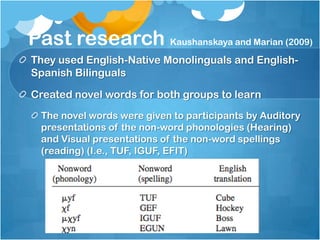
Created novel words for both groups to learn
 The novel words were given to participants by Auditory
 presentations of the non-word phonologies (Hearing)
 and Visual presentations of the non-word spellings
 (reading) (I.e., TUF, IGUF, EFIT)
Kaushanskaya and Marian (2009) Cont’d

What they found:


                                   
 Experience of bilinguals with Spanish
 facilitated novel-word learning


 From this experiment we can conclude that
 bilinguals have an advantage in learning and
 memorizing new language.
Past Research Findings
What led to my research…
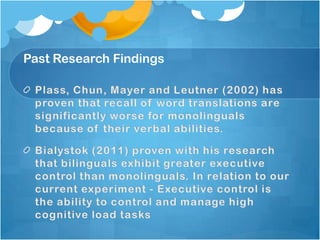
 Many past research like base article has
 been done on Alphabet based novel
 words.
 But what about character based
 languages?
Current research


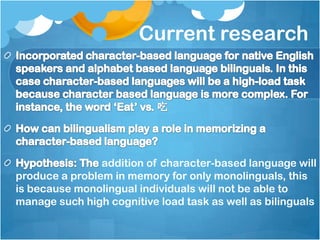
                addition of character-based language will
produce a problem in memory for only monolinguals, this
is because monolingual individuals will not be able to
manage such high cognitive load task as well as bilinguals
Current research                           Cont’d


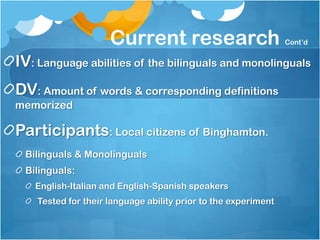
IV: Language abilities of the bilinguals and monolinguals
DV: Amount of words & corresponding definitions
memorized

Participants: Local citizens of Binghamton.
 Bilinguals & Monolinguals
 Bilinguals:
   English-Italian and English-Spanish speakers
    Tested for their language ability prior to the experiment
Current research                  Cont’d


Materials:

 Chinese Presentation Matching Survey (CPMS)


 Word selection
Current research                       Cont’d

Procedures:
1) Instructed to pay full attention to the presentations on the
   screen & memorize
2) Presentation includes Chinese word & definition
3) Presentation will appear for eight seconds
4) During visual display of stimuli, participants will also hear
   the pronunciation of the Chinese word from the loud
   speaker (Played twice)
5) Fill out CPMS survey form
6) Debriefed
Results
The results will be analyzed by a paired sample T-test
 Proposed Results will show:
   Bilinguals had higher portion of correct responses
   than monolinguals
   Past research supports:
   Van Aasche, Duyck, Hartsuiker, and Diependaele
   (2009) that bilinguals possess a highly integrated
   processing system that reaches across
   languages, this means that bilinguals have hold a
   functioning system that helps them learn language
   regardless of what the language is
Implications
 What this means:
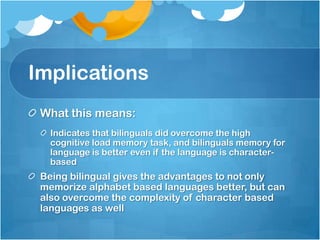
   Indicates that bilinguals did overcome the high
   cognitive load memory task, and bilinguals memory for
   language is better even if the language is character-
   based
 Being bilingual gives the advantages to not only
 memorize alphabet based languages better, but can
 also overcome the complexity of character based
 languages as well
Presentation coglab

Presentation coglab

  • 1.
  • 2.
    Outline Introduction oftopic Bilingualism & Cognitive Load theory Past research indications Current research Method Participants Materials Procedures Results Discussion
  • 3.
    1 - Bilingualism Bilinguals are people who are capable of speaking, writing, and interpreting fluently in two languages My interest in this topic Many people who moves to another country must learn the language of that country. (Like me) New York is a melting pot that holds so many different ethnic groups, with many bilinguals. What are the basic advantages?
  • 4.
    2 - CognitiveLoad theory States that our working memory holds limited capacity. The memory capacity used depends on the difficulty of that information. Consider… Complexity of information: High-Load task: tasks which are more complex, and requires more memory capacity, which leaves very little room for other memory processes Low-Load task: easier tasks, which requires less memory capacity, leaving memory with greater capacity
  • 5.
    Past research Kaushanskayaand Marian (2009) They used English-Native Monolinguals and English- Spanish Bilinguals Created novel words for both groups to learn The novel words were given to participants by Auditory presentations of the non-word phonologies (Hearing) and Visual presentations of the non-word spellings (reading) (I.e., TUF, IGUF, EFIT)
  • 6.
    Kaushanskaya and Marian(2009) Cont’d What they found:  Experience of bilinguals with Spanish facilitated novel-word learning From this experiment we can conclude that bilinguals have an advantage in learning and memorizing new language.
  • 7.
  • 8.
    What led tomy research… Many past research like base article has been done on Alphabet based novel words. But what about character based languages?
  • 9.
    Current research addition of character-based language will produce a problem in memory for only monolinguals, this is because monolingual individuals will not be able to manage such high cognitive load task as well as bilinguals
  • 10.
    Current research Cont’d IV: Language abilities of the bilinguals and monolinguals DV: Amount of words & corresponding definitions memorized Participants: Local citizens of Binghamton. Bilinguals & Monolinguals Bilinguals: English-Italian and English-Spanish speakers Tested for their language ability prior to the experiment
  • 11.
    Current research Cont’d Materials: Chinese Presentation Matching Survey (CPMS) Word selection
  • 12.
    Current research Cont’d Procedures: 1) Instructed to pay full attention to the presentations on the screen & memorize 2) Presentation includes Chinese word & definition 3) Presentation will appear for eight seconds 4) During visual display of stimuli, participants will also hear the pronunciation of the Chinese word from the loud speaker (Played twice) 5) Fill out CPMS survey form 6) Debriefed
  • 13.
    Results The results willbe analyzed by a paired sample T-test Proposed Results will show: Bilinguals had higher portion of correct responses than monolinguals Past research supports: Van Aasche, Duyck, Hartsuiker, and Diependaele (2009) that bilinguals possess a highly integrated processing system that reaches across languages, this means that bilinguals have hold a functioning system that helps them learn language regardless of what the language is
  • 14.
    Implications What thismeans: Indicates that bilinguals did overcome the high cognitive load memory task, and bilinguals memory for language is better even if the language is character- based Being bilingual gives the advantages to not only memorize alphabet based languages better, but can also overcome the complexity of character based languages as well