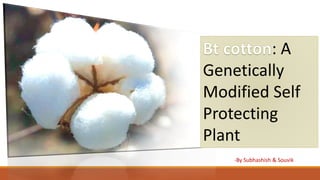
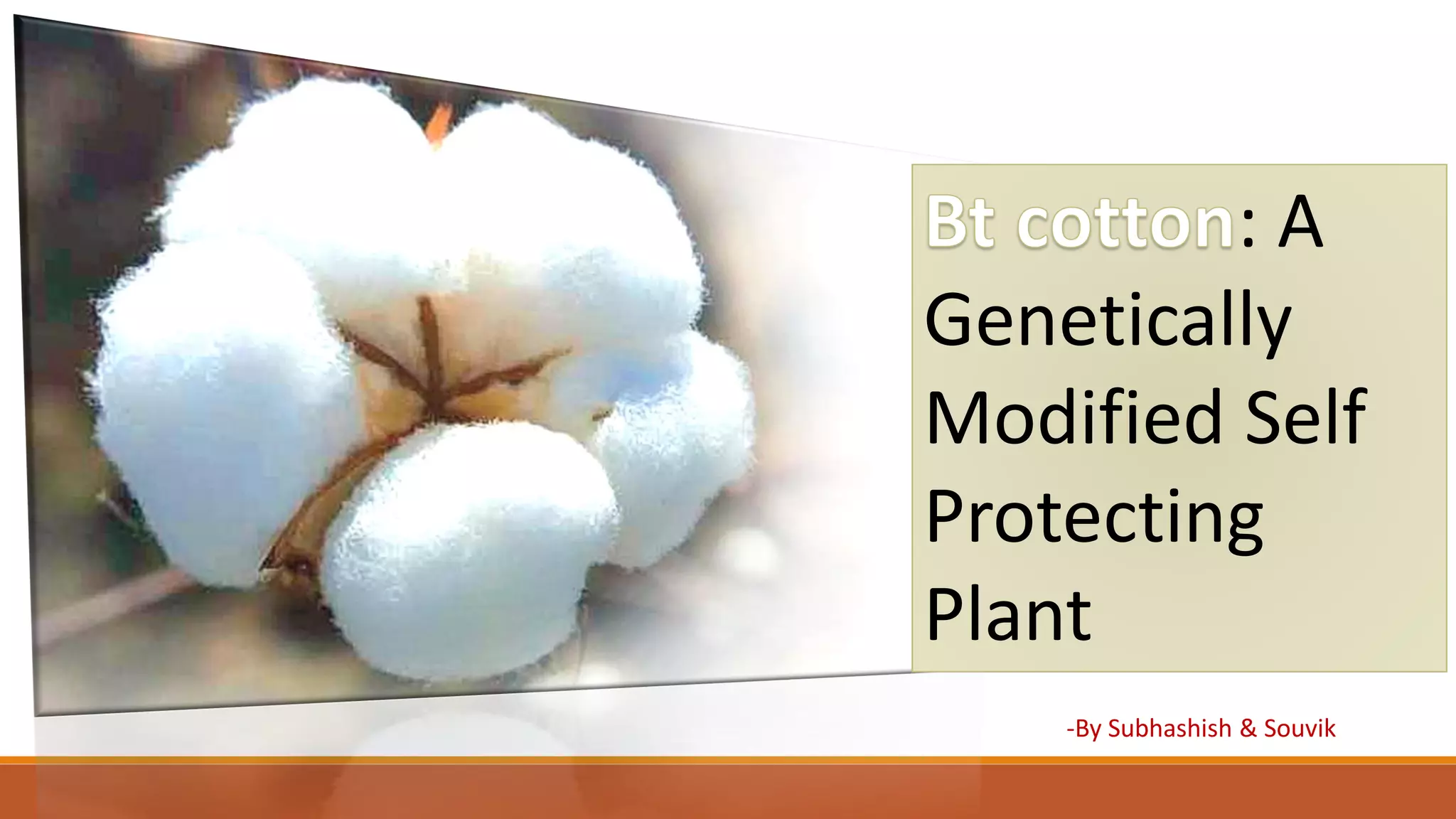
: A
Genetically
Modified Self
Protecting
Plant
-By Subhashish & Souvik
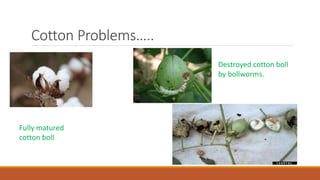
Cotton Problems
..
Fully matured
cotton boll
Destroyed cotton boll
by bollworms.
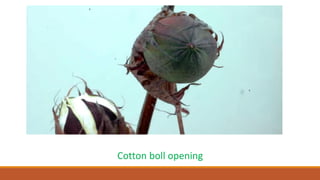
Cotton boll opening
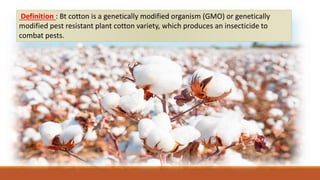
Definition : Bt cotton is a genetically modified organism (GMO) or genetically
modified pest resistant plant cotton variety, which produces an insecticide to
combat pests.
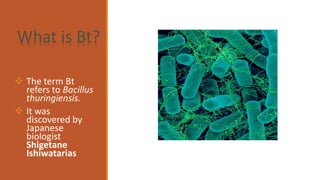
❖ The term Bt
refers to Bacillus
thuringiensis.
❖ It was
discovered by
Japanese
biologist
Shigetane
Ishiwatarias
What is Bt?
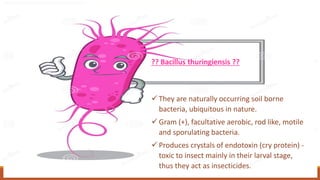
?? Bacillus thuringiensis ??
✓ They are naturally occurring soil borne
bacteria, ubiquitous in nature.
✓ Gram (+), facultative aerobic, rod like, motile
and sporulating bacteria.
✓ Produces crystals of endotoxin (cry protein) -
toxic to insect mainly in their larval stage,
thus they act as insecticides.
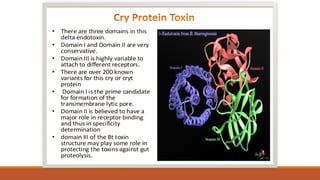
Cry (Crystal) Proteins
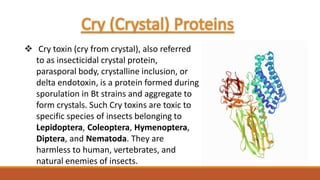
❖ Cry toxin (cry from crystal), also referred
to as insecticidal crystal protein,
parasporal body, crystalline inclusion, or
delta endotoxin, is a protein formed during
sporulation in Bt strains and aggregate to
form crystals. Such Cry toxins are toxic to
specific species of insects belonging to
Lepidoptera, Coleoptera, Hymenoptera,
Diptera, and Nematoda. They are
harmless to human, vertebrates, and
natural enemies of insects.
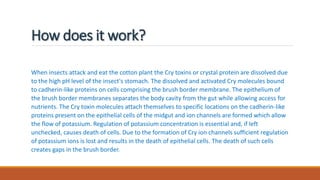
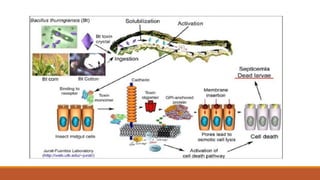
How does it work?
When insects attack and eat the cotton plant the Cry toxins or crystal protein are dissolved due
to the high pH level of the insect's stomach. The dissolved and activated Cry molecules bound
to cadherin-like proteins on cells comprising the brush border membrane. The epithelium of
the brush border membranes separates the body cavity from the gut while allowing access for
nutrients. The Cry toxin molecules attach themselves to specific locations on the cadherin-like
proteins present on the epithelial cells of the midgut and ion channels are formed which allow
the flow of potassium. Regulation of potassium concentration is essential and, if left
unchecked, causes death of cells. Due to the formation of Cry ion channels sufficient regulation
of potassium ions is lost and results in the death of epithelial cells. The death of such cells
creates gaps in the brush border.
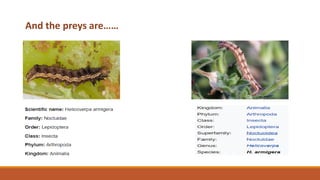
And the preys are


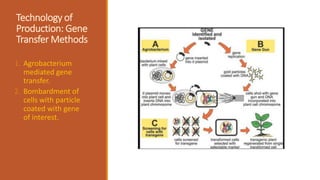
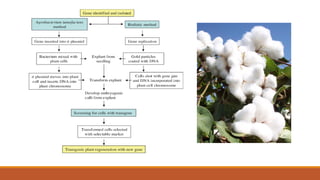
Technology of
Production: Gene
Transfer Methods
1. Agrobacterium
mediated gene
transfer.
2. Bombardment of
cells with particle
coated with gene
of interest.
Advantages:-
1. Increases yield of cotton due to effective control of three types of bollworms, viz. American,
Spotted and Pink bollworms as Insects belonged to Lepidoptera (Bollworms) are sensitive to
crystalline endotoxic protein produced by Bt gene (more profit).
2. Reduction in insecticide use in the cultivation of Bt cotton in which bollworms are major
pests. No health hazards due to rare use of insecticides (particularly who is engaged in
spraying of insecticides)
3. Potential reduction in the cost of cultivation (depending on seed cost versus insecticide
costs).
4. Most of the Cry proteins deposited into soil by Bt crops were degraded in soil within a few
days, and they had no effect on soil bacteria, actinomyces, fungi, protozoa, algae,
nematodes, or earthworm.
Disadvantages:-
‱Bt-crops are pricier than regular crops.
‱Bt-gene might disrupt natural gene flow process, as
some researchers fear.
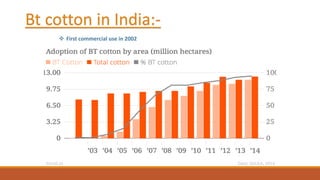
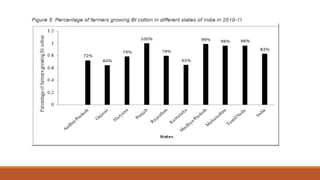
Bt cotton in India:-
❖ First commercial use in 2002
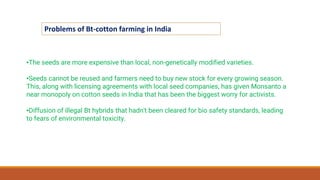
‱The seeds are more expensive than local, non-genetically modified varieties.
‱Seeds cannot be reused and farmers need to buy new stock for every growing season.
This, along with licensing agreements with local seed companies, has given Monsanto a
near monopoly on cotton seeds in India that has been the biggest worry for activists.
‱Diffusion of illegal Bt hybrids that hadn't been cleared for bio safety standards, leading
to fears of environmental toxicity.
Problems of Bt-cotton farming in India
Concerns
.
➱ The results of experiments conducted by researchers at the University of Caen, France, and
supported by GEKKO Foundation, in Germany, showed that toxins produced in Bt corn,
Mon810, can impact significantly the viability of human cells. The effects were observed with
relatively high concentrations of the toxins; however, further investigations should be
conducted to find out how such toxins impact the cells.
➱ Biosafety tests indicated absolute safety to goats, cows, buffaloes, fish and poultry. Feed-
safety studies with Bt cottonseed meal were carried out with goats, buffalos, cows, rabbits,
birds and fish. The results revealed that the animals fed with Bt-cotton seed meal were
comparable to the control animals in various tests and showed no ill-effects. These studies
were carried out by the National Dairy Research Institute, Karnal; Central Avian Research
Institute, Bareily; Industrial Toxicological Research Centre, Lucknow; National Institute of
Nutrition, Hyderabad; Central Institute of Fisheries Education, Mumbai and GB Pant
University for Agriculture and Technology, Pant Nagar.
❖ References:
1. Genetically engineered (modified) crops (Bacillus thuringiensis crops) and the world
controversy on their safety, Mohamed Samir Tawfik Abbas
2. Wikipedia.org
3. Bt cotton vis-Ă -vis environmental protection: An Indian Perspective, S. Manickam, K.
N. Gururajan and N. Gopalakrishnan,Central Institute for Cotton Research, Regional
Station, Coimbatore, India
4. Bt Cotton in India: A Country Profile by Bhagirath Choudhary, Kadambini Gaur.
5. Bt cotton Biotechnology; Medical World

Presentation- Bt cotton.pdf

  • 1.
  • 2.
    Cotton Problems
.. Fully matured cottonboll Destroyed cotton boll by bollworms.
  • 3.
  • 4.
    Definition : Btcotton is a genetically modified organism (GMO) or genetically modified pest resistant plant cotton variety, which produces an insecticide to combat pests.
  • 5.
    ❖ The termBt refers to Bacillus thuringiensis. ❖ It was discovered by Japanese biologist Shigetane Ishiwatarias What is Bt?
  • 6.
    ?? Bacillus thuringiensis?? ✓ They are naturally occurring soil borne bacteria, ubiquitous in nature. ✓ Gram (+), facultative aerobic, rod like, motile and sporulating bacteria. ✓ Produces crystals of endotoxin (cry protein) - toxic to insect mainly in their larval stage, thus they act as insecticides.
  • 7.
    Cry (Crystal) Proteins ❖Cry toxin (cry from crystal), also referred to as insecticidal crystal protein, parasporal body, crystalline inclusion, or delta endotoxin, is a protein formed during sporulation in Bt strains and aggregate to form crystals. Such Cry toxins are toxic to specific species of insects belonging to Lepidoptera, Coleoptera, Hymenoptera, Diptera, and Nematoda. They are harmless to human, vertebrates, and natural enemies of insects.
  • 9.
    How does itwork? When insects attack and eat the cotton plant the Cry toxins or crystal protein are dissolved due to the high pH level of the insect's stomach. The dissolved and activated Cry molecules bound to cadherin-like proteins on cells comprising the brush border membrane. The epithelium of the brush border membranes separates the body cavity from the gut while allowing access for nutrients. The Cry toxin molecules attach themselves to specific locations on the cadherin-like proteins present on the epithelial cells of the midgut and ion channels are formed which allow the flow of potassium. Regulation of potassium concentration is essential and, if left unchecked, causes death of cells. Due to the formation of Cry ion channels sufficient regulation of potassium ions is lost and results in the death of epithelial cells. The death of such cells creates gaps in the brush border.
  • 11.
    And the preysare


  • 12.
    Technology of Production: Gene TransferMethods 1. Agrobacterium mediated gene transfer. 2. Bombardment of cells with particle coated with gene of interest.
  • 14.
    Advantages:- 1. Increases yieldof cotton due to effective control of three types of bollworms, viz. American, Spotted and Pink bollworms as Insects belonged to Lepidoptera (Bollworms) are sensitive to crystalline endotoxic protein produced by Bt gene (more profit). 2. Reduction in insecticide use in the cultivation of Bt cotton in which bollworms are major pests. No health hazards due to rare use of insecticides (particularly who is engaged in spraying of insecticides) 3. Potential reduction in the cost of cultivation (depending on seed cost versus insecticide costs). 4. Most of the Cry proteins deposited into soil by Bt crops were degraded in soil within a few days, and they had no effect on soil bacteria, actinomyces, fungi, protozoa, algae, nematodes, or earthworm.
  • 15.
    Disadvantages:- ‱Bt-crops are pricierthan regular crops. ‱Bt-gene might disrupt natural gene flow process, as some researchers fear.
  • 16.
    Bt cotton inIndia:- ❖ First commercial use in 2002
  • 18.
    ‱The seeds aremore expensive than local, non-genetically modified varieties. ‱Seeds cannot be reused and farmers need to buy new stock for every growing season. This, along with licensing agreements with local seed companies, has given Monsanto a near monopoly on cotton seeds in India that has been the biggest worry for activists. ‱Diffusion of illegal Bt hybrids that hadn't been cleared for bio safety standards, leading to fears of environmental toxicity. Problems of Bt-cotton farming in India
  • 19.
    Concerns
. ➱ The resultsof experiments conducted by researchers at the University of Caen, France, and supported by GEKKO Foundation, in Germany, showed that toxins produced in Bt corn, Mon810, can impact significantly the viability of human cells. The effects were observed with relatively high concentrations of the toxins; however, further investigations should be conducted to find out how such toxins impact the cells. ➱ Biosafety tests indicated absolute safety to goats, cows, buffaloes, fish and poultry. Feed- safety studies with Bt cottonseed meal were carried out with goats, buffalos, cows, rabbits, birds and fish. The results revealed that the animals fed with Bt-cotton seed meal were comparable to the control animals in various tests and showed no ill-effects. These studies were carried out by the National Dairy Research Institute, Karnal; Central Avian Research Institute, Bareily; Industrial Toxicological Research Centre, Lucknow; National Institute of Nutrition, Hyderabad; Central Institute of Fisheries Education, Mumbai and GB Pant University for Agriculture and Technology, Pant Nagar.
  • 20.
    ❖ References: 1. Geneticallyengineered (modified) crops (Bacillus thuringiensis crops) and the world controversy on their safety, Mohamed Samir Tawfik Abbas 2. Wikipedia.org 3. Bt cotton vis-à-vis environmental protection: An Indian Perspective, S. Manickam, K. N. Gururajan and N. Gopalakrishnan,Central Institute for Cotton Research, Regional Station, Coimbatore, India 4. Bt Cotton in India: A Country Profile by Bhagirath Choudhary, Kadambini Gaur. 5. Bt cotton Biotechnology; Medical World