Impact of new technologies and
social networks on a secondary
education theatre project

J. Pedro López, Pablo Ballesteros, David Jiménez, José M. Menéndez
Universidad Politécnica de Madrid, I.E.S. Al-Satt
Nantes, 30th October 2013
Index
•
•
•
•
•
•

Introduction
Environment
Objectives
Content creation and distribution
Social Networks
Conclusions

2
Introduction
• Collaboration between: University
(UPM) and Secondary Education HighSchool (Al-Satt)
• Introduction of internet tools (social
networks) in Secondary Education.
• Searching for the students’ motivation.
• Analysis of results (survey / analytics)
3
Environment
• 27 Students: 3rd E.S.O. (14-18 y.o.)
• Selective subject theater: Sept 2012June 2013.
• Low academic level (80% repeating a
year) and from “diversification” programs
• Complicated disciplanary expedient
• At risk of social exclusion
4
Objectives
• Finding motivation in theater.
• Using techniques of avant-gard and
contemporary theater.
• Creating a corporative image.
• Make them feel important.
• Using technology to improve results.

5
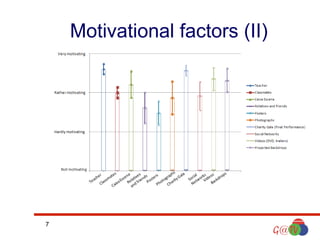
Motivational factors (I)
• Teacher
• Performances
• Social Networks (Facebook, Twitter,
YouTube, Blog)
• Content creation: text, images, video
• Distribution through channels: press, posters,
DVD, social networks, recording
visualization.
• Family and schoolmates less important
6
Motivational factors (II)

7
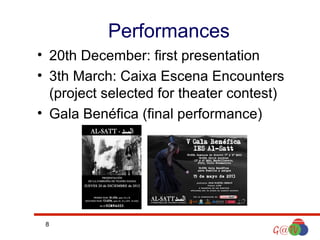
Performances
• 20th December: first presentation
• 3th March: Caixa Escena Encounters
(project selected for theater contest)
• Gala Benéfica (final performance)

8
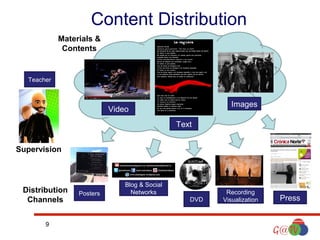
Content Distribution
Materials &
Contents

Teacher

Images

Video
Text
Supervision

Distribution
Channels
9

Posters

Blog & Social
Networks
DVD

Recording
Visualization

Press
Social Networks
• Students normally access to Facebook,
Twitter or YouTube.
• Not creating new platforms (Moodle),
using the existent ones.
• Introduce theater subject in their normal
life as a motivational tool.
• Corporative image creation:

10
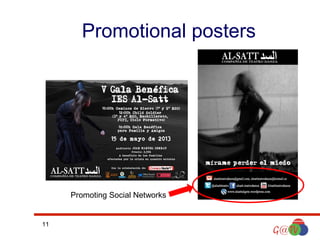
Promotional posters

Promoting Social Networks

11
Social Network Consumption
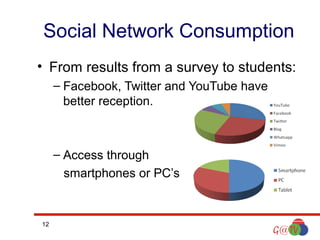
• From results from a survey to students:
– Facebook, Twitter and YouTube have
better reception.

– Access through
smartphones or PC’s

12
Results
• Survey for the students, developed in
final class:
– Motivational factors
– Perception of quality
– Interest and theater and the subject

• Analytics from social networks and
internet consumption.

13
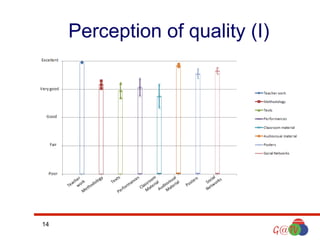
Perception of quality (I)

14
Perception of quality (II)
• Appreciation of teacher’s work
• Good reception to material and contents
and distribution (social networks).
• Positive interest in audiovisual contents
created.
• A perception of own improvement in
performances.
15
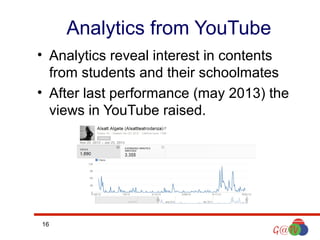
Analytics from YouTube
• Analytics reveal interest in contents
from students and their schoolmates
• After last performance (may 2013) the
views in YouTube raised.

16
Conclusions (I)
• Motivation is a key factor in students’
education (especially in artistic subjects)
• Youth are subject to continuous and
multiple stimuli, and traditional education
system is too static
• Technology surrounds them and their
usage is an advantage for the teacher,
not an impediment.
17
Conclusions (II)
• Social networks are an important
motivational factor.
• Common S.N. obtained better reception
than specifically created ones, such as a
blog or a moodle.
• Audiovisual and graphical content are
profitable in the learning process:
– Motivation factor
– To see their errors
18
Trailer: Child Soldier

19
Thanks for your attention

20

Impact of new technologies and social network on a secondary education theatre project

  • 1.
    Impact of newtechnologies and social networks on a secondary education theatre project J. Pedro López, Pablo Ballesteros, David Jiménez, José M. Menéndez Universidad Politécnica de Madrid, I.E.S. Al-Satt Nantes, 30th October 2013
  • 2.
  • 3.
    Introduction • Collaboration between:University (UPM) and Secondary Education HighSchool (Al-Satt) • Introduction of internet tools (social networks) in Secondary Education. • Searching for the students’ motivation. • Analysis of results (survey / analytics) 3
  • 4.
    Environment • 27 Students:3rd E.S.O. (14-18 y.o.) • Selective subject theater: Sept 2012June 2013. • Low academic level (80% repeating a year) and from “diversification” programs • Complicated disciplanary expedient • At risk of social exclusion 4
  • 5.
    Objectives • Finding motivationin theater. • Using techniques of avant-gard and contemporary theater. • Creating a corporative image. • Make them feel important. • Using technology to improve results. 5
  • 6.
    Motivational factors (I) •Teacher • Performances • Social Networks (Facebook, Twitter, YouTube, Blog) • Content creation: text, images, video • Distribution through channels: press, posters, DVD, social networks, recording visualization. • Family and schoolmates less important 6
  • 7.
  • 8.
    Performances • 20th December:first presentation • 3th March: Caixa Escena Encounters (project selected for theater contest) • Gala Benéfica (final performance) 8
  • 9.
  • 10.
    Social Networks • Studentsnormally access to Facebook, Twitter or YouTube. • Not creating new platforms (Moodle), using the existent ones. • Introduce theater subject in their normal life as a motivational tool. • Corporative image creation: 10
  • 11.
  • 12.
    Social Network Consumption •From results from a survey to students: – Facebook, Twitter and YouTube have better reception. – Access through smartphones or PC’s 12
  • 13.
    Results • Survey forthe students, developed in final class: – Motivational factors – Perception of quality – Interest and theater and the subject • Analytics from social networks and internet consumption. 13
  • 14.
  • 15.
    Perception of quality(II) • Appreciation of teacher’s work • Good reception to material and contents and distribution (social networks). • Positive interest in audiovisual contents created. • A perception of own improvement in performances. 15
  • 16.
    Analytics from YouTube •Analytics reveal interest in contents from students and their schoolmates • After last performance (may 2013) the views in YouTube raised. 16
  • 17.
    Conclusions (I) • Motivationis a key factor in students’ education (especially in artistic subjects) • Youth are subject to continuous and multiple stimuli, and traditional education system is too static • Technology surrounds them and their usage is an advantage for the teacher, not an impediment. 17
  • 18.
    Conclusions (II) • Socialnetworks are an important motivational factor. • Common S.N. obtained better reception than specifically created ones, such as a blog or a moodle. • Audiovisual and graphical content are profitable in the learning process: – Motivation factor – To see their errors 18
  • 19.
  • 20.
    Thanks for yourattention 20