No-Reference Algorithms for Video
Quality Assessment based on
Artifact Evaluation in MPEG-2 and
H.264 Encoding Standards
Juan Pedro López Velasco
Universidad Politécnica de Madrid
Ghent, 31th May 2013
1
Index
• No-Reference Quality Assessment
• Encoding standards
• Advanced tools
• Work in Artifacts detection:
– Blocking
– Blurring
• Conclusions
2
No-Reference Algorithms
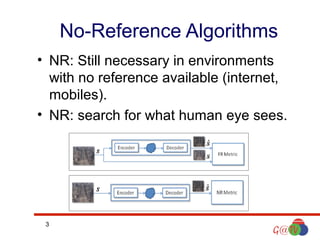
• NR: Still necessary in environments
with no reference available (internet,
mobiles).
• NR: search for what human eye sees.
3
Encoding standards
Each standard offers better tecniques
than the previous ones.
• H.263 / MPEG-2
• H.264
• HEVC (in the future)
4
Artifacts
• Blocking
• Blurring
5
Advanced Tools
• Improvement in H.264 from MPEG-2
includes:
– Deblocking filter
– Variability in macroblocks size
– Efficiency improvement
6
Blocking
• Based on gradient detection and
filtering, evaluates the changes in
degree in edges for each
pixel/macroblock.
7
Advanced Gradient Filter
• Original image (No encoding)
8
MPEG-2
– Blocking artifact detected in homogeneous
areas.
9
H.264
• Without deblocking filter
– Blocking artifact detected in homogeneous
areas.
10
Deblocking filter
• The effience in deblocking is not perfect
in big homogeneous areas.
11
Blurring
• Based on transforms, such as
Hadamard and distribution of energies,
taking into account the variability of
macroblock size in H.264.
12
Diagrams of energy
distribution
• Distribution of energies based on
Hadamard coefficient analysis
13
Conclusions
• Efficiency in detecting artifacts, also in
H.264, based on metrics from MPEG-2
– Necessity of taking into account advances
encoding to improve results:
• Deblocking filter.
• Variability of coefficients /
• The final decision depends on what
human eye see (NR vs. FR).
14
Thanks for your attention
15

No-Reference Algorithms for Video Quality Assessment based on Artifact Evaluation in MPEG-2 and H.264 Encoding Standards