A Simple Portable Potable Water
Treatment Plant in Rural Areas
By Edwin I. Ekwue, Vasant Dhanraj, Robert A. Birch
The Journal of the Association of Professional Engineers of Trinidad and Tobago
Vol.41, No.1, April/May 2013, pp.29-34. ISSN 1000 7924
Presented by
 Theresia Florenta Sinurat 1410941006
 Afip Herliansa 1410942001
 Wahdini Putri Guspi 1410942004
 Nyak Nisa Ul Khairani 1410942013
 Bingesti Vegi Mayolan 1410942016
 Qurratu Ayunin 1410942026
Introduction
 The earth majority consist of water, but only 3% of that water is fresh water and available to humans with
only 0.06% easily accessible to humans for use. It is estimated that over 80 countries in the world suffer
from a water shortage and about 2 billion people lack access to clean water.
 In Latin America and the Caribbean, over 75 million people have little or no access to drinking water. There
is the need to provide more water for drinking particularly in the rural areas.
 In many smaller islands of the Caribbean, rooftop rainwater systems is the main source of fresh water
particularly in the rural areas. Rainwater ponds are also used for agriculture and primarily for livestock
production. The possibilities of contamination of rainwater collected from rooftops arising from the
building materials and airborne contamination from heavy traffic and industries.
 This therefore calls for the production of simple, cheap but effective ways of treating water for small
households. This paper involves the design, construction and testing of a portable water treatment plant
that could be used to produce potable water for drinking for a household in a local setting.
Discussion
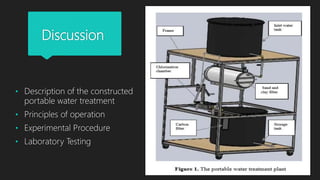
• Description of the constructed
portable water treatment
• Principles of operation
• Experimental Procedure
• Laboratory Testing
Discussion
Conclusion
 This paper has described the design, construction and testing of a portable potable water
treatment plant that is capable of purifying various types of fresh water to acceptable levels for
drinking.
 The design used was fabricated with a total cost of US $840,-
 The level of testing of this device should be continued so as to be adequate enough to make a
more definite statement of the effectiveness of the system.
 the best angle of sand and clay filter proccess is 13◦

Presentation about Environmental Engineering Thingy (Simple WTP)

  • 1.
    A Simple PortablePotable Water Treatment Plant in Rural Areas By Edwin I. Ekwue, Vasant Dhanraj, Robert A. Birch The Journal of the Association of Professional Engineers of Trinidad and Tobago Vol.41, No.1, April/May 2013, pp.29-34. ISSN 1000 7924
  • 2.
    Presented by  TheresiaFlorenta Sinurat 1410941006  Afip Herliansa 1410942001  Wahdini Putri Guspi 1410942004  Nyak Nisa Ul Khairani 1410942013  Bingesti Vegi Mayolan 1410942016  Qurratu Ayunin 1410942026
  • 3.
    Introduction  The earthmajority consist of water, but only 3% of that water is fresh water and available to humans with only 0.06% easily accessible to humans for use. It is estimated that over 80 countries in the world suffer from a water shortage and about 2 billion people lack access to clean water.  In Latin America and the Caribbean, over 75 million people have little or no access to drinking water. There is the need to provide more water for drinking particularly in the rural areas.  In many smaller islands of the Caribbean, rooftop rainwater systems is the main source of fresh water particularly in the rural areas. Rainwater ponds are also used for agriculture and primarily for livestock production. The possibilities of contamination of rainwater collected from rooftops arising from the building materials and airborne contamination from heavy traffic and industries.  This therefore calls for the production of simple, cheap but effective ways of treating water for small households. This paper involves the design, construction and testing of a portable water treatment plant that could be used to produce potable water for drinking for a household in a local setting.
  • 4.
    Discussion • Description ofthe constructed portable water treatment • Principles of operation • Experimental Procedure • Laboratory Testing
  • 5.
  • 6.
    Conclusion  This paperhas described the design, construction and testing of a portable potable water treatment plant that is capable of purifying various types of fresh water to acceptable levels for drinking.  The design used was fabricated with a total cost of US $840,-  The level of testing of this device should be continued so as to be adequate enough to make a more definite statement of the effectiveness of the system.  the best angle of sand and clay filter proccess is 13◦