
Water Conservation
Author : Parham Sagharichi Ha
Agenda
1. What is water conservation ?
2. Why is water conservation so important ?
3. How can we reduce water consumption ?
4. Water cycle
5. Water crisis in iran
6. Iran’s water outlook
7. What are some water conservation methods?
8. Reference
What is water conservation?
▪ Water conservation involves reducing the usage of water and
recycling of waste water for various purposes such as cleaning,
irrigation and manufacturing. Another method for implementing
water conservation is by improving water management practices.
These improve the use of water resources to benefit people and
the environment. Conserving water is important because water is
a finite and vulnerable resource that sustains life, economic
development and the environment.
Why is water conservation so important?
▪ Water conservation is important because it keeps water clean and pure
and conserves the environment. It is also important because the supply
of water is not endless. About 2 percent of Earth’s fresh water is locked
in glaciers and ice caps, while 97 percent is salt water. Therefore, only 1
percent of water on Earth is available for drinking.
▪ Water conservation involves refraining from water pollution. It is
important because, currently, only about 10 percent of Earth’s waste
water is disposed of appropriately, discloses About.com. In addition,
water conservation saves money, minimizes the effects of water shortage
and ensures that future generations have an adequate water supply.
Strategies used in water conservation include reducing wastage,
preventing damaging water quality and improving the practices of water
management.
How much do you need water ?
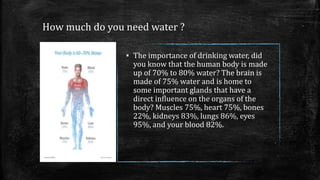
▪ The importance of drinking water, did
you know that the human body is made
up of 70% to 80% water? The brain is
made of 75% water and is home to
some important glands that have a
direct influence on the organs of the
body? Muscles 75%, heart 75%, bones
22%, kidneys 83%, lungs 86%, eyes
95%, and your blood 82%.
How can we reduce water consumption ?
▪ There are two way (Engineering practices and Behavioral
practices).
▪ Engineering practices: practices based on modifications in
plumbing, fixtures, or water supply operating procedures.
▪ Behavioral practices: practices based on changing water use
habits.
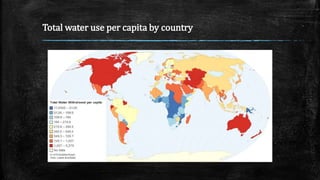
Total water use per capita by country
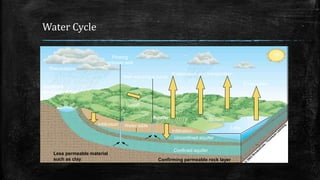
Water Cycle
Evaporation and transpiration
Evaporation
Stream
Infiltration
Water tableInfiltration
Unconfined aquifer
Confined aquifer
Lake
Well requiring a pump
Flowing
artesian well
Runoff
Precipitation
Confined
Recharge Area
Aquifer
Less permeable material
such as clay Confirming permeable rock layer
Water Cycle
▪ Water evaporates from oceans, rivers and lakes (water in its liquid
form) and rises into the atmosphere (water in its gas form) where it
condenses to form clouds. Precipitation then falls to the earth in the
form of rain (water in its liquid) or snow (water in its solid form)
where it flows into oceans, rivers and lakes and the process begins
again.
Water crisis in iran
1. Water use 70% higher than the global average.
2. Iran has a national population of 75 million people, 12 million of
whom reside in the capital.
3. According to the Institute for Forest and Pasture Research,
groundwater levels have dropped two metres in recent years
across 70 plains, affecting as much as 100 million hectares.
4. According to the UN Development Program, the level of Iran’s per
capita water resources are predicted to fall to as little as 816m³
in 2025, down from 2,025m³ in 1990.
Water crisis in iran
5. Due to high evaporation of surface water.
6. Groundwater is free to all users, with no price charged even for
irrigation.
7. Iran is divided into six key and 31 secondary catchment areas.
Besides the Persian Gulf and Gulf of Oman Basins, all of Iran’s
basins are located in the interior, where renewable freshwater
sources are limited. Close to half of Iran’s total renewable water
is located in the Persian Gulf and Gulf of Oman Basins,
representing one quarter of its land mass. Conversely, the
Markazi Basin covers more than half of Iran’s land mass, but
holds less than one-third of the available freshwater.
Water crisis in iran
8. Three of Iran’s lakes, Lake Maharlu, Lake Bakhtegan and Lake
Parishan, have dried and turned to desert according to the
Habitats Office of the National Department of Environment. All of
these lakes are Ramsar sites and have faced irreversible
ecosystem destruction. Once the second largest lake in Iran, Lake
Bakhtegan has dried completely, due to the combined effects of
prolonged drought and dam construction along the Kor River.
Lake Urmia meanwhile is following a similar path, with a 70%
surface water reduction over the last 20 years. There are an
estimated 40 dams on the 14 rivers emptying into Lake Urmia.
9. Agriculture accounts for over 90% water use in Iran.
Water crisis in iran
10. Climate change impacts, while not a direct cause of Iran’s current
water scarcity, will exacerbate water shortages and reduce
already limited rainfall. According to Massoumeh Ebtekar, head
of Iran’s Environmental Protection Organisation,Iran’s climate
has already warmed by 1.5 to 3 degrees due to greenhouse gas
emissions.
Iran’s Water Outlook
▪ President Rouhani has outlined his proposal for a National Water
Conservation Plan, aimed at reorganising water resources and re-
evaluating water projects. Encouragingly, he has stated that to
begin addressing water shortages: domestic water use needs to be
reduced; the agricultural sector must be made more water
efficient; groundwater must be protected; and the drilling of wells
regulated. Given the heightened tensions over water insecurity and
the increasing civil unrest as water is diverted from towns to cities,
the population’s response to water restrictions may lead to
internal instability, resentment of the government and little or no
progress on water conservation. Strong governance will be
required if rationing and increased industry efficiency are to
succeed.
Iran’s Water Outlook
▪ When these factors are linked with the predictions of climate
change impacts on water resources, it is clear Iran is facing an
impending water crisis of staggering proportion. Lower
precipitation and continued population growth are leading to
increased demand for a dwindling supply. Addressing such
significant water reductions will require a concerted effort across
Iran and urgent government investment to identify potential water
sources. Wastewater treatment, undervalued thus far in Iranian
water plans, may prove to be one of the most cost-effective and
realistic options to ensure continued water supply.
Iran’s Water Outlook
▪ The government has been constructing dams to address water
shortages since the 1950s, but this will not address the growing
gap between demand and supply. With the Caspian Sea Water
Transfer given the green light by parliament in February 2013, it
also seems inter-basin transfers are likely to continue despite the
significant environmental impact these transfers cause. More of
the same thinking is unlikely to address shortages in the long-
term, no matter what re-directions are taken. Real change will
require considerable policy reconstruction, changes in water
allocation priorities and a commitment to reduce water wastage
across all sectors.
What are some water conservation methods?
1. Eat less meat
According to the U.S. Geological survey, it takes 2,607 gallons of water
to produce a single serving of steak and 408 gallons for a serving of
chicken. A handful of almonds requires only 12 gallons to grow, rice
needs 36 gallons, and lettuce and potatoes need only 6 gallons each.
2. Wash only full loads
In both the dishwasher and washing machine, or set the water levels
to accommodate smaller loads.
What are some water conservation methods?
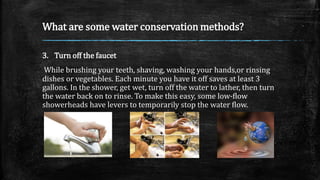
3. Turn off the faucet
While brushing your teeth, shaving, washing your hands,or rinsing
dishes or vegetables. Each minute you have it off saves at least 3
gallons. In the shower, get wet, turn off the water to lather, then turn
the water back on to rinse. To make this easy, some low-flow
showerheads have levers to temporarily stop the water flow.
What are some water conservation methods?
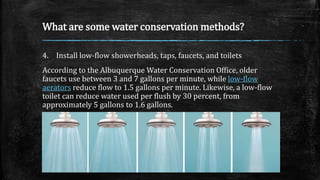
4. Install low-flow showerheads, taps, faucets, and toilets
According to the Albuquerque Water Conservation Office, older
faucets use between 3 and 7 gallons per minute, while low-flow
aerators reduce flow to 1.5 gallons per minute. Likewise, a low-flow
toilet can reduce water used per flush by 30 percent, from
approximately 5 gallons to 1.6 gallons.
What are some water conservation methods?
5. Wash fruits and veggies in a bowl
Running water uses up to four times as much and is lost down the
drain. Use a bowl instead and the water can be used in your garden
when you're done.
6. Monitor your water bill
A peak in your consumption should be questioned, as it could mean a
hidden leak.
7. Report city or business water waste
8. Take shorter showers
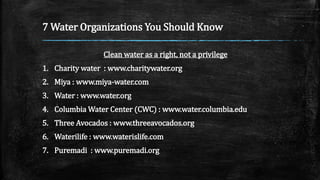
7 Water Organizations You Should Know
Clean water as a right, not a privilege
1. Charity water : www.charitywater.org
2. Miya : www.miya-water.com
3. Water : www.water.org
4. Columbia Water Center (CWC) : www.water.columbia.edu
5. Three Avocados : www.threeavocados.org
6. Waterilife : www.waterislife.com
7. Puremadi : www.puremadi.org
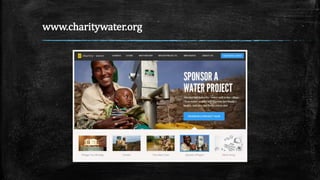
www.charitywater.org
Charity water : www.charitywater.org
▪ What: Nonprofit that brings clean and safe drinking water to
people in developing countries.
How: 100% of the nonprofit’s public donations go directly to clean
water technologies that range from wells to water filtration.
Answering this basic human need, charity water offers a lot of
opportunities to get involved, from volunteering to fundraising. One
creative way to raise funds is to pledge your birthday, a campaign
in which individuals decide that instead of receiving gifts, friends
and family are encouraged to donate to charity water.
Where: 20 developing countries in Africa, Asia, Latin America and
the Caribbean.
There a lot of way that you can help charity water
1. You can host a music festival for clean water.
2. You can give up Christmas gifts for clean water.
3. You can bake cookies for clean water.
4. You can ride across the U.S. for clean water.
5. You can lose weight for clean water.
6. You can make a music video for clean water.
7. You can grow a mustache for clean water.
8. You can sell t-shirts for clean water.
9. You can take photos for clean water…
10. or donate instead!
What are some good water conservation slogans?
▪ Many water slogans focus on not wasting the resource. Examples
include:
▪ "You never know the worth of water until the well runs dry,“
▪ "How many drops make up an ocean? Conserve water; every drop
counts,“
▪ "If we don’t learn to conserve, we’ll all be fish out of water,"
▪ "Don’t flush our planet’s most valuable resource."
▪ Slogans sometimes stress the importance of keeping water clean:
"Water, water everywhere but not a drop to drink."
Reference
▪ http://www.waterforlife.alberta.ca
▪ http://chartsbin.com/view/1455
▪ http://www.drinking-water-for-health.com
▪ http://water.usgs.gov
▪ http://www.un.org
▪ http://www.goodnet.org
▪ Law Library Scholar in Residence by Sanaz Alasti October 2013
▪ Overview of Water Management in Iran , Reza Ardakanian
▪ Global Food and Water Crises Research Programme, Sinéad Lehane
Do you have any questions ?
Parham Sagharichi Ha

Water Conservation

  • 1.
    Water Conservation Author :Parham Sagharichi Ha
  • 2.
    Agenda 1. What iswater conservation ? 2. Why is water conservation so important ? 3. How can we reduce water consumption ? 4. Water cycle 5. Water crisis in iran 6. Iran’s water outlook 7. What are some water conservation methods? 8. Reference
  • 3.
    What is waterconservation? ▪ Water conservation involves reducing the usage of water and recycling of waste water for various purposes such as cleaning, irrigation and manufacturing. Another method for implementing water conservation is by improving water management practices. These improve the use of water resources to benefit people and the environment. Conserving water is important because water is a finite and vulnerable resource that sustains life, economic development and the environment.
  • 4.
    Why is waterconservation so important? ▪ Water conservation is important because it keeps water clean and pure and conserves the environment. It is also important because the supply of water is not endless. About 2 percent of Earth’s fresh water is locked in glaciers and ice caps, while 97 percent is salt water. Therefore, only 1 percent of water on Earth is available for drinking. ▪ Water conservation involves refraining from water pollution. It is important because, currently, only about 10 percent of Earth’s waste water is disposed of appropriately, discloses About.com. In addition, water conservation saves money, minimizes the effects of water shortage and ensures that future generations have an adequate water supply. Strategies used in water conservation include reducing wastage, preventing damaging water quality and improving the practices of water management.
  • 5.
    How much doyou need water ? ▪ The importance of drinking water, did you know that the human body is made up of 70% to 80% water? The brain is made of 75% water and is home to some important glands that have a direct influence on the organs of the body? Muscles 75%, heart 75%, bones 22%, kidneys 83%, lungs 86%, eyes 95%, and your blood 82%.
  • 6.
    How can wereduce water consumption ? ▪ There are two way (Engineering practices and Behavioral practices). ▪ Engineering practices: practices based on modifications in plumbing, fixtures, or water supply operating procedures. ▪ Behavioral practices: practices based on changing water use habits.
  • 7.
    Total water useper capita by country
  • 8.
    Water Cycle Evaporation andtranspiration Evaporation Stream Infiltration Water tableInfiltration Unconfined aquifer Confined aquifer Lake Well requiring a pump Flowing artesian well Runoff Precipitation Confined Recharge Area Aquifer Less permeable material such as clay Confirming permeable rock layer
  • 9.
    Water Cycle ▪ Waterevaporates from oceans, rivers and lakes (water in its liquid form) and rises into the atmosphere (water in its gas form) where it condenses to form clouds. Precipitation then falls to the earth in the form of rain (water in its liquid) or snow (water in its solid form) where it flows into oceans, rivers and lakes and the process begins again.
  • 10.
    Water crisis iniran 1. Water use 70% higher than the global average. 2. Iran has a national population of 75 million people, 12 million of whom reside in the capital. 3. According to the Institute for Forest and Pasture Research, groundwater levels have dropped two metres in recent years across 70 plains, affecting as much as 100 million hectares. 4. According to the UN Development Program, the level of Iran’s per capita water resources are predicted to fall to as little as 816m³ in 2025, down from 2,025m³ in 1990.
  • 11.
    Water crisis iniran 5. Due to high evaporation of surface water. 6. Groundwater is free to all users, with no price charged even for irrigation. 7. Iran is divided into six key and 31 secondary catchment areas. Besides the Persian Gulf and Gulf of Oman Basins, all of Iran’s basins are located in the interior, where renewable freshwater sources are limited. Close to half of Iran’s total renewable water is located in the Persian Gulf and Gulf of Oman Basins, representing one quarter of its land mass. Conversely, the Markazi Basin covers more than half of Iran’s land mass, but holds less than one-third of the available freshwater.
  • 12.
    Water crisis iniran 8. Three of Iran’s lakes, Lake Maharlu, Lake Bakhtegan and Lake Parishan, have dried and turned to desert according to the Habitats Office of the National Department of Environment. All of these lakes are Ramsar sites and have faced irreversible ecosystem destruction. Once the second largest lake in Iran, Lake Bakhtegan has dried completely, due to the combined effects of prolonged drought and dam construction along the Kor River. Lake Urmia meanwhile is following a similar path, with a 70% surface water reduction over the last 20 years. There are an estimated 40 dams on the 14 rivers emptying into Lake Urmia. 9. Agriculture accounts for over 90% water use in Iran.
  • 13.
    Water crisis iniran 10. Climate change impacts, while not a direct cause of Iran’s current water scarcity, will exacerbate water shortages and reduce already limited rainfall. According to Massoumeh Ebtekar, head of Iran’s Environmental Protection Organisation,Iran’s climate has already warmed by 1.5 to 3 degrees due to greenhouse gas emissions.
  • 14.
    Iran’s Water Outlook ▪President Rouhani has outlined his proposal for a National Water Conservation Plan, aimed at reorganising water resources and re- evaluating water projects. Encouragingly, he has stated that to begin addressing water shortages: domestic water use needs to be reduced; the agricultural sector must be made more water efficient; groundwater must be protected; and the drilling of wells regulated. Given the heightened tensions over water insecurity and the increasing civil unrest as water is diverted from towns to cities, the population’s response to water restrictions may lead to internal instability, resentment of the government and little or no progress on water conservation. Strong governance will be required if rationing and increased industry efficiency are to succeed.
  • 15.
    Iran’s Water Outlook ▪When these factors are linked with the predictions of climate change impacts on water resources, it is clear Iran is facing an impending water crisis of staggering proportion. Lower precipitation and continued population growth are leading to increased demand for a dwindling supply. Addressing such significant water reductions will require a concerted effort across Iran and urgent government investment to identify potential water sources. Wastewater treatment, undervalued thus far in Iranian water plans, may prove to be one of the most cost-effective and realistic options to ensure continued water supply.
  • 16.
    Iran’s Water Outlook ▪The government has been constructing dams to address water shortages since the 1950s, but this will not address the growing gap between demand and supply. With the Caspian Sea Water Transfer given the green light by parliament in February 2013, it also seems inter-basin transfers are likely to continue despite the significant environmental impact these transfers cause. More of the same thinking is unlikely to address shortages in the long- term, no matter what re-directions are taken. Real change will require considerable policy reconstruction, changes in water allocation priorities and a commitment to reduce water wastage across all sectors.
  • 17.
    What are somewater conservation methods? 1. Eat less meat According to the U.S. Geological survey, it takes 2,607 gallons of water to produce a single serving of steak and 408 gallons for a serving of chicken. A handful of almonds requires only 12 gallons to grow, rice needs 36 gallons, and lettuce and potatoes need only 6 gallons each. 2. Wash only full loads In both the dishwasher and washing machine, or set the water levels to accommodate smaller loads.
  • 18.
    What are somewater conservation methods? 3. Turn off the faucet While brushing your teeth, shaving, washing your hands,or rinsing dishes or vegetables. Each minute you have it off saves at least 3 gallons. In the shower, get wet, turn off the water to lather, then turn the water back on to rinse. To make this easy, some low-flow showerheads have levers to temporarily stop the water flow.
  • 19.
    What are somewater conservation methods? 4. Install low-flow showerheads, taps, faucets, and toilets According to the Albuquerque Water Conservation Office, older faucets use between 3 and 7 gallons per minute, while low-flow aerators reduce flow to 1.5 gallons per minute. Likewise, a low-flow toilet can reduce water used per flush by 30 percent, from approximately 5 gallons to 1.6 gallons.
  • 20.
    What are somewater conservation methods? 5. Wash fruits and veggies in a bowl Running water uses up to four times as much and is lost down the drain. Use a bowl instead and the water can be used in your garden when you're done. 6. Monitor your water bill A peak in your consumption should be questioned, as it could mean a hidden leak. 7. Report city or business water waste 8. Take shorter showers
  • 21.
    7 Water OrganizationsYou Should Know Clean water as a right, not a privilege 1. Charity water : www.charitywater.org 2. Miya : www.miya-water.com 3. Water : www.water.org 4. Columbia Water Center (CWC) : www.water.columbia.edu 5. Three Avocados : www.threeavocados.org 6. Waterilife : www.waterislife.com 7. Puremadi : www.puremadi.org
  • 22.
  • 23.
    Charity water :www.charitywater.org ▪ What: Nonprofit that brings clean and safe drinking water to people in developing countries. How: 100% of the nonprofit’s public donations go directly to clean water technologies that range from wells to water filtration. Answering this basic human need, charity water offers a lot of opportunities to get involved, from volunteering to fundraising. One creative way to raise funds is to pledge your birthday, a campaign in which individuals decide that instead of receiving gifts, friends and family are encouraged to donate to charity water. Where: 20 developing countries in Africa, Asia, Latin America and the Caribbean.
  • 24.
    There a lotof way that you can help charity water 1. You can host a music festival for clean water. 2. You can give up Christmas gifts for clean water. 3. You can bake cookies for clean water. 4. You can ride across the U.S. for clean water. 5. You can lose weight for clean water. 6. You can make a music video for clean water. 7. You can grow a mustache for clean water. 8. You can sell t-shirts for clean water. 9. You can take photos for clean water… 10. or donate instead!
  • 25.
    What are somegood water conservation slogans? ▪ Many water slogans focus on not wasting the resource. Examples include: ▪ "You never know the worth of water until the well runs dry,“ ▪ "How many drops make up an ocean? Conserve water; every drop counts,“ ▪ "If we don’t learn to conserve, we’ll all be fish out of water," ▪ "Don’t flush our planet’s most valuable resource." ▪ Slogans sometimes stress the importance of keeping water clean: "Water, water everywhere but not a drop to drink."
  • 26.
    Reference ▪ http://www.waterforlife.alberta.ca ▪ http://chartsbin.com/view/1455 ▪http://www.drinking-water-for-health.com ▪ http://water.usgs.gov ▪ http://www.un.org ▪ http://www.goodnet.org ▪ Law Library Scholar in Residence by Sanaz Alasti October 2013 ▪ Overview of Water Management in Iran , Reza Ardakanian ▪ Global Food and Water Crises Research Programme, Sinéad Lehane
  • 27.
    Do you haveany questions ? Parham Sagharichi Ha