The Role of Science and Operations in the James Web Space Telescope  Mission Development Presenter  D.G. Hunter Co-authors  H.S. Stockman K.S. Long Track T5  May 20, 2004
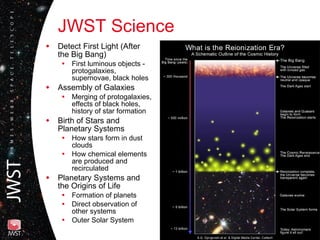
JWST Science Detect First Light (After the Big Bang) First luminous objects - protogalaxies, supernovae, black holes Assembly of Galaxies Merging of protogalaxies, effects of black holes, history of star formation Birth of Stars and Planetary Systems How stars form in dust clouds How chemical elements are produced and recirculated Planetary Systems and the Origins of Life Formation of planets Direct observation of other systems Outer Solar System
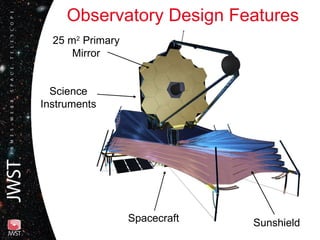
Observatory Design Features Science Instruments Spacecraft Sunshield 25 m 2  Primary Mirror
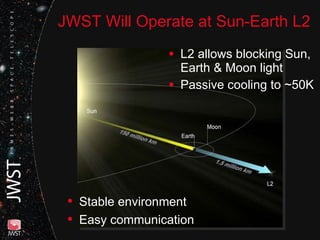
JWST Will Operate at Sun-Earth L2 L2 allows blocking Sun, Earth & Moon light Passive cooling to ~50K Stable environment Easy communication
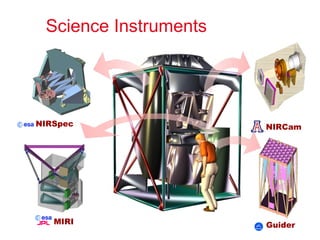
Science Instruments Guider MIRI NIRSpec NIRCam
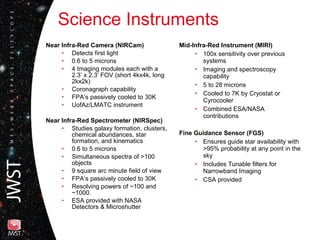
Science Instruments Mid-Infra-Red Instrument (MIRI) 100x sensitivity over previous systems Imaging and spectroscopy capability 5 to 28 microns Cooled to 7K by Cryostat or Cyrocooler Combined ESA/NASA contributions Fine Guidance Sensor (FGS) Ensures guide star availability with >95% probability at any point in the sky Includes Tunable filters for Narrowband Imaging  CSA provided Near Infra-Red Camera (NIRCam) Detects first light 0.6 to 5 microns 4 Imaging modules each with a 2.3’ x 2.3‘ FOV (short 4kx4k, long 2kx2k) Coronagraph capability FPA’s passively cooled to 30K UofAz/LMATC instrument Near Infra-Red Spectrometer (NIRSpec) Studies galaxy formation, clusters, chemical abundances, star formation, and kinematics 0.6 to 5 microns  Simultaneous spectra of >100 objects 9 square arc minute field of view FPA’s passively cooled to 30K Resolving powers of ~100 and ~1000. ESA provided with NASA Detectors & Microshutter
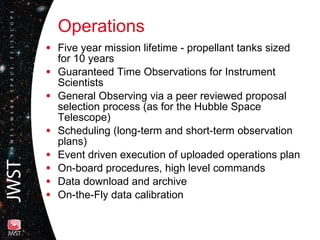
Operations Five year mission lifetime - propellant tanks sized for 10 years Guaranteed Time Observations for Instrument Scientists General Observing via a peer reviewed proposal selection process (as for the Hubble Space Telescope) Scheduling (long-term and short-term observation plans) Event driven execution of uploaded operations plan On-board procedures, high level commands Data download and archive On-the-Fly data calibration
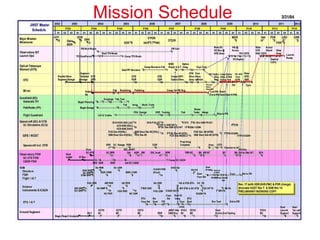
Mission Schedule
Mission Participants NASA ESA CSA Project lead at Goddard Space Flight Center (GSFC) Observatory Contractor: Northrop Grumman Space Technology (NGST) Science and Operations Center at the Space Telescope Science Institute (STScI)
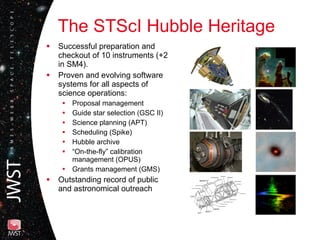
The STScI Hubble Heritage Successful preparation and checkout of 10 instruments (+2 in SM4). Proven and evolving software systems for all aspects of science operations: Proposal management Guide star selection (GSC II) Science planning (APT) Scheduling (Spike) Hubble archive “ On-the-fly” calibration management (OPUS) Grants management (GMS) Outstanding record of public and astronomical outreach
STScI Role in JWST Manage the science program from observing program solicitation and selection to grants management and science outreach support. Operate JWST - beginning in commissioning Develop the science and operations ground systems Perform ground segment verification Perform end to end testing Scientific and Public outreach  Support the Project and JWST teams during the development phase: Mission architecture & system engineering ISIM & Scientific instruments & ISIM flight software Optics and wavefront sensing and control Science and operations input to many working groups
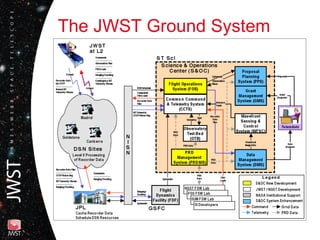
The JWST Ground System
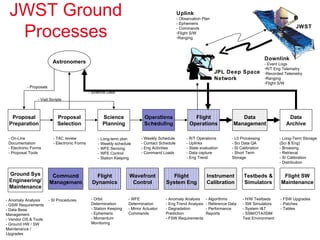
JWST Ground Processes Proposal Preparation Proposal Selection Science Planning Operations Scheduling Flight Operations Data Management Data Archive Ground Sys Engineering/ Maintenance Flight System Eng Testbeds & Simulators Flight Dynamics Wavefront Control Instrument Calibration Command Management Flight SW Maintenance Astronomers Uplink - Observation Plan - Ephemeris - Commands Flight S/W Ranging JPL Deep Space Network JWST Ground Processes  and Key Relationships Downlink - Event Logs R/T Eng Telemetry Recorded Telemetry Ranging Flight S/W JWST - On-Line  Documentation - Electronic Forms - Proposal Tools - TAC review - Electronic Forms - Long-term plan - Weekly schedule - WFE Sensing - WFE Control - Station Keeping - Weekly Schedule - Contact Schedule  - Eng Activities - Command Loads - R/T Operations - Uplinks - State evaluation - Data capture - Eng Trend - L0 Processing - Sci Data QA - SI Calibration - Short Term Storage - Long-Term Storage (Sci & Eng) - Browsing - Retrieval - SI Calibration - Distribution - WFE Determination - Mirror Actuator Commands - FSW Upgrades - Patches - Tables - SI Procedures - Anomaly Analysis - GSW Requirements - Data Base Management - Vendor OS & Tools - Ground HW / SW  Maintenance / Upgrades - H/W Testbeds - SW Simulators - System I&T - SSM/OTA/ISIM Test Environment - Orbit Determination - Station Keeping - Ephemeris - Momentum Monitoring - Anomaly Analysis - Eng Trend Analysis - Degradation Prediction - FSW Requirements - Algorithms - Reference Data - Performance Reports - Proposals - Science Data - Visit Scripts
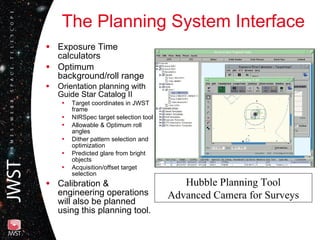
The Planning System Interface Exposure Time calculators Optimum background/roll range Orientation planning with Guide Star Catalog II Target coordinates in JWST frame NIRSpec target selection tool Allowable & Optimum roll angles Dither pattern selection and optimization Predicted glare from bright objects Acquisition/offset target selection Calibration & engineering operations will also be planned using this planning tool. Hubble Planning Tool Advanced Camera for Surveys
Participation in Development Inform the Observatory development process of the science and operations drivers for, and consequences of each design decision.  Ultimate objectives: achieving a high scientific return,  reduced lifecycle cost, efficient operations and design.
Influencing Development - 1 Develop and maintain the Mission Operations Concept Systems Engineering  Participate in requirements development. Evaluate the operations consequences for system level trades. Science Instrument Teams Develop operation concepts with common approaches Develop the calibration plans Gain knowledge of the instruments’ design & behavior Develop the tools and resources the astronomy community will need for high yield science. Flight software Ensure commonality of commanding approaches, syntax and terminology Develop on-board procedures.
Influencing Development - 2 Integration and Test Develop and manage the Project Reference Database  Provide test conductors who will migrate to the operations team  Develop operations procedures - test against simulators and with the ground system in the loop with the flight systems. Commissioning Develop plans and procedures, working with the flight systems developers Operate observatory.
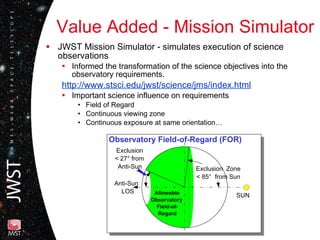
Value Added - Mission Simulator JWST Mission Simulator - simulates execution of science observations  Informed the transformation of the science objectives into the observatory requirements. 	http://www.stsci.edu/jwst/science/jms/index.html Important science influence on requirements Field of Regard Continuous viewing zone Continuous exposure at same orientation… Anti-Sun LOS Allowable Observatory Field-of- Regard SUN Exclusion < 27° from Anti-Sun Exclusion  Zone < 85 °  from Sun Observatory Field-of-Regard (FOR)
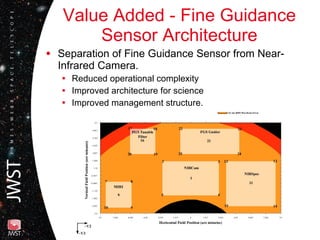
Value Added - Fine Guidance Sensor Architecture Separation of Fine Guidance Sensor from Near-Infrared Camera. Reduced operational complexity Improved architecture for science Improved management structure.
Value Added - Day in the Life Simulations Developed prototype of flight software for event-driven operations including:  Executive and processing functions On-board procedure scripts Commands and telemetry for science instruments and spacecraft Executed on top of Command and Data Handling System flight code running on a flight representative single board computer. Loaded and ran six days of observation plans for three science instruments. Produced detailed event logs plus memory and CPU statistics. The exercise:  developed detailed requirements, confirmed the event driven design with flight like operations,  produced flight like prototypes for the flight software. Now preparing to implement more complex scenarios.
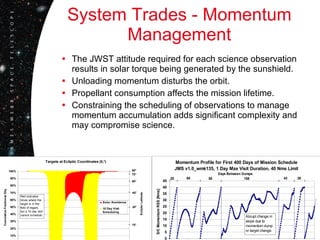
System Trades - Momentum Management The JWST attitude required for each science observation results in solar torque being generated by the sunshield.  Unloading momentum disturbs the orbit. Propellant consumption affects the mission lifetime.  Constraining the scheduling of observations to manage momentum accumulation adds significant complexity and may compromise science.
Ongoing Challenges Aspects of operations are highly sensitive to the flight segment design, such as: Momentum management - smaller sunshield is better Stray light avoidance - larger sunshield is better Both affect scheduling of science observations. Importance of operations involvement in design trades   Funding profile - Pressures on Phase A/B funding Lowest lifecycle cost often requires higher initial outlay but few missions have sufficient early funding. Prioritization of effort in high impact areas. Not everyone has learned the same lessons Different missions follow different paradigms Demonstrate merits of approach by example.
 

Presentation

  • 1.
    The Role ofScience and Operations in the James Web Space Telescope Mission Development Presenter D.G. Hunter Co-authors H.S. Stockman K.S. Long Track T5 May 20, 2004
  • 2.
    JWST Science DetectFirst Light (After the Big Bang) First luminous objects - protogalaxies, supernovae, black holes Assembly of Galaxies Merging of protogalaxies, effects of black holes, history of star formation Birth of Stars and Planetary Systems How stars form in dust clouds How chemical elements are produced and recirculated Planetary Systems and the Origins of Life Formation of planets Direct observation of other systems Outer Solar System
  • 3.
    Observatory Design FeaturesScience Instruments Spacecraft Sunshield 25 m 2 Primary Mirror
  • 4.
    JWST Will Operateat Sun-Earth L2 L2 allows blocking Sun, Earth & Moon light Passive cooling to ~50K Stable environment Easy communication
  • 5.
    Science Instruments GuiderMIRI NIRSpec NIRCam
  • 6.
    Science Instruments Mid-Infra-RedInstrument (MIRI) 100x sensitivity over previous systems Imaging and spectroscopy capability 5 to 28 microns Cooled to 7K by Cryostat or Cyrocooler Combined ESA/NASA contributions Fine Guidance Sensor (FGS) Ensures guide star availability with >95% probability at any point in the sky Includes Tunable filters for Narrowband Imaging CSA provided Near Infra-Red Camera (NIRCam) Detects first light 0.6 to 5 microns 4 Imaging modules each with a 2.3’ x 2.3‘ FOV (short 4kx4k, long 2kx2k) Coronagraph capability FPA’s passively cooled to 30K UofAz/LMATC instrument Near Infra-Red Spectrometer (NIRSpec) Studies galaxy formation, clusters, chemical abundances, star formation, and kinematics 0.6 to 5 microns Simultaneous spectra of >100 objects 9 square arc minute field of view FPA’s passively cooled to 30K Resolving powers of ~100 and ~1000. ESA provided with NASA Detectors & Microshutter
  • 7.
    Operations Five yearmission lifetime - propellant tanks sized for 10 years Guaranteed Time Observations for Instrument Scientists General Observing via a peer reviewed proposal selection process (as for the Hubble Space Telescope) Scheduling (long-term and short-term observation plans) Event driven execution of uploaded operations plan On-board procedures, high level commands Data download and archive On-the-Fly data calibration
  • 8.
  • 9.
    Mission Participants NASAESA CSA Project lead at Goddard Space Flight Center (GSFC) Observatory Contractor: Northrop Grumman Space Technology (NGST) Science and Operations Center at the Space Telescope Science Institute (STScI)
  • 10.
    The STScI HubbleHeritage Successful preparation and checkout of 10 instruments (+2 in SM4). Proven and evolving software systems for all aspects of science operations: Proposal management Guide star selection (GSC II) Science planning (APT) Scheduling (Spike) Hubble archive “ On-the-fly” calibration management (OPUS) Grants management (GMS) Outstanding record of public and astronomical outreach
  • 11.
    STScI Role inJWST Manage the science program from observing program solicitation and selection to grants management and science outreach support. Operate JWST - beginning in commissioning Develop the science and operations ground systems Perform ground segment verification Perform end to end testing Scientific and Public outreach Support the Project and JWST teams during the development phase: Mission architecture & system engineering ISIM & Scientific instruments & ISIM flight software Optics and wavefront sensing and control Science and operations input to many working groups
  • 12.
  • 13.
    JWST Ground ProcessesProposal Preparation Proposal Selection Science Planning Operations Scheduling Flight Operations Data Management Data Archive Ground Sys Engineering/ Maintenance Flight System Eng Testbeds & Simulators Flight Dynamics Wavefront Control Instrument Calibration Command Management Flight SW Maintenance Astronomers Uplink - Observation Plan - Ephemeris - Commands Flight S/W Ranging JPL Deep Space Network JWST Ground Processes and Key Relationships Downlink - Event Logs R/T Eng Telemetry Recorded Telemetry Ranging Flight S/W JWST - On-Line Documentation - Electronic Forms - Proposal Tools - TAC review - Electronic Forms - Long-term plan - Weekly schedule - WFE Sensing - WFE Control - Station Keeping - Weekly Schedule - Contact Schedule - Eng Activities - Command Loads - R/T Operations - Uplinks - State evaluation - Data capture - Eng Trend - L0 Processing - Sci Data QA - SI Calibration - Short Term Storage - Long-Term Storage (Sci & Eng) - Browsing - Retrieval - SI Calibration - Distribution - WFE Determination - Mirror Actuator Commands - FSW Upgrades - Patches - Tables - SI Procedures - Anomaly Analysis - GSW Requirements - Data Base Management - Vendor OS & Tools - Ground HW / SW Maintenance / Upgrades - H/W Testbeds - SW Simulators - System I&T - SSM/OTA/ISIM Test Environment - Orbit Determination - Station Keeping - Ephemeris - Momentum Monitoring - Anomaly Analysis - Eng Trend Analysis - Degradation Prediction - FSW Requirements - Algorithms - Reference Data - Performance Reports - Proposals - Science Data - Visit Scripts
  • 14.
    The Planning SystemInterface Exposure Time calculators Optimum background/roll range Orientation planning with Guide Star Catalog II Target coordinates in JWST frame NIRSpec target selection tool Allowable & Optimum roll angles Dither pattern selection and optimization Predicted glare from bright objects Acquisition/offset target selection Calibration & engineering operations will also be planned using this planning tool. Hubble Planning Tool Advanced Camera for Surveys
  • 15.
    Participation in DevelopmentInform the Observatory development process of the science and operations drivers for, and consequences of each design decision. Ultimate objectives: achieving a high scientific return, reduced lifecycle cost, efficient operations and design.
  • 16.
    Influencing Development -1 Develop and maintain the Mission Operations Concept Systems Engineering Participate in requirements development. Evaluate the operations consequences for system level trades. Science Instrument Teams Develop operation concepts with common approaches Develop the calibration plans Gain knowledge of the instruments’ design & behavior Develop the tools and resources the astronomy community will need for high yield science. Flight software Ensure commonality of commanding approaches, syntax and terminology Develop on-board procedures.
  • 17.
    Influencing Development -2 Integration and Test Develop and manage the Project Reference Database Provide test conductors who will migrate to the operations team Develop operations procedures - test against simulators and with the ground system in the loop with the flight systems. Commissioning Develop plans and procedures, working with the flight systems developers Operate observatory.
  • 18.
    Value Added -Mission Simulator JWST Mission Simulator - simulates execution of science observations Informed the transformation of the science objectives into the observatory requirements. http://www.stsci.edu/jwst/science/jms/index.html Important science influence on requirements Field of Regard Continuous viewing zone Continuous exposure at same orientation… Anti-Sun LOS Allowable Observatory Field-of- Regard SUN Exclusion < 27° from Anti-Sun Exclusion Zone < 85 ° from Sun Observatory Field-of-Regard (FOR)
  • 19.
    Value Added -Fine Guidance Sensor Architecture Separation of Fine Guidance Sensor from Near-Infrared Camera. Reduced operational complexity Improved architecture for science Improved management structure.
  • 20.
    Value Added -Day in the Life Simulations Developed prototype of flight software for event-driven operations including: Executive and processing functions On-board procedure scripts Commands and telemetry for science instruments and spacecraft Executed on top of Command and Data Handling System flight code running on a flight representative single board computer. Loaded and ran six days of observation plans for three science instruments. Produced detailed event logs plus memory and CPU statistics. The exercise: developed detailed requirements, confirmed the event driven design with flight like operations, produced flight like prototypes for the flight software. Now preparing to implement more complex scenarios.
  • 21.
    System Trades -Momentum Management The JWST attitude required for each science observation results in solar torque being generated by the sunshield. Unloading momentum disturbs the orbit. Propellant consumption affects the mission lifetime. Constraining the scheduling of observations to manage momentum accumulation adds significant complexity and may compromise science.
  • 22.
    Ongoing Challenges Aspectsof operations are highly sensitive to the flight segment design, such as: Momentum management - smaller sunshield is better Stray light avoidance - larger sunshield is better Both affect scheduling of science observations. Importance of operations involvement in design trades Funding profile - Pressures on Phase A/B funding Lowest lifecycle cost often requires higher initial outlay but few missions have sufficient early funding. Prioritization of effort in high impact areas. Not everyone has learned the same lessons Different missions follow different paradigms Demonstrate merits of approach by example.
  • 23.