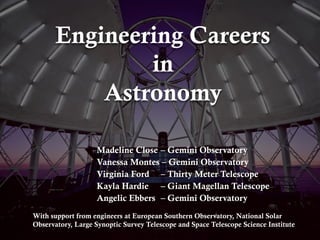
Engineering Careers
in
Astronomy
Madeline Close – Gemini Observatory
Vanessa Montes – Gemini Observatory
Virginia Ford – Thirty Meter Telescope
Kayla Hardie – Giant Magellan Telescope
Angelic Ebbers – Gemini Observatory
With support from engineers at European Southern Observatory, National Solar
Observatory, Large Synoptic Survey Telescope and Space Telescope Science Institute
Today’s Talk
  What do engineers have to do with astronomy?
§  Panel members will speak about our current work, how we became
involved in astronomy and what our biggest lessons have been.
§  Opportunity for Q&A
  What do engineers do in astronomy?
§  Interactive activity about the many roles and projects that different
engineering disciplines are involved with.
  What is next for engineers in astronomy?
§  What key projects and technologies are the future of astronomy
§  Opportunity for Q&A
  What to take away:
§  Astronomy needs engineers from many disciplines
§  Astronomy offers exciting opportunities and work for engineers
What do engineers have to do with astronomy?
  The short answer: Lots!
§  How many electrical engineers are in the audience?
§  How many mechanical …
§  How many optical …
§  How many software …
§  How many aerospace …
  Astronomy needs all of your skill sets!
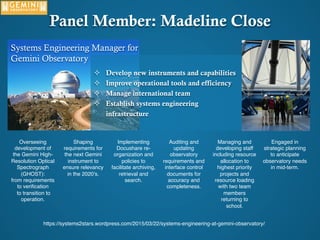
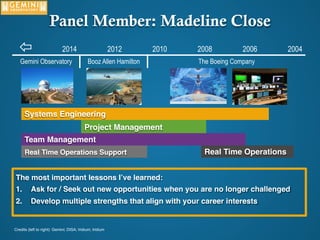
Panel Member: Madeline Close
Systems Engineering Manager for
Gemini Observatory
²  Develop new instruments and capabilities
²  Improve operational tools and efficiency
²  Manage international team
²  Establish systems engineering
infrastructure
Overseeing
development of
the Gemini High-
Resolution Optical
Spectrograph
(GHOST):
from requirements
to verification
to transition to
operation.
Shaping
requirements for
the next Gemini
instrument to
ensure relevancy
in the 2020’s.
Implementing
Docushare re-
organization and
policies to
facilitate archiving,
retrieval and
search.
Auditing and
updating
observatory
requirements and
interface control
documents for
accuracy and
completeness.
Managing and
developing staff
including resource
allocation to
highest priority
projects and
resource loading
with two team
members
returning to
school.
Engaged in
strategic planning
to anticipate
observatory needs
in mid-term.
https://systems2stars.wordpress.com/2015/03/22/systems-engineering-at-gemini-observatory/
The most important lessons I’ve learned:
1.  Ask for / Seek out new opportunities when you are no longer challenged
2.  Develop multiple strengths that align with your career interests
Credits (left to right): Gemini; DISA; Iridium; Iridium
Real Time Operations Support
Systems Engineering
Team Management
Project Management
Real Time Operations
ñ
2014 2012 2010 2008 2006 2004
Gemini Observatory Booz Allen Hamilton The Boeing Company
Panel Member: Madeline Close
Panel	
  Member:	
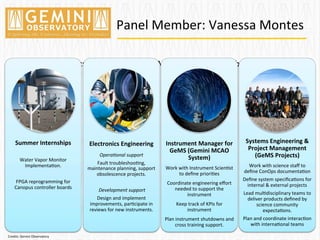
  Vanessa	
  Montes	
  
Electronics	
  Engineer	
  &	
  Project	
  Manager	
  at	
  Gemini	
  Observatory	


Summer	
  Internships	


Water	
  Vapor	
  Monitor	
  
Implementa=on.	


FPGA	
  reprogramming	
  for	
  
Canopus	
  controller	
  boards	
  
Electronics	
  Engineering	


Opera&onal	
  support	
  
Fault	
  troubleshoo=ng,	
  
maintenance	
  planning,	
  support	
  
obsolescence	
  projects.	


  Development	
  support	
  
Design	
  and	
  implement	
  
improvements,	
  par=cipate	
  in	
  
reviews	
  for	
  new	
  instruments.	


Instrument	
  Manager	
  for	
  
GeMS	
  (Gemini	
  MCAO	
  
System)	


Work	
  with	
  Instrument	
  Scien=st	
  
to	
  define	
  priori=es	


Coordinate	
  engineering	
  effort	
  
needed	
  to	
  support	
  the	
  
instrument	


Keep	
  track	
  of	
  KPIs	
  for	
  
instrument	


Plan	
  instrument	
  shutdowns	
  and	
  
cross	
  training	
  support.	


Systems	
  Engineering	
  &	
  
Project	
  Management	
  
(GeMS	
  Projects)	


Work	
  with	
  science	
  staff	
  to	
  
define	
  ConOps	
  documenta=on	
  
Define	
  system	
  specifica=ons	
  for	
  
internal	
  &	
  external	
  projects	
  
Lead	
  mul=disciplinary	
  teams	
  to	
  
deliver	
  products	
  defined	
  by	
  
science	
  community	
  
expecta=ons.	
  
Plan	
  and	
  coordinate	
  interac=on	
  
with	
  interna=onal	
  teams	
  	
  
Credits:	
  Gemini	
  Observatory	
  
Panel	
  Member:	
  Vanessa	
  Montes	
  
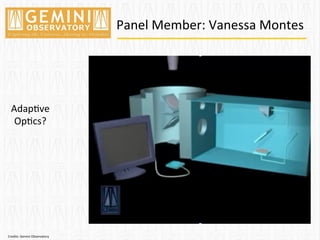
Adap=ve	
  
Op=cs?	
  
Credits:	
  Gemini	
  Observatory	
  
Panel	
  Member:	
  Vanessa	
  Montes	
  
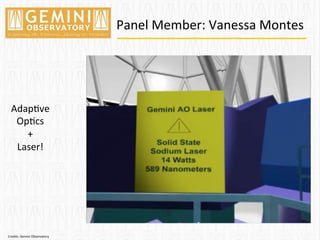
Adap=ve	
  
Op=cs	
  
+	
  
Laser!	
  
Credits:	
  Gemini	
  Observatory	
  
Panel	
  Member:	
  Vanessa	
  Montes	
  
Most	
  important	
  lessons	
  learned	
  so	
  far…	
  
o  Communicate	
  posi=vely	
  and	
  effec=vely	
  	
  
o  Choose	
  your	
  baTles	
  
o  Find	
  a	
  sponsor	
  –	
  someone	
  who	
  advocates	
  for	
  you	
  when	
  you	
  
are	
  not	
  there	
  
o  Be	
  you!	


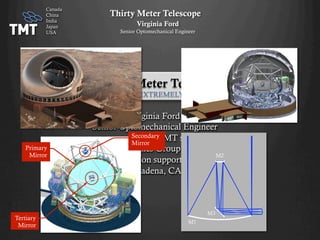
Virginia Ford
Senior Optomechanical Engineer
member of TMT staff
Optics Group
non-profit organization supported by 5 countries
Pasadena, CA
Thirty Meter Telescope
NEXT GENERATION EXTREMELY LARGE TELESCOPE
M3
M1
M2
Secondary
Mirror
Tertiary
Mirror
Primary
Mirror
Thirty Meter Telescope
Virginia Ford
Senior Optomechanical Engineer
Canada
China
India
Japan
USA
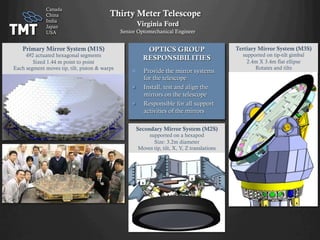
Primary Mirror System (M1S)
492 actuated hexagonal segments
Sized 1.44 m point to point
Each segment moves tip, tilt, piston & warps
Secondary Mirror System (M2S)
supported on a hexapod
Size: 3.2m diameter
Moves tip, tilt, X, Y, Z translations
OPTICS GROUP
RESPONSIBILITIES
Provide the mirror systems
for the telescope
Install, test and align the
mirrors on the telescope
Responsible for all support
activities of the mirrors
Tertiary Mirror System (M3S)
supported on tip-tilt gimbal
2.4m X 3.4m flat ellipse
Rotates and tilts
Thirty Meter Telescope
Virginia Ford
Senior Optomechanical Engineer
Canada
China
India
Japan
USA
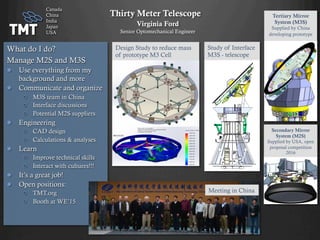
Tertiary Mirror
System (M3S)
Supplied by China
developing prototype
Secondary Mirror
System (M2S)
Supplied by USA, open
proposal competition
2016
Study of Interface
M3S - telescope
Design Study to reduce mass
of prototype M3 Cell
What do I do?
Manage M2S and M3S
Use everything from my
background and more
Communicate and organize
M3S team in China
Interface discussions
Potential M2S suppliers
Engineering
CAD design
Calculations & analyses
Learn
Improve technical skills
Interact with cultures!!!
It’s a great job!
Open positions:
TMT.org
Booth at WE’15
Meeting in China
Thirty Meter Telescope
Virginia Ford
Senior Optomechanical Engineer
Canada
China
India
Japan
USA
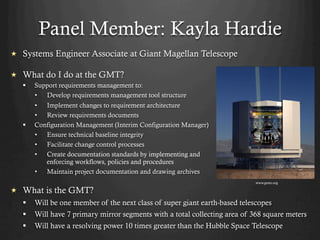
Panel Member: Kayla Hardie
  Systems Engineer Associate at Giant Magellan Telescope
  What do I do at the GMT?
§  Support requirements management to:
•  Develop requirements management tool structure
•  Implement changes to requirement architecture
•  Review requirements documents
§  Configuration Management (Interim Configuration Manager)
•  Ensure technical baseline integrity
•  Facilitate change control processes
•  Create documentation standards by implementing and
enforcing workflows, policies and procedures
•  Maintain project documentation and drawing archives
  What is the GMT?
§  Will be one member of the next class of super giant earth-based telescopes
§  Will have 7 primary mirror segments with a total collecting area of 368 square meters
§  Will have a resolving power 10 times greater than the Hubble Space Telescope
www.gmto.org
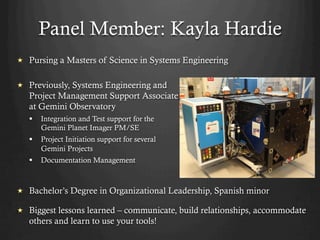
Panel Member: Kayla Hardie
  Previously, Systems Engineering and
Project Management Support Associate
at Gemini Observatory
§  Integration and Test support for the
Gemini Planet Imager PM/SE
§  Project Initiation support for several
Gemini Projects
§  Documentation Management
  Bachelor’s Degree in Organizational Leadership, Spanish minor
  Biggest lessons learned – communicate, build relationships, accommodate
others and learn to use your tools!
  Pursing a Masters of Science in Systems Engineering
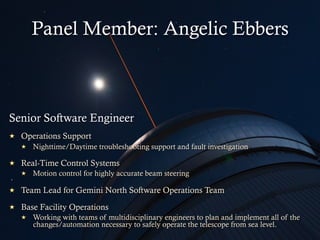
Senior Software Engineer
  Operations Support
  Nighttime/Daytime troubleshooting support and fault investigation
  Real-Time Control Systems
  Motion control for highly accurate beam steering
  Team Lead for Gemini North Software Operations Team
  Base Facility Operations
  Working with teams of multidisciplinary engineers to plan and implement all of the
changes/automation necessary to safely operate the telescope from sea level.
Panel Member: Angelic Ebbers
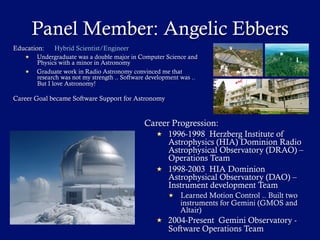
Career Progression:
  1996-1998 Herzberg Institute of
Astrophysics (HIA) Dominion Radio
Astrophysical Observatory (DRAO) –
Operations Team
  1998-2003 HIA Dominion
Astrophysical Observatory (DAO) –
Instrument development Team
  Learned Motion Control .. Built two
instruments for Gemini (GMOS and
Altair)
  2004-Present Gemini Observatory -
Software Operations Team
Education: Hybrid Scientist/Engineer
  Undergraduate was a double major in Computer Science and
Physics with a minor in Astronomy
  Graduate work in Radio Astronomy convinced me that
research was not my strength .. Software development was ..
But I love Astronomy!
Career Goal became Software Support for Astronomy
What do engineers do in astronomy?
Activity
  Find a partner or two!
  Open up the Activity Booklet. Read each Narrative and
decide which engineering discipline it represents.
  Engineers will be walking around to answer questions and
help out.
  Once finished, raise your hand to get an answer key.
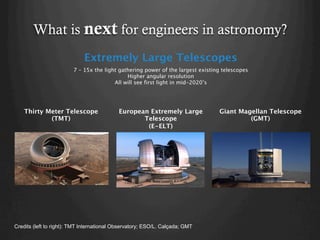
What is next for engineers in astronomy?
Extremely Large Telescopes
7 – 15x the light gathering power of the largest existing telescopes
Higher angular resolution
All will see first light in mid-2020’s
Thirty Meter Telescope
(TMT)
European Extremely Large
Telescope
(E-ELT)
Giant Magellan Telescope
(GMT)
Credits (left to right): TMT International Observatory; ESO/L. Calçada; GMT
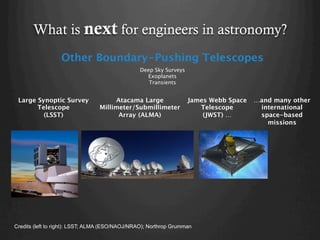
What is next for engineers in astronomy?
Other Boundary-Pushing Telescopes
Deep Sky Surveys
Exoplanets
Transients
Large Synoptic Survey
Telescope
(LSST)
Atacama Large
Millimeter/Submillimeter
Array (ALMA)
James Webb Space
Telescope
(JWST) …
…and many other
international
space-based
missions
Credits (left to right): LSST; ALMA (ESO/NAOJ/NRAO); Northrop Grumman
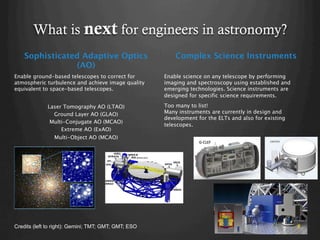
What is next for engineers in astronomy?
Sophisticated Adaptive Optics
(AO)
Complex Science Instruments
Enable ground-based telescopes to correct for
atmospheric turbulence and achieve image quality
equivalent to space-based telescopes.
Enable science on any telescope by performing
imaging and spectroscopy using established and
emerging technologies. Science instruments are
designed for specific science requirements.
Laser Tomography AO (LTAO)
Ground Layer AO (GLAO)
Multi-Conjugate AO (MCAO)
Extreme AO (ExAO)
Multi-Object AO (MCAO)
Too many to list!
Many instruments are currently in design and
development for the ELTs and also for existing
telescopes.
Credits (left to right): Gemini; TMT; GMT; GMT; ESO
What is next for engineers in astronomy?
Credits: TMT International Observatory
Thank You!
Thank you to the following organizations for participating in SWE this year:
Gemini Observatory www.gemini.edu
Thirty Meter Telescope International Observatory www.tmt.org
Giant Magellan Telescope www.gmto.org
European Southern Observatory www.eso.org
Large Synoptic Survey Telescope www.lsst.org
National Solar Observatory www.nso.edu
Space Telescope Science Institute www.stsci.edu
Association of Universities for Research in Astronomy www.aura-astronomy.org

Engineering Careers in Astronomy

  • 1.
    Engineering Careers in Astronomy Madeline Close– Gemini Observatory Vanessa Montes – Gemini Observatory Virginia Ford – Thirty Meter Telescope Kayla Hardie – Giant Magellan Telescope Angelic Ebbers – Gemini Observatory With support from engineers at European Southern Observatory, National Solar Observatory, Large Synoptic Survey Telescope and Space Telescope Science Institute
  • 2.
    Today’s Talk   Whatdo engineers have to do with astronomy? §  Panel members will speak about our current work, how we became involved in astronomy and what our biggest lessons have been. §  Opportunity for Q&A   What do engineers do in astronomy? §  Interactive activity about the many roles and projects that different engineering disciplines are involved with.   What is next for engineers in astronomy? §  What key projects and technologies are the future of astronomy §  Opportunity for Q&A   What to take away: §  Astronomy needs engineers from many disciplines §  Astronomy offers exciting opportunities and work for engineers
  • 3.
    What do engineershave to do with astronomy?   The short answer: Lots! §  How many electrical engineers are in the audience? §  How many mechanical … §  How many optical … §  How many software … §  How many aerospace …   Astronomy needs all of your skill sets!
  • 4.
    Panel Member: MadelineClose Systems Engineering Manager for Gemini Observatory ²  Develop new instruments and capabilities ²  Improve operational tools and efficiency ²  Manage international team ²  Establish systems engineering infrastructure Overseeing development of the Gemini High- Resolution Optical Spectrograph (GHOST): from requirements to verification to transition to operation. Shaping requirements for the next Gemini instrument to ensure relevancy in the 2020’s. Implementing Docushare re- organization and policies to facilitate archiving, retrieval and search. Auditing and updating observatory requirements and interface control documents for accuracy and completeness. Managing and developing staff including resource allocation to highest priority projects and resource loading with two team members returning to school. Engaged in strategic planning to anticipate observatory needs in mid-term. https://systems2stars.wordpress.com/2015/03/22/systems-engineering-at-gemini-observatory/
  • 5.
    The most importantlessons I’ve learned: 1.  Ask for / Seek out new opportunities when you are no longer challenged 2.  Develop multiple strengths that align with your career interests Credits (left to right): Gemini; DISA; Iridium; Iridium Real Time Operations Support Systems Engineering Team Management Project Management Real Time Operations ñ 2014 2012 2010 2008 2006 2004 Gemini Observatory Booz Allen Hamilton The Boeing Company Panel Member: Madeline Close
  • 6.
    Panel  Member:  Vanessa  Montes   Electronics  Engineer  &  Project  Manager  at  Gemini  Observatory     Summer  Internships     Water  Vapor  Monitor   Implementa=on.     FPGA  reprogramming  for   Canopus  controller  boards   Electronics  Engineering     Opera&onal  support   Fault  troubleshoo=ng,   maintenance  planning,  support   obsolescence  projects.      Development  support   Design  and  implement   improvements,  par=cipate  in   reviews  for  new  instruments.     Instrument  Manager  for   GeMS  (Gemini  MCAO   System)     Work  with  Instrument  Scien=st   to  define  priori=es     Coordinate  engineering  effort   needed  to  support  the   instrument         Keep  track  of  KPIs  for   instrument       Plan  instrument  shutdowns  and   cross  training  support.         Systems  Engineering  &   Project  Management   (GeMS  Projects)     Work  with  science  staff  to   define  ConOps  documenta=on   Define  system  specifica=ons  for   internal  &  external  projects   Lead  mul=disciplinary  teams  to   deliver  products  defined  by   science  community   expecta=ons.   Plan  and  coordinate  interac=on   with  interna=onal  teams     Credits:  Gemini  Observatory  
  • 7.
    Panel  Member:  Vanessa  Montes   Adap=ve   Op=cs?   Credits:  Gemini  Observatory  
  • 8.
    Panel  Member:  Vanessa  Montes   Adap=ve   Op=cs   +   Laser!   Credits:  Gemini  Observatory  
  • 9.
    Panel  Member:  Vanessa  Montes   Most  important  lessons  learned  so  far…   o  Communicate  posi=vely  and  effec=vely     o  Choose  your  baTles   o  Find  a  sponsor  –  someone  who  advocates  for  you  when  you   are  not  there   o  Be  you!    
  • 10.
    Virginia Ford Senior OptomechanicalEngineer member of TMT staff Optics Group non-profit organization supported by 5 countries Pasadena, CA Thirty Meter Telescope NEXT GENERATION EXTREMELY LARGE TELESCOPE M3 M1 M2 Secondary Mirror Tertiary Mirror Primary Mirror Thirty Meter Telescope Virginia Ford Senior Optomechanical Engineer Canada China India Japan USA
  • 11.
    Primary Mirror System(M1S) 492 actuated hexagonal segments Sized 1.44 m point to point Each segment moves tip, tilt, piston & warps Secondary Mirror System (M2S) supported on a hexapod Size: 3.2m diameter Moves tip, tilt, X, Y, Z translations OPTICS GROUP RESPONSIBILITIES Provide the mirror systems for the telescope Install, test and align the mirrors on the telescope Responsible for all support activities of the mirrors Tertiary Mirror System (M3S) supported on tip-tilt gimbal 2.4m X 3.4m flat ellipse Rotates and tilts Thirty Meter Telescope Virginia Ford Senior Optomechanical Engineer Canada China India Japan USA
  • 12.
    Tertiary Mirror System (M3S) Suppliedby China developing prototype Secondary Mirror System (M2S) Supplied by USA, open proposal competition 2016 Study of Interface M3S - telescope Design Study to reduce mass of prototype M3 Cell What do I do? Manage M2S and M3S Use everything from my background and more Communicate and organize M3S team in China Interface discussions Potential M2S suppliers Engineering CAD design Calculations & analyses Learn Improve technical skills Interact with cultures!!! It’s a great job! Open positions: TMT.org Booth at WE’15 Meeting in China Thirty Meter Telescope Virginia Ford Senior Optomechanical Engineer Canada China India Japan USA
  • 13.
    Panel Member: KaylaHardie   Systems Engineer Associate at Giant Magellan Telescope   What do I do at the GMT? §  Support requirements management to: •  Develop requirements management tool structure •  Implement changes to requirement architecture •  Review requirements documents §  Configuration Management (Interim Configuration Manager) •  Ensure technical baseline integrity •  Facilitate change control processes •  Create documentation standards by implementing and enforcing workflows, policies and procedures •  Maintain project documentation and drawing archives   What is the GMT? §  Will be one member of the next class of super giant earth-based telescopes §  Will have 7 primary mirror segments with a total collecting area of 368 square meters §  Will have a resolving power 10 times greater than the Hubble Space Telescope www.gmto.org
  • 14.
    Panel Member: KaylaHardie   Previously, Systems Engineering and Project Management Support Associate at Gemini Observatory §  Integration and Test support for the Gemini Planet Imager PM/SE §  Project Initiation support for several Gemini Projects §  Documentation Management   Bachelor’s Degree in Organizational Leadership, Spanish minor   Biggest lessons learned – communicate, build relationships, accommodate others and learn to use your tools!   Pursing a Masters of Science in Systems Engineering
  • 15.
    Senior Software Engineer  Operations Support   Nighttime/Daytime troubleshooting support and fault investigation   Real-Time Control Systems   Motion control for highly accurate beam steering   Team Lead for Gemini North Software Operations Team   Base Facility Operations   Working with teams of multidisciplinary engineers to plan and implement all of the changes/automation necessary to safely operate the telescope from sea level. Panel Member: Angelic Ebbers
  • 16.
    Panel Member: AngelicEbbers Career Progression:   1996-1998 Herzberg Institute of Astrophysics (HIA) Dominion Radio Astrophysical Observatory (DRAO) – Operations Team   1998-2003 HIA Dominion Astrophysical Observatory (DAO) – Instrument development Team   Learned Motion Control .. Built two instruments for Gemini (GMOS and Altair)   2004-Present Gemini Observatory - Software Operations Team Education: Hybrid Scientist/Engineer   Undergraduate was a double major in Computer Science and Physics with a minor in Astronomy   Graduate work in Radio Astronomy convinced me that research was not my strength .. Software development was .. But I love Astronomy! Career Goal became Software Support for Astronomy
  • 17.
    What do engineersdo in astronomy? Activity   Find a partner or two!   Open up the Activity Booklet. Read each Narrative and decide which engineering discipline it represents.   Engineers will be walking around to answer questions and help out.   Once finished, raise your hand to get an answer key.
  • 18.
    What is nextfor engineers in astronomy? Extremely Large Telescopes 7 – 15x the light gathering power of the largest existing telescopes Higher angular resolution All will see first light in mid-2020’s Thirty Meter Telescope (TMT) European Extremely Large Telescope (E-ELT) Giant Magellan Telescope (GMT) Credits (left to right): TMT International Observatory; ESO/L. Calçada; GMT
  • 19.
    What is nextfor engineers in astronomy? Other Boundary-Pushing Telescopes Deep Sky Surveys Exoplanets Transients Large Synoptic Survey Telescope (LSST) Atacama Large Millimeter/Submillimeter Array (ALMA) James Webb Space Telescope (JWST) … …and many other international space-based missions Credits (left to right): LSST; ALMA (ESO/NAOJ/NRAO); Northrop Grumman
  • 20.
    What is nextfor engineers in astronomy? Sophisticated Adaptive Optics (AO) Complex Science Instruments Enable ground-based telescopes to correct for atmospheric turbulence and achieve image quality equivalent to space-based telescopes. Enable science on any telescope by performing imaging and spectroscopy using established and emerging technologies. Science instruments are designed for specific science requirements. Laser Tomography AO (LTAO) Ground Layer AO (GLAO) Multi-Conjugate AO (MCAO) Extreme AO (ExAO) Multi-Object AO (MCAO) Too many to list! Many instruments are currently in design and development for the ELTs and also for existing telescopes. Credits (left to right): Gemini; TMT; GMT; GMT; ESO
  • 21.
    What is nextfor engineers in astronomy? Credits: TMT International Observatory
  • 22.
    Thank You! Thank youto the following organizations for participating in SWE this year: Gemini Observatory www.gemini.edu Thirty Meter Telescope International Observatory www.tmt.org Giant Magellan Telescope www.gmto.org European Southern Observatory www.eso.org Large Synoptic Survey Telescope www.lsst.org National Solar Observatory www.nso.edu Space Telescope Science Institute www.stsci.edu Association of Universities for Research in Astronomy www.aura-astronomy.org