Master Universitario en Astrof´ısica
Universidad Complutense de Madrid
Trabajo de fin de M´aster
Definition of the mission statement for
the ‘La Pinta’ interstellar project
Author:
Julia Mar´ın-Yaseli de la Parra
European Space Astronomy Centre
Supervisor:
Dr. Jos´e A. Caballero
Centro de Astrobiolog´ıa
Departmento de Astrof´ısica
Tutor:
Prof. David Montes
September 2015
I, Julia Mar´ın-Yaseli de la Parra, declare that this thesis titled, ‘Definition of the mission
statement for the ‘La Pinta’ interstellar project’ and the work presented in it are my
own. I confirm that:
This work was done wholly while in candidature for a research degree at this
University.
Any art of this thesis has previously been submitted for a degree or any other
qualification at this University or any other institution
Where I have consulted the published work of others, this is always clearly at-
tributed.
Where I have quoted from the work of others, the source is always given. With
the exception of such quotations, this thesis is entirely my own work.
I have acknowledged all main sources of help.
Signed:
Date: Tres Cantos, 03 September 2015
‘If we are alone in the Universe, it sure
seems like an awful waste of space’
Carl Sagan
Abstract
Today thousands of exoplanets are already known. In the next decade tens of thousands
will be identify, and some of them will be in habitable zones around stars in the solar
neighbourhood. Missions HARPS, Kepler or Gaia are fully working on the search of
new planets and will be substituted by TESS, CARMENES, Cheops , JWST or HiRes
in the E-ELT. Perhaps the next step will be a ‘neo-Darwin’ mission or even an optical-
infrared interferometer on the Moon. It is possible to speculate what could happen in a
few decades; to send robotic missions in situ exploration of other planetary systems.
The goal of the project is to develop the concept of ‘starship’ and to define the require-
ments and perform the phase 0 according with Standards of ESA, ECSS.
After several iterations there is no doubt about the viability of a project of this impor-
tance, but the costs would be high due to the novelty of the technology. There are still
some aspects to be developed further in subsequent phases which could cause deviations
from the actual results. Unfortunately the short duration of this project does not allow
to go further.
Rodrigo de Triana sighted a ‘new continent’ from La Pinta; maybe ‘La Pinta’ observes
a new continent in another exoplanet.
Resumen
Hoy en d´ıa se conocen miles de exoplanetas. En la pr´oxima d´ecada decenas de miles se
identificar´an, algunos de ellos en las regiones de habitabilidad orbitando estrellas veci-
nas al Sol. Misiones como HARPS, Kepler o Gaia operan actualmente para dejar paso
a TESS, CARMENES, Cheops , JWST o HiRes en el E-ELT en un futuro pr´oximo.
Probablemente el siguiente paso sea una misi´on ”neo-darwiniana” o incluso un inter-
fer´ometro en ´optico-IR en la Luna. En las pr´oximas d´ecadas es muy posible que una
misi´on rob´otica se aventure a explorar in situ nuevos sistemas planetarios.
El objetivo de este proyecto es desarrollar el concepto de ”nave estelar” y definir los
requisitos y el desarrollo de una primera fase preliminar, de acuerdo con los est´andares
ESA, ECSS.
Tras diversas iteraciones no hay duda acerca de la viabilidad de un proyecto de este
calibre, aunque los costes ser´ıan elevados debido a lo novedoso de la tecnolog´ıa y quedan
algunos aspectos a desarrollar en profundidad en siguientes fases lo que podr´ıa hacer
variar los resultados obtenidos en estos c´alculos. Lamentablemente la corta duraci´on de
este proyecto no permite ir m´as all´a.
Rodrigo de Triana divis´o un nuevo continente desde La Pinta; quiz´as ”La Pinta” observe
un nuevo continente en un exoplaneta.
Acknowledgements
It is a pleasure to express my gratitude to my supervisor, Jos´e A. Caballero, who has
provide me with the freedom to work autonomously in order to be able to juggle science
operations of Rosetta, where I currently work with the development of this work.
I want to dedicate this small project to Alvaro Ortiz and Ainhoa Mendizabal who have
been my coaches and mentors in Deimos 2 satellite operations team.
v
Contents
Abstract iv
Acknowledgements v
Contents vi
List of Figures viii
List of Tables ix
Abbreviations x
1 Introduction 1
1.1 Project Phasing and Planning . . . . . . . . . . . . . . . . . . . . . . . . . 1
1.1.1 Conceptual Study or Needs Identification . . . . . . . . . . . . . . 2
1.2 Objectives of this thesis . . . . . . . . . . . . . . . . . . . . . . . . . . . . 3
1.3 La Pinta Mission objetives . . . . . . . . . . . . . . . . . . . . . . . . . . . 3
2 State of the art 5
2.1 A little bit of history . . . . . . . . . . . . . . . . . . . . . . . . . . . . . . 5
2.2 Historical spacecraft . . . . . . . . . . . . . . . . . . . . . . . . . . . . . . 6
2.2.1 The Pioneers . . . . . . . . . . . . . . . . . . . . . . . . . . . . . . 6
2.2.2 The Voyagers . . . . . . . . . . . . . . . . . . . . . . . . . . . . . . 6
2.2.3 Project Daedalus . . . . . . . . . . . . . . . . . . . . . . . . . . . . 7
2.2.4 Project Longshot . . . . . . . . . . . . . . . . . . . . . . . . . . . . 7
2.2.5 Orion as a reference of propulsion. . . . . . . . . . . . . . . . . . . 7
2.2.6 New Horizons and the viability of a real mission towards the Solar
System. . . . . . . . . . . . . . . . . . . . . . . . . . . . . . . . . . 7
2.2.7 Interstellar Boundary Explorer. New future data from interstellar
boundary . . . . . . . . . . . . . . . . . . . . . . . . . . . . . . . . 8
2.2.8 Rosetta mission and its complex instruments as a reference of pay-
load . . . . . . . . . . . . . . . . . . . . . . . . . . . . . . . . . . . 8
2.3 The α Centauri system . . . . . . . . . . . . . . . . . . . . . . . . . . . . . 9
3 Mission Overview and Operational concept 10
3.1 Principle Operational Rules . . . . . . . . . . . . . . . . . . . . . . . . . . 10
vi
Contents vii
3.2 Mission analysis concept . . . . . . . . . . . . . . . . . . . . . . . . . . . . 10
3.2.1 Orbital design . . . . . . . . . . . . . . . . . . . . . . . . . . . . . 11
3.2.2 Environmental analysis overview . . . . . . . . . . . . . . . . . . . 13
3.2.2.1 Local Interestellar Medium . . . . . . . . . . . . . . . . . 13
3.2.2.2 Collision avoidance protocol . . . . . . . . . . . . . . . . 13
3.2.3 Thermal protection . . . . . . . . . . . . . . . . . . . . . . . . . . . 14
3.3 Launcher’s needs . . . . . . . . . . . . . . . . . . . . . . . . . . . . . . . . 14
3.4 Instrument Planning . . . . . . . . . . . . . . . . . . . . . . . . . . . . . . 14
3.4.1 Instrument Objectives . . . . . . . . . . . . . . . . . . . . . . . . . 14
3.4.2 Instrument Description . . . . . . . . . . . . . . . . . . . . . . . . 15
3.4.3 Mission Planning Operations . . . . . . . . . . . . . . . . . . . . . 16
3.4.4 Instrument Operations Execution . . . . . . . . . . . . . . . . . . . 16
3.4.5 Instrument Data Processing . . . . . . . . . . . . . . . . . . . . . . 17
3.4.6 Instrument Maintenance . . . . . . . . . . . . . . . . . . . . . . . . 17
3.5 Conclusion . . . . . . . . . . . . . . . . . . . . . . . . . . . . . . . . . . . 17
4 Systems 18
4.1 Flight segment overview . . . . . . . . . . . . . . . . . . . . . . . . . . . . 18
4.1.1 Primary propulsion system . . . . . . . . . . . . . . . . . . . . . . 18
4.1.1.1 Secondary propulsion system: Solar sails . . . . . . . . . 19
4.1.2 Electrical Power System . . . . . . . . . . . . . . . . . . . . . . . 19
4.1.3 AOCS . . . . . . . . . . . . . . . . . . . . . . . . . . . . . . . . . . 19
4.1.3.1 Some possible solutions: the ‘Buoy satellite’ . . . . . . . 19
4.1.4 COMMS . . . . . . . . . . . . . . . . . . . . . . . . . . . . . . . . 20
4.1.5 OBC . . . . . . . . . . . . . . . . . . . . . . . . . . . . . . . . . . . 20
4.1.6 Payload: EXOS (Exoplanet Observation System) . . . . . . . . . 20
4.1.7 Secondary payload . . . . . . . . . . . . . . . . . . . . . . . . . . . 21
4.2 Ground Segment Overview . . . . . . . . . . . . . . . . . . . . . . . . . . 21
4.3 Mission requirements . . . . . . . . . . . . . . . . . . . . . . . . . . . . . . 22
5 Risk / limitations 23
5.1 Risk identification and assessment . . . . . . . . . . . . . . . . . . . . . . 23
6 Conclusions 25
A Documentation for Mission Definition Review and next expected phases
26
A.1 Mission Definition Review (MDR) . . . . . . . . . . . . . . . . . . . . . . 26
A.2 Programme Plans . . . . . . . . . . . . . . . . . . . . . . . . . . . . . . . . 27
B Satellite preliminar design 28
Bibliography 30
List of Figures
1.1 General mission concept design. . . . . . . . . . . . . . . . . . . . . . . . . 4
B.1 Preliminar design overview. . . . . . . . . . . . . . . . . . . . . . . . . . . 28
B.2 Preliminar design overview 2. . . . . . . . . . . . . . . . . . . . . . . . . . 29
viii
List of Tables
1.1 La Pinta Mission objectives. . . . . . . . . . . . . . . . . . . . . . . . . . 4
2.1 α Cen B Star and planet characteristics. . . . . . . . . . . . . . . . . . . . 9
3.1 Linear velocity scale to α Cen (neglecting relativistic effects) . . . . . . . 11
3.2 Linear mission analysis to effective α Cen. . . . . . . . . . . . . . . . . . . 12
3.3 Approximate mission profile for a 10-ton flyby interstellar probe α Cen. . 13
3.4 Launcher candidates for the ‘La Pinta’. . . . . . . . . . . . . . . . . . . . 14
3.5 Potential science drivers. . . . . . . . . . . . . . . . . . . . . . . . . . . . . 16
4.1 Mission requirements for interstellar probe α Cen. . . . . . . . . . . . . . 22
5.1 La Pinta Mission risk identification list. . . . . . . . . . . . . . . . . . . . 24
A.1 Programme Plans . . . . . . . . . . . . . . . . . . . . . . . . . . . . . . . . 27
ix
Abbreviations
α Cen Alpha Centauri
AIAA American Institute (of) Aeronautics and Astronautics
AO Announcement (of) Opportunities
au astronomical unit
ECSS European Cooperation on Space Standarization
ESA European Space Agency
GSD Ground Sampling Distance
HK HouseKeeping
IBEX Interstellar Boundary Explorer
IFOP Instrument Flight Operations Plan
IRAS Infra Red Astronomical Satellite
ISO International Organization for Standardization
MDR Mission Definition Review
LTP Long Term Plan
OBC OnBoard Computer
MO Mission Objectives
MOC Mission Operations Center
MTP Medium Term Plan
NASA National Aeronautics (and) Space Administration
NORAD NORth American Aerospace Defense Command
NTR Nuclear Thermal Reactor
PI Principle Investigators
POS Preferred Observation Sequences
PSF Planning Skeleton Files
RTG Radioisotope Thermoelectric Generator
x
Abbreviations xi
SDC Science Data Centre
SGS Science Ground Segment
SOC Science Operations Center
STP Short Term Plan
SWG Science Working Group
TFM Trabajo (de) Fin (de) M´aster
TM TeleMetry (data)
VSTP Very Short Term Plan
Chapter 1
Introduction
All space missions are designed, developed and tested following some standard phases
and reviews. No matter if the mission is European or Chinese, the basic concepts vary
very few. Mainly, there are two types of documentation; according with ESA disciplines
or following NASA documentation. Both intend to be applied for the management,
engineering and product assurance in space missions.
Requirements in these standards are defined in terms of what must be accomplished,
rather than in terms of how to organise and perform the necessary work.
Most space programs tend to apply the organisational structures and methods when
they are effective, and to reduce the documentation as much as possible prioritizing
costs. The formulation of the procedures usually takes into account the ISO 9000 family
of documents.
1.1 Project Phasing and Planning
There is no single avenue by which a space mission starts. An original concept for a
project to obtain scientific data may come from diverse sources, but all of them agrees
with the effort typically goes through these different phases according with NASA stan-
dards:
• Pre-Phase A – Conceptual Study
• Phase A – Preliminary Analysis
• Phase B – Definition
• Phase C/D – Design and Development
• Phase E – Operations Phase
1
Chapter 1. Introduction 2
However, according with ESA standars the planning of a project is structured into
different sequential phases. For both of them the start of a phase is generally subject
to the passing of a milestone. Although each phase is a part of a sequential logic, the
start of the next phase can be decided before all the tasks of the current phase are fully
completed. In this case, induced risks have to be clearly identified. Reviews are used as
control gates in the full system life cycle to determine whether the system development
process should continue from one phase to the next, or what modifications may be
required.
The overlapping of the activities of different phases does not prevent responsibility for
the phases from being assigned to different lead actors. The model philosophy shall be
defined as early as possible with respect to project phasing and planning, taking into
account available resources and technological risks. ESA standards split the mission
phases into the following ones,
• Phase 0 – Mission Analysis/Needs Identification
• Phase A – Feasibility
• Phase B – Preliminary Definition
• Phase C – Detailed Definition
• Phase D – Production/Ground Qualification Testing
• Phase E – Utilisation
• Phase F – Disposal Phase
In this document only first two phases of NASA standards or first one from ESA is going
to be developed. The rest of mission phases definitions can be consulted in [7] and [16].
1.1.1 Conceptual Study or Needs Identification
The phase starts when a person or group petitions have an idea or plan. The proposal
is studied and evaluated for merit, and, if accepted, the task of screening feasibility is
delegated to a department or center (robotic, solar system, etc...)
Prior to Phase A, the following activities typically take place: Headquarters establishes a
Science Working Group (SWG). The SWG develops the science goals and requirements,
and prepares a preliminary scientific conception of the mission. Based on the high-level
concept and the work of the SWG, a scientific document called the Announcement of
Opportunity (AO) is sent out by Headquarters to individual scientists at universities,
space centers, and science organizations. The AO defines the existing concept of the
mission and the scientific opportunities, goals, requirements, and system concepts. In
the case of this thesis the tutor plays the role of Headquartes and the AO is defined in
the proposal of the ‘Trabajo de fin de M´aster’ (TFM).
All proposals for new experiments are reviewed for science merit as related to the goal
of the mission. Mass, power consumption, science return, safety, and ability to support
the mission from the ”home institution” are among key criteria. A library of launch
possibilities that becomes available to the project may be developed too.
Chapter 1. Introduction 3
Usually the presentation of the study concept to the agency Headquarters by the per-
sonnel and approval to proceed to Phase A signify the end of Conceptual Study. In this
case this presentation corresponds to the presentation to the TFM into the university.
If passed, a next phase of the mission can be developed by a future PhD student.
1.2 Objectives of this thesis
The main objective of this TFM is to be able to pass a Mission Definition Review (MDR)
according with ECSS standards of ESA for an interstellar mission or NASA documen-
tation. The technology involved, except for reasonable coming invents, is realistic and
has been or is already tested for space industry. In order to make things simpler we will
summarize the objectives according with ECSS,
“This phase concerns the needs identification and the mission analysis and allows:
• Identification and characterisation of the intended mission,
• Its expression in terms of needs, expected performance and dependability and
safety goals,
• Assessment of operating constraints, in particular as regards the physical and
operational environment,
• Identification of possible system concepts, with emphasis on the degree of innova-
tion and any critical aspect. The data obtained from currently active programmes
shall be used as a source of feedback,
• Preliminary assessment of project management data (organisation, costs, sched-
ules).
The above analysis results in the phase 0 documentation (e.g. mission specification). At
the end of the phase 0, a Mission Definition Review can take place.”
1.3 La Pinta Mission objetives
Mission objetives (MO) shall be concrete, well-defined and shall contain just one target.
The feasibility of reaching the mission objectives must be established and it will be
evaluated into the Chapter 5. This mission has been designed as a Exoplanet research
program, in spite of some secondary objectives can be evaluated as well.
The principal MO of this mission is simple: to arrive the closest stellar system to us and
being able to know more about its exoplanet Centauri Bb. For doing this, the definition
of the objectives is enumerated in Table 1.1.
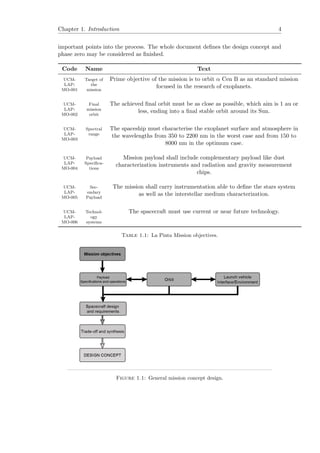
As it is showed in Figure 1.1, once MO are defined the next step will be to specify the
payload and operations. They are summarized in chapter 3 with an analysis of the orbit
and a launcher evaluation. The spacecraft design is established along chapter 4. At
the end of this section the mission requirements are defined, following the scheme of the
draw. Finally conclusions contains the Trade-off of the mission ans synthesis of the most
Chapter 1. Introduction 4
important points into the process. The whole document defines the design concept and
phase zero may be considered as finished.
Code Name Text
UCM-
LAP-
MO-001
Target of
the
mission
Prime objective of the mission is to orbit α Cen B as an standard mission
focused in the research of exoplanets.
UCM-
LAP-
MO-002
Final
mission
orbit
The achieved final orbit must be as close as possible, which aim is 1 au or
less, ending into a final stable orbit around its Sun.
UCM-
LAP-
MO-003
Spectral
range
The spaceship must characterise the exoplanet surface and atmosphere in
the wavelengths from 350 to 2200 nm in the worst case and from 150 to
8000 nm in the optimum case.
UCM-
LAP-
MO-004
Payload
Specifica-
tions
Mission payload shall include complementary payload like dust
characterization instruments and radiation and gravity measurement
chips.
UCM-
LAP-
MO-005
Sec-
ondary
Payload
The mission shall carry instrumentation able to define the stars system
as well as the interstellar medium characterization.
UCM-
LAP-
MO-006
Technol-
ogy
systems
The spacecraft must use current or near future technology.
Table 1.1: La Pinta Mission objectives.
Figure 1.1: General mission concept design.
Chapter 2
State of the art
2.1 A little bit of history
In 1903 Tsiolkovsky published ‘The exploration of Cosmis Space By Means of Reaction
Devices’ the first publication about an interstellar project. In the decade of 60’s many
publications were written; Bussard proposed the intestellar ramjet project and in 1963
Spencer and Sagan published related papers too. In 1968 Dyson published his article on
the economics of interstellar travel. This same year the film ”2001 A Space Oddyssey”
premiered.
The 70’s was a great decade for interstellar issues: while in 1972 and 1973 Pioner 10
and Pioneer 11 space probes are launched, the project Daedalus is initiated and diverse
publications about this topic invaded the journals; In 1977 Voyager 1 and 2 are launches
and Jaffe initiates his studies of Insterstellar Precursor Probe mission. At the end of the
decade the Daedalus study is published.
It is not until 1989 when the first interstellar academic text was written, ‘The Starflight
Handbook’ by Mallove and Matloff. In 1993 Solem first proposed the Medusa sail concept
and two years after Anderson published the NASA Horizon Mission Methodology.
Although first exoplanets discoveries were dated in 1995, the true is that in 1983 with
the launch of IRAS (InfraRed Astronomical Satellite) exoplanets space mission began.
In 1984 Beta Pictoris was discovered with a surrounded disk of dust. The dust was made
by articles much bigger than interstellar dust. Some areas was completely empty. That
revealed as the first place at the universe where planets were creating. In 2008 a group
of astronomers confirmed this theory when discovered a giant planet with its disk. Then
theoretical simulations in the search of exoplanets stopped and real exploration began.
In 2006 the New Horizons mission to Pluto started its trip and in 2009 Millis and Davies
published AIAA book on ‘Frontiers of Propulsion Science’. Long and Obousy published
Project Icarus starship study. The first interstellar travel session at UK Charterhouse
conference was celebrated.
In 2010 Millis used energy trends to predict first interstellar launch. First Earth-like
solar system was discovered and world’s first solar sail spacecraft, the Japanese Ikaros
was finally successfully launched. The same year McNutt Decadal Survey White paper
proposes for an interstellar probe mission.
5
Chapter 2. State of the art 6
2.2 Historical spacecraft
The answer to the question if we are serious about reaching for the stars may be answered
with the state of the art of today’s space missions. This section do not pretend to be
a complete study of the interstellar astronautical history but the missions’s references
that will be used in this document.
2.2.1 The Pioneers
Pioneer 10 was launched in March 1972 and the NASA Pioneer program (which included
Pioneer 6–11) is one of the most successful in space history. In particular the Pioneer
10 and 11 probes are the first robotic explorers to visit the outer planets and to travel
beyond the orbit of the dwarf planet Pluto.
Pioneer 10, with a mass of 258 kg of which around 29 kg comprised the science in-
struments, is the first interstellar spacecraft because it was the first to leave the Solar
System. It passed Neptune in June 1983 and left the Solar System 11 years later. Cur-
rently traveling at a speed of around 2.6 au/year it will reach the nearest stars in around
2 million years.
As with the Voyager spacecraft, the Pioneer probe was powered by a Radioisotope
Thermoelectric Generator (RTG), providing around 155 W of power during the launch
and 140 W by the time of the Jupiter flyby encounter. Six hydrazine thrusters were
included to provide velocity, attitude and spin-rate control.
Pioneer 11 was nearly identical to the Pioneer 10 spacecraft except for an additional
science instrument known as a flux gate magnetometer. It was launched in April 1973
and left the Solar System 17 years later in February 1990. Communications were lost in
November 1995, 22 years after launch. Pioneer 11 also used a Jupiter gravity assist to
pick up velocity.
2.2.2 The Voyagers
Launched in September 1977 Voyager 1 (just 2 weeks after Voyager 2) remains the most
distant manmade object ever sent into space. Currently traveling at a speed of 17.1 km/s
or 3.6 au/year it is also one of the fastest manmade objects. Its primary mission was to
reach and explore the Jupiter and Saturn systems. It also had an extended mission to
locate and study the outer boundaries of the Solar System and enter the Kuiper Belt.
Despite being launched in the 1970s, none of the current space probes (even New Hori-
zons) will overtake Voyager 1, due to the benefit of several gravity assists from the outer
gas giants. Both the Voyager probes were 722 kg in mass. They had a 3.7 m diameter
high gain antenna and 16 hydrazine thrusters, all run from an RTG supplying 420 W.
The spacecraft were covered with thermal blankets to protect them.
In December 2004 it finally crossed the termination shock of our Solar System, where
the heliosheath meets the interstellar medium and the solar wind compresses up against
interstellar space. As of 2005 Voyager 1 was in the heliosheath and would have reached
the heliopause by 2015, by which time it would technically become the first manmade
Chapter 2. State of the art 7
object to have left the Solar System. As of November 2008 it was at a distance of 108
au from the Sun with radio signals taking nearly 15 hours to reach Earth.
2.2.3 Project Daedalus
Project Daedalus was a study conducted between 1973 and 1978 by the British In-
terplanetary Society to design a plausible unmanned interstellar spacecraft. Intended
mainly as a scientific probe, the design criteria specified that the spacecraft had to use
existing or near-future technology and had to be able to reach its destination within a
human lifetime. Alan Bond led a team of scientists and engineers who proposed using
a fusion rocket to reach Barnard’s Star 5.9 light years away. The trip was estimated to
take 50 years, but the design was required to be flexible enough that it could be sent to
any other target star.
2.2.4 Project Longshot
Project Longshot was a conceptual design for an interstellar spacecraft, an unmanned
probe, intended to fly to and enter orbit around α Centauri B powered by nuclear
pulse propulsion. Developed by the US Naval Academy and NASA, from 1987 to 1988,
Longshot was designed to be built at Space Station Freedom the precursor to the existing
International Space Station. Unlike the somewhat similar Project Daedalus, Longshot
was designed solely using existing technology although some development would have
been required.
2.2.5 Orion as a reference of propulsion.
Many historical research projects have explored the possibility of nuclear pulse tech-
nology for space applications. This includes the external pulse rocket in the guise of
Project Orion conducted in the 1950s. This involved the use of nuclear bombs being
detonated rearward of a vehicle, the products from which would ‘push’ the vehicle along
and provide thrust.It would obtain exhaust velocities 10,000 km/s (3% of light speed)
and reach the nearest stars within a century or so. The historical calculations clearly
show that external pulse technology can produce a performance appropriate for deep
space missions. This issue will be deeply treated in Chapter 4.1.1
2.2.6 New Horizons and the viability of a real mission towards the
Solar System.
Launched in 2006 and recently arrived to Pluto, New Horizons is the latest robotic probe
to be sent out into the Solar System as part of the NASA New Frontiers program. As
the spacecraft is moving on a trajectory towards Pluto, and out into the Kuiper Belt to
a distance of 55 AU, it is capturing images from afar of the dwarf planet, demonstrating
a capability to track distance targets while also in motion, a critical requirement for an
interstellar probe. When the spacecraft arrived at the Pluto system it flied at a relative
velocity of 13.8 km/s during the closest approach.
Chapter 2. State of the art 8
New Horizons reached Jupiter in February 2007 and Saturn in June 2008 and attained a
velocity on passing of 21 km/s. As of March 2008 the probe is located 9.37 au from the
Sun and is traveling at 16.3 km/s or 3.4 au/year, although it will eventually slow down
to around 2.5 au/year so will never catch up with either of the two Voyager probes.
The probe has a mass of around 478 kg, and it uses an RTG system for power generation
in the range 200–240 W. The propulsion system is comprised of 16 large and small
hydrazine thrusters proving a capability for up to 0.29 km/s velocity increment from a
thrust range of 0.9–4.4 N. These are used for trajectory changes and attitude control.
The spacecraft uses a 2.1-m diameter high gain antenna for communications as well
as several medium- to low-gain antennas. Without doubt, New Horizons is the most
ambitious spacecraft mission yet launched to the outer part of the Solar System.
2.2.7 Interstellar Boundary Explorer. New future data from interstel-
lar boundary
The NASA Interstellar Boundary Explorer (IBEX) mission was launched in October
2008 to a final altitude around 37 times the radius of Earth. It is by no means comparable
in distance to the Voyager or New Horizons missions. However, its mission and associated
technology are worth mentioning in the context of robotic explorers.
IBEX has a mission to study the interstellar boundary and in particular how the solar
wind interacts with the interstellar medium. It will fill in the picture by providing
information on the global nature of the heliosheath termination shock interaction with
the surrounding interstellar space as well as the galactic cosmic ray particles emanating
from beyond our Solar System. This will allow an improved understanding of how the
large atmosphere of our Sun interacts with the interstellar wind passing through the
galaxy, which will be very usefull information for next future stellar missions
2.2.8 Rosetta mission and its complex instruments as a reference of
payload
If we take as an example a complex instrumentation mission, there is no better choice
than Rosetta. Its 3000 kg of spacecraft and more than 11 on board instruments, plus
Philae, makes a good example of Bus for La Pinta.
Rosetta is a large aluminium box with dimensions 2.8 x 2.1 x 2.0 metres. The scientific
instruments are mounted on the ’top’ of the box (Payload Support Module) while the
subsystems are on the ’base’ (Bus Support Module).On one side of the orbiter is a 2.2-
metre diameter communications dish – the steerable high-gain antenna. Two enormous
solar panel ’wings’ extend from the other sides. These wings have a total span of about
32 metres tip to tip. Each of them comprises five panels, and both may be rotated
through +/-180 degrees to catch the maximum amount of sunlight.
The scientific instruments almost always point towards the comet, while the antenna
and solar arrays point towards the Sun and Earth (at large distances, they are more or
less in the same direction). This issue will be deeply treated in Chapter 4.1.6
Chapter 2. State of the art 9
2.3 The α Centauri system
The closest planetary system to our Sun was detected by ESO HARPS instrument.
‘Alpha Centauri’ is the name given to what appears as a single star to the naked eye
and the brightest star in the southern constellation of Centaurus but it what finally was
a three-star system just 4.3 light years away.
At -0.29 visual magnitude, it is fainter only than Sirius and Canopus. The next brightest
star in the night sky is Arcturus. Actually a multiple star system, its two main stars are
‘Alpha Centauri A’ (α Cen A) and ‘Alpha Centauri B’ (α Cen B), usually defined to
identify them as the different components of the binary α Cen AB. A third companion,
‘Proxima Centauri’, α Cen C, has a distance much greater than the observed separation
between stars A and B and is probably gravitationally associated with the AB system.
α Cen A is the principal member of the binary system, being slightly larger and more
luminous than the Sun. It is a solar-like main-sequence star with a similar yellowish
color whose stellar classification is spectral type G2 V. From the determined mutual
orbital parameters, Alpha Centauri A is about 10% more massive than the Sun, with a
radius about 23% larger.
α Cen B is slightly smaller and less luminous than the Sun. It is a main-sequence star
of spectral type K1 V, making it more an orange color than the primary star. Alpha
Centauri B is about 90% the mass of the Sun and 14% smaller in radius. Although it
has a lower luminosity than component A, star B emits more energy in the X-ray band.
α Cen C, also known as Proxima Centauri and the closer star to Sun, is of spectral
class M5 Ve or M5 VIe, suggesting this is either a small main-sequence star (Type V)
or subdwarf (VI) with emission lines. Its B-V color index is +1.90 and its mass is about
0.123 solar masses.
α Cen Bb is no Earth twin; its heat-blasted surface may be covered with molten rock,
with a temperature of 1500 degrees, the maximum spectrum of radiance would corre-
spond with NIR emission.
Planet α Cen B b Star α Cen B
Discovered in 2012 Distance 1.3 pc
Mass 0.0036 (± 0.0003) MJ Mass 0.934 (± 0.006) MSun
Semi-major axis 0.04 AU Radius 0.863 RSun
Orbital period 3.2357 (± 0.0008) days Spectral type K1 V
Eccentricity 0.0 App. magnitude V 1.33
Detection Method Radial Velocity RA2000 14:39:35.0
Update July 25, 2014 Dec2000 -60:50:15
Table 2.1: α Cen B Star and planet characteristics.
Chapter 3
Mission Overview and
Operational concept
3.1 Principle Operational Rules
Unfortunately operations are one of the main challenges for an interstellar mission.
Most planetary missions are pre-planned by the Mission Operation Center (MOC) and
executed in a near future since they are designed. They usually are divided into Short
Term Plans (STP) with a duration of a week, Medium Term Plans (MTP) that cover
a whole month and Long Term Plans (LTP) that usually covers aorund three months.
Some missions allows even Very Short Term Plans (VSTP) for fast observations or
emergency issues.
In the case of the ‘La Pinta’ probe the planning team shall predict observations with
various years in advance and taking as inputs orbits and auxiliary data from various
years of delay. For this reason it is required a sort of intelligent software for the On
Board Computer (OBC) that will be developed in Chapter 4.1.5
The Mission Operations Concept has been defined in terms of a number of strategies.
The strategies relevant to the instruments are addressed in the following sections.
3.2 Mission analysis concept
The mission trajectory proposed should approximate a straight between the sun and
one of the stars of the system. A solar flyby can be added to enhance the spacecraft
speed in addition to the nuclear propulsion. The departure can be taken as a hyperbolic
trajectory with the sun at one of the focus, for this trajectory the hyperbolic excess speed
of the orbit can be calculated according to the mission requirements. With the present
day advanced nuclear propulsion it can be possible to achieve an acceleration of 1g for
a calculated amount of time in the first phase of the trajectory, when the velocity of
the stellar-ship starts form hyperbolic excess speed and reaches its maximum attainable
value (0.1c-0.75c).Upon reaching this limiting speed we can shut down the propulsion
and let the spacecraft travel at this speed for the second phase of its trajectory, before
arrival in the third phase we can again start the spacecraft engines for the deceleration.
10
Chapter 3. Mission Overview and Operational concept 11
3.2.1 Orbital design
The distance is fixed (neglecting variations on the trajectory for now) as the distance
from Earth to α Cen, so the only parameters that are variable are the velocity and time
taken over the journey. An increased speed will result in short mission durations. In
this chapter the required technology is supposed to be available (propulsion system will
be developed during the next chapter). So, how fast is it required to go?
For simplicity, the speed requirements are considered for a linear distance profile to an
effective α Cen distance of 4.3 ly or 272,000 au, where a 1 light year = 9.46 x 10¹⁵ m =
63,240 au. At first the fact that α Cen is out of the ecliptic plane is ignored as well as
acceleration requirements.
Table 3.1 shows typical journey times to reach this distance for given constant velocities.
The data clearly shows that to reach the nearest star in a time frame of order 50 years,
the spacecraft must reach 1/10 of light speed.
Velocity (km/s) % light speed Time to effective α Cen
10 0.003 130000 years
100 0.03 13000 years
1000 0.3 1300 years
10000 3 130 years
25000 8 50 years
100000 33 13 years
Table 3.1: Linear velocity scale to α Cen (neglecting relativistic effects) .
To put these speed requirements into perspective, this can be compared to the fastest
spacecraft so far sent out into deep space. These are the Pioneer and Voyager spacecraft.
Pioneer 10 was launched in March 1972 and is currently traveling at around 13 km/s
or 2.6 au/year. Pioneer 11 was launched in April 1973 and is currently traveling at 12
km/s or around 2.4 au/year. Voyager 1 was launched in August 1977 and Voyager 2 in
September 1977 and both are traveling at around 17 km/s or 3.6 au/year. In January
2006 NASA also launched the New Horizons mission, which has recently visited Pluto
and moved on to the Kuiper Belt. It is currently traveling at around 18 km/s or 3.8
au/year.
To reach Alpha Centauri at current speeds, most of these spacecraft would reach there
nearest line of sight star in many tens of thousands of years. If a spacecraft could attain
a sufficient cruise velocity to reach α Cen within a reasonable time frame, what sort of
mission options would there be?
For our simple analysis, gravitational slingshots and deviations from the ecliptic plane
are not considered as well as deceleration phase for the analysis and assume a flyby-only
trajectory. It is assumed constant acceleration for an initial period of time. Table 3.2
shows the results of several hypothetical mission profiles.
For comparison, the Daedalus Project had a mission profile that involved two accelera-
tion phases, the first at 0.03 g to 0.071 c followed by 0.01 g up to a cruise speed of 0.12c
to get to Barnard’s Star 5.9 ly away in around 46 years.
Chapter 3. Mission Overview and Operational concept 12
Acceleration phase Cruise phase Min. data return
0.01 g for 5 years 0.05 c for 84 years 94 years
0.01 g for 10 years 0.1 c for 42 years 57 years
0.1 g for 1 year 0.1 c for 42 years 48 years
0.1 g for 5 years 0.5 c for 8 years 18 years
0.5 g for 1 year 0.5 c for 8 years 14 years
Table 3.2: Linear mission analysis to effective α Cen.
One is quickly led to some simple conclusions about practical requirements for acceler-
ation (0.01–1 g), mission velocity (0.1–0.5c) and mission duration (10–100 years).
An ideal mission profile would be one that employed 0.1 g acceleration for a few years
up to 0.3c resulting in total mission duration of 50 years. Conventional thinking, e.g.
in Ref.[1] about future interstellar missions is that they are likely to be one of two types:
• Type I: A short 50-year mission using high exhaust velocity engines to accelerate
to a moderate fraction of the speed of light, 0.1–0.3c, completing the mission
within the lifetime of designers.Identification and characterisation of the intended
mission,
• Type II: A long 100–1,000 year mission using low exhaust velocity engines, com-
pleting the mission duration over several generations of designers.
It is generally believed that a Type I mission would require a large technology jump,
but a Type II mission would require only a moderate jump, except perhaps with the
environmental lifetime requirements.
Now all the above analysis is based upon linear theory, but in reality rockets are governed
by the ideal rocket equation which is logarithmic that means values have a ∆ error.
Anycase results are quite similar and the total mission duration would be around 50
years.
Energy required calculation may be simplified considering that the energy needed to
impart a vehicle to produce kinetic energy for forward momentum, assuming 100%
conversion efficiency. Considering the case of a vehicle accelerated for 0.1 g up to 0.3
c, once the kinetic energy is calculated the power required is obtained by dividing the
energy by the number of seconds during the boost phase if the propellant mass is assumed
to dominate the total mass of the vehicle. The results is that the minimum power to
push a 1-ton vehicle to 1/3 of light speed over a period of 3 years is around 50 GW. For
the same speed a 100,000-ton vehicle would require around 5 PW of power.
From this analysis some data to assess the suitability of various propulsion schemes can
be produced and it is summarized in the next table 3.3. It is important to consider that
the balance between acceleration and boost duration is limited to the speed of light.
All data calculated during this section will be used in the propulsion chapter 4.1.1 to
the propulsion method choice and total mass calculations.
Chapter 3. Mission Overview and Operational concept 13
Description Mission data
Initial acceleration (g) 0.1
Cruise velocity (km/s) 30,937 (10.3% c)
Fraction light speed ∼ 1/10
Boost duration (years) 1
Boost distance (light years) 0.051
Cruise duration (years) 41
Minimum energy (J) 4.8 x 10¹⁸
Minimum power (GW) 150
Table 3.3: Approximate mission profile for a 10-ton flyby interstellar probe α Cen.
3.2.2 Environmental analysis overview
As showed in the previous chapter the preliminar calculated lifetime for the mission is
41 years of cruise and let’s say 9 years of nominal, considering all the mission risks. So
all the subsystems will be exposed for 50 years of space radiation, very high and very
low temperatures and a high variety of micro particles and other small objects.
The initial radiation analysis is usually performed though standard tools like SPENVIS,
from ESA. To see how the program works the Ref [20] goes directly to the online software.
This programm has been created with the best radiation models we have now, but
unfortunately it doesn’t include far orbits from the Earth and 50 years missions so the
model has been extrapolated to the case of the ‘La Pinta’.
A rough estimation would be a Total Ionizing Dose (TID) of 3 x 10⁴ Krads without any
kind of protection and less than 10 Krads (the standard TID protection for commercial
space components) for 12 cm of aluminium shielding protection.
3.2.2.1 Local Interestellar Medium
The local interstellar medium properties have been studied in Ref [11] though there is
no in-situ observational data as no probe has been able to traverse the heliopause and
measure the desired properties directly. We do not have sufficient knowledge of the
various cloud distribution in the local interstellar neighbourhood viz the ionisation state
and the dust particle or grain density. Estimation of these parameters are crucial for a
successful interstellar probe. Methods to eradicate the effects of interstellar dust grain
on the spacecraft is a key aspect of this mission. For this reason the dust experiment
characterization is described in chapter 4.1.6.
3.2.2.2 Collision avoidance protocol
Due to the high amount of space junk around the Earth protocols of collission avoidance
plans are more than enough for the ‘La Pinta’ mission. The only difference is that
NORAD is not detecting high distance objects yet. A NavCam (image adquisitions
though payload cameras to use for navigation purposes) protocol shall be implemented
into the instrument planning to detect possible objects to intercept the mission orbit.
Chapter 3. Mission Overview and Operational concept 14
Some objects should not be possible to see in vis-IR ranges and this is contemplated
into the risk Section 5.
3.2.3 Thermal protection
To protect the probe from thermal radiations during its closest approach to the suns
and use the thermal energy to accelerate the probe, a carrier with thermal shielding,
cryogenic tank and an appropriate propulsion system must be designed. To survive such
thermal inputs carbon-carbon thermal shield is required. There will be a huge amount
of waste heat from the propulsion system and nuclear reactor. The fuel tanks must be
shielded from this heat. The spacecraft will need highly efficient radiators. Radiation
from dissipation process can be reflected away from rest of the spacecraft by specially
engineered mirrors which can reflect infra red radiations. Ceramic buffers can be located
between the power unit and the fuel tanks.
3.3 Launcher’s needs
At first, it is not necessary to use a very complex in orbit accomplishment considering
the mission requirements. Some references talk about in orbit accomplishment phases
and more complex solutions since they include X-Ray cameras or more heavy bunch of
instrumentation. Clearly it is not the case of the ‘La Pinta’ and the biggest rockets
in Earth can support a single launch down to 10 tons of preliminary maximum weight.
Table 3.4 summarizes the launchers being able to carry more than 104 kg to a GTO
right now,
Launcher In orbit weight Successfully launches
Ariane 5 ECA 10 x 103 kg 64 of 68
Atlas 5 13 x 103 kg 36 of 37
Delta IV 12.98 x 10³ kg 20 of 21
Falcon Heavy 12 x 103 kg N / A
Long March 5 14 x 103 kg N / A
Table 3.4: Launcher candidates for the ‘La Pinta’.
3.4 Instrument Planning
The standard Science Planning starts with the Announcement of Opportunity and the
generation of proposals by the observers. These proposals are reviewed and approved
by the Time Allocation Committee. The approved proposals are further processed later
and the selection of the payloads is performed.
3.4.1 Instrument Objectives
The science goals would be split into a priority order. Primary science objectives would
be along the lines of
Chapter 3. Mission Overview and Operational concept 15
1. Terrestrial planets
2. Giant planets
3. The stars
4. Minor objects
5. Dust
Secondary science objectives would be along the lines of:
• observations of solar system outer bodies
• measurements of the heliopause and interstellar medium
• measurements addressing gravitational issues
• spacecraft reliability with long duration missions
According with Table 3.5 a selection of detectors and instrumentation can be done with
the MO and the selected orbit. This is not a linear process and some iterations has
been done between the different related chapters. It is important to emphasise than the
description of the payload observations and
babab
3.4.2 Instrument Description
According with Table 3.5, and UCM-LAP-MO-003, UCM-LAP-MO-004 and UCM-
LAP-MO-005 the instrumentation shall be composed by a telescope with the maximum
resolution possible, an hyper spectral detector system composed by at least eight bands,
including RGB and NIR to cover the huge spectral range required in MO. The actual
state of the art for these kind of devices is very evolved due to they are commonly used
in the Earth Observation Missions.
Primary payload is composed as well for a Dust Analyser that would measure the num-
ber, mass, momentum and velocity distribution of dust grains in the environment on
the α Cen Bb system.
Finally, and as primary instrumentation an ion mass analyser equipped with a dust
collector, a primary ion gun, and an optical microscope for target characterization would
be fulfill the rest of MO. Dust from the near environment would be collected on a target.
The target would be then moved under a microscope where the positions of any dust
particles were determined. The dust particles would be then bombarded with pulses of
indium ions from the primary ion gun. The resulting secondary ions would be extracted
into the time-of-flight mass spectrometer.
Las two instruments have been derived from [15] and Rosetta instruments, COSIMA
and GIADA. They are widely validated after 12 years in orbit and two more years fully
operating, in spite of their complexity.
Chapter 3. Mission Overview and Operational concept 16
Topic Objective
Gravitation Gravimetric characterization of the new solar system
Heliosphere What is the extent of the solar wind and its interaction with the
solar heliosphere?
Stellar physics Characterization in the IR and optical wavelengths of the new triple
system
Interstellar space What is the mass function of objects in the Kuiper belt or Oort
cloud?
Planetology How many exoplanets does the α Cen system have?
Map of the α Cen Bb system as accurate as possible
Dust
characterization
What are the properties of the interstellar medium in terms of its
dust?
What is the abundance of interstellar nuclides along the mission
orbit ?
Solar system Is the new solar system typical in structure and metal content to
others in the galaxy?
Spacecraft What is the long time survivability of the stellarship structure and
electronics?
Table 3.5: Potential science drivers.
3.4.3 Mission Planning Operations
The operations related planning functions are split between Mission Operations Center
(MOC) and Science Operations Center (SOC). SOC is mainly in charge of planning
the sequence of pointings and the corresponding instrument configurations. The MOC
is planning the relevant S/C activities and the routine Instrument activities such as
activation / deactivation of the instruments, and so on. The MOC provides a long term
planning input to SOC in form of a batch of Planning Skeleton Files ( PSF’s),which
covers long periods of time in this case. This batch is provided to SOC some month in
advance to the concerned planning period. In order to limit the necessary replanning,
the SOC provides a batch of Preferred Observation Sequences (POS’s).
The MOC creates the relevant Timelines and creates a Timeline Summary to provide
the means to follow the instrument operations.
3.4.4 Instrument Operations Execution
The Timeline, which consists basically of a sequence of commands with the associated
planned execution times, will be loaded on the command scheduler. The instrument
Chapter 3. Mission Overview and Operational concept 17
related operations will be executed automatically from the command scheduler in or-
bit, i.e. the telecommands related to the instrument configurations for the planned
observations are released at the predefined times.
In addition an on-board Broadcast Packet, which provides general information such as
orbit trajectories or attitude values, is provided every polling cycle, to the instruments.
The instruments can use this information to configure themselves automatically for
special events, e.g. eclipse or specific tarjets.
All safety and health related operations, which require a reaction time, may be sent to the
OBC to decide, thanks to their specific designed algorithms what to do. Unfortunately
the MOC will only perform long term flight procedures in form of the Instrument Flight
Operations Plan (IFOP).
Since the baseline is that all instrument operations are preplanned, changes to the In-
strument configurations can only be implemented for the next planning period when the
new Timeline will be applied.
3.4.5 Instrument Data Processing
The probe housekeeping data (HK), which is needed for monitoring of health and safety,
is processed by the MOC. The HK is routed together with the science TM data to
performs a quick look analysis of the instrument performance. This analysis is used
amongst others to identify Targets Of Opportunities (TOO), which may require a re-
planning of the observation schedule.
The MOC maintains an archive of all raw TM data. In case of interruptions of the data
links between the ground stations and the MOC, the MOC retrieves the data from the
ground stations and consolidates this archive.
3.4.6 Instrument Maintenance
The maintenance of the Instrument configurations including the Instrument related OBS
(Instrument Application S/W and Front End Processor S/W) is a task of the PI Teams.
Relevant S/W images are to be provided via SOC to the MOC. The MOC generates the
appropriate Load Memory Commands and ensures a proper uplink of the commands
including a check of the OBS by means of a Memory Dump.
The MOC will keep track of the changes made to the on-board configuration, which
will allow to re-establish the instrument environment after a major anomaly. SOC will
approve the instrument configuration and will provide additional inputs if necessary.
3.5 Conclusion
The major challenge in the design of the La Pinta operational concept and its mission
analysis are given by the delay in the RF signal and its consequences. Although a com-
plete mission analysis requires to develop own software and a high amount of calculations
the real challenge is the Mission Planing Subsystem (MPS), which must be able to make
what we could name is as ‘VLTP’; Very Long Term Plans.
Chapter 4
Systems
4.1 Flight segment overview
4.1.1 Primary propulsion system
Acquiring the required velocity described in Chapter 3.2.1 on launch and getting rid
of it on arrival whas been the hardest challenge for this study. As one of the Mission
objectives, UCM-LAP-MO-006, tries to approximate the technology use for this mission
to the actual state of art the first studies for this TFM were based on electric and ‘green’
propellant. But after the conclusions at the end of 3.2.1, the conclusions of the study
has been summarized below.
The nuclear pulse propulsion has been approached for this kind of mission according
with Chapter 3.2.1 requirements. This is along the lines of the historical Orion and
Daedalus concepts. Chemical propulsion systems are clearly limited in their reach and
will only get us into Earth orbit and the Moon. Electric propulsion is ideal for Earth-
orbiting satellites and for sending probes to the planets within the inner Solar System,
but no further. It can be combined with nuclear reactor technology, however, and a
nuclear-electric engine clearly has the potential to take our robotic probes hundreds of
au from our Sun.
Nuclear thermal propulsion uses a nuclear thermal reactor or NTR. A simple fission
reaction is used to produce the necessary heat in the reactor. A propellant is accelerated
through the reactor. Temperature of flow is as high as 3000 K. Due to compressible
nature of the propellant the flow is supersonic as it passes through De Laval nozzle.
Specific impulse of 500 and above is easily reached.
Gas core reactors seem to be the most feasible method of propulsion. A gas core reactor
is a reactor that uses Uranium Hexafluoride as a nuclear fuel to initiate fission reaction.
Fission takes place with bombardment of gaseous Uranium Hexafluoride with Neutrons.
Neutron cross sections obtained due to core geometry makes the reaction kinetics swifter.
Results shows that a small light bulb engine will provide 448 MW with 44.7 kN thrust
in a 15.1 metric tons engine weight. The specific impulse obtained would be 15.2 km /
s. Comparing these results for the section 3.2.1 needs that would means the mechanism
is under the required value. For this reason a combined mechanism with solar sails can
be designed.
18
Chapter 4. Systems 19
4.1.1.1 Secondary propulsion system: Solar sails
Solar sail and microwave sail technology have the potential to meet the performance for
an interplanetary mission and beyond in the near term. However, stretching this tech-
nology to an interstellar mission is a real challenge. For this project, the consideration
of an auxiliary propulsion system to nuclear’s one may be possible to reach lower values
in the hibernating phase. However, research into this technology is at an early phase,
and it is possible that with the development of nanomaterials in particular that clipper
missions to the stars may yet be in the cards. This addition to the propulsion would
generate an extra 160 km/ s after a year under optimal conditions (sails are vulnerable
to radiation and solar wind and will be dagradated over the years).
4.1.2 Electrical Power System
Standard platforms from 300 to 500 kg usually provides around 500 W of power for
payload consumptions of 250 / 300 W in orbit average. This estimations doesn’t takes
into account cryogenics requirements for the IR detectors. In case of specific payload
requirements, values could arise until 500 W and secondary solar cells system can be
implemented without a high amount of mass increment. At first this mission would only
cover the near IR and these mechanisms are not considered.
The power balance will be a function of the distance to Sun / α Cen B, depending on
the mission phase. There will be a GAP period of time in between when La Pinta will
be hibernating. Power margins would be performed in follow phases of the mission.
4.1.3 AOCS
Main attitude system in deep space are star trackers. An improvement of attitude can
be achieved when payload optical detectors are used as secondary cameras to contrast
information with STS system. Anycase attitude becomes a critical point for this mission
since is vital for a proper orbit determination and successful comunication link.
One main problem to take into account in AOCS system is dust and/or radiation parti-
cles. These fenomena can be raise the signal to noise of the star tracker detector made
them useless. Typical cases of these fenomena are the South Atlantic Anomaly y LEO
orbits when STS systems can not be used since protons seem like stars in the detectors
and interplanetary missions crossing a high dust density levels, when it happens the
same, e.g. during the Rosetta operations phase.
Fortunately, the tarjet is a binary solar system that meams the AOCS would have one
extra reference point. This fact could improve accuracy in manoeuvring and operations.
4.1.3.1 Some possible solutions: the ‘Buoy satellite’
The idea is similar to Inmarsat network of satellites for sea tracking but in a solar
system scale: the placement of an in orbit buoy satellite/s continously emitting the
Earth position in order to improve AOCS of the ‘La Pinta’ stellarship.
Chapter 4. Systems 20
4.1.4 COMMS
To communicate in ranges of 1000 AU or more, efficient long range and low mass telecom-
munications techniques is a topic of advanced communication. In order to keep the
physical size of transmitter reasonable and limit the required transmitter power, an op-
tical downlink operating in near infrared with a 1 m diffractive primary can be selected.
The system requires integrated optical communications, attitude, guidance and control
in order to hold the pointing requirement. Moreover, there should also be very high
gain.The data from the experiments during interstellar flight will be returned to earth
at low data rates. This will also ensure that the contact with the probe is maintained.
Since the probe has to be fully autonomous,any problems with communication systems
due to degradation of transmitting equipment of faulty link analysis will have to be cor-
rected by making improvements in receiving equipment. Maintaining constant contact
will give time to implement any corrective measures in the receiving equipment.
The same solution of Buoy systems can be developed as an intermediate link, e.g. in
the surroundings of Pluto, but a deeper analysis may be performed to study their via-
bility. Although optical links seems to be part of science fiction books the true is some
companies like RUAG are developing satellite to satellite optical link communications
nowadays. That would up the amount of data being transmitted by 10 to 100 times what
state-of-the-art radio rigs can do, which would make interplanetary Internet roughly as
fast as a typical broadband connection on Earth. The constrain is some GAPs will be
produced during loses on the line of sight.
Secondary communication system shall be carried as part od the redundancy. X band
(8,4 GHz) with data rates of approximately 300 Mbps are actually used for planetary
communications. This data rate would determine the MPS PSF’s.
4.1.5 OBC
A probed mission to α Cen has to be designed with the Artificial Intelligence proto-
cols. As explained in section 3.4.4, some decisions that required reaction times shall be
calculated on board though protocols of auto learning with similar methods of google
car computer trained with deep learning (see Ref [22]). Although this point is vital for
the development of the project the author’s skills in this matter doesn’t afford to get
further.
4.1.6 Payload: EXOS (Exoplanet Observation System)
As explained before in chapter 3.4.2, three instruments make up the primary payload.
Ion mass and dust analyser have been explained briefly before. The telescope required
for this mission shall provide an acceptable resolution.
Comparing with Earth observation missions values of 600 km of swath is similar to the
low resolution satellites that are used for study the terrain, water distribution, etc... For
a distance of 1 au, according with Rayleigh criteria, it is necesary a telescope aperture
of 2,5 meters to obtain a ground sample distance (GSD) of 1 meter resulting a swath
of 312.5 km for a pixel size of 6 micras. The required number of pixels of the detector
Chapter 4. Systems 21
shall be around 417000 pixels that means 2.5 mm of airy disc to obtain images without
darkening which can be possible with a good quality optical design.
4.1.7 Secondary payload
In order to fulfill the potential science drivers from Table 3.5, some secondary instru-
mentation shall be carried. The space environment unit controller would make up by a
plasma detector and diverse radiation dosimeter. Nowadays this technology can be found
in the Microelectromechanical systems (MEMS) market. Another secondary payload
that can be called the ‘Newton’ instrumentation; a bunch of instruments to characterize
the new solar system gravity and modify on-orbit gravity propagator to characterize the
final accomplishment manoeuvres. Again, this technology has been widely tested and
miniaturized.
4.2 Ground Segment Overview
La pinta Ground Segment consists of the Operational Ground Segment (OGS) and the
Science Ground Segment (SGS). The OGS contains:
• Ground stations: since ESA and NASA’s SGS are the only ones prepared to Deep
Space mission contacts and both of them are into the North hemisphere, a specific
ground antenna placed in south hemisphere would be required to be included into
the budgets.
• the Mission Operations Centre (MOC)
• associated communication facilities.
The Science Ground Segment (SGS) contains: La Pinta Science Operations Centre
(SOC), the Science Data Centre (SDC) and associated communication facilities.
The Science Ground Segment is complemented by the Science Community, the Time
Allocation Committee (TAC), the instrument teams of the Principle Investigators (PI)
and La Pinta Science Working Team (LPSWT).
The MOC is the focal point for the control of La Pinta probe. It is the only source for
telecommands (TC) sent to the spacecraft. It performs safety and health checks of the
probe using housekeeping (HK) telemetry data (TM). It interfaces to the SOC for the
planning of the spacecraft operations and routes the TM augmented with auxiliary data
(such as determined orbit and reconstructed attitude) to the SDC.
The SOC interfaces to the Science Community to receive the observation proposals
from the science community. It analyses and processes the proposals, and generates an
observation plan, consisting of a timeline of target pointings and the definition of the
corresponding instrument configurations.
The SDC receives the TM (Housekeeping and Science) and relevant auxiliary data from
the MOC. Taking into account the instrument characteristics the SDC will convert the
raw science data into physical units and will make available the final science products
to the science community via a Science Archive.
Chapter 4. Systems 22
4.3 Mission requirements
This table summarized the work performed in the previous chapters, transforming all
calculations and ideas into requirements for the next phase of the mission. Although
some of them seem to be obvious it is really important to write all the needs into
this format because each one will be used to extract several payload requirements, bus
requirements, and so on..Again, due to limitations in the size of this document is not
possible to list all of them and ‘common’ requirements to all kind of missions, e.g. ‘The
probe shall allow to automatically task and execute the download of acquired images...
’ etc has been removed. The sam for the GS requirements due to they have been
considered ‘common’ to any interplanetary mission.
Code Description Mission requirement
UCM-
LAP-
MR-001
Lifetime Mission nominal lifetime shall be greater than 50 years
UCM-
LAP-
MR-002
Propulsion Mission propulsion subsystem shall provide a minimum of 50 GW
UCM-
LAP-
MR-003
Power EPS subsystem shall provide a minimum of 500 W
UCM-
LAP-
MR-004
Radiation 12 cm Aluminium shielding shall protect the sensitive subsystems
UCM-
LAP-
MR-005
Mass Total satellite mass will be below 104 kg
UCM-
LAP-
MR-006
Collision
avoidance
The probe shall be capable of planning and performing collision
avoidance manoeuvres.
UCM-
LAP-
MR-007
Orbit
maintenance
The probe shall provide the capability to monitor and adjust the
orbit altitude and the phasing of the stellarship over the entire
mission life time
UCM-
LAP-
MR-008
Payload
optical
resolution
GSD shall be below 40 km
UCM-
LAP-
MR-009
Payload dust
characteriza-
tion
Dust analyzer shall be able to collect information during seven
years of nominal operations phase
Table 4.1: Mission requirements for interstellar probe α Cen.
Chapter 5
Risk / limitations
Risks are threats to mission accomplishment, due to their harmful effects on mission cost,
plan and technological performance. It is an unwanted scenario that has the potentials
of likelihood of happening and also the harmful effect on a mission.
Risks are the result of the doubt, because of the unpredictable nature or proper man-
agement of events; risks are intrinsic to every mission, and can occur at any instance,
during the mission duration.
This chapter shall provide all elements necessary to ensure that the implementation of
risk management commensurate with the project, organization, and management, while
meeting customer requirements.
5.1 Risk identification and assessment
First step for a risk management plan would be a description of the identified risks,
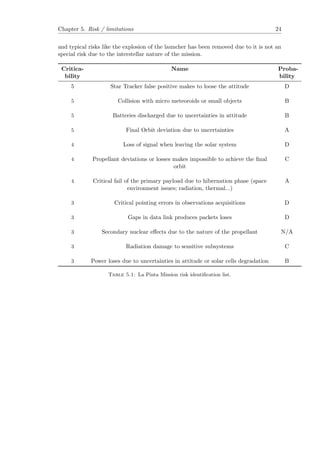
which will be summarized in the Table 5.1. The criticability is defined as severity of
costs and, of course, end of the mission,
• Catastrophic; (5) Lead to mission cease
• Critical Mission; (4) with costs up by > 70 %
• Major Mission; (3)cost up by > 50 %
• Significant Mission; (2) cost up by > 30 %
• Negligible; (1) No effect
Probabilities are measured from A to E, being A the minimum, Not at all occur, 1 of
10000 missions and E the maximum one; definitely occur, will happen one or more times
in mission. Only interstellar or long term interplanetary missions has been taken into
account for statistics. Not Applicable (N/A) values is cited when risk comes from new
technology in space never tested is the responsible of the risk.
Unfortunately the requirement for the size of this document doesn’t allow to list a
complete risk identification, so only uppon significant mission risks can be summarized
23
Chapter 5. Risk / limitations 24
and typical risks like the explosion of the launcher has been removed due to it is not an
special risk due to the interstellar nature of the mission.
Critica-
bility
Name Proba-
bility
5 Star Tracker false positive makes to loose the attitude D
5 Collision with micro meteoroids or small objects B
5 Batteries discharged due to uncertainties in attitude B
5 Final Orbit deviation due to uncertainties A
4 Loss of signal when leaving the solar system D
4 Propellant deviations or losses makes impossible to achieve the final
orbit
C
4 Critical fail of the primary payload due to hibernation phase (space
environment issues; radiation, thermal...)
A
3 Critical pointing errors in observations acquisitions D
3 Gaps in data link produces packets loses D
3 Secondary nuclear effects due to the nature of the propellant N/A
3 Radiation damage to sensitive subsystems C
3 Power loses due to uncertainties in attitude or solar cells degradation B
Table 5.1: La Pinta Mission risk identification list.
Chapter 6
Conclusions
As stated above, it would appear that the prospects for robotic missions to the stars
are much closer than many predict today. Even if this mission has shortcomings, it
will be shown that interstellar flight is clearly in the realm of future space technology
specialists.
It is essential to realize that as the nearest star system, α Cen will continue to be the
main next target and it will be an important road stop in the research of exoplanets.
This document has a clearly engineering point of view. One of the challenges on writing
this project has been to merge both disciplines, astrophysics needs with space engineer
solutions, to obtain a Phase 0 for a spacecraft mission that counts with all the scientific
requirements since the beginning.
While the nuclear methods presented in this document hold a promising future for
traveling out of the solar system, many issues such as radiation protection and cushioning
against high inertia needs to be worked out. However, the challenges seem solvable with
cooperative work from like minded scientists.
It has been more than 35 years since the landmark Daedalus engineering study. This
documents doesn’t pretend to be a replacement of the classical studies, but an annex
into the interstellar state of art based on previous studies with the new technologies
applications orientated to improve the previous papers.
This will be a complete re-design of the previous systems including a re-examination
of some of the original assumptions. Time will show if this ambitious project meets its
overall goals in advancing fusion based space propulsion. It is hoped that this thesis will
incite the thought process for realization of interstellar flight of mankind.
Finally, in order to conclude the TFM objective the Apendix A shows the verification
of the objectives for the phase 0 of the La Pinta project, which coincides with the
objective of the thesis. All points seems to be agreed with expectations, except for
the use of nuclear propulsion, which is considered a near future technology and would
partially violate the MO UCM-LAP-MO-006. With the 83 % of the objectives fully
completed, the author considers this Phase ended.
25
Appendix A
Documentation for Mission
Definition Review and next
expected phases
A.1 Mission Definition Review (MDR)
There are three main documents to present in terms of passing a MDR,
• Schedule
• Risk Management Police document
• Risk Management Plan
The last two ones are concerning about risks, and they are defined in Section 5. However
the complete document is required to pass this review in order to contextualize the risks.
Concerning the first document the required issued to be included are,
• Requirement identification contained in Section 4.3
• Purpose and objectives summarized in Section 1.3
• Expected response
Key milestones in Section 1.2
Main and key inspection points in Section 1.1
Identification of the activities in Section 1.1.1
Flow of the activities (logical links between activities) along the whole docu-
ment with the cross-reference links.
Start and finish date of activities in Section A.2
Identification of the critical path activities in Section 5
26
Appendix A. Appendix Title Here 27
A.2 Programme Plans
A more detailed plan for the design of the mission can be found in table A.1 . The first
phase would be the end of this TFM, being a standard duration of this phase around
a year. The complete phase two may be done in a period of a year as well, while the
rest of phases would approximately takes half a year each, with a total duration of seven
years of project. This would correspond to the end of the phase C of ECSS from ESA,
Detailed Definition, and would be a good candidate for a complete PhD.
Phase Description Summary
1 Team assembly and
definition of terms of
reference
Internal publication of Physics Requirements Document
and team assembly. This represents the official start of
the project
2 Construction of work
programme
Internal publication of Project Programme Document
and allocation of work programme
3 Work programme
conceptual design
External publication of concept design options
4 Work programme
preliminary design
Internal publication of preliminary design options
5 Preliminary design review Pass preliminary design review and complete actions as
appropriate
6 Work programme, down
select to detailed design
options
Down select to Baseline Model and internal publication
of System Requirements Document
7 Work programme, system
integration
Produce Integrated Baseline Model and internal
publication of subsystem Requirements Document
8 Detailed design review Pass detailed design review and complete actions as
appropriate
9 Certification of theoretical
design solution
Internal publication of La Pinta Certification Document
10 Publication of final design
solution
Publication of executive summary reports represents the
key deliverable for the Project
Table A.1: Programme Plans
Appendix B
Satellite preliminar design
The following draws have been performed by a famous video game called ‘Kerbal Space
Program’ that is capable to design space missions with a pretty precision in maths and
engineering. For more information about it, see Ref[21].
Figure B.1: Preliminar design overview.
28
Appendix B. Satellite preliminar design 29
Figure B.2: Preliminar design overview 2.
Bibliography
[1] K. F. Long. Deep Space Propulsion: A Roadmap to Interstellar Flight . Springer,
December 2011.
[2] P. Gilster. Centauri Dreams: Imagining and Planning Interstellar Exploration.
Copernicus, October 2004.
[3] M. Perryman. The Exoplanet Handbook. Cambridge University Press, May 2011.
[4] G. F. Bignami, A. Sommariva. A Scenario for Interstellar Exploration and Its
Financing. Springer, April 2013.
[5] J. L. Linsky,V. V. Izmodenov,E. M¨obius,R. von Steiger. From the Outer Heliosphere
to the Local Bubble Comparison of New Observations with Theory. Previously
published in Space Science Reviews Volume 143, Issues 1–4, 2009 Springer, 2009.
[6] G. L. Matloff, L. Johnson,C. Bangs. Living off the Land in Space; Green Roads to
the Cosmos. Copernicus, 2007.
—————————————————Manuals———————————————
[7] European Space Agency Standards (ECSS). Project Phasing and Planning. Mission
Operations Concept ECSS-M-30A, 6th June 2011.
[8] NASA-ESA document. Laser Interferometer Space Antenna (LISA) Operations
Concept. LISA-OPS-RP-0001, March 24, 2009.
[9] NASA. 2015 NASA Technology Roadmaps. Draft, May 2015.
30
Bibliography 31
—————————————————Articles———————————————
[10] M. Schmidt, F. Dreger. Mission Operations Concept and Ground Segment System
Architecture relevant to the Instrument Operations of the INTEGRAL Mission.
INT-SYS-MIS-TN-0001-OGI, 1998.
[11] R. F. Wimmer-Schweingruber,Ralph McNutt, N. A. Schwadron, P. C. Frisch,
M. Gruntman, P. Wurz, E.Valtonen. Interstellar heliospheric probe/heliospheric
boundary explorer mission, a mission to the outermost boundaries of the solar sys-
tem. Exp Astron (2009) 24:9–46 DOI 10.1007/s10686-008-9134-5, March,2009.
[12] S. Pizzurro, C. Circi. Optimal Trajectories for Solar Bow Shock Mission. ISSN
0010-9525, Cosmic Research 2012, Vol.50, No.6, pp.459-465, February 2012.
[13] Xiangyuan Zeng,K. T. Alfriend, J. Li, S. R. Vadali. Optimal Solar Sail Trajectory
Analysis for Interstellar Missions. American Astronautical Society 2014, 59:502–516
DOI 10.1007/s40295-014-0008-y, July 2014.
[14] D.J. McComas, F. Allegrini, P. Bochsler, M. Bzowski, M. Collier, H. Fahr, H.
Fichtner, P. Frisch, H.O. Funsten, S.A. Fuselier, G. Gloeckler, M. Gruntman, V.
Izmodenov, P. Knappenberger, M. Lee, S. Livi, D. Mitchell, E. M¨obius, T. Moore,
S. Pope, D. Reisenfeld, E. Roelof, J. Scherrer, N. Schwadron, R. Tyler, M. Wieser,
M. Witte, P. Wurz, G. Zank. IBEX—Interstellar Boundary Explorer . Space Sci
Rev (2009) 146: 11–33 DOI 10.1007/s11214-009-9499-4,Abril 2009.
[15] S.A. Fuselier, P. Bochsler, D. Chornay, G. Clark, G.B. Crew, G. Dunn, S. Ellis,
T. Friedmann · H.O. Funsten · A.G. Ghielmetti · J. Googins, M.S. Granoff, J.W.
Hamilton · J. Hanley, D. Heirtzler, E. Hertzberg, D. Isaac, B. King, U. Knauss, H.
Kucharek, F. Kudirka, S. Livi, J. Lobell, S. Longworth, K. Mashburn, D.J. McCo-
mas, E. M¨obius, A.S. Moore, T.E. Moore, R.J. Nemanich, J. Nolin, M. O’Neal, D.
Piazza, L. Peterson, S.E. Pope, P. Rosmarynowski, L.A. Saul, J.R. Scherrer, j.A.
Scheer, C. Schlemm, N.A. Schwadron , C. Tillier, S. Turco, J. Tyler, M. Vosbury,
M. Wieser, P. Wurz, S. Zaffke The IBEX-Lo Sensor . Space Sci Rev (2009) 146:
117–147 DOI 10.1007/s11214-009-9495-8,May 2009.
Bibliography 32
————————————————–Webpages——————————————-
[16] http://www2.jpl.nasa.gov/basics/bsf7-1.php.
[17] http://www.esa.int/Our_Activities/Space_Science/Rosetta/Europe_s_
comet_chaser.
[18] https://www.linkedin.com/pulse/overview-space-missions-dedicated-portrayal-mar%
C3%ADn-yaseli-de-la-parra?trk=prof-post.
[19] http://exoplanet.eu/catalog/alf_cen_b_b/.
[20] https://www.spenvis.oma.be/.
[21] https://kerbalspaceprogram.com/en/.
[22] http://www.technologyreview.com/news/533936/
ces-2015-nvidia-demos-a-car-computer-trained-with-deep-learning/.

main

  • 1.
    Master Universitario enAstrof´ısica Universidad Complutense de Madrid Trabajo de fin de M´aster Definition of the mission statement for the ‘La Pinta’ interstellar project Author: Julia Mar´ın-Yaseli de la Parra European Space Astronomy Centre Supervisor: Dr. Jos´e A. Caballero Centro de Astrobiolog´ıa Departmento de Astrof´ısica Tutor: Prof. David Montes September 2015
  • 3.
    I, Julia Mar´ın-Yaselide la Parra, declare that this thesis titled, ‘Definition of the mission statement for the ‘La Pinta’ interstellar project’ and the work presented in it are my own. I confirm that: This work was done wholly while in candidature for a research degree at this University. Any art of this thesis has previously been submitted for a degree or any other qualification at this University or any other institution Where I have consulted the published work of others, this is always clearly at- tributed. Where I have quoted from the work of others, the source is always given. With the exception of such quotations, this thesis is entirely my own work. I have acknowledged all main sources of help. Signed: Date: Tres Cantos, 03 September 2015
  • 4.
    ‘If we arealone in the Universe, it sure seems like an awful waste of space’ Carl Sagan
  • 5.
    Abstract Today thousands ofexoplanets are already known. In the next decade tens of thousands will be identify, and some of them will be in habitable zones around stars in the solar neighbourhood. Missions HARPS, Kepler or Gaia are fully working on the search of new planets and will be substituted by TESS, CARMENES, Cheops , JWST or HiRes in the E-ELT. Perhaps the next step will be a ‘neo-Darwin’ mission or even an optical- infrared interferometer on the Moon. It is possible to speculate what could happen in a few decades; to send robotic missions in situ exploration of other planetary systems. The goal of the project is to develop the concept of ‘starship’ and to define the require- ments and perform the phase 0 according with Standards of ESA, ECSS. After several iterations there is no doubt about the viability of a project of this impor- tance, but the costs would be high due to the novelty of the technology. There are still some aspects to be developed further in subsequent phases which could cause deviations from the actual results. Unfortunately the short duration of this project does not allow to go further. Rodrigo de Triana sighted a ‘new continent’ from La Pinta; maybe ‘La Pinta’ observes a new continent in another exoplanet. Resumen Hoy en d´ıa se conocen miles de exoplanetas. En la pr´oxima d´ecada decenas de miles se identificar´an, algunos de ellos en las regiones de habitabilidad orbitando estrellas veci- nas al Sol. Misiones como HARPS, Kepler o Gaia operan actualmente para dejar paso a TESS, CARMENES, Cheops , JWST o HiRes en el E-ELT en un futuro pr´oximo. Probablemente el siguiente paso sea una misi´on ”neo-darwiniana” o incluso un inter- fer´ometro en ´optico-IR en la Luna. En las pr´oximas d´ecadas es muy posible que una misi´on rob´otica se aventure a explorar in situ nuevos sistemas planetarios. El objetivo de este proyecto es desarrollar el concepto de ”nave estelar” y definir los requisitos y el desarrollo de una primera fase preliminar, de acuerdo con los est´andares ESA, ECSS. Tras diversas iteraciones no hay duda acerca de la viabilidad de un proyecto de este calibre, aunque los costes ser´ıan elevados debido a lo novedoso de la tecnolog´ıa y quedan algunos aspectos a desarrollar en profundidad en siguientes fases lo que podr´ıa hacer variar los resultados obtenidos en estos c´alculos. Lamentablemente la corta duraci´on de este proyecto no permite ir m´as all´a. Rodrigo de Triana divis´o un nuevo continente desde La Pinta; quiz´as ”La Pinta” observe un nuevo continente en un exoplaneta.
  • 6.
    Acknowledgements It is apleasure to express my gratitude to my supervisor, Jos´e A. Caballero, who has provide me with the freedom to work autonomously in order to be able to juggle science operations of Rosetta, where I currently work with the development of this work. I want to dedicate this small project to Alvaro Ortiz and Ainhoa Mendizabal who have been my coaches and mentors in Deimos 2 satellite operations team. v
  • 7.
    Contents Abstract iv Acknowledgements v Contentsvi List of Figures viii List of Tables ix Abbreviations x 1 Introduction 1 1.1 Project Phasing and Planning . . . . . . . . . . . . . . . . . . . . . . . . . 1 1.1.1 Conceptual Study or Needs Identification . . . . . . . . . . . . . . 2 1.2 Objectives of this thesis . . . . . . . . . . . . . . . . . . . . . . . . . . . . 3 1.3 La Pinta Mission objetives . . . . . . . . . . . . . . . . . . . . . . . . . . . 3 2 State of the art 5 2.1 A little bit of history . . . . . . . . . . . . . . . . . . . . . . . . . . . . . . 5 2.2 Historical spacecraft . . . . . . . . . . . . . . . . . . . . . . . . . . . . . . 6 2.2.1 The Pioneers . . . . . . . . . . . . . . . . . . . . . . . . . . . . . . 6 2.2.2 The Voyagers . . . . . . . . . . . . . . . . . . . . . . . . . . . . . . 6 2.2.3 Project Daedalus . . . . . . . . . . . . . . . . . . . . . . . . . . . . 7 2.2.4 Project Longshot . . . . . . . . . . . . . . . . . . . . . . . . . . . . 7 2.2.5 Orion as a reference of propulsion. . . . . . . . . . . . . . . . . . . 7 2.2.6 New Horizons and the viability of a real mission towards the Solar System. . . . . . . . . . . . . . . . . . . . . . . . . . . . . . . . . . 7 2.2.7 Interstellar Boundary Explorer. New future data from interstellar boundary . . . . . . . . . . . . . . . . . . . . . . . . . . . . . . . . 8 2.2.8 Rosetta mission and its complex instruments as a reference of pay- load . . . . . . . . . . . . . . . . . . . . . . . . . . . . . . . . . . . 8 2.3 The α Centauri system . . . . . . . . . . . . . . . . . . . . . . . . . . . . . 9 3 Mission Overview and Operational concept 10 3.1 Principle Operational Rules . . . . . . . . . . . . . . . . . . . . . . . . . . 10 vi
  • 8.
    Contents vii 3.2 Missionanalysis concept . . . . . . . . . . . . . . . . . . . . . . . . . . . . 10 3.2.1 Orbital design . . . . . . . . . . . . . . . . . . . . . . . . . . . . . 11 3.2.2 Environmental analysis overview . . . . . . . . . . . . . . . . . . . 13 3.2.2.1 Local Interestellar Medium . . . . . . . . . . . . . . . . . 13 3.2.2.2 Collision avoidance protocol . . . . . . . . . . . . . . . . 13 3.2.3 Thermal protection . . . . . . . . . . . . . . . . . . . . . . . . . . . 14 3.3 Launcher’s needs . . . . . . . . . . . . . . . . . . . . . . . . . . . . . . . . 14 3.4 Instrument Planning . . . . . . . . . . . . . . . . . . . . . . . . . . . . . . 14 3.4.1 Instrument Objectives . . . . . . . . . . . . . . . . . . . . . . . . . 14 3.4.2 Instrument Description . . . . . . . . . . . . . . . . . . . . . . . . 15 3.4.3 Mission Planning Operations . . . . . . . . . . . . . . . . . . . . . 16 3.4.4 Instrument Operations Execution . . . . . . . . . . . . . . . . . . . 16 3.4.5 Instrument Data Processing . . . . . . . . . . . . . . . . . . . . . . 17 3.4.6 Instrument Maintenance . . . . . . . . . . . . . . . . . . . . . . . . 17 3.5 Conclusion . . . . . . . . . . . . . . . . . . . . . . . . . . . . . . . . . . . 17 4 Systems 18 4.1 Flight segment overview . . . . . . . . . . . . . . . . . . . . . . . . . . . . 18 4.1.1 Primary propulsion system . . . . . . . . . . . . . . . . . . . . . . 18 4.1.1.1 Secondary propulsion system: Solar sails . . . . . . . . . 19 4.1.2 Electrical Power System . . . . . . . . . . . . . . . . . . . . . . . 19 4.1.3 AOCS . . . . . . . . . . . . . . . . . . . . . . . . . . . . . . . . . . 19 4.1.3.1 Some possible solutions: the ‘Buoy satellite’ . . . . . . . 19 4.1.4 COMMS . . . . . . . . . . . . . . . . . . . . . . . . . . . . . . . . 20 4.1.5 OBC . . . . . . . . . . . . . . . . . . . . . . . . . . . . . . . . . . . 20 4.1.6 Payload: EXOS (Exoplanet Observation System) . . . . . . . . . 20 4.1.7 Secondary payload . . . . . . . . . . . . . . . . . . . . . . . . . . . 21 4.2 Ground Segment Overview . . . . . . . . . . . . . . . . . . . . . . . . . . 21 4.3 Mission requirements . . . . . . . . . . . . . . . . . . . . . . . . . . . . . . 22 5 Risk / limitations 23 5.1 Risk identification and assessment . . . . . . . . . . . . . . . . . . . . . . 23 6 Conclusions 25 A Documentation for Mission Definition Review and next expected phases 26 A.1 Mission Definition Review (MDR) . . . . . . . . . . . . . . . . . . . . . . 26 A.2 Programme Plans . . . . . . . . . . . . . . . . . . . . . . . . . . . . . . . . 27 B Satellite preliminar design 28 Bibliography 30
  • 9.
    List of Figures 1.1General mission concept design. . . . . . . . . . . . . . . . . . . . . . . . . 4 B.1 Preliminar design overview. . . . . . . . . . . . . . . . . . . . . . . . . . . 28 B.2 Preliminar design overview 2. . . . . . . . . . . . . . . . . . . . . . . . . . 29 viii
  • 10.
    List of Tables 1.1La Pinta Mission objectives. . . . . . . . . . . . . . . . . . . . . . . . . . 4 2.1 α Cen B Star and planet characteristics. . . . . . . . . . . . . . . . . . . . 9 3.1 Linear velocity scale to α Cen (neglecting relativistic effects) . . . . . . . 11 3.2 Linear mission analysis to effective α Cen. . . . . . . . . . . . . . . . . . . 12 3.3 Approximate mission profile for a 10-ton flyby interstellar probe α Cen. . 13 3.4 Launcher candidates for the ‘La Pinta’. . . . . . . . . . . . . . . . . . . . 14 3.5 Potential science drivers. . . . . . . . . . . . . . . . . . . . . . . . . . . . . 16 4.1 Mission requirements for interstellar probe α Cen. . . . . . . . . . . . . . 22 5.1 La Pinta Mission risk identification list. . . . . . . . . . . . . . . . . . . . 24 A.1 Programme Plans . . . . . . . . . . . . . . . . . . . . . . . . . . . . . . . . 27 ix
  • 11.
    Abbreviations α Cen AlphaCentauri AIAA American Institute (of) Aeronautics and Astronautics AO Announcement (of) Opportunities au astronomical unit ECSS European Cooperation on Space Standarization ESA European Space Agency GSD Ground Sampling Distance HK HouseKeeping IBEX Interstellar Boundary Explorer IFOP Instrument Flight Operations Plan IRAS Infra Red Astronomical Satellite ISO International Organization for Standardization MDR Mission Definition Review LTP Long Term Plan OBC OnBoard Computer MO Mission Objectives MOC Mission Operations Center MTP Medium Term Plan NASA National Aeronautics (and) Space Administration NORAD NORth American Aerospace Defense Command NTR Nuclear Thermal Reactor PI Principle Investigators POS Preferred Observation Sequences PSF Planning Skeleton Files RTG Radioisotope Thermoelectric Generator x
  • 12.
    Abbreviations xi SDC ScienceData Centre SGS Science Ground Segment SOC Science Operations Center STP Short Term Plan SWG Science Working Group TFM Trabajo (de) Fin (de) M´aster TM TeleMetry (data) VSTP Very Short Term Plan
  • 13.
    Chapter 1 Introduction All spacemissions are designed, developed and tested following some standard phases and reviews. No matter if the mission is European or Chinese, the basic concepts vary very few. Mainly, there are two types of documentation; according with ESA disciplines or following NASA documentation. Both intend to be applied for the management, engineering and product assurance in space missions. Requirements in these standards are defined in terms of what must be accomplished, rather than in terms of how to organise and perform the necessary work. Most space programs tend to apply the organisational structures and methods when they are effective, and to reduce the documentation as much as possible prioritizing costs. The formulation of the procedures usually takes into account the ISO 9000 family of documents. 1.1 Project Phasing and Planning There is no single avenue by which a space mission starts. An original concept for a project to obtain scientific data may come from diverse sources, but all of them agrees with the effort typically goes through these different phases according with NASA stan- dards: • Pre-Phase A – Conceptual Study • Phase A – Preliminary Analysis • Phase B – Definition • Phase C/D – Design and Development • Phase E – Operations Phase 1
  • 14.
    Chapter 1. Introduction2 However, according with ESA standars the planning of a project is structured into different sequential phases. For both of them the start of a phase is generally subject to the passing of a milestone. Although each phase is a part of a sequential logic, the start of the next phase can be decided before all the tasks of the current phase are fully completed. In this case, induced risks have to be clearly identified. Reviews are used as control gates in the full system life cycle to determine whether the system development process should continue from one phase to the next, or what modifications may be required. The overlapping of the activities of different phases does not prevent responsibility for the phases from being assigned to different lead actors. The model philosophy shall be defined as early as possible with respect to project phasing and planning, taking into account available resources and technological risks. ESA standards split the mission phases into the following ones, • Phase 0 – Mission Analysis/Needs Identification • Phase A – Feasibility • Phase B – Preliminary Definition • Phase C – Detailed Definition • Phase D – Production/Ground Qualification Testing • Phase E – Utilisation • Phase F – Disposal Phase In this document only first two phases of NASA standards or first one from ESA is going to be developed. The rest of mission phases definitions can be consulted in [7] and [16]. 1.1.1 Conceptual Study or Needs Identification The phase starts when a person or group petitions have an idea or plan. The proposal is studied and evaluated for merit, and, if accepted, the task of screening feasibility is delegated to a department or center (robotic, solar system, etc...) Prior to Phase A, the following activities typically take place: Headquarters establishes a Science Working Group (SWG). The SWG develops the science goals and requirements, and prepares a preliminary scientific conception of the mission. Based on the high-level concept and the work of the SWG, a scientific document called the Announcement of Opportunity (AO) is sent out by Headquarters to individual scientists at universities, space centers, and science organizations. The AO defines the existing concept of the mission and the scientific opportunities, goals, requirements, and system concepts. In the case of this thesis the tutor plays the role of Headquartes and the AO is defined in the proposal of the ‘Trabajo de fin de M´aster’ (TFM). All proposals for new experiments are reviewed for science merit as related to the goal of the mission. Mass, power consumption, science return, safety, and ability to support the mission from the ”home institution” are among key criteria. A library of launch possibilities that becomes available to the project may be developed too.
  • 15.
    Chapter 1. Introduction3 Usually the presentation of the study concept to the agency Headquarters by the per- sonnel and approval to proceed to Phase A signify the end of Conceptual Study. In this case this presentation corresponds to the presentation to the TFM into the university. If passed, a next phase of the mission can be developed by a future PhD student. 1.2 Objectives of this thesis The main objective of this TFM is to be able to pass a Mission Definition Review (MDR) according with ECSS standards of ESA for an interstellar mission or NASA documen- tation. The technology involved, except for reasonable coming invents, is realistic and has been or is already tested for space industry. In order to make things simpler we will summarize the objectives according with ECSS, “This phase concerns the needs identification and the mission analysis and allows: • Identification and characterisation of the intended mission, • Its expression in terms of needs, expected performance and dependability and safety goals, • Assessment of operating constraints, in particular as regards the physical and operational environment, • Identification of possible system concepts, with emphasis on the degree of innova- tion and any critical aspect. The data obtained from currently active programmes shall be used as a source of feedback, • Preliminary assessment of project management data (organisation, costs, sched- ules). The above analysis results in the phase 0 documentation (e.g. mission specification). At the end of the phase 0, a Mission Definition Review can take place.” 1.3 La Pinta Mission objetives Mission objetives (MO) shall be concrete, well-defined and shall contain just one target. The feasibility of reaching the mission objectives must be established and it will be evaluated into the Chapter 5. This mission has been designed as a Exoplanet research program, in spite of some secondary objectives can be evaluated as well. The principal MO of this mission is simple: to arrive the closest stellar system to us and being able to know more about its exoplanet Centauri Bb. For doing this, the definition of the objectives is enumerated in Table 1.1. As it is showed in Figure 1.1, once MO are defined the next step will be to specify the payload and operations. They are summarized in chapter 3 with an analysis of the orbit and a launcher evaluation. The spacecraft design is established along chapter 4. At the end of this section the mission requirements are defined, following the scheme of the draw. Finally conclusions contains the Trade-off of the mission ans synthesis of the most
  • 16.
    Chapter 1. Introduction4 important points into the process. The whole document defines the design concept and phase zero may be considered as finished. Code Name Text UCM- LAP- MO-001 Target of the mission Prime objective of the mission is to orbit α Cen B as an standard mission focused in the research of exoplanets. UCM- LAP- MO-002 Final mission orbit The achieved final orbit must be as close as possible, which aim is 1 au or less, ending into a final stable orbit around its Sun. UCM- LAP- MO-003 Spectral range The spaceship must characterise the exoplanet surface and atmosphere in the wavelengths from 350 to 2200 nm in the worst case and from 150 to 8000 nm in the optimum case. UCM- LAP- MO-004 Payload Specifica- tions Mission payload shall include complementary payload like dust characterization instruments and radiation and gravity measurement chips. UCM- LAP- MO-005 Sec- ondary Payload The mission shall carry instrumentation able to define the stars system as well as the interstellar medium characterization. UCM- LAP- MO-006 Technol- ogy systems The spacecraft must use current or near future technology. Table 1.1: La Pinta Mission objectives. Figure 1.1: General mission concept design.
  • 17.
    Chapter 2 State ofthe art 2.1 A little bit of history In 1903 Tsiolkovsky published ‘The exploration of Cosmis Space By Means of Reaction Devices’ the first publication about an interstellar project. In the decade of 60’s many publications were written; Bussard proposed the intestellar ramjet project and in 1963 Spencer and Sagan published related papers too. In 1968 Dyson published his article on the economics of interstellar travel. This same year the film ”2001 A Space Oddyssey” premiered. The 70’s was a great decade for interstellar issues: while in 1972 and 1973 Pioner 10 and Pioneer 11 space probes are launched, the project Daedalus is initiated and diverse publications about this topic invaded the journals; In 1977 Voyager 1 and 2 are launches and Jaffe initiates his studies of Insterstellar Precursor Probe mission. At the end of the decade the Daedalus study is published. It is not until 1989 when the first interstellar academic text was written, ‘The Starflight Handbook’ by Mallove and Matloff. In 1993 Solem first proposed the Medusa sail concept and two years after Anderson published the NASA Horizon Mission Methodology. Although first exoplanets discoveries were dated in 1995, the true is that in 1983 with the launch of IRAS (InfraRed Astronomical Satellite) exoplanets space mission began. In 1984 Beta Pictoris was discovered with a surrounded disk of dust. The dust was made by articles much bigger than interstellar dust. Some areas was completely empty. That revealed as the first place at the universe where planets were creating. In 2008 a group of astronomers confirmed this theory when discovered a giant planet with its disk. Then theoretical simulations in the search of exoplanets stopped and real exploration began. In 2006 the New Horizons mission to Pluto started its trip and in 2009 Millis and Davies published AIAA book on ‘Frontiers of Propulsion Science’. Long and Obousy published Project Icarus starship study. The first interstellar travel session at UK Charterhouse conference was celebrated. In 2010 Millis used energy trends to predict first interstellar launch. First Earth-like solar system was discovered and world’s first solar sail spacecraft, the Japanese Ikaros was finally successfully launched. The same year McNutt Decadal Survey White paper proposes for an interstellar probe mission. 5
  • 18.
    Chapter 2. Stateof the art 6 2.2 Historical spacecraft The answer to the question if we are serious about reaching for the stars may be answered with the state of the art of today’s space missions. This section do not pretend to be a complete study of the interstellar astronautical history but the missions’s references that will be used in this document. 2.2.1 The Pioneers Pioneer 10 was launched in March 1972 and the NASA Pioneer program (which included Pioneer 6–11) is one of the most successful in space history. In particular the Pioneer 10 and 11 probes are the first robotic explorers to visit the outer planets and to travel beyond the orbit of the dwarf planet Pluto. Pioneer 10, with a mass of 258 kg of which around 29 kg comprised the science in- struments, is the first interstellar spacecraft because it was the first to leave the Solar System. It passed Neptune in June 1983 and left the Solar System 11 years later. Cur- rently traveling at a speed of around 2.6 au/year it will reach the nearest stars in around 2 million years. As with the Voyager spacecraft, the Pioneer probe was powered by a Radioisotope Thermoelectric Generator (RTG), providing around 155 W of power during the launch and 140 W by the time of the Jupiter flyby encounter. Six hydrazine thrusters were included to provide velocity, attitude and spin-rate control. Pioneer 11 was nearly identical to the Pioneer 10 spacecraft except for an additional science instrument known as a flux gate magnetometer. It was launched in April 1973 and left the Solar System 17 years later in February 1990. Communications were lost in November 1995, 22 years after launch. Pioneer 11 also used a Jupiter gravity assist to pick up velocity. 2.2.2 The Voyagers Launched in September 1977 Voyager 1 (just 2 weeks after Voyager 2) remains the most distant manmade object ever sent into space. Currently traveling at a speed of 17.1 km/s or 3.6 au/year it is also one of the fastest manmade objects. Its primary mission was to reach and explore the Jupiter and Saturn systems. It also had an extended mission to locate and study the outer boundaries of the Solar System and enter the Kuiper Belt. Despite being launched in the 1970s, none of the current space probes (even New Hori- zons) will overtake Voyager 1, due to the benefit of several gravity assists from the outer gas giants. Both the Voyager probes were 722 kg in mass. They had a 3.7 m diameter high gain antenna and 16 hydrazine thrusters, all run from an RTG supplying 420 W. The spacecraft were covered with thermal blankets to protect them. In December 2004 it finally crossed the termination shock of our Solar System, where the heliosheath meets the interstellar medium and the solar wind compresses up against interstellar space. As of 2005 Voyager 1 was in the heliosheath and would have reached the heliopause by 2015, by which time it would technically become the first manmade
  • 19.
    Chapter 2. Stateof the art 7 object to have left the Solar System. As of November 2008 it was at a distance of 108 au from the Sun with radio signals taking nearly 15 hours to reach Earth. 2.2.3 Project Daedalus Project Daedalus was a study conducted between 1973 and 1978 by the British In- terplanetary Society to design a plausible unmanned interstellar spacecraft. Intended mainly as a scientific probe, the design criteria specified that the spacecraft had to use existing or near-future technology and had to be able to reach its destination within a human lifetime. Alan Bond led a team of scientists and engineers who proposed using a fusion rocket to reach Barnard’s Star 5.9 light years away. The trip was estimated to take 50 years, but the design was required to be flexible enough that it could be sent to any other target star. 2.2.4 Project Longshot Project Longshot was a conceptual design for an interstellar spacecraft, an unmanned probe, intended to fly to and enter orbit around α Centauri B powered by nuclear pulse propulsion. Developed by the US Naval Academy and NASA, from 1987 to 1988, Longshot was designed to be built at Space Station Freedom the precursor to the existing International Space Station. Unlike the somewhat similar Project Daedalus, Longshot was designed solely using existing technology although some development would have been required. 2.2.5 Orion as a reference of propulsion. Many historical research projects have explored the possibility of nuclear pulse tech- nology for space applications. This includes the external pulse rocket in the guise of Project Orion conducted in the 1950s. This involved the use of nuclear bombs being detonated rearward of a vehicle, the products from which would ‘push’ the vehicle along and provide thrust.It would obtain exhaust velocities 10,000 km/s (3% of light speed) and reach the nearest stars within a century or so. The historical calculations clearly show that external pulse technology can produce a performance appropriate for deep space missions. This issue will be deeply treated in Chapter 4.1.1 2.2.6 New Horizons and the viability of a real mission towards the Solar System. Launched in 2006 and recently arrived to Pluto, New Horizons is the latest robotic probe to be sent out into the Solar System as part of the NASA New Frontiers program. As the spacecraft is moving on a trajectory towards Pluto, and out into the Kuiper Belt to a distance of 55 AU, it is capturing images from afar of the dwarf planet, demonstrating a capability to track distance targets while also in motion, a critical requirement for an interstellar probe. When the spacecraft arrived at the Pluto system it flied at a relative velocity of 13.8 km/s during the closest approach.
  • 20.
    Chapter 2. Stateof the art 8 New Horizons reached Jupiter in February 2007 and Saturn in June 2008 and attained a velocity on passing of 21 km/s. As of March 2008 the probe is located 9.37 au from the Sun and is traveling at 16.3 km/s or 3.4 au/year, although it will eventually slow down to around 2.5 au/year so will never catch up with either of the two Voyager probes. The probe has a mass of around 478 kg, and it uses an RTG system for power generation in the range 200–240 W. The propulsion system is comprised of 16 large and small hydrazine thrusters proving a capability for up to 0.29 km/s velocity increment from a thrust range of 0.9–4.4 N. These are used for trajectory changes and attitude control. The spacecraft uses a 2.1-m diameter high gain antenna for communications as well as several medium- to low-gain antennas. Without doubt, New Horizons is the most ambitious spacecraft mission yet launched to the outer part of the Solar System. 2.2.7 Interstellar Boundary Explorer. New future data from interstel- lar boundary The NASA Interstellar Boundary Explorer (IBEX) mission was launched in October 2008 to a final altitude around 37 times the radius of Earth. It is by no means comparable in distance to the Voyager or New Horizons missions. However, its mission and associated technology are worth mentioning in the context of robotic explorers. IBEX has a mission to study the interstellar boundary and in particular how the solar wind interacts with the interstellar medium. It will fill in the picture by providing information on the global nature of the heliosheath termination shock interaction with the surrounding interstellar space as well as the galactic cosmic ray particles emanating from beyond our Solar System. This will allow an improved understanding of how the large atmosphere of our Sun interacts with the interstellar wind passing through the galaxy, which will be very usefull information for next future stellar missions 2.2.8 Rosetta mission and its complex instruments as a reference of payload If we take as an example a complex instrumentation mission, there is no better choice than Rosetta. Its 3000 kg of spacecraft and more than 11 on board instruments, plus Philae, makes a good example of Bus for La Pinta. Rosetta is a large aluminium box with dimensions 2.8 x 2.1 x 2.0 metres. The scientific instruments are mounted on the ’top’ of the box (Payload Support Module) while the subsystems are on the ’base’ (Bus Support Module).On one side of the orbiter is a 2.2- metre diameter communications dish – the steerable high-gain antenna. Two enormous solar panel ’wings’ extend from the other sides. These wings have a total span of about 32 metres tip to tip. Each of them comprises five panels, and both may be rotated through +/-180 degrees to catch the maximum amount of sunlight. The scientific instruments almost always point towards the comet, while the antenna and solar arrays point towards the Sun and Earth (at large distances, they are more or less in the same direction). This issue will be deeply treated in Chapter 4.1.6
  • 21.
    Chapter 2. Stateof the art 9 2.3 The α Centauri system The closest planetary system to our Sun was detected by ESO HARPS instrument. ‘Alpha Centauri’ is the name given to what appears as a single star to the naked eye and the brightest star in the southern constellation of Centaurus but it what finally was a three-star system just 4.3 light years away. At -0.29 visual magnitude, it is fainter only than Sirius and Canopus. The next brightest star in the night sky is Arcturus. Actually a multiple star system, its two main stars are ‘Alpha Centauri A’ (α Cen A) and ‘Alpha Centauri B’ (α Cen B), usually defined to identify them as the different components of the binary α Cen AB. A third companion, ‘Proxima Centauri’, α Cen C, has a distance much greater than the observed separation between stars A and B and is probably gravitationally associated with the AB system. α Cen A is the principal member of the binary system, being slightly larger and more luminous than the Sun. It is a solar-like main-sequence star with a similar yellowish color whose stellar classification is spectral type G2 V. From the determined mutual orbital parameters, Alpha Centauri A is about 10% more massive than the Sun, with a radius about 23% larger. α Cen B is slightly smaller and less luminous than the Sun. It is a main-sequence star of spectral type K1 V, making it more an orange color than the primary star. Alpha Centauri B is about 90% the mass of the Sun and 14% smaller in radius. Although it has a lower luminosity than component A, star B emits more energy in the X-ray band. α Cen C, also known as Proxima Centauri and the closer star to Sun, is of spectral class M5 Ve or M5 VIe, suggesting this is either a small main-sequence star (Type V) or subdwarf (VI) with emission lines. Its B-V color index is +1.90 and its mass is about 0.123 solar masses. α Cen Bb is no Earth twin; its heat-blasted surface may be covered with molten rock, with a temperature of 1500 degrees, the maximum spectrum of radiance would corre- spond with NIR emission. Planet α Cen B b Star α Cen B Discovered in 2012 Distance 1.3 pc Mass 0.0036 (± 0.0003) MJ Mass 0.934 (± 0.006) MSun Semi-major axis 0.04 AU Radius 0.863 RSun Orbital period 3.2357 (± 0.0008) days Spectral type K1 V Eccentricity 0.0 App. magnitude V 1.33 Detection Method Radial Velocity RA2000 14:39:35.0 Update July 25, 2014 Dec2000 -60:50:15 Table 2.1: α Cen B Star and planet characteristics.
  • 22.
    Chapter 3 Mission Overviewand Operational concept 3.1 Principle Operational Rules Unfortunately operations are one of the main challenges for an interstellar mission. Most planetary missions are pre-planned by the Mission Operation Center (MOC) and executed in a near future since they are designed. They usually are divided into Short Term Plans (STP) with a duration of a week, Medium Term Plans (MTP) that cover a whole month and Long Term Plans (LTP) that usually covers aorund three months. Some missions allows even Very Short Term Plans (VSTP) for fast observations or emergency issues. In the case of the ‘La Pinta’ probe the planning team shall predict observations with various years in advance and taking as inputs orbits and auxiliary data from various years of delay. For this reason it is required a sort of intelligent software for the On Board Computer (OBC) that will be developed in Chapter 4.1.5 The Mission Operations Concept has been defined in terms of a number of strategies. The strategies relevant to the instruments are addressed in the following sections. 3.2 Mission analysis concept The mission trajectory proposed should approximate a straight between the sun and one of the stars of the system. A solar flyby can be added to enhance the spacecraft speed in addition to the nuclear propulsion. The departure can be taken as a hyperbolic trajectory with the sun at one of the focus, for this trajectory the hyperbolic excess speed of the orbit can be calculated according to the mission requirements. With the present day advanced nuclear propulsion it can be possible to achieve an acceleration of 1g for a calculated amount of time in the first phase of the trajectory, when the velocity of the stellar-ship starts form hyperbolic excess speed and reaches its maximum attainable value (0.1c-0.75c).Upon reaching this limiting speed we can shut down the propulsion and let the spacecraft travel at this speed for the second phase of its trajectory, before arrival in the third phase we can again start the spacecraft engines for the deceleration. 10
  • 23.
    Chapter 3. MissionOverview and Operational concept 11 3.2.1 Orbital design The distance is fixed (neglecting variations on the trajectory for now) as the distance from Earth to α Cen, so the only parameters that are variable are the velocity and time taken over the journey. An increased speed will result in short mission durations. In this chapter the required technology is supposed to be available (propulsion system will be developed during the next chapter). So, how fast is it required to go? For simplicity, the speed requirements are considered for a linear distance profile to an effective α Cen distance of 4.3 ly or 272,000 au, where a 1 light year = 9.46 x 10¹⁵ m = 63,240 au. At first the fact that α Cen is out of the ecliptic plane is ignored as well as acceleration requirements. Table 3.1 shows typical journey times to reach this distance for given constant velocities. The data clearly shows that to reach the nearest star in a time frame of order 50 years, the spacecraft must reach 1/10 of light speed. Velocity (km/s) % light speed Time to effective α Cen 10 0.003 130000 years 100 0.03 13000 years 1000 0.3 1300 years 10000 3 130 years 25000 8 50 years 100000 33 13 years Table 3.1: Linear velocity scale to α Cen (neglecting relativistic effects) . To put these speed requirements into perspective, this can be compared to the fastest spacecraft so far sent out into deep space. These are the Pioneer and Voyager spacecraft. Pioneer 10 was launched in March 1972 and is currently traveling at around 13 km/s or 2.6 au/year. Pioneer 11 was launched in April 1973 and is currently traveling at 12 km/s or around 2.4 au/year. Voyager 1 was launched in August 1977 and Voyager 2 in September 1977 and both are traveling at around 17 km/s or 3.6 au/year. In January 2006 NASA also launched the New Horizons mission, which has recently visited Pluto and moved on to the Kuiper Belt. It is currently traveling at around 18 km/s or 3.8 au/year. To reach Alpha Centauri at current speeds, most of these spacecraft would reach there nearest line of sight star in many tens of thousands of years. If a spacecraft could attain a sufficient cruise velocity to reach α Cen within a reasonable time frame, what sort of mission options would there be? For our simple analysis, gravitational slingshots and deviations from the ecliptic plane are not considered as well as deceleration phase for the analysis and assume a flyby-only trajectory. It is assumed constant acceleration for an initial period of time. Table 3.2 shows the results of several hypothetical mission profiles. For comparison, the Daedalus Project had a mission profile that involved two accelera- tion phases, the first at 0.03 g to 0.071 c followed by 0.01 g up to a cruise speed of 0.12c to get to Barnard’s Star 5.9 ly away in around 46 years.
  • 24.
    Chapter 3. MissionOverview and Operational concept 12 Acceleration phase Cruise phase Min. data return 0.01 g for 5 years 0.05 c for 84 years 94 years 0.01 g for 10 years 0.1 c for 42 years 57 years 0.1 g for 1 year 0.1 c for 42 years 48 years 0.1 g for 5 years 0.5 c for 8 years 18 years 0.5 g for 1 year 0.5 c for 8 years 14 years Table 3.2: Linear mission analysis to effective α Cen. One is quickly led to some simple conclusions about practical requirements for acceler- ation (0.01–1 g), mission velocity (0.1–0.5c) and mission duration (10–100 years). An ideal mission profile would be one that employed 0.1 g acceleration for a few years up to 0.3c resulting in total mission duration of 50 years. Conventional thinking, e.g. in Ref.[1] about future interstellar missions is that they are likely to be one of two types: • Type I: A short 50-year mission using high exhaust velocity engines to accelerate to a moderate fraction of the speed of light, 0.1–0.3c, completing the mission within the lifetime of designers.Identification and characterisation of the intended mission, • Type II: A long 100–1,000 year mission using low exhaust velocity engines, com- pleting the mission duration over several generations of designers. It is generally believed that a Type I mission would require a large technology jump, but a Type II mission would require only a moderate jump, except perhaps with the environmental lifetime requirements. Now all the above analysis is based upon linear theory, but in reality rockets are governed by the ideal rocket equation which is logarithmic that means values have a ∆ error. Anycase results are quite similar and the total mission duration would be around 50 years. Energy required calculation may be simplified considering that the energy needed to impart a vehicle to produce kinetic energy for forward momentum, assuming 100% conversion efficiency. Considering the case of a vehicle accelerated for 0.1 g up to 0.3 c, once the kinetic energy is calculated the power required is obtained by dividing the energy by the number of seconds during the boost phase if the propellant mass is assumed to dominate the total mass of the vehicle. The results is that the minimum power to push a 1-ton vehicle to 1/3 of light speed over a period of 3 years is around 50 GW. For the same speed a 100,000-ton vehicle would require around 5 PW of power. From this analysis some data to assess the suitability of various propulsion schemes can be produced and it is summarized in the next table 3.3. It is important to consider that the balance between acceleration and boost duration is limited to the speed of light. All data calculated during this section will be used in the propulsion chapter 4.1.1 to the propulsion method choice and total mass calculations.
  • 25.
    Chapter 3. MissionOverview and Operational concept 13 Description Mission data Initial acceleration (g) 0.1 Cruise velocity (km/s) 30,937 (10.3% c) Fraction light speed ∼ 1/10 Boost duration (years) 1 Boost distance (light years) 0.051 Cruise duration (years) 41 Minimum energy (J) 4.8 x 10¹⁸ Minimum power (GW) 150 Table 3.3: Approximate mission profile for a 10-ton flyby interstellar probe α Cen. 3.2.2 Environmental analysis overview As showed in the previous chapter the preliminar calculated lifetime for the mission is 41 years of cruise and let’s say 9 years of nominal, considering all the mission risks. So all the subsystems will be exposed for 50 years of space radiation, very high and very low temperatures and a high variety of micro particles and other small objects. The initial radiation analysis is usually performed though standard tools like SPENVIS, from ESA. To see how the program works the Ref [20] goes directly to the online software. This programm has been created with the best radiation models we have now, but unfortunately it doesn’t include far orbits from the Earth and 50 years missions so the model has been extrapolated to the case of the ‘La Pinta’. A rough estimation would be a Total Ionizing Dose (TID) of 3 x 10⁴ Krads without any kind of protection and less than 10 Krads (the standard TID protection for commercial space components) for 12 cm of aluminium shielding protection. 3.2.2.1 Local Interestellar Medium The local interstellar medium properties have been studied in Ref [11] though there is no in-situ observational data as no probe has been able to traverse the heliopause and measure the desired properties directly. We do not have sufficient knowledge of the various cloud distribution in the local interstellar neighbourhood viz the ionisation state and the dust particle or grain density. Estimation of these parameters are crucial for a successful interstellar probe. Methods to eradicate the effects of interstellar dust grain on the spacecraft is a key aspect of this mission. For this reason the dust experiment characterization is described in chapter 4.1.6. 3.2.2.2 Collision avoidance protocol Due to the high amount of space junk around the Earth protocols of collission avoidance plans are more than enough for the ‘La Pinta’ mission. The only difference is that NORAD is not detecting high distance objects yet. A NavCam (image adquisitions though payload cameras to use for navigation purposes) protocol shall be implemented into the instrument planning to detect possible objects to intercept the mission orbit.
  • 26.
    Chapter 3. MissionOverview and Operational concept 14 Some objects should not be possible to see in vis-IR ranges and this is contemplated into the risk Section 5. 3.2.3 Thermal protection To protect the probe from thermal radiations during its closest approach to the suns and use the thermal energy to accelerate the probe, a carrier with thermal shielding, cryogenic tank and an appropriate propulsion system must be designed. To survive such thermal inputs carbon-carbon thermal shield is required. There will be a huge amount of waste heat from the propulsion system and nuclear reactor. The fuel tanks must be shielded from this heat. The spacecraft will need highly efficient radiators. Radiation from dissipation process can be reflected away from rest of the spacecraft by specially engineered mirrors which can reflect infra red radiations. Ceramic buffers can be located between the power unit and the fuel tanks. 3.3 Launcher’s needs At first, it is not necessary to use a very complex in orbit accomplishment considering the mission requirements. Some references talk about in orbit accomplishment phases and more complex solutions since they include X-Ray cameras or more heavy bunch of instrumentation. Clearly it is not the case of the ‘La Pinta’ and the biggest rockets in Earth can support a single launch down to 10 tons of preliminary maximum weight. Table 3.4 summarizes the launchers being able to carry more than 104 kg to a GTO right now, Launcher In orbit weight Successfully launches Ariane 5 ECA 10 x 103 kg 64 of 68 Atlas 5 13 x 103 kg 36 of 37 Delta IV 12.98 x 10³ kg 20 of 21 Falcon Heavy 12 x 103 kg N / A Long March 5 14 x 103 kg N / A Table 3.4: Launcher candidates for the ‘La Pinta’. 3.4 Instrument Planning The standard Science Planning starts with the Announcement of Opportunity and the generation of proposals by the observers. These proposals are reviewed and approved by the Time Allocation Committee. The approved proposals are further processed later and the selection of the payloads is performed. 3.4.1 Instrument Objectives The science goals would be split into a priority order. Primary science objectives would be along the lines of
  • 27.
    Chapter 3. MissionOverview and Operational concept 15 1. Terrestrial planets 2. Giant planets 3. The stars 4. Minor objects 5. Dust Secondary science objectives would be along the lines of: • observations of solar system outer bodies • measurements of the heliopause and interstellar medium • measurements addressing gravitational issues • spacecraft reliability with long duration missions According with Table 3.5 a selection of detectors and instrumentation can be done with the MO and the selected orbit. This is not a linear process and some iterations has been done between the different related chapters. It is important to emphasise than the description of the payload observations and babab 3.4.2 Instrument Description According with Table 3.5, and UCM-LAP-MO-003, UCM-LAP-MO-004 and UCM- LAP-MO-005 the instrumentation shall be composed by a telescope with the maximum resolution possible, an hyper spectral detector system composed by at least eight bands, including RGB and NIR to cover the huge spectral range required in MO. The actual state of the art for these kind of devices is very evolved due to they are commonly used in the Earth Observation Missions. Primary payload is composed as well for a Dust Analyser that would measure the num- ber, mass, momentum and velocity distribution of dust grains in the environment on the α Cen Bb system. Finally, and as primary instrumentation an ion mass analyser equipped with a dust collector, a primary ion gun, and an optical microscope for target characterization would be fulfill the rest of MO. Dust from the near environment would be collected on a target. The target would be then moved under a microscope where the positions of any dust particles were determined. The dust particles would be then bombarded with pulses of indium ions from the primary ion gun. The resulting secondary ions would be extracted into the time-of-flight mass spectrometer. Las two instruments have been derived from [15] and Rosetta instruments, COSIMA and GIADA. They are widely validated after 12 years in orbit and two more years fully operating, in spite of their complexity.
  • 28.
    Chapter 3. MissionOverview and Operational concept 16 Topic Objective Gravitation Gravimetric characterization of the new solar system Heliosphere What is the extent of the solar wind and its interaction with the solar heliosphere? Stellar physics Characterization in the IR and optical wavelengths of the new triple system Interstellar space What is the mass function of objects in the Kuiper belt or Oort cloud? Planetology How many exoplanets does the α Cen system have? Map of the α Cen Bb system as accurate as possible Dust characterization What are the properties of the interstellar medium in terms of its dust? What is the abundance of interstellar nuclides along the mission orbit ? Solar system Is the new solar system typical in structure and metal content to others in the galaxy? Spacecraft What is the long time survivability of the stellarship structure and electronics? Table 3.5: Potential science drivers. 3.4.3 Mission Planning Operations The operations related planning functions are split between Mission Operations Center (MOC) and Science Operations Center (SOC). SOC is mainly in charge of planning the sequence of pointings and the corresponding instrument configurations. The MOC is planning the relevant S/C activities and the routine Instrument activities such as activation / deactivation of the instruments, and so on. The MOC provides a long term planning input to SOC in form of a batch of Planning Skeleton Files ( PSF’s),which covers long periods of time in this case. This batch is provided to SOC some month in advance to the concerned planning period. In order to limit the necessary replanning, the SOC provides a batch of Preferred Observation Sequences (POS’s). The MOC creates the relevant Timelines and creates a Timeline Summary to provide the means to follow the instrument operations. 3.4.4 Instrument Operations Execution The Timeline, which consists basically of a sequence of commands with the associated planned execution times, will be loaded on the command scheduler. The instrument
  • 29.
    Chapter 3. MissionOverview and Operational concept 17 related operations will be executed automatically from the command scheduler in or- bit, i.e. the telecommands related to the instrument configurations for the planned observations are released at the predefined times. In addition an on-board Broadcast Packet, which provides general information such as orbit trajectories or attitude values, is provided every polling cycle, to the instruments. The instruments can use this information to configure themselves automatically for special events, e.g. eclipse or specific tarjets. All safety and health related operations, which require a reaction time, may be sent to the OBC to decide, thanks to their specific designed algorithms what to do. Unfortunately the MOC will only perform long term flight procedures in form of the Instrument Flight Operations Plan (IFOP). Since the baseline is that all instrument operations are preplanned, changes to the In- strument configurations can only be implemented for the next planning period when the new Timeline will be applied. 3.4.5 Instrument Data Processing The probe housekeeping data (HK), which is needed for monitoring of health and safety, is processed by the MOC. The HK is routed together with the science TM data to performs a quick look analysis of the instrument performance. This analysis is used amongst others to identify Targets Of Opportunities (TOO), which may require a re- planning of the observation schedule. The MOC maintains an archive of all raw TM data. In case of interruptions of the data links between the ground stations and the MOC, the MOC retrieves the data from the ground stations and consolidates this archive. 3.4.6 Instrument Maintenance The maintenance of the Instrument configurations including the Instrument related OBS (Instrument Application S/W and Front End Processor S/W) is a task of the PI Teams. Relevant S/W images are to be provided via SOC to the MOC. The MOC generates the appropriate Load Memory Commands and ensures a proper uplink of the commands including a check of the OBS by means of a Memory Dump. The MOC will keep track of the changes made to the on-board configuration, which will allow to re-establish the instrument environment after a major anomaly. SOC will approve the instrument configuration and will provide additional inputs if necessary. 3.5 Conclusion The major challenge in the design of the La Pinta operational concept and its mission analysis are given by the delay in the RF signal and its consequences. Although a com- plete mission analysis requires to develop own software and a high amount of calculations the real challenge is the Mission Planing Subsystem (MPS), which must be able to make what we could name is as ‘VLTP’; Very Long Term Plans.
  • 30.
    Chapter 4 Systems 4.1 Flightsegment overview 4.1.1 Primary propulsion system Acquiring the required velocity described in Chapter 3.2.1 on launch and getting rid of it on arrival whas been the hardest challenge for this study. As one of the Mission objectives, UCM-LAP-MO-006, tries to approximate the technology use for this mission to the actual state of art the first studies for this TFM were based on electric and ‘green’ propellant. But after the conclusions at the end of 3.2.1, the conclusions of the study has been summarized below. The nuclear pulse propulsion has been approached for this kind of mission according with Chapter 3.2.1 requirements. This is along the lines of the historical Orion and Daedalus concepts. Chemical propulsion systems are clearly limited in their reach and will only get us into Earth orbit and the Moon. Electric propulsion is ideal for Earth- orbiting satellites and for sending probes to the planets within the inner Solar System, but no further. It can be combined with nuclear reactor technology, however, and a nuclear-electric engine clearly has the potential to take our robotic probes hundreds of au from our Sun. Nuclear thermal propulsion uses a nuclear thermal reactor or NTR. A simple fission reaction is used to produce the necessary heat in the reactor. A propellant is accelerated through the reactor. Temperature of flow is as high as 3000 K. Due to compressible nature of the propellant the flow is supersonic as it passes through De Laval nozzle. Specific impulse of 500 and above is easily reached. Gas core reactors seem to be the most feasible method of propulsion. A gas core reactor is a reactor that uses Uranium Hexafluoride as a nuclear fuel to initiate fission reaction. Fission takes place with bombardment of gaseous Uranium Hexafluoride with Neutrons. Neutron cross sections obtained due to core geometry makes the reaction kinetics swifter. Results shows that a small light bulb engine will provide 448 MW with 44.7 kN thrust in a 15.1 metric tons engine weight. The specific impulse obtained would be 15.2 km / s. Comparing these results for the section 3.2.1 needs that would means the mechanism is under the required value. For this reason a combined mechanism with solar sails can be designed. 18
  • 31.
    Chapter 4. Systems19 4.1.1.1 Secondary propulsion system: Solar sails Solar sail and microwave sail technology have the potential to meet the performance for an interplanetary mission and beyond in the near term. However, stretching this tech- nology to an interstellar mission is a real challenge. For this project, the consideration of an auxiliary propulsion system to nuclear’s one may be possible to reach lower values in the hibernating phase. However, research into this technology is at an early phase, and it is possible that with the development of nanomaterials in particular that clipper missions to the stars may yet be in the cards. This addition to the propulsion would generate an extra 160 km/ s after a year under optimal conditions (sails are vulnerable to radiation and solar wind and will be dagradated over the years). 4.1.2 Electrical Power System Standard platforms from 300 to 500 kg usually provides around 500 W of power for payload consumptions of 250 / 300 W in orbit average. This estimations doesn’t takes into account cryogenics requirements for the IR detectors. In case of specific payload requirements, values could arise until 500 W and secondary solar cells system can be implemented without a high amount of mass increment. At first this mission would only cover the near IR and these mechanisms are not considered. The power balance will be a function of the distance to Sun / α Cen B, depending on the mission phase. There will be a GAP period of time in between when La Pinta will be hibernating. Power margins would be performed in follow phases of the mission. 4.1.3 AOCS Main attitude system in deep space are star trackers. An improvement of attitude can be achieved when payload optical detectors are used as secondary cameras to contrast information with STS system. Anycase attitude becomes a critical point for this mission since is vital for a proper orbit determination and successful comunication link. One main problem to take into account in AOCS system is dust and/or radiation parti- cles. These fenomena can be raise the signal to noise of the star tracker detector made them useless. Typical cases of these fenomena are the South Atlantic Anomaly y LEO orbits when STS systems can not be used since protons seem like stars in the detectors and interplanetary missions crossing a high dust density levels, when it happens the same, e.g. during the Rosetta operations phase. Fortunately, the tarjet is a binary solar system that meams the AOCS would have one extra reference point. This fact could improve accuracy in manoeuvring and operations. 4.1.3.1 Some possible solutions: the ‘Buoy satellite’ The idea is similar to Inmarsat network of satellites for sea tracking but in a solar system scale: the placement of an in orbit buoy satellite/s continously emitting the Earth position in order to improve AOCS of the ‘La Pinta’ stellarship.
  • 32.
    Chapter 4. Systems20 4.1.4 COMMS To communicate in ranges of 1000 AU or more, efficient long range and low mass telecom- munications techniques is a topic of advanced communication. In order to keep the physical size of transmitter reasonable and limit the required transmitter power, an op- tical downlink operating in near infrared with a 1 m diffractive primary can be selected. The system requires integrated optical communications, attitude, guidance and control in order to hold the pointing requirement. Moreover, there should also be very high gain.The data from the experiments during interstellar flight will be returned to earth at low data rates. This will also ensure that the contact with the probe is maintained. Since the probe has to be fully autonomous,any problems with communication systems due to degradation of transmitting equipment of faulty link analysis will have to be cor- rected by making improvements in receiving equipment. Maintaining constant contact will give time to implement any corrective measures in the receiving equipment. The same solution of Buoy systems can be developed as an intermediate link, e.g. in the surroundings of Pluto, but a deeper analysis may be performed to study their via- bility. Although optical links seems to be part of science fiction books the true is some companies like RUAG are developing satellite to satellite optical link communications nowadays. That would up the amount of data being transmitted by 10 to 100 times what state-of-the-art radio rigs can do, which would make interplanetary Internet roughly as fast as a typical broadband connection on Earth. The constrain is some GAPs will be produced during loses on the line of sight. Secondary communication system shall be carried as part od the redundancy. X band (8,4 GHz) with data rates of approximately 300 Mbps are actually used for planetary communications. This data rate would determine the MPS PSF’s. 4.1.5 OBC A probed mission to α Cen has to be designed with the Artificial Intelligence proto- cols. As explained in section 3.4.4, some decisions that required reaction times shall be calculated on board though protocols of auto learning with similar methods of google car computer trained with deep learning (see Ref [22]). Although this point is vital for the development of the project the author’s skills in this matter doesn’t afford to get further. 4.1.6 Payload: EXOS (Exoplanet Observation System) As explained before in chapter 3.4.2, three instruments make up the primary payload. Ion mass and dust analyser have been explained briefly before. The telescope required for this mission shall provide an acceptable resolution. Comparing with Earth observation missions values of 600 km of swath is similar to the low resolution satellites that are used for study the terrain, water distribution, etc... For a distance of 1 au, according with Rayleigh criteria, it is necesary a telescope aperture of 2,5 meters to obtain a ground sample distance (GSD) of 1 meter resulting a swath of 312.5 km for a pixel size of 6 micras. The required number of pixels of the detector
  • 33.
    Chapter 4. Systems21 shall be around 417000 pixels that means 2.5 mm of airy disc to obtain images without darkening which can be possible with a good quality optical design. 4.1.7 Secondary payload In order to fulfill the potential science drivers from Table 3.5, some secondary instru- mentation shall be carried. The space environment unit controller would make up by a plasma detector and diverse radiation dosimeter. Nowadays this technology can be found in the Microelectromechanical systems (MEMS) market. Another secondary payload that can be called the ‘Newton’ instrumentation; a bunch of instruments to characterize the new solar system gravity and modify on-orbit gravity propagator to characterize the final accomplishment manoeuvres. Again, this technology has been widely tested and miniaturized. 4.2 Ground Segment Overview La pinta Ground Segment consists of the Operational Ground Segment (OGS) and the Science Ground Segment (SGS). The OGS contains: • Ground stations: since ESA and NASA’s SGS are the only ones prepared to Deep Space mission contacts and both of them are into the North hemisphere, a specific ground antenna placed in south hemisphere would be required to be included into the budgets. • the Mission Operations Centre (MOC) • associated communication facilities. The Science Ground Segment (SGS) contains: La Pinta Science Operations Centre (SOC), the Science Data Centre (SDC) and associated communication facilities. The Science Ground Segment is complemented by the Science Community, the Time Allocation Committee (TAC), the instrument teams of the Principle Investigators (PI) and La Pinta Science Working Team (LPSWT). The MOC is the focal point for the control of La Pinta probe. It is the only source for telecommands (TC) sent to the spacecraft. It performs safety and health checks of the probe using housekeeping (HK) telemetry data (TM). It interfaces to the SOC for the planning of the spacecraft operations and routes the TM augmented with auxiliary data (such as determined orbit and reconstructed attitude) to the SDC. The SOC interfaces to the Science Community to receive the observation proposals from the science community. It analyses and processes the proposals, and generates an observation plan, consisting of a timeline of target pointings and the definition of the corresponding instrument configurations. The SDC receives the TM (Housekeeping and Science) and relevant auxiliary data from the MOC. Taking into account the instrument characteristics the SDC will convert the raw science data into physical units and will make available the final science products to the science community via a Science Archive.
  • 34.
    Chapter 4. Systems22 4.3 Mission requirements This table summarized the work performed in the previous chapters, transforming all calculations and ideas into requirements for the next phase of the mission. Although some of them seem to be obvious it is really important to write all the needs into this format because each one will be used to extract several payload requirements, bus requirements, and so on..Again, due to limitations in the size of this document is not possible to list all of them and ‘common’ requirements to all kind of missions, e.g. ‘The probe shall allow to automatically task and execute the download of acquired images... ’ etc has been removed. The sam for the GS requirements due to they have been considered ‘common’ to any interplanetary mission. Code Description Mission requirement UCM- LAP- MR-001 Lifetime Mission nominal lifetime shall be greater than 50 years UCM- LAP- MR-002 Propulsion Mission propulsion subsystem shall provide a minimum of 50 GW UCM- LAP- MR-003 Power EPS subsystem shall provide a minimum of 500 W UCM- LAP- MR-004 Radiation 12 cm Aluminium shielding shall protect the sensitive subsystems UCM- LAP- MR-005 Mass Total satellite mass will be below 104 kg UCM- LAP- MR-006 Collision avoidance The probe shall be capable of planning and performing collision avoidance manoeuvres. UCM- LAP- MR-007 Orbit maintenance The probe shall provide the capability to monitor and adjust the orbit altitude and the phasing of the stellarship over the entire mission life time UCM- LAP- MR-008 Payload optical resolution GSD shall be below 40 km UCM- LAP- MR-009 Payload dust characteriza- tion Dust analyzer shall be able to collect information during seven years of nominal operations phase Table 4.1: Mission requirements for interstellar probe α Cen.
  • 35.
    Chapter 5 Risk /limitations Risks are threats to mission accomplishment, due to their harmful effects on mission cost, plan and technological performance. It is an unwanted scenario that has the potentials of likelihood of happening and also the harmful effect on a mission. Risks are the result of the doubt, because of the unpredictable nature or proper man- agement of events; risks are intrinsic to every mission, and can occur at any instance, during the mission duration. This chapter shall provide all elements necessary to ensure that the implementation of risk management commensurate with the project, organization, and management, while meeting customer requirements. 5.1 Risk identification and assessment First step for a risk management plan would be a description of the identified risks, which will be summarized in the Table 5.1. The criticability is defined as severity of costs and, of course, end of the mission, • Catastrophic; (5) Lead to mission cease • Critical Mission; (4) with costs up by > 70 % • Major Mission; (3)cost up by > 50 % • Significant Mission; (2) cost up by > 30 % • Negligible; (1) No effect Probabilities are measured from A to E, being A the minimum, Not at all occur, 1 of 10000 missions and E the maximum one; definitely occur, will happen one or more times in mission. Only interstellar or long term interplanetary missions has been taken into account for statistics. Not Applicable (N/A) values is cited when risk comes from new technology in space never tested is the responsible of the risk. Unfortunately the requirement for the size of this document doesn’t allow to list a complete risk identification, so only uppon significant mission risks can be summarized 23
  • 36.
    Chapter 5. Risk/ limitations 24 and typical risks like the explosion of the launcher has been removed due to it is not an special risk due to the interstellar nature of the mission. Critica- bility Name Proba- bility 5 Star Tracker false positive makes to loose the attitude D 5 Collision with micro meteoroids or small objects B 5 Batteries discharged due to uncertainties in attitude B 5 Final Orbit deviation due to uncertainties A 4 Loss of signal when leaving the solar system D 4 Propellant deviations or losses makes impossible to achieve the final orbit C 4 Critical fail of the primary payload due to hibernation phase (space environment issues; radiation, thermal...) A 3 Critical pointing errors in observations acquisitions D 3 Gaps in data link produces packets loses D 3 Secondary nuclear effects due to the nature of the propellant N/A 3 Radiation damage to sensitive subsystems C 3 Power loses due to uncertainties in attitude or solar cells degradation B Table 5.1: La Pinta Mission risk identification list.
  • 37.
    Chapter 6 Conclusions As statedabove, it would appear that the prospects for robotic missions to the stars are much closer than many predict today. Even if this mission has shortcomings, it will be shown that interstellar flight is clearly in the realm of future space technology specialists. It is essential to realize that as the nearest star system, α Cen will continue to be the main next target and it will be an important road stop in the research of exoplanets. This document has a clearly engineering point of view. One of the challenges on writing this project has been to merge both disciplines, astrophysics needs with space engineer solutions, to obtain a Phase 0 for a spacecraft mission that counts with all the scientific requirements since the beginning. While the nuclear methods presented in this document hold a promising future for traveling out of the solar system, many issues such as radiation protection and cushioning against high inertia needs to be worked out. However, the challenges seem solvable with cooperative work from like minded scientists. It has been more than 35 years since the landmark Daedalus engineering study. This documents doesn’t pretend to be a replacement of the classical studies, but an annex into the interstellar state of art based on previous studies with the new technologies applications orientated to improve the previous papers. This will be a complete re-design of the previous systems including a re-examination of some of the original assumptions. Time will show if this ambitious project meets its overall goals in advancing fusion based space propulsion. It is hoped that this thesis will incite the thought process for realization of interstellar flight of mankind. Finally, in order to conclude the TFM objective the Apendix A shows the verification of the objectives for the phase 0 of the La Pinta project, which coincides with the objective of the thesis. All points seems to be agreed with expectations, except for the use of nuclear propulsion, which is considered a near future technology and would partially violate the MO UCM-LAP-MO-006. With the 83 % of the objectives fully completed, the author considers this Phase ended. 25
  • 38.
    Appendix A Documentation forMission Definition Review and next expected phases A.1 Mission Definition Review (MDR) There are three main documents to present in terms of passing a MDR, • Schedule • Risk Management Police document • Risk Management Plan The last two ones are concerning about risks, and they are defined in Section 5. However the complete document is required to pass this review in order to contextualize the risks. Concerning the first document the required issued to be included are, • Requirement identification contained in Section 4.3 • Purpose and objectives summarized in Section 1.3 • Expected response Key milestones in Section 1.2 Main and key inspection points in Section 1.1 Identification of the activities in Section 1.1.1 Flow of the activities (logical links between activities) along the whole docu- ment with the cross-reference links. Start and finish date of activities in Section A.2 Identification of the critical path activities in Section 5 26
  • 39.
    Appendix A. AppendixTitle Here 27 A.2 Programme Plans A more detailed plan for the design of the mission can be found in table A.1 . The first phase would be the end of this TFM, being a standard duration of this phase around a year. The complete phase two may be done in a period of a year as well, while the rest of phases would approximately takes half a year each, with a total duration of seven years of project. This would correspond to the end of the phase C of ECSS from ESA, Detailed Definition, and would be a good candidate for a complete PhD. Phase Description Summary 1 Team assembly and definition of terms of reference Internal publication of Physics Requirements Document and team assembly. This represents the official start of the project 2 Construction of work programme Internal publication of Project Programme Document and allocation of work programme 3 Work programme conceptual design External publication of concept design options 4 Work programme preliminary design Internal publication of preliminary design options 5 Preliminary design review Pass preliminary design review and complete actions as appropriate 6 Work programme, down select to detailed design options Down select to Baseline Model and internal publication of System Requirements Document 7 Work programme, system integration Produce Integrated Baseline Model and internal publication of subsystem Requirements Document 8 Detailed design review Pass detailed design review and complete actions as appropriate 9 Certification of theoretical design solution Internal publication of La Pinta Certification Document 10 Publication of final design solution Publication of executive summary reports represents the key deliverable for the Project Table A.1: Programme Plans
  • 40.
    Appendix B Satellite preliminardesign The following draws have been performed by a famous video game called ‘Kerbal Space Program’ that is capable to design space missions with a pretty precision in maths and engineering. For more information about it, see Ref[21]. Figure B.1: Preliminar design overview. 28
  • 41.
    Appendix B. Satellitepreliminar design 29 Figure B.2: Preliminar design overview 2.
  • 42.
    Bibliography [1] K. F.Long. Deep Space Propulsion: A Roadmap to Interstellar Flight . Springer, December 2011. [2] P. Gilster. Centauri Dreams: Imagining and Planning Interstellar Exploration. Copernicus, October 2004. [3] M. Perryman. The Exoplanet Handbook. Cambridge University Press, May 2011. [4] G. F. Bignami, A. Sommariva. A Scenario for Interstellar Exploration and Its Financing. Springer, April 2013. [5] J. L. Linsky,V. V. Izmodenov,E. M¨obius,R. von Steiger. From the Outer Heliosphere to the Local Bubble Comparison of New Observations with Theory. Previously published in Space Science Reviews Volume 143, Issues 1–4, 2009 Springer, 2009. [6] G. L. Matloff, L. Johnson,C. Bangs. Living off the Land in Space; Green Roads to the Cosmos. Copernicus, 2007. —————————————————Manuals——————————————— [7] European Space Agency Standards (ECSS). Project Phasing and Planning. Mission Operations Concept ECSS-M-30A, 6th June 2011. [8] NASA-ESA document. Laser Interferometer Space Antenna (LISA) Operations Concept. LISA-OPS-RP-0001, March 24, 2009. [9] NASA. 2015 NASA Technology Roadmaps. Draft, May 2015. 30
  • 43.
    Bibliography 31 —————————————————Articles——————————————— [10] M.Schmidt, F. Dreger. Mission Operations Concept and Ground Segment System Architecture relevant to the Instrument Operations of the INTEGRAL Mission. INT-SYS-MIS-TN-0001-OGI, 1998. [11] R. F. Wimmer-Schweingruber,Ralph McNutt, N. A. Schwadron, P. C. Frisch, M. Gruntman, P. Wurz, E.Valtonen. Interstellar heliospheric probe/heliospheric boundary explorer mission, a mission to the outermost boundaries of the solar sys- tem. Exp Astron (2009) 24:9–46 DOI 10.1007/s10686-008-9134-5, March,2009. [12] S. Pizzurro, C. Circi. Optimal Trajectories for Solar Bow Shock Mission. ISSN 0010-9525, Cosmic Research 2012, Vol.50, No.6, pp.459-465, February 2012. [13] Xiangyuan Zeng,K. T. Alfriend, J. Li, S. R. Vadali. Optimal Solar Sail Trajectory Analysis for Interstellar Missions. American Astronautical Society 2014, 59:502–516 DOI 10.1007/s40295-014-0008-y, July 2014. [14] D.J. McComas, F. Allegrini, P. Bochsler, M. Bzowski, M. Collier, H. Fahr, H. Fichtner, P. Frisch, H.O. Funsten, S.A. Fuselier, G. Gloeckler, M. Gruntman, V. Izmodenov, P. Knappenberger, M. Lee, S. Livi, D. Mitchell, E. M¨obius, T. Moore, S. Pope, D. Reisenfeld, E. Roelof, J. Scherrer, N. Schwadron, R. Tyler, M. Wieser, M. Witte, P. Wurz, G. Zank. IBEX—Interstellar Boundary Explorer . Space Sci Rev (2009) 146: 11–33 DOI 10.1007/s11214-009-9499-4,Abril 2009. [15] S.A. Fuselier, P. Bochsler, D. Chornay, G. Clark, G.B. Crew, G. Dunn, S. Ellis, T. Friedmann · H.O. Funsten · A.G. Ghielmetti · J. Googins, M.S. Granoff, J.W. Hamilton · J. Hanley, D. Heirtzler, E. Hertzberg, D. Isaac, B. King, U. Knauss, H. Kucharek, F. Kudirka, S. Livi, J. Lobell, S. Longworth, K. Mashburn, D.J. McCo- mas, E. M¨obius, A.S. Moore, T.E. Moore, R.J. Nemanich, J. Nolin, M. O’Neal, D. Piazza, L. Peterson, S.E. Pope, P. Rosmarynowski, L.A. Saul, J.R. Scherrer, j.A. Scheer, C. Schlemm, N.A. Schwadron , C. Tillier, S. Turco, J. Tyler, M. Vosbury, M. Wieser, P. Wurz, S. Zaffke The IBEX-Lo Sensor . Space Sci Rev (2009) 146: 117–147 DOI 10.1007/s11214-009-9495-8,May 2009.
  • 44.
    Bibliography 32 ————————————————–Webpages——————————————- [16] http://www2.jpl.nasa.gov/basics/bsf7-1.php. [17]http://www.esa.int/Our_Activities/Space_Science/Rosetta/Europe_s_ comet_chaser. [18] https://www.linkedin.com/pulse/overview-space-missions-dedicated-portrayal-mar% C3%ADn-yaseli-de-la-parra?trk=prof-post. [19] http://exoplanet.eu/catalog/alf_cen_b_b/. [20] https://www.spenvis.oma.be/. [21] https://kerbalspaceprogram.com/en/. [22] http://www.technologyreview.com/news/533936/ ces-2015-nvidia-demos-a-car-computer-trained-with-deep-learning/.