

GROUP DYNAMICS
 NISHA NUPUR
14MB000006
 KAVITA JHA
14MB000019
 SINJINI BANERJEE
14MB000023
 PRIYA PARUL
14MB000035
 KHUSHBU KUMARI
14MB000060
Definition: Group Dynamics
The social process by
which people interact
and behave in group
environment.
Group
Collection of two or more individuals,
interacting and interdependent and who
have come together to achieve a
particular objective.
Characteristics of a group
 Two or more persons.
 Direct interactions.
 Collection identity.
 Common purpose.
Why Groups are formed?
 Safety and Security needs.
 Relatedness and Belongingness.
 Esteem needs.
 Power and Authority.
 Identity or Status.
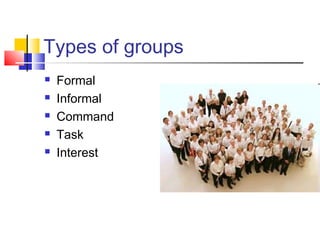
Types of groups
 Formal
 Informal
 Command
 Task
 Interest
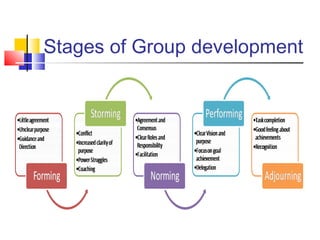
Stages of Group development
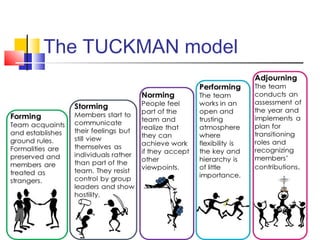
The TUCKMAN model
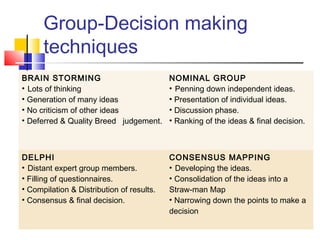
Group-Decision making
techniques
BRAIN STORMING
• Lots of thinking
• Generation of many ideas
• No criticism of other ideas
• Deferred & Quality Breed judgement.
NOMINAL GROUP
• Penning down independent ideas.
• Presentation of individual ideas.
• Discussion phase.
• Ranking of the ideas & final decision.
DELPHI
• Distant expert group members.
• Filling of questionnaires.
• Compilation & Distribution of results.
• Consensus & final decision.
CONSENSUS MAPPING
• Developing the ideas.
• Consolidation of the ideas into a
Straw-man Map
• Narrowing down the points to make a
decision
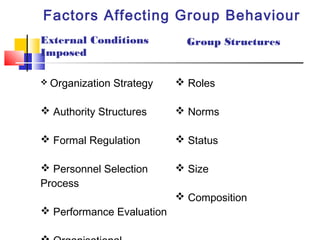
Factors Affecting Group Behaviour
External Conditions
Imposed
Group Structures
 Organization Strategy
 Authority Structures
 Formal Regulation
 Personnel Selection
Process
 Performance Evaluation
 Roles
 Norms
 Status
 Size
 Composition
THANK YOU!!!
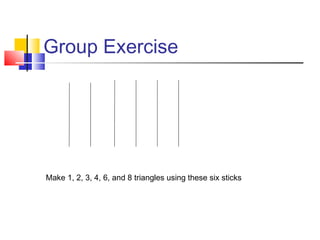
Group Exercise
Make 1, 2, 3, 4, 6, and 8 triangles using these six sticks

Groupdynamics

  • 1.
    GROUP DYNAMICS  NISHANUPUR 14MB000006  KAVITA JHA 14MB000019  SINJINI BANERJEE 14MB000023  PRIYA PARUL 14MB000035  KHUSHBU KUMARI 14MB000060
  • 2.
    Definition: Group Dynamics Thesocial process by which people interact and behave in group environment.
  • 3.
    Group Collection of twoor more individuals, interacting and interdependent and who have come together to achieve a particular objective.
  • 4.
    Characteristics of agroup  Two or more persons.  Direct interactions.  Collection identity.  Common purpose.
  • 5.
    Why Groups areformed?  Safety and Security needs.  Relatedness and Belongingness.  Esteem needs.  Power and Authority.  Identity or Status.
  • 6.
    Types of groups Formal  Informal  Command  Task  Interest
  • 7.
    Stages of Groupdevelopment
  • 8.
  • 9.
    Group-Decision making techniques BRAIN STORMING •Lots of thinking • Generation of many ideas • No criticism of other ideas • Deferred & Quality Breed judgement. NOMINAL GROUP • Penning down independent ideas. • Presentation of individual ideas. • Discussion phase. • Ranking of the ideas & final decision. DELPHI • Distant expert group members. • Filling of questionnaires. • Compilation & Distribution of results. • Consensus & final decision. CONSENSUS MAPPING • Developing the ideas. • Consolidation of the ideas into a Straw-man Map • Narrowing down the points to make a decision
  • 10.
    Factors Affecting GroupBehaviour External Conditions Imposed Group Structures  Organization Strategy  Authority Structures  Formal Regulation  Personnel Selection Process  Performance Evaluation  Roles  Norms  Status  Size  Composition
  • 11.
  • 12.
    Group Exercise Make 1,2, 3, 4, 6, and 8 triangles using these six sticks