Present Tense
Simple
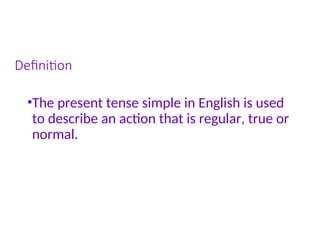
Definition
•The present tense simple in English is used
to describe an action that is regular, true or
normal.
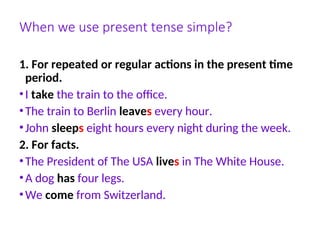
When we use present tense simple?
1. For repeated or regular actions in the present time
period.
•I take the train to the office.
•The train to Berlin leaves every hour.
•John sleeps eight hours every night during the week.
2. For facts.
•The President of The USA lives in The White House.
•A dog has four legs.
•We come from Switzerland.
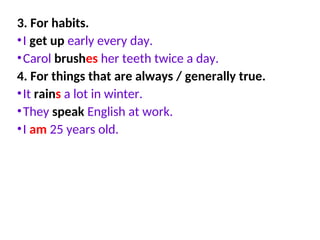
3. For habits.
•I get up early every day.
•Carol brushes her teeth twice a day.
4. For things that are always / generally true.
•It rains a lot in winter.
•They speak English at work.
•I am 25 years old.
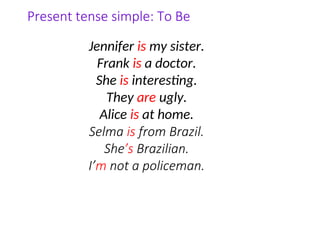
Present tense simple: To Be
Jennifer is my sister.
Frank is a doctor.
She is interesting.
They are ugly.
Alice is at home.
Selma is from Brazil.
She’s Brazilian.
I’m not a policeman.
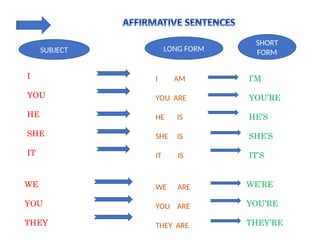
I
YOU
HE
SHE
IT
WE
YOU
THEY
SUBJECT LONG FORM
SHORT
FORM
I AM
YOU ARE
HE IS
SHE IS
IT IS
WE ARE
YOU ARE
THEY ARE
I’M
YOU’RE
HE’S
SHE’S
IT’S
WE’RE
YOU’RE
THEY’RE
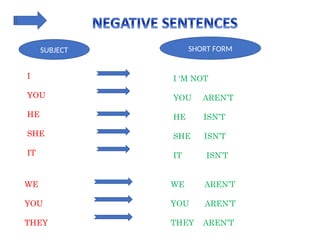
SUBJECT
I
YOU
HE
SHE
IT
WE
YOU
THEY
SHORT FORM
I ‘M NOT
YOU AREN’T
HE ISN’T
SHE ISN’T
IT ISN’T
WE AREN’T
YOU AREN’T
THEY AREN’T
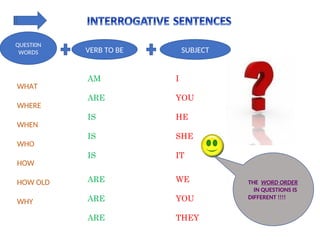
SUBJECT
I
YOU
HE
SHE
IT
WE
YOU
THEY
VERB TO BE
AM
ARE
IS
IS
IS
ARE
ARE
ARE
QUESTI0N
WORDS
WHAT
WHERE
WHEN
WHO
HOW
HOW OLD
WHY
THE WORD ORDER
IN QUESTIONS IS
DIFFERENT !!!!
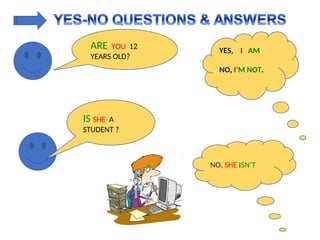
ARE YOU 12
YEARS OLD?
YES, I AM
NO, I’M NOT.
IS SHE A
STUDENT ?
NO, SHE ISN’T
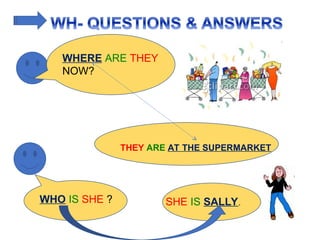
WHERE ARE THEY
NOW?
THEY ARE AT THE SUPERMARKET
WHO IS SHE ? SHE IS SALLY.
Present tense simple
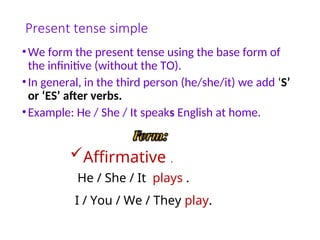
•We form the present tense using the base form of
the infinitive (without the TO).
•In general, in the third person (he/she/it) we add ‘S’
or ‘ES’ after verbs.
•Example: He / She / It speaks English at home.
Affirmative .
He / She / It plays .
I / You / We / They play.
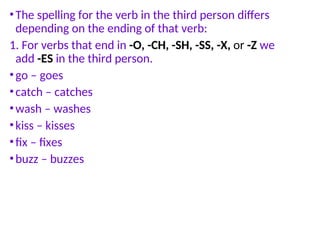
•The spelling for the verb in the third person differs
depending on the ending of that verb:
1. For verbs that end in -O, -CH, -SH, -SS, -X, or -Z we
add -ES in the third person.
•go – goes
•catch – catches
•wash – washes
•kiss – kisses
•fix – fixes
•buzz – buzzes
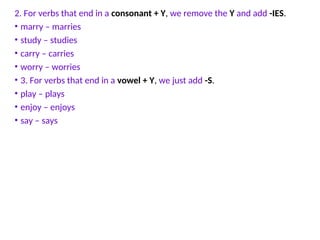
2. For verbs that end in a consonant + Y, we remove the Y and add -IES.
• marry – marries
• study – studies
• carry – carries
• worry – worries
• 3. For verbs that end in a vowel + Y, we just add -S.
• play – plays
• enjoy – enjoys
• say – says
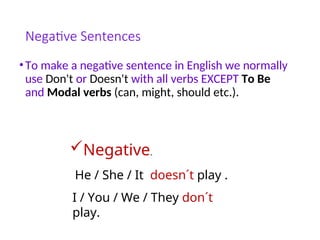
Negative Sentences
•To make a negative sentence in English we normally
use Don't or Doesn't with all verbs EXCEPT To Be
and Modal verbs (can, might, should etc.).
Negative.
He / She / It doesn´t play .
I / You / We / They don´t
play.
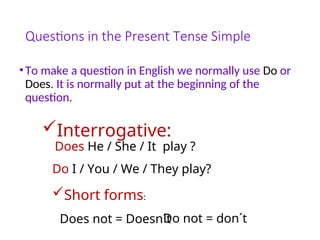
Questions in the Present Tense Simple
•To make a question in English we normally use Do or
Does. It is normally put at the beginning of the
question.
Interrogative:
Does He / She / It play ?
Do I / You / We / They play?
Short forms:
Does not = Doesn´t
Do not = don´t
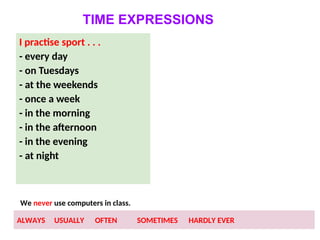
TIME EXPRESSIONS
I practise sport . . .
- every day
- on Tuesdays
- at the weekends
- once a week
- in the morning
- in the afternoon
- in the evening
- at night
We never use computers in class.
ALWAYS USUALLY OFTEN SOMETIMES HARDLY EVER
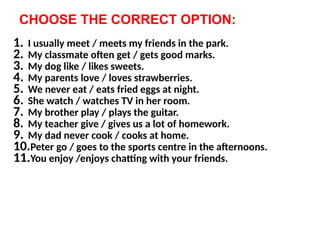
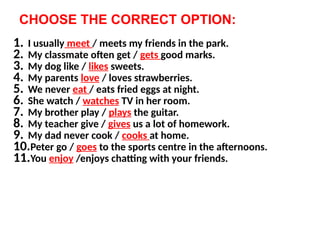
CHOOSE THE CORRECT OPTION:
1. I usually meet / meets my friends in the park.
2. My classmate often get / gets good marks.
3. My dog like / likes sweets.
4. My parents love / loves strawberries.
5. We never eat / eats fried eggs at night.
6. She watch / watches TV in her room.
7. My brother play / plays the guitar.
8. My teacher give / gives us a lot of homework.
9. My dad never cook / cooks at home.
10.Peter go / goes to the sports centre in the afternoons.
11.You enjoy /enjoys chatting with your friends.
CHOOSE THE CORRECT OPTION:
1. I usually meet / meets my friends in the park.
2. My classmate often get / gets good marks.
3. My dog like / likes sweets.
4. My parents love / loves strawberries.
5. We never eat / eats fried eggs at night.
6. She watch / watches TV in her room.
7. My brother play / plays the guitar.
8. My teacher give / gives us a lot of homework.
9. My dad never cook / cooks at home.
10.Peter go / goes to the sports centre in the afternoons.
11.You enjoy /enjoys chatting with your friends.
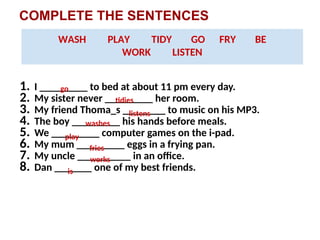
COMPLETE THE SENTENCES
1. I _________ to bed at about 11 pm every day.
2. My sister never _________ her room.
3. My friend Thoma_s ________ to music on his MP3.
4. The boy _________ his hands before meals.
5. We _________ computer games on the i-pad.
6. My mum _________ eggs in a frying pan.
7. My uncle __________ in an office.
8. Dan _______ one of my best friends.
WASH PLAY TIDY GO FRY BE
WORK LISTEN
go
tidies
listens
washes
play
fries
works
is
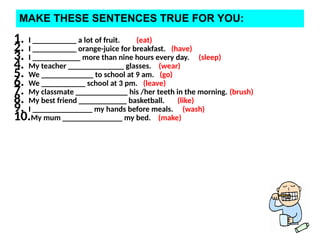
MAKE THESE SENTENCES TRUE FOR YOU:
1. I ___________ a lot of fruit. (eat)
2. I ___________ orange-juice for breakfast. (have)
3. I ____________ more than nine hours every day. (sleep)
4. My teacher ______________ glasses. (wear)
5. We _____________ to school at 9 am. (go)
6. We ___________ school at 3 pm. (leave)
7. My classmate _____________ his /her teeth in the morning. (brush)
8. My best friend ____________ basketball. (like)
9. I _______________ my hands before meals. (wash)
10.My mum _______________ my bed. (make)
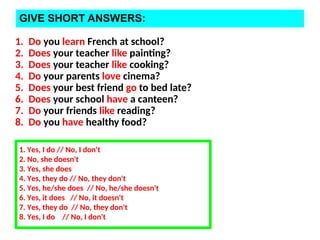
GIVE SHORT ANSWERS:
1. Do you learn French at school?
2. Does your teacher like painting?
3. Does your teacher like cooking?
4. Do your parents love cinema?
5. Does your best friend go to bed late?
6. Does your school have a canteen?
7. Do your friends like reading?
8. Do you have healthy food?
1. Yes, I do // No, I don't
2. No, she doesn't
3. Yes, she does
4. Yes, they do // No, they don't
5. Yes, he/she does // No, he/she doesn't
6. Yes, it does // No, it doesn't
7. Yes, they do // No, they don't
8. Yes, I do // No, I don't
simple present questions version 2 -
Unjumble
• ELLLO - Beginner English - A2 - Present Simple
• Speaking - Present Simple - Do you...? (31 pytań) - mówienie po
angielsku (hcp) - Speaking cards

PRESENT SIMPLE and HOW TO USE IT IN SENTENCES

  • 1.
  • 2.
    Definition •The present tensesimple in English is used to describe an action that is regular, true or normal.
  • 3.
    When we usepresent tense simple? 1. For repeated or regular actions in the present time period. •I take the train to the office. •The train to Berlin leaves every hour. •John sleeps eight hours every night during the week. 2. For facts. •The President of The USA lives in The White House. •A dog has four legs. •We come from Switzerland.
  • 4.
    3. For habits. •Iget up early every day. •Carol brushes her teeth twice a day. 4. For things that are always / generally true. •It rains a lot in winter. •They speak English at work. •I am 25 years old.
  • 5.
    Present tense simple:To Be Jennifer is my sister. Frank is a doctor. She is interesting. They are ugly. Alice is at home. Selma is from Brazil. She’s Brazilian. I’m not a policeman.
  • 6.
    I YOU HE SHE IT WE YOU THEY SUBJECT LONG FORM SHORT FORM IAM YOU ARE HE IS SHE IS IT IS WE ARE YOU ARE THEY ARE I’M YOU’RE HE’S SHE’S IT’S WE’RE YOU’RE THEY’RE
  • 7.
    SUBJECT I YOU HE SHE IT WE YOU THEY SHORT FORM I ‘MNOT YOU AREN’T HE ISN’T SHE ISN’T IT ISN’T WE AREN’T YOU AREN’T THEY AREN’T
  • 8.
  • 9.
    ARE YOU 12 YEARSOLD? YES, I AM NO, I’M NOT. IS SHE A STUDENT ? NO, SHE ISN’T
  • 10.
    WHERE ARE THEY NOW? THEYARE AT THE SUPERMARKET WHO IS SHE ? SHE IS SALLY.
  • 11.
    Present tense simple •Weform the present tense using the base form of the infinitive (without the TO). •In general, in the third person (he/she/it) we add ‘S’ or ‘ES’ after verbs. •Example: He / She / It speaks English at home. Affirmative . He / She / It plays . I / You / We / They play.
  • 12.
    •The spelling forthe verb in the third person differs depending on the ending of that verb: 1. For verbs that end in -O, -CH, -SH, -SS, -X, or -Z we add -ES in the third person. •go – goes •catch – catches •wash – washes •kiss – kisses •fix – fixes •buzz – buzzes
  • 13.
    2. For verbsthat end in a consonant + Y, we remove the Y and add -IES. • marry – marries • study – studies • carry – carries • worry – worries • 3. For verbs that end in a vowel + Y, we just add -S. • play – plays • enjoy – enjoys • say – says
  • 14.
    Negative Sentences •To makea negative sentence in English we normally use Don't or Doesn't with all verbs EXCEPT To Be and Modal verbs (can, might, should etc.). Negative. He / She / It doesn´t play . I / You / We / They don´t play.
  • 15.
    Questions in thePresent Tense Simple •To make a question in English we normally use Do or Does. It is normally put at the beginning of the question. Interrogative: Does He / She / It play ? Do I / You / We / They play? Short forms: Does not = Doesn´t Do not = don´t
  • 16.
    TIME EXPRESSIONS I practisesport . . . - every day - on Tuesdays - at the weekends - once a week - in the morning - in the afternoon - in the evening - at night We never use computers in class. ALWAYS USUALLY OFTEN SOMETIMES HARDLY EVER
  • 17.
    CHOOSE THE CORRECTOPTION: 1. I usually meet / meets my friends in the park. 2. My classmate often get / gets good marks. 3. My dog like / likes sweets. 4. My parents love / loves strawberries. 5. We never eat / eats fried eggs at night. 6. She watch / watches TV in her room. 7. My brother play / plays the guitar. 8. My teacher give / gives us a lot of homework. 9. My dad never cook / cooks at home. 10.Peter go / goes to the sports centre in the afternoons. 11.You enjoy /enjoys chatting with your friends.
  • 18.
    CHOOSE THE CORRECTOPTION: 1. I usually meet / meets my friends in the park. 2. My classmate often get / gets good marks. 3. My dog like / likes sweets. 4. My parents love / loves strawberries. 5. We never eat / eats fried eggs at night. 6. She watch / watches TV in her room. 7. My brother play / plays the guitar. 8. My teacher give / gives us a lot of homework. 9. My dad never cook / cooks at home. 10.Peter go / goes to the sports centre in the afternoons. 11.You enjoy /enjoys chatting with your friends.
  • 19.
    COMPLETE THE SENTENCES 1.I _________ to bed at about 11 pm every day. 2. My sister never _________ her room. 3. My friend Thoma_s ________ to music on his MP3. 4. The boy _________ his hands before meals. 5. We _________ computer games on the i-pad. 6. My mum _________ eggs in a frying pan. 7. My uncle __________ in an office. 8. Dan _______ one of my best friends. WASH PLAY TIDY GO FRY BE WORK LISTEN go tidies listens washes play fries works is
  • 20.
    MAKE THESE SENTENCESTRUE FOR YOU: 1. I ___________ a lot of fruit. (eat) 2. I ___________ orange-juice for breakfast. (have) 3. I ____________ more than nine hours every day. (sleep) 4. My teacher ______________ glasses. (wear) 5. We _____________ to school at 9 am. (go) 6. We ___________ school at 3 pm. (leave) 7. My classmate _____________ his /her teeth in the morning. (brush) 8. My best friend ____________ basketball. (like) 9. I _______________ my hands before meals. (wash) 10.My mum _______________ my bed. (make)
  • 21.
    GIVE SHORT ANSWERS: 1.Do you learn French at school? 2. Does your teacher like painting? 3. Does your teacher like cooking? 4. Do your parents love cinema? 5. Does your best friend go to bed late? 6. Does your school have a canteen? 7. Do your friends like reading? 8. Do you have healthy food? 1. Yes, I do // No, I don't 2. No, she doesn't 3. Yes, she does 4. Yes, they do // No, they don't 5. Yes, he/she does // No, he/she doesn't 6. Yes, it does // No, it doesn't 7. Yes, they do // No, they don't 8. Yes, I do // No, I don't
  • 22.
    simple present questionsversion 2 - Unjumble • ELLLO - Beginner English - A2 - Present Simple • Speaking - Present Simple - Do you...? (31 pytań) - mówienie po angielsku (hcp) - Speaking cards