To be 
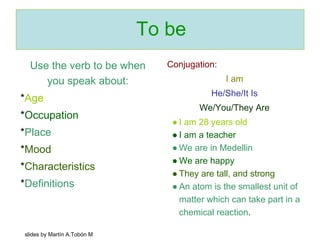
Use the verb to be when 
you speak about: 
*Age 
*Occupation 
*Place 
*Mood 
*Characteristics 
*Definitions 
Conjugation: 
I am 
He/She/It Is 
We/You/They Are 
● I am 28 years old 
● I am a teacher 
● We are in Medellin 
● We are happy 
● They are tall, and strong 
● An atom is the smallest unit of 
matter which can take part in a 
chemical reaction. 
slides by Martín A.Tobón M
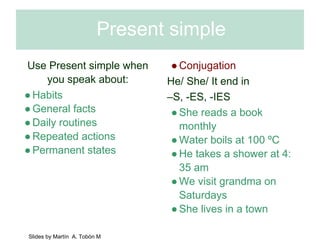
Present simple 
Use Present simple when 
you speak about: 
● Habits 
● General facts 
● Daily routines 
● Repeated actions 
● Permanent states 
● Conjugation 
He/ She/ It end in 
–S, -ES, -IES 
● She reads a book 
monthly 
● Water boils at 100 ºC 
● He takes a shower at 4: 
35 am 
● We visit grandma on 
Saturdays 
● She lives in a town 
Slides by Martín A. Tobón M
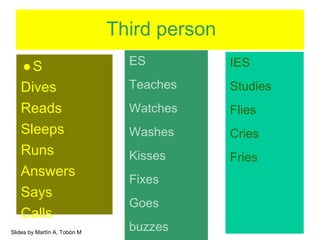
Third person 
● S 
Dives 
Reads 
Sleeps 
Runs 
Answers 
Says 
Calls 
ES 
Teaches 
Watches 
Washes 
Kisses 
Fixes 
Goes 
buzzes 
IES 
Studies 
Flies 
Cries 
Fries 
Slides by Martín A. Tobón M
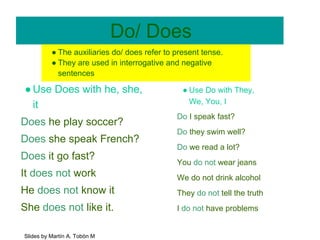
Do/ Does 
● The auxiliaries do/ does refer to present tense. 
● They are used in interrogative and negative 
sentences 
● Use Does with he, she, 
it 
Does he play soccer? 
Does she speak French? 
Does it go fast? 
It does not work 
He does not know it 
She does not like it. 
● Use Do with They, 
We, You, I 
Do I speak fast? 
Do they swim well? 
Do we read a lot? 
You do not wear jeans 
We do not drink alcohol 
They do not tell the truth 
I do not have problems 
Slides by Martín A. Tobón M
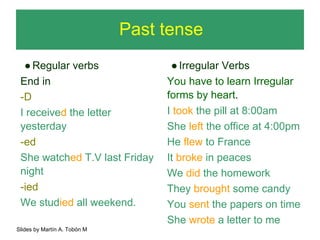
Past tense 
● Regular verbs 
End in 
-D 
I received the letter 
yesterday 
-ed 
She watched T.V last Friday 
night 
-ied 
We studied all weekend. 
● Irregular Verbs 
You have to learn Irregular 
forms by heart. 
I took the pill at 8:00am 
She left the office at 4:00pm 
He flew to France 
It broke in peaces 
We did the homework 
They brought some candy 
You sent the papers on time 
She wrote a letter to me 
Slides by Martín A. Tobón M
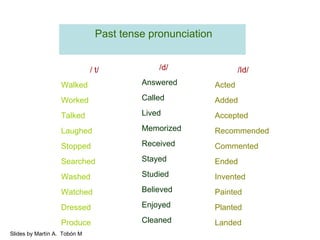
Past tense pronunciation 
/ t/ 
Walked 
Worked 
Talked 
Laughed 
Stopped 
Searched 
Washed 
Watched 
Dressed 
Produce 
/d/ 
Answered 
Called 
Lived 
Memorized 
Received 
Stayed 
Studied 
Believed 
Enjoyed 
Cleaned 
/Id/ 
Acted 
Added 
Accepted 
Recommended 
Commented 
Ended 
Invented 
Painted 
Planted 
Landed 
Slides by Martín A. Tobón M
Did 
Negative 
● I did not work yesterday 
● She did not hide the 
information 
● He did not hurt himself 
● We did not shake the hip 
● They did not tear the paper 
● He did not throw the stone 
● We did not know the answer 
● They did not forbid smoking 
here 
Interrogative 
● Did you go to the play? 
● Did she call you yesterday? 
● Did he leave on time? 
● Did you eat before class? 
● Did you choose your car? 
● Did she burn the letter? 
● Did they throw the stone? 
● Did they forgive you? 
● Did he forget her birthday? 
● Did you work last weekend? 
Slides by Martin A. Tobón M
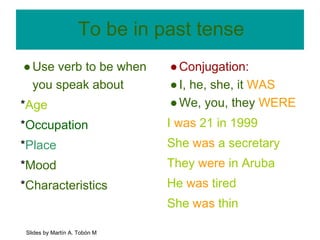
To be in past tense 
● Use verb to be when 
you speak about 
*Age 
*Occupation 
*Place 
*Mood 
*Characteristics 
● Conjugation: 
● I, he, she, it WAS 
● We, you, they WERE 
I was 21 in 1999 
She was a secretary 
They were in Aruba 
He was tired 
She was thin 
Slides by Martín A. Tobón M
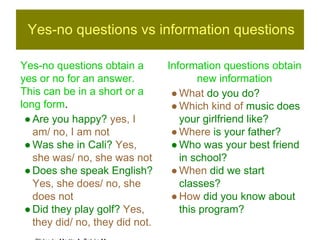
Yes-no questions vs information questions 
Yes-no questions obtain a 
yes or no for an answer. 
This can be in a short or a 
long form. 
● Are you happy? yes, I 
am/ no, I am not 
● Was she in Cali? Yes, 
she was/ no, she was not 
● Does she speak English? 
Yes, she does/ no, she 
does not 
● Did they play golf? Yes, 
they did/ no, they did not. 
Information questions obtain 
new information 
● What do you do? 
● Which kind of music does 
your girlfriend like? 
● Where is your father? 
● Who was your best friend 
in school? 
● When did we start 
classes? 
● How did you know about 
this program? 
Slides by Martín A. Tobón M