What is Applied Linguistics?
 Though the term "applied linguistics" has traditionally been
associated with the scientific study of such areas as TESOL,
TEFL, TESL, language teaching and learning, applied
linguists do a variety of things: The basic idea is, as the
definition implies, to contribute to the real-world issues.
An historic overview of language
teaching approaches
 Pre- 20th Century Trends
 Popular approaches in Language Teaching in 20th
Century
 Teachers’ choice of best approaches, materials and
techniques for students
Pre-20th Century Trends:
 Greek and Rome Period
 Renaissance
 1631-1658
 19th
Century
 The end of 19th
Century
 Early 20th
century
The Development of Applied Linguistics—
Early History
 the ancient Greeks
 Plato and Aristotle: design of curriculum of grammar, rhetoric
 English:
 Samuel Johnson (1755). Dictionary of the English Language
 authority on the meanings of English words
 standardizing English spellings
 Robert Lowth (1762). Short Introduction to English Grammar
 adopted as ‘correct English”
CLASSICAL PERIOD (17th , 18th and 19t
h centuries)
EDUCATION AS AN ARM OF THEOCRACY
Purpose of education to teach religious orthodoxy
and good moral character
FOREİGN LANGUAGE LEARNİNG ASSOCIATED
WITH THE LEARNİNG OF GREEK AND LATİN
purpose of learning a foreign language to
promote speakers’ intellectuality
1850’s: Classical method came to be known as
Grammar Translation Method
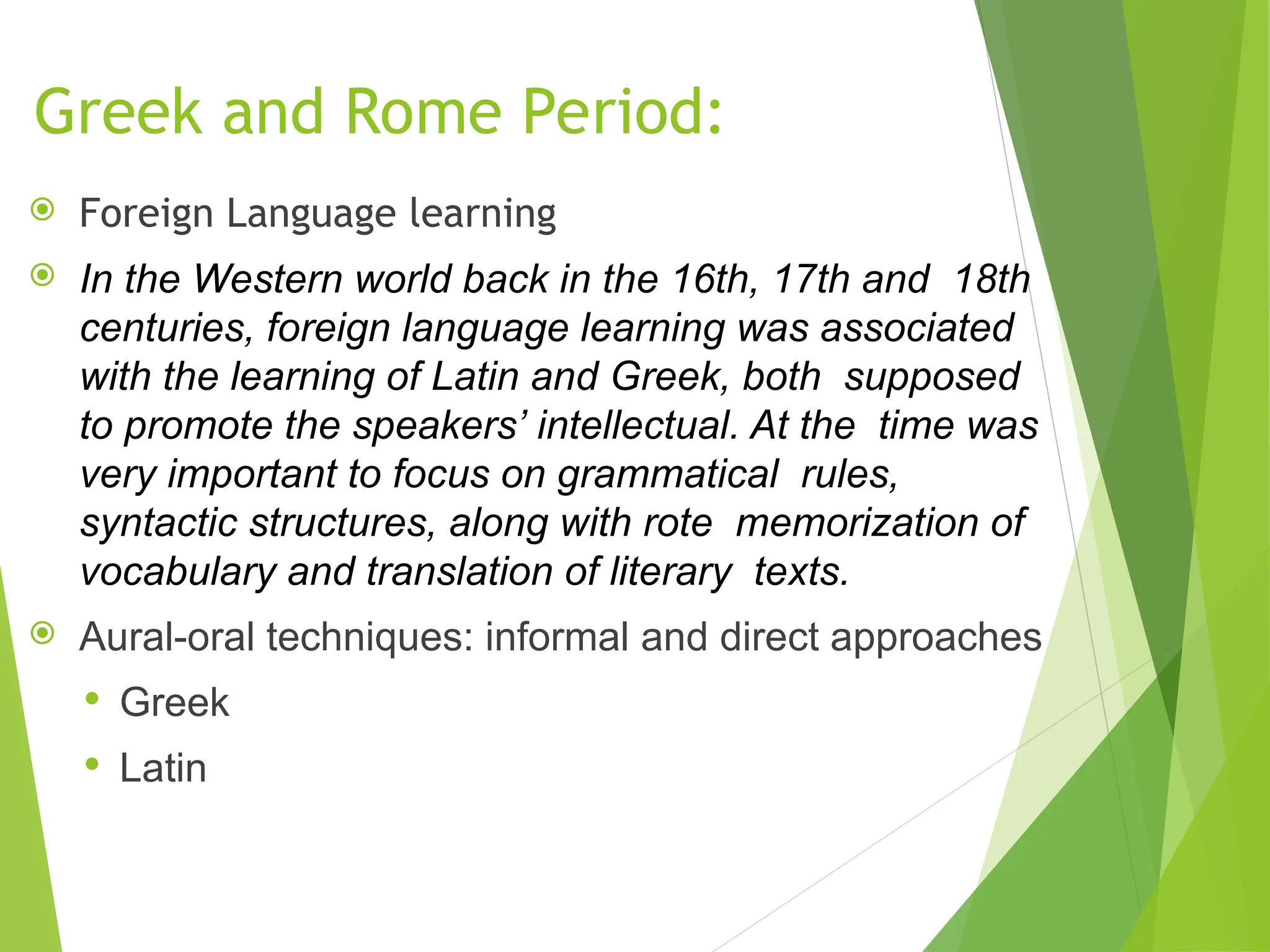
Greek and Rome Period:
 Foreign Language learning
 In the Western world back in the 16th, 17th and 18th
centuries, foreign language learning was associated
with the learning of Latin and Greek, both supposed
to promote the speakers’ intellectual. At the time was
very important to focus on grammatical rules,
syntactic structures, along with rote memorization of
vocabulary and translation of literary texts.
 Aural-oral techniques: informal and direct approaches
 Greek
 Latin
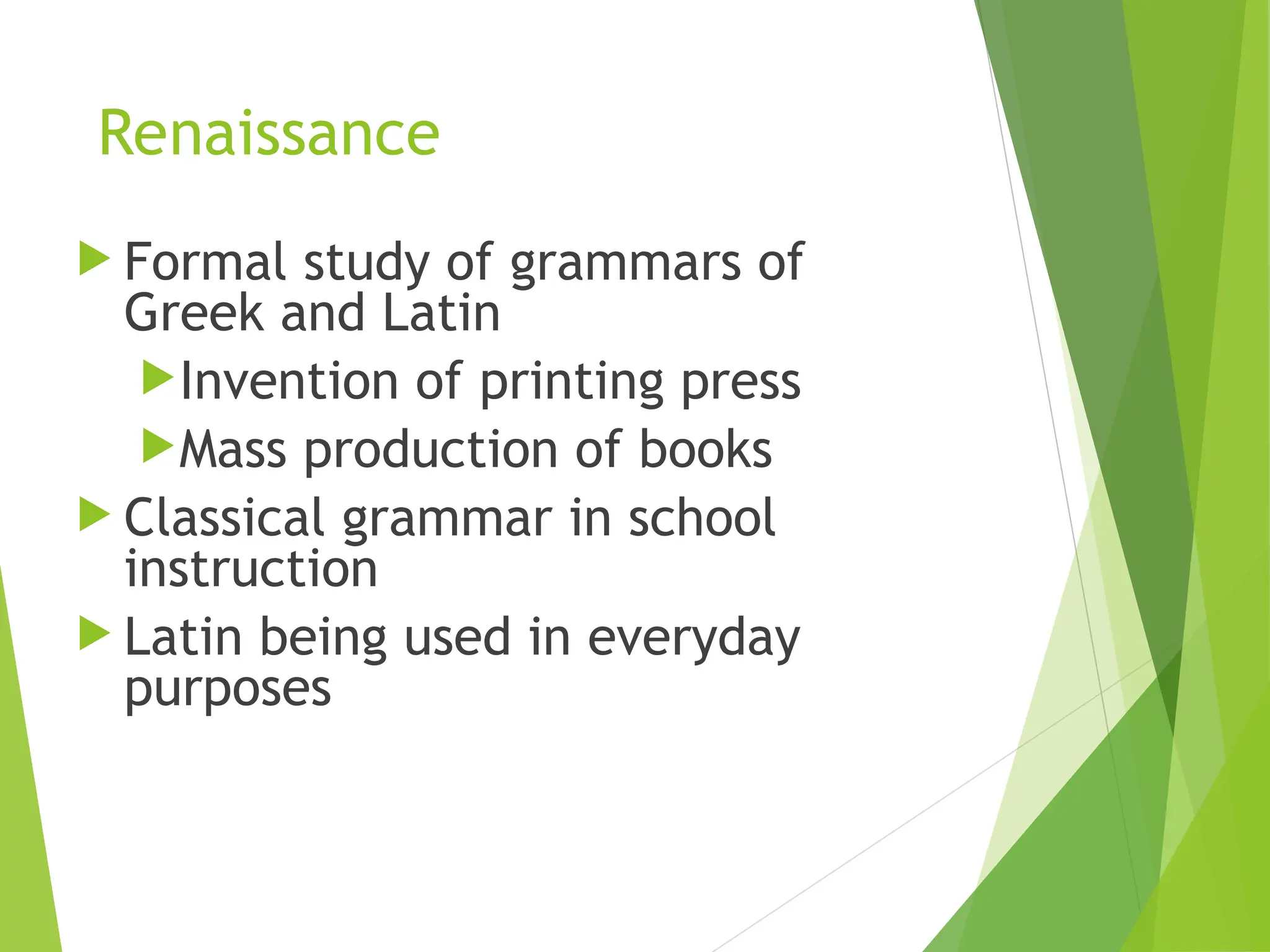
Renaissance
 Formal study of grammars of
Greek and Latin
Invention of printing press
Mass production of books
 Classical grammar in school
instruction
 Latin being used in everyday
purposes
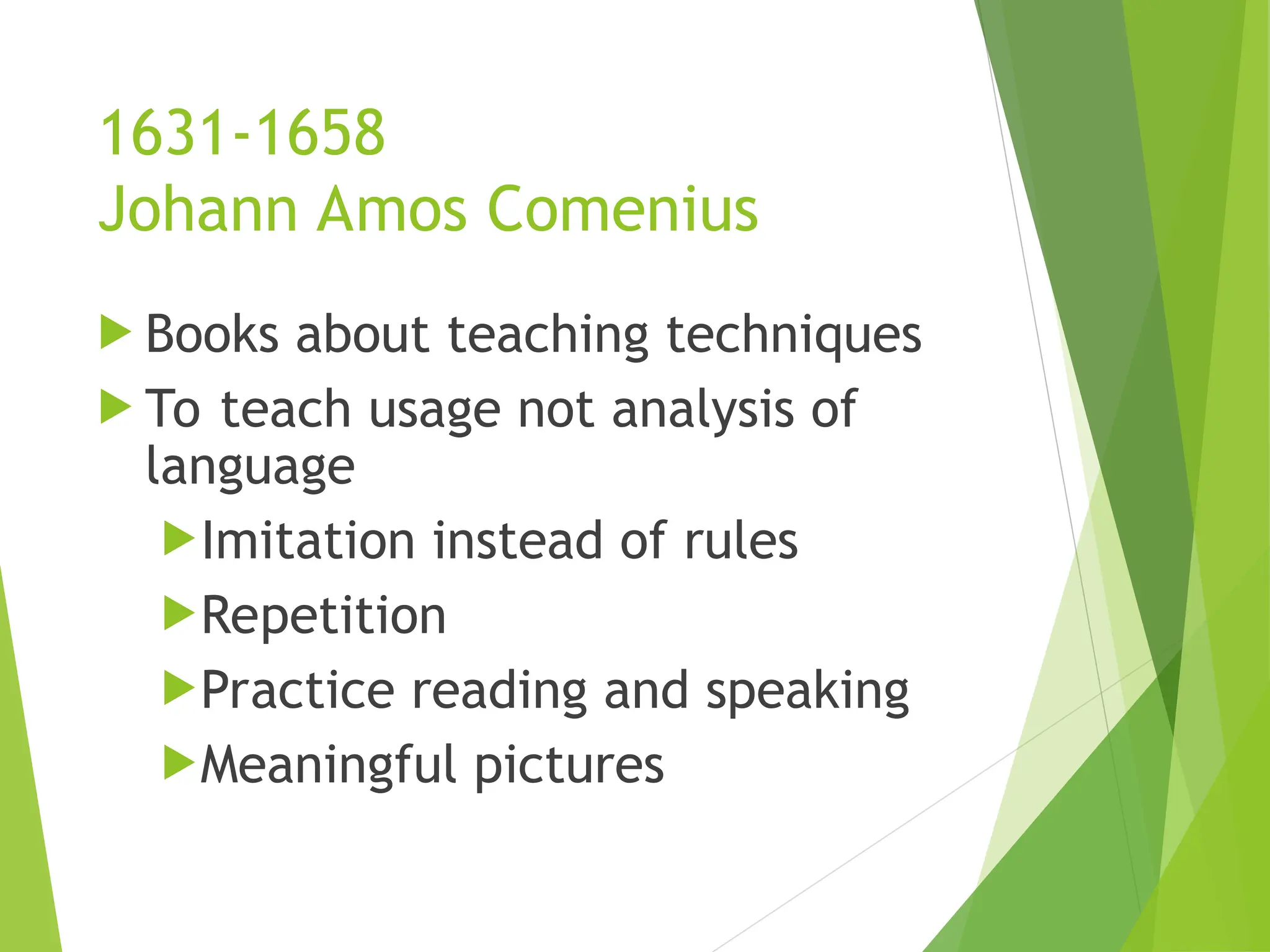
1631-1658
Johann Amos Comenius
 Books about teaching techniques
 To teach usage not analysis of
language
Imitation instead of rules
Repetition
Practice reading and speaking
Meaningful pictures
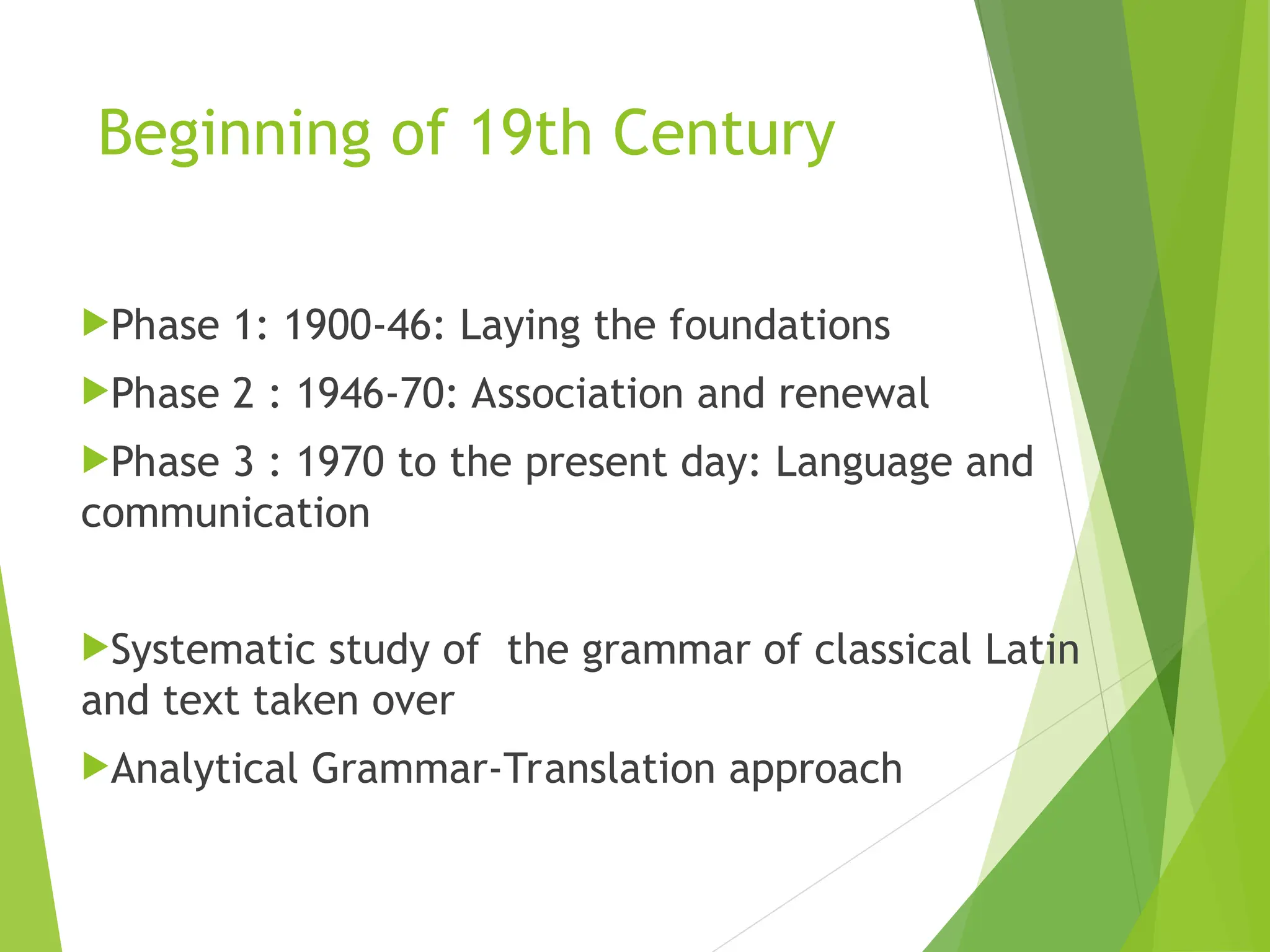
Beginning of 19th Century
Phase 1: 1900-46: Laying the foundations
Phase 2 : 1946-70: Association and renewal
Phase 3 : 1970 to the present day: Language and
communication
Systematic study of the grammar of classical Latin
and text taken over
Analytical Grammar-Translation approach
The teaching of English as a foreign
or second language
Contexts of English language teaching, Phase 1


1.Secondary schools in Europe. Interest in learning English rising.
Anglocists among leaders of the Reform Movement. The key British
contribution was phonetics. Main representative: Daniel Jones (1881-
1967).
2.Adult education in Europe. The primary context for Direct Method
teaching along Berlitz lines since the 1880s. Native speaker teachers.
Main representative: Harold Palmer (1877- 1949).
3. Basic schooling in the Empire. To1920s: English still taught as a ‘quasi
-mother-tongue’; 1920s onwards: beginnings of ‘English ;is a second
language’. Main representative: Michael West (1888- 1973).
4. Adult education in the UK. ‘English for foreigners’ Small numbers until
refugee invasion in 1930s. Main representative: C. E. Eckersley (1893-
1967).
The teaching of English as a foreign
or second language
 If there is one word that sums up the 1960s like
‘patterns’ in the 1950s and ‘functions’ in the 1970s, it
would be ‘situations'. But ‘situations’ were also events
like ‘An evening Out’ or ‘A Visit to the Theatre’ depicted
in dialogues designed to dis-play a ‘chunk’ of language
in use more or less as it actually occurred in real life, and
not invented as a device for illustrating meaning.
 Television was hugely popular in the 1960s and it
seemed to offer an ideal medium for demonstrating
language in situations.
The teaching of English as a
foreign or second language
 1960-70: Renewal
In the new climate, research was also back on the menu and ELT
benefited from a number of specific projects, four of which are
summarized below. They all attracted government support in some
form:
1. The ‘Survey of English Usage’ directed by Randolph Quirk was
set up at London University in 1960. The ultimate outcome was the
most substantial grammar of English since Jespersen’s: A Grammar
of contemporary English (1972) which was later expanded as A Com-
prehensive Grammar o f the English Language(1985).
2. London also played host to the ‘Program in Linguistics and
English Teaching’ (1964-71), directed by M. A. K. Halliday. This
project produced a range of innovative mother-tongue teaching
materials for schools.
 3. The Scope project (1966-72), which has
already been mentioned, that is set up by
the Schools Council at the University of Leeds
under the direction of John Ridge and June
Derrick. Its aim was to produce teaching
materials for English as a second language in
primary schools.
 4. ‘Primary French’ (to use its popular name)
was the largest language teaching research
enterprise of its day. It started in 1963 and
continued until 1974. It was proposed that
French should be introduced into primary
schools as a course materials
The teaching of English as a
foreign or second language
 In the history of ELT in the1970s the idea of
communication was the main point, which found its
way into almost every aspect of the subject: syllabus
planning, teaching materials, testing and
assessment, and so on.
 Communicative Language Teaching (CLT) repres-
ented a conscious choice between competing
models.
 What adult learners were looking for—and the
communicative movement was directed at adults
in the first instance—wasinstruction
in English which was relevant to their needs
and wishes.
The teaching of English as a
foreign or second language
 Three approaches in particular found favor among
teachers and course designers:
 One was role-playing or simulation where learners either
enacted a communicative event from a memorized text, or
improvised one from given guidelines.
 Second was ‘problem solving’ which had considerable appeal in
ESP because it carried research connotations.
 But probably the most popular model was skill training which had
the advantage of representing a reasonably holistic view of
learning while at the same time permitting the exercise of
specific components.
Other approaches
Reading approach(1941 in
U.S.)
Audiolingual Approach
Oral Situational
Approach(Britain)
The end of 19th Century
 Direct Method: to use rather
then to analyze a language
France, Germany, Europe
Spoken form taught first
Solid training in phonetic
Pronunciation and oral skills
1850’s to 1950’s: Grammar Translatio
n
 Emphasis on learnıng to read & wrıte
 Focus on grammatical rules, syntactic
structures, rote memorization of vocabulary
and translation of literary texts
 Voc. is taught in the form of lists of isolated
words.
 Medium of instruction was the mother tongue
 No provision for the oral use of language
 Speaking and listening were mediated via
“conversation classes”, add-ons to the main
course
Early Mid-20th Centur
y
 Demand for ability to speak a foreign language
 Reformers reconsidering the nature of
langauge and learning
 Three Reformers (the way children learned
languages was relevant to how adults learned
languages)
 C. Marcel
 F. Gouin
 T. Pendergast
Individuals Reformers (Claude Marcel)
 Claude Marcel:
 Emphasized the importance of understanding
meaning in language learning
 Devising of Rational Method
 The teaching of Reading: The first Priority in
foreign language Teaching
 He was the first to develop a coherent and
educationally responsible methodology of language
teaching derived from an analysis of the activity
itself and its relationship to other branches of
knowledge.
Individuals Reformers (François
Gouin)
 François Gouin ‘Series Method’
Painful experience in learning German
 Tried to memorize a German grammar book and a list of
248 irregular German verbs
Observed his three-year old nephew
Emphasized presenting each item in context and using gestures to
supplement verbal meaning
Taught learners directly a series of connected sentences.
Ex. I stretch out my arm. I take hold of the handle. I open the door. I
pull the door.
Came up with the following insights
 Children use language to represent their conceptions.
 Language is a means of thinking, of representing the world to
oneself.
Individuals Reformers (Thomas
Prendergast)
 Thomas Prendergast ‘Mastery System’
Proposed the first structural syllabus (arranging
grammatical structures so that the easiest was taught
first)
He went further and observed what children were
doing and the learning processes they appeared to be
using
He used detached sentences as his basic learning
data
Individuals Reformers (Thomas
Prendergast)
 To Him the crucial feature of language was the
capacity of human beings to generate an infinite
number of sentences from a finite set of
means. (Generative Principle)
 Mastery System: The mastery of languages, or
the art of Speaking foreign languages
idiomatically.
 He noticed that small infants inter-pret the
meaning of language by making use of other
information available to them in the wider
context, what people do, how they look, their
gestures and facial expressions.
Individuals Reformers (Thomas
Prendergast)
 Prendergast’s seven teaching steps:
 Step 1: required the memorization of five or six
sentences making up about one hundred words
altogether. The basic aim was a correct pronunciation
and a fluent control of the model sentences
 Step 2: learners work on written language.
 Step 3 and 4: are concerned with the manipulation of
the model sentences (‘evolutions’) and the acquisition
of further models.
 Steps 5, 6, and 7: the development of reading and
conversation skills.
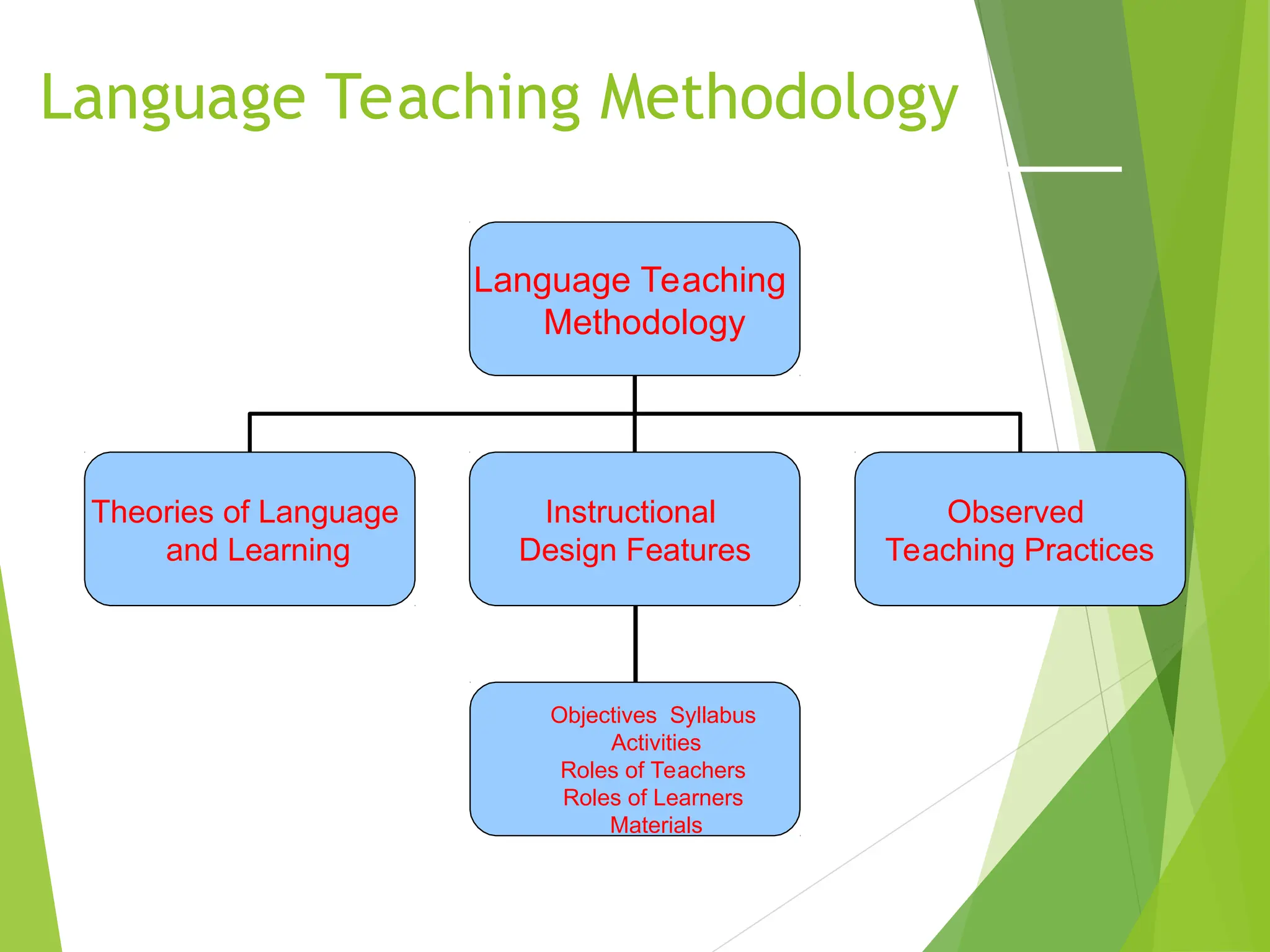
Language Teaching Methodology
Language Teaching
Methodology
Theories of Language
and Learning
Instructional
Design Features
Observed
Teaching Practices
Objectives Syllabus
Activities
Roles of Teachers
Roles of Learners
Materials
20th Century: 9 Approaches and
Methods of Language Teaching
 Grammar-Translation
 Direct
 Reading
 Audio-lingualism(U.S.)
 Oral-Situational (Britain)
 Cognitive
 Affective-Humanistic
 Comprehension-Based
 Communicative
Grammar Translation
Approach
Given in native language
Grammatical parsing: forms
and inflection
Translate sentences
Not for communication
Direct Approach
No use of mother tongue
Dialogues, actions, picture
Grammar and target culture
taught inductively
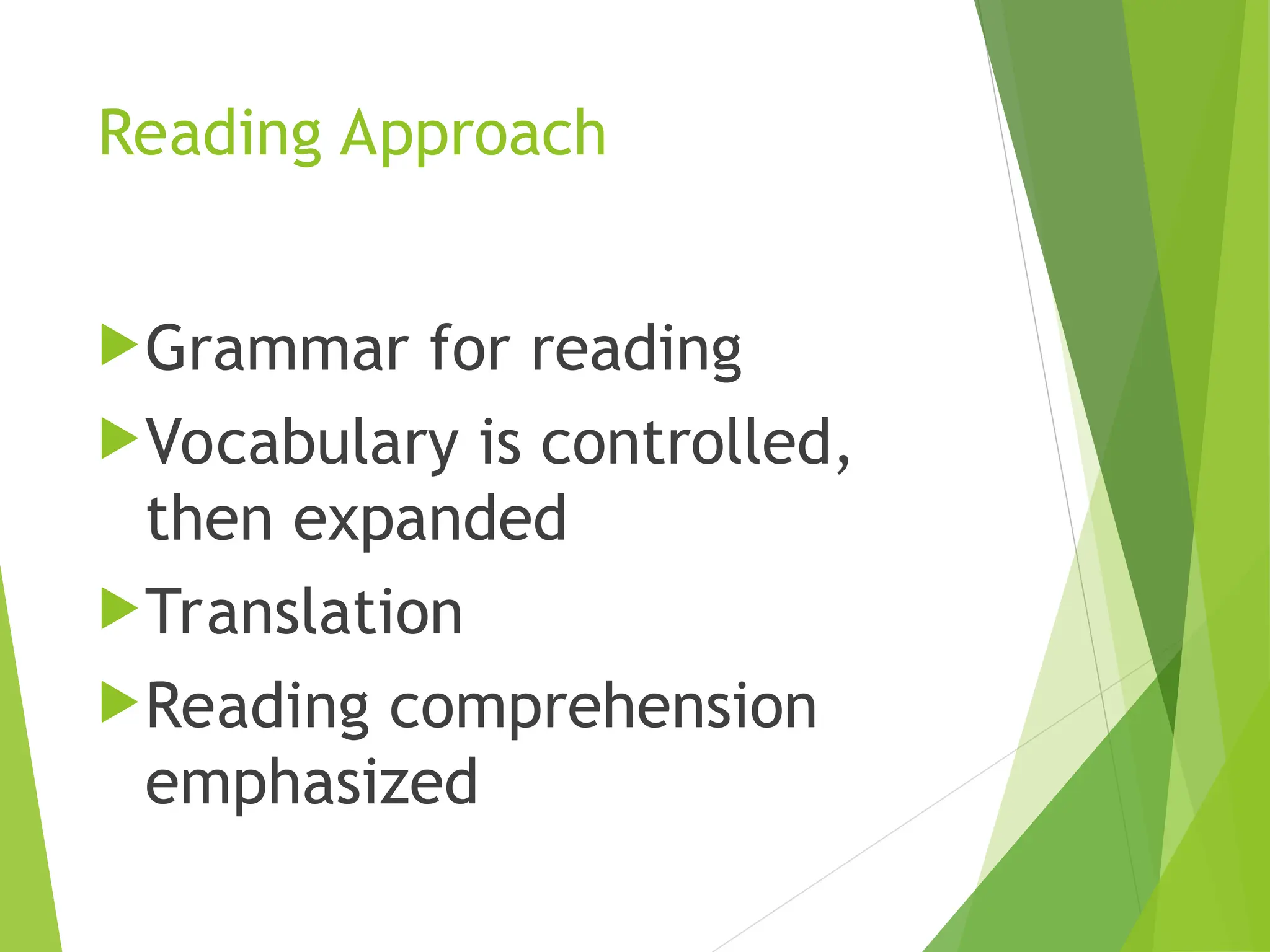
Reading Approach
Grammar for reading
Vocabulary is controlled,
then expanded
Translation
Reading comprehension
emphasized
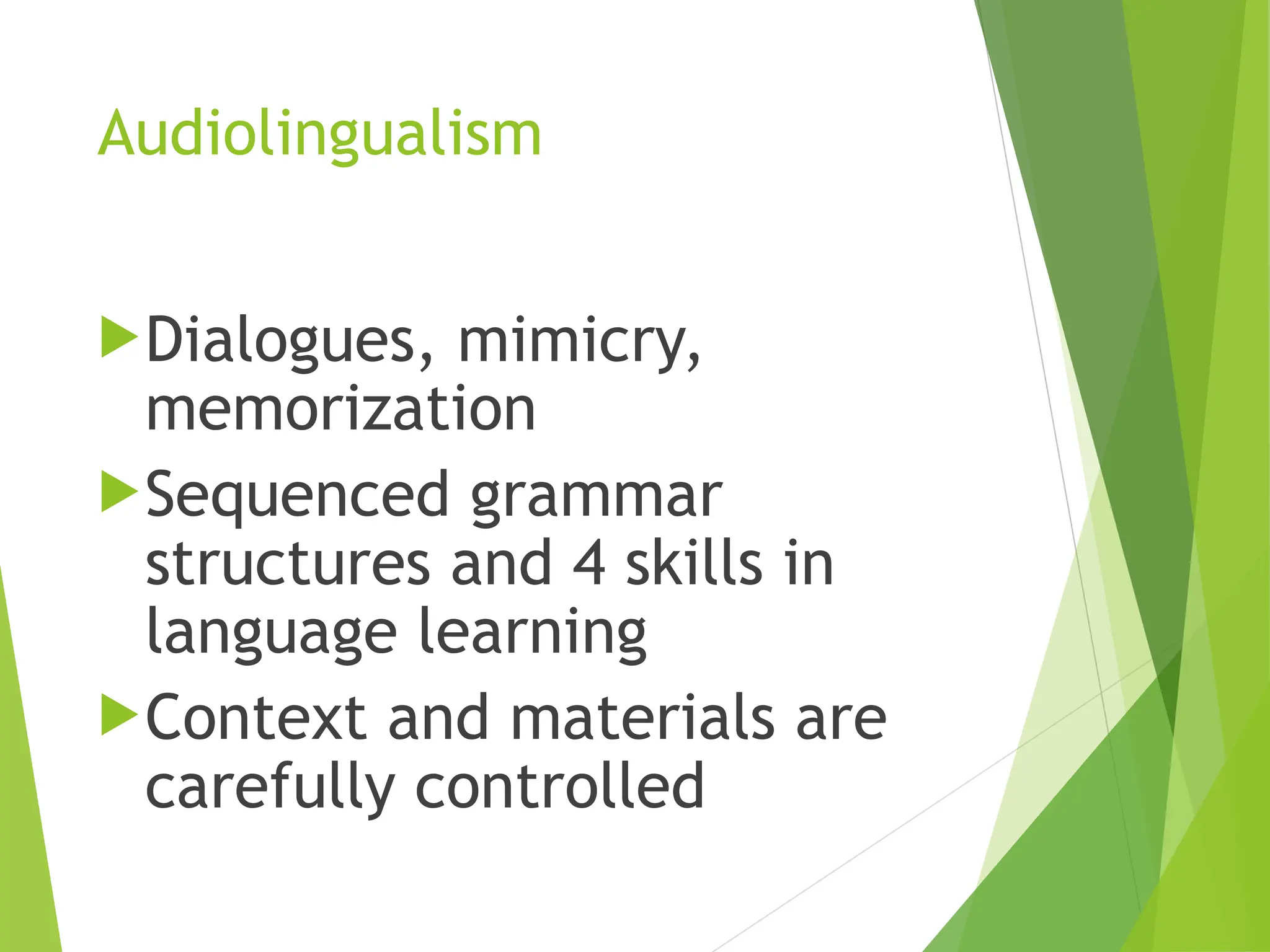
Audiolingualism
Dialogues, mimicry,
memorization
Sequenced grammar
structures and 4 skills in
language learning
Context and materials are
carefully controlled
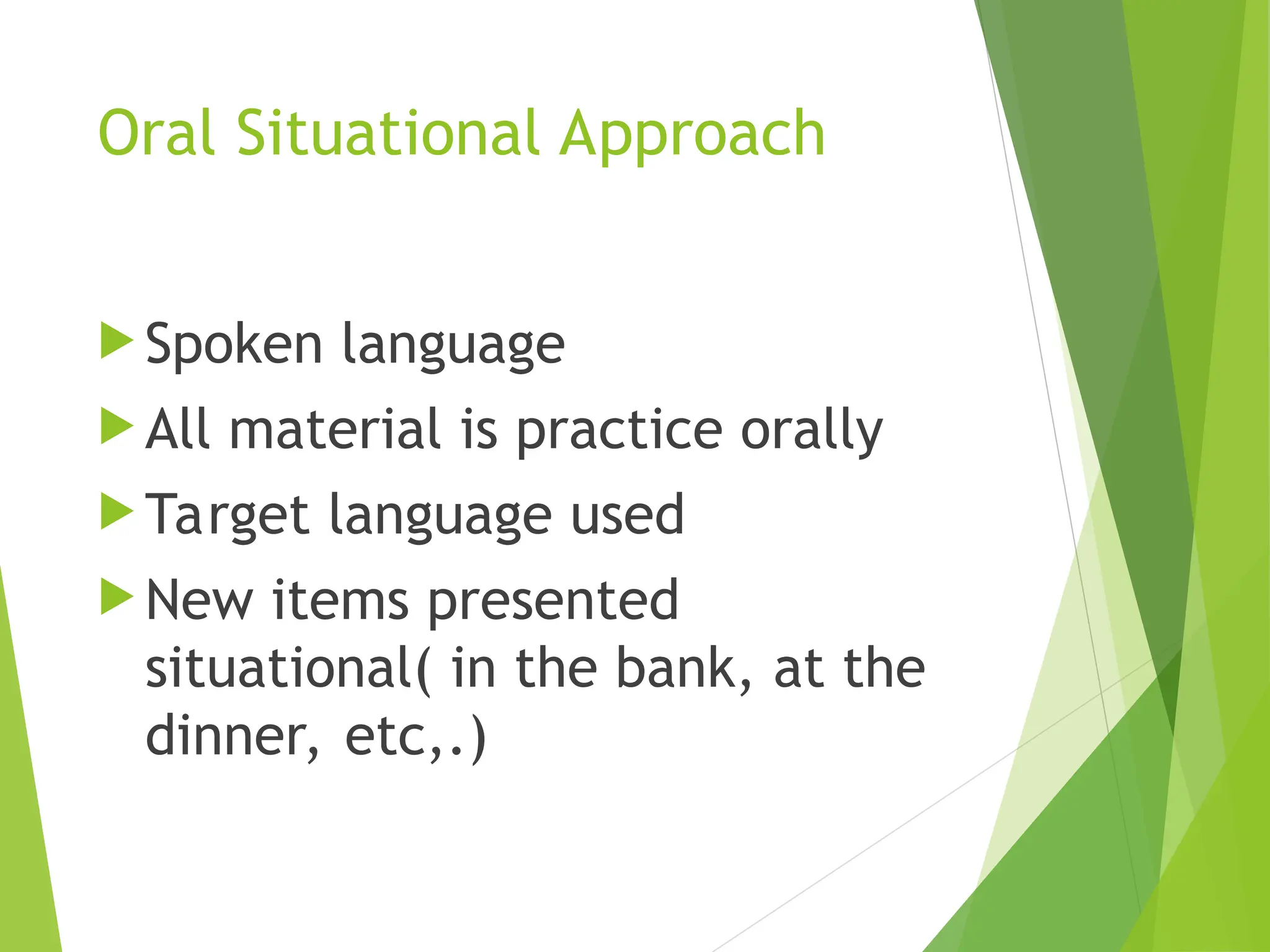
Oral Situational Approach
 Spoken language
 All material is practice orally
 Target language used
 New items presented
situational( in the bank, at the
dinner, etc,.)
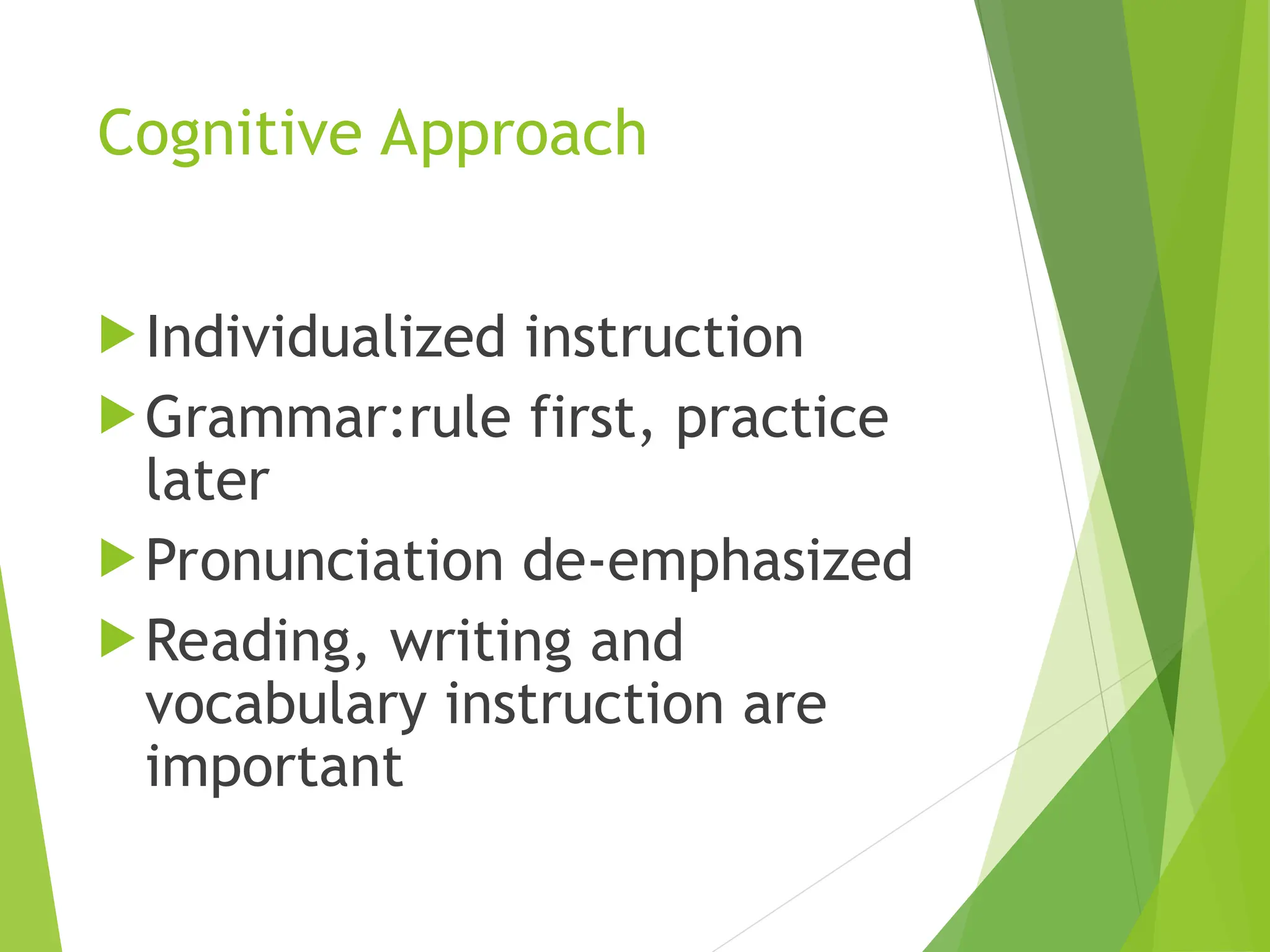
Cognitive Approach
Individualized instruction
Grammar:rule first, practice
later
Pronunciation de-emphasized
Reading, writing and
vocabulary instruction are
important
Affective Humanistic
Approach
 Pair, small group and individual
feelings
 Communication
 Self-realization experience
 Class atmosphere, peer support
and interaction
Comprehension based
Approach
Listening comprehension
Exposed to meaningful input
Error correction is not
necessary
Authentic materials: audio and
video tapes
Content – Based Method
 In content-based instruction (CBI), the
curriculum organizing principle is
subject matter, not language. CBI can be
focused around regular academic courses
such as history and science taught in the
target language or organized around a
series of selected themes drawn from the
regular curriculum
Communicative Approach
Communicate in target
language
Group or pair works
Role play and drama
Authentic real-life material
Integrated skills
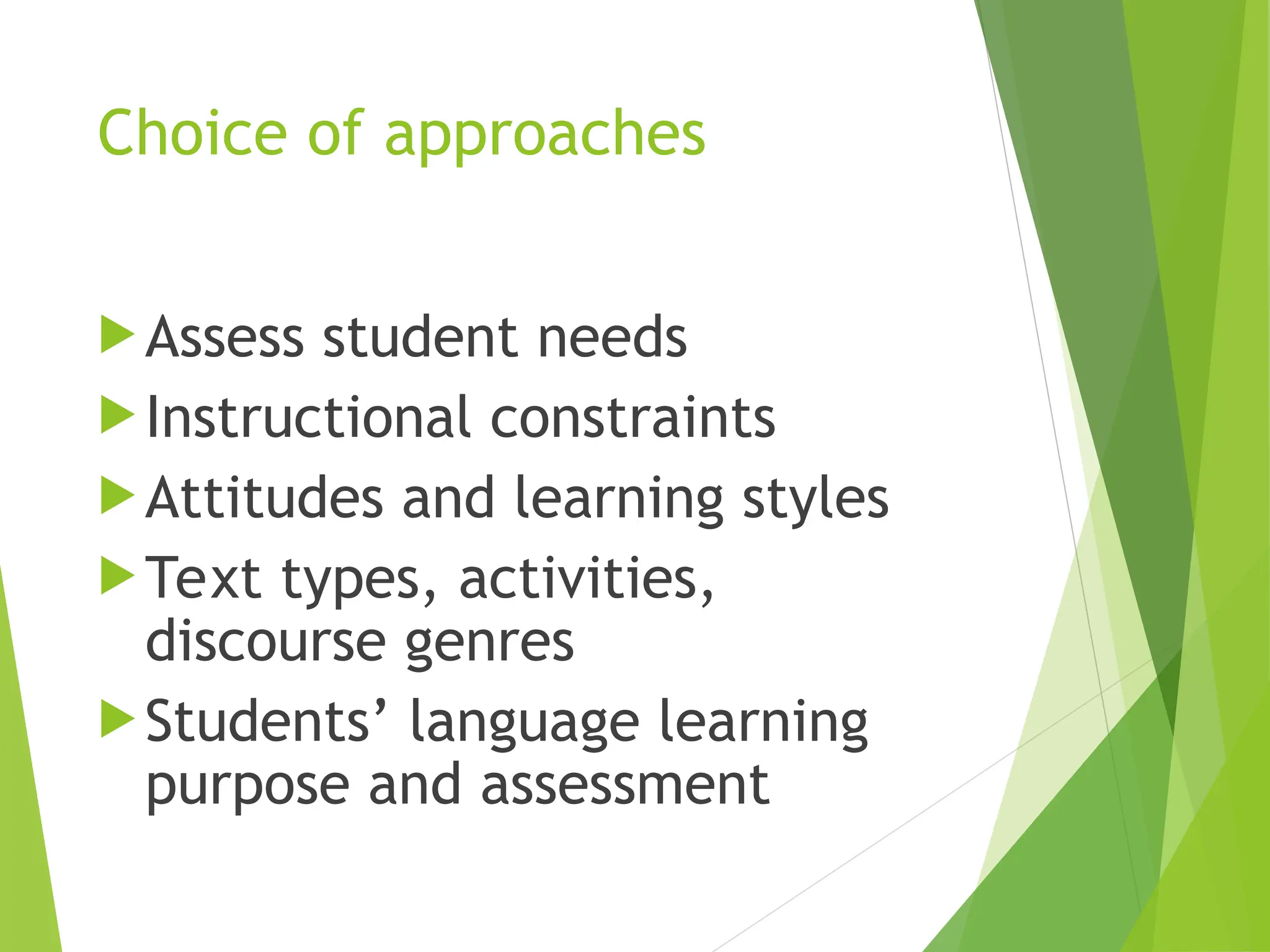
Choice of approaches
Assess student needs
Instructional constraints
Attitudes and learning styles
Text types, activities,
discourse genres
Students’ language learning
purpose and assessment
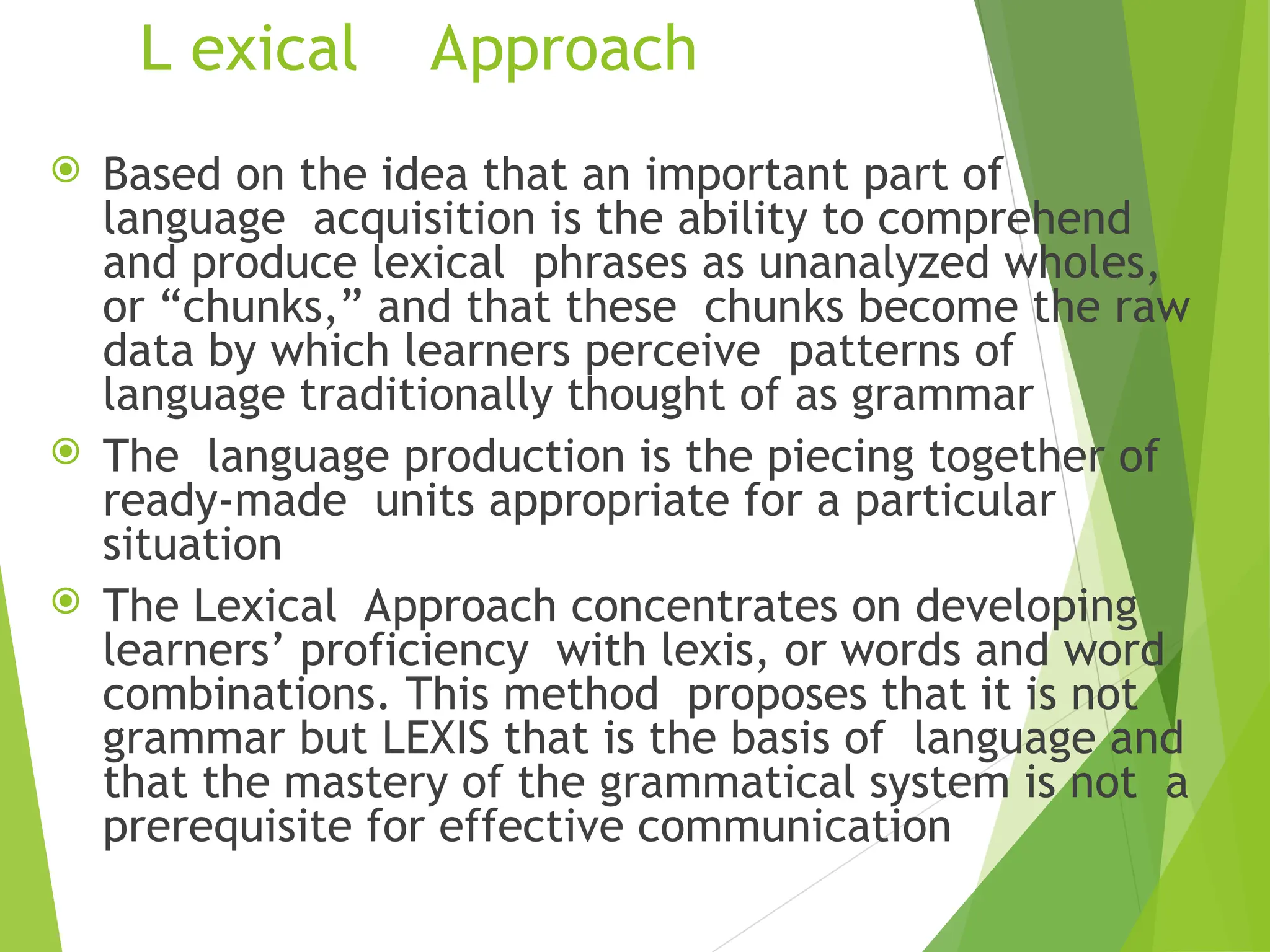
L exical Approach
 Based on the idea that an important part of
language acquisition is the ability to comprehend
and produce lexical phrases as unanalyzed wholes,
or “chunks,” and that these chunks become the raw
data by which learners perceive patterns of
language traditionally thought of as grammar
 The language production is the piecing together of
ready-made units appropriate for a particular
situation
 The Lexical Approach concentrates on developing
learners’ proficiency with lexis, or words and word
combinations. This method proposes that it is not
grammar but LEXIS that is the basis of language and
that the mastery of the grammatical system is not a
prerequisite for effective communication
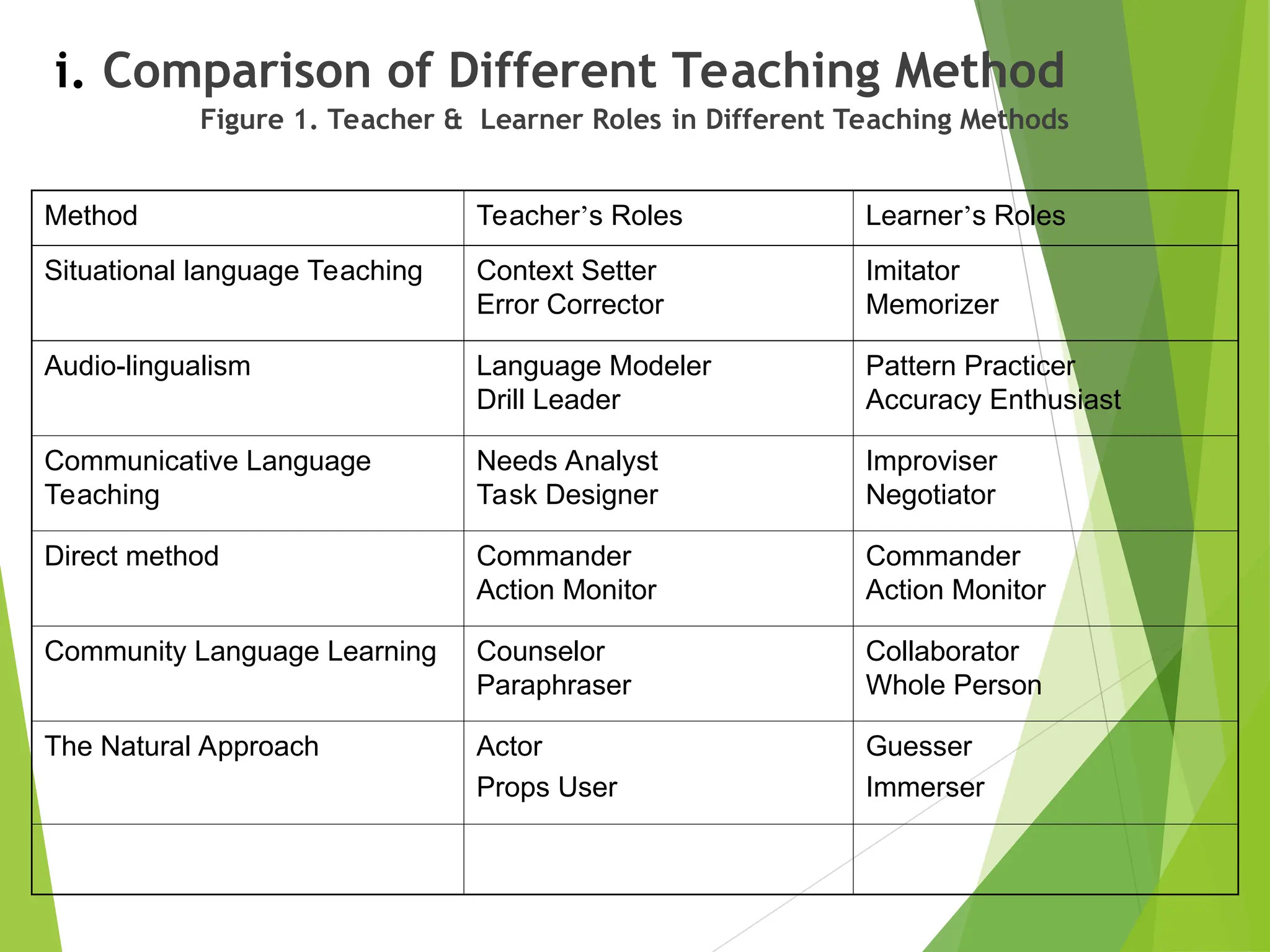
i. Comparison of Different Teaching Method
Figure 1. Teacher & Learner Roles in Different Teaching Methods
Method Teacher’s Roles Learner’s Roles
Situational language Teaching Context Setter
Error Corrector
Imitator
Memorizer
Audio-lingualism Language Modeler
Drill Leader
Pattern Practicer
Accuracy Enthusiast
Communicative Language
Teaching
Needs Analyst
Task Designer
Improviser
Negotiator
Direct method Commander
Action Monitor
Commander
Action Monitor
Community Language Learning Counselor
Paraphraser
Collaborator
Whole Person
The Natural Approach Actor
Props User
Guesser
Immerser
Question
 According to the definition, what are some possible
issues concerned in the field of Applied Linguistics?
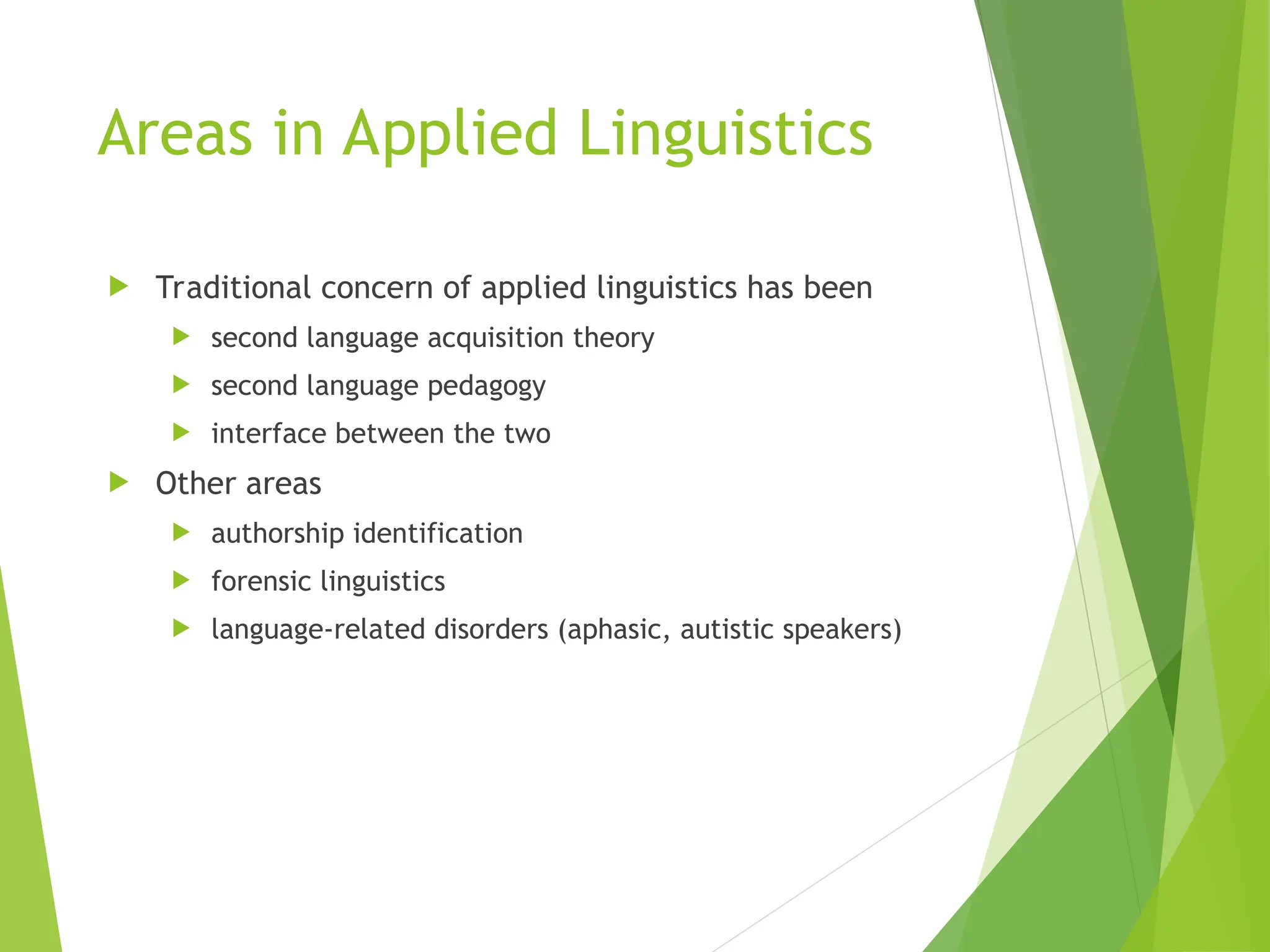
Areas in Applied Linguistics
 Traditional concern of applied linguistics has been
 second language acquisition theory
 second language pedagogy
 interface between the two
 Other areas
 authorship identification
 forensic linguistics
 language-related disorders (aphasic, autistic speakers)
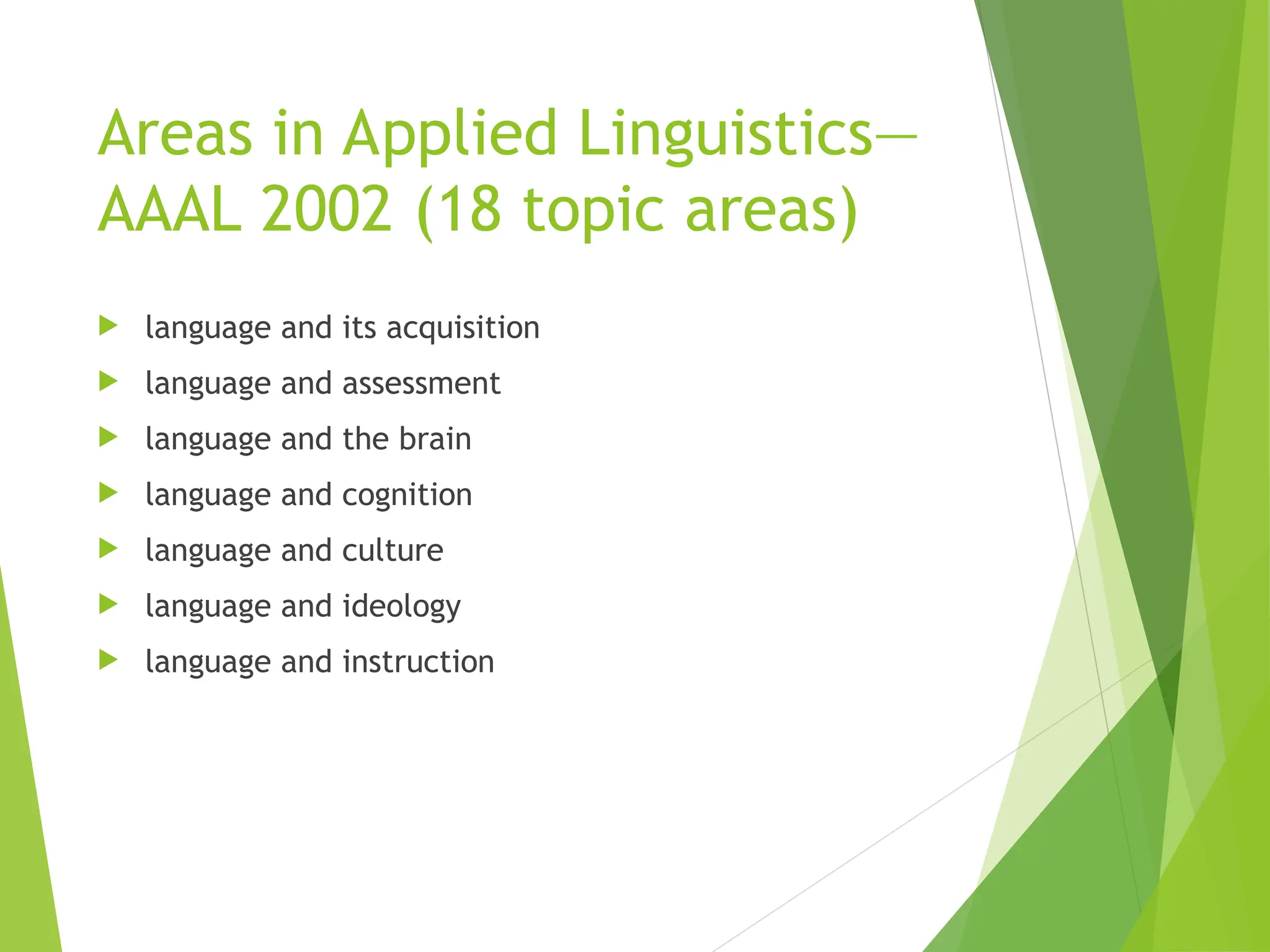
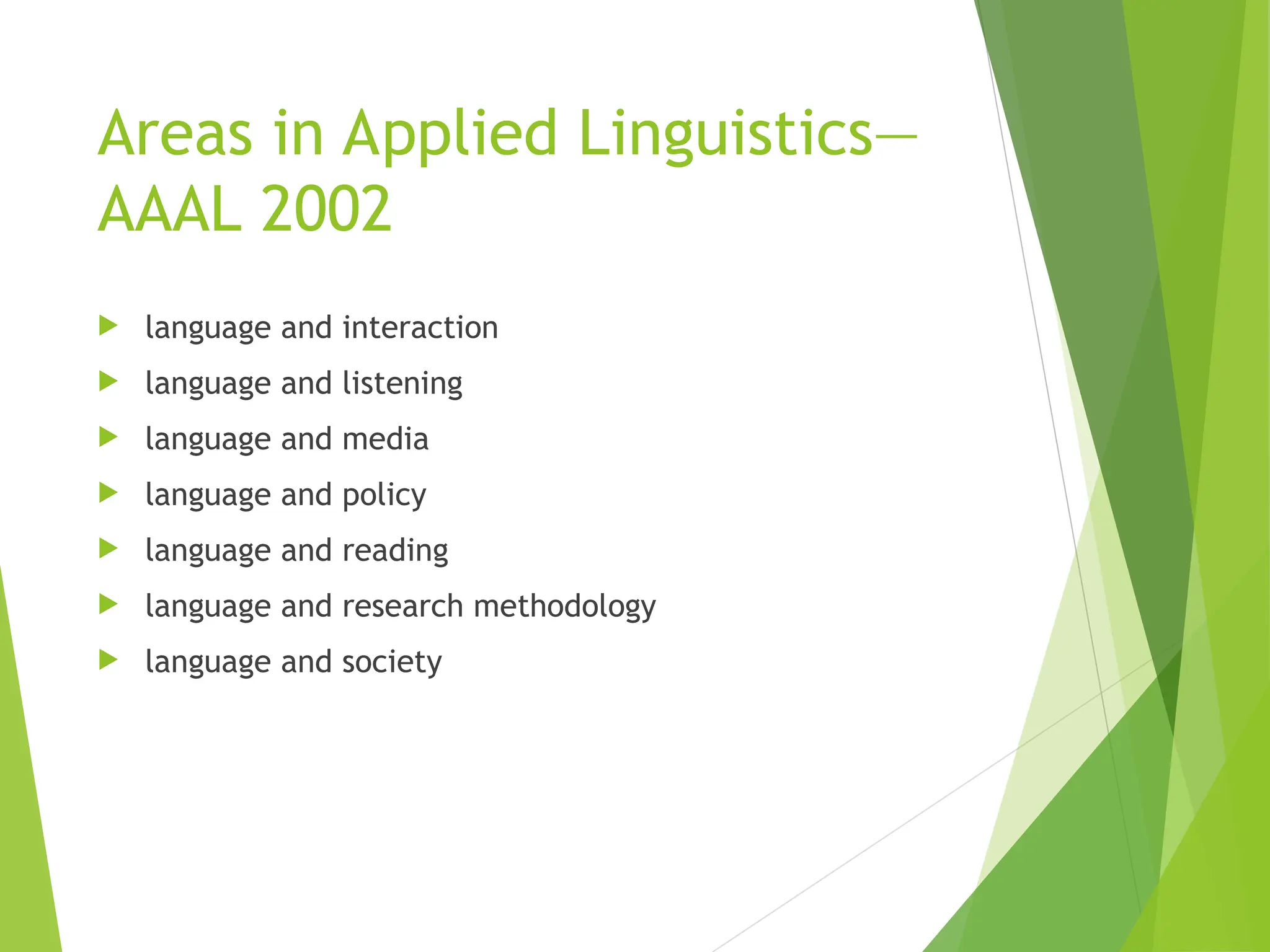
Areas in Applied Linguistics—
AAAL 2002 (18 topic areas)
 language and its acquisition
 language and assessment
 language and the brain
 language and cognition
 language and culture
 language and ideology
 language and instruction
Areas in Applied Linguistics—
AAAL 2002
 language and interaction
 language and listening
 language and media
 language and policy
 language and reading
 language and research methodology
 language and society
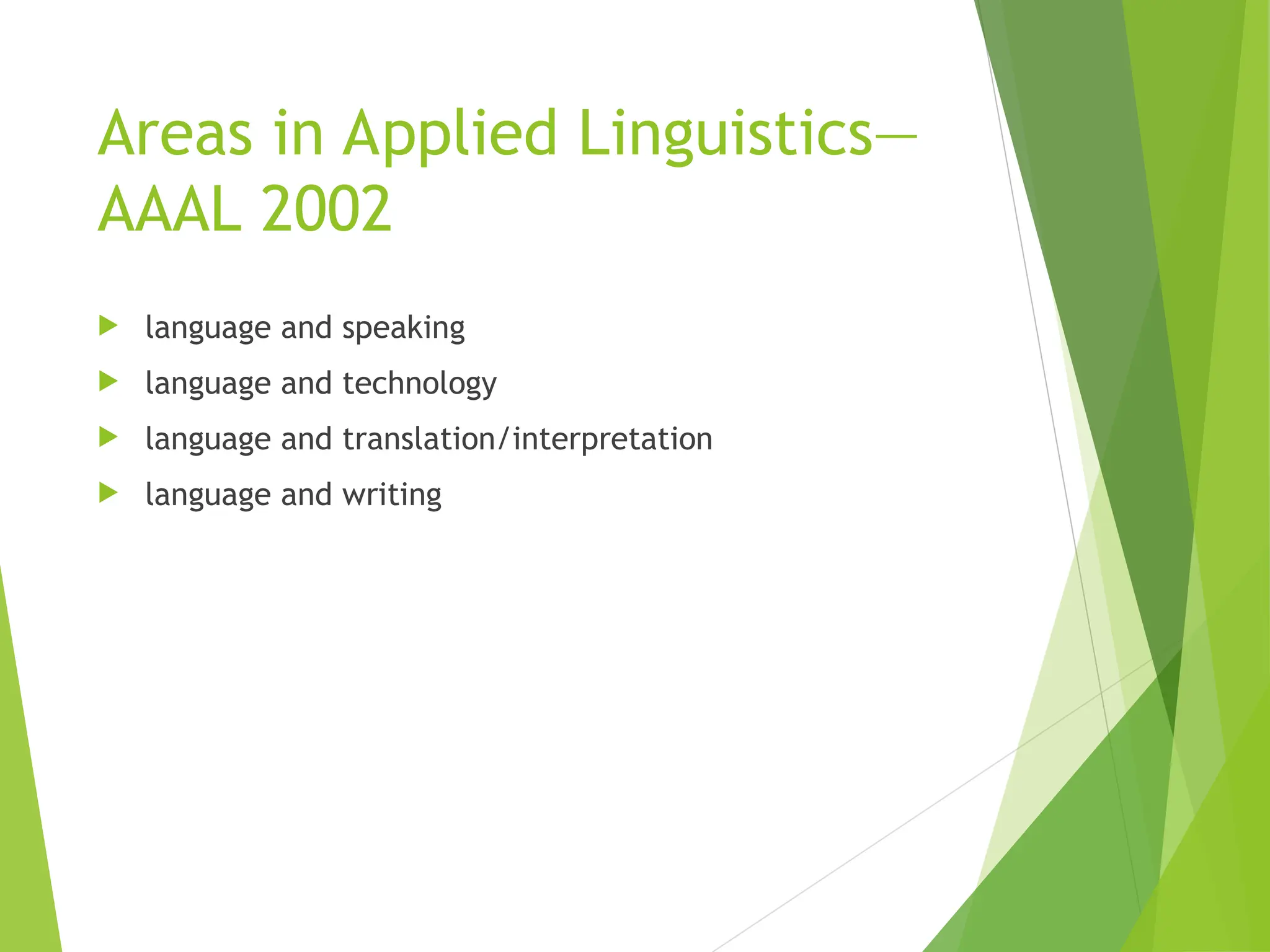
Areas in Applied Linguistics—
AAAL 2002
 language and speaking
 language and technology
 language and translation/interpretation
 language and writing

Applied linguistics Approaches and Methods History.ppt

  • 1.
    What is AppliedLinguistics?  Though the term "applied linguistics" has traditionally been associated with the scientific study of such areas as TESOL, TEFL, TESL, language teaching and learning, applied linguists do a variety of things: The basic idea is, as the definition implies, to contribute to the real-world issues.
  • 2.
    An historic overviewof language teaching approaches  Pre- 20th Century Trends  Popular approaches in Language Teaching in 20th Century  Teachers’ choice of best approaches, materials and techniques for students
  • 3.
    Pre-20th Century Trends: Greek and Rome Period  Renaissance  1631-1658  19th Century  The end of 19th Century  Early 20th century
  • 4.
    The Development ofApplied Linguistics— Early History  the ancient Greeks  Plato and Aristotle: design of curriculum of grammar, rhetoric  English:  Samuel Johnson (1755). Dictionary of the English Language  authority on the meanings of English words  standardizing English spellings  Robert Lowth (1762). Short Introduction to English Grammar  adopted as ‘correct English”
  • 5.
    CLASSICAL PERIOD (17th, 18th and 19t h centuries) EDUCATION AS AN ARM OF THEOCRACY Purpose of education to teach religious orthodoxy and good moral character FOREİGN LANGUAGE LEARNİNG ASSOCIATED WITH THE LEARNİNG OF GREEK AND LATİN purpose of learning a foreign language to promote speakers’ intellectuality 1850’s: Classical method came to be known as Grammar Translation Method
  • 6.
    Greek and RomePeriod:  Foreign Language learning  In the Western world back in the 16th, 17th and 18th centuries, foreign language learning was associated with the learning of Latin and Greek, both supposed to promote the speakers’ intellectual. At the time was very important to focus on grammatical rules, syntactic structures, along with rote memorization of vocabulary and translation of literary texts.  Aural-oral techniques: informal and direct approaches  Greek  Latin
  • 7.
    Renaissance  Formal studyof grammars of Greek and Latin Invention of printing press Mass production of books  Classical grammar in school instruction  Latin being used in everyday purposes
  • 8.
    1631-1658 Johann Amos Comenius Books about teaching techniques  To teach usage not analysis of language Imitation instead of rules Repetition Practice reading and speaking Meaningful pictures
  • 9.
    Beginning of 19thCentury Phase 1: 1900-46: Laying the foundations Phase 2 : 1946-70: Association and renewal Phase 3 : 1970 to the present day: Language and communication Systematic study of the grammar of classical Latin and text taken over Analytical Grammar-Translation approach
  • 10.
    The teaching ofEnglish as a foreign or second language Contexts of English language teaching, Phase 1   1.Secondary schools in Europe. Interest in learning English rising. Anglocists among leaders of the Reform Movement. The key British contribution was phonetics. Main representative: Daniel Jones (1881- 1967). 2.Adult education in Europe. The primary context for Direct Method teaching along Berlitz lines since the 1880s. Native speaker teachers. Main representative: Harold Palmer (1877- 1949). 3. Basic schooling in the Empire. To1920s: English still taught as a ‘quasi -mother-tongue’; 1920s onwards: beginnings of ‘English ;is a second language’. Main representative: Michael West (1888- 1973). 4. Adult education in the UK. ‘English for foreigners’ Small numbers until refugee invasion in 1930s. Main representative: C. E. Eckersley (1893- 1967).
  • 11.
    The teaching ofEnglish as a foreign or second language  If there is one word that sums up the 1960s like ‘patterns’ in the 1950s and ‘functions’ in the 1970s, it would be ‘situations'. But ‘situations’ were also events like ‘An evening Out’ or ‘A Visit to the Theatre’ depicted in dialogues designed to dis-play a ‘chunk’ of language in use more or less as it actually occurred in real life, and not invented as a device for illustrating meaning.  Television was hugely popular in the 1960s and it seemed to offer an ideal medium for demonstrating language in situations.
  • 12.
    The teaching ofEnglish as a foreign or second language  1960-70: Renewal In the new climate, research was also back on the menu and ELT benefited from a number of specific projects, four of which are summarized below. They all attracted government support in some form: 1. The ‘Survey of English Usage’ directed by Randolph Quirk was set up at London University in 1960. The ultimate outcome was the most substantial grammar of English since Jespersen’s: A Grammar of contemporary English (1972) which was later expanded as A Com- prehensive Grammar o f the English Language(1985). 2. London also played host to the ‘Program in Linguistics and English Teaching’ (1964-71), directed by M. A. K. Halliday. This project produced a range of innovative mother-tongue teaching materials for schools.
  • 13.
     3. TheScope project (1966-72), which has already been mentioned, that is set up by the Schools Council at the University of Leeds under the direction of John Ridge and June Derrick. Its aim was to produce teaching materials for English as a second language in primary schools.  4. ‘Primary French’ (to use its popular name) was the largest language teaching research enterprise of its day. It started in 1963 and continued until 1974. It was proposed that French should be introduced into primary schools as a course materials
  • 14.
    The teaching ofEnglish as a foreign or second language  In the history of ELT in the1970s the idea of communication was the main point, which found its way into almost every aspect of the subject: syllabus planning, teaching materials, testing and assessment, and so on.  Communicative Language Teaching (CLT) repres- ented a conscious choice between competing models.  What adult learners were looking for—and the communicative movement was directed at adults in the first instance—wasinstruction in English which was relevant to their needs and wishes.
  • 15.
    The teaching ofEnglish as a foreign or second language  Three approaches in particular found favor among teachers and course designers:  One was role-playing or simulation where learners either enacted a communicative event from a memorized text, or improvised one from given guidelines.  Second was ‘problem solving’ which had considerable appeal in ESP because it carried research connotations.  But probably the most popular model was skill training which had the advantage of representing a reasonably holistic view of learning while at the same time permitting the exercise of specific components.
  • 16.
    Other approaches Reading approach(1941in U.S.) Audiolingual Approach Oral Situational Approach(Britain)
  • 17.
    The end of19th Century  Direct Method: to use rather then to analyze a language France, Germany, Europe Spoken form taught first Solid training in phonetic Pronunciation and oral skills
  • 18.
    1850’s to 1950’s:Grammar Translatio n  Emphasis on learnıng to read & wrıte  Focus on grammatical rules, syntactic structures, rote memorization of vocabulary and translation of literary texts  Voc. is taught in the form of lists of isolated words.  Medium of instruction was the mother tongue  No provision for the oral use of language  Speaking and listening were mediated via “conversation classes”, add-ons to the main course
  • 19.
    Early Mid-20th Centur y Demand for ability to speak a foreign language  Reformers reconsidering the nature of langauge and learning  Three Reformers (the way children learned languages was relevant to how adults learned languages)  C. Marcel  F. Gouin  T. Pendergast
  • 20.
    Individuals Reformers (ClaudeMarcel)  Claude Marcel:  Emphasized the importance of understanding meaning in language learning  Devising of Rational Method  The teaching of Reading: The first Priority in foreign language Teaching  He was the first to develop a coherent and educationally responsible methodology of language teaching derived from an analysis of the activity itself and its relationship to other branches of knowledge.
  • 21.
    Individuals Reformers (François Gouin) François Gouin ‘Series Method’ Painful experience in learning German  Tried to memorize a German grammar book and a list of 248 irregular German verbs Observed his three-year old nephew Emphasized presenting each item in context and using gestures to supplement verbal meaning Taught learners directly a series of connected sentences. Ex. I stretch out my arm. I take hold of the handle. I open the door. I pull the door. Came up with the following insights  Children use language to represent their conceptions.  Language is a means of thinking, of representing the world to oneself.
  • 22.
    Individuals Reformers (Thomas Prendergast) Thomas Prendergast ‘Mastery System’ Proposed the first structural syllabus (arranging grammatical structures so that the easiest was taught first) He went further and observed what children were doing and the learning processes they appeared to be using He used detached sentences as his basic learning data
  • 23.
    Individuals Reformers (Thomas Prendergast) To Him the crucial feature of language was the capacity of human beings to generate an infinite number of sentences from a finite set of means. (Generative Principle)  Mastery System: The mastery of languages, or the art of Speaking foreign languages idiomatically.  He noticed that small infants inter-pret the meaning of language by making use of other information available to them in the wider context, what people do, how they look, their gestures and facial expressions.
  • 24.
    Individuals Reformers (Thomas Prendergast) Prendergast’s seven teaching steps:  Step 1: required the memorization of five or six sentences making up about one hundred words altogether. The basic aim was a correct pronunciation and a fluent control of the model sentences  Step 2: learners work on written language.  Step 3 and 4: are concerned with the manipulation of the model sentences (‘evolutions’) and the acquisition of further models.  Steps 5, 6, and 7: the development of reading and conversation skills.
  • 25.
    Language Teaching Methodology LanguageTeaching Methodology Theories of Language and Learning Instructional Design Features Observed Teaching Practices Objectives Syllabus Activities Roles of Teachers Roles of Learners Materials
  • 26.
    20th Century: 9Approaches and Methods of Language Teaching  Grammar-Translation  Direct  Reading  Audio-lingualism(U.S.)  Oral-Situational (Britain)  Cognitive  Affective-Humanistic  Comprehension-Based  Communicative
  • 27.
    Grammar Translation Approach Given innative language Grammatical parsing: forms and inflection Translate sentences Not for communication
  • 28.
    Direct Approach No useof mother tongue Dialogues, actions, picture Grammar and target culture taught inductively
  • 29.
    Reading Approach Grammar forreading Vocabulary is controlled, then expanded Translation Reading comprehension emphasized
  • 30.
    Audiolingualism Dialogues, mimicry, memorization Sequenced grammar structuresand 4 skills in language learning Context and materials are carefully controlled
  • 31.
    Oral Situational Approach Spoken language  All material is practice orally  Target language used  New items presented situational( in the bank, at the dinner, etc,.)
  • 32.
    Cognitive Approach Individualized instruction Grammar:rulefirst, practice later Pronunciation de-emphasized Reading, writing and vocabulary instruction are important
  • 33.
    Affective Humanistic Approach  Pair,small group and individual feelings  Communication  Self-realization experience  Class atmosphere, peer support and interaction
  • 34.
    Comprehension based Approach Listening comprehension Exposedto meaningful input Error correction is not necessary Authentic materials: audio and video tapes
  • 35.
    Content – BasedMethod  In content-based instruction (CBI), the curriculum organizing principle is subject matter, not language. CBI can be focused around regular academic courses such as history and science taught in the target language or organized around a series of selected themes drawn from the regular curriculum
  • 36.
    Communicative Approach Communicate intarget language Group or pair works Role play and drama Authentic real-life material Integrated skills
  • 37.
    Choice of approaches Assessstudent needs Instructional constraints Attitudes and learning styles Text types, activities, discourse genres Students’ language learning purpose and assessment
  • 38.
    L exical Approach Based on the idea that an important part of language acquisition is the ability to comprehend and produce lexical phrases as unanalyzed wholes, or “chunks,” and that these chunks become the raw data by which learners perceive patterns of language traditionally thought of as grammar  The language production is the piecing together of ready-made units appropriate for a particular situation  The Lexical Approach concentrates on developing learners’ proficiency with lexis, or words and word combinations. This method proposes that it is not grammar but LEXIS that is the basis of language and that the mastery of the grammatical system is not a prerequisite for effective communication
  • 40.
    i. Comparison ofDifferent Teaching Method Figure 1. Teacher & Learner Roles in Different Teaching Methods Method Teacher’s Roles Learner’s Roles Situational language Teaching Context Setter Error Corrector Imitator Memorizer Audio-lingualism Language Modeler Drill Leader Pattern Practicer Accuracy Enthusiast Communicative Language Teaching Needs Analyst Task Designer Improviser Negotiator Direct method Commander Action Monitor Commander Action Monitor Community Language Learning Counselor Paraphraser Collaborator Whole Person The Natural Approach Actor Props User Guesser Immerser
  • 41.
    Question  According tothe definition, what are some possible issues concerned in the field of Applied Linguistics?
  • 42.
    Areas in AppliedLinguistics  Traditional concern of applied linguistics has been  second language acquisition theory  second language pedagogy  interface between the two  Other areas  authorship identification  forensic linguistics  language-related disorders (aphasic, autistic speakers)
  • 43.
    Areas in AppliedLinguistics— AAAL 2002 (18 topic areas)  language and its acquisition  language and assessment  language and the brain  language and cognition  language and culture  language and ideology  language and instruction
  • 44.
    Areas in AppliedLinguistics— AAAL 2002  language and interaction  language and listening  language and media  language and policy  language and reading  language and research methodology  language and society
  • 45.
    Areas in AppliedLinguistics— AAAL 2002  language and speaking  language and technology  language and translation/interpretation  language and writing