“Functional English”
ENG-101
Lecture 10
“Position of Adverbs”
By: Tariq Amin
Lecturer, Dept of English,
KUST
Course: Functional English ENG-101 - Instructor: Tariq Amin, Lecturer, Dept of English, KUST - Email: tariq.ktk.733@gmail.com
Discussion Agenda
 Position of Adverbs
 Three positions
 Adverbs used in any of the three positions
 Position of adverbs of manner, place and time in one sentence
Course: Functional English ENG-101 - Instructor: Tariq Amin, Lecturer, Dept of English, KUST - Email: tariq.ktk.733@gmail.com
Topic: Position of Adverbs
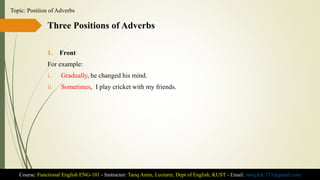
Three Positions of Adverbs
1. Front
For example:
i. Gradually, he changed his mind.
ii. Sometimes, I play cricket with my friends.
Course: Functional English ENG-101 - Instructor: Tariq Amin, Lecturer, Dept of English, KUST - Email: tariq.ktk.733@gmail.com
Topic: Position of Adverbs
Three Positions of Adverbs
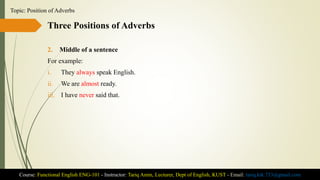
2. Middle of a sentence
For example:
i. They always speak English.
ii. We are almost ready.
iii. I have never said that.
Course: Functional English ENG-101 - Instructor: Tariq Amin, Lecturer, Dept of English, KUST - Email: tariq.ktk.733@gmail.com
Topic: Position of Adverbs
Three Positions of Adverbs
2. Middle of a sentence
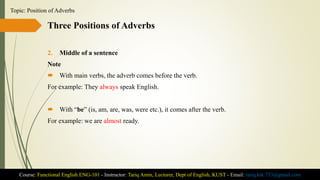
Note
 With main verbs, the adverb comes before the verb.
For example: They always speak English.
 With “be” (is, am, are, was, were etc.), it comes after the verb.
For example: we are almost ready.
Course: Functional English ENG-101 - Instructor: Tariq Amin, Lecturer, Dept of English, KUST - Email: tariq.ktk.733@gmail.com
Topic: Position of Adverbs
Three Positions of Adverbs
2. Middle of a sentence
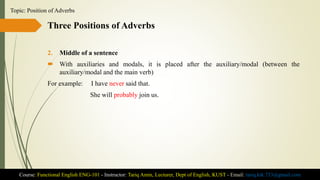
 With auxiliaries and modals, it is placed after the auxiliary/modal (between the
auxiliary/modal and the main verb)
For example: I have never said that.
She will probably join us.
Course: Functional English ENG-101 - Instructor: Tariq Amin, Lecturer, Dept of English, KUST - Email: tariq.ktk.733@gmail.com
Topic: Position of Adverbs
Three Positions of Adverbs
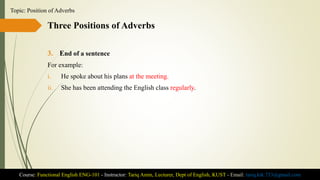
3. End of a sentence
For example:
i. He spoke about his plans at the meeting.
ii. She has been attending the English class regularly.
Course: Functional English ENG-101 - Instructor: Tariq Amin, Lecturer, Dept of English, KUST - Email: tariq.ktk.733@gmail.com
Topic: Position of Adverbs
Adverbs used in any of the three positions
The following adverbs can be used in any of the positions in a sentence.
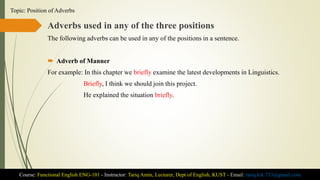
 Adverb of Manner
For example: In this chapter we briefly examine the latest developments in Linguistics.
Briefly, I think we should join this project.
He explained the situation briefly.
Course: Functional English ENG-101 - Instructor: Tariq Amin, Lecturer, Dept of English, KUST - Email: tariq.ktk.733@gmail.com
Topic: Position of Adverbs
Adverbs used in any of the three positions
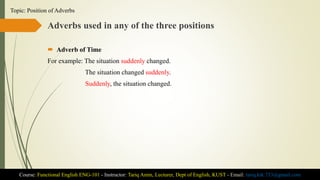
 Adverb of Time
For example: The situation suddenly changed.
The situation changed suddenly.
Suddenly, the situation changed.
Course: Functional English ENG-101 - Instructor: Tariq Amin, Lecturer, Dept of English, KUST - Email: tariq.ktk.733@gmail.com
Topic: Position of Adverbs
Adverbs used in any of the three positions
 Adverb of Probability
For example: This is obviously a mistake.
This is a mistake, obviously.
Obviously, this is a mistake.
Course: Functional English ENG-101 - Instructor: Tariq Amin, Lecturer, Dept of English, KUST - Email: tariq.ktk.733@gmail.com
Topic: Position of Adverbs
Adverbs used in any of the three positions
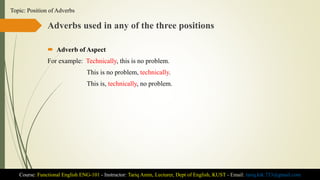
 Adverb of Aspect
For example: Technically, this is no problem.
This is no problem, technically.
This is, technically, no problem.
Course: Functional English ENG-101 - Instructor: Tariq Amin, Lecturer, Dept of English, KUST - Email: tariq.ktk.733@gmail.com
Topic: Position of Adverbs
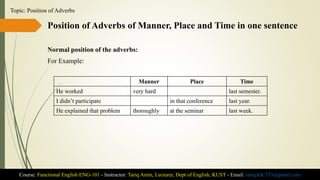
Position of Adverbs of Manner, Place and Time in one sentence
Normal position of the adverbs:
For Example:
Course: Functional English ENG-101 - Instructor: Tariq Amin, Lecturer, Dept of English, KUST - Email: tariq.ktk.733@gmail.com
Topic: Position of Adverbs
Manner Place Time
He worked very hard last semester.
I didn’t participate in that conference last year.
He explained that problem thoroughly at the seminar last week.
Position of Adverbs of Manner, Place and Time in one sentence
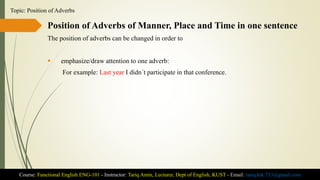
The position of adverbs can be changed in order to
 emphasize/draw attention to one adverb:
For example: Last year I didn´t participate in that conference.
Course: Functional English ENG-101 - Instructor: Tariq Amin, Lecturer, Dept of English, KUST - Email: tariq.ktk.733@gmail.com
Topic: Position of Adverbs
Position of Adverbs of Manner, Place and Time in one sentence
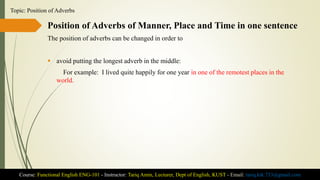
The position of adverbs can be changed in order to
 avoid putting the longest adverb in the middle:
For example: I lived quite happily for one year in one of the remotest places in the
world.
Course: Functional English ENG-101 - Instructor: Tariq Amin, Lecturer, Dept of English, KUST - Email: tariq.ktk.733@gmail.com
Topic: Position of Adverbs
Position of Adverbs of Manner, Place and Time in one sentence
The position of adverbs can be changed in order to
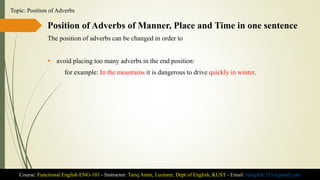
 avoid placing too many adverbs in the end position:
for example: In the mountains it is dangerous to drive quickly in winter.
Course: Functional English ENG-101 - Instructor: Tariq Amin, Lecturer, Dept of English, KUST - Email: tariq.ktk.733@gmail.com
Topic: Position of Adverbs
Position of Adverbs
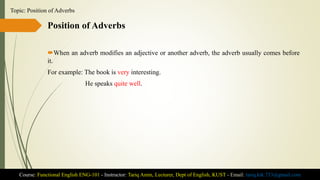
When an adverb modifies an adjective or another adverb, the adverb usually comes before
it.
For example: The book is very interesting.
He speaks quite well.
Course: Functional English ENG-101 - Instructor: Tariq Amin, Lecturer, Dept of English, KUST - Email: tariq.ktk.733@gmail.com
Topic: Position of Adverbs
Position of Adverbs
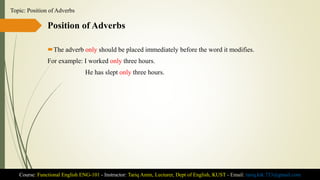
The adverb only should be placed immediately before the word it modifies.
For example: I worked only three hours.
He has slept only three hours.
Course: Functional English ENG-101 - Instructor: Tariq Amin, Lecturer, Dept of English, KUST - Email: tariq.ktk.733@gmail.com
Topic: Position of Adverbs
Position of Adverbs
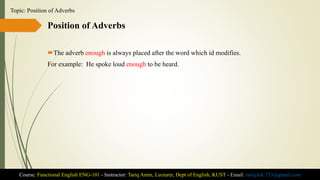
The adverb enough is always placed after the word which id modifies.
For example: He spoke loud enough to be heard.
Course: Functional English ENG-101 - Instructor: Tariq Amin, Lecturer, Dept of English, KUST - Email: tariq.ktk.733@gmail.com
Topic: Position of Adverbs
THANK YOU
Course: Functional English ENG-101 - Instructor: Tariq Amin, Lecturer, Dept of English, KUST - Email: tariq.ktk.733@gmail.com

position of adverbs

  • 1.
    “Functional English” ENG-101 Lecture 10 “Positionof Adverbs” By: Tariq Amin Lecturer, Dept of English, KUST Course: Functional English ENG-101 - Instructor: Tariq Amin, Lecturer, Dept of English, KUST - Email: tariq.ktk.733@gmail.com
  • 2.
    Discussion Agenda  Positionof Adverbs  Three positions  Adverbs used in any of the three positions  Position of adverbs of manner, place and time in one sentence Course: Functional English ENG-101 - Instructor: Tariq Amin, Lecturer, Dept of English, KUST - Email: tariq.ktk.733@gmail.com Topic: Position of Adverbs
  • 3.
    Three Positions ofAdverbs 1. Front For example: i. Gradually, he changed his mind. ii. Sometimes, I play cricket with my friends. Course: Functional English ENG-101 - Instructor: Tariq Amin, Lecturer, Dept of English, KUST - Email: tariq.ktk.733@gmail.com Topic: Position of Adverbs
  • 4.
    Three Positions ofAdverbs 2. Middle of a sentence For example: i. They always speak English. ii. We are almost ready. iii. I have never said that. Course: Functional English ENG-101 - Instructor: Tariq Amin, Lecturer, Dept of English, KUST - Email: tariq.ktk.733@gmail.com Topic: Position of Adverbs
  • 5.
    Three Positions ofAdverbs 2. Middle of a sentence Note  With main verbs, the adverb comes before the verb. For example: They always speak English.  With “be” (is, am, are, was, were etc.), it comes after the verb. For example: we are almost ready. Course: Functional English ENG-101 - Instructor: Tariq Amin, Lecturer, Dept of English, KUST - Email: tariq.ktk.733@gmail.com Topic: Position of Adverbs
  • 6.
    Three Positions ofAdverbs 2. Middle of a sentence  With auxiliaries and modals, it is placed after the auxiliary/modal (between the auxiliary/modal and the main verb) For example: I have never said that. She will probably join us. Course: Functional English ENG-101 - Instructor: Tariq Amin, Lecturer, Dept of English, KUST - Email: tariq.ktk.733@gmail.com Topic: Position of Adverbs
  • 7.
    Three Positions ofAdverbs 3. End of a sentence For example: i. He spoke about his plans at the meeting. ii. She has been attending the English class regularly. Course: Functional English ENG-101 - Instructor: Tariq Amin, Lecturer, Dept of English, KUST - Email: tariq.ktk.733@gmail.com Topic: Position of Adverbs
  • 8.
    Adverbs used inany of the three positions The following adverbs can be used in any of the positions in a sentence.  Adverb of Manner For example: In this chapter we briefly examine the latest developments in Linguistics. Briefly, I think we should join this project. He explained the situation briefly. Course: Functional English ENG-101 - Instructor: Tariq Amin, Lecturer, Dept of English, KUST - Email: tariq.ktk.733@gmail.com Topic: Position of Adverbs
  • 9.
    Adverbs used inany of the three positions  Adverb of Time For example: The situation suddenly changed. The situation changed suddenly. Suddenly, the situation changed. Course: Functional English ENG-101 - Instructor: Tariq Amin, Lecturer, Dept of English, KUST - Email: tariq.ktk.733@gmail.com Topic: Position of Adverbs
  • 10.
    Adverbs used inany of the three positions  Adverb of Probability For example: This is obviously a mistake. This is a mistake, obviously. Obviously, this is a mistake. Course: Functional English ENG-101 - Instructor: Tariq Amin, Lecturer, Dept of English, KUST - Email: tariq.ktk.733@gmail.com Topic: Position of Adverbs
  • 11.
    Adverbs used inany of the three positions  Adverb of Aspect For example: Technically, this is no problem. This is no problem, technically. This is, technically, no problem. Course: Functional English ENG-101 - Instructor: Tariq Amin, Lecturer, Dept of English, KUST - Email: tariq.ktk.733@gmail.com Topic: Position of Adverbs
  • 12.
    Position of Adverbsof Manner, Place and Time in one sentence Normal position of the adverbs: For Example: Course: Functional English ENG-101 - Instructor: Tariq Amin, Lecturer, Dept of English, KUST - Email: tariq.ktk.733@gmail.com Topic: Position of Adverbs Manner Place Time He worked very hard last semester. I didn’t participate in that conference last year. He explained that problem thoroughly at the seminar last week.
  • 13.
    Position of Adverbsof Manner, Place and Time in one sentence The position of adverbs can be changed in order to  emphasize/draw attention to one adverb: For example: Last year I didn´t participate in that conference. Course: Functional English ENG-101 - Instructor: Tariq Amin, Lecturer, Dept of English, KUST - Email: tariq.ktk.733@gmail.com Topic: Position of Adverbs
  • 14.
    Position of Adverbsof Manner, Place and Time in one sentence The position of adverbs can be changed in order to  avoid putting the longest adverb in the middle: For example: I lived quite happily for one year in one of the remotest places in the world. Course: Functional English ENG-101 - Instructor: Tariq Amin, Lecturer, Dept of English, KUST - Email: tariq.ktk.733@gmail.com Topic: Position of Adverbs
  • 15.
    Position of Adverbsof Manner, Place and Time in one sentence The position of adverbs can be changed in order to  avoid placing too many adverbs in the end position: for example: In the mountains it is dangerous to drive quickly in winter. Course: Functional English ENG-101 - Instructor: Tariq Amin, Lecturer, Dept of English, KUST - Email: tariq.ktk.733@gmail.com Topic: Position of Adverbs
  • 16.
    Position of Adverbs Whenan adverb modifies an adjective or another adverb, the adverb usually comes before it. For example: The book is very interesting. He speaks quite well. Course: Functional English ENG-101 - Instructor: Tariq Amin, Lecturer, Dept of English, KUST - Email: tariq.ktk.733@gmail.com Topic: Position of Adverbs
  • 17.
    Position of Adverbs Theadverb only should be placed immediately before the word it modifies. For example: I worked only three hours. He has slept only three hours. Course: Functional English ENG-101 - Instructor: Tariq Amin, Lecturer, Dept of English, KUST - Email: tariq.ktk.733@gmail.com Topic: Position of Adverbs
  • 18.
    Position of Adverbs Theadverb enough is always placed after the word which id modifies. For example: He spoke loud enough to be heard. Course: Functional English ENG-101 - Instructor: Tariq Amin, Lecturer, Dept of English, KUST - Email: tariq.ktk.733@gmail.com Topic: Position of Adverbs
  • 19.
    THANK YOU Course: FunctionalEnglish ENG-101 - Instructor: Tariq Amin, Lecturer, Dept of English, KUST - Email: tariq.ktk.733@gmail.com