Preposition
Preposition 
Position Direction Verb Time 
on the table go to school wait for on Monday 
at supermarket fly over the house believe in in September 
in class room come out of the room listen to at noon
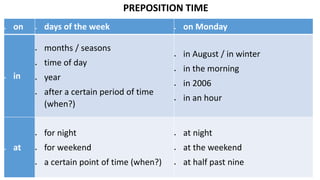
PREPOSITION TIME 
 on  days of the week  on Monday 
 in 
 months / seasons 
 time of day 
 year 
 after a certain period of time 
(when?) 
 in August / in winter 
 in the morning 
 in 2006 
 in an hour 
 at 
 for night 
 for weekend 
 a certain point of time (when?) 
 at night 
 at the weekend 
 at half past nine
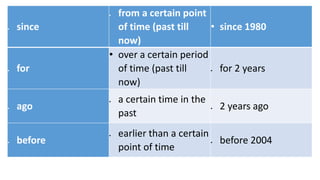
 since 
 from a certain point 
of time (past till 
now) 
• since 1980 
 for 
• over a certain period 
of time (past till 
now) 
 for 2 years 
 ago  a certain time in the 
past  2 years ago 
 before  earlier than a certain 
point of time  before 2004
• Prepositions are short words (on, in, to) that usually stand in front of nouns 
(sometimes also in front of gerund verbs). 
• Even advanced learners of English find prepositions difficult, as a 1:1 
translation is usually not possible. One preposition in your native language 
might have several translations depending on the situation. 
• There are hardly any rules as to when to use which preposition. The only 
way to learn prepositions is looking them up in a dictionary, reading a lot in 
English (literature) and learning useful phrases off by heart (study tips). 
• The following table contains rules for some of the most frequently used 
prepositions in English:
• to  telling the time • ten to six (5:50) 
 past  telling the time • ten past six (6:10) 
 to / till / until 
 marking the beginning 
and end of a period of 
time 
 from Monday to/till 
Friday 
 till / until 
• in the sense of how long 
something is going to 
last 
 He is on holiday until 
Friday. 
 by 
• in the sense of at the 
latest 
• up to a certain time 
 I will be back by 6 
o’clock. 
 By 11 o'clock, I had read 
five pages.
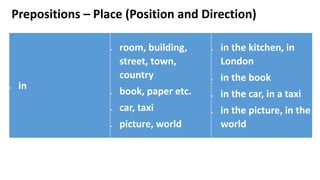
Prepositions – Place (Position and Direction) 
 in 
 room, building, 
street, town, 
country 
 book, paper etc. 
 car, taxi 
 picture, world 
 in the kitchen, in 
London 
 in the book 
 in the car, in a taxi 
 in the picture, in the 
world
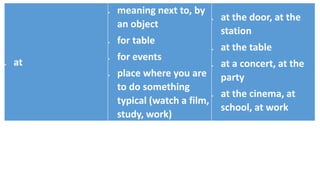
 at 
 meaning next to, by 
an object 
 for table 
 for events 
 place where you are 
to do something 
typical (watch a film, 
study, work) 
 at the door, at the 
station 
 at the table 
 at a concert, at the 
party 
 at the cinema, at 
school, at work
 on 
 attached 
 for a place with a 
river 
 being on a surface 
 for a certain side 
(left, right) 
 for a floor in a house 
 for public transport 
 for television, radio 
 the picture on the 
wall 
 London lies on the 
Thames. 
 on the table 
 on the left 
 on the first floor 
 on the bus, on a 
plane 
 on TV, on the radio
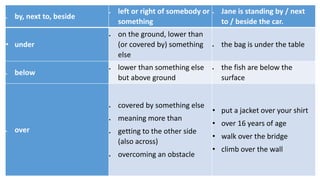
 by, next to, beside  left or right of somebody or 
something 
 Jane is standing by / next 
to / beside the car. 
• under 
 on the ground, lower than 
(or covered by) something 
else 
 the bag is under the table 
 below  lower than something else 
but above ground 
 the fish are below the 
surface 
 over 
 covered by something else 
 meaning more than 
 getting to the other side 
(also across) 
 overcoming an obstacle 
• put a jacket over your shirt 
• over 16 years of age 
• walk over the bridge 
• climb over the wall
• above 
 higher than something 
else, but not directly 
over it 
 a path above the lake 
 across 
 getting to the other side 
(also over) 
 getting to the other side 
 walk across the bridge 
 swim across the lake 
 through 
 something with limits on 
top, bottom and the 
sides 
• drive through the tunnel 
 to 
 movement to person or 
building 
 movement to a place or 
country 
 for bed 
 go to the cinema 
 go to London / Ireland 
 go to bed
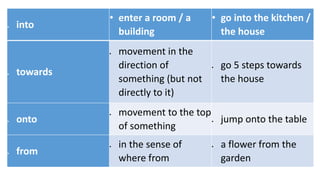
 into 
• enter a room / a 
building 
• go into the kitchen / 
the house 
 towards 
 movement in the 
direction of 
something (but not 
directly to it) 
 go 5 steps towards 
the house 
 onto  movement to the top 
of something  jump onto the table 
 from  in the sense of 
where from 
 a flower from the 
garden
 from  who gave it  a present from Jane 
• of 
 who/what does it 
belong to 
 what does it show 
 a page of the book 
 the picture of a 
palace 
• by  who made it  a book by Mark 
Twain 
 on 
 walking or riding on 
horseback 
 entering a public 
transport vehicle 
 on foot, on 
horseback 
 get on the bus
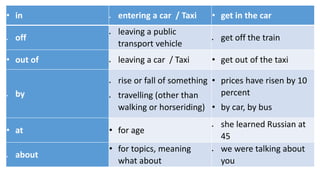
• in  entering a car / Taxi • get in the car 
 off  leaving a public 
transport vehicle  get off the train 
• out of  leaving a car / Taxi • get out of the taxi 
 by 
 rise or fall of something 
 travelling (other than 
walking or horseriding) 
• prices have risen by 10 
percent 
• by car, by bus 
• at • for age  she learned Russian at 
45 
 about 
• for topics, meaning 
what about 
 we were talking about 
you
• Verbs & Prepositions 
• Some verbs are usually followed by prepositions before the object 
of the verb. these are called dependent prepositions and they are 
followed by a noun or a gerund (‘ing’ form). 
• He’s waiting for a bus. 
• For is the dependent preposition for ‘wait’ 
We can use other prepositions with ‘wait’ – e.g. He waited at the 
bus stop – but ‘for’ is the dependent preposition.
Verbs with ‘for’ 
• He apologised for being late. You can also ‘apologise to someone’ 
• I applied for the job but I didn’t get it. 
• How do you ask for a coffee in Polish? 
• She spent many years caring for her aged parents. 
• I can’t go out tonight because I have to prepare for my interview 
tomorrow. 
• With ‘from’ 
• This spray should protect you from mosquitoes. 
• Has he recovered from his illness yet? 
• He won an award because he saved someone from drowning. 
• I suffer from hay fever.
With ‘in’ 
• She believes in ghosts. 
• Our company specialises in computer software. 
• You have to work hard if you want to succeed in life. 
With ‘of’ 
• I don’t approve of your language, young man. 
• Our dog died of old age. 
• This shampoo smells of bananas. 
With ‘on’ 
• The film is based on the novel by Boris Pasternak. 
• If you make so much noise I can’t concentrate on my work. 
• Come on! We’re relying on you! 
• We don’t agree on anything but we’re good friends.
With ‘with’ 
• I agree with everything you’ve said. 
• My secretary will provide you with more information if you need it.
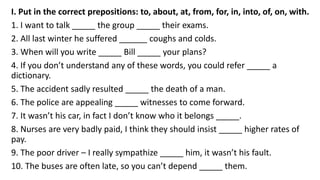
I. Put in the correct prepositions: to, about, at, from, for, in, into, of, on, with. 
1. I want to talk _____ the group _____ their exams. 
2. All last winter he suffered ______ coughs and colds. 
3. When will you write _____ Bill _____ your plans? 
4. If you don’t understand any of these words, you could refer _____ a 
dictionary. 
5. The accident sadly resulted _____ the death of a man. 
6. The police are appealing _____ witnesses to come forward. 
7. It wasn’t his car, in fact I don’t know who it belongs _____. 
8. Nurses are very badly paid, I think they should insist _____ higher rates of 
pay. 
9. The poor driver – I really sympathize _____ him, it wasn’t his fault. 
10. The buses are often late, so you can’t depend _____ them.
11. Do you qualify _____ a state pension when you are 55? 
12. Keep enough money to pay _____ your ticket. 
13. Have you heard _____ what had happened _____ him? Oh, I don’t care 
_____ him. 
14. I said _____ you I was thinking _____ going to America. I actually dreamt 
_____ it. 
15. She listened _____ me and then told me _____ her problems. 
16. The bus ran _____ the wall of a house. 
17. People started to shout _____ the driver. 
18. Who was the boy you were all laughing _____? 
19. I saw somebody staring _____ me from the other side of the road. 
20. He was always arguing _____ his brother.
Put in the correct prepositions: of, to, with, at, about, for, from. 
1. He was afraid _____ his enemies. 
2. I’ve always been terribly fond _____ you. 
3. He is unaccustomed _____ the heat. 
4. They may feel jealous _____ your success. 
5. I was terrified _____ her. 
6. That was clever _____ you. 
7. I turned the job down, which was stupid ________ me. 
8. My problems are very similar _____ yours. 
9. He was dedicated _____ his job. 
10. I could never be bored _____ football.
11. He was very pleased _____ her. 
12. He was shocked _____ the hatred they had shown. 
13. She had always been bad _____ languages. 
14. It’s difficult _____ young people to be on their own. 
15. It was unusual _____ them to go away at the weekend. 
16. It was rude _____ him to leave so suddenly. 
17. She was rude _____ him for no reason. 
18. She was still angry _____ the results. 
19. They’re getting pretty fed up _____ him. 
20. If you continue to support someone who is in trouble you are 
loyal _____ them.
Preposition
Preposition
Preposition

Preposition

  • 1.
  • 2.
    Preposition Position DirectionVerb Time on the table go to school wait for on Monday at supermarket fly over the house believe in in September in class room come out of the room listen to at noon
  • 6.
    PREPOSITION TIME on  days of the week  on Monday  in  months / seasons  time of day  year  after a certain period of time (when?)  in August / in winter  in the morning  in 2006  in an hour  at  for night  for weekend  a certain point of time (when?)  at night  at the weekend  at half past nine
  • 7.
     since from a certain point of time (past till now) • since 1980  for • over a certain period of time (past till now)  for 2 years  ago  a certain time in the past  2 years ago  before  earlier than a certain point of time  before 2004
  • 8.
    • Prepositions areshort words (on, in, to) that usually stand in front of nouns (sometimes also in front of gerund verbs). • Even advanced learners of English find prepositions difficult, as a 1:1 translation is usually not possible. One preposition in your native language might have several translations depending on the situation. • There are hardly any rules as to when to use which preposition. The only way to learn prepositions is looking them up in a dictionary, reading a lot in English (literature) and learning useful phrases off by heart (study tips). • The following table contains rules for some of the most frequently used prepositions in English:
  • 9.
    • to telling the time • ten to six (5:50)  past  telling the time • ten past six (6:10)  to / till / until  marking the beginning and end of a period of time  from Monday to/till Friday  till / until • in the sense of how long something is going to last  He is on holiday until Friday.  by • in the sense of at the latest • up to a certain time  I will be back by 6 o’clock.  By 11 o'clock, I had read five pages.
  • 10.
    Prepositions – Place(Position and Direction)  in  room, building, street, town, country  book, paper etc.  car, taxi  picture, world  in the kitchen, in London  in the book  in the car, in a taxi  in the picture, in the world
  • 11.
     at meaning next to, by an object  for table  for events  place where you are to do something typical (watch a film, study, work)  at the door, at the station  at the table  at a concert, at the party  at the cinema, at school, at work
  • 12.
     on attached  for a place with a river  being on a surface  for a certain side (left, right)  for a floor in a house  for public transport  for television, radio  the picture on the wall  London lies on the Thames.  on the table  on the left  on the first floor  on the bus, on a plane  on TV, on the radio
  • 13.
     by, nextto, beside  left or right of somebody or something  Jane is standing by / next to / beside the car. • under  on the ground, lower than (or covered by) something else  the bag is under the table  below  lower than something else but above ground  the fish are below the surface  over  covered by something else  meaning more than  getting to the other side (also across)  overcoming an obstacle • put a jacket over your shirt • over 16 years of age • walk over the bridge • climb over the wall
  • 14.
    • above higher than something else, but not directly over it  a path above the lake  across  getting to the other side (also over)  getting to the other side  walk across the bridge  swim across the lake  through  something with limits on top, bottom and the sides • drive through the tunnel  to  movement to person or building  movement to a place or country  for bed  go to the cinema  go to London / Ireland  go to bed
  • 15.
     into •enter a room / a building • go into the kitchen / the house  towards  movement in the direction of something (but not directly to it)  go 5 steps towards the house  onto  movement to the top of something  jump onto the table  from  in the sense of where from  a flower from the garden
  • 16.
     from who gave it  a present from Jane • of  who/what does it belong to  what does it show  a page of the book  the picture of a palace • by  who made it  a book by Mark Twain  on  walking or riding on horseback  entering a public transport vehicle  on foot, on horseback  get on the bus
  • 17.
    • in entering a car / Taxi • get in the car  off  leaving a public transport vehicle  get off the train • out of  leaving a car / Taxi • get out of the taxi  by  rise or fall of something  travelling (other than walking or horseriding) • prices have risen by 10 percent • by car, by bus • at • for age  she learned Russian at 45  about • for topics, meaning what about  we were talking about you
  • 18.
    • Verbs &Prepositions • Some verbs are usually followed by prepositions before the object of the verb. these are called dependent prepositions and they are followed by a noun or a gerund (‘ing’ form). • He’s waiting for a bus. • For is the dependent preposition for ‘wait’ We can use other prepositions with ‘wait’ – e.g. He waited at the bus stop – but ‘for’ is the dependent preposition.
  • 19.
    Verbs with ‘for’ • He apologised for being late. You can also ‘apologise to someone’ • I applied for the job but I didn’t get it. • How do you ask for a coffee in Polish? • She spent many years caring for her aged parents. • I can’t go out tonight because I have to prepare for my interview tomorrow. • With ‘from’ • This spray should protect you from mosquitoes. • Has he recovered from his illness yet? • He won an award because he saved someone from drowning. • I suffer from hay fever.
  • 20.
    With ‘in’ •She believes in ghosts. • Our company specialises in computer software. • You have to work hard if you want to succeed in life. With ‘of’ • I don’t approve of your language, young man. • Our dog died of old age. • This shampoo smells of bananas. With ‘on’ • The film is based on the novel by Boris Pasternak. • If you make so much noise I can’t concentrate on my work. • Come on! We’re relying on you! • We don’t agree on anything but we’re good friends.
  • 21.
    With ‘with’ •I agree with everything you’ve said. • My secretary will provide you with more information if you need it.
  • 22.
    I. Put inthe correct prepositions: to, about, at, from, for, in, into, of, on, with. 1. I want to talk _____ the group _____ their exams. 2. All last winter he suffered ______ coughs and colds. 3. When will you write _____ Bill _____ your plans? 4. If you don’t understand any of these words, you could refer _____ a dictionary. 5. The accident sadly resulted _____ the death of a man. 6. The police are appealing _____ witnesses to come forward. 7. It wasn’t his car, in fact I don’t know who it belongs _____. 8. Nurses are very badly paid, I think they should insist _____ higher rates of pay. 9. The poor driver – I really sympathize _____ him, it wasn’t his fault. 10. The buses are often late, so you can’t depend _____ them.
  • 23.
    11. Do youqualify _____ a state pension when you are 55? 12. Keep enough money to pay _____ your ticket. 13. Have you heard _____ what had happened _____ him? Oh, I don’t care _____ him. 14. I said _____ you I was thinking _____ going to America. I actually dreamt _____ it. 15. She listened _____ me and then told me _____ her problems. 16. The bus ran _____ the wall of a house. 17. People started to shout _____ the driver. 18. Who was the boy you were all laughing _____? 19. I saw somebody staring _____ me from the other side of the road. 20. He was always arguing _____ his brother.
  • 24.
    Put in thecorrect prepositions: of, to, with, at, about, for, from. 1. He was afraid _____ his enemies. 2. I’ve always been terribly fond _____ you. 3. He is unaccustomed _____ the heat. 4. They may feel jealous _____ your success. 5. I was terrified _____ her. 6. That was clever _____ you. 7. I turned the job down, which was stupid ________ me. 8. My problems are very similar _____ yours. 9. He was dedicated _____ his job. 10. I could never be bored _____ football.
  • 25.
    11. He wasvery pleased _____ her. 12. He was shocked _____ the hatred they had shown. 13. She had always been bad _____ languages. 14. It’s difficult _____ young people to be on their own. 15. It was unusual _____ them to go away at the weekend. 16. It was rude _____ him to leave so suddenly. 17. She was rude _____ him for no reason. 18. She was still angry _____ the results. 19. They’re getting pretty fed up _____ him. 20. If you continue to support someone who is in trouble you are loyal _____ them.