PREPOSITIONS
Definition:-
Preposition is a word, which is used before a noun, a
noun phrase or a pronoun , connecting it to another
word.
@ Simple prepositions: Prepositions which consists only one word.
e.g. in, on, at, with, against etc..,
@ Compound prepositions: Prepositions which consists of two or more words.
e.g. instead of, in the middle of, by the side of etc..,
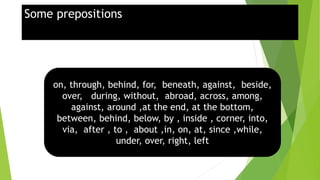
Some prepositions
on, through, behind, for, beneath, against, beside,
over, during, without, abroad, across, among,
against, around ,at the end, at the bottom,
between, behind, below, by , inside , corner, into,
via, after , to , about ,in, on, at, since ,while,
under, over, right, left
Kinds of Prepositions
There are three types in prepositions
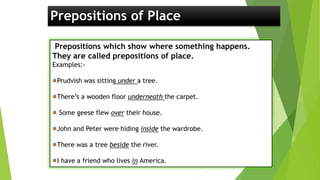
Prepositions of Place
Prepositions which show where something happens.
They are called prepositions of place.
Examples:-
Prudvish was sitting under a tree.
There’s a wooden floor underneath the carpet.
Some geese flew over their house.
John and Peter were hiding inside the wardrobe.
There was a tree beside the river.
I have a friend who lives in America.
Prepositions of Time
Prepositions which tell when something happens. They are
called prepositions of time.
Examples:-
School starts at nine o’clock.
We’re going to the zoo on Saturday.
I visited my grandparents during the summer.
You must finish the work by Friday.
I’ll do my homework before dinner.
Prepositions of Direction
Prepositions which tell where or in which direction
something moves. They are called prepositions of
direction.
Examples:-
The boys chased after each other.
The football rolled down the hill.
A man was walking along the riverbank.
We were travelling towards Madhurai.
Prepositions with special uses
Our modules are full of real life examples.
I ate a plate of rice and a quarter of milk.
Would you like a glass of lemon juice?
I need three pieces of paper.
Most of the children in my class are from
AP.
There are several ways of cooking Upma.
Usage of OF
Usage of “FOR”
I made this gift for Mom.
Is there any room for me on this hotel?
I’m buying a new dress for Christmas.
We’re going downtown for a meeting.
Is there any food left for me ?
Usage of “WITH”
He pounds nails with a hammer.
Mix the flour with water.
She painted the picture with her new paints.
Would you like to come with us to the cinema?
I can do difficult problems with the help of my
mom.
Who is the man with the beard?
Usage of “EXCEPT” AND “INSTEAD OF”
I like all kinds of food except Upma.
Everyone likes chocolate except Tom.
We go to school every day except Saturday and Sunday.
You should eat fruits instead of candy.
Dad is coming to the theater with us instead of Mom.
We could watch TV instead of reading our books.
Usage of “LIKE”, “AS” and “THEN”
Kathleen looks like her dad.
Andrew smiles like his mother.
Peter sings like a professional singer.
Eswar is nearly as tall as the teacher.
My backpack is bigger than John’s.
Dad is taller than all of us.
This painting is more beautiful than that one.
The neighbourhood streets are less busy than
downtown streets.
Prepositions with Adjective ,Verbs .
Prepositions are used with some adjectives. The adjectives
in these examples are printed in color.
Dad was angry with us.
We were afraid of the big dog.
She’s not very interested in sports.
John is very good at drawing.
Mr. Lee is pleased with our work.
The teachers are always kind to us.
What’s wrong with the computer?
Prepositions are used with some verbs. The verbs
in these examples are printed in color.
I’m looking for my pencil. Have you seen it?
Can you think of another word for ‘pleased’?
Does this book belong to you?
We’re listening to CDs.
I agree with you.
Tell me about the show you saw.
Cut the cake into five pieces.
They borrowed money from the bank.
Prepositions are used with some nouns. The
nouns in these examples are printed in color.
What’s the answer to this question?
Is there a reason for this delay?
What’s the matter with you?
Here’s an example of good behavior.
Congratulations on winning the competition!
Traffic can cause damage to the environment.
5.5. Next to / Beside
Next to and beside refer to an object or a person
that is at the side of another thing.
For instance: A security personnel stands next
to the entrance gate.
6.Near / Close to
Near and close to carry same connotation as next
to / beside. The only difference is the distance.
‘Next to’ is used to express a short distance, while
‘near’ is used to highlight a longer distance.
For instance: The bus stop is near the bank.
7.On
•On is used a preposition of time, place and
position.
•This means it indicates ‘days of the week’.
•‘On’ is used to point out the position of a person
or an object.
For instance: The bottle is kept on the table.
(Indicates position)
The office will be open on Saturday. (This indicates
time.)
8.Above / Over
Above and over mean position higher than a
reference point. In other words, ‘above’ or ‘over’
mean at a higher position than other object or
Fill in the correct prepositions.
1.Peter is playing tennis on Sunday.
2.My brother's birthday is------------ the 5th of November.
3.My birthday is --------------May.
4.We are going to see my parents ------------- the weekend.
5. -------------------1666, a great fire broke out in London.
6.I don't like walking alone in the streets------------ night.
7.What are you doing----------------- the afternoon?
8.My friend has been living in Canada------------ two years.
9.I have been waiting for you----------------- seven o'clock.
10.I will have finished this essay --------------------- Friday.
Fill in the correct prepositions.
1.Peter is playing tennis on Sunday.
2.My brother's birthday is on the 5th of November.
3.My birthday is inMay.
4.We are going to see my parents at the weekend.
5.In 1666, a great fire broke out in London.
6.I don't like walking alone in the streets at night.
7.What are you doing in the afternoon?
8.My friend has been living in Canada for two years.
9.I have been waiting for you since seven o'clock.
10.I will have finished this essay by Friday.

PREPOSITIONS 12.pptx

  • 1.
  • 2.
    Definition:- Preposition is aword, which is used before a noun, a noun phrase or a pronoun , connecting it to another word.
  • 5.
    @ Simple prepositions:Prepositions which consists only one word. e.g. in, on, at, with, against etc.., @ Compound prepositions: Prepositions which consists of two or more words. e.g. instead of, in the middle of, by the side of etc..,
  • 6.
    Some prepositions on, through,behind, for, beneath, against, beside, over, during, without, abroad, across, among, against, around ,at the end, at the bottom, between, behind, below, by , inside , corner, into, via, after , to , about ,in, on, at, since ,while, under, over, right, left
  • 7.
    Kinds of Prepositions Thereare three types in prepositions
  • 8.
    Prepositions of Place Prepositionswhich show where something happens. They are called prepositions of place. Examples:- Prudvish was sitting under a tree. There’s a wooden floor underneath the carpet. Some geese flew over their house. John and Peter were hiding inside the wardrobe. There was a tree beside the river. I have a friend who lives in America.
  • 9.
    Prepositions of Time Prepositionswhich tell when something happens. They are called prepositions of time. Examples:- School starts at nine o’clock. We’re going to the zoo on Saturday. I visited my grandparents during the summer. You must finish the work by Friday. I’ll do my homework before dinner.
  • 10.
    Prepositions of Direction Prepositionswhich tell where or in which direction something moves. They are called prepositions of direction. Examples:- The boys chased after each other. The football rolled down the hill. A man was walking along the riverbank. We were travelling towards Madhurai.
  • 11.
    Prepositions with specialuses Our modules are full of real life examples. I ate a plate of rice and a quarter of milk. Would you like a glass of lemon juice? I need three pieces of paper. Most of the children in my class are from AP. There are several ways of cooking Upma. Usage of OF
  • 12.
    Usage of “FOR” Imade this gift for Mom. Is there any room for me on this hotel? I’m buying a new dress for Christmas. We’re going downtown for a meeting. Is there any food left for me ?
  • 13.
    Usage of “WITH” Hepounds nails with a hammer. Mix the flour with water. She painted the picture with her new paints. Would you like to come with us to the cinema? I can do difficult problems with the help of my mom. Who is the man with the beard?
  • 14.
    Usage of “EXCEPT”AND “INSTEAD OF” I like all kinds of food except Upma. Everyone likes chocolate except Tom. We go to school every day except Saturday and Sunday. You should eat fruits instead of candy. Dad is coming to the theater with us instead of Mom. We could watch TV instead of reading our books.
  • 15.
    Usage of “LIKE”,“AS” and “THEN” Kathleen looks like her dad. Andrew smiles like his mother. Peter sings like a professional singer. Eswar is nearly as tall as the teacher. My backpack is bigger than John’s. Dad is taller than all of us. This painting is more beautiful than that one. The neighbourhood streets are less busy than downtown streets.
  • 16.
    Prepositions with Adjective,Verbs . Prepositions are used with some adjectives. The adjectives in these examples are printed in color. Dad was angry with us. We were afraid of the big dog. She’s not very interested in sports. John is very good at drawing. Mr. Lee is pleased with our work. The teachers are always kind to us. What’s wrong with the computer?
  • 17.
    Prepositions are usedwith some verbs. The verbs in these examples are printed in color. I’m looking for my pencil. Have you seen it? Can you think of another word for ‘pleased’? Does this book belong to you? We’re listening to CDs. I agree with you. Tell me about the show you saw. Cut the cake into five pieces. They borrowed money from the bank.
  • 18.
    Prepositions are usedwith some nouns. The nouns in these examples are printed in color. What’s the answer to this question? Is there a reason for this delay? What’s the matter with you? Here’s an example of good behavior. Congratulations on winning the competition! Traffic can cause damage to the environment.
  • 26.
    5.5. Next to/ Beside Next to and beside refer to an object or a person that is at the side of another thing. For instance: A security personnel stands next to the entrance gate. 6.Near / Close to Near and close to carry same connotation as next to / beside. The only difference is the distance. ‘Next to’ is used to express a short distance, while ‘near’ is used to highlight a longer distance. For instance: The bus stop is near the bank. 7.On •On is used a preposition of time, place and position. •This means it indicates ‘days of the week’. •‘On’ is used to point out the position of a person or an object. For instance: The bottle is kept on the table. (Indicates position) The office will be open on Saturday. (This indicates time.) 8.Above / Over Above and over mean position higher than a reference point. In other words, ‘above’ or ‘over’ mean at a higher position than other object or
  • 27.
    Fill in thecorrect prepositions. 1.Peter is playing tennis on Sunday. 2.My brother's birthday is------------ the 5th of November. 3.My birthday is --------------May. 4.We are going to see my parents ------------- the weekend. 5. -------------------1666, a great fire broke out in London. 6.I don't like walking alone in the streets------------ night. 7.What are you doing----------------- the afternoon? 8.My friend has been living in Canada------------ two years. 9.I have been waiting for you----------------- seven o'clock. 10.I will have finished this essay --------------------- Friday.
  • 28.
    Fill in thecorrect prepositions. 1.Peter is playing tennis on Sunday. 2.My brother's birthday is on the 5th of November. 3.My birthday is inMay. 4.We are going to see my parents at the weekend. 5.In 1666, a great fire broke out in London. 6.I don't like walking alone in the streets at night. 7.What are you doing in the afternoon? 8.My friend has been living in Canada for two years. 9.I have been waiting for you since seven o'clock. 10.I will have finished this essay by Friday.