Preparation Activities — GESE Grade 3
1
Practise 1 — Weekly diary
	
Describing daily routines and times
	
Times and dates
	
Describing states in the past
	
Past tense of the verb to be
	
Places in the local area
	
Place of study
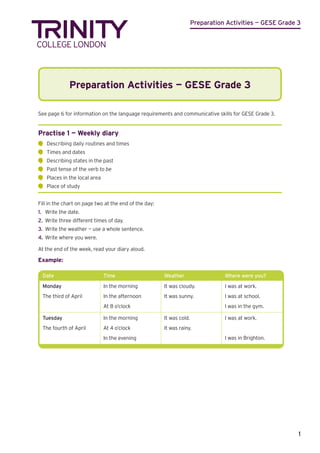
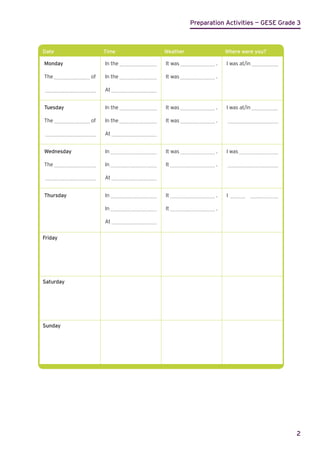
Fill in the chart on page two at the end of the day:
1.	 Write the date.
2.	 Write three different times of day.
3.	 Write the weather — use a whole sentence.
4.	 Write where you were.
At the end of the week, read your diary aloud.
Example:
Date Time Weather Where were you?
Monday
The third of April
In the morning
In the afternoon
At 8 o’clock
It was cloudy.
It was sunny.
I was at work.
I was at school.
I was in the gym.
Tuesday
The fourth of April
In the morning
At 4 o’clock
In the evening
It was cold.
It was rainy.
I was at work.
I was in Brighton.
Preparation Activities — GESE Grade 3
See page 6 for information on the language requirements and communicative skills for GESE Grade 3.
Preparation Activities — GESE Grade 3
2
Date Time Weather Where were you?
Monday
The of
In the
In the
At
It was .
It was .
I was at/in
Tuesday
The of
In the
In the
At
It was .
It was .
I was at/in
Wednesday
The
In
In
At
It was .
It .
I was
Thursday In
In
At
It .
It .
I
Friday
Saturday
Sunday
Preparation Activities — GESE Grade 3
3
Practise 2 — Daily routines and free time
	
Describing daily routines and times
	
Asking simple questions about everyday life
	
Home life
	
Free time
	
Times and dates
	
Link words and, and then
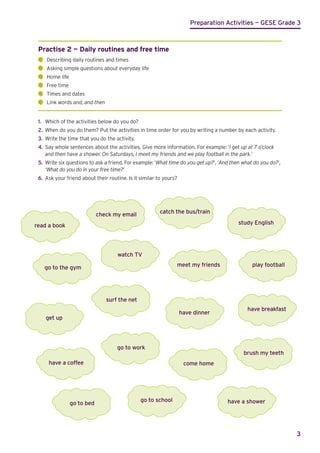
1.	 Which of the activities below do you do?
2.	 When do you do them? Put the activities in time order for you by writing a number by each activity.
3.	 Write the time that you do the activity.
4.	 Say whole sentences about the activities. Give more information. For example: ‘I get up at 7 o’clock
	 and then have a shower. On Saturdays, I meet my friends and we play football in the park.’
5.	 Write six questions to ask a friend. For example: ‘What time do you get up?’, ‘And then what do you do?’,
	‘What do you do in your free time?’
6.	 Ask your friend about their routine. Is it similar to yours?
check my email
meet my friends play football
go to the gym
surf the net
go to work
come home
brush my teeth
go to bed
have a coffee
catch the bus/train
get up
go to school
read a book
have breakfast
watch TV
have dinner
study English
have a shower
Preparation Activities — GESE Grade 3
4
Practise 3 — My photos
	
Describing current activities of real people or those in pictures
	
Asking simple questions about everyday life
	
Present continuous tense
	
Prepositions of movement from, to, up, down, along, across
1.	 Take one photograph a day for a week using your mobile phone or camera.
2.	 At the end of the week, look at your photographs and answer these questions:
◗
◗ What time was it?
◗
◗ Where were you?
◗
◗ What is happening in the photograph?
◗
◗ What are the people doing?
3.	 Show a friend your photos and describe them.
4.	 Ask your friend to show you some photos — ask them about the pictures.
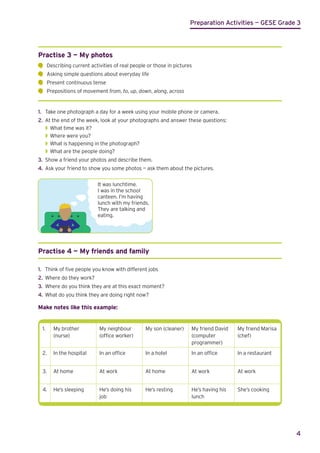
It was lunchtime.
I was in the school
canteen. I’m having
lunch with my friends.
They are talking and
eating.
Practise 4 — My friends and family
1.	 Think of five people you know with different jobs
2.	 Where do they work?
3.	 Where do you think they are at this exact moment?
4.	 What do you think they are doing right now?
Make notes like this example:
1. My brother
(nurse)
My neighbour
(office worker)
My son (cleaner) My friend David
(computer
programmer)
My friend Marisa
(chef)
2. In the hospital In an office In a hotel In an office In a restaurant
3. At home At work At home At work At work
4. He’s sleeping He’s doing his
job
He’s resting He’s having his
lunch
She’s cooking
Preparation Activities — GESE Grade 3
5
Practise 5 — Directions
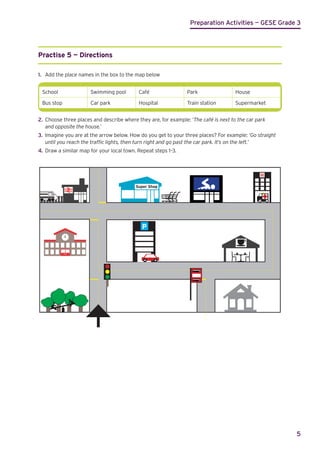
1.	 Add the place names in the box to the map below
School Swimming pool Café Park House
Bus stop Car park Hospital Train station Supermarket
2.	 Choose three places and describe where they are, for example: ‘The café is next to the car park
	 and opposite the house.’
3.	 Imagine you are at the arrow below. How do you get to your three places? For example: ‘Go straight
	 until you reach the traffic lights, then turn right and go past the car park. It’s on the left.’
4.	 Draw a similar map for your local town. Repeat steps 1–3.
P
H
Super Shop
Preparation Activities — GESE Grade 3
6
	 Language requirements
Language functions
◗
◗ Describing daily routines and times
◗
◗ Giving dates
◗
◗ Expressing ability and inability
◗
◗ Giving very simple directions and locations
◗
◗ Describing current activities of real people or those in pictures
◗
◗ Describing states in the past
◗
◗ Asking simple questions about everyday life
Grammar
◗
◗ Present continuous tense
◗
◗ Can and can’t
◗
◗ Prepositions of movement from, to, up, down, along, across
◗
◗ Prepositions of time on, in, at
◗
◗ Prepositions of place near, in front of, behind, opposite
◗
◗ Past tense of the verb to be
◗
◗ Link words and, and then
Lexis
◗
◗ Jobs
◗
◗ Places in the local area
◗
◗ Place of study
◗
◗ Home life
◗
◗ Weather
◗
◗ Free time
◗
◗ Times and dates
◗
◗ Ordinal numbers up to 31st
for dates
◗
◗ Words and phrases relating to the language functions listed above
You can also find this information on page 19 of the Exam Information booklet at
www.trinitycollege.com/GESEexaminformation
	 Communicative skills
◗
◗ Show understanding by responding appropriately to simple questions and requests
◗
◗ Use basic sentence patterns and phrases to communicate limited information related
to simple everyday situations
◗
◗ Exchange basic information about everyday life and activities by asking and answering
simple questions
◗
◗ Link groups of words in a very simple way using and, and then

Preparation activities trinity gese grade 3

  • 1.
    Preparation Activities —GESE Grade 3 1 Practise 1 — Weekly diary Describing daily routines and times Times and dates Describing states in the past Past tense of the verb to be Places in the local area Place of study Fill in the chart on page two at the end of the day: 1. Write the date. 2. Write three different times of day. 3. Write the weather — use a whole sentence. 4. Write where you were. At the end of the week, read your diary aloud. Example: Date Time Weather Where were you? Monday The third of April In the morning In the afternoon At 8 o’clock It was cloudy. It was sunny. I was at work. I was at school. I was in the gym. Tuesday The fourth of April In the morning At 4 o’clock In the evening It was cold. It was rainy. I was at work. I was in Brighton. Preparation Activities — GESE Grade 3 See page 6 for information on the language requirements and communicative skills for GESE Grade 3.
  • 2.
    Preparation Activities —GESE Grade 3 2 Date Time Weather Where were you? Monday The of In the In the At It was . It was . I was at/in Tuesday The of In the In the At It was . It was . I was at/in Wednesday The In In At It was . It . I was Thursday In In At It . It . I Friday Saturday Sunday
  • 3.
    Preparation Activities —GESE Grade 3 3 Practise 2 — Daily routines and free time Describing daily routines and times Asking simple questions about everyday life Home life Free time Times and dates Link words and, and then 1. Which of the activities below do you do? 2. When do you do them? Put the activities in time order for you by writing a number by each activity. 3. Write the time that you do the activity. 4. Say whole sentences about the activities. Give more information. For example: ‘I get up at 7 o’clock and then have a shower. On Saturdays, I meet my friends and we play football in the park.’ 5. Write six questions to ask a friend. For example: ‘What time do you get up?’, ‘And then what do you do?’, ‘What do you do in your free time?’ 6. Ask your friend about their routine. Is it similar to yours? check my email meet my friends play football go to the gym surf the net go to work come home brush my teeth go to bed have a coffee catch the bus/train get up go to school read a book have breakfast watch TV have dinner study English have a shower
  • 4.
    Preparation Activities —GESE Grade 3 4 Practise 3 — My photos Describing current activities of real people or those in pictures Asking simple questions about everyday life Present continuous tense Prepositions of movement from, to, up, down, along, across 1. Take one photograph a day for a week using your mobile phone or camera. 2. At the end of the week, look at your photographs and answer these questions: ◗ ◗ What time was it? ◗ ◗ Where were you? ◗ ◗ What is happening in the photograph? ◗ ◗ What are the people doing? 3. Show a friend your photos and describe them. 4. Ask your friend to show you some photos — ask them about the pictures. It was lunchtime. I was in the school canteen. I’m having lunch with my friends. They are talking and eating. Practise 4 — My friends and family 1. Think of five people you know with different jobs 2. Where do they work? 3. Where do you think they are at this exact moment? 4. What do you think they are doing right now? Make notes like this example: 1. My brother (nurse) My neighbour (office worker) My son (cleaner) My friend David (computer programmer) My friend Marisa (chef) 2. In the hospital In an office In a hotel In an office In a restaurant 3. At home At work At home At work At work 4. He’s sleeping He’s doing his job He’s resting He’s having his lunch She’s cooking
  • 5.
    Preparation Activities —GESE Grade 3 5 Practise 5 — Directions 1. Add the place names in the box to the map below School Swimming pool Café Park House Bus stop Car park Hospital Train station Supermarket 2. Choose three places and describe where they are, for example: ‘The café is next to the car park and opposite the house.’ 3. Imagine you are at the arrow below. How do you get to your three places? For example: ‘Go straight until you reach the traffic lights, then turn right and go past the car park. It’s on the left.’ 4. Draw a similar map for your local town. Repeat steps 1–3. P H Super Shop
  • 6.
    Preparation Activities —GESE Grade 3 6 Language requirements Language functions ◗ ◗ Describing daily routines and times ◗ ◗ Giving dates ◗ ◗ Expressing ability and inability ◗ ◗ Giving very simple directions and locations ◗ ◗ Describing current activities of real people or those in pictures ◗ ◗ Describing states in the past ◗ ◗ Asking simple questions about everyday life Grammar ◗ ◗ Present continuous tense ◗ ◗ Can and can’t ◗ ◗ Prepositions of movement from, to, up, down, along, across ◗ ◗ Prepositions of time on, in, at ◗ ◗ Prepositions of place near, in front of, behind, opposite ◗ ◗ Past tense of the verb to be ◗ ◗ Link words and, and then Lexis ◗ ◗ Jobs ◗ ◗ Places in the local area ◗ ◗ Place of study ◗ ◗ Home life ◗ ◗ Weather ◗ ◗ Free time ◗ ◗ Times and dates ◗ ◗ Ordinal numbers up to 31st for dates ◗ ◗ Words and phrases relating to the language functions listed above You can also find this information on page 19 of the Exam Information booklet at www.trinitycollege.com/GESEexaminformation Communicative skills ◗ ◗ Show understanding by responding appropriately to simple questions and requests ◗ ◗ Use basic sentence patterns and phrases to communicate limited information related to simple everyday situations ◗ ◗ Exchange basic information about everyday life and activities by asking and answering simple questions ◗ ◗ Link groups of words in a very simple way using and, and then