Grammar: Using Prepositions
1 Adapted in part from George Yule’s Oxford Practice Grammar. Advanced, Oxford, 2006, pp. 124-137 and
http://academicguides.waldenu.edu/writingcenter/grammar/prepositions by Guillaume Filion © 2017, the CAC,
University of Victoria. This copy is solely for the use by a student, staff, or faculty member. Any other use may be
infringement of copyright if done without securing the permission of copyright owners.
Prepositions: The Basics
A preposition is a word or group of words used to link nouns, pronouns and phrases to other words in a sentence.
Some examples of prepositions are single words like in, at, on, of, to, by and with or phrases such as in front of,
next to, instead of.
Prepositions in English are most frequently dictated by fixed expressions. While there are some general guidelines
to follow, many prepositions are used idiomatically with certain verbs. In these cases, it is best to memorize the
phrase instead of the individual preposition.
A Few Rules for Usage
Although there are hardly any rules as to when to use which preposition, most commonly prepositions define
relationships between nouns and locate words, actions or ideas in a particular time or place. To remember the
role of prepositions, notice that ''position'' appears in the word ''preposition''!
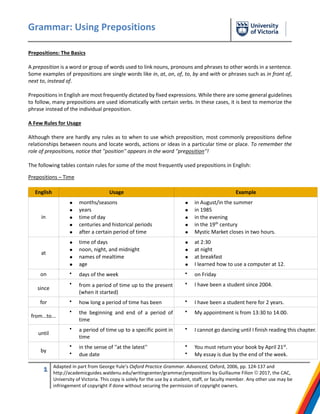
The following tables contain rules for some of the most frequently used prepositions in English:
Prepositions – Time
English Usage Example
in
 months/seasons
 years
 time of day
 centuries and historical periods
 after a certain period of time
 in August/in the summer
 in 1985
 in the evening
 in the 19th
century
 Mystic Market closes in two hours.
at
 time of days
 noon, night, and midnight
 names of mealtime
 age
 at 2:30
 at night
 at breakfast
 I learned how to use a computer at 12.
on  days of the week  on Friday
since
 from a period of time up to the present
(when it started)
 I have been a student since 2004.
for  how long a period of time has been  I have been a student here for 2 years.
from...to...
 the beginning and end of a period of
time
 My appointment is from 13:30 to 14:00.
until
 a period of time up to a specific point in
time
 I cannot go dancing until I finish reading this chapter.
by
 in the sense of ''at the latest''
 due date
 You must return your book by April 21st
.
 My essay is due by the end of the week.
Grammar: Using Prepositions
2 Adapted in part from George Yule’s Oxford Practice Grammar. Advanced, Oxford, 2006, pp. 124-137 and
http://academicguides.waldenu.edu/writingcenter/grammar/prepositions by Guillaume Filion © 2017, the CAC,
University of Victoria. This copy is solely for the use by a student, staff, or faculty member. Any other use may be
infringement of copyright if done without securing the permission of copyright owners.
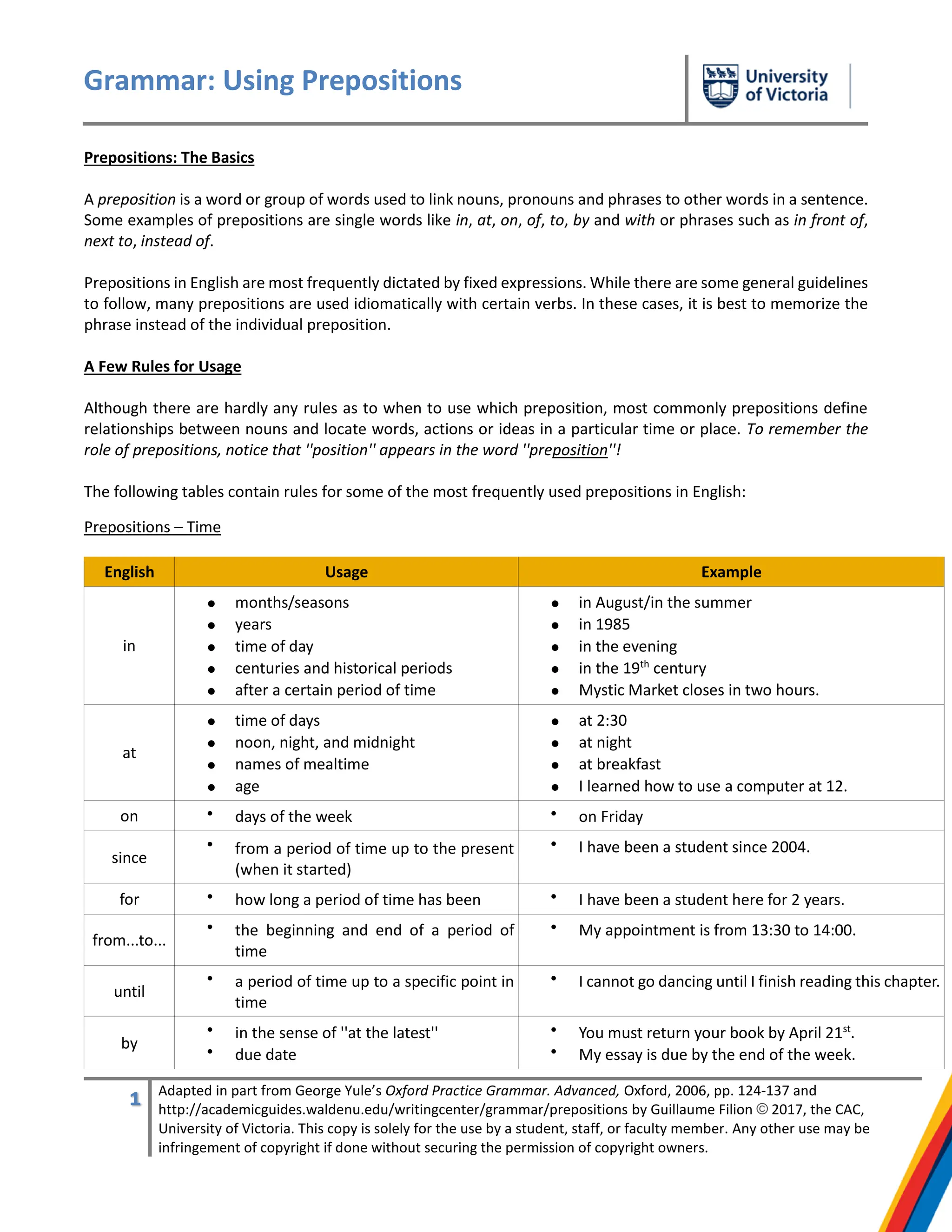
Prepositions – Place (Location and Direction)
English Usage Example
in  when something is in a place, it is inside it
(enclosed within limits)
 in class/in Victoria
 in the book
 in the car/in a taxi
 You look serious in this photo.
at
 located at a specific place (a point)
 for events
 place where you are to do something
typical (watch a movie, study, work)
 at the library
 at a concert/at a party
 at the cinema/at school/at work
on
 being on a surface (not enclosed)
 for a certain side (left, right)
 for a floor in a building
 for public transport
 for television, radio
 I left the keys on the table.
 Go down this hall to the end, turn right, and it's
the third door on your left.
 My apartment is on the fourth floor.
 I forgot my phone on the bus.
 You can hear my brother on the radio.
to
 moving toward a specific place (the goal or
end point of movement)
 Every morning, I take the bus to campus.
from  for the origin or starting point
 I used carrots from my garden.
 I received a suspicious email from my bank.
 I will be on vacation from July 31 for a week.
towards  movement in direction of something  I suddenly saw a dog running towards me.
across  movement from one side to another
 There is a coffee shop across the street.
 I swam across the lake.
through
 movement from one side to another but
''in something''
 I entered the room through an open window.
 You have to go through the kitchen to get to the
bathroom.
between
 a place ''in the middle'' of two or more
separate people or things
 I was standing between my friend and his parents.
 The gap between the rich and poor keeps growing.
among
 a place ''surrounded'' by more than two
people or things together as a group (in the
sense of ''included in'')
 France is among the countries of Western Europe.
 Among the advantages of exercising regularly are
lower risks of depression and a better quality of
life.
Grammar: Using Prepositions
3 Adapted in part from George Yule’s Oxford Practice Grammar. Advanced, Oxford, 2006, pp. 124-137 and
http://academicguides.waldenu.edu/writingcenter/grammar/prepositions by Guillaume Filion © 2017, the CAC,
University of Victoria. This copy is solely for the use by a student, staff, or faculty member. Any other use may be
infringement of copyright if done without securing the permission of copyright owners.
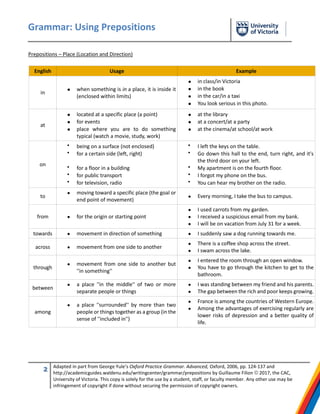
Prepositions - Connections
English Usage Example
of
 between two noun phrases to show that the
first belongs to or is part of the second
 to say how people are related
 The keyboard of my computer is pink.
 Richard is the son of Audrey/He is a good friend of
mine.
with
 Between two noun phrases when the second is
a particular feature of the first
 to say that people or things are together
 for the specific thing used to perform an action
 I spilled coffee on the computer with a pink keyboard.
 I think Sarah is studying with Tara/I went to a workshop
with my friend.
 My roommate killed a spider with a book.
by
 when we want to describe an action in a more
general way
 My roommate saved my live by killing the spider.
Prepositions in Academic Writing
Here are the prepositions most frequently used in academic writing, with some explanations for their use:
English Usage Example
about
 For topics (in the sense of ''with regard
to/concerned with'')
 She was the author of many books about the history of
ancient Egypt.
for
 with a purpose/giving a reason (associated with
an action; shortened form of ''for the purpose
of'')
 The concept of class is important for understanding
how society works.
 Theories about strategies for linking nouns and verbs
from  the origin, cause or agent of something
 The meaning is often hard to guess from the individual
words.
in
 inclusion, location or position within a time
period or limits
 You can see this in works by contemporary authors.
on  the basis for something
 Many engineers proceed on the assumption that the
digital age is unique.
of
 belonging to, relating to, or connected with
 describe a relation/causation
 the origin, cause, motive or reason of
something
 The results of the investigation are still relevant.
 The root of the problem is the absence of any evidence
supporting our thesis.
 Henderson discovered that the king died of poisoning
by analyzing blood samples.
by  describe a direct cause or agent
 According to folklore, he was killed by strangulation by
the Mad King when he protested the new tax.
Grammar: Using Prepositions
4 Adapted in part from George Yule’s Oxford Practice Grammar. Advanced, Oxford, 2006, pp. 124-137 and
http://academicguides.waldenu.edu/writingcenter/grammar/prepositions by Guillaume Filion © 2017, the CAC,
University of Victoria. This copy is solely for the use by a student, staff, or faculty member. Any other use may be
infringement of copyright if done without securing the permission of copyright owners.
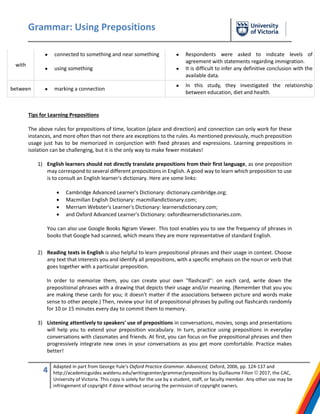
with
 connected to something and near something
 using something
 Respondents were asked to indicate levels of
agreement with statements regarding immigration.
 It is difficult to infer any definitive conclusion with the
available data.
between  marking a connection
 In this study, they investigated the relationship
between education, diet and health.
Tips for Learning Prepositions
The above rules for prepositions of time, location (place and direction) and connection can only work for these
instances, and more often than not there are exceptions to the rules. As mentioned previously, much preposition
usage just has to be memorized in conjunction with fixed phrases and expressions. Learning prepositions in
isolation can be challenging, but it is the only way to make fewer mistakes!
1) English learners should not directly translate prepositions from their first language, as one preposition
may correspond to several different prepositions in English. A good way to learn which preposition to use
is to consult an English learner's dictionary. Here are some links:
 Cambridge Advanced Learner's Dictionary: dictionary.cambridge.org;
 Macmillan English Dictionary: macmillandictionary.com;
 Merriam Webster's Learner's Dictionary: learnersdictionary.com;
 and Oxford Advanced Learner's Dictionary: oxfordlearnersdictionaries.com.
You can also use Google Books Ngram Viewer. This tool enables you to see the frequency of phrases in
books that Google had scanned, which means they are more representative of standard English.
2) Reading texts in English is also helpful to learn prepositional phrases and their usage in context. Choose
any text that interests you and identify all prepositions, with a specific emphasis on the noun or verb that
goes together with a particular preposition.
In order to memorize them, you can create your own ''flashcard'': on each card, write down the
prepositional phrases with a drawing that depicts their usage and/or meaning. (Remember that you you
are making these cards for you; it doesn't matter if the associations between picture and words make
sense to other people.) Then, review your list of prepositional phrases by pulling out flashcards randomly
for 10 or 15 minutes every day to commit them to memory.
3) Listening attentively to speakers' use of prepositions in conversations, movies, songs and presentations
will help you to extend your preposition vocabulary. In turn, practice using prepositions in everyday
conversations with classmates and friends. At first, you can focus on five prepositional phrases and then
progressively integrate new ones in your conversations as you get more comfortable. Practice makes
better!
Grammar: Using Prepositions
5 Adapted in part from George Yule’s Oxford Practice Grammar. Advanced, Oxford, 2006, pp. 124-137 and
http://academicguides.waldenu.edu/writingcenter/grammar/prepositions by Guillaume Filion © 2017, the CAC,
University of Victoria. This copy is solely for the use by a student, staff, or faculty member. Any other use may be
infringement of copyright if done without securing the permission of copyright owners.
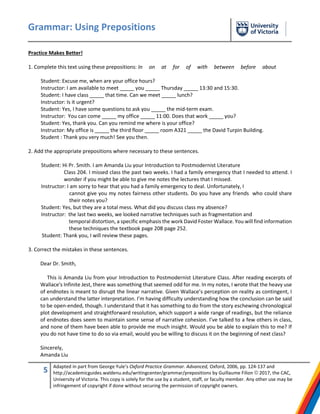
Practice Makes Better!
1. Complete this text using these prepositions: In on at for of with between before about
Student: Excuse me, when are your office hours?
Instructor: I am available to meet _____ you _____ Thursday _____ 13:30 and 15:30.
Student: I have class _____ that time. Can we meet _____ lunch?
Instructor: Is it urgent?
Student: Yes, I have some questions to ask you _____ the mid-term exam.
Instructor: You can come _____ my office _____ 11:00. Does that work _____ you?
Student: Yes, thank you. Can you remind me where is your office?
Instructor: My office is _____ the third floor _____ room A321 _____ the David Turpin Building.
Student : Thank you very much! See you then.
2. Add the appropriate prepositions where necessary to these sentences.
Student: Hi Pr. Smith. I am Amanda Liu your Introduction to Postmodernist Literature
Class 204. I missed class the past two weeks. I had a family emergency that I needed to attend. I
wonder if you might be able to give me notes the lectures that I missed.
Instructor: I am sorry to hear that you had a family emergency to deal. Unfortunately, I
cannot give you my notes fairness other students. Do you have any friends who could share
their notes you?
Student: Yes, but they are a total mess. What did you discuss class my absence?
Instructor: the last two weeks, we looked narrative techniques such as fragmentation and
temporal distortion, a specific emphasis the work David Foster Wallace. You will find information
these techniques the textbook page 208 page 252.
Student: Thank you, I will review these pages.
3. Correct the mistakes in these sentences.
Dear Dr. Smith,
This is Amanda Liu from your Introduction to Postmodernist Literature Class. After reading excerpts of
Wallace's Infinite Jest, there was something that seemed odd for me. In my notes, I wrote that the heavy use
of endnotes is meant to disrupt the linear narrative. Given Wallace’s perception on reality as contingent, I
can understand the latter interpretation. I’m having difficulty understanding how the conclusion can be said
to be open-ended, though. I understand that it has something to do from the story eschewing chronological
plot development and straightforward resolution, which support a wide range of readings, but the reliance
of endnotes does seem to maintain some sense of narrative cohesion. I’ve talked to a few others in class,
and none of them have been able to provide me much insight. Would you be able to explain this to me? If
you do not have time to do so via email, would you be willing to discuss it on the beginning of next class?
Sincerely,
Amanda Liu

Preposition Final structures of eng.pdf

  • 1.
    Grammar: Using Prepositions 1Adapted in part from George Yule’s Oxford Practice Grammar. Advanced, Oxford, 2006, pp. 124-137 and http://academicguides.waldenu.edu/writingcenter/grammar/prepositions by Guillaume Filion © 2017, the CAC, University of Victoria. This copy is solely for the use by a student, staff, or faculty member. Any other use may be infringement of copyright if done without securing the permission of copyright owners. Prepositions: The Basics A preposition is a word or group of words used to link nouns, pronouns and phrases to other words in a sentence. Some examples of prepositions are single words like in, at, on, of, to, by and with or phrases such as in front of, next to, instead of. Prepositions in English are most frequently dictated by fixed expressions. While there are some general guidelines to follow, many prepositions are used idiomatically with certain verbs. In these cases, it is best to memorize the phrase instead of the individual preposition. A Few Rules for Usage Although there are hardly any rules as to when to use which preposition, most commonly prepositions define relationships between nouns and locate words, actions or ideas in a particular time or place. To remember the role of prepositions, notice that ''position'' appears in the word ''preposition''! The following tables contain rules for some of the most frequently used prepositions in English: Prepositions – Time English Usage Example in  months/seasons  years  time of day  centuries and historical periods  after a certain period of time  in August/in the summer  in 1985  in the evening  in the 19th century  Mystic Market closes in two hours. at  time of days  noon, night, and midnight  names of mealtime  age  at 2:30  at night  at breakfast  I learned how to use a computer at 12. on  days of the week  on Friday since  from a period of time up to the present (when it started)  I have been a student since 2004. for  how long a period of time has been  I have been a student here for 2 years. from...to...  the beginning and end of a period of time  My appointment is from 13:30 to 14:00. until  a period of time up to a specific point in time  I cannot go dancing until I finish reading this chapter. by  in the sense of ''at the latest''  due date  You must return your book by April 21st .  My essay is due by the end of the week.
  • 2.
    Grammar: Using Prepositions 2Adapted in part from George Yule’s Oxford Practice Grammar. Advanced, Oxford, 2006, pp. 124-137 and http://academicguides.waldenu.edu/writingcenter/grammar/prepositions by Guillaume Filion © 2017, the CAC, University of Victoria. This copy is solely for the use by a student, staff, or faculty member. Any other use may be infringement of copyright if done without securing the permission of copyright owners. Prepositions – Place (Location and Direction) English Usage Example in  when something is in a place, it is inside it (enclosed within limits)  in class/in Victoria  in the book  in the car/in a taxi  You look serious in this photo. at  located at a specific place (a point)  for events  place where you are to do something typical (watch a movie, study, work)  at the library  at a concert/at a party  at the cinema/at school/at work on  being on a surface (not enclosed)  for a certain side (left, right)  for a floor in a building  for public transport  for television, radio  I left the keys on the table.  Go down this hall to the end, turn right, and it's the third door on your left.  My apartment is on the fourth floor.  I forgot my phone on the bus.  You can hear my brother on the radio. to  moving toward a specific place (the goal or end point of movement)  Every morning, I take the bus to campus. from  for the origin or starting point  I used carrots from my garden.  I received a suspicious email from my bank.  I will be on vacation from July 31 for a week. towards  movement in direction of something  I suddenly saw a dog running towards me. across  movement from one side to another  There is a coffee shop across the street.  I swam across the lake. through  movement from one side to another but ''in something''  I entered the room through an open window.  You have to go through the kitchen to get to the bathroom. between  a place ''in the middle'' of two or more separate people or things  I was standing between my friend and his parents.  The gap between the rich and poor keeps growing. among  a place ''surrounded'' by more than two people or things together as a group (in the sense of ''included in'')  France is among the countries of Western Europe.  Among the advantages of exercising regularly are lower risks of depression and a better quality of life.
  • 3.
    Grammar: Using Prepositions 3Adapted in part from George Yule’s Oxford Practice Grammar. Advanced, Oxford, 2006, pp. 124-137 and http://academicguides.waldenu.edu/writingcenter/grammar/prepositions by Guillaume Filion © 2017, the CAC, University of Victoria. This copy is solely for the use by a student, staff, or faculty member. Any other use may be infringement of copyright if done without securing the permission of copyright owners. Prepositions - Connections English Usage Example of  between two noun phrases to show that the first belongs to or is part of the second  to say how people are related  The keyboard of my computer is pink.  Richard is the son of Audrey/He is a good friend of mine. with  Between two noun phrases when the second is a particular feature of the first  to say that people or things are together  for the specific thing used to perform an action  I spilled coffee on the computer with a pink keyboard.  I think Sarah is studying with Tara/I went to a workshop with my friend.  My roommate killed a spider with a book. by  when we want to describe an action in a more general way  My roommate saved my live by killing the spider. Prepositions in Academic Writing Here are the prepositions most frequently used in academic writing, with some explanations for their use: English Usage Example about  For topics (in the sense of ''with regard to/concerned with'')  She was the author of many books about the history of ancient Egypt. for  with a purpose/giving a reason (associated with an action; shortened form of ''for the purpose of'')  The concept of class is important for understanding how society works.  Theories about strategies for linking nouns and verbs from  the origin, cause or agent of something  The meaning is often hard to guess from the individual words. in  inclusion, location or position within a time period or limits  You can see this in works by contemporary authors. on  the basis for something  Many engineers proceed on the assumption that the digital age is unique. of  belonging to, relating to, or connected with  describe a relation/causation  the origin, cause, motive or reason of something  The results of the investigation are still relevant.  The root of the problem is the absence of any evidence supporting our thesis.  Henderson discovered that the king died of poisoning by analyzing blood samples. by  describe a direct cause or agent  According to folklore, he was killed by strangulation by the Mad King when he protested the new tax.
  • 4.
    Grammar: Using Prepositions 4Adapted in part from George Yule’s Oxford Practice Grammar. Advanced, Oxford, 2006, pp. 124-137 and http://academicguides.waldenu.edu/writingcenter/grammar/prepositions by Guillaume Filion © 2017, the CAC, University of Victoria. This copy is solely for the use by a student, staff, or faculty member. Any other use may be infringement of copyright if done without securing the permission of copyright owners. with  connected to something and near something  using something  Respondents were asked to indicate levels of agreement with statements regarding immigration.  It is difficult to infer any definitive conclusion with the available data. between  marking a connection  In this study, they investigated the relationship between education, diet and health. Tips for Learning Prepositions The above rules for prepositions of time, location (place and direction) and connection can only work for these instances, and more often than not there are exceptions to the rules. As mentioned previously, much preposition usage just has to be memorized in conjunction with fixed phrases and expressions. Learning prepositions in isolation can be challenging, but it is the only way to make fewer mistakes! 1) English learners should not directly translate prepositions from their first language, as one preposition may correspond to several different prepositions in English. A good way to learn which preposition to use is to consult an English learner's dictionary. Here are some links:  Cambridge Advanced Learner's Dictionary: dictionary.cambridge.org;  Macmillan English Dictionary: macmillandictionary.com;  Merriam Webster's Learner's Dictionary: learnersdictionary.com;  and Oxford Advanced Learner's Dictionary: oxfordlearnersdictionaries.com. You can also use Google Books Ngram Viewer. This tool enables you to see the frequency of phrases in books that Google had scanned, which means they are more representative of standard English. 2) Reading texts in English is also helpful to learn prepositional phrases and their usage in context. Choose any text that interests you and identify all prepositions, with a specific emphasis on the noun or verb that goes together with a particular preposition. In order to memorize them, you can create your own ''flashcard'': on each card, write down the prepositional phrases with a drawing that depicts their usage and/or meaning. (Remember that you you are making these cards for you; it doesn't matter if the associations between picture and words make sense to other people.) Then, review your list of prepositional phrases by pulling out flashcards randomly for 10 or 15 minutes every day to commit them to memory. 3) Listening attentively to speakers' use of prepositions in conversations, movies, songs and presentations will help you to extend your preposition vocabulary. In turn, practice using prepositions in everyday conversations with classmates and friends. At first, you can focus on five prepositional phrases and then progressively integrate new ones in your conversations as you get more comfortable. Practice makes better!
  • 5.
    Grammar: Using Prepositions 5Adapted in part from George Yule’s Oxford Practice Grammar. Advanced, Oxford, 2006, pp. 124-137 and http://academicguides.waldenu.edu/writingcenter/grammar/prepositions by Guillaume Filion © 2017, the CAC, University of Victoria. This copy is solely for the use by a student, staff, or faculty member. Any other use may be infringement of copyright if done without securing the permission of copyright owners. Practice Makes Better! 1. Complete this text using these prepositions: In on at for of with between before about Student: Excuse me, when are your office hours? Instructor: I am available to meet _____ you _____ Thursday _____ 13:30 and 15:30. Student: I have class _____ that time. Can we meet _____ lunch? Instructor: Is it urgent? Student: Yes, I have some questions to ask you _____ the mid-term exam. Instructor: You can come _____ my office _____ 11:00. Does that work _____ you? Student: Yes, thank you. Can you remind me where is your office? Instructor: My office is _____ the third floor _____ room A321 _____ the David Turpin Building. Student : Thank you very much! See you then. 2. Add the appropriate prepositions where necessary to these sentences. Student: Hi Pr. Smith. I am Amanda Liu your Introduction to Postmodernist Literature Class 204. I missed class the past two weeks. I had a family emergency that I needed to attend. I wonder if you might be able to give me notes the lectures that I missed. Instructor: I am sorry to hear that you had a family emergency to deal. Unfortunately, I cannot give you my notes fairness other students. Do you have any friends who could share their notes you? Student: Yes, but they are a total mess. What did you discuss class my absence? Instructor: the last two weeks, we looked narrative techniques such as fragmentation and temporal distortion, a specific emphasis the work David Foster Wallace. You will find information these techniques the textbook page 208 page 252. Student: Thank you, I will review these pages. 3. Correct the mistakes in these sentences. Dear Dr. Smith, This is Amanda Liu from your Introduction to Postmodernist Literature Class. After reading excerpts of Wallace's Infinite Jest, there was something that seemed odd for me. In my notes, I wrote that the heavy use of endnotes is meant to disrupt the linear narrative. Given Wallace’s perception on reality as contingent, I can understand the latter interpretation. I’m having difficulty understanding how the conclusion can be said to be open-ended, though. I understand that it has something to do from the story eschewing chronological plot development and straightforward resolution, which support a wide range of readings, but the reliance of endnotes does seem to maintain some sense of narrative cohesion. I’ve talked to a few others in class, and none of them have been able to provide me much insight. Would you be able to explain this to me? If you do not have time to do so via email, would you be willing to discuss it on the beginning of next class? Sincerely, Amanda Liu