z
Preparing Yourself to
Conduct or Defend a
Deposition
presented by
Jeffrey C. Miller
June 25, 2015
z
TAKING
Managing Client
Expectations when
a Deposition
z
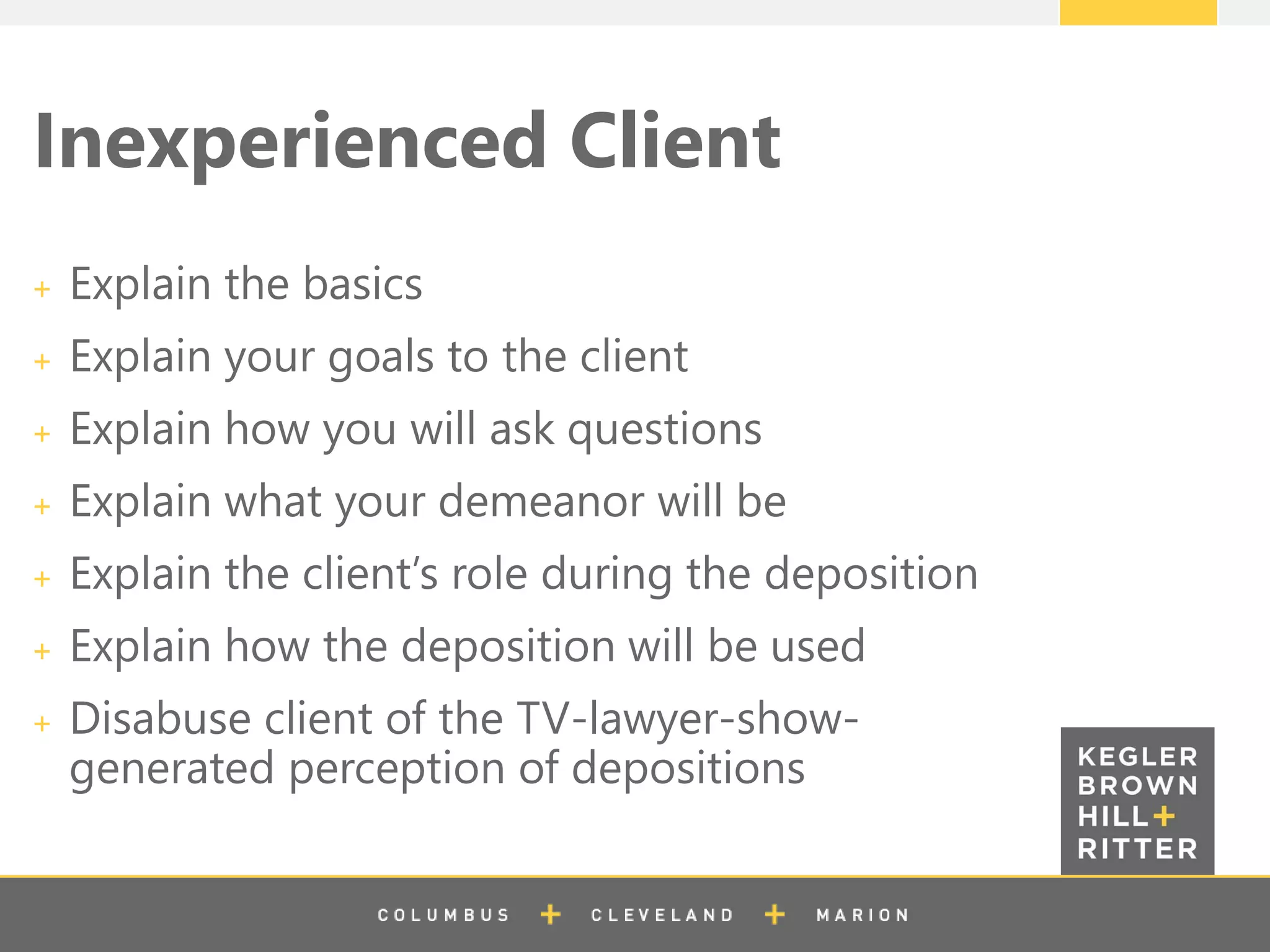
Inexperienced Client
Explain the basics
Explain your goals to the client
Explain how you will ask questions
Explain what your demeanor will be
Explain the client’s role during the deposition
Explain how the deposition will be used
Disabuse client of the TV-lawyer-show-
generated perception of depositions
z
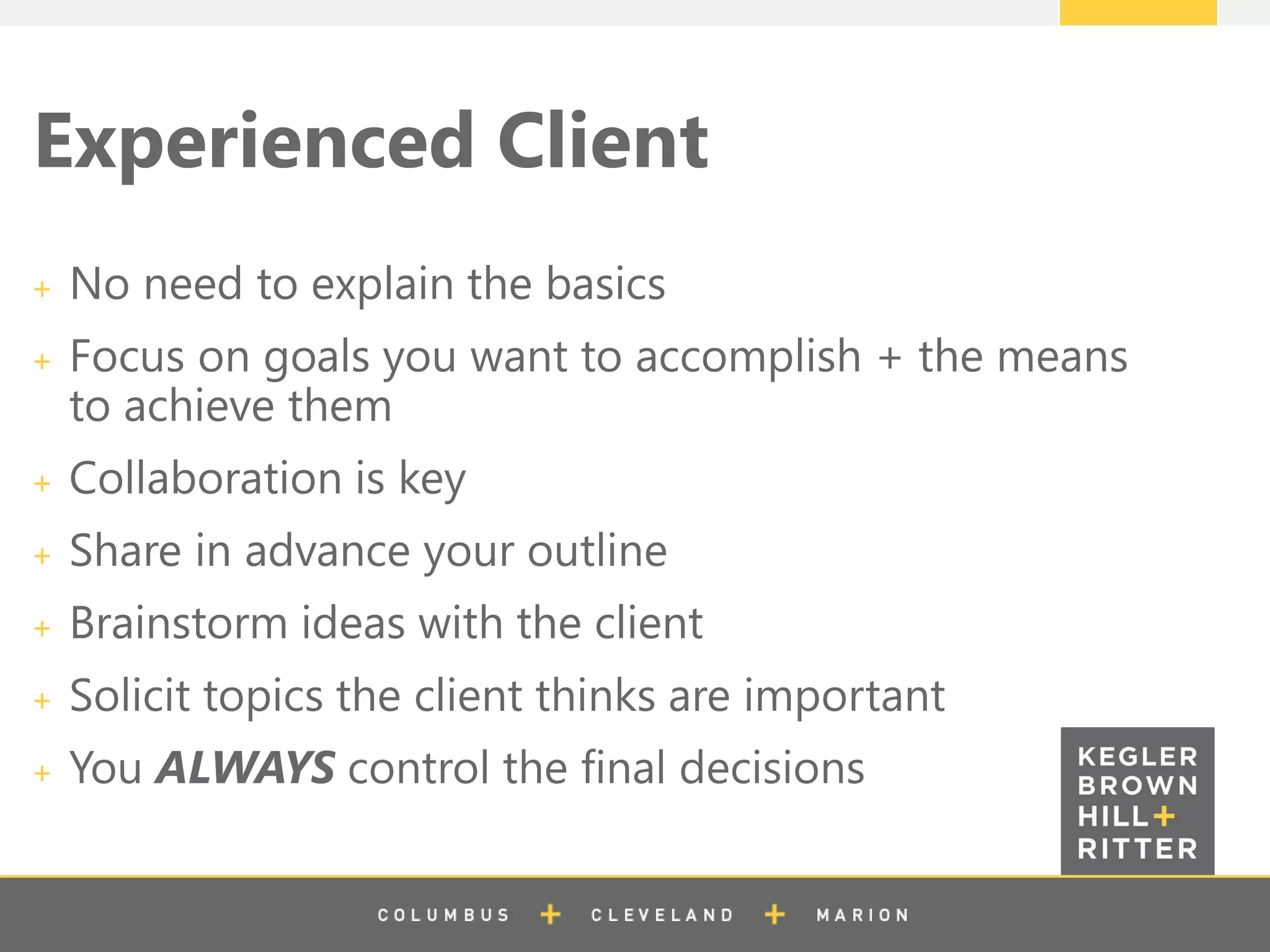
Experienced Client
No need to explain the basics
Focus on goals you want to accomplish + the means
to achieve them
Collaboration is key
Share in advance your outline
Brainstorm ideas with the client
Solicit topics the client thinks are important
You ALWAYS control the final decisions
z
DEFENDING
Managing Client
Expectations when
a Deposition
z
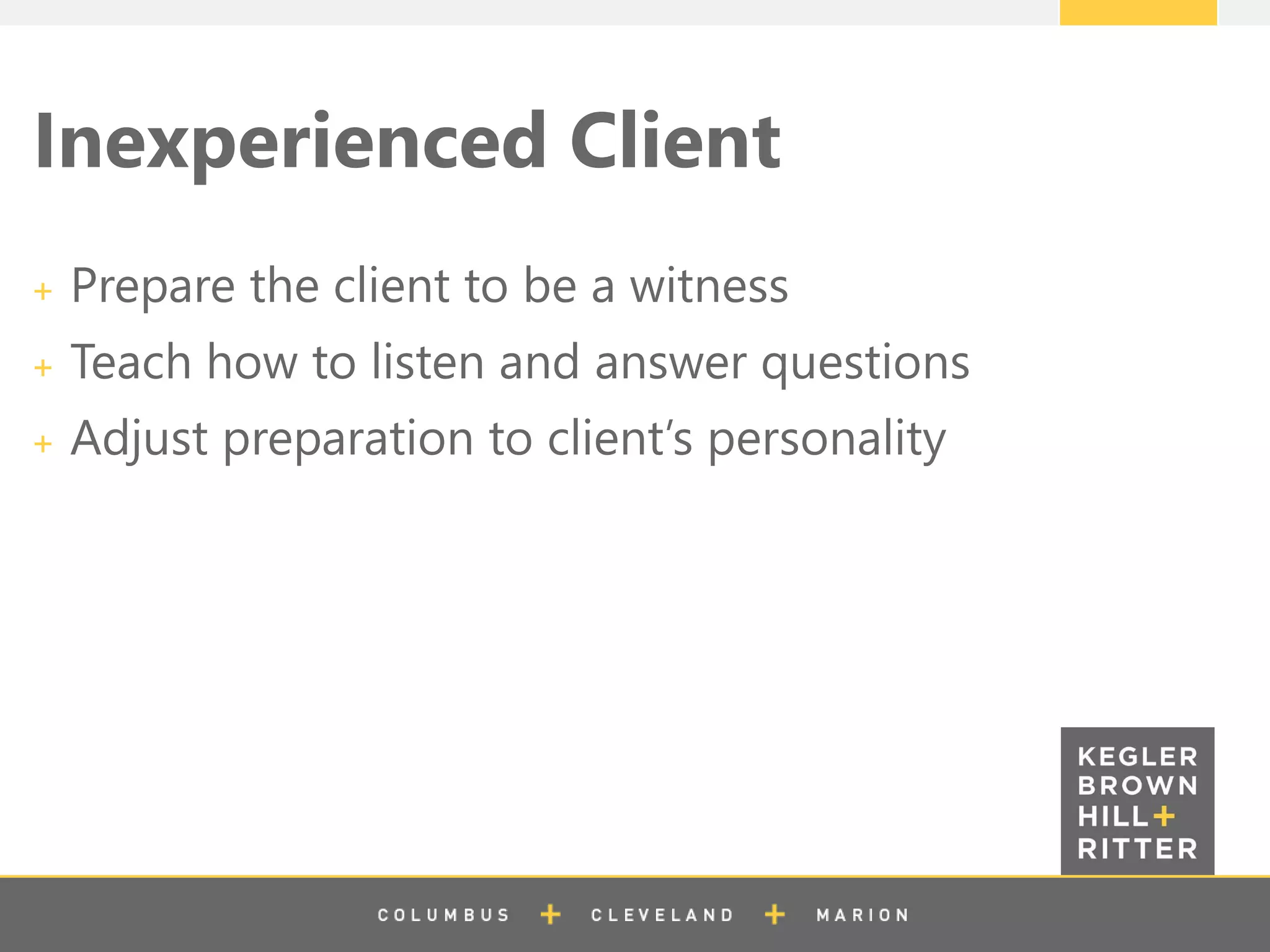
Inexperienced Client
Prepare the client to be a witness
Teach how to listen and answer questions
Adjust preparation to client’s personality
z
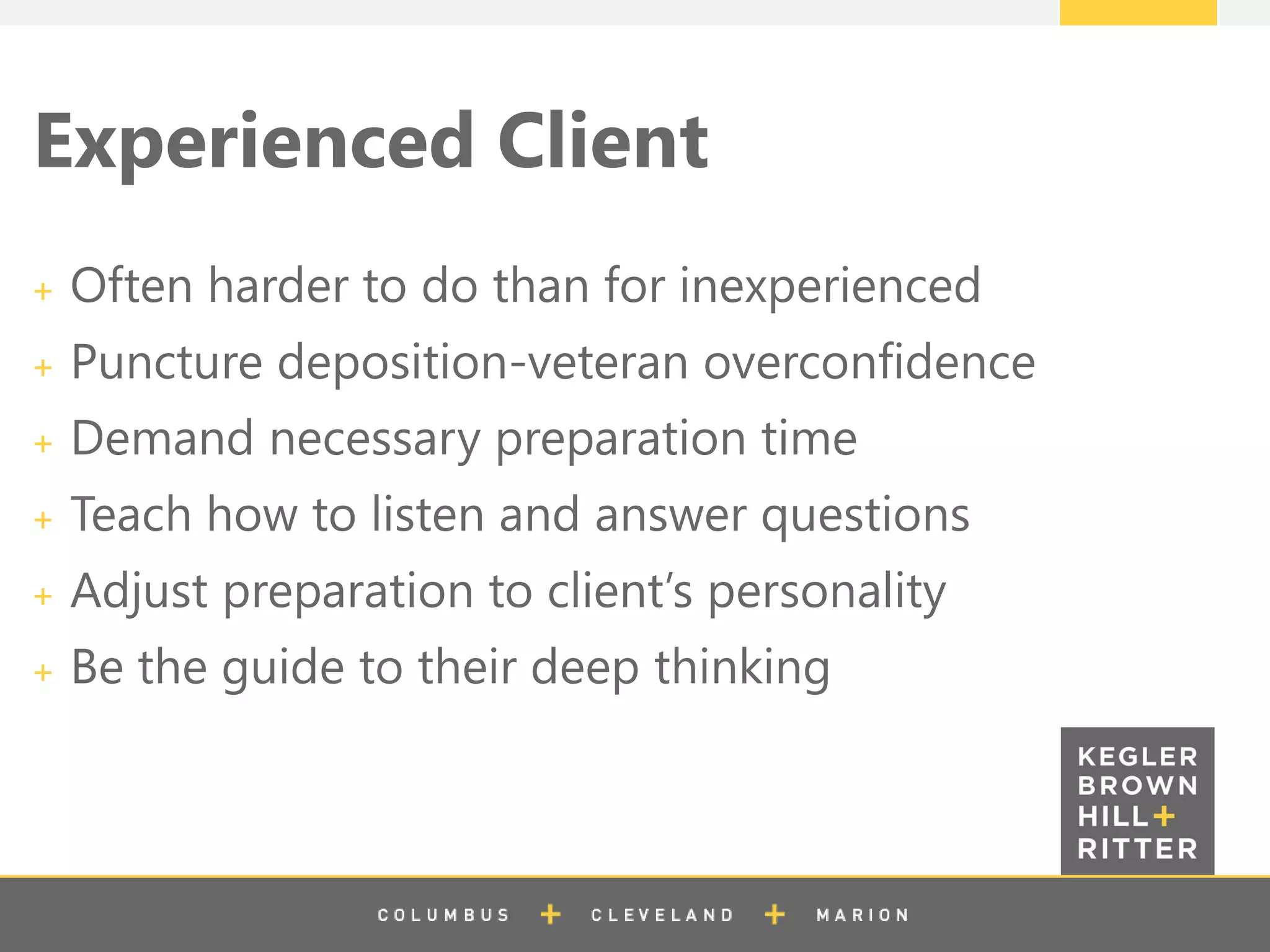
Experienced Client
Often harder to do than for inexperienced
Puncture deposition-veteran overconfidence
Demand necessary preparation time
Teach how to listen and answer questions
Adjust preparation to client’s personality
Be the guide to their deep thinking
z
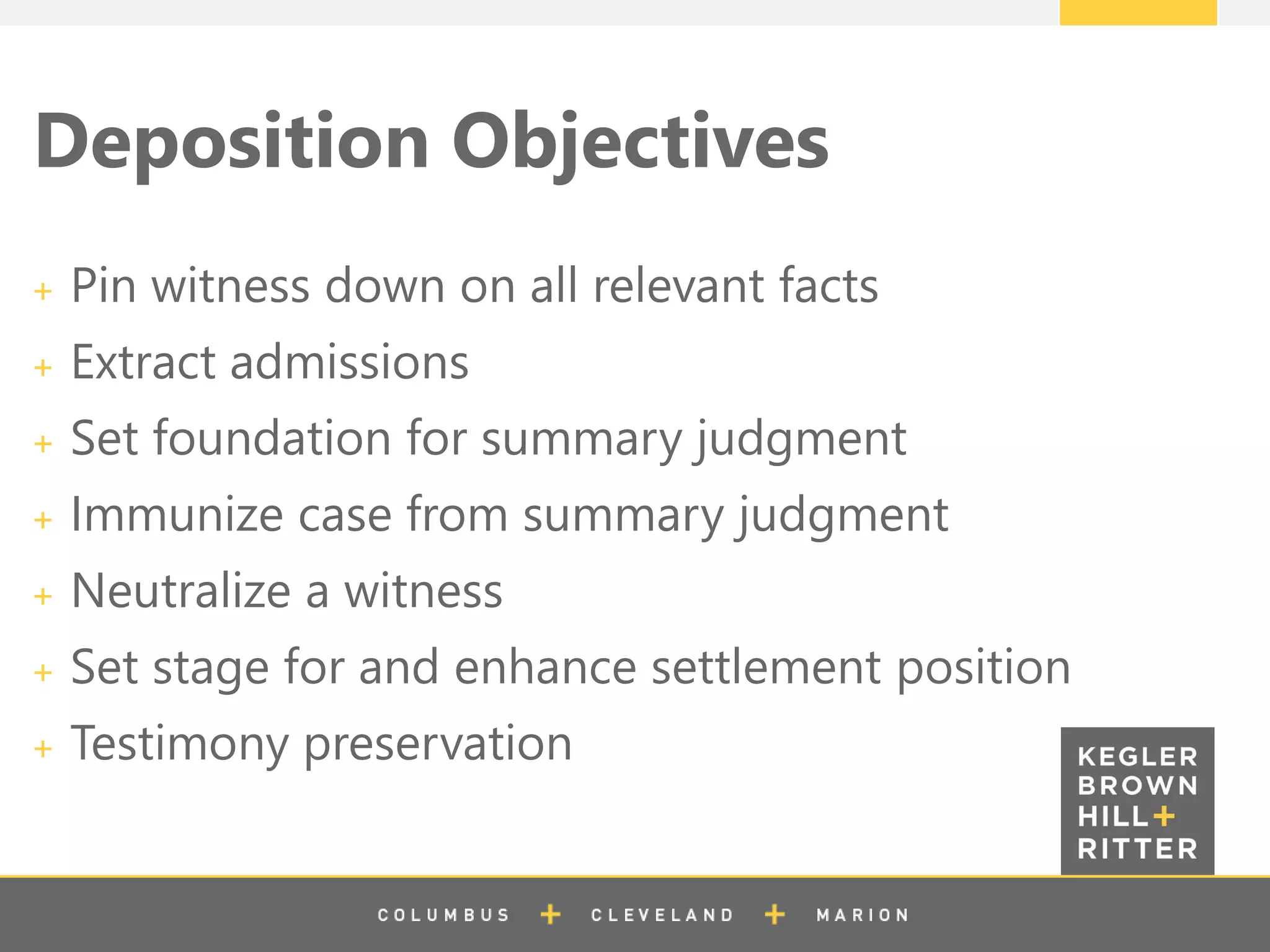
Deposition Objectives
Pin witness down on all relevant facts
Extract admissions
Set foundation for summary judgment
Immunize case from summary judgment
Neutralize a witness
Set stage for and enhance settlement position
Testimony preservation
z
Acquiring + Organizing
Documentary Evidence
Get all relevant documents in advance, unless
circumstances dictate otherwise
Now almost always electronic
Organization: Critical to have computerized data
management system
Read, discuss with client
Reread + Repeat
Don’t rest until you thoroughly understand
z
Sequence of Questions +
Overall Plan for Questioning
Preparing an outline – good but not good enough
Write out in detail every single question you intend to ask
It will expose the missing pieces
It will force you to think about sequence
Ideas explode from the computer as you do this
It is the intense, deep thinking that is critical to success
CAUTION: Do not become tethered
to your question list!
z
The Great Deposition
Art of a great deposition is being thoroughly prepared
Know exactly where you intend to go
Know exactly what you intend to ask
Know exactly how you intend to ask it
Listen carefully to the answers.
Be prepared to seize the moment
z
Parties, Non-Parties, + Experts
Parties v. non-parties = privilege v. no privilege
Communications between attorney and testifying expert
FRCP 26(a)(2) and 26(b)(4)(c): Mostly privileged
ORCP 26(B)(5)(c) and (d): Mostly privileged
If no privilege, be careful what you say
z
PREPARING
for Expert Deposition
z
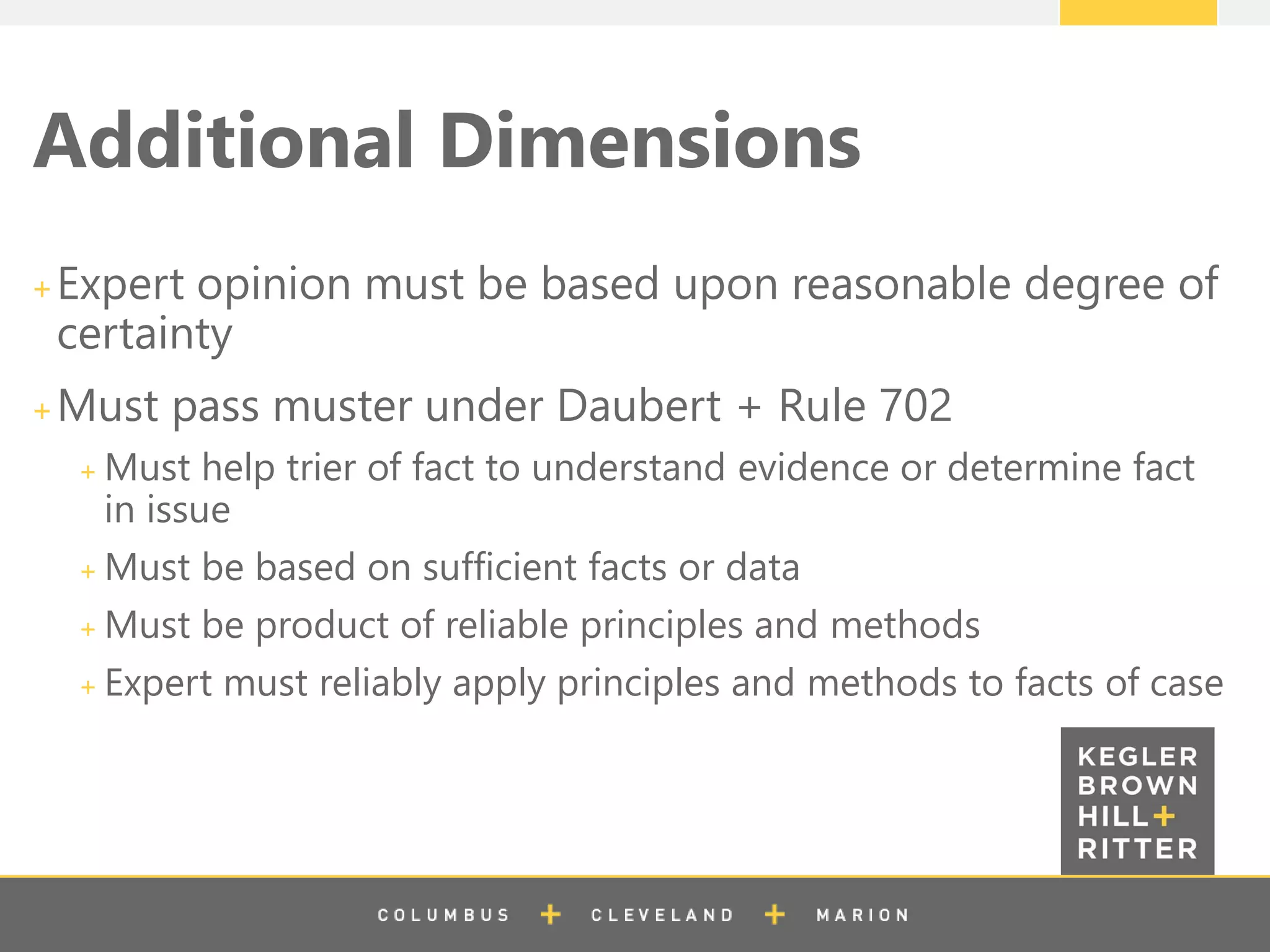
Additional Dimensions
Expert opinion must be based upon reasonable degree of
certainty
Must pass muster under Daubert + Rule 702
Must help trier of fact to understand evidence or determine fact
in issue
Must be based on sufficient facts or data
Must be product of reliable principles and methods
Expert must reliably apply principles and methods to facts of case
z
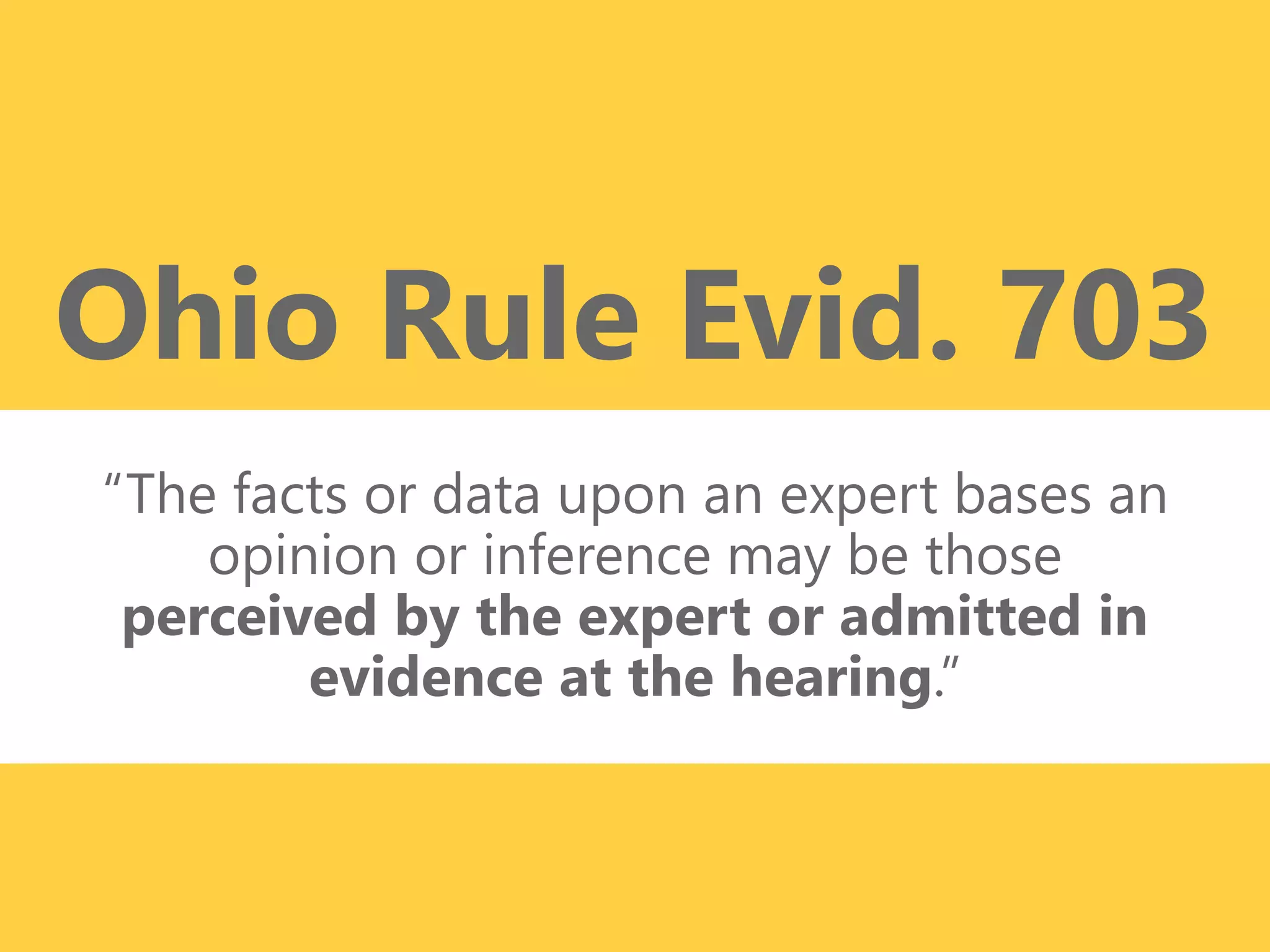
“The facts or data upon an expert bases an
opinion or inference may be those
perceived by the expert or admitted in
evidence at the hearing.”
Ohio Rule Evid. 703
z
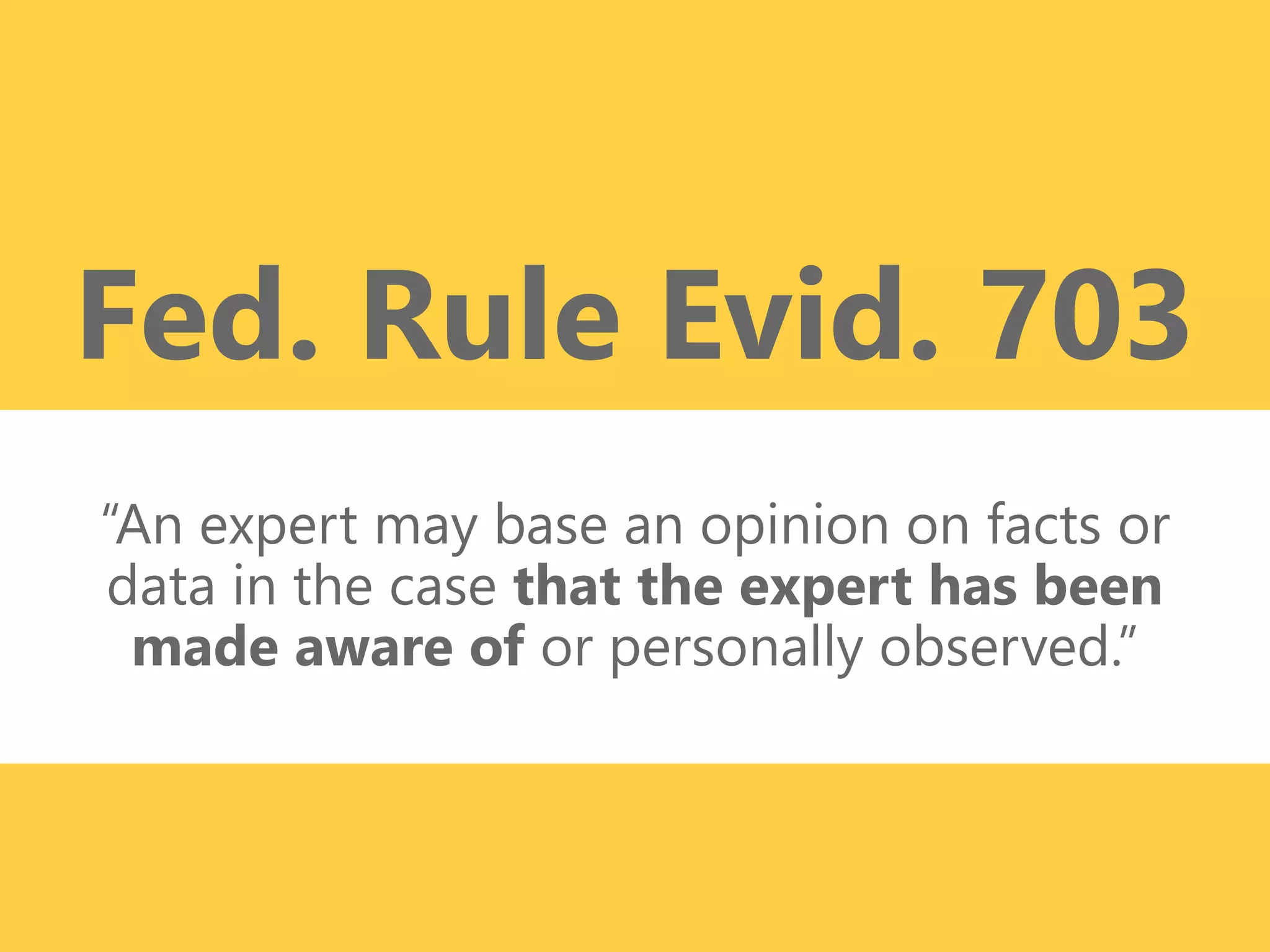
“An expert may base an opinion on facts or
data in the case that the expert has been
made aware of or personally observed.”
Fed. Rule Evid. 703
z
Taking Expert Deposition
Get the report; study it; review with your expert
Cannot discover drafts (FRCP 26(b)(4)(B); ORCP 26(B)(5)(c))
Get prior deposition testimony
If any doubt re expertise, prepare questions to explore
and challenge
Extract all facts on which expert’s opinion based
Extract admissions – you will be surprised
Learned treatises: Suggest them or ask for them
z
Defending Expert Deposition
Teach the expert how to answer questions
Anticipate other side’s questions
Grill your own expert
Make your expert’s preparation harder than the
deposition
Challenge every assumption
Make the expert defend every conclusion
Examine + prepare him to defend every
element of Evidence Rule 702
z
But my case is
too small…
z
No, it’s Not.
If the case is smaller
Documents are likely to be fewer
Breadth of events are likely to be narrower
If not, you must do what you must do
For your client – it is your duty
For yourself – it is how you build a reputation
z
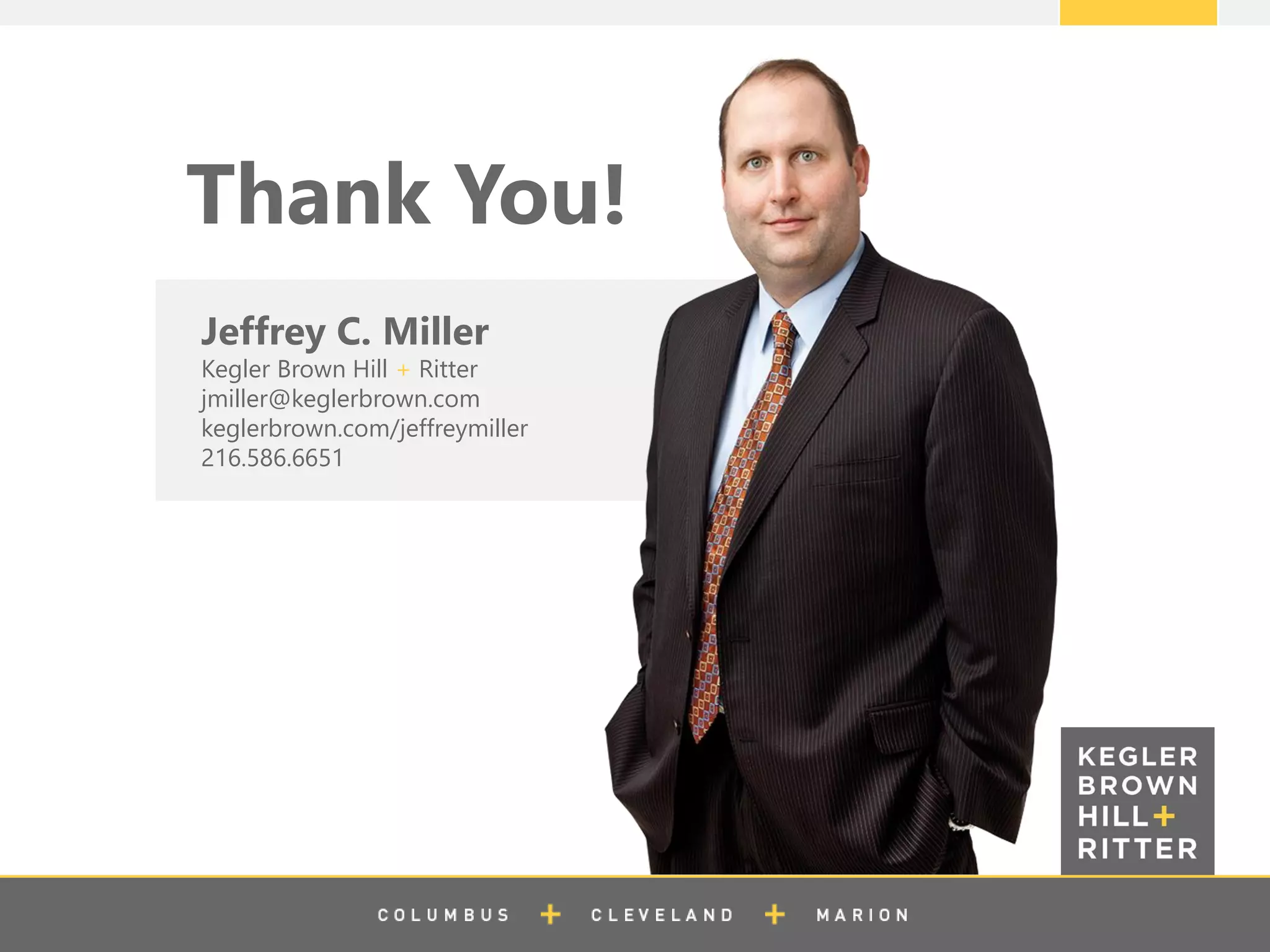
Thank You!
Jeffrey C. Miller
Kegler Brown Hill + Ritter
jmiller@keglerbrown.com
keglerbrown.com/jeffreymiller
216.586.6651

Preparing Yourself to Conduct or Defend a Deposition

  • 1.
    z Preparing Yourself to Conductor Defend a Deposition presented by Jeffrey C. Miller June 25, 2015
  • 2.
  • 3.
    z Inexperienced Client Explain thebasics Explain your goals to the client Explain how you will ask questions Explain what your demeanor will be Explain the client’s role during the deposition Explain how the deposition will be used Disabuse client of the TV-lawyer-show- generated perception of depositions
  • 4.
    z Experienced Client No needto explain the basics Focus on goals you want to accomplish + the means to achieve them Collaboration is key Share in advance your outline Brainstorm ideas with the client Solicit topics the client thinks are important You ALWAYS control the final decisions
  • 5.
  • 6.
    z Inexperienced Client Prepare theclient to be a witness Teach how to listen and answer questions Adjust preparation to client’s personality
  • 7.
    z Experienced Client Often harderto do than for inexperienced Puncture deposition-veteran overconfidence Demand necessary preparation time Teach how to listen and answer questions Adjust preparation to client’s personality Be the guide to their deep thinking
  • 8.
    z Deposition Objectives Pin witnessdown on all relevant facts Extract admissions Set foundation for summary judgment Immunize case from summary judgment Neutralize a witness Set stage for and enhance settlement position Testimony preservation
  • 9.
    z Acquiring + Organizing DocumentaryEvidence Get all relevant documents in advance, unless circumstances dictate otherwise Now almost always electronic Organization: Critical to have computerized data management system Read, discuss with client Reread + Repeat Don’t rest until you thoroughly understand
  • 10.
    z Sequence of Questions+ Overall Plan for Questioning Preparing an outline – good but not good enough Write out in detail every single question you intend to ask It will expose the missing pieces It will force you to think about sequence Ideas explode from the computer as you do this It is the intense, deep thinking that is critical to success CAUTION: Do not become tethered to your question list!
  • 11.
    z The Great Deposition Artof a great deposition is being thoroughly prepared Know exactly where you intend to go Know exactly what you intend to ask Know exactly how you intend to ask it Listen carefully to the answers. Be prepared to seize the moment
  • 12.
    z Parties, Non-Parties, +Experts Parties v. non-parties = privilege v. no privilege Communications between attorney and testifying expert FRCP 26(a)(2) and 26(b)(4)(c): Mostly privileged ORCP 26(B)(5)(c) and (d): Mostly privileged If no privilege, be careful what you say
  • 13.
  • 14.
    z Additional Dimensions Expert opinionmust be based upon reasonable degree of certainty Must pass muster under Daubert + Rule 702 Must help trier of fact to understand evidence or determine fact in issue Must be based on sufficient facts or data Must be product of reliable principles and methods Expert must reliably apply principles and methods to facts of case
  • 15.
    z “The facts ordata upon an expert bases an opinion or inference may be those perceived by the expert or admitted in evidence at the hearing.” Ohio Rule Evid. 703
  • 16.
    z “An expert maybase an opinion on facts or data in the case that the expert has been made aware of or personally observed.” Fed. Rule Evid. 703
  • 17.
    z Taking Expert Deposition Getthe report; study it; review with your expert Cannot discover drafts (FRCP 26(b)(4)(B); ORCP 26(B)(5)(c)) Get prior deposition testimony If any doubt re expertise, prepare questions to explore and challenge Extract all facts on which expert’s opinion based Extract admissions – you will be surprised Learned treatises: Suggest them or ask for them
  • 18.
    z Defending Expert Deposition Teachthe expert how to answer questions Anticipate other side’s questions Grill your own expert Make your expert’s preparation harder than the deposition Challenge every assumption Make the expert defend every conclusion Examine + prepare him to defend every element of Evidence Rule 702
  • 19.
    z But my caseis too small…
  • 20.
    z No, it’s Not. Ifthe case is smaller Documents are likely to be fewer Breadth of events are likely to be narrower If not, you must do what you must do For your client – it is your duty For yourself – it is how you build a reputation
  • 21.
    z Thank You! Jeffrey C.Miller Kegler Brown Hill + Ritter jmiller@keglerbrown.com keglerbrown.com/jeffreymiller 216.586.6651