Practical Tips for Effective Expert Planner TestimonyPresented by:Christopher P. Benvenuto, Esq.Collene W. Walter, ASLA, AICP, LEED APAPA Florida ConferenceThe Breakers, Palm BeachSeptember 8, 20111
Introduction/Background of PresentersChristopher P. Benvenuto, Gunster (WPB)Shareholder/AttorneyLand Use Litigation, Property Rights Litigation, and Commercial LitigationJ.D., M.S. in Real Estate, B.S.B.A, University of FloridaCollene W. Walter, Urban Design Kilday Studios (WPB)Principal PlannerASLA, AICP, LEED APB.A. in Landscape Architecture, Cornell University; M.A. in Urban and Regional Planning, Florida Atlantic University2
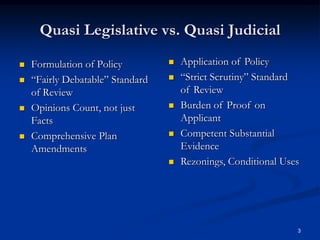
Quasi Legislative vs. Quasi JudicialApplication of Policy“Strict Scrutiny” Standard of ReviewBurden of Proof on ApplicantCompetent Substantial EvidenceRezonings, Conditional UsesFormulation of Policy“Fairly Debatable” Standard of ReviewOpinions Count, not just FactsComprehensive Plan Amendments3
Quasi-Judicial HearingsDistinction between Planner as Agent of Applicant, and Planner as Expert WitnessPreparation is Key to a Successful PresentationPresenting Competent Substantial Evidence to support RequestImportance of Creating a Record to Setup AppealCross Examination – Rare, but be PreparedPractical Tips for Helpful Preparation4
Overview of the Land Development Process from Application to LitigationApplication Review by administrative staffPublic quasi-judicial hearing before local commission/boardAppeals - administrative/circuit court challengesLitigation – filing of petition/complaintWritten discovery and document requestsDepositionsTrial5
LitigationOverview of Litigation ProcessPreparation of Expert ReportsWritten discoveryDepositionsTrial6
Litigation:  Preparing Expert ReportsPractical Considerations when Preparing Expert ReportsBe careful what you write:  Your words may come back later to haunt you!Data and AssumptionsFaulty assumptions in a report will likely be exposed in deposition and undermine your credibility at trialBe careful of not only what you relied upon, but what you may have failed to considerQuality Control and Proofreading Report should be clear and understandable to the reader – not just you7
Litigation:  Discovery and DepositionsOverview of Discovery ProcessWritten Discovery/Subpoena Duces Tecum – sample request:“All documents (including drafts), including but not limited to computer files which have not been printed and put in your files, in your possession or control relating to the above captioned lawsuit, prepared and/or reviewed by you, including legal instructions, memoranda, ledgers, surveys, manuals, laws, ordinances, regulations, plans, reports, studies, sketches, renderings, site plans, photographs, videos, appraisals, data book(s), comparable sales data, costs estimates, documentation relating to proposed and potential cures, reports of other individuals and experts and all other documents and tangible items that you have considered or relied upon in this case.”What you reviewed or did not review is relevant.8
Preparing for DepositionsDiffering approaches between “fact witness” depositions and “expert witness” depositionsWhat to Expect at a depositionWhat you can and can’t rely uponThoroughly review any expert reports you drafted and be prepared to defend your assumptions and conclusionsThis includes what you considered, what you didn’t consider, and why you didn’t consider itAttorney’s Goal in Deposition: Paint you in a corner, and lock in your testimony for trial.9
Practical Tips in Preparing for Your DepositionAlways tell the truth!Act like the Professional that you areRelax and take your timeRemember your testimony will be transcribed – you are creating a record Sarcastic responses and jokes do not translate well on paperDon’t answer a question you don’t understand.  Ask to rephrase.Don’t speculate.  If you don’t remember, you don’t remember.Do not volunteer information.  Make the attorney draw it out of you.  If he or she doesn’t, that’s their problem.10
Preparing to Testify in CourtOverview of examination process at trial (direct, cross, re-direct)Different approaches for Direct and Cross ExamKnow your audience (Judge or Jury)Your role is to provide specialized expertise and educate the judge or jury11
Strategies for Effective Testimony on Direct ExamPreparation with attorneysDirect testimony should play like an informative conversation, not like a scriptDo NOT just memorize questions and answersIt’s ok to rehearse general topics and anticipated responses ahead of timeRemember, the goal is not just to answer the attorney’s question, but to educate the judge or jury.  Make sure the lay person can understand the issue and your answer.Perspectives from an expert witness testifying on directPerspectives from an attorney examining a witness on direct12
Strategies for Effective Testimony on Cross ExamReview your deposition testimony ahead of trial and know what you previously testified to.  If you try coming up with a different answer that contradicts prior testimony, you will likely be impeached and lose credibility with a judge or jury.Answer only what is asked of you.   If you need to supplement or further explain your answer, consider whether to do so on cross or re-direct.Don’t be afraid to ask opposing counsel to re-phrase a question or clarify a question if it is ambiguous, overly presumptuous, or mischaracterizes facts or your prior testimony.There will be an opportunity for opposing counsel to object to improperly phrased questions.Consider having someone do a mock cross exam of you in advance.Think of toughest questions possible and how you would answer and explain them.13
Strategies for Effective Testimony on Cross Exam (cont.)Dealing with questions where the answer may be harmful to your caseDon’t shy away from admitting to harmful information – if opposing counsel has to slowly drag it out of you, it may look worse than if you confronted it head on (“softening the blow”)  Can the answer be explained away?If so, you may wish to provide an explanation on cross, or just save for re-direct. (usually, the attorney will decide in advance)It’s not the end of the world to concede a point.If you take an irrational position just to avoid conceding a point, you will lose credibility with the judge or jury.Perspectives from an expert witness being cross-examinedPerspectives from a cross-examining attorney14
Communicating with Clients and AttorneysWhat is privileged and what is not?Different types of communications – face to face meetings, phone calls, faxes, letters, e-mailBE CAREFUL of casual conversational use of e-mails.  They are traditionally, the most damning form of evidence.Communications during the application process may later be discoverable if the matter goes to litigation, so be careful with casual writings.Example:  Contractual provision providing right to cancel an agreement if permits are not likely to be obtained by a certain date.Recommended best practices15
Communicating with Government AgenciesPublic Records and Applications What you send to local governments is all public recordPublic record requests (typically in litigation context)Be careful with e-mail “conversations” with municipalities and government agencies.16
Questions?17

9/8 THUR 16:00 | Practical Tips for Effective Expert Planning Testimony

  • 1.
    Practical Tips forEffective Expert Planner TestimonyPresented by:Christopher P. Benvenuto, Esq.Collene W. Walter, ASLA, AICP, LEED APAPA Florida ConferenceThe Breakers, Palm BeachSeptember 8, 20111
  • 2.
    Introduction/Background of PresentersChristopherP. Benvenuto, Gunster (WPB)Shareholder/AttorneyLand Use Litigation, Property Rights Litigation, and Commercial LitigationJ.D., M.S. in Real Estate, B.S.B.A, University of FloridaCollene W. Walter, Urban Design Kilday Studios (WPB)Principal PlannerASLA, AICP, LEED APB.A. in Landscape Architecture, Cornell University; M.A. in Urban and Regional Planning, Florida Atlantic University2
  • 3.
    Quasi Legislative vs.Quasi JudicialApplication of Policy“Strict Scrutiny” Standard of ReviewBurden of Proof on ApplicantCompetent Substantial EvidenceRezonings, Conditional UsesFormulation of Policy“Fairly Debatable” Standard of ReviewOpinions Count, not just FactsComprehensive Plan Amendments3
  • 4.
    Quasi-Judicial HearingsDistinction betweenPlanner as Agent of Applicant, and Planner as Expert WitnessPreparation is Key to a Successful PresentationPresenting Competent Substantial Evidence to support RequestImportance of Creating a Record to Setup AppealCross Examination – Rare, but be PreparedPractical Tips for Helpful Preparation4
  • 5.
    Overview of theLand Development Process from Application to LitigationApplication Review by administrative staffPublic quasi-judicial hearing before local commission/boardAppeals - administrative/circuit court challengesLitigation – filing of petition/complaintWritten discovery and document requestsDepositionsTrial5
  • 6.
    LitigationOverview of LitigationProcessPreparation of Expert ReportsWritten discoveryDepositionsTrial6
  • 7.
    Litigation: PreparingExpert ReportsPractical Considerations when Preparing Expert ReportsBe careful what you write: Your words may come back later to haunt you!Data and AssumptionsFaulty assumptions in a report will likely be exposed in deposition and undermine your credibility at trialBe careful of not only what you relied upon, but what you may have failed to considerQuality Control and Proofreading Report should be clear and understandable to the reader – not just you7
  • 8.
    Litigation: Discoveryand DepositionsOverview of Discovery ProcessWritten Discovery/Subpoena Duces Tecum – sample request:“All documents (including drafts), including but not limited to computer files which have not been printed and put in your files, in your possession or control relating to the above captioned lawsuit, prepared and/or reviewed by you, including legal instructions, memoranda, ledgers, surveys, manuals, laws, ordinances, regulations, plans, reports, studies, sketches, renderings, site plans, photographs, videos, appraisals, data book(s), comparable sales data, costs estimates, documentation relating to proposed and potential cures, reports of other individuals and experts and all other documents and tangible items that you have considered or relied upon in this case.”What you reviewed or did not review is relevant.8
  • 9.
    Preparing for DepositionsDifferingapproaches between “fact witness” depositions and “expert witness” depositionsWhat to Expect at a depositionWhat you can and can’t rely uponThoroughly review any expert reports you drafted and be prepared to defend your assumptions and conclusionsThis includes what you considered, what you didn’t consider, and why you didn’t consider itAttorney’s Goal in Deposition: Paint you in a corner, and lock in your testimony for trial.9
  • 10.
    Practical Tips inPreparing for Your DepositionAlways tell the truth!Act like the Professional that you areRelax and take your timeRemember your testimony will be transcribed – you are creating a record Sarcastic responses and jokes do not translate well on paperDon’t answer a question you don’t understand. Ask to rephrase.Don’t speculate. If you don’t remember, you don’t remember.Do not volunteer information. Make the attorney draw it out of you. If he or she doesn’t, that’s their problem.10
  • 11.
    Preparing to Testifyin CourtOverview of examination process at trial (direct, cross, re-direct)Different approaches for Direct and Cross ExamKnow your audience (Judge or Jury)Your role is to provide specialized expertise and educate the judge or jury11
  • 12.
    Strategies for EffectiveTestimony on Direct ExamPreparation with attorneysDirect testimony should play like an informative conversation, not like a scriptDo NOT just memorize questions and answersIt’s ok to rehearse general topics and anticipated responses ahead of timeRemember, the goal is not just to answer the attorney’s question, but to educate the judge or jury. Make sure the lay person can understand the issue and your answer.Perspectives from an expert witness testifying on directPerspectives from an attorney examining a witness on direct12
  • 13.
    Strategies for EffectiveTestimony on Cross ExamReview your deposition testimony ahead of trial and know what you previously testified to. If you try coming up with a different answer that contradicts prior testimony, you will likely be impeached and lose credibility with a judge or jury.Answer only what is asked of you. If you need to supplement or further explain your answer, consider whether to do so on cross or re-direct.Don’t be afraid to ask opposing counsel to re-phrase a question or clarify a question if it is ambiguous, overly presumptuous, or mischaracterizes facts or your prior testimony.There will be an opportunity for opposing counsel to object to improperly phrased questions.Consider having someone do a mock cross exam of you in advance.Think of toughest questions possible and how you would answer and explain them.13
  • 14.
    Strategies for EffectiveTestimony on Cross Exam (cont.)Dealing with questions where the answer may be harmful to your caseDon’t shy away from admitting to harmful information – if opposing counsel has to slowly drag it out of you, it may look worse than if you confronted it head on (“softening the blow”) Can the answer be explained away?If so, you may wish to provide an explanation on cross, or just save for re-direct. (usually, the attorney will decide in advance)It’s not the end of the world to concede a point.If you take an irrational position just to avoid conceding a point, you will lose credibility with the judge or jury.Perspectives from an expert witness being cross-examinedPerspectives from a cross-examining attorney14
  • 15.
    Communicating with Clientsand AttorneysWhat is privileged and what is not?Different types of communications – face to face meetings, phone calls, faxes, letters, e-mailBE CAREFUL of casual conversational use of e-mails. They are traditionally, the most damning form of evidence.Communications during the application process may later be discoverable if the matter goes to litigation, so be careful with casual writings.Example: Contractual provision providing right to cancel an agreement if permits are not likely to be obtained by a certain date.Recommended best practices15
  • 16.
    Communicating with GovernmentAgenciesPublic Records and Applications What you send to local governments is all public recordPublic record requests (typically in litigation context)Be careful with e-mail “conversations” with municipalities and government agencies.16
  • 17.