IN THE WORLD OF FILMMAKING
PREPARATION IS KEY
GOOD PLANNING IS THE FOUNDATION OF
SUCCESS.
THERE IS NO GUESSING OR LUCK
INVOLVED.
YOU CANNOT BE FULLY CREATIVE
IF YOU ARE NOT FULLY ORGANISED...
Filmmaking is made up of different creative processes:
Script writing
Storyboarding
Test shooting
Shooting
Editing
STEP 1: WRITING YOUR SCRIPT
You should write your ideas down –
don’t rely on memory.
Write it down in a simple way –
actions and emotions.
STEP 1: WRITING YOUR SCRIPT
A male student is at college. The student is listening to music on his headphones as he
walks across the car park with his bike. He chains up his bike and fixes his bag over his
shoulder, holding it carefully.
The bell rings in college and students start to disperse to their lessons. The bell doesn't
appear to distract this student. Instead, with his eyes fixed and headphones still on, he
heads towards the quadrangle, walking in the opposite direction to other students.
Other students glance over their shoulder with a confused look, wondering where he is
going. He continues to walk across the quadrangle - staring ahead of himself.
Suddenly he stops dead in his tracks, almost freezing. There appears to be nobody visible
around him. He pulls down his headphones slowly and brings his bag around to his
front, while continuing to stare forward. He calmly reaches into his bag. We see one
final look of his stare, before he closes his eyes tightly shut.
END OF SCENE.
STEP 1: WRITING YOUR SCRIPT
EXT. - COLLEGE CAR PARK – DAY
A male student is at college.
INT. - BEDROOM – NIGHT
The student is in his bedroom.
etc.
STEP 2: WALK THROUGH
Walk through your script. Act it out.
If possible, do it on location.
Will help you identify any problems with script
/any problems with the potential locations.
You will learn more about the potential
successes or failures of your project. Find the
problems early!
STEP 3: DIGITAL STORYBOARD
Take a variety of different frames, angles and shot
types.
Print them or put them on your phones as reference
for filming.
STEP 4: SHOT LIST
ALWAYS have a shot list.
Annotate your script.
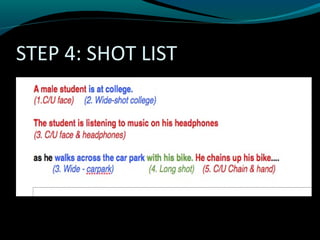
STEP 4: SHOT LIST
STEP 4: SHOT LIST
Front of college:
3. Wide shot of college
Car park:
1. CU of face
2. CU face and headphones
4. Long shot bike
5. C/U Chain and hand
etc....
STEP 7:SHOOTING SCHEDULE
Organise your shooting day/time.
What restrictions do you have?
If you are organised – you can shoot on
time...and possibly shoot more
(more options when editing).
STEP 7: SHOOTING SCHEDULE
10.00 Pick up equipment. Everyone meet at Johns house.
10.30 Leave Johns. Go to LOCATION 1: The Park.
10.45 -11.30 Shoot ‘playground’ location (map 1)
Shots 3,4,7,12,14
11.30 - 13.00 Shooting ‘forest’ location (map 3)
Shots 1,2,5,24
13.00 Travel to LOCATION 4: Claybury Fields
13.30 - 14.30 Shooting by the canal. (map 2).
Shots 16-21. .
Mark Scheme
There is evidence of excellence in the creative use of most of the
following technical skills:
holding a shot steady
framing a shot, including and excluding elements as
appropriate;
using a variety of shot distances as appropriate;
selecting mise-en-scène including colour, figure, lighting,
objects and setting;
editing so that meaning is apparent to the viewer;
using varied shot transitions and other effects selectively and
appropriately for the task set;
 using sound with images and editing appropriately for the task
set;
using titles and production logo appropriately.
Conventions
Production Logo Titles entering appropriate to
atmosphere:
http://www.youtube.com/watch?v=20EO4XMBQgM&featur
http://www.youtube.com/watch?v=d01wQVRJcqY&feature=r
http://thrillerproject.blogspot.co.uk/search/label/Student%2
Fits the conventions of a thriller genre
Advice
Use additional lighting
Shoot more footage than you think you need (approx
1 hour)
Shoot from a variety of camera angles (levels)
Start shooting before action
Take shots of randomly connected images
Take advantage of training sessions
Use youtube for tutorials (After Effects and Final Cut)
Editing can’t compensate for poor footage
Lighting hardest to get right
Need everyone’s phone numbers
Use adventurous camera angles
Experiment!
Re-shoot, re-shoot
Take ‘filler’ shots
Get the mood right
Simple storyline
Choose music first – take storyboard/ music along
Guide to filming
Poor planning
Group lets you down
Too ambitious
Silly friends
Miss the beginning of footage
Things that often go wrong
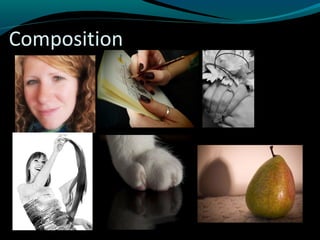
Composition
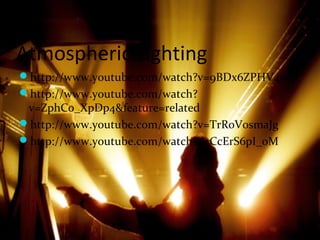
Atmospheric Lighting
http://www.youtube.com/watch?v=9BDx6ZPHV4w
http://www.youtube.com/watch?
v=ZphC0_XpDp4&feature=related
http://www.youtube.com/watch?v=TrRoV0smaJg
http://www.youtube.com/watch?v=CcErS6pI_0M
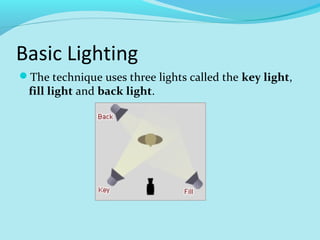
Basic Lighting
The technique uses three lights called the key light,
fill light and back light.
Key Light
This is the main light. It is usually the strongest and has
the most influence on the look of the scene. It is
placed to one side of the camera/subject so that this
side is well lit and the other side has some shadow.
Fill Light
This is the secondary light and is placed on the opposite
side of the key light. It is used to fill the shadows
created by the key. The fill will usually be softer and
less bright than the key. To acheive this, you could
move the light further away.
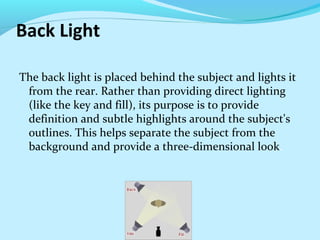
Back Light
The back light is placed behind the subject and lights it
from the rear. Rather than providing direct lighting
(like the key and fill), its purpose is to provide
definition and subtle highlights around the subject's
outlines. This helps separate the subject from the
background and provide a three-dimensional look.
Getting Creative
Removing the fill light is a great way to intentionally
leave shadows on the subjects face.You could also
choose to use only the back light, turning your
subjects into silhouettes.
Smoke
Water
Other creative ideas....
Candle Light
If you want to set a romantic mood, either inside or
out, candles can help you achieve it. Use a variety of
candles to create interest.
Christmas Lights
Chinese lanterns
Lots of lamps
Colour Gels
Torches
http://www.youtube.com/watch?v=-cQkzuXkID0
Titles
Cooltext http://cooltext.com/
Swish max http://www.youtube.com/watch?
v=OoCHFQ1rVpE&feature=related
Other editing effects
Chroma Key
http://www.youtube.com/user/hurtwoodhousemedia
#p/u/109/nYUQS7DK8jc
Black and white (lighting)
http://www.youtube.com/watch?v=TzsoU254zBU
Preparing for filming

Preparing for filming

  • 2.
    IN THE WORLDOF FILMMAKING PREPARATION IS KEY GOOD PLANNING IS THE FOUNDATION OF SUCCESS.
  • 3.
    THERE IS NOGUESSING OR LUCK INVOLVED. YOU CANNOT BE FULLY CREATIVE IF YOU ARE NOT FULLY ORGANISED...
  • 4.
    Filmmaking is madeup of different creative processes: Script writing Storyboarding Test shooting Shooting Editing
  • 5.
    STEP 1: WRITINGYOUR SCRIPT You should write your ideas down – don’t rely on memory. Write it down in a simple way – actions and emotions.
  • 6.
    STEP 1: WRITINGYOUR SCRIPT A male student is at college. The student is listening to music on his headphones as he walks across the car park with his bike. He chains up his bike and fixes his bag over his shoulder, holding it carefully. The bell rings in college and students start to disperse to their lessons. The bell doesn't appear to distract this student. Instead, with his eyes fixed and headphones still on, he heads towards the quadrangle, walking in the opposite direction to other students. Other students glance over their shoulder with a confused look, wondering where he is going. He continues to walk across the quadrangle - staring ahead of himself. Suddenly he stops dead in his tracks, almost freezing. There appears to be nobody visible around him. He pulls down his headphones slowly and brings his bag around to his front, while continuing to stare forward. He calmly reaches into his bag. We see one final look of his stare, before he closes his eyes tightly shut. END OF SCENE.
  • 7.
    STEP 1: WRITINGYOUR SCRIPT EXT. - COLLEGE CAR PARK – DAY A male student is at college. INT. - BEDROOM – NIGHT The student is in his bedroom. etc.
  • 8.
    STEP 2: WALKTHROUGH Walk through your script. Act it out. If possible, do it on location. Will help you identify any problems with script /any problems with the potential locations. You will learn more about the potential successes or failures of your project. Find the problems early!
  • 9.
    STEP 3: DIGITALSTORYBOARD Take a variety of different frames, angles and shot types. Print them or put them on your phones as reference for filming.
  • 10.
    STEP 4: SHOTLIST ALWAYS have a shot list. Annotate your script.
  • 11.
  • 12.
    STEP 4: SHOTLIST Front of college: 3. Wide shot of college Car park: 1. CU of face 2. CU face and headphones 4. Long shot bike 5. C/U Chain and hand etc....
  • 13.
    STEP 7:SHOOTING SCHEDULE Organiseyour shooting day/time. What restrictions do you have? If you are organised – you can shoot on time...and possibly shoot more (more options when editing).
  • 14.
    STEP 7: SHOOTINGSCHEDULE 10.00 Pick up equipment. Everyone meet at Johns house. 10.30 Leave Johns. Go to LOCATION 1: The Park. 10.45 -11.30 Shoot ‘playground’ location (map 1) Shots 3,4,7,12,14 11.30 - 13.00 Shooting ‘forest’ location (map 3) Shots 1,2,5,24 13.00 Travel to LOCATION 4: Claybury Fields 13.30 - 14.30 Shooting by the canal. (map 2). Shots 16-21. .
  • 15.
    Mark Scheme There isevidence of excellence in the creative use of most of the following technical skills: holding a shot steady framing a shot, including and excluding elements as appropriate; using a variety of shot distances as appropriate; selecting mise-en-scène including colour, figure, lighting, objects and setting; editing so that meaning is apparent to the viewer; using varied shot transitions and other effects selectively and appropriately for the task set;  using sound with images and editing appropriately for the task set; using titles and production logo appropriately.
  • 16.
    Conventions Production Logo Titlesentering appropriate to atmosphere: http://www.youtube.com/watch?v=20EO4XMBQgM&featur http://www.youtube.com/watch?v=d01wQVRJcqY&feature=r http://thrillerproject.blogspot.co.uk/search/label/Student%2 Fits the conventions of a thriller genre
  • 17.
    Advice Use additional lighting Shootmore footage than you think you need (approx 1 hour) Shoot from a variety of camera angles (levels) Start shooting before action Take shots of randomly connected images Take advantage of training sessions Use youtube for tutorials (After Effects and Final Cut)
  • 18.
    Editing can’t compensatefor poor footage Lighting hardest to get right Need everyone’s phone numbers Use adventurous camera angles Experiment! Re-shoot, re-shoot Take ‘filler’ shots Get the mood right Simple storyline Choose music first – take storyboard/ music along Guide to filming
  • 19.
    Poor planning Group letsyou down Too ambitious Silly friends Miss the beginning of footage Things that often go wrong
  • 20.
  • 21.
  • 22.
    Basic Lighting The techniqueuses three lights called the key light, fill light and back light.
  • 23.
    Key Light This isthe main light. It is usually the strongest and has the most influence on the look of the scene. It is placed to one side of the camera/subject so that this side is well lit and the other side has some shadow.
  • 24.
    Fill Light This isthe secondary light and is placed on the opposite side of the key light. It is used to fill the shadows created by the key. The fill will usually be softer and less bright than the key. To acheive this, you could move the light further away.
  • 25.
    Back Light The backlight is placed behind the subject and lights it from the rear. Rather than providing direct lighting (like the key and fill), its purpose is to provide definition and subtle highlights around the subject's outlines. This helps separate the subject from the background and provide a three-dimensional look.
  • 26.
    Getting Creative Removing thefill light is a great way to intentionally leave shadows on the subjects face.You could also choose to use only the back light, turning your subjects into silhouettes. Smoke Water
  • 27.
    Other creative ideas.... CandleLight If you want to set a romantic mood, either inside or out, candles can help you achieve it. Use a variety of candles to create interest. Christmas Lights Chinese lanterns Lots of lamps Colour Gels Torches http://www.youtube.com/watch?v=-cQkzuXkID0
  • 28.
    Titles Cooltext http://cooltext.com/ Swish maxhttp://www.youtube.com/watch? v=OoCHFQ1rVpE&feature=related
  • 29.
    Other editing effects ChromaKey http://www.youtube.com/user/hurtwoodhousemedia #p/u/109/nYUQS7DK8jc Black and white (lighting) http://www.youtube.com/watch?v=TzsoU254zBU