Applying
Quality
Standards
What are Quality Standards?
Quality standards are defined as
documents that provide requirements,
specifications, guidelines, or characteristics
that can be used consistently to ensure
that materials, products, processes, and
services are fit for their purpose.
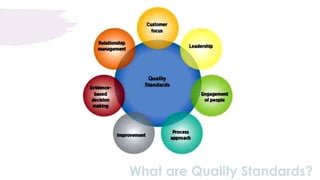
What are Quality Standards?
Who Uses Quality Standards?
Organizations turn to standards for guidelines, definitions, and
procedures that help them achieve objectives such as:
• Satisfying their customers’ quality requirements
• Ensuring their products and services are safe
• Complying with regulations
• Meeting environmental objectives
• Protecting products against climatic or other
adverse conditions
• Ensuring that internal processes are defined and
controlled
Standards Operating Procedures
Standard operating procedures are written, step-by-step
instructions that describe how to perform a routine activity.
Employees should complete them in the exact same way every
time so that the business can remain consistent.
Standard operating procedures help maintain safety and
efficiency for departments such as:
• Production/operations
• Sales and customer service
• Employee training
• Legal
• Financial
A good standard operating procedure should clearly outline
the steps and inform the employee of any safety concerns.
Why Do We Need Standard Operating
Procedures?
Standard operating procedures
are detailed, written instructions on
how to perform a routine business
activity. A standard operating
procedure is an effective tool that
every business should have.
Are SOPs relevant?
Across all industries, our clients are telling
us that now more than ever, that effective
SOPs and Work Instructions are an essential
component of a highly effective organization.
Many believed that any business unit without
a robust procedure system is doomed to
failure in today’s business environment and
competitive global marketplace.
Standard Operating Procedures at
a minimum give you the following:
Consistency
The number one reason for
procedures is consistency in the
way an individual carries out a
task or activity.
Reduction of Errors
A written procedure
details a set of instructions
for performing a task.
Communication
Another great reason you
need SOPs in your
organization is for the benefit
of communication.
Characteristic of Materials
Used in Specific Projects
Characteristic of Materials Used in Specific Projects
1. Selection of Materials
It is a step in the process of
designing any physical object.
For example:
• HP brand for printer
• Intel brand for Computer Hardware
Characteristic of Materials Used in Specific Projects
2. Testing Material
It is the determination of the
technological and operational
properties of materials, primarily
using machines and instruments.
Characteristic of Materials Used in Specific Projects
3. Cost of Material
Characteristic of common materials for
increased security is also a great factor in
the design and planning process.
The characteristic of the materials to be
used for specific project must be:
✓ Of good quality
- This is the most important factor when choosing
materials to buy.
✓ Reliable
- It means that you can be sure that it will perform its
function well, will operate safely and will give the best
it could give.
The characteristic of the materials to be used for specific project
✓ Suitable for the application/purposes
- Choose the materials which are very
necessary to make the project possible.
✓ Low cost –
- It does not mean that you will choose for the
less expensive one and exclude the quality.
Fault Identification and Reporting
These are the things to be considered when:
A. Receiving Materials:
1. Match the packing slip to the items received and
ensures that the materials are destined on tour
department.
2. That you are receiving the materials indicated on the
purchase order regarding quantity and discount.
3. That the materials are in acceptable condition.
4. That terms regarding installation and/or set up of
equipment are met.
Fault Identification and Reporting
B. Receiving Reports
Whenever goods are received:
1. The person receiving the goods must document,
using the administrative software, that all goods
were received for each requisition before any
payment can be made to the vendor.
2. Any exceptions must be noted so that partial
payments can be processed, or defective goods
can be returned.
Fault Identification and Reporting
C. Returning of Merchandise
When merchandise is received which is
incomplete or defective, the supervisor
will return the materials to the supplier or
to the store where it was bought and
decide with the vendor for replacement.
Fault Identification and Reporting
D. Making an Inventory Report of the
Materials
Effective management checks are
an important means of providing
assurance of the integrity and
security of the benefit processes.
Occupational Health
and Safety (OHS)
(OHS) relate to health, safety,
and welfare issues in the
workplace.
Occupational Health and Safety (OHS)
Occupational health and safety are
concerned with addressing many types
of workplace hazards, such as:
• Chemicals
• Physical hazards
• Biological agents
• Psychological fallout
• Ergonomic issues
• Accidents
OHS
Management
Issues
Types and Work-related errors
A. Quantity of work (untimely
completion, limited production)
1. Poor prioritizing, timing, scheduling
2. Lost time
3. Slow response to work requests, untimely
completion of assignments
4. Preventable accidents
B. Quality of work (failure to meet
quality standards)
1. Inaccuracies, errors
2. Failure to meet expectations for
product quality, cost or service
3. Customer/client dissatisfaction
4. Spoilage and/or waste of materials
5. Inappropriate or poor work methods

Applying Quality Standards.pdf

  • 1.
  • 2.
    What are QualityStandards? Quality standards are defined as documents that provide requirements, specifications, guidelines, or characteristics that can be used consistently to ensure that materials, products, processes, and services are fit for their purpose.
  • 3.
    What are QualityStandards?
  • 4.
    Who Uses QualityStandards? Organizations turn to standards for guidelines, definitions, and procedures that help them achieve objectives such as: • Satisfying their customers’ quality requirements • Ensuring their products and services are safe • Complying with regulations • Meeting environmental objectives • Protecting products against climatic or other adverse conditions • Ensuring that internal processes are defined and controlled
  • 5.
    Standards Operating Procedures Standardoperating procedures are written, step-by-step instructions that describe how to perform a routine activity. Employees should complete them in the exact same way every time so that the business can remain consistent. Standard operating procedures help maintain safety and efficiency for departments such as: • Production/operations • Sales and customer service • Employee training • Legal • Financial A good standard operating procedure should clearly outline the steps and inform the employee of any safety concerns.
  • 6.
    Why Do WeNeed Standard Operating Procedures? Standard operating procedures are detailed, written instructions on how to perform a routine business activity. A standard operating procedure is an effective tool that every business should have.
  • 8.
    Are SOPs relevant? Acrossall industries, our clients are telling us that now more than ever, that effective SOPs and Work Instructions are an essential component of a highly effective organization. Many believed that any business unit without a robust procedure system is doomed to failure in today’s business environment and competitive global marketplace.
  • 9.
    Standard Operating Proceduresat a minimum give you the following: Consistency The number one reason for procedures is consistency in the way an individual carries out a task or activity.
  • 10.
    Reduction of Errors Awritten procedure details a set of instructions for performing a task.
  • 11.
    Communication Another great reasonyou need SOPs in your organization is for the benefit of communication.
  • 12.
  • 13.
    Characteristic of MaterialsUsed in Specific Projects 1. Selection of Materials It is a step in the process of designing any physical object. For example: • HP brand for printer • Intel brand for Computer Hardware
  • 14.
    Characteristic of MaterialsUsed in Specific Projects 2. Testing Material It is the determination of the technological and operational properties of materials, primarily using machines and instruments.
  • 15.
    Characteristic of MaterialsUsed in Specific Projects 3. Cost of Material Characteristic of common materials for increased security is also a great factor in the design and planning process.
  • 16.
    The characteristic ofthe materials to be used for specific project must be: ✓ Of good quality - This is the most important factor when choosing materials to buy. ✓ Reliable - It means that you can be sure that it will perform its function well, will operate safely and will give the best it could give.
  • 17.
    The characteristic ofthe materials to be used for specific project ✓ Suitable for the application/purposes - Choose the materials which are very necessary to make the project possible. ✓ Low cost – - It does not mean that you will choose for the less expensive one and exclude the quality.
  • 18.
    Fault Identification andReporting These are the things to be considered when: A. Receiving Materials: 1. Match the packing slip to the items received and ensures that the materials are destined on tour department. 2. That you are receiving the materials indicated on the purchase order regarding quantity and discount. 3. That the materials are in acceptable condition. 4. That terms regarding installation and/or set up of equipment are met.
  • 19.
    Fault Identification andReporting B. Receiving Reports Whenever goods are received: 1. The person receiving the goods must document, using the administrative software, that all goods were received for each requisition before any payment can be made to the vendor. 2. Any exceptions must be noted so that partial payments can be processed, or defective goods can be returned.
  • 20.
    Fault Identification andReporting C. Returning of Merchandise When merchandise is received which is incomplete or defective, the supervisor will return the materials to the supplier or to the store where it was bought and decide with the vendor for replacement.
  • 21.
    Fault Identification andReporting D. Making an Inventory Report of the Materials Effective management checks are an important means of providing assurance of the integrity and security of the benefit processes.
  • 22.
    Occupational Health and Safety(OHS) (OHS) relate to health, safety, and welfare issues in the workplace.
  • 23.
    Occupational Health andSafety (OHS) Occupational health and safety are concerned with addressing many types of workplace hazards, such as: • Chemicals • Physical hazards • Biological agents • Psychological fallout • Ergonomic issues • Accidents
  • 24.
  • 25.
    Types and Work-relatederrors A. Quantity of work (untimely completion, limited production) 1. Poor prioritizing, timing, scheduling 2. Lost time 3. Slow response to work requests, untimely completion of assignments 4. Preventable accidents
  • 26.
    B. Quality ofwork (failure to meet quality standards) 1. Inaccuracies, errors 2. Failure to meet expectations for product quality, cost or service 3. Customer/client dissatisfaction 4. Spoilage and/or waste of materials 5. Inappropriate or poor work methods