INGUINAL HERNIA
LT COL SM SHAHADAT HOSSAIN
MCPS,FCPS( Surgery),FCPS(Thoracic Surgery)
Adv Trg on Thoracoscopy,CNUH,South Korea
CMH ,Bogra
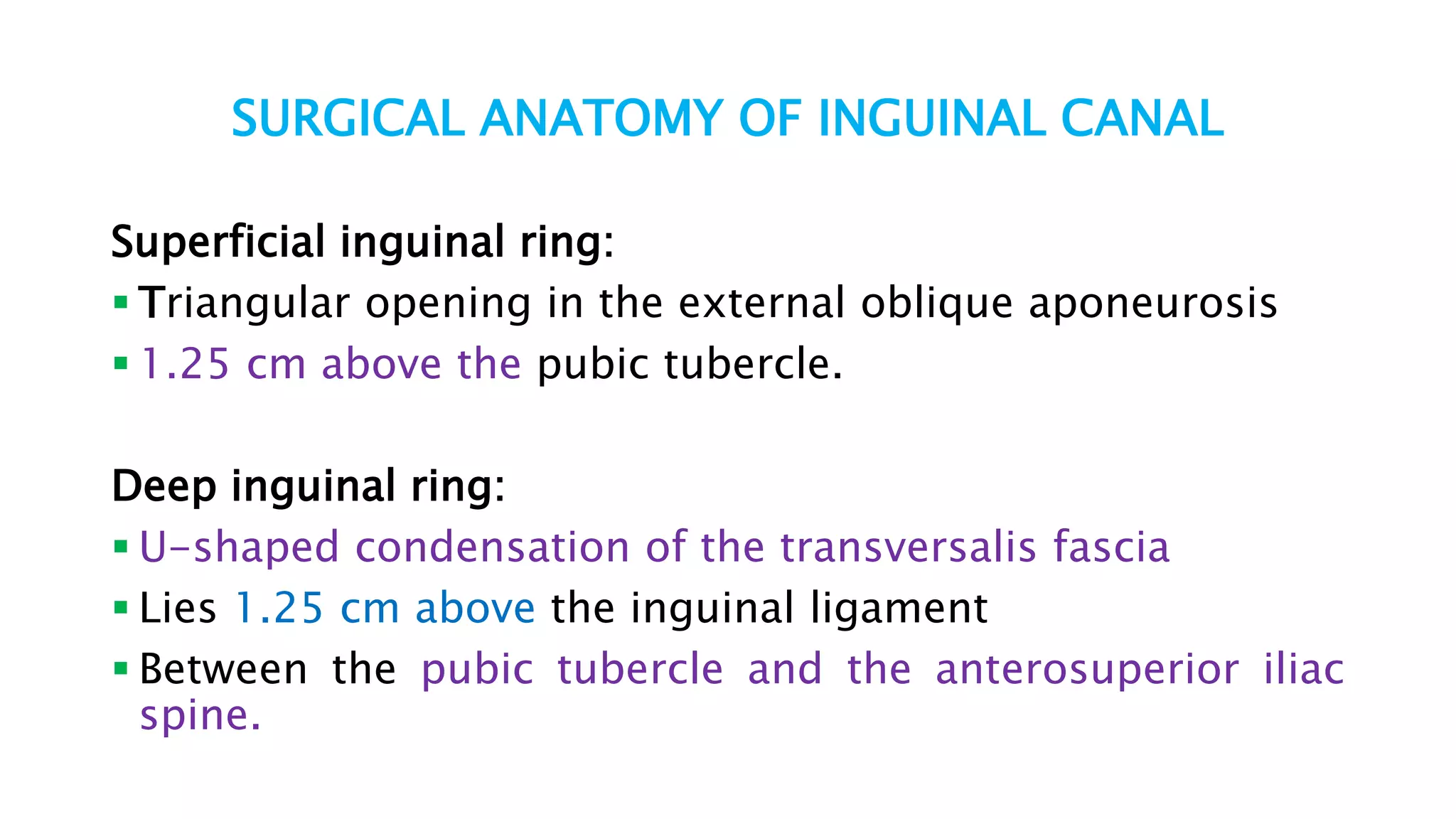
SURGICAL ANATOMY OF INGUINAL CANAL
Superficial inguinal ring:
 Triangular opening in the external oblique aponeurosis
 1.25 cm above the pubic tubercle.
Deep inguinal ring:
 U-shaped condensation of the transversalis fascia
 Lies 1.25 cm above the inguinal ligament
 Between the pubic tubercle and the anterosuperior iliac
spine.
Inguinal (Poupart’s) ligament
 It is formed by the lower border of the external oblique
aponeurosis
 Which is thickened and folded backwards on itself
 Extending from anterosuperior iliac spine to pubic
tubercle.
INGUINAL CANAL
 It is an oblique passage in lower part of abdominal wall
 4 cm long
 Situated above the medial ½ of inguinal ligament
 Extending from deep inguinal ring to superficial inguinal
ring
INGUINAL CANAL
BOUNDARIES
Anterior:
• External oblique aponeurosis
• Conjoined muscle laterally
Posterior:
• Inferior epigastric artery
• Fascia transversalis
Roof:
Conjoined muscle
Floor: Inguinal ligament.
CONTENTS OF INGUINAL CANAL
1. Spermatic cord in males
2. Round ligament in females
3. Ilioinguinal nerve
CONTENTS OF SPERMATIC CORD
1. Vas deferens
2. Artery to vas
3. Testicular and cremasteric artery
4. Genital branch of genitofemoral nerve
5. Pampiniform plexus of veins
6. Remains of processus vaginalis
7. Sympathetic plexus.
CLASSIFICATION
Anatomical:
Indirect hernia
 It comes out through internal ring along with the cord.
 It is lateral to the inferior epigastric artery.
Direct hernia
 It occurs through the posterior wall of the inguinal canal
through ‘Hesselbach’s triangle’.
‘HESSELBACH’S TRIANGLE’
a. Medially by lateral border of rectus muscle
b. Laterally by inferior epigastric artery
c. Below by inguinal ligament.
According to the Extent
Incomplete:
Bubonocele: Here sac is confined to the inguinal canal.
Funicular: Here sac crosses the superficial inguinal ring,
but does not reach the bottom of the scrotum.
Complete: Here sac descends to the bottom of the
scrotum.
Saddle-bag or pantaloon hernial sac has got both medial
and lateral component.
INDIRECT INGUINAL HERNIA
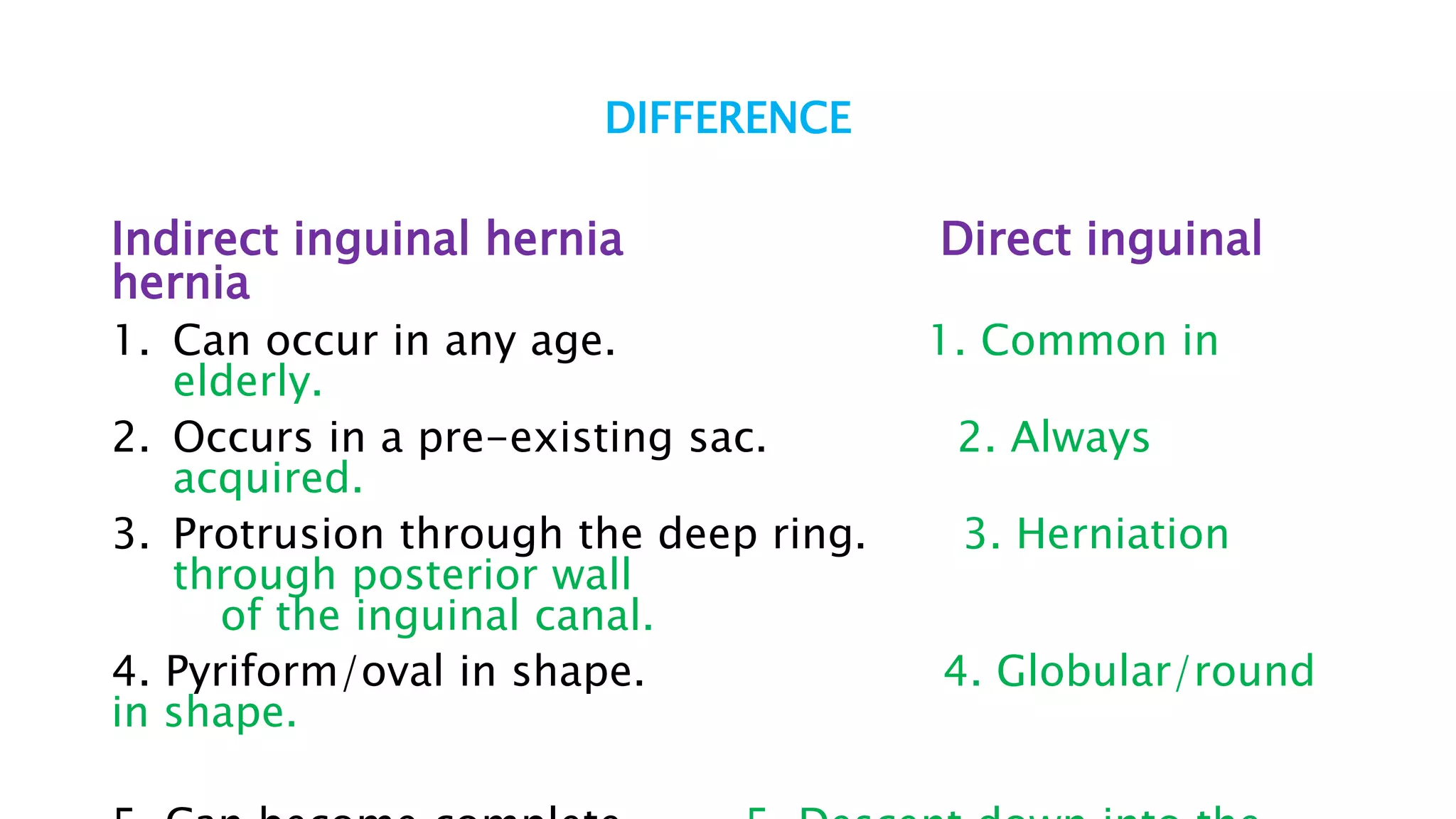
DIFFERENCE
Indirect inguinal hernia Direct inguinal
hernia
1. Can occur in any age. 1. Common in
elderly.
2. Occurs in a pre-existing sac. 2. Always
acquired.
3. Protrusion through the deep ring. 3. Herniation
through posterior wall
of the inguinal canal.
4. Pyriform/oval in shape. 4. Globular/round
in shape.
DIFFERENCE
6. Sac is anterolateral to the cord. 6. Sac is posterior to the
cord.
7. Ring occlusion test does not show any impulse.
7.Test shows impulse even after
occluding the deep ring.
8. Invagination test shows impulse on the tip of the little
finger
8. Impulse is felt over the pulp of
the little finger.
9.Obstruction/strangulation are common. 9.Rare but can
PRECIPITATING FACTORS
1. Respiratory causes like bronchial asthma,
tuberculosis, bronchitis
2. Chronic constipation
3. Benign prostatic hyperplasia (BPH), urethral stricture
4. Straining
5. Obesity
6. Smoking
7. Multiple pregnancies
8. Appendicectomy
9. Ascites
CLINICAL FEATURES
a. Dragging pain and swelling in the groin
b. Cough impulse
c. Get above the swelling
d. Internal ring occlusion test
e. Zieman’s test
f. Head or leg rising test
g. Examination of chest
h. DRE
EXAMINATION
OPERATIONS FOR INGUINAL HERNIA
1. Herniotomy
2. Open suture repair
• Bassini
• Shouldice
• Desarda
3. Open flat mesh repair
• Lichtenstein
OPERATIONS FOR INGUINAL HERNIA
4.Open complex mesh repair
• Plugs
• Hernia systems
5.Open preperitoneal repair
• Stoppa
6. Laparoscopic repair
• TEP
• TAPP
Bassini’s diagram
A. Subcutaneous fat
B. External oblique
C. Iliac vein
E. Spermatic cord
F. Nerves in inguinal canal
G. Transversalis fascia.
Lichtenstein’s repair
POSITIONING THE MESH
1. Just outside the muscle in the subcutaneous space
(onlay).
2. Within the defect (inlay) – only applies to mesh plugs in
small defects.
3. Between fascial layers in the abdominal wall
(intraparietal or sublay).
4. Immediately extraperitoneally, against muscle or fascia
(also sublay).
STRANGULATED HERNIA
It occurs when blood supply of the contents of hernia is
seriously impaired leading to formation of gangrene.
PATHOLOGY
PATHOLOGY
CAUSES OF STRANGULATION
1. Narrow neck
2. Adhesions
3. Irreducibility
4. Long-time, large hernia with adhesions.
FEATURES OF STRANGULATED HERNIA
a. Tense, tender, irreducible
b. No impulse on coughing
c. Shock, toxicity
d. Abdominal distension, vomiting
e. Rebound tenderness
INVESTIGATIONS
a. Plain X-ray abdomen in erect posture shows multiple
air-fluid levels.
b. Serum electrolytes.
c. Blood urea and serum creatinine.
d. Total count is increased.
e. U/S abdomen.
TREATMENT
1. Ryle’s tube aspiration.
2. Intravenous fluids to correct dehydration and electrolyte
imbalance.
3. Antibiotics.
4. Catheterisation to maintain adequate urine output.
5. Emergency surgery
SURGERY
1. Groin incision is made with incision extending into the
most prominent area of the swelling.
2. Sac is exposed.
3. Constriction ring and superficial ring is released (cut).
4. Sac is opened carefully without allowing the spillage of
fluid.
5. Fluid is sucked with a suction apparatus.
6. Viability is checked by colour, peristalsis,
pulsation,bleeding.
7. When gangrenous, resection and anastomosis is done.
Figure
Inguinal hernia

Inguinal hernia

  • 1.
    INGUINAL HERNIA LT COLSM SHAHADAT HOSSAIN MCPS,FCPS( Surgery),FCPS(Thoracic Surgery) Adv Trg on Thoracoscopy,CNUH,South Korea CMH ,Bogra
  • 2.
    SURGICAL ANATOMY OFINGUINAL CANAL Superficial inguinal ring:  Triangular opening in the external oblique aponeurosis  1.25 cm above the pubic tubercle. Deep inguinal ring:  U-shaped condensation of the transversalis fascia  Lies 1.25 cm above the inguinal ligament  Between the pubic tubercle and the anterosuperior iliac spine.
  • 3.
    Inguinal (Poupart’s) ligament It is formed by the lower border of the external oblique aponeurosis  Which is thickened and folded backwards on itself  Extending from anterosuperior iliac spine to pubic tubercle.
  • 4.
    INGUINAL CANAL  Itis an oblique passage in lower part of abdominal wall  4 cm long  Situated above the medial ½ of inguinal ligament  Extending from deep inguinal ring to superficial inguinal ring
  • 5.
  • 6.
    BOUNDARIES Anterior: • External obliqueaponeurosis • Conjoined muscle laterally Posterior: • Inferior epigastric artery • Fascia transversalis Roof: Conjoined muscle Floor: Inguinal ligament.
  • 7.
  • 8.
    CONTENTS OF INGUINALCANAL 1. Spermatic cord in males 2. Round ligament in females 3. Ilioinguinal nerve
  • 9.
    CONTENTS OF SPERMATICCORD 1. Vas deferens 2. Artery to vas 3. Testicular and cremasteric artery 4. Genital branch of genitofemoral nerve 5. Pampiniform plexus of veins 6. Remains of processus vaginalis 7. Sympathetic plexus.
  • 10.
    CLASSIFICATION Anatomical: Indirect hernia  Itcomes out through internal ring along with the cord.  It is lateral to the inferior epigastric artery. Direct hernia  It occurs through the posterior wall of the inguinal canal through ‘Hesselbach’s triangle’.
  • 11.
    ‘HESSELBACH’S TRIANGLE’ a. Mediallyby lateral border of rectus muscle b. Laterally by inferior epigastric artery c. Below by inguinal ligament.
  • 12.
    According to theExtent Incomplete: Bubonocele: Here sac is confined to the inguinal canal. Funicular: Here sac crosses the superficial inguinal ring, but does not reach the bottom of the scrotum. Complete: Here sac descends to the bottom of the scrotum. Saddle-bag or pantaloon hernial sac has got both medial and lateral component.
  • 13.
  • 14.
    DIFFERENCE Indirect inguinal herniaDirect inguinal hernia 1. Can occur in any age. 1. Common in elderly. 2. Occurs in a pre-existing sac. 2. Always acquired. 3. Protrusion through the deep ring. 3. Herniation through posterior wall of the inguinal canal. 4. Pyriform/oval in shape. 4. Globular/round in shape.
  • 15.
    DIFFERENCE 6. Sac isanterolateral to the cord. 6. Sac is posterior to the cord. 7. Ring occlusion test does not show any impulse. 7.Test shows impulse even after occluding the deep ring. 8. Invagination test shows impulse on the tip of the little finger 8. Impulse is felt over the pulp of the little finger. 9.Obstruction/strangulation are common. 9.Rare but can
  • 16.
    PRECIPITATING FACTORS 1. Respiratorycauses like bronchial asthma, tuberculosis, bronchitis 2. Chronic constipation 3. Benign prostatic hyperplasia (BPH), urethral stricture 4. Straining 5. Obesity 6. Smoking 7. Multiple pregnancies 8. Appendicectomy 9. Ascites
  • 17.
    CLINICAL FEATURES a. Draggingpain and swelling in the groin b. Cough impulse c. Get above the swelling d. Internal ring occlusion test e. Zieman’s test f. Head or leg rising test g. Examination of chest h. DRE
  • 18.
  • 19.
    OPERATIONS FOR INGUINALHERNIA 1. Herniotomy 2. Open suture repair • Bassini • Shouldice • Desarda 3. Open flat mesh repair • Lichtenstein
  • 20.
    OPERATIONS FOR INGUINALHERNIA 4.Open complex mesh repair • Plugs • Hernia systems 5.Open preperitoneal repair • Stoppa 6. Laparoscopic repair • TEP • TAPP
  • 21.
    Bassini’s diagram A. Subcutaneousfat B. External oblique C. Iliac vein E. Spermatic cord F. Nerves in inguinal canal G. Transversalis fascia.
  • 22.
  • 23.
  • 24.
    POSITIONING THE MESH 1.Just outside the muscle in the subcutaneous space (onlay). 2. Within the defect (inlay) – only applies to mesh plugs in small defects. 3. Between fascial layers in the abdominal wall (intraparietal or sublay). 4. Immediately extraperitoneally, against muscle or fascia (also sublay).
  • 25.
    STRANGULATED HERNIA It occurswhen blood supply of the contents of hernia is seriously impaired leading to formation of gangrene.
  • 26.
  • 27.
  • 28.
    CAUSES OF STRANGULATION 1.Narrow neck 2. Adhesions 3. Irreducibility 4. Long-time, large hernia with adhesions.
  • 29.
    FEATURES OF STRANGULATEDHERNIA a. Tense, tender, irreducible b. No impulse on coughing c. Shock, toxicity d. Abdominal distension, vomiting e. Rebound tenderness
  • 30.
    INVESTIGATIONS a. Plain X-rayabdomen in erect posture shows multiple air-fluid levels. b. Serum electrolytes. c. Blood urea and serum creatinine. d. Total count is increased. e. U/S abdomen.
  • 31.
    TREATMENT 1. Ryle’s tubeaspiration. 2. Intravenous fluids to correct dehydration and electrolyte imbalance. 3. Antibiotics. 4. Catheterisation to maintain adequate urine output. 5. Emergency surgery
  • 32.
    SURGERY 1. Groin incisionis made with incision extending into the most prominent area of the swelling. 2. Sac is exposed. 3. Constriction ring and superficial ring is released (cut). 4. Sac is opened carefully without allowing the spillage of fluid. 5. Fluid is sucked with a suction apparatus. 6. Viability is checked by colour, peristalsis, pulsation,bleeding. 7. When gangrenous, resection and anastomosis is done.
  • 33.