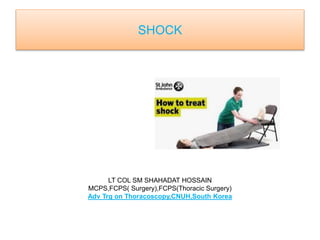
SHOCK
LT COL SM SHAHADAT HOSSAIN
MCPS,FCPS( Surgery),FCPS(Thoracic Surgery)
Adv Trg on Thoracoscopy,CNUH,South Korea
DEFINITION
Shock is a systemic state of low tissue
perfusion that is inadequate for normal
cellular respiration.
What happened ?
CLASSIFICATION OF SHOCK
1. Hypovolaemic shock
2. Cardiogenic shock
3. Obstructive shock
4. Distributive shock
5. Endocrine shock
CAUSE
1. Hypovolaemic shock
a. Haemorrhage.
b. Severe burns.
c. Peritonitis, intestinal obstruction.
d. Vomiting and diarrhoea.
CAUSE
2.Cardiogenic
a. Valvular heart disease.
b. Myocardial infarction.
c. Cardiac arrhythmias.
d. Cardiomyopathy.
CAUSE
3. Obstructive
a. Cardiac Tamponade
b. Pulmonary Embolism
c. Tension Pneumothorax
d. Air embolism
CAUSE
4.Distributive shock
a. Septic shock
b. Anaphylaxis
c. Spinal cord injury
NEUROGENIC ETIOLOGY
Neurogenic
a. Paraplegia.
b. Quadriplegia.
c. Trauma to spinal cord.
d. Spinal anesthesia.
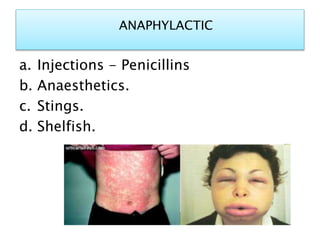
ANAPHYLACTIC
a. Injections - Penicillins
b. Anaesthetics.
c. Stings.
d. Shelfish.
SEPTIC
a. Gram +
b. Gram-
c. Fungi / Virus
d. Protozoa
CAUSE
5.Endocrine
a. Hypo & Hyperthyroidism.
b. Adrenal insufficiency.
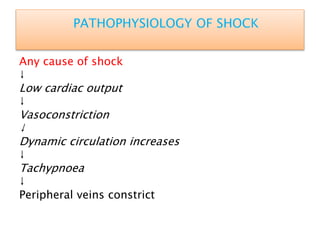
PATHOPHYSIOLOGY OF SHOCK
Any cause of shock
↓
Low cardiac output
↓
Vasoconstriction
↓
Dynamic circulation increases
↓
Tachypnoea
↓
Peripheral veins constrict
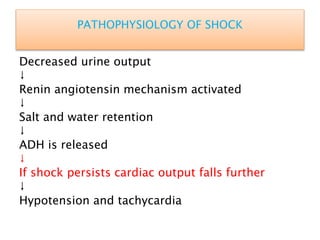
PATHOPHYSIOLOGY OF SHOCK
Decreased urine output
↓
Renin angiotensin mechanism activated
↓
Salt and water retention
↓
ADH is released
↓
If shock persists cardiac output falls further
↓
Hypotension and tachycardia
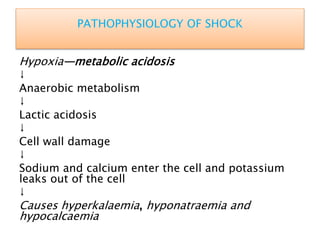
PATHOPHYSIOLOGY OF SHOCK
Hypoxia—metabolic acidosis
↓
Anaerobic metabolism
↓
Lactic acidosis
↓
Cell wall damage
↓
Sodium and calcium enter the cell and potassium
leaks out of the cell
↓
Causes hyperkalaemia, hyponatraemia and
hypocalcaemia
PATHOPHYSIOLOGY OF SHOCK
Lysosomes break down
↓
SICK CELL SYNDROME
Platelets are activated forming small clots
↓
Disseminated intravascular coagulation (DIC)
↓
Further bleeding.
SHOCK – EFFECTS ON ORGAN
o Heart – ↓ CO / hypotension / myocardial
depressants
o Lung - ↓gas exchange / tachypnoea /
pulmonary edema
o Endocrine – ADH → ↑ reabsorption of water
SHOCK – EFFECTS ON ORGAN
o CNS – perfusion ↓ – drowsy
o Blood - Coagulation abnormalities – DIC
o Renal - ↓ GFR - ↓ urine output
o GIT – mucosal ischaemia – bleeding &
hepatic - ↑ enzyme levels
STAGES OF SHOCK
Stage1 compensatory shock by
neuroendocrine response to maintain the
perfusion of the vital organs like brain, heart,
kidney, liver.
Stage2 decompensatory shock where there is
persistent shock with severe hypotension,
oliguria, tachycardia.
Stage3 irreversible shock with severe hypoxia
and MODS.
CLINICAL FEATURES
Types
a. Mild shock.
b. Moderate shock.
c. Severe shock.
MILD SHOCK
 Conscious level- mild anxiety.
 Pulse rate- increased.
 Respiratory rate- increased.
 Blood pressure- normal.
 Urine output -normal.
 Extremities pale and cool.
 Sweat on forehead, hand and feet.
MODERATE SHOCK
 Conscious level- drowsy.
 Pulse rate- increased.
 Respiratory rate- increased.
 Blood pressure- mild hypotension.
 Urine output- reduced.
SEVERE SHOCK
 Conscious level- comatose.
 Pulse rate- increased.
 Respiratory rate- laboured.
 Blood pressure- severe hypotension.
 Urine output -anuric.
MONITORING
Minimum
a.ECG
b.Pulse oximetry
c.Blood pressure
d.Urine output
MONITORING
Additional modalities
a. Central venous pressure
b. Invasive blood pressure
c. Cardiac output
d. Base deficit and serum lactate
MONITORS FOR ORGAN/SYSTEMIC PERFUSION.
Systemic perfusion
I. Base deficit
II. Lactate
III. Mixed venous oxygen saturation
Kidney Urine output
MONITORS FOR ORGAN/SYSTEMIC PERFUSION
Muscle
a. Near-infrared spectroscopy
b. Tissue oxygen electrode
Gut
a. Sublingual capnometry
b. Gut mucosal pH
c. Laser Doppler flowmetry
MONITORS FOR ORGAN/SYSTEMIC PERFUSION
Brain
a. Conscious level
b. Tissue oxygen electrode
c. Near-infrared spectroscopy
TREATMENT
GOAL:
 Increase O2 delivery
 Decrease demand
PRINCIPLES OF RESUSCITATION
A: Airway
Patent upper airway
B: Breathing
Adequate ventilation and oxygenation
C: Circulation
Placement of adequate IV access
FLUID THERAPY IN SHOCK
Crystalloid Solutions
I. Normal saline
II. Ringers Lactate solution
III. Hartmann’s solution
IV. Colloid Solutions
V. Blood transfusion
DYNAMIC FLUID RESPONSE
Infusing 250-500ml of Fluid rapidly in 5 - 10
mts.
1. Responders – Improvement
2. Transient responders – revert back
3. Non – responders
VASOPRESSORS / INOTROPIC DRUGS
Vasopressors – Phenylephrine / NA
Distributive shock states
Septic shock / Neurogenic
Inotropics - Dobutamine
Cardiogenic shock / Severe septic shock
To increase the cardiac output
OTHER TREATMENTS
1. Correction of Acid – base balance
2. Steriods - Hydrocortisone
3. Antibiotics
4. Catheterisation
5. Nasal O2 / Ventilatory support
6. CVP Line
7. Control of Pain
8. ICU – Critical care management
SEPTIC SHOCK
• Septic shock may be due to gram-positive
organisms, gram negative organisms, fungi,
viruses or protozoal origin.
• Gram-negative septicaemia/gram-negative
septic shock is called as endotoxic shock.
PATHOPHYSIOLOGY OF SEPTIC SHOCK
Toxins/endotoxins from organisms like E. Coli, Klebsiella,
Pseudomonas, and Proteus
↓
Inflammation, cellular activation of macrophages,
neutrophils,
monocytes
↓
Release of cytokines, free radicals
↓
Chemotaxis of cells, endothelial injury, altered
coagulation
cascade—SIRS
↓
PATHOPHYSIOLOGY OF SEPTIC SHOCK
Reversible hyperdynamic warm stage of septic
shock with
fever, tachycardia, tachypnoea
↓
Severe circulatory failure with MODS (failure of
lungs, kidneys, liver, heart) with DIC
↓
Hypodynamic, irreversible cold stage of septic
shock.
TREATMENT
• Appropriate antibiotics—third generation
cephalosporins/ aminoglycosides.
• Correction of fluid and electrolyte by crystalloids,
blood transfusion.

Shock

  • 1.
    SHOCK LT COL SMSHAHADAT HOSSAIN MCPS,FCPS( Surgery),FCPS(Thoracic Surgery) Adv Trg on Thoracoscopy,CNUH,South Korea
  • 2.
    DEFINITION Shock is asystemic state of low tissue perfusion that is inadequate for normal cellular respiration.
  • 3.
  • 4.
    CLASSIFICATION OF SHOCK 1.Hypovolaemic shock 2. Cardiogenic shock 3. Obstructive shock 4. Distributive shock 5. Endocrine shock
  • 5.
    CAUSE 1. Hypovolaemic shock a.Haemorrhage. b. Severe burns. c. Peritonitis, intestinal obstruction. d. Vomiting and diarrhoea.
  • 6.
    CAUSE 2.Cardiogenic a. Valvular heartdisease. b. Myocardial infarction. c. Cardiac arrhythmias. d. Cardiomyopathy.
  • 7.
    CAUSE 3. Obstructive a. CardiacTamponade b. Pulmonary Embolism c. Tension Pneumothorax d. Air embolism
  • 8.
    CAUSE 4.Distributive shock a. Septicshock b. Anaphylaxis c. Spinal cord injury
  • 9.
    NEUROGENIC ETIOLOGY Neurogenic a. Paraplegia. b.Quadriplegia. c. Trauma to spinal cord. d. Spinal anesthesia.
  • 10.
    ANAPHYLACTIC a. Injections -Penicillins b. Anaesthetics. c. Stings. d. Shelfish.
  • 11.
    SEPTIC a. Gram + b.Gram- c. Fungi / Virus d. Protozoa
  • 12.
    CAUSE 5.Endocrine a. Hypo &Hyperthyroidism. b. Adrenal insufficiency.
  • 13.
    PATHOPHYSIOLOGY OF SHOCK Anycause of shock ↓ Low cardiac output ↓ Vasoconstriction ↓ Dynamic circulation increases ↓ Tachypnoea ↓ Peripheral veins constrict
  • 14.
    PATHOPHYSIOLOGY OF SHOCK Decreasedurine output ↓ Renin angiotensin mechanism activated ↓ Salt and water retention ↓ ADH is released ↓ If shock persists cardiac output falls further ↓ Hypotension and tachycardia
  • 15.
    PATHOPHYSIOLOGY OF SHOCK Hypoxia—metabolicacidosis ↓ Anaerobic metabolism ↓ Lactic acidosis ↓ Cell wall damage ↓ Sodium and calcium enter the cell and potassium leaks out of the cell ↓ Causes hyperkalaemia, hyponatraemia and hypocalcaemia
  • 16.
    PATHOPHYSIOLOGY OF SHOCK Lysosomesbreak down ↓ SICK CELL SYNDROME Platelets are activated forming small clots ↓ Disseminated intravascular coagulation (DIC) ↓ Further bleeding.
  • 17.
    SHOCK – EFFECTSON ORGAN o Heart – ↓ CO / hypotension / myocardial depressants o Lung - ↓gas exchange / tachypnoea / pulmonary edema o Endocrine – ADH → ↑ reabsorption of water
  • 18.
    SHOCK – EFFECTSON ORGAN o CNS – perfusion ↓ – drowsy o Blood - Coagulation abnormalities – DIC o Renal - ↓ GFR - ↓ urine output o GIT – mucosal ischaemia – bleeding & hepatic - ↑ enzyme levels
  • 19.
    STAGES OF SHOCK Stage1compensatory shock by neuroendocrine response to maintain the perfusion of the vital organs like brain, heart, kidney, liver. Stage2 decompensatory shock where there is persistent shock with severe hypotension, oliguria, tachycardia. Stage3 irreversible shock with severe hypoxia and MODS.
  • 20.
    CLINICAL FEATURES Types a. Mildshock. b. Moderate shock. c. Severe shock.
  • 21.
    MILD SHOCK  Consciouslevel- mild anxiety.  Pulse rate- increased.  Respiratory rate- increased.  Blood pressure- normal.  Urine output -normal.  Extremities pale and cool.  Sweat on forehead, hand and feet.
  • 22.
    MODERATE SHOCK  Consciouslevel- drowsy.  Pulse rate- increased.  Respiratory rate- increased.  Blood pressure- mild hypotension.  Urine output- reduced.
  • 23.
    SEVERE SHOCK  Consciouslevel- comatose.  Pulse rate- increased.  Respiratory rate- laboured.  Blood pressure- severe hypotension.  Urine output -anuric.
  • 24.
  • 25.
    MONITORING Additional modalities a. Centralvenous pressure b. Invasive blood pressure c. Cardiac output d. Base deficit and serum lactate
  • 26.
    MONITORS FOR ORGAN/SYSTEMICPERFUSION. Systemic perfusion I. Base deficit II. Lactate III. Mixed venous oxygen saturation Kidney Urine output
  • 27.
    MONITORS FOR ORGAN/SYSTEMICPERFUSION Muscle a. Near-infrared spectroscopy b. Tissue oxygen electrode Gut a. Sublingual capnometry b. Gut mucosal pH c. Laser Doppler flowmetry
  • 28.
    MONITORS FOR ORGAN/SYSTEMICPERFUSION Brain a. Conscious level b. Tissue oxygen electrode c. Near-infrared spectroscopy
  • 29.
    TREATMENT GOAL:  Increase O2delivery  Decrease demand
  • 30.
    PRINCIPLES OF RESUSCITATION A:Airway Patent upper airway B: Breathing Adequate ventilation and oxygenation C: Circulation Placement of adequate IV access
  • 31.
    FLUID THERAPY INSHOCK Crystalloid Solutions I. Normal saline II. Ringers Lactate solution III. Hartmann’s solution IV. Colloid Solutions V. Blood transfusion
  • 32.
    DYNAMIC FLUID RESPONSE Infusing250-500ml of Fluid rapidly in 5 - 10 mts. 1. Responders – Improvement 2. Transient responders – revert back 3. Non – responders
  • 33.
    VASOPRESSORS / INOTROPICDRUGS Vasopressors – Phenylephrine / NA Distributive shock states Septic shock / Neurogenic Inotropics - Dobutamine Cardiogenic shock / Severe septic shock To increase the cardiac output
  • 34.
    OTHER TREATMENTS 1. Correctionof Acid – base balance 2. Steriods - Hydrocortisone 3. Antibiotics 4. Catheterisation 5. Nasal O2 / Ventilatory support 6. CVP Line 7. Control of Pain 8. ICU – Critical care management
  • 35.
    SEPTIC SHOCK • Septicshock may be due to gram-positive organisms, gram negative organisms, fungi, viruses or protozoal origin. • Gram-negative septicaemia/gram-negative septic shock is called as endotoxic shock.
  • 36.
    PATHOPHYSIOLOGY OF SEPTICSHOCK Toxins/endotoxins from organisms like E. Coli, Klebsiella, Pseudomonas, and Proteus ↓ Inflammation, cellular activation of macrophages, neutrophils, monocytes ↓ Release of cytokines, free radicals ↓ Chemotaxis of cells, endothelial injury, altered coagulation cascade—SIRS ↓
  • 37.
    PATHOPHYSIOLOGY OF SEPTICSHOCK Reversible hyperdynamic warm stage of septic shock with fever, tachycardia, tachypnoea ↓ Severe circulatory failure with MODS (failure of lungs, kidneys, liver, heart) with DIC ↓ Hypodynamic, irreversible cold stage of septic shock.
  • 38.
    TREATMENT • Appropriate antibiotics—thirdgeneration cephalosporins/ aminoglycosides. • Correction of fluid and electrolyte by crystalloids, blood transfusion.