Prehospital and Emergency
Room Care for Burns
Teodoro J. Herbosa MD FPCS!
Department of Emergency Medicine!
Division of Trauma Dept of Surgery!
Philippine General Hospital!
University of the Philippines, Manila!
Former Undersecretary DoH
BURN INJURIES:

A SERIOUS PUBLIC HEALTH PROBLEM
• Globally a serious public health problem
• Devastating injury - 4th
most common
injury
• >195,000 deaths yearly from fires alone
• More deaths from scald, electrical
burns, & other forms of burns
• Global data are not available
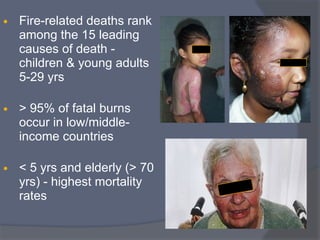
• Fire-related deaths rank
among the 15 leading
causes of death -
children & young adults
5-29 yrs
!
• > 95% of fatal burns
occur in low/middle-
income countries
!
• < 5 yrs and elderly (> 70
yrs) - highest mortality
rates
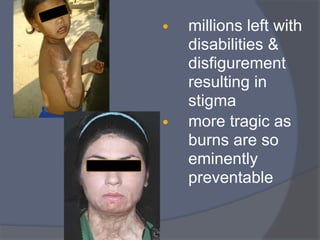
• millions left with
disabilities &
disfigurement
resulting in
stigma
• more tragic as
burns are so
eminently
preventable
BURN TREATMENT
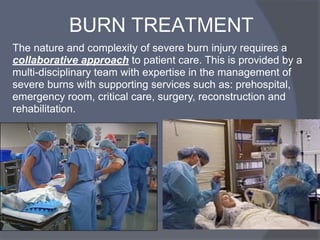
The nature and complexity of severe burn injury requires a
collaborative approach to patient care. This is provided by a
multi-disciplinary team with expertise in the management of
severe burns with supporting services such as: prehospital,
emergency room, critical care, surgery, reconstruction and
rehabilitation.
• Bringing together the expertise required to
coordinate clinical services across the continuum
of care - from first responder, prehospital, initial
hospital admission through to hospital discharge,
rehabilitation and ongoing care.
• Sharing clinical expertise
• Developing standardized clinical practice
guidelines for patient care
• Increasing the focus on prevention, improving
links to community outreach services for patients
and undertaking research to improve patient care
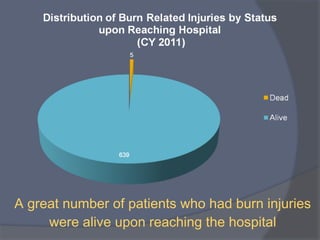
A great number of patients who had burn injuries
were alive upon reaching the hospital
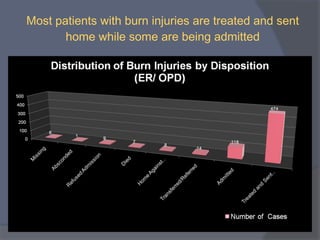
Most patients with burn injuries are treated and sent
home while some are being admitted
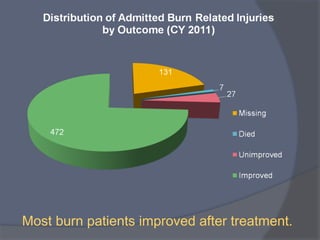
Most burn patients improved after treatment.
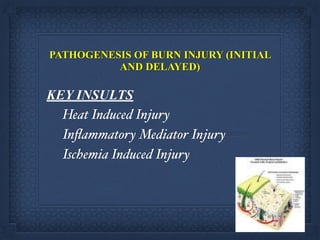
PATHOGENESIS OF BURN INJURY (INITIAL
AND DELAYED)

KEY INSULTS
Heat Induced Injury !
Inflammatory Mediator Injury !
Ischemia Induced Injury
Burns : results from dry heat, corrosive
substances/friction!
!
!! Scalds: caused by wet heat!
!
General Principles:!
first address your own safety!
stop burning!
cover injury!
obtain medical aid
Classification of burns!
! ! ! thermal!
!chemical!
!electrical
Burn Patient
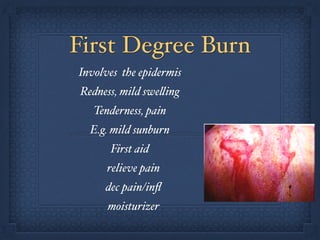
First Degree Burn
Involves the epidermis!
Redness, mild swelling!
Tenderness, pain!
E.g. mild sunburn!
First aid!
relieve pain!
dec pain/infl!
moisturizer
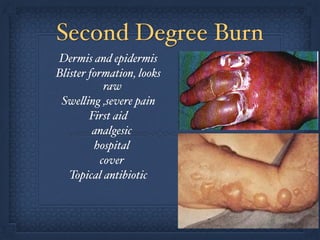
Second Degree Burn
Dermis and epidermis!
Blister formation, looks
raw!
Swelling ,severe pain!
First aid!
analgesic!
hospital!
cover!
Topical antibiotic
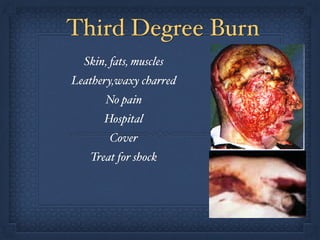
Third Degree Burn
Skin, fats, muscles!
Leathery,waxy charred!
No pain!
Hospital!
Cover !
Treat for shock
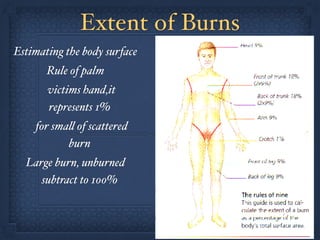
Extent of Burns
Estimating the body surface !
Rule of palm!
victims hand,it
represents 1% !
for small of scattered
burn!
Large burn, unburned
subtract to 100%
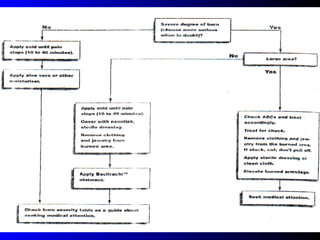
Thermal Burn
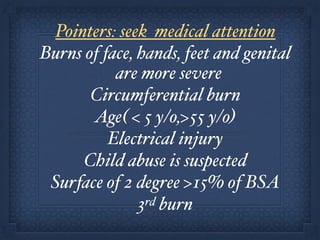
Pointers: seek medical attention !
Burns of face, hands, feet and genital
are more severe!
Circumferential burn!
Age( < 5 y/o,>55 y/o)!
Electrical injury!
Child abuse is suspected!
Surface of 2 degree >15% of BSA!
3rd burn
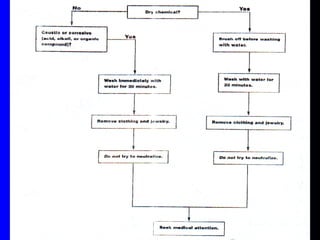
Chemical Burn
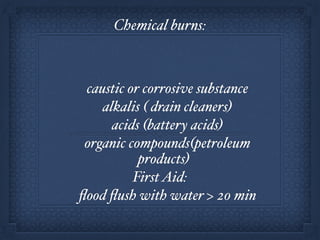
Chemical burns:
!
caustic or corrosive substance!
alkalis ( drain cleaners)!
acids (battery acids)!
organic compounds(petroleum
products)!
FirstAid:!
flood flush with water > 20 min
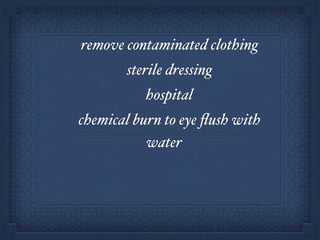
remove contaminated clothing!
sterile dressing!
hospital!
chemical burn to eye flush with
water
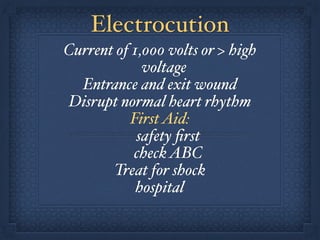
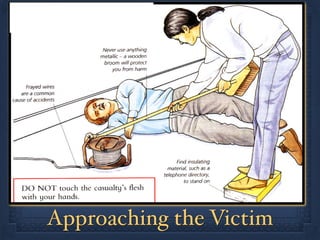
Electrocution
Current of 1,000 volts or > high
voltage!
Entrance and exit wound!
Disrupt normal heart rhythm!
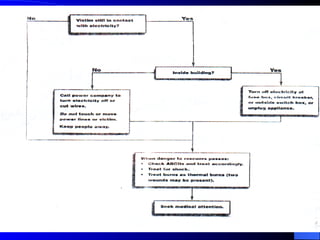
FirstAid:!
safety first!
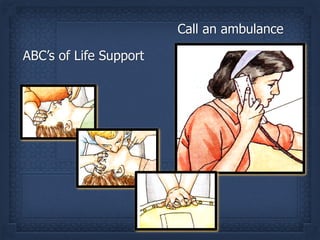
checkABC!
Treat for shock!
hospital
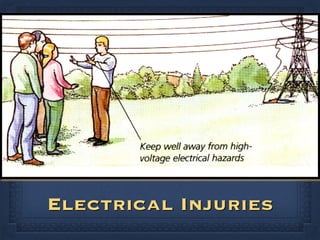
Electrical Injuries
Approaching the Victim
ABC’s of Life Support
Call an ambulance
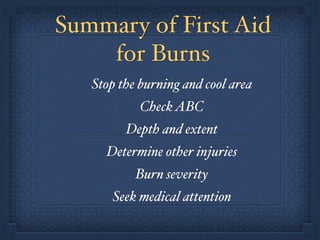
Summary of First Aid
for Burns
Stop the burning and cool area!
CheckABC!
Depth and extent!
Determine other injuries!
Burn severity!
Seek medical attention
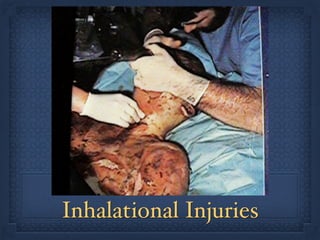
Inhalational Injuries
CARBON MONOXIDE TOXICITY

Carbon monoxide toxicity - leading
cause of death in fires
While oxygen is being used during
combustion,
carbon monoxide is being released -
it is a basic by-product of combustion.
Carbon monoxide is rapidly
transported across the alveolar
membrane (lungs)
and preferentially binds with the
hemoglobin molecule (RBC) in place
of oxygen.
CARBON MONOXIDE TOXICITY

shifts the Hb-O2 curve to the left,
impairing oxygen unloading at the
tissues
a major impairment in oxygen delivery,
since 98% of oxygen is carried to the
tissues on Hb
prolonged exposure, CO can saturate
the cell,
binding to cytochrome oxidase,
thereby further
impairing mitochondrial function and
adenosine triphosphate (ATP)
production.
CARBON MONOXIDE TOXICITY

SYMPTOMS:
usually not present until
carboxyhemoglobin > 15%.
those of decreased tissue oxygenation,
initial manifestations being neurologic
due to the impairment in cerebral
oxygenation.
myocardial dysfunction can also
develop,
with evidence of myocardial ischemia or
even infarction,
especially with preexisting coronary
artery disease.
CARBON MONOXIDE TOXICITY

SYMPTOMS:
neurologic dysfunction can lead to a
progressive/permanent cerebral
dysfunction.
patient will awaken transiently after
severe inhalation injury only to have
progressive neurologic deterioration 24
to 48 hrs later.
Cyanide toxicity - very similar to carbon
monoxide, with severe metabolic
acidosis and obtundation in severe
cases.
Diagnosis - more difficult because
cyanide levels not readily available
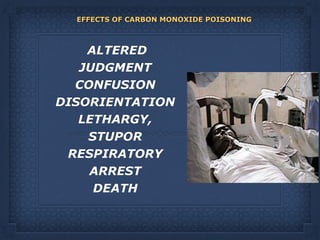
EFFECTS OF CARBON MONOXIDE POISONING


ALTERED
JUDGMENT

CONFUSION

DISORIENTATION

LETHARGY,
STUPOR

RESPIRATORY
ARREST

DEATH
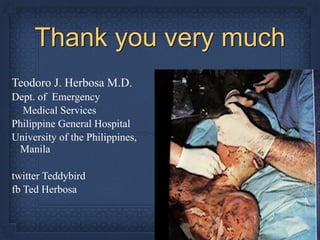
Thank you very much
Teodoro J. Herbosa M.D.
Dept. of Emergency
Medical Services
Philippine General Hospital
University of the Philippines,
Manila
!
twitter Teddybird
fb Ted Herbosa

Prehospital burns

  • 1.
    Prehospital and Emergency RoomCare for Burns Teodoro J. Herbosa MD FPCS! Department of Emergency Medicine! Division of Trauma Dept of Surgery! Philippine General Hospital! University of the Philippines, Manila! Former Undersecretary DoH
  • 2.
    BURN INJURIES:
 A SERIOUSPUBLIC HEALTH PROBLEM • Globally a serious public health problem • Devastating injury - 4th most common injury • >195,000 deaths yearly from fires alone • More deaths from scald, electrical burns, & other forms of burns • Global data are not available
  • 3.
    • Fire-related deathsrank among the 15 leading causes of death - children & young adults 5-29 yrs ! • > 95% of fatal burns occur in low/middle- income countries ! • < 5 yrs and elderly (> 70 yrs) - highest mortality rates
  • 4.
    • millions leftwith disabilities & disfigurement resulting in stigma • more tragic as burns are so eminently preventable
  • 5.
    BURN TREATMENT The natureand complexity of severe burn injury requires a collaborative approach to patient care. This is provided by a multi-disciplinary team with expertise in the management of severe burns with supporting services such as: prehospital, emergency room, critical care, surgery, reconstruction and rehabilitation.
  • 6.
    • Bringing togetherthe expertise required to coordinate clinical services across the continuum of care - from first responder, prehospital, initial hospital admission through to hospital discharge, rehabilitation and ongoing care. • Sharing clinical expertise • Developing standardized clinical practice guidelines for patient care • Increasing the focus on prevention, improving links to community outreach services for patients and undertaking research to improve patient care
  • 7.
    A great numberof patients who had burn injuries were alive upon reaching the hospital
  • 8.
    Most patients withburn injuries are treated and sent home while some are being admitted
  • 9.
    Most burn patientsimproved after treatment.
  • 10.
    PATHOGENESIS OF BURNINJURY (INITIAL AND DELAYED)
 KEY INSULTS Heat Induced Injury ! Inflammatory Mediator Injury ! Ischemia Induced Injury
  • 11.
    Burns : resultsfrom dry heat, corrosive substances/friction! ! !! Scalds: caused by wet heat! ! General Principles:! first address your own safety! stop burning! cover injury! obtain medical aid
  • 12.
    Classification of burns! !! ! thermal! !chemical! !electrical
  • 13.
  • 14.
    First Degree Burn Involvesthe epidermis! Redness, mild swelling! Tenderness, pain! E.g. mild sunburn! First aid! relieve pain! dec pain/infl! moisturizer
  • 15.
    Second Degree Burn Dermisand epidermis! Blister formation, looks raw! Swelling ,severe pain! First aid! analgesic! hospital! cover! Topical antibiotic
  • 16.
    Third Degree Burn Skin,fats, muscles! Leathery,waxy charred! No pain! Hospital! Cover ! Treat for shock
  • 17.
    Extent of Burns Estimatingthe body surface ! Rule of palm! victims hand,it represents 1% ! for small of scattered burn! Large burn, unburned subtract to 100%
  • 18.
  • 19.
    Pointers: seek medicalattention ! Burns of face, hands, feet and genital are more severe! Circumferential burn! Age( < 5 y/o,>55 y/o)! Electrical injury! Child abuse is suspected! Surface of 2 degree >15% of BSA! 3rd burn
  • 20.
  • 21.
    Chemical burns: ! caustic orcorrosive substance! alkalis ( drain cleaners)! acids (battery acids)! organic compounds(petroleum products)! FirstAid:! flood flush with water > 20 min
  • 22.
    remove contaminated clothing! steriledressing! hospital! chemical burn to eye flush with water
  • 24.
    Electrocution Current of 1,000volts or > high voltage! Entrance and exit wound! Disrupt normal heart rhythm! FirstAid:! safety first! checkABC! Treat for shock! hospital
  • 25.
  • 26.
  • 27.
    ABC’s of LifeSupport Call an ambulance
  • 28.
    Summary of FirstAid for Burns Stop the burning and cool area! CheckABC! Depth and extent! Determine other injuries! Burn severity! Seek medical attention
  • 29.
  • 30.
    CARBON MONOXIDE TOXICITY
 Carbonmonoxide toxicity - leading cause of death in fires While oxygen is being used during combustion, carbon monoxide is being released - it is a basic by-product of combustion. Carbon monoxide is rapidly transported across the alveolar membrane (lungs) and preferentially binds with the hemoglobin molecule (RBC) in place of oxygen.
  • 31.
    CARBON MONOXIDE TOXICITY
 shiftsthe Hb-O2 curve to the left, impairing oxygen unloading at the tissues a major impairment in oxygen delivery, since 98% of oxygen is carried to the tissues on Hb prolonged exposure, CO can saturate the cell, binding to cytochrome oxidase, thereby further impairing mitochondrial function and adenosine triphosphate (ATP) production.
  • 32.
    CARBON MONOXIDE TOXICITY
 SYMPTOMS: usuallynot present until carboxyhemoglobin > 15%. those of decreased tissue oxygenation, initial manifestations being neurologic due to the impairment in cerebral oxygenation. myocardial dysfunction can also develop, with evidence of myocardial ischemia or even infarction, especially with preexisting coronary artery disease.
  • 33.
    CARBON MONOXIDE TOXICITY
 SYMPTOMS: neurologicdysfunction can lead to a progressive/permanent cerebral dysfunction. patient will awaken transiently after severe inhalation injury only to have progressive neurologic deterioration 24 to 48 hrs later. Cyanide toxicity - very similar to carbon monoxide, with severe metabolic acidosis and obtundation in severe cases. Diagnosis - more difficult because cyanide levels not readily available
  • 34.
    EFFECTS OF CARBONMONOXIDE POISONING
 
 
 ALTERED JUDGMENT
 CONFUSION
 DISORIENTATION
 LETHARGY, STUPOR
 RESPIRATORY ARREST
 DEATH
  • 35.
    Thank you verymuch Teodoro J. Herbosa M.D. Dept. of Emergency Medical Services Philippine General Hospital University of the Philippines, Manila ! twitter Teddybird fb Ted Herbosa