DANNY F. MARIBAO
High School – Faculty
BLWC
 Women should start
taking care of themselves
before becoming pregnant
 Good health habits during
childhood and adolescence
help prepare a woman for
childbearing
“Be good to your baby before
it is born”
 As soon as she
believes she is
pregnant seek
prenatal care
◦Always need good
medical care,
whether it is her first,
second, or a later
pregnancy.
 Most of the time, a woman
does not know she is
pregnant until several
weeks after conception.
 Many signs can indicate
pregnancy
◦No single sign is, by
itself, a sure sign of
pregnancy.
1. Missed menstrual period
◦ Delay of 10 or more days
◦ May stop for other reasons:
•Emotional
stress
•Changes in
climate
•diet
•Exercise
•Rapid change
in body weigh
•Chronic
diseases
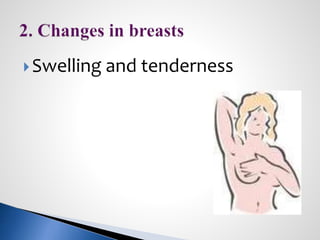
Swelling and tenderness
 May occur at any time
of the day
 About 1/2-1/3
experience
 Occurring at the same
time daily through 4th
month –12th week good
sign.
 Usually occurs in 1st
trimester as body adjusts.
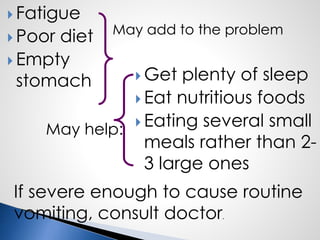
 Fatigue
 Poor diet
 Empty
stomach  Get plenty of sleep
 Eat nutritious foods
 Eating several small
meals rather than 2-
3 large ones
May add to the problem
May help:
If severe enough to cause routine
vomiting, consult doctor.
Growing uterus puts
pressure on the bladder
Hormones may also cause
more frequent urination
 As body adjusts to pregnancy,
may feel very tired
 May sleep more than usual
and need to take naps
 For some – lasts throughout 1st
trimester
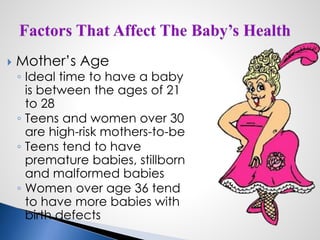
 Mother’s Age
◦ Ideal time to have a baby
is between the ages of 21
to 28
◦ Teens and women over 30
are high-risk mothers-to-be
◦ Teens tend to have
premature babies, stillborn
and malformed babies
◦ Women over age 36 tend
to have more babies with
birth defects
 Mothers Weight
◦ Non-pregnant weight is below 85% of her proper weight
could endanger her and her child’s health
 Mother’s body meets her dietary need before it
meets the needs of her baby.
 Underweight woman’s body will first use her food
intake to correct her own vitamin deficiencies. Thus
pass fewer nutrients to the baby
 Underweight women often have low-birth weight
infants
( under 5 ½ pounds)
◦ Women whose nonpregnant weight is above 120%
 Uses a greater proportion of her food intake for
energy
 High blood pressure, diabetes (body’s inability to
utilize sugar) and delivery problems are more likely.
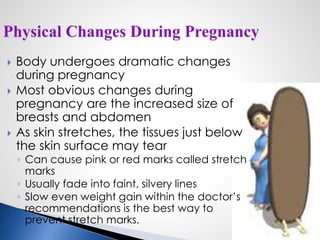
 Body undergoes dramatic changes
during pregnancy
 Most obvious changes during
pregnancy are the increased size of
breasts and abdomen
 As skin stretches, the tissues just below
the skin surface may tear
◦ Can cause pink or red marks called stretch
marks
◦ Usually fade into faint, silvery lines
◦ Slow even weight gain within the doctor’s
recommendations is the best way to
prevent stretch marks.
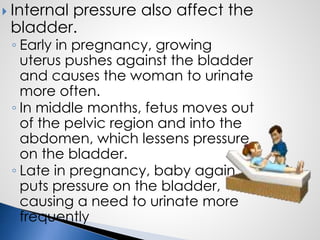
 Internal pressure also affect the
bladder.
◦ Early in pregnancy, growing
uterus pushes against the bladder
and causes the woman to urinate
more often.
◦ In middle months, fetus moves out
of the pelvic region and into the
abdomen, which lessens pressure
on the bladder.
◦ Late in pregnancy, baby again
puts pressure on the bladder,
causing a need to urinate more
frequently
 Not as obvious as physical ones- just as
real.
 Important influence on emotions is how
she feels about being pregnant.
 Hormones cause many of a woman’s
emotional changes during pregnancy.
 Positive thoughts and feelings are
impossible for a woman to have a
health baby.
 Feelings stimulate the nervous system
and the flow of adrenaline (hormone
that prepares the body to cope with
stress; makes person feel more
energetic.)
 When happy adrenaline level is low,
heartbeat and breathing are slow, and
muscles are relaxed.
 When stressed, adrenaline crosses
placenta to baby, carrying stress
signals.
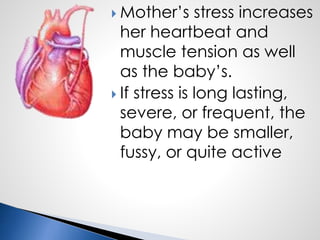
 Mother’s stress increases
her heartbeat and
muscle tension as well
as the baby’s.
 If stress is long lasting,
severe, or frequent, the
baby may be smaller,
fussy, or quite active
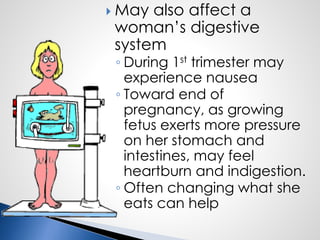
 May also affect a
woman’s digestive
system
◦ During 1st trimester may
experience nausea
◦ Toward end of
pregnancy, as growing
fetus exerts more pressure
on her stomach and
intestines, may feel
heartburn and indigestion.
◦ Often changing what she
eats can help
DANNY F. MARIBAO
High School – Faculty
BLWC

Pregnancy

  • 1.
    DANNY F. MARIBAO HighSchool – Faculty BLWC
  • 2.
     Women shouldstart taking care of themselves before becoming pregnant  Good health habits during childhood and adolescence help prepare a woman for childbearing “Be good to your baby before it is born”
  • 3.
     As soonas she believes she is pregnant seek prenatal care ◦Always need good medical care, whether it is her first, second, or a later pregnancy.
  • 4.
     Most ofthe time, a woman does not know she is pregnant until several weeks after conception.  Many signs can indicate pregnancy ◦No single sign is, by itself, a sure sign of pregnancy.
  • 5.
    1. Missed menstrualperiod ◦ Delay of 10 or more days ◦ May stop for other reasons: •Emotional stress •Changes in climate •diet •Exercise •Rapid change in body weigh •Chronic diseases
  • 6.
  • 7.
     May occurat any time of the day  About 1/2-1/3 experience  Occurring at the same time daily through 4th month –12th week good sign.  Usually occurs in 1st trimester as body adjusts.
  • 8.
     Fatigue  Poordiet  Empty stomach  Get plenty of sleep  Eat nutritious foods  Eating several small meals rather than 2- 3 large ones May add to the problem May help: If severe enough to cause routine vomiting, consult doctor.
  • 9.
    Growing uterus puts pressureon the bladder Hormones may also cause more frequent urination
  • 10.
     As bodyadjusts to pregnancy, may feel very tired  May sleep more than usual and need to take naps  For some – lasts throughout 1st trimester
  • 11.
     Mother’s Age ◦Ideal time to have a baby is between the ages of 21 to 28 ◦ Teens and women over 30 are high-risk mothers-to-be ◦ Teens tend to have premature babies, stillborn and malformed babies ◦ Women over age 36 tend to have more babies with birth defects
  • 12.
     Mothers Weight ◦Non-pregnant weight is below 85% of her proper weight could endanger her and her child’s health  Mother’s body meets her dietary need before it meets the needs of her baby.  Underweight woman’s body will first use her food intake to correct her own vitamin deficiencies. Thus pass fewer nutrients to the baby  Underweight women often have low-birth weight infants ( under 5 ½ pounds) ◦ Women whose nonpregnant weight is above 120%  Uses a greater proportion of her food intake for energy  High blood pressure, diabetes (body’s inability to utilize sugar) and delivery problems are more likely.
  • 13.
     Body undergoesdramatic changes during pregnancy  Most obvious changes during pregnancy are the increased size of breasts and abdomen  As skin stretches, the tissues just below the skin surface may tear ◦ Can cause pink or red marks called stretch marks ◦ Usually fade into faint, silvery lines ◦ Slow even weight gain within the doctor’s recommendations is the best way to prevent stretch marks.
  • 14.
     Internal pressurealso affect the bladder. ◦ Early in pregnancy, growing uterus pushes against the bladder and causes the woman to urinate more often. ◦ In middle months, fetus moves out of the pelvic region and into the abdomen, which lessens pressure on the bladder. ◦ Late in pregnancy, baby again puts pressure on the bladder, causing a need to urinate more frequently
  • 15.
     Not asobvious as physical ones- just as real.  Important influence on emotions is how she feels about being pregnant.  Hormones cause many of a woman’s emotional changes during pregnancy.  Positive thoughts and feelings are impossible for a woman to have a health baby.
  • 16.
     Feelings stimulatethe nervous system and the flow of adrenaline (hormone that prepares the body to cope with stress; makes person feel more energetic.)  When happy adrenaline level is low, heartbeat and breathing are slow, and muscles are relaxed.  When stressed, adrenaline crosses placenta to baby, carrying stress signals.
  • 17.
     Mother’s stressincreases her heartbeat and muscle tension as well as the baby’s.  If stress is long lasting, severe, or frequent, the baby may be smaller, fussy, or quite active
  • 18.
     May alsoaffect a woman’s digestive system ◦ During 1st trimester may experience nausea ◦ Toward end of pregnancy, as growing fetus exerts more pressure on her stomach and intestines, may feel heartburn and indigestion. ◦ Often changing what she eats can help
  • 19.
    DANNY F. MARIBAO HighSchool – Faculty BLWC