WELCOME
RUCHISMITA JENA
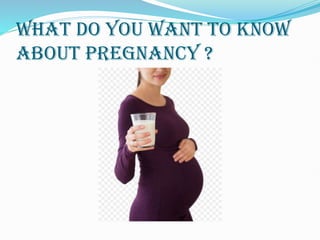
WHAT DO YOU WANT TO KNOW
ABOUT PREGNANCY ?
OVERVIEW
Pregnancy occurs when a sperm fertilizes an egg after it’s
released from the ovary during ovulation . The fertilized
egg then travels down into the uterus , where implantation
occurs . A successful implantation results in pregnancy.
On average , a full-term pregnancy lasts 40 weeks . There are
many factors that can affect a pregnancy . Women who
receive an early pregnancy diagnosis and prenatal care are
more likely to experience a healthy pregnancy and give
birth to a healthy baby .
Knowing what to expect during the full pregnancy term is
important for monitoring both your health and the health
of the baby . If you’d like to prevent pregnancy .there are
also effective forms of birth control you should keep in
mind.
SYMPTOMS OF PREGNANCY
You may notice some signs and symptoms before you even take a pregnancy test. Others will appear weeks later , as your
hormone levels change.
 Missed period
 Headache
 Spotting
 Weight gain
 Pregnancy-induced hypertension
 Heartburn
 Constipation
 Cramps
 Back pain
 Anemia
 Depression
 Insomnia
 Breast changes
 Acne
 Vomiting
 Hip pain
 Diarrhea
 Stress and pregnancy
The bottom line
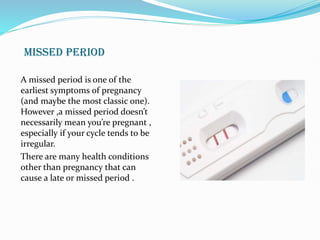
MISSED PERIOD
A missed period is one of the
earliest symptoms of pregnancy
(and maybe the most classic one).
However ,a missed period doesn’t
necessarily mean you’re pregnant ,
especially if your cycle tends to be
irregular.
There are many health conditions
other than pregnancy that can
cause a late or missed period .
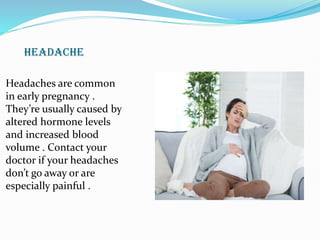
HEADACHE
Headaches are common
in early pregnancy .
They’re usually caused by
altered hormone levels
and increased blood
volume . Contact your
doctor if your headaches
don’t go away or are
especially painful .
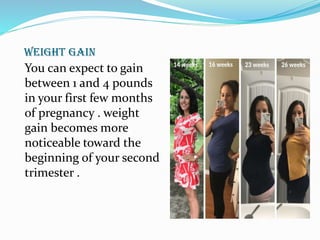
WEIGHT GAIN
You can expect to gain
between 1 and 4 pounds
in your first few months
of pregnancy . weight
gain becomes more
noticeable toward the
beginning of your second
trimester .
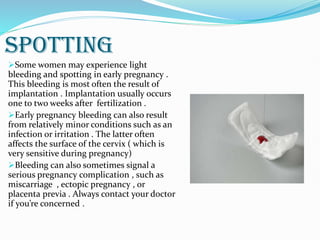
SPOTTING
Some women may experience light
bleeding and spotting in early pregnancy .
This bleeding is most often the result of
implantation . Implantation usually occurs
one to two weeks after fertilization .
Early pregnancy bleeding can also result
from relatively minor conditions such as an
infection or irritation . The latter often
affects the surface of the cervix ( which is
very sensitive during pregnancy)
Bleeding can also sometimes signal a
serious pregnancy complication , such as
miscarriage , ectopic pregnancy , or
placenta previa . Always contact your doctor
if you’re concerned .
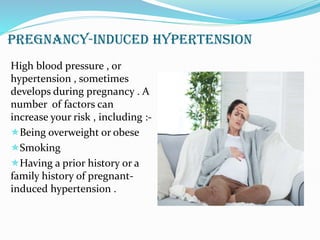
PREGNANCY-INDUCED HYPERTENSION
High blood pressure , or
hypertension , sometimes
develops during pregnancy . A
number of factors can
increase your risk , including :-
Being overweight or obese
Smoking
Having a prior history or a
family history of pregnant-
induced hypertension .
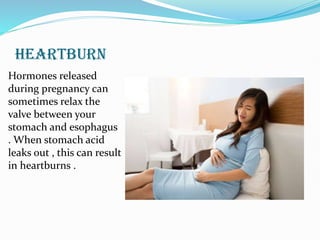
HEARTBURN
Hormones released
during pregnancy can
sometimes relax the
valve between your
stomach and esophagus
. When stomach acid
leaks out , this can result
in heartburns .
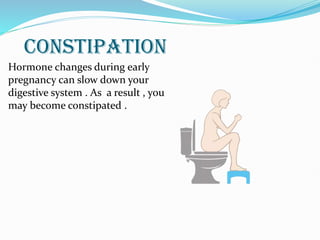
CONSTIPATION
Hormone changes during early
pregnancy can slow down your
digestive system . As a result , you
may become constipated .
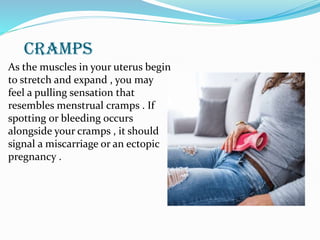
CRAMPS
As the muscles in your uterus begin
to stretch and expand , you may
feel a pulling sensation that
resembles menstrual cramps . If
spotting or bleeding occurs
alongside your cramps , it should
signal a miscarriage or an ectopic
pregnancy .
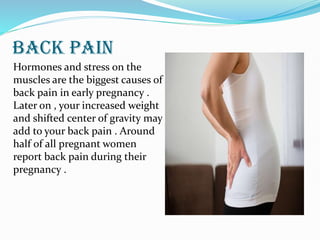
BACK PAIN
Hormones and stress on the
muscles are the biggest causes of
back pain in early pregnancy .
Later on , your increased weight
and shifted center of gravity may
add to your back pain . Around
half of all pregnant women
report back pain during their
pregnancy .
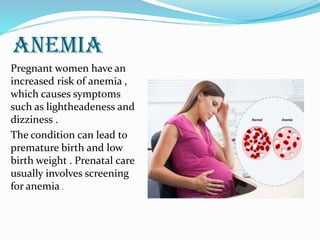
ANEMIA
Pregnant women have an
increased risk of anemia ,
which causes symptoms
such as lightheadeness and
dizziness .
The condition can lead to
premature birth and low
birth weight . Prenatal care
usually involves screening
for anemia .
DEPRESSION
Between 14 and 23 percent
of all pregnant women
develop depression during
their pregnancy . The
many biological and
emotional changes you
experience can be
contributing causes .
Be sure to tell your doctor
if you don’t feel like your
usual self .
INSOMNIA
Insomnia is another common
symptoms of early pregnancy .
Stress , physical discomfort , and
hormonal changes can be
contributing causes . A balanced
diet , good sleep habits , and yoga
stretches can all help you get a
good night ’s sleep .
BREAST CHANGES
Breast changes are one of the first
noticeable signs of pregnancy . Even
before you’re far enough along for a
positive test , Your breasts may begin
to feel tender , swollen , and
generally heavy or full . Your nipples
may also become larger and more
sensitive , and the areolae may
darken .
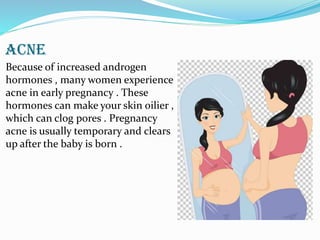
ACNE
Because of increased androgen
hormones , many women experience
acne in early pregnancy . These
hormones can make your skin oilier ,
which can clog pores . Pregnancy
acne is usually temporary and clears
up after the baby is born .
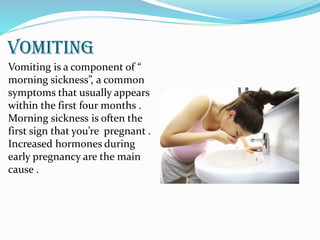
VOMITING
Vomiting is a component of “
morning sickness”, a common
symptoms that usually appears
within the first four months .
Morning sickness is often the
first sign that you’re pregnant .
Increased hormones during
early pregnancy are the main
cause .
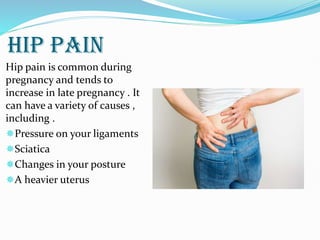
HIP PAIN
Hip pain is common during
pregnancy and tends to
increase in late pregnancy . It
can have a variety of causes ,
including .
Pressure on your ligaments
Sciatica
Changes in your posture
A heavier uterus
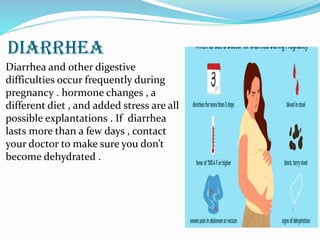
DIARRHEA
Diarrhea and other digestive
difficulties occur frequently during
pregnancy . hormone changes , a
different diet , and added stress are all
possible explantations . If diarrhea
lasts more than a few days , contact
your doctor to make sure you don’t
become dehydrated .
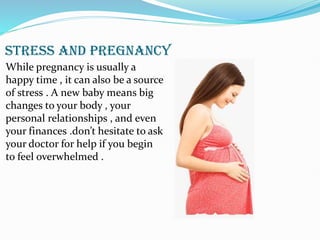
STRESS AND PREGNANCY
While pregnancy is usually a
happy time , it can also be a source
of stress . A new baby means big
changes to your body , your
personal relationships , and even
your finances .don’t hesitate to ask
your doctor for help if you begin
to feel overwhelmed .
THE BOTTOM LINE
 If you think you may be pregnant , you shouldn’t rely
solely on these signs and symptoms for confirmation .
Taking a home pregnancy test or seeing your doctor for
lab testing can confirm a possible pregnancy .
 Many of these signs and symptoms can also be caused
by other health conditions , such as premenstrual
syndrome {PMS} .
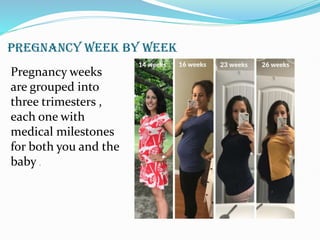
PREGNANCY WEEK BY WEEK
Pregnancy weeks
are grouped into
three trimesters ,
each one with
medical milestones
for both you and the
baby .
FIRST TRIMESTER
 A baby grows rapidly during the first trimester(weeks 1 to
12) . The fetus begins developing their brain , spinal cord ,
and organs . The baby’s heart will also begin to beat .
 During the firsttrimester , the probability of a miscarriage
is relatively high . According to the american college of
obstetricians and gynecologists (ACOG) , it’s estimated
that about 1 to 10 pregnancies end in miscarriage , and that
about 85% of these occur in the first trimester .
 Seek immediate help if you experience the symptoms of
miscarriage .
SECOND TRIMESTER
 During the second trimester of pregnancy (weeks 13 to 27) ,
your healthcare provider will likely perform an anatomy
scan ultrasound .
 This test checks the fetus’s developmental abnormalities .
The test results can also reveal the sex of your baby , if you
wish to find out before the baby is born .
 You’ll probably begin to feel your baby move , kick , and
punch inside of your uterus .
 After 23 weeks , a baby in utero is considered “viable.’’ this
means that it could survive living outside of your womb .
Babies born healthy the longer you are able to carry the
pregnancy .
THIRD TRIMESTER
 During the third trimester (weeks 28 to 40) , your
weight gain will accelerate , and you may feel more
tired .
 Your baby can now sense light as well as open and
close their eyes . Their bones are also formed .
 As labor approaches , you may feel pelvic discomfort ,
and your feet may swell . Contractions that don’t lead
to labor , known as braxton-hicks contractions , may
start to occur in the week before you deliver .
THE BOTTOM LINE
 Every pregnancy is different , but developments will
most likely occur within this general time frame . Find
out more about the changes you and your baby will
undergo throughout the trimesters and sign up for our
i’m expecting newsletter to receive week-by-week
pregnancy guidance .
PREGNANCY TESTS
Home pregnancy tests are very accurate after the
first day of your missed period . If you get a positive
result on a home pregnancy test , you should schedule
an appointment with your doctor right away . An
ultrasound will be used to confirm and date your
pregnancy .
Pregnancy is diagnosed by measuring the body’s
levels of human chorionic gonadotropin(hCP) . Also
referred to as the pregnancy hormone , hCG is
produced upon implantation . However , it may not be
detected untill after you miss a period .
After you miss a period , hCG levels increase rapidly,
hCG is detected through either a urine or a blood test .
Urine tests may be provided at a doctor’s office , and
they’re the same as the tests you can take at home .
Blood tests can be performed in a laboartory . hCG
blood tests are about as home pregnancy tests . The
difference is that blood tests may be ordered as soon
as six days after ovulation .
The sooner you can confirmyou’re pregnant , the
better . An early diagnosis will allow you to take better
care of your baby’s health .
PREGNANCY AND VAGINAL
DISCHARGE
An increase in vaginal discharge is one of
the earliest signs of pregnancy . Your
production of discharge may increase as
early as one to two weeks after conception ,
before you’ve even missed a period .
As your pregnancy progress , you’ll
continue to produce increasing amounts of
discharge . The discharge will also tend to
become thicker and occur more frequently
. It’s usually heaviest at the end of your
pregnancy .
During the final weeks of your
pregnancy . Your discharge may contain
streaks of thick mucus and blood . This is
called “ the bloody show .’’ it can be an
early sign of labor . You should let your
doctor know if you have any bleeding .
CONTD.......
Normal vaginal discharge , or leukorrhea , is thin and
either clear or milky white . It’s also mild-smelling .
If your discharge is yellow , green , or gray with a
strong , unpleasant odor , it’s considered abnormal .
Abnormal discharge can be a sign of an infection or a
problem with your pregnancy , especially if there’s
redness , itching , or vulvular swelling .
If you think you have abnormal vaginal discharge , let
your healthcare provider know immediately .
PREGNANCY AND
URINARY TRACT
INFECTIONS (UTIs)
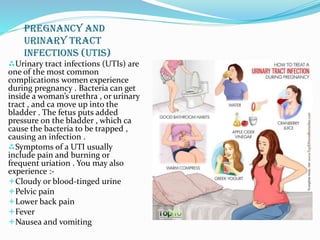
Urinary tract infections (UTIs) are
one of the most common
complications women experience
during pregnancy . Bacteria can get
inside a woman’s urethra , or urinary
tract , and ca move up into the
bladder . The fetus puts added
pressure on the bladder , which ca
cause the bacteria to be trapped ,
causing an infection .
Symptoms of a UTI usually
include pain and burning or
frequent uriation . You may also
experience :-
Cloudy or blood-tinged urine
Pelvic pain
Lower back pain
Fever
Nausea and vomiting
CONTD...........
Nearly 18% of pregnant women develop a UTI . You can
help prevent these infections by emptying your bladder
frequently , especially before and after sex . Drink plenty of
water to stay hydrated . Avoid using douches and harsh
soaps in the gentle area .
Contact your healthcare provider if you healthcare provider
if you have symptoms of a UTI . Infections during
pregnancy can be dangerous because they increase the risk
of premature labor .
When caught early , most UTIs can be treated with
antibiotics that are effective against bacteria but still sage
for use during pregnancy .
PREGNANCY PREVENTION
women who have male sexual
partners should consider birth
control if they’re not interested in
becoming pregnant .
Some methods of pregnancy
prevention work better for certain
individuals . Talk to your doctor
aboutbirth control that’s right for
you . A few of the most comon birth
control methods are discussed
below:-
CONTD..........
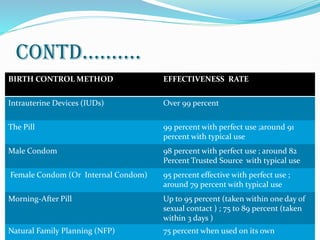
BIRTH CONTROL METHOD EFFECTIVENESS RATE
Intrauterine Devices (IUDs) Over 99 percent
The Pill 99 percent with perfect use ;around 91
percent with typical use
Male Condom 98 percent with perfect use ; around 82
Percent Trusted Source with typical use
Female Condom (Or Internal Condom) 95 percent effective with perfect use ;
around 79 percent with typical use
Morning-After Pill Up to 95 percent (taken within one day of
sexual contact ) ; 75 to 89 percent (taken
within 3 days )
Natural Family Planning (NFP) 75 percent when used on its own
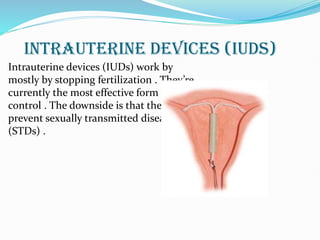
INTRAUTERINE DEVICES (IUDs)
Intrauterine devices (IUDs) work by
mostly by stopping fertilization . They’re
currently the most effective form of birth
control . The downside is that they don’t
prevent sexually transmitted diseases
(STDs) .
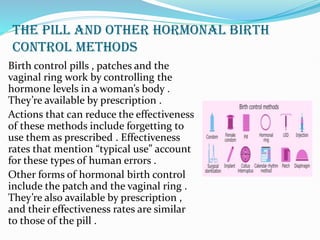
THE PILL AND OTHER HORMONAL BIRTH
CONTROL METHODS
Birth control pills , patches and the
vaginal ring work by controlling the
hormone levels in a woman’s body .
They’re available by prescription .
Actions that can reduce the effectiveness
of these methods include forgetting to
use them as prescribed . Effectiveness
rates that mention “typical use” account
for these types of human errors .
Other forms of hormonal birth control
include the patch and the vaginal ring .
They’re also available by prescription ,
and their effectiveness rates are similar
to those of the pill .
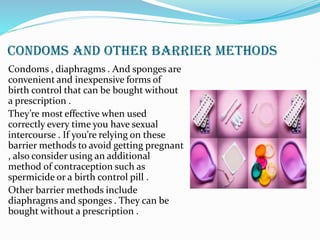
CONDOMS AND OTHER BARRIER METHODS
Condoms , diaphragms . And sponges are
convenient and inexpensive forms of
birth control that can be bought without
a prescription .
They’re most effective when used
correctly every time you have sexual
intercourse . If you’re relying on these
barrier methods to avoid getting pregnant
, also consider using an additional
method of contraception such as
spermicide or a birth control pill .
Other barrier methods include
diaphragms and sponges . They can be
bought without a prescription .
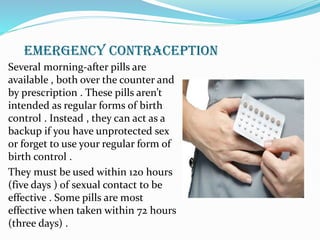
EMERGENCY CONTRACEPTION
Several morning-after pills are
available , both over the counter and
by prescription . These pills aren’t
intended as regular forms of birth
control . Instead , they can act as a
backup if you have unprotected sex
or forget to use your regular form of
birth control .
They must be used within 120 hours
(five days ) of sexual contact to be
effective . Some pills are most
effective when taken within 72 hours
(three days) .
NATURAL FAMILY PLANNING (NFP)
Natural family Planning (NFP) , or
fertility awareness , is the birth control
method with the highest failure rate .
With NFP , a woman tracks her
menstrual cycle so that she can predict
when she’ll ovulate . She’ll then avoid
intercourse during her fertile window .
Accidental pregnancies can occur
because there are many variables
affecting a woman’s cycle from month to
month .
THE BOTTOM LINE
 Condoms are the only birth control method that both
prevent pregnancy and protect against STDs .
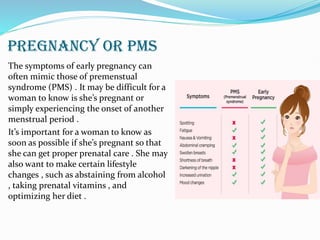
PREGNANCY OR PMS
The symptoms of early pregnancy can
often mimic those of premenstual
syndrome (PMS) . It may be difficult for a
woman to know is she’s pregnant or
simply experiencing the onset of another
menstrual period .
It’s important for a woman to know as
soon as possible if she’s pregnant so that
she can get proper prenatal care . She may
also want to make certain lifestyle
changes , such as abstaining from alcohol
, taking prenatal vitamins , and
optimizing her diet .
CONTD.........
 Taking a pregnancy test is the best , and easiest , way to
determine if it’s PMS or early pregnancy . You can take a
home test or visit your healthcare provider .
 Some common symptoms of both PMS and early
pregnancy include :-
 Breast pain
 Bleeding
 Mood changes
 Fatigue
 Food sensitivities
 Cramping
● Early pregnancy and PMS are often difficult to tell apart .
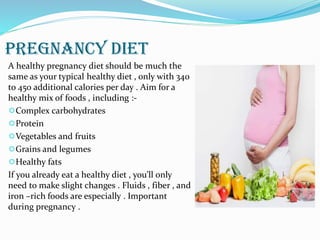
PREGNANCY DIET
A healthy pregnancy diet should be much the
same as your typical healthy diet , only with 340
to 450 additional calories per day . Aim for a
healthy mix of foods , including :-
Complex carbohydrates
Protein
Vegetables and fruits
Grains and legumes
Healthy fats
If you already eat a healthy diet , you’ll only
need to make slight changes . Fluids , fiber , and
iron –rich foods are especially . Important
during pregnancy .
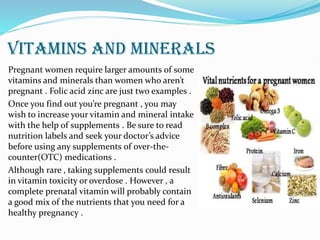
VITAMINS AND MINERALS
Pregnant women require larger amounts of some
vitamins and minerals than women who aren’t
pregnant . Folic acid zinc are just two examples .
Once you find out you’re pregnant , you may
wish to increase your vitamin and mineral intake
with the help of supplements . Be sure to read
nutrition labels and seek your doctor’s advice
before using any supplements of over-the-
counter(OTC) medications .
Although rare , taking supplements could result
in vitamin toxicity or overdose . However , a
complete prenatal vitamin will probably contain
a good mix of the nutrients that you need for a
healthy pregnancy .
THE BOTTOM LINE
Taking care of yourself is one of the best ways to take
care of your growing baby .
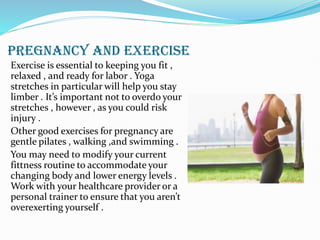
PREGNANCY AND EXERCISE
Exercise is essential to keeping you fit ,
relaxed , and ready for labor . Yoga
stretches in particular will help you stay
limber . It’s important not to overdo your
stretches , however , as you could risk
injury .
Other good exercises for pregnancy are
gentle pilates , walking ,and swimming .
You may need to modify your current
fittness routine to accommodate your
changing body and lower energy levels .
Work with your healthcare provider or a
personal trainer to ensure that you aren’t
overexerting yourself .
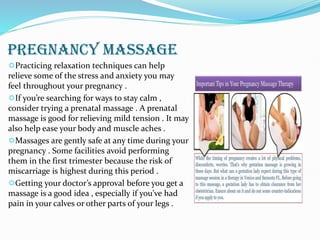
PREGNANCY MASSAGE
Practicing relaxation techniques can help
relieve some of the stress and anxiety you may
feel throughout your pregnancy .
If you’re searching for ways to stay calm ,
consider trying a prenatal massage . A prenatal
massage is good for relieving mild tension . It may
also help ease your body and muscle aches .
Massages are gently safe at any time during your
pregnancy . Some facilities avoid performing
them in the first trimester because the risk of
miscarriage is highest during this period .
Getting your doctor’s approval before you get a
massage is a good idea , especially if you’ve had
pain in your calves or other parts of your legs .
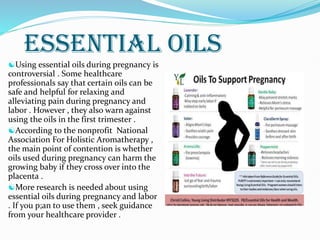
ESSENTIAL OILS
Using essential oils during pregnancy is
controversial . Some healthcare
professionals say that certain oils can be
safe and helpful for relaxing and
alleviating pain during pregnancy and
labor . However , they also warn against
using the oils in the first trimester .
According to the nonprofit National
Association For Holistic Aromatherapy ,
the main point of contention is whether
oils used during pregnancy can harm the
growing baby if they cross over into the
placenta .
More research is needed about using
essential oils during pregnancy and labor
. If you p;an to use them , seek guidance
from your healthcare provider .
THE BOTTOM LINE
 Prenatal massage can be a soothing and tranquil part
of your pregnancy routine , with or without the
essential oils .
WHEN TO SEEK MEDICAL CARE
 Most women in their 20s or early 30s have a good
chance of a problem-free pregnancy . Teens and
women over the age of 35 are at a higher risk for health
complications .
CONTD........
 Underlying Conditions :-
underlying health conditions such as high blood pressure
, diabetes , or cardiovascular disease will increase your risk
of pregnancy complications . Other examples include :-
Cancer
Kidney disease
Epilepsy
If you have one of these conditions , ensure that it’s properly
monitored and treated throughout your pregnancy .
Otherwise , it can lead to miscarriage , poor fetal growth ,
and birth defects .
OTHER RISK FACTORS
Other factors that can affect an otherwise healthy
pregnancy include :-
Multiple-birth pregnancies , such as twins or triplets .
Infections , including STDs .
Being overweight of obese .
anaemia
PREGNANCY COMPLICATIONS
 Pregnancy complications can involve the baby’s health , the
mothers health , or both . They can occur during
pregnancy or delivery .
 Common pregnancy complications include ;
High blood pressure
Gestational diabetes
Preeclampsia
Preterm labor
Miscarriage
● Addressing them early can minimize the harms done to the
mother or the baby .
PREGNANCY AND LABOR
 Sometime after your fourth
month of pregnancy , you may
begin to experience braxton-
hicks contractions , or false labor
. They’re completely normal and
serve to prepare your uterus for
the job ahead of real labor.
 Braxton-hicks contractions don’t
occur at regular intervals , and
they don’t increase in intensity .
If you experience regular
contractions before week 37 ,it
could be preterm labor . If this
occurs , call your healthcare
provider for help .
EARLY LABOR
 Labor contractions are generally classified as early
labor contractions and active labor contractions . Early
labor contractions last between 30 and 45 seconds .
They may be far apart at first , but by the end of early
labor , contractions will be about five minutes apart .
 Your water might break early during labor , or your
doctor may break it for you later on during your labor .
When the cervix begins to open , you’ll see a blood-
tinged discharge coating your mucous plug .
ACTIVE LABOR
 In active labor , the cervix dilates , and the
contractions get closer together and become more
intense .
 If you’re in active labor , you should call your
healthcare provider and head to your birth setting . If
you;re unsure whether it’s active labor , it’s still a good
idea to call and check in .
LABOR PAIN
 Pain will be at its height during active labor . Have a
discussion with your doctor about your preferred method
of dealing with pain .
 You may choose drug-free measures such as mediation ,
yoga , or listening to music .
 If you choose to manage your pain with drugs , your doctor
will need to know whether to use analgesics or anesthetics .
 Analgesics , such as meperidine (demerol) , dull the pain
but allow you to retain some fewling . Anesthetics , such as
epidural , prevent certain muscle movement and
completely block the pain .
THE BOTTOM LINE
 Whether you’re planning for a vaginal or a cesarean
delivery , you may feel nervous as your due date
approaches .
PROGNOSIS
 You’re likely to move through each week of your
pregnancy without too much trouble . Pregnancy
brings with it many changes to your body . But those
changes don’t always have a serious impact on your
health .
 However , certain lifestyle choices can either help or
actively harm your baby’s development .
Contd.......
 Some actions that can keep you and your baby healthy include :
Taking a multivitamin
Getting a sufficient sleep
Practicing safe sex
Getting a flu shot
Visiting your dentist
● Some things you’ll want to avoid include :
Smoking
Drinking alcohol
Eating raw meat , deli meat , or unpasteurized dairy products
Sitting in a hot tub or sauna
Gaining too much weighy
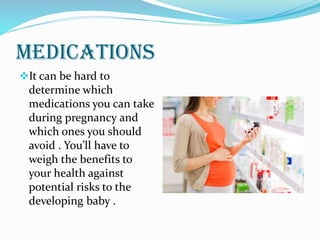
MEDICATIONS
It can be hard to
determine which
medications you can take
during pregnancy and
which ones you should
avoid . You’ll have to
weigh the benefits to
your health against
potential risks to the
developing baby .
CONTD.....
Ask your healthcare provider about any drugs you may
take , even OTC ones for minor aliments such as
headaches .
According to the Food and Drug Adminstration (FDA)
trusted source ,each year 50 percent of pregnant
women in the united states report tak9ing at lest one
medication .
CONTD.......
In the 1970s , the FDA created a letter system trusted
source to categorize drugs and their perceived risk to
pregnant women . However , they began to phase out
this letter system (and use updated drug labelling) in
2015 . Their new rules for drug labelling trusted
source only apply to prescription drugs .
The service mother to baby also provides up-to-date
information on the safety of specific drugs .
THE BOTTOM LINE
 Learning or relearning all the rules of pregnancy can
be overwhelming , especially if you’re having your first
child .feel more prepared with this handy list of
pregnancy do’s and don’ts .
THE TAKEAWAY
Under the affordable care act (ACA) , all health
insurance plans in the united states are required to
offer some level of prenatal care .
Once your pregnancy’s been confirmed , call your
insurance provider to get an idea of what’s covered by
your specific plan . If you don’t have health insurance
when you find out you’re pregnant , speak to your
doctor about steps you can take to get coverage .
CONTD....
 The timing of your first prenatal visit may depend on
your overall health . Most women may have their first
visit during week 8 of pregnancy . Women whose
pregnancies are considered high-risk , such as those
who are over 35 or have chronic conditions , may be
asked to see their doctors earlier .
 There are many ways to mentally and physically
prepare for labor . Many hospitals offer birthing
classes prior to delivery so that women may better
understand the signs and stages of labor .
CONTD......
 In your third trimester , you may want to prepare a
hospital bag of toiletries , sleepwear , and other
everyday essentials . This bag would be ready to take
with you when labor begins . During the third
trimester , you and your doctor should also discuss
your labor and delivery plan in detail .
 Knowing when to go to the birth setting , who’ll be
assisting in the birth , and what role your doctor will
play in the process can contribute to greater peace of
mind as you enter those final weeks .
PREGNANCY AND THERE DIFFERENT STAGES / PPT

PREGNANCY AND THERE DIFFERENT STAGES / PPT

  • 1.
  • 2.
  • 3.
    WHAT DO YOUWANT TO KNOW ABOUT PREGNANCY ?
  • 4.
    OVERVIEW Pregnancy occurs whena sperm fertilizes an egg after it’s released from the ovary during ovulation . The fertilized egg then travels down into the uterus , where implantation occurs . A successful implantation results in pregnancy. On average , a full-term pregnancy lasts 40 weeks . There are many factors that can affect a pregnancy . Women who receive an early pregnancy diagnosis and prenatal care are more likely to experience a healthy pregnancy and give birth to a healthy baby . Knowing what to expect during the full pregnancy term is important for monitoring both your health and the health of the baby . If you’d like to prevent pregnancy .there are also effective forms of birth control you should keep in mind.
  • 5.
    SYMPTOMS OF PREGNANCY Youmay notice some signs and symptoms before you even take a pregnancy test. Others will appear weeks later , as your hormone levels change.  Missed period  Headache  Spotting  Weight gain  Pregnancy-induced hypertension  Heartburn  Constipation  Cramps  Back pain  Anemia  Depression  Insomnia  Breast changes  Acne  Vomiting  Hip pain  Diarrhea  Stress and pregnancy The bottom line
  • 6.
    MISSED PERIOD A missedperiod is one of the earliest symptoms of pregnancy (and maybe the most classic one). However ,a missed period doesn’t necessarily mean you’re pregnant , especially if your cycle tends to be irregular. There are many health conditions other than pregnancy that can cause a late or missed period .
  • 7.
    HEADACHE Headaches are common inearly pregnancy . They’re usually caused by altered hormone levels and increased blood volume . Contact your doctor if your headaches don’t go away or are especially painful .
  • 8.
    WEIGHT GAIN You canexpect to gain between 1 and 4 pounds in your first few months of pregnancy . weight gain becomes more noticeable toward the beginning of your second trimester .
  • 9.
    SPOTTING Some women mayexperience light bleeding and spotting in early pregnancy . This bleeding is most often the result of implantation . Implantation usually occurs one to two weeks after fertilization . Early pregnancy bleeding can also result from relatively minor conditions such as an infection or irritation . The latter often affects the surface of the cervix ( which is very sensitive during pregnancy) Bleeding can also sometimes signal a serious pregnancy complication , such as miscarriage , ectopic pregnancy , or placenta previa . Always contact your doctor if you’re concerned .
  • 10.
    PREGNANCY-INDUCED HYPERTENSION High bloodpressure , or hypertension , sometimes develops during pregnancy . A number of factors can increase your risk , including :- Being overweight or obese Smoking Having a prior history or a family history of pregnant- induced hypertension .
  • 11.
    HEARTBURN Hormones released during pregnancycan sometimes relax the valve between your stomach and esophagus . When stomach acid leaks out , this can result in heartburns .
  • 12.
    CONSTIPATION Hormone changes duringearly pregnancy can slow down your digestive system . As a result , you may become constipated .
  • 13.
    CRAMPS As the musclesin your uterus begin to stretch and expand , you may feel a pulling sensation that resembles menstrual cramps . If spotting or bleeding occurs alongside your cramps , it should signal a miscarriage or an ectopic pregnancy .
  • 14.
    BACK PAIN Hormones andstress on the muscles are the biggest causes of back pain in early pregnancy . Later on , your increased weight and shifted center of gravity may add to your back pain . Around half of all pregnant women report back pain during their pregnancy .
  • 15.
    ANEMIA Pregnant women havean increased risk of anemia , which causes symptoms such as lightheadeness and dizziness . The condition can lead to premature birth and low birth weight . Prenatal care usually involves screening for anemia .
  • 16.
    DEPRESSION Between 14 and23 percent of all pregnant women develop depression during their pregnancy . The many biological and emotional changes you experience can be contributing causes . Be sure to tell your doctor if you don’t feel like your usual self .
  • 17.
    INSOMNIA Insomnia is anothercommon symptoms of early pregnancy . Stress , physical discomfort , and hormonal changes can be contributing causes . A balanced diet , good sleep habits , and yoga stretches can all help you get a good night ’s sleep .
  • 18.
    BREAST CHANGES Breast changesare one of the first noticeable signs of pregnancy . Even before you’re far enough along for a positive test , Your breasts may begin to feel tender , swollen , and generally heavy or full . Your nipples may also become larger and more sensitive , and the areolae may darken .
  • 19.
    ACNE Because of increasedandrogen hormones , many women experience acne in early pregnancy . These hormones can make your skin oilier , which can clog pores . Pregnancy acne is usually temporary and clears up after the baby is born .
  • 20.
    VOMITING Vomiting is acomponent of “ morning sickness”, a common symptoms that usually appears within the first four months . Morning sickness is often the first sign that you’re pregnant . Increased hormones during early pregnancy are the main cause .
  • 21.
    HIP PAIN Hip painis common during pregnancy and tends to increase in late pregnancy . It can have a variety of causes , including . Pressure on your ligaments Sciatica Changes in your posture A heavier uterus
  • 22.
    DIARRHEA Diarrhea and otherdigestive difficulties occur frequently during pregnancy . hormone changes , a different diet , and added stress are all possible explantations . If diarrhea lasts more than a few days , contact your doctor to make sure you don’t become dehydrated .
  • 23.
    STRESS AND PREGNANCY Whilepregnancy is usually a happy time , it can also be a source of stress . A new baby means big changes to your body , your personal relationships , and even your finances .don’t hesitate to ask your doctor for help if you begin to feel overwhelmed .
  • 24.
    THE BOTTOM LINE If you think you may be pregnant , you shouldn’t rely solely on these signs and symptoms for confirmation . Taking a home pregnancy test or seeing your doctor for lab testing can confirm a possible pregnancy .  Many of these signs and symptoms can also be caused by other health conditions , such as premenstrual syndrome {PMS} .
  • 25.
    PREGNANCY WEEK BYWEEK Pregnancy weeks are grouped into three trimesters , each one with medical milestones for both you and the baby .
  • 26.
    FIRST TRIMESTER  Ababy grows rapidly during the first trimester(weeks 1 to 12) . The fetus begins developing their brain , spinal cord , and organs . The baby’s heart will also begin to beat .  During the firsttrimester , the probability of a miscarriage is relatively high . According to the american college of obstetricians and gynecologists (ACOG) , it’s estimated that about 1 to 10 pregnancies end in miscarriage , and that about 85% of these occur in the first trimester .  Seek immediate help if you experience the symptoms of miscarriage .
  • 27.
    SECOND TRIMESTER  Duringthe second trimester of pregnancy (weeks 13 to 27) , your healthcare provider will likely perform an anatomy scan ultrasound .  This test checks the fetus’s developmental abnormalities . The test results can also reveal the sex of your baby , if you wish to find out before the baby is born .  You’ll probably begin to feel your baby move , kick , and punch inside of your uterus .  After 23 weeks , a baby in utero is considered “viable.’’ this means that it could survive living outside of your womb . Babies born healthy the longer you are able to carry the pregnancy .
  • 28.
    THIRD TRIMESTER  Duringthe third trimester (weeks 28 to 40) , your weight gain will accelerate , and you may feel more tired .  Your baby can now sense light as well as open and close their eyes . Their bones are also formed .  As labor approaches , you may feel pelvic discomfort , and your feet may swell . Contractions that don’t lead to labor , known as braxton-hicks contractions , may start to occur in the week before you deliver .
  • 29.
    THE BOTTOM LINE Every pregnancy is different , but developments will most likely occur within this general time frame . Find out more about the changes you and your baby will undergo throughout the trimesters and sign up for our i’m expecting newsletter to receive week-by-week pregnancy guidance .
  • 30.
    PREGNANCY TESTS Home pregnancytests are very accurate after the first day of your missed period . If you get a positive result on a home pregnancy test , you should schedule an appointment with your doctor right away . An ultrasound will be used to confirm and date your pregnancy . Pregnancy is diagnosed by measuring the body’s levels of human chorionic gonadotropin(hCP) . Also referred to as the pregnancy hormone , hCG is produced upon implantation . However , it may not be detected untill after you miss a period . After you miss a period , hCG levels increase rapidly, hCG is detected through either a urine or a blood test . Urine tests may be provided at a doctor’s office , and they’re the same as the tests you can take at home . Blood tests can be performed in a laboartory . hCG blood tests are about as home pregnancy tests . The difference is that blood tests may be ordered as soon as six days after ovulation . The sooner you can confirmyou’re pregnant , the better . An early diagnosis will allow you to take better care of your baby’s health .
  • 31.
    PREGNANCY AND VAGINAL DISCHARGE Anincrease in vaginal discharge is one of the earliest signs of pregnancy . Your production of discharge may increase as early as one to two weeks after conception , before you’ve even missed a period . As your pregnancy progress , you’ll continue to produce increasing amounts of discharge . The discharge will also tend to become thicker and occur more frequently . It’s usually heaviest at the end of your pregnancy . During the final weeks of your pregnancy . Your discharge may contain streaks of thick mucus and blood . This is called “ the bloody show .’’ it can be an early sign of labor . You should let your doctor know if you have any bleeding .
  • 32.
    CONTD....... Normal vaginal discharge, or leukorrhea , is thin and either clear or milky white . It’s also mild-smelling . If your discharge is yellow , green , or gray with a strong , unpleasant odor , it’s considered abnormal . Abnormal discharge can be a sign of an infection or a problem with your pregnancy , especially if there’s redness , itching , or vulvular swelling . If you think you have abnormal vaginal discharge , let your healthcare provider know immediately .
  • 33.
    PREGNANCY AND URINARY TRACT INFECTIONS(UTIs) Urinary tract infections (UTIs) are one of the most common complications women experience during pregnancy . Bacteria can get inside a woman’s urethra , or urinary tract , and ca move up into the bladder . The fetus puts added pressure on the bladder , which ca cause the bacteria to be trapped , causing an infection . Symptoms of a UTI usually include pain and burning or frequent uriation . You may also experience :- Cloudy or blood-tinged urine Pelvic pain Lower back pain Fever Nausea and vomiting
  • 34.
    CONTD........... Nearly 18% ofpregnant women develop a UTI . You can help prevent these infections by emptying your bladder frequently , especially before and after sex . Drink plenty of water to stay hydrated . Avoid using douches and harsh soaps in the gentle area . Contact your healthcare provider if you healthcare provider if you have symptoms of a UTI . Infections during pregnancy can be dangerous because they increase the risk of premature labor . When caught early , most UTIs can be treated with antibiotics that are effective against bacteria but still sage for use during pregnancy .
  • 35.
    PREGNANCY PREVENTION women whohave male sexual partners should consider birth control if they’re not interested in becoming pregnant . Some methods of pregnancy prevention work better for certain individuals . Talk to your doctor aboutbirth control that’s right for you . A few of the most comon birth control methods are discussed below:-
  • 36.
    CONTD.......... BIRTH CONTROL METHODEFFECTIVENESS RATE Intrauterine Devices (IUDs) Over 99 percent The Pill 99 percent with perfect use ;around 91 percent with typical use Male Condom 98 percent with perfect use ; around 82 Percent Trusted Source with typical use Female Condom (Or Internal Condom) 95 percent effective with perfect use ; around 79 percent with typical use Morning-After Pill Up to 95 percent (taken within one day of sexual contact ) ; 75 to 89 percent (taken within 3 days ) Natural Family Planning (NFP) 75 percent when used on its own
  • 37.
    INTRAUTERINE DEVICES (IUDs) Intrauterinedevices (IUDs) work by mostly by stopping fertilization . They’re currently the most effective form of birth control . The downside is that they don’t prevent sexually transmitted diseases (STDs) .
  • 38.
    THE PILL ANDOTHER HORMONAL BIRTH CONTROL METHODS Birth control pills , patches and the vaginal ring work by controlling the hormone levels in a woman’s body . They’re available by prescription . Actions that can reduce the effectiveness of these methods include forgetting to use them as prescribed . Effectiveness rates that mention “typical use” account for these types of human errors . Other forms of hormonal birth control include the patch and the vaginal ring . They’re also available by prescription , and their effectiveness rates are similar to those of the pill .
  • 39.
    CONDOMS AND OTHERBARRIER METHODS Condoms , diaphragms . And sponges are convenient and inexpensive forms of birth control that can be bought without a prescription . They’re most effective when used correctly every time you have sexual intercourse . If you’re relying on these barrier methods to avoid getting pregnant , also consider using an additional method of contraception such as spermicide or a birth control pill . Other barrier methods include diaphragms and sponges . They can be bought without a prescription .
  • 40.
    EMERGENCY CONTRACEPTION Several morning-afterpills are available , both over the counter and by prescription . These pills aren’t intended as regular forms of birth control . Instead , they can act as a backup if you have unprotected sex or forget to use your regular form of birth control . They must be used within 120 hours (five days ) of sexual contact to be effective . Some pills are most effective when taken within 72 hours (three days) .
  • 41.
    NATURAL FAMILY PLANNING(NFP) Natural family Planning (NFP) , or fertility awareness , is the birth control method with the highest failure rate . With NFP , a woman tracks her menstrual cycle so that she can predict when she’ll ovulate . She’ll then avoid intercourse during her fertile window . Accidental pregnancies can occur because there are many variables affecting a woman’s cycle from month to month .
  • 42.
    THE BOTTOM LINE Condoms are the only birth control method that both prevent pregnancy and protect against STDs .
  • 43.
    PREGNANCY OR PMS Thesymptoms of early pregnancy can often mimic those of premenstual syndrome (PMS) . It may be difficult for a woman to know is she’s pregnant or simply experiencing the onset of another menstrual period . It’s important for a woman to know as soon as possible if she’s pregnant so that she can get proper prenatal care . She may also want to make certain lifestyle changes , such as abstaining from alcohol , taking prenatal vitamins , and optimizing her diet .
  • 44.
    CONTD.........  Taking apregnancy test is the best , and easiest , way to determine if it’s PMS or early pregnancy . You can take a home test or visit your healthcare provider .  Some common symptoms of both PMS and early pregnancy include :-  Breast pain  Bleeding  Mood changes  Fatigue  Food sensitivities  Cramping ● Early pregnancy and PMS are often difficult to tell apart .
  • 45.
    PREGNANCY DIET A healthypregnancy diet should be much the same as your typical healthy diet , only with 340 to 450 additional calories per day . Aim for a healthy mix of foods , including :- Complex carbohydrates Protein Vegetables and fruits Grains and legumes Healthy fats If you already eat a healthy diet , you’ll only need to make slight changes . Fluids , fiber , and iron –rich foods are especially . Important during pregnancy .
  • 46.
    VITAMINS AND MINERALS Pregnantwomen require larger amounts of some vitamins and minerals than women who aren’t pregnant . Folic acid zinc are just two examples . Once you find out you’re pregnant , you may wish to increase your vitamin and mineral intake with the help of supplements . Be sure to read nutrition labels and seek your doctor’s advice before using any supplements of over-the- counter(OTC) medications . Although rare , taking supplements could result in vitamin toxicity or overdose . However , a complete prenatal vitamin will probably contain a good mix of the nutrients that you need for a healthy pregnancy .
  • 47.
    THE BOTTOM LINE Takingcare of yourself is one of the best ways to take care of your growing baby .
  • 48.
    PREGNANCY AND EXERCISE Exerciseis essential to keeping you fit , relaxed , and ready for labor . Yoga stretches in particular will help you stay limber . It’s important not to overdo your stretches , however , as you could risk injury . Other good exercises for pregnancy are gentle pilates , walking ,and swimming . You may need to modify your current fittness routine to accommodate your changing body and lower energy levels . Work with your healthcare provider or a personal trainer to ensure that you aren’t overexerting yourself .
  • 49.
    PREGNANCY MASSAGE Practicing relaxationtechniques can help relieve some of the stress and anxiety you may feel throughout your pregnancy . If you’re searching for ways to stay calm , consider trying a prenatal massage . A prenatal massage is good for relieving mild tension . It may also help ease your body and muscle aches . Massages are gently safe at any time during your pregnancy . Some facilities avoid performing them in the first trimester because the risk of miscarriage is highest during this period . Getting your doctor’s approval before you get a massage is a good idea , especially if you’ve had pain in your calves or other parts of your legs .
  • 50.
    ESSENTIAL OILS Using essentialoils during pregnancy is controversial . Some healthcare professionals say that certain oils can be safe and helpful for relaxing and alleviating pain during pregnancy and labor . However , they also warn against using the oils in the first trimester . According to the nonprofit National Association For Holistic Aromatherapy , the main point of contention is whether oils used during pregnancy can harm the growing baby if they cross over into the placenta . More research is needed about using essential oils during pregnancy and labor . If you p;an to use them , seek guidance from your healthcare provider .
  • 51.
    THE BOTTOM LINE Prenatal massage can be a soothing and tranquil part of your pregnancy routine , with or without the essential oils .
  • 52.
    WHEN TO SEEKMEDICAL CARE  Most women in their 20s or early 30s have a good chance of a problem-free pregnancy . Teens and women over the age of 35 are at a higher risk for health complications .
  • 53.
    CONTD........  Underlying Conditions:- underlying health conditions such as high blood pressure , diabetes , or cardiovascular disease will increase your risk of pregnancy complications . Other examples include :- Cancer Kidney disease Epilepsy If you have one of these conditions , ensure that it’s properly monitored and treated throughout your pregnancy . Otherwise , it can lead to miscarriage , poor fetal growth , and birth defects .
  • 54.
    OTHER RISK FACTORS Otherfactors that can affect an otherwise healthy pregnancy include :- Multiple-birth pregnancies , such as twins or triplets . Infections , including STDs . Being overweight of obese . anaemia
  • 55.
    PREGNANCY COMPLICATIONS  Pregnancycomplications can involve the baby’s health , the mothers health , or both . They can occur during pregnancy or delivery .  Common pregnancy complications include ; High blood pressure Gestational diabetes Preeclampsia Preterm labor Miscarriage ● Addressing them early can minimize the harms done to the mother or the baby .
  • 56.
    PREGNANCY AND LABOR Sometime after your fourth month of pregnancy , you may begin to experience braxton- hicks contractions , or false labor . They’re completely normal and serve to prepare your uterus for the job ahead of real labor.  Braxton-hicks contractions don’t occur at regular intervals , and they don’t increase in intensity . If you experience regular contractions before week 37 ,it could be preterm labor . If this occurs , call your healthcare provider for help .
  • 57.
    EARLY LABOR  Laborcontractions are generally classified as early labor contractions and active labor contractions . Early labor contractions last between 30 and 45 seconds . They may be far apart at first , but by the end of early labor , contractions will be about five minutes apart .  Your water might break early during labor , or your doctor may break it for you later on during your labor . When the cervix begins to open , you’ll see a blood- tinged discharge coating your mucous plug .
  • 58.
    ACTIVE LABOR  Inactive labor , the cervix dilates , and the contractions get closer together and become more intense .  If you’re in active labor , you should call your healthcare provider and head to your birth setting . If you;re unsure whether it’s active labor , it’s still a good idea to call and check in .
  • 59.
    LABOR PAIN  Painwill be at its height during active labor . Have a discussion with your doctor about your preferred method of dealing with pain .  You may choose drug-free measures such as mediation , yoga , or listening to music .  If you choose to manage your pain with drugs , your doctor will need to know whether to use analgesics or anesthetics .  Analgesics , such as meperidine (demerol) , dull the pain but allow you to retain some fewling . Anesthetics , such as epidural , prevent certain muscle movement and completely block the pain .
  • 60.
    THE BOTTOM LINE Whether you’re planning for a vaginal or a cesarean delivery , you may feel nervous as your due date approaches .
  • 61.
    PROGNOSIS  You’re likelyto move through each week of your pregnancy without too much trouble . Pregnancy brings with it many changes to your body . But those changes don’t always have a serious impact on your health .  However , certain lifestyle choices can either help or actively harm your baby’s development .
  • 62.
    Contd.......  Some actionsthat can keep you and your baby healthy include : Taking a multivitamin Getting a sufficient sleep Practicing safe sex Getting a flu shot Visiting your dentist ● Some things you’ll want to avoid include : Smoking Drinking alcohol Eating raw meat , deli meat , or unpasteurized dairy products Sitting in a hot tub or sauna Gaining too much weighy
  • 63.
    MEDICATIONS It can behard to determine which medications you can take during pregnancy and which ones you should avoid . You’ll have to weigh the benefits to your health against potential risks to the developing baby .
  • 64.
    CONTD..... Ask your healthcareprovider about any drugs you may take , even OTC ones for minor aliments such as headaches . According to the Food and Drug Adminstration (FDA) trusted source ,each year 50 percent of pregnant women in the united states report tak9ing at lest one medication .
  • 65.
    CONTD....... In the 1970s, the FDA created a letter system trusted source to categorize drugs and their perceived risk to pregnant women . However , they began to phase out this letter system (and use updated drug labelling) in 2015 . Their new rules for drug labelling trusted source only apply to prescription drugs . The service mother to baby also provides up-to-date information on the safety of specific drugs .
  • 66.
    THE BOTTOM LINE Learning or relearning all the rules of pregnancy can be overwhelming , especially if you’re having your first child .feel more prepared with this handy list of pregnancy do’s and don’ts .
  • 67.
    THE TAKEAWAY Under theaffordable care act (ACA) , all health insurance plans in the united states are required to offer some level of prenatal care . Once your pregnancy’s been confirmed , call your insurance provider to get an idea of what’s covered by your specific plan . If you don’t have health insurance when you find out you’re pregnant , speak to your doctor about steps you can take to get coverage .
  • 68.
    CONTD....  The timingof your first prenatal visit may depend on your overall health . Most women may have their first visit during week 8 of pregnancy . Women whose pregnancies are considered high-risk , such as those who are over 35 or have chronic conditions , may be asked to see their doctors earlier .  There are many ways to mentally and physically prepare for labor . Many hospitals offer birthing classes prior to delivery so that women may better understand the signs and stages of labor .
  • 69.
    CONTD......  In yourthird trimester , you may want to prepare a hospital bag of toiletries , sleepwear , and other everyday essentials . This bag would be ready to take with you when labor begins . During the third trimester , you and your doctor should also discuss your labor and delivery plan in detail .  Knowing when to go to the birth setting , who’ll be assisting in the birth , and what role your doctor will play in the process can contribute to greater peace of mind as you enter those final weeks .