1
 Prenatal care is care a woman receives while
she is pregnant.
 Is usually provided by an OB/GYN, family
practice physician, nurse midwife, or other
health professional.
 Monitors how the pregnancy is progressing and
identifies potential health problems.
 Mothers are given information on prenatal tests,
maternal vaccinations, healthy nutrition, alcohol
and substance abuse, smoking, and
environmental and reproductive hazards.
2
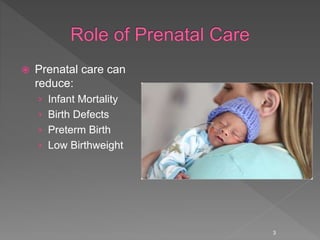
 Prenatal care can
reduce:
› Infant Mortality
› Birth Defects
› Preterm Birth
› Low Birthweight
3
 http://bcove.me/khymbhlm
4
5
6
Kelly Thorman was born at 21 ½ weeks after conception. This
picture was taken three weeks later and Kelly later died of
pneumonia.
7
 Perceived susceptibility
 Perceived severity
 Perceived threat
 Perceived benefits
 Perceived barriers
 Self-efficacy
 Cues to action
8
9
10
11
Cocaine Opiates Marijuana
Perceived financial
barrier did not affect care
Perceived financial
barrier did not affect
care
Perceived financial
barrier did not affect care
Attitudes toward value of
care was a barrier
Attitudes toward value of
care was a barrier
Attitudes toward value of
care was a barrier
Opiate use statistically
significant to explain
lack of care
Negative provider
perceptions were related
to little or no care
Negative provider
perceptions were related
to little or no care
Negative provider
perceptions were related
to little or no care
Efficacy of care related Efficacy of care related Efficacy of care related
Fear of being reported
relate
Fear of being reported
related
Fear of being reported
related
Impediment to Care Statistically Significant
Transportation
Long wait times at the clinic
Too many additional problems
Did not have problems with other pregnancy
Afraid doctor would find out about substance use *
Afraid they would be asked to stop smoking or
drinking
Fear of medical examination *
Felt prenatal care was not needed *
Afraid to find out she was pregnant *
Already knew she was pregnant *
No babysitter for other children *
12
 Perceived barriers, age, country card status,
and benefits to baby explained 22% of
variance in month of prenatal care initiation.
 Women with fewer perceived barriers, were
older, and had a country card were more
likely to enter care earlier.
13
 49.2% of the women initiated care within 3-4
months.
 34% had inadequate care that was initiated
after the fourth month.
 Negative experiences included waiting time,
waking up early to go to the doctor, not
wanting to see the doctor, having motion
sickness, having an examination, and
waiting for transportation.
14
 Women were divided into self-pay,
commercial-pay, and government
subsidized.
 There were no significant differences
between the three pay categories.
15
16
 Reinvent prenatal care as a targeted
intervention (risk appropriate intervention).
 Factor in barriers and facilitators to care
when planning interventions.
 Provide prenatal care to the uninsured.
17

Prenatal Care Powerpoint

  • 1.
  • 2.
     Prenatal careis care a woman receives while she is pregnant.  Is usually provided by an OB/GYN, family practice physician, nurse midwife, or other health professional.  Monitors how the pregnancy is progressing and identifies potential health problems.  Mothers are given information on prenatal tests, maternal vaccinations, healthy nutrition, alcohol and substance abuse, smoking, and environmental and reproductive hazards. 2
  • 3.
     Prenatal carecan reduce: › Infant Mortality › Birth Defects › Preterm Birth › Low Birthweight 3
  • 4.
  • 5.
  • 6.
  • 7.
    Kelly Thorman wasborn at 21 ½ weeks after conception. This picture was taken three weeks later and Kelly later died of pneumonia. 7
  • 8.
     Perceived susceptibility Perceived severity  Perceived threat  Perceived benefits  Perceived barriers  Self-efficacy  Cues to action 8
  • 9.
  • 10.
  • 11.
    11 Cocaine Opiates Marijuana Perceivedfinancial barrier did not affect care Perceived financial barrier did not affect care Perceived financial barrier did not affect care Attitudes toward value of care was a barrier Attitudes toward value of care was a barrier Attitudes toward value of care was a barrier Opiate use statistically significant to explain lack of care Negative provider perceptions were related to little or no care Negative provider perceptions were related to little or no care Negative provider perceptions were related to little or no care Efficacy of care related Efficacy of care related Efficacy of care related Fear of being reported relate Fear of being reported related Fear of being reported related
  • 12.
    Impediment to CareStatistically Significant Transportation Long wait times at the clinic Too many additional problems Did not have problems with other pregnancy Afraid doctor would find out about substance use * Afraid they would be asked to stop smoking or drinking Fear of medical examination * Felt prenatal care was not needed * Afraid to find out she was pregnant * Already knew she was pregnant * No babysitter for other children * 12
  • 13.
     Perceived barriers,age, country card status, and benefits to baby explained 22% of variance in month of prenatal care initiation.  Women with fewer perceived barriers, were older, and had a country card were more likely to enter care earlier. 13
  • 14.
     49.2% ofthe women initiated care within 3-4 months.  34% had inadequate care that was initiated after the fourth month.  Negative experiences included waiting time, waking up early to go to the doctor, not wanting to see the doctor, having motion sickness, having an examination, and waiting for transportation. 14
  • 15.
     Women weredivided into self-pay, commercial-pay, and government subsidized.  There were no significant differences between the three pay categories. 15
  • 16.
  • 17.
     Reinvent prenatalcare as a targeted intervention (risk appropriate intervention).  Factor in barriers and facilitators to care when planning interventions.  Provide prenatal care to the uninsured. 17