Preformulation Study
and Regulation
Presented By-
SAURABH DUBEY
B- Pharm 4th Year
Under the Guidance of-
Mr. Ashutosh Kushwaha ( Associate Prof.)
Department of Pharmaceutics
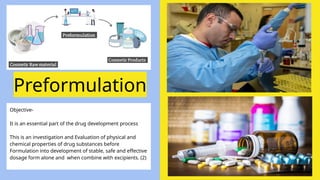
Preformulation
Objective-
It is an essential part of the drug development process
This is an investigation and Evaluation of physical and
chemical properties of drug substances before
Formulation into development of stable, safe and effective
dosage form alone and when combine with excipients. (2)
Content
1-Polymorphism and Pseudopolymorphism
2-Crystalline and Amorphous forms
3-Hygroscopic, Deliquescent, Efflorescent
4-Flow Properties
5-Wetting agent
6-Solubility Analysis
7-Partition Coefficient
8-BCS
8-ICH Guideline
Polymorphism
when a substance exist in more than one crystalline
species with different internal lattice called
Polymorphs
Eg.Theobroma oil - α, β and γ form
It have same chemical but different physical
properties
Most stable Polymorphic form has Highest melting
point and lowest dissolution rate
Wettability, Compressibility & Crystal shape property
of material changes upon polymorphic conversion
The polymorphic form 3rd of riboflavin is 20 times
more soluble than the form 1st
Method for study of polymorphs
1- DSC (Differential scanning calorimetry)
investigation of Solid- solid interaction
2- XRD (X-ray diffraction methods)
3- Melting points (Highest in stable form)
4- Solubility (Amorphous>Metastable>Stable)
5- PXRD (Power X-ray diffraction method)
6- TGA (Thermal gravimetric analysis)
Moisture content determination
Important point
The Metastable Polymorphic forms will generally result in a high dissolution rate
The Stable Polymorphic form of a drug candidate has highest melting point
Polymorphism is important in the Formulation of Capsule
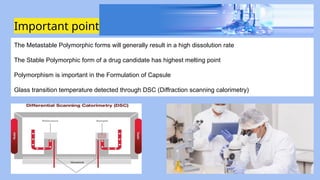
Glass transition temperature detected through DSC (Diffraction scanning calorimetry)
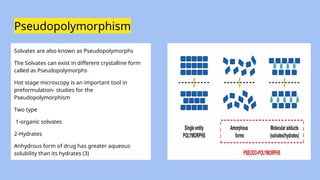
Pseudopolymorphism
Solvates are also known as Pseudopolymorphs
The Solvates can exist in different crystalline form
called as Pseudopolymorphs
Hot stage microscopy is an important tool in
preformulation- studies for the
Pseudopolymorphism
Two type
1-organic solvates
2-Hydrates
Anhydrous form of drug has greater aqueous
solubility than its hydrates (3)
Crystal
Crystalline forms
In Crystalline form structure have
characteristics fixed internal Geometric pattern
These are showing sharp melting point
These are Anisotropic in nature
more stable than amorphous show diffraction
band
Notes- X-ray powder diffraction method used
for the study of Crystalline compound
Amorphous forms
Randomly arranged do not have any fixed
internal structure
Considered as Super cooled fluid
Do not have sharp melting point
These are Isotropic in nature
less stable than crystalline forms
Notes- Single refractive index
Hygroscopic
It is determined by- TGA (Thermogravimetric analysis)
It is used for moisture content determination
The substance which absorb moisture or water from the atmosphere are called Hygroscopic powders
Deliquescent
The substance which absorb moisture or water from atmosphere until it dissolves are called
Deliquescent
Efflorescent
These substance liberate water of crystallization
A crystalline powder that contains water of crystallization or hydration This water can liberated either
during manipulations or an exposure to a low humidity environment then the powder will become
sticky and pasty, or it may even liquefy
Flow Properties
Angle of Repose (3)
It is the maximum Angle possible between surface of
the pile of the Powder and horizontal plane.
It is used to determine flow property of powders
Rough and irregular surface Higher Angle of Repose
Lower the Angle of repose Better the flow properties
θ is directly proportional to Surface roughness
Notes- 25-30[Excellent Flow Properties]
Carr's Consolidation Index
Also known as compressibility
Carr's index is the indication of the Flowability of
a powder
In a Flatter cone free flowing powder, the bulk
density and tapped density would be close in
value
therefore, the carr's index would Small
Notes- 1-10[Excellent Flow Properties]
Wetting Agents
The wetting agent molecule has a portion with an affinity for the particle surface and portion with an affinity for
water. [HLB Value: 7-9]
Wetting is the extent of contact between a liquid and surface , when two are brought in contact with each other
First stage of wetting is Addition of a granulating agent to powder is characterized by- Pendular State
Act in suspension reduce contact Angle between substance and solvent
Contact angle [θ=0°] Complete wetting
Contact angle [θ=90°] Cohesive force=Adhesive force
Wa > Wc - wetting occurs
Wetting agent test
Drave Test :- it is the time taken for wet skin of cotton yarn to skin in wetting solution contained in 500 mL.
Emperic Test ,Trough Test ,Contact Angle method
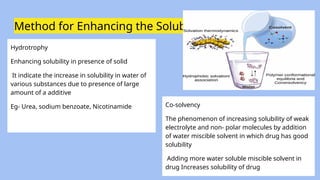
Method for Enhancing the Solubility
Co-solvency
The phenomenon of increasing solubility of weak
electrolyte and non- polar molecules by addition
of water miscible solvent in which drug has good
solubility
Adding more water soluble miscible solvent in
drug Increases solubility of drug
Hydrotrophy
Enhancing solubility in presence of solid
It indicate the increase in solubility in water of
various substances due to presence of large
amount of a additive
Eg- Urea, sodium benzoate, Nicotinamide
Method For Enhancing the Solubility
Complexation
Complexation is association of two or more
species capable of independent existence
it generally result
1-Donor acceptor Mechanism
2-lewis acid-base reaction
Mechanism of beta cyclodextrin for solubilization
EDTA- Hexadentate Ligand
PH modification
The PH of pharmaceutical buffer system can be
calculated by Henderson- Hasselbalch equation
Solubilization
Amount of solid / solute/ drug present in the
solvent at saturated condition at state temperature
and pressure
Order Of Solubility - Amorphous>metastable>stable
HLB value for best solubilizing agent -15
Partition Coefficient(K, PC, P, Pi)
It is also known as- Distribution Coefficient
When a solid is added into two immiscible
liquid/phases it distributed itself between these
two phases in a fixed ratio referred as partition
or distribution coefficient.
If value of PC >1= drug is lipophilic
If value of PC <1= drug is Hydrophilic
Organic Solvent = ocatanal, either, ethyl oleate
acetate, chloroform.
Method for Measurements
Shake flask method
Chromatographic method (HPLC or TLC)
Coulter Counter method
Filter Chrome method
The PH partition hypothesis explain drug
absorption due to- Lipophilicity, Unionized Form
Partition coefficient related with- Lipophilicity
/Hydrophilicity of drug and Rate of drug Absorption
Biopharmaceutical Classification System of Drugs
Proposed by G L Amidon
Maximum drugs falls under BSC Class- II and IV
High solubility and High permeability in Class - I
High permeability drug = > 90% Absorption
95% well absorption in Class- I
Biopharmaceutical Classification System of Drugs
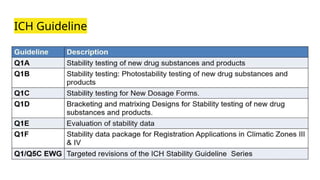
ICH Guidelines
ICH Guideline "international council for Harmonisation of technical requirements for pharmaceuticals for
Human use"
"International conference on Harmonisation of technical registration for registration of pharmaceuticals
for Human use"
As per ICH Guideline India comes in Zone III and IV (whole world divided into 4 zones)
ICH topics divided into 4 categories [QSEM]
Q- Quality [Q1-Q2]
S- Safety
E- Efficacy
M- Multidisciplinary
ICH Guideline
Thank You

Preformulation Study and Regulation.pptx

  • 1.
    Preformulation Study and Regulation PresentedBy- SAURABH DUBEY B- Pharm 4th Year Under the Guidance of- Mr. Ashutosh Kushwaha ( Associate Prof.) Department of Pharmaceutics
  • 2.
    Preformulation Objective- It is anessential part of the drug development process This is an investigation and Evaluation of physical and chemical properties of drug substances before Formulation into development of stable, safe and effective dosage form alone and when combine with excipients. (2)
  • 3.
    Content 1-Polymorphism and Pseudopolymorphism 2-Crystallineand Amorphous forms 3-Hygroscopic, Deliquescent, Efflorescent 4-Flow Properties 5-Wetting agent 6-Solubility Analysis 7-Partition Coefficient 8-BCS 8-ICH Guideline
  • 4.
    Polymorphism when a substanceexist in more than one crystalline species with different internal lattice called Polymorphs Eg.Theobroma oil - α, β and γ form It have same chemical but different physical properties Most stable Polymorphic form has Highest melting point and lowest dissolution rate Wettability, Compressibility & Crystal shape property of material changes upon polymorphic conversion The polymorphic form 3rd of riboflavin is 20 times more soluble than the form 1st Method for study of polymorphs 1- DSC (Differential scanning calorimetry) investigation of Solid- solid interaction 2- XRD (X-ray diffraction methods) 3- Melting points (Highest in stable form) 4- Solubility (Amorphous>Metastable>Stable) 5- PXRD (Power X-ray diffraction method) 6- TGA (Thermal gravimetric analysis) Moisture content determination
  • 5.
    Important point The MetastablePolymorphic forms will generally result in a high dissolution rate The Stable Polymorphic form of a drug candidate has highest melting point Polymorphism is important in the Formulation of Capsule Glass transition temperature detected through DSC (Diffraction scanning calorimetry)
  • 6.
    Pseudopolymorphism Solvates are alsoknown as Pseudopolymorphs The Solvates can exist in different crystalline form called as Pseudopolymorphs Hot stage microscopy is an important tool in preformulation- studies for the Pseudopolymorphism Two type 1-organic solvates 2-Hydrates Anhydrous form of drug has greater aqueous solubility than its hydrates (3)
  • 7.
    Crystal Crystalline forms In Crystallineform structure have characteristics fixed internal Geometric pattern These are showing sharp melting point These are Anisotropic in nature more stable than amorphous show diffraction band Notes- X-ray powder diffraction method used for the study of Crystalline compound Amorphous forms Randomly arranged do not have any fixed internal structure Considered as Super cooled fluid Do not have sharp melting point These are Isotropic in nature less stable than crystalline forms Notes- Single refractive index
  • 8.
    Hygroscopic It is determinedby- TGA (Thermogravimetric analysis) It is used for moisture content determination The substance which absorb moisture or water from the atmosphere are called Hygroscopic powders Deliquescent The substance which absorb moisture or water from atmosphere until it dissolves are called Deliquescent Efflorescent These substance liberate water of crystallization A crystalline powder that contains water of crystallization or hydration This water can liberated either during manipulations or an exposure to a low humidity environment then the powder will become sticky and pasty, or it may even liquefy
  • 9.
    Flow Properties Angle ofRepose (3) It is the maximum Angle possible between surface of the pile of the Powder and horizontal plane. It is used to determine flow property of powders Rough and irregular surface Higher Angle of Repose Lower the Angle of repose Better the flow properties θ is directly proportional to Surface roughness Notes- 25-30[Excellent Flow Properties] Carr's Consolidation Index Also known as compressibility Carr's index is the indication of the Flowability of a powder In a Flatter cone free flowing powder, the bulk density and tapped density would be close in value therefore, the carr's index would Small Notes- 1-10[Excellent Flow Properties]
  • 10.
    Wetting Agents The wettingagent molecule has a portion with an affinity for the particle surface and portion with an affinity for water. [HLB Value: 7-9] Wetting is the extent of contact between a liquid and surface , when two are brought in contact with each other First stage of wetting is Addition of a granulating agent to powder is characterized by- Pendular State Act in suspension reduce contact Angle between substance and solvent Contact angle [θ=0°] Complete wetting Contact angle [θ=90°] Cohesive force=Adhesive force Wa > Wc - wetting occurs Wetting agent test Drave Test :- it is the time taken for wet skin of cotton yarn to skin in wetting solution contained in 500 mL. Emperic Test ,Trough Test ,Contact Angle method
  • 11.
    Method for Enhancingthe Solubility Co-solvency The phenomenon of increasing solubility of weak electrolyte and non- polar molecules by addition of water miscible solvent in which drug has good solubility Adding more water soluble miscible solvent in drug Increases solubility of drug Hydrotrophy Enhancing solubility in presence of solid It indicate the increase in solubility in water of various substances due to presence of large amount of a additive Eg- Urea, sodium benzoate, Nicotinamide
  • 12.
    Method For Enhancingthe Solubility Complexation Complexation is association of two or more species capable of independent existence it generally result 1-Donor acceptor Mechanism 2-lewis acid-base reaction Mechanism of beta cyclodextrin for solubilization EDTA- Hexadentate Ligand PH modification The PH of pharmaceutical buffer system can be calculated by Henderson- Hasselbalch equation Solubilization Amount of solid / solute/ drug present in the solvent at saturated condition at state temperature and pressure Order Of Solubility - Amorphous>metastable>stable HLB value for best solubilizing agent -15
  • 13.
    Partition Coefficient(K, PC,P, Pi) It is also known as- Distribution Coefficient When a solid is added into two immiscible liquid/phases it distributed itself between these two phases in a fixed ratio referred as partition or distribution coefficient. If value of PC >1= drug is lipophilic If value of PC <1= drug is Hydrophilic Organic Solvent = ocatanal, either, ethyl oleate acetate, chloroform. Method for Measurements Shake flask method Chromatographic method (HPLC or TLC) Coulter Counter method Filter Chrome method The PH partition hypothesis explain drug absorption due to- Lipophilicity, Unionized Form Partition coefficient related with- Lipophilicity /Hydrophilicity of drug and Rate of drug Absorption
  • 14.
    Biopharmaceutical Classification Systemof Drugs Proposed by G L Amidon Maximum drugs falls under BSC Class- II and IV High solubility and High permeability in Class - I High permeability drug = > 90% Absorption 95% well absorption in Class- I
  • 15.
  • 16.
    ICH Guidelines ICH Guideline"international council for Harmonisation of technical requirements for pharmaceuticals for Human use" "International conference on Harmonisation of technical registration for registration of pharmaceuticals for Human use" As per ICH Guideline India comes in Zone III and IV (whole world divided into 4 zones) ICH topics divided into 4 categories [QSEM] Q- Quality [Q1-Q2] S- Safety E- Efficacy M- Multidisciplinary
  • 17.
  • 18.

Editor's Notes