PREFORMULATION
STUDIES
CONTENTS
 PREFORMULATION STUDIES
1.ORGANOLEPTIC PROPERTIES
2.BULK CHARACTERSTICS
SOLID STATE
FLOW PROPERTIES
DENSITIES
COMPRESSIBILITY
CRYSTALLINE
POLYMORPHISM
HYGROSCOPCITY
2
 PREFORMULATION
It is defined as the phase of research and
development in which preformulation studies characterize physical
and chemical properties of a drug molecule in order to develop safe,
effective and stable dosage.
 OBJECTIVES OF PREFORMULATION
To establish the physico-chemical parameters of a new drug entity
To determine its kinetics and stability
To establish its compatibility with common excipients
It provides insights into how drug products should be processed and
stored to ensure their quality
3
Bulk characterization:
Crystallinity
• Crystal habit and internal structure of the drug can Effect the bulk and physicochemical
property of the molecule
• Crystal habit is description of outer appearance of crystal.
• Internal structure is molecular arrangement within the solid.
• Change with internal structure usually alters crystal habit. Eg. Conversion of sodium salt
to its free acid form produce both change in internal structure & crystal habit.
Different shapes of crystals
Depending upon The internal structure of the compounds is classified as
1.Crystalline
2.Amorphous
 Crystalline compounds are characterized by repetitious spacing of constituent atom or
molecule in three dimensional array.
 In amorphous form atom or molecule are randomly placed.
 Solubility & dissolution rate are greater for amorphous form than crystalline,as
amorphous form has higher thermodynamic energy.
Eg. Amorphous form of Novobiocin is well absorbed whereas crystalline form
results in poor absorption.
4
Polymorphism:
• It is the ability of the compound to crystallize as more than one distinct crystalline
species with different internal lattice.
• Different crystalline forms are called polymorphs.
• Polymorphs are of 2 types
1. Enatiotropic
2. Monotropic
polymorph which can be changed from one form into another by varying temp or
pressure is called as Enantiotropic polymorph. Eg. Sulphur.
One polymorph which is unstable at all temp. & pressure is called as Monotropic
polymorph. Eg. Glyceryl stearate.
Polymorphs differ from each other with respect to their physical property such as
• Solubility
• Melting point
• Density
• Hardness
• Compression characteristic
Eg. 1)Chloromphenicol exist in A,B & C forms, of these B form is more
stable & most preferable
5
ANALYTICAL METHODS FOR THE CHARACTERIZATION OF SOLID FORMS
Microscopy
Hot stage microscopy
Thermal analysis
X-ray diffraction
Infrared (IR) spectroscopy
Proton magnetic resonance (PMR)
Nuclear magnetic resonance (NMR)
Scanning electron microscopy
MICROSCOPY
• Material with more than one refractive index are anisotropic & appear bright with brilliant
colours against black polarized background.
• The colour intensity depends upon crystal thickness.
• Isotropic material have single refractive index and this substance do not transmit light with
crossed polarizing filter and appears black.
• Advantage : By this method, we can study crystal morphology & difference between
polymorphic form.
• Disadvantage:This require a well trained optical crystallographer, as there are many possible
crystal habit & their appearance at different orientation.
6
Hot stage microscope
• The polarizing microscope fitted with hot stage is useful for investigating
polymorphism, melting point & transition temp.
• Disadvantage :In this technique, the molecules can degrade during the melting
process.
Thermal analysis
• Differential scanning calorimetry (DSC) & Differential thermal analysis are (DTA)
are particularly useful in the investigation of polymorphism.
• It measures the heat loss or gain resulting from physical or chemical changes within a
sample as a function of temp.
• For characterizing crystal forms , the heat of fusion can be obtained from the area
under DSC- curve for melting endotherms.
• Similarly, heat of transition from one polymorph to another may be calculated. A
sharp symmetric melting endotherm can indicate relative purity of molecule. A broad
asymmetric curve indicates presence of impurities
7
HYGROSCOPICITY
• Many drug substances, particularly water –soluble salt forms, have a tendency to adsorb
atmospheric moisture.
• Adsorption and moisture content depend upon the atmospheric humidity, temperature,
surface area, exposure and the mechanism of moisture uptake.
The degree of Hygroscopicity is classified into four classes:
Slightly hygroscopic: increase in weight is ≥ 0.2% w/w and < 2% w/w
Hygroscopic : increase in weight is ≥ 0.2 % w/w and < 15 % w/w
Very hygroscopic : increase in weight is ≥ 15% w/w
Deliquescent : sufficient water is adsorbed to form a solution
Hygroscopicity is tested by:
Samples are exposed to the moisture
exposed to controlled relative humidity environments
moisture uptake is monitored at different time points
Analytical methods which is used are :
• Gravimetry
• Karl Fischer Titration
• Gas chromatography 8
PARTICLE SIZE
• Particle size is characterized using these terms :
• Very coarse, Coarse, Moderately coarse, Fine ,Very fine .
• Particle size can influence variety of important factors :
Dissolution rate
Suspendability
Uniform distribution
Penetrability Lack of grittiness
Methods to Determine Particle Size
 Sieving (5µ-150µ)
 Microscopy(0.2µ-100µ)
 Sedimentation rate method(1µ-200µ)
 Light energy diffraction(0.5µ-500µ)
 Laser holography(1.4µ-100µ)
POWDER FLOW PROPERTIES
• Powder flow properties can be affected by change in particle size, shape & density.
The flow properties depends upon following-
1. Force of friction
2. Cohesion between one particle to another
• Fine particle posses poor flow by filling void spaces between larger particles causing
packing & densification of particles.
• By using glident we can alter the flow properties. e.g. Talc
9
DETERMINATION OF POWDER FLOW PROPERTIES
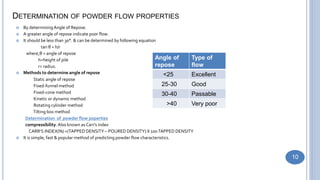
 By determiningAngle of Repose.
 A greater angle of repose indicate poor flow.
 It should be less than 30°. & can be determined by following equation
tan θ = h/r
where,θ = angle of repose
h=height of pile
r= radius.
 Methods to determine angle of repose
Static angle of repose
Fixed-funnel method
Fixed-cone method
Kinetic or dynamic method
Rotating cylinder method
Tilting box method
Determination of powder flow poperties
compressibility.Also known as Carr's index
CARR’S INDEX(%) =(TAPPED DENSITY – POURED DENSITY) X 100TAPPED DENSITY
 It is simple, fast & popular method of predicting powder flow characteristics.
Angle of
repose
Type of
flow
<25 Excellent
25-30 Good
30-40 Passable
>40 Very poor
10
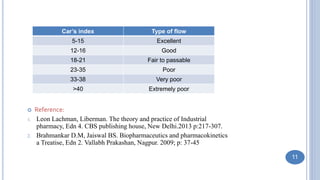
Car’s index Type of flow
5-15 Excellent
12-16 Good
18-21 Fair to passable
23-35 Poor
33-38 Very poor
>40 Extremely poor
 Reference:
1. Leon Lachman, Liberman. The theory and practice of Industrial
pharmacy, Edn 4. CBS publishing house, New Delhi.2013 p:217-307.
2. Brahmankar D.M, Jaiswal BS. Biopharmaceutics and pharmacokinetics
a Treatise, Edn 2. Vallabh Prakashan, Nagpur. 2009; p: 37-45
11

Pharma

  • 1.
  • 2.
    CONTENTS  PREFORMULATION STUDIES 1.ORGANOLEPTICPROPERTIES 2.BULK CHARACTERSTICS SOLID STATE FLOW PROPERTIES DENSITIES COMPRESSIBILITY CRYSTALLINE POLYMORPHISM HYGROSCOPCITY 2
  • 3.
     PREFORMULATION It isdefined as the phase of research and development in which preformulation studies characterize physical and chemical properties of a drug molecule in order to develop safe, effective and stable dosage.  OBJECTIVES OF PREFORMULATION To establish the physico-chemical parameters of a new drug entity To determine its kinetics and stability To establish its compatibility with common excipients It provides insights into how drug products should be processed and stored to ensure their quality 3
  • 4.
    Bulk characterization: Crystallinity • Crystalhabit and internal structure of the drug can Effect the bulk and physicochemical property of the molecule • Crystal habit is description of outer appearance of crystal. • Internal structure is molecular arrangement within the solid. • Change with internal structure usually alters crystal habit. Eg. Conversion of sodium salt to its free acid form produce both change in internal structure & crystal habit. Different shapes of crystals Depending upon The internal structure of the compounds is classified as 1.Crystalline 2.Amorphous  Crystalline compounds are characterized by repetitious spacing of constituent atom or molecule in three dimensional array.  In amorphous form atom or molecule are randomly placed.  Solubility & dissolution rate are greater for amorphous form than crystalline,as amorphous form has higher thermodynamic energy. Eg. Amorphous form of Novobiocin is well absorbed whereas crystalline form results in poor absorption. 4
  • 5.
    Polymorphism: • It isthe ability of the compound to crystallize as more than one distinct crystalline species with different internal lattice. • Different crystalline forms are called polymorphs. • Polymorphs are of 2 types 1. Enatiotropic 2. Monotropic polymorph which can be changed from one form into another by varying temp or pressure is called as Enantiotropic polymorph. Eg. Sulphur. One polymorph which is unstable at all temp. & pressure is called as Monotropic polymorph. Eg. Glyceryl stearate. Polymorphs differ from each other with respect to their physical property such as • Solubility • Melting point • Density • Hardness • Compression characteristic Eg. 1)Chloromphenicol exist in A,B & C forms, of these B form is more stable & most preferable 5
  • 6.
    ANALYTICAL METHODS FORTHE CHARACTERIZATION OF SOLID FORMS Microscopy Hot stage microscopy Thermal analysis X-ray diffraction Infrared (IR) spectroscopy Proton magnetic resonance (PMR) Nuclear magnetic resonance (NMR) Scanning electron microscopy MICROSCOPY • Material with more than one refractive index are anisotropic & appear bright with brilliant colours against black polarized background. • The colour intensity depends upon crystal thickness. • Isotropic material have single refractive index and this substance do not transmit light with crossed polarizing filter and appears black. • Advantage : By this method, we can study crystal morphology & difference between polymorphic form. • Disadvantage:This require a well trained optical crystallographer, as there are many possible crystal habit & their appearance at different orientation. 6
  • 7.
    Hot stage microscope •The polarizing microscope fitted with hot stage is useful for investigating polymorphism, melting point & transition temp. • Disadvantage :In this technique, the molecules can degrade during the melting process. Thermal analysis • Differential scanning calorimetry (DSC) & Differential thermal analysis are (DTA) are particularly useful in the investigation of polymorphism. • It measures the heat loss or gain resulting from physical or chemical changes within a sample as a function of temp. • For characterizing crystal forms , the heat of fusion can be obtained from the area under DSC- curve for melting endotherms. • Similarly, heat of transition from one polymorph to another may be calculated. A sharp symmetric melting endotherm can indicate relative purity of molecule. A broad asymmetric curve indicates presence of impurities 7
  • 8.
    HYGROSCOPICITY • Many drugsubstances, particularly water –soluble salt forms, have a tendency to adsorb atmospheric moisture. • Adsorption and moisture content depend upon the atmospheric humidity, temperature, surface area, exposure and the mechanism of moisture uptake. The degree of Hygroscopicity is classified into four classes: Slightly hygroscopic: increase in weight is ≥ 0.2% w/w and < 2% w/w Hygroscopic : increase in weight is ≥ 0.2 % w/w and < 15 % w/w Very hygroscopic : increase in weight is ≥ 15% w/w Deliquescent : sufficient water is adsorbed to form a solution Hygroscopicity is tested by: Samples are exposed to the moisture exposed to controlled relative humidity environments moisture uptake is monitored at different time points Analytical methods which is used are : • Gravimetry • Karl Fischer Titration • Gas chromatography 8
  • 9.
    PARTICLE SIZE • Particlesize is characterized using these terms : • Very coarse, Coarse, Moderately coarse, Fine ,Very fine . • Particle size can influence variety of important factors : Dissolution rate Suspendability Uniform distribution Penetrability Lack of grittiness Methods to Determine Particle Size  Sieving (5µ-150µ)  Microscopy(0.2µ-100µ)  Sedimentation rate method(1µ-200µ)  Light energy diffraction(0.5µ-500µ)  Laser holography(1.4µ-100µ) POWDER FLOW PROPERTIES • Powder flow properties can be affected by change in particle size, shape & density. The flow properties depends upon following- 1. Force of friction 2. Cohesion between one particle to another • Fine particle posses poor flow by filling void spaces between larger particles causing packing & densification of particles. • By using glident we can alter the flow properties. e.g. Talc 9
  • 10.
    DETERMINATION OF POWDERFLOW PROPERTIES  By determiningAngle of Repose.  A greater angle of repose indicate poor flow.  It should be less than 30°. & can be determined by following equation tan θ = h/r where,θ = angle of repose h=height of pile r= radius.  Methods to determine angle of repose Static angle of repose Fixed-funnel method Fixed-cone method Kinetic or dynamic method Rotating cylinder method Tilting box method Determination of powder flow poperties compressibility.Also known as Carr's index CARR’S INDEX(%) =(TAPPED DENSITY – POURED DENSITY) X 100TAPPED DENSITY  It is simple, fast & popular method of predicting powder flow characteristics. Angle of repose Type of flow <25 Excellent 25-30 Good 30-40 Passable >40 Very poor 10
  • 11.
    Car’s index Typeof flow 5-15 Excellent 12-16 Good 18-21 Fair to passable 23-35 Poor 33-38 Very poor >40 Extremely poor  Reference: 1. Leon Lachman, Liberman. The theory and practice of Industrial pharmacy, Edn 4. CBS publishing house, New Delhi.2013 p:217-307. 2. Brahmankar D.M, Jaiswal BS. Biopharmaceutics and pharmacokinetics a Treatise, Edn 2. Vallabh Prakashan, Nagpur. 2009; p: 37-45 11