PREFORMULATION
Laxmidhar sahoo
Associate professor
Introduction:
Preformulation testing is considered as the first step
before rational development of the dosage form with
a drug molecule.
It involves the exploitation of biopharmaceuticals
principles in selecting the right excipient, right
composition, right processing steps, and right
packaging materials
So, the Preformulation testing is considered the
fundamental aspect of developing robust
formulations and can be considered as a learning
process before actually developing the dosage forms
Disciplines
Medicinal Chemistry and Pharmacology
Pre-formulation Research
Formulation development
Process R&D
Analytical R&D
Toxicology and drug metabolism
Definition:
Preformulation study is defined as the stage of
research and development in which Preformulation
scientist characterize physical and chemical
properties of a drug molecule in order to develop
safe, effective and stable dosage form
When???
• If the drug shows sufficient activity in animals &
is to be evaluated in humans.
Focus……
• On physicochemical properties of a new
compound which may affect the drug
performance &development of efficacious dosage
form.
Objectives:
The preformulation investigations confirm that
there are no significant barriers to the
compound’s development as a marketed drug.
The formulation scientist uses these informations
to develop dosage forms.
Goals of Preformulation:
To generate useful information to the formulator to
design an optimum drug delivery system.
 To establish the necessary physicochemical
parameters of new drug substances.
To determine kinetic rate profile.
To establish physical characteristics.
To establish compatibility with common excipients
Preformulation parameters Method used
Organoleptic Properties Colour and odour determination
Crystallinity & Polymorphism X-ray Diffraction Studies
Fine Particle Characterization Microscopic Method
Solubility Profile Equilibrium Solubility Method
Analytical Method Development UV Spectroscopic Method, HPLC Method
Ionization Constant, pKa Determination of Spectral Shifts by UV
Spectroscopy
Partition Coefficient Using octanol / water
Bulk Density Tapping Method
Powder Flow Properties % Compressibility Determination, Angle of
Repose
Compatibility With Excipient DSC
Stability Solution and Solid State Stability
Stability Indicating Method
Development
Forced Degradation Studies
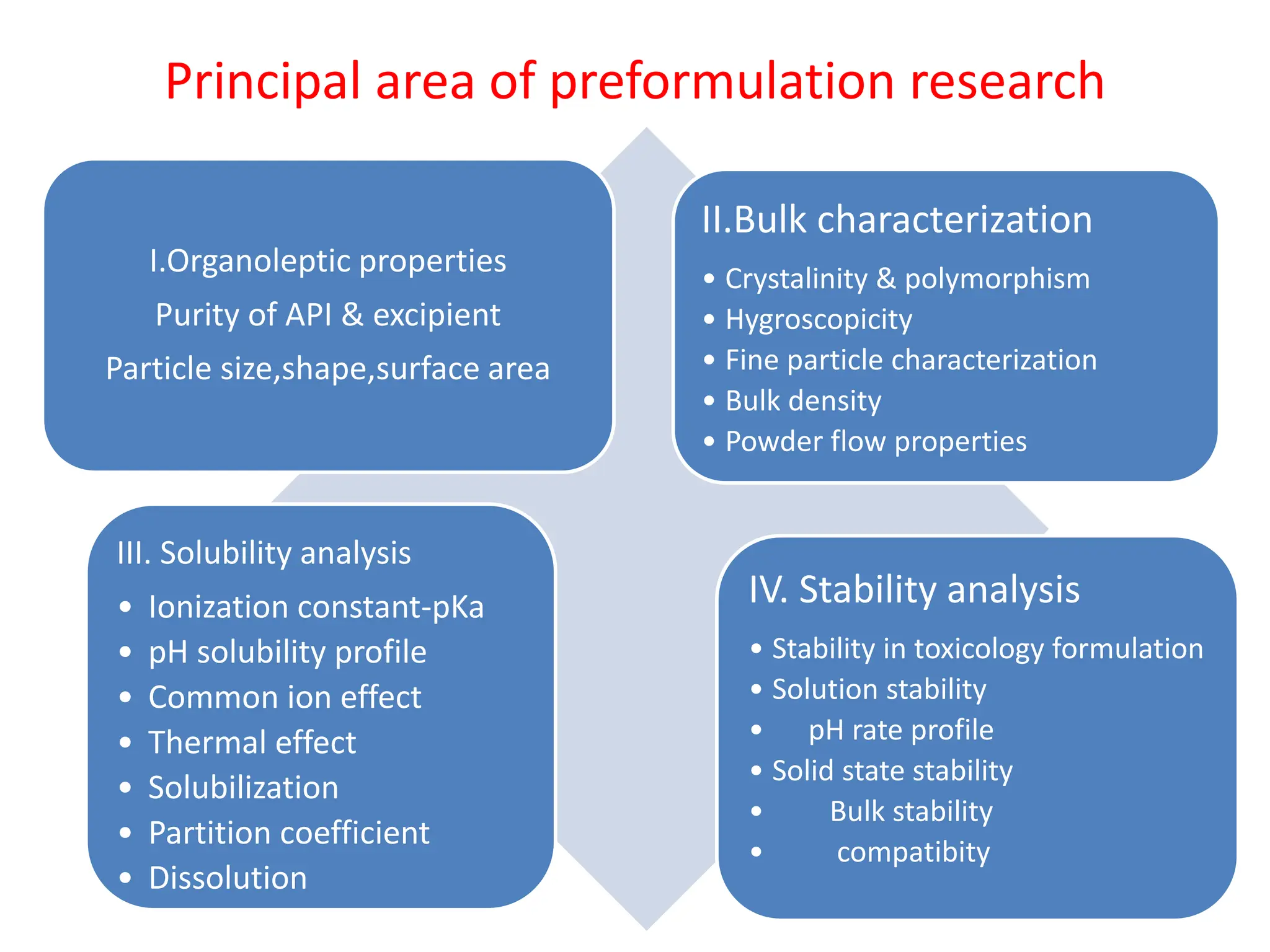
Principal area of preformulation research
I.Organoleptic properties
Purity of API & excipient
Particle size,shape,surface area
II.Bulk characterization
• Crystalinity & polymorphism
• Hygroscopicity
• Fine particle characterization
• Bulk density
• Powder flow properties
III. Solubility analysis
• Ionization constant-pKa
• pH solubility profile
• Common ion effect
• Thermal effect
• Solubilization
• Partition coefficient
• Dissolution
IV. Stability analysis
• Stability in toxicology formulation
• Solution stability
• pH rate profile
• Solid state stability
• Bulk stability
• compatibity
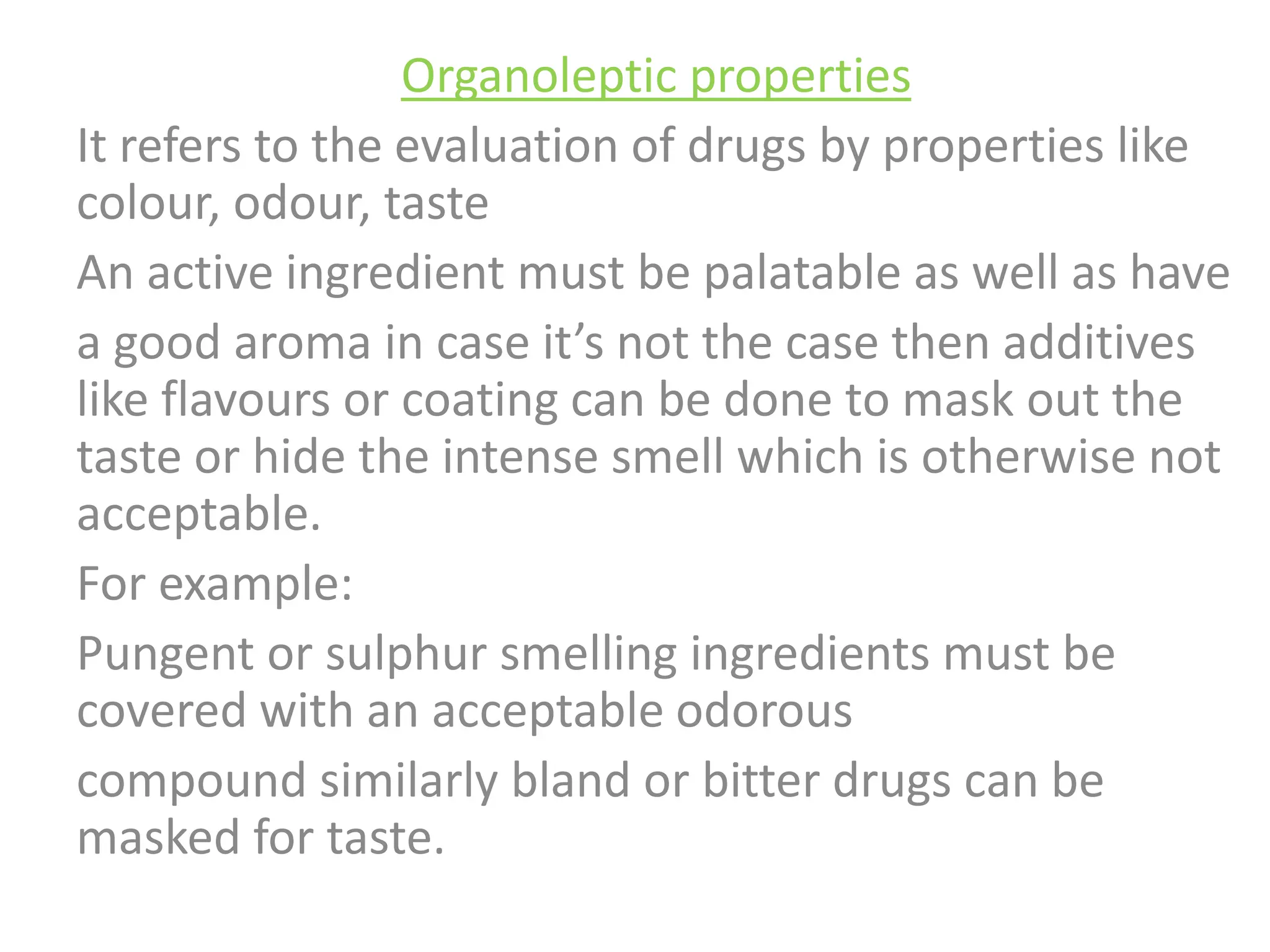
Organoleptic properties
It refers to the evaluation of drugs by properties like
colour, odour, taste
An active ingredient must be palatable as well as have
a good aroma in case it’s not the case then additives
like flavours or coating can be done to mask out the
taste or hide the intense smell which is otherwise not
acceptable.
For example:
Pungent or sulphur smelling ingredients must be
covered with an acceptable odorous
compound similarly bland or bitter drugs can be
masked for taste.
Purity of API and excipient
These solid drugs are pure organic compounds that exist as
either crystalline or amorphous.
The purity of the chemical substance is considered as its
essential quality to comply with various Pharmacopoeial tests
including therapeutic efficacy.
Melting point of a chemical substance is considered its
intrinsic property which can be used as an indicator of purity of
that substance.
As an example, a pure crystalline API can be identified by its
unique and very sharp melting temperature determined by
capillary method.
Apart from that method, purity of an API can be determined
by HPLC, TLC, DSC, or GC. In chromatographic methods,
reference standard of an API is considered 100% pure and
unknown samples are compared against that reference standard
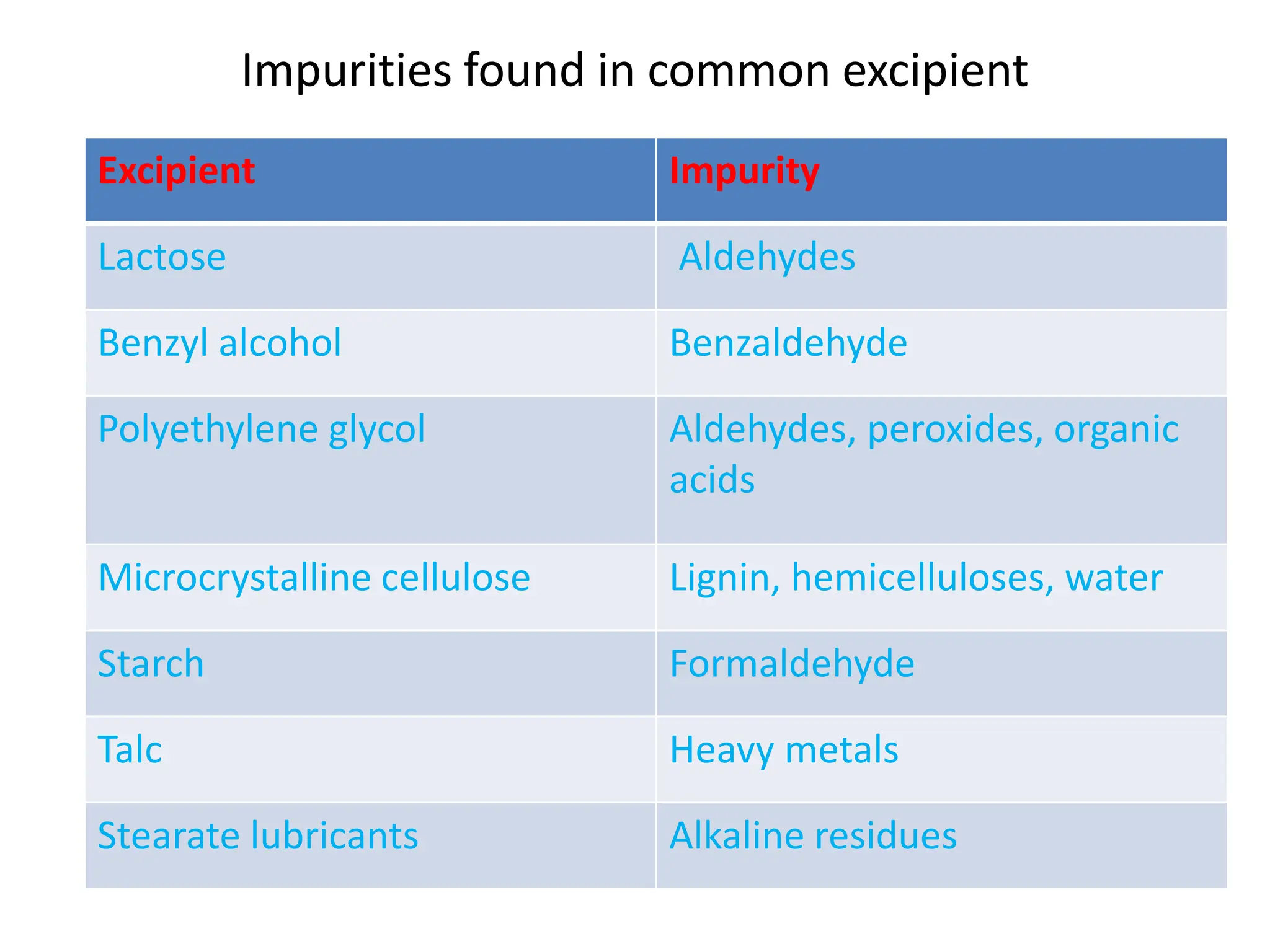
Impurities found in common excipient
Excipient Impurity
Lactose Aldehydes
Benzyl alcohol Benzaldehyde
Polyethylene glycol Aldehydes, peroxides, organic
acids
Microcrystalline cellulose Lignin, hemicelluloses, water
Starch Formaldehyde
Talc Heavy metals
Stearate lubricants Alkaline residues
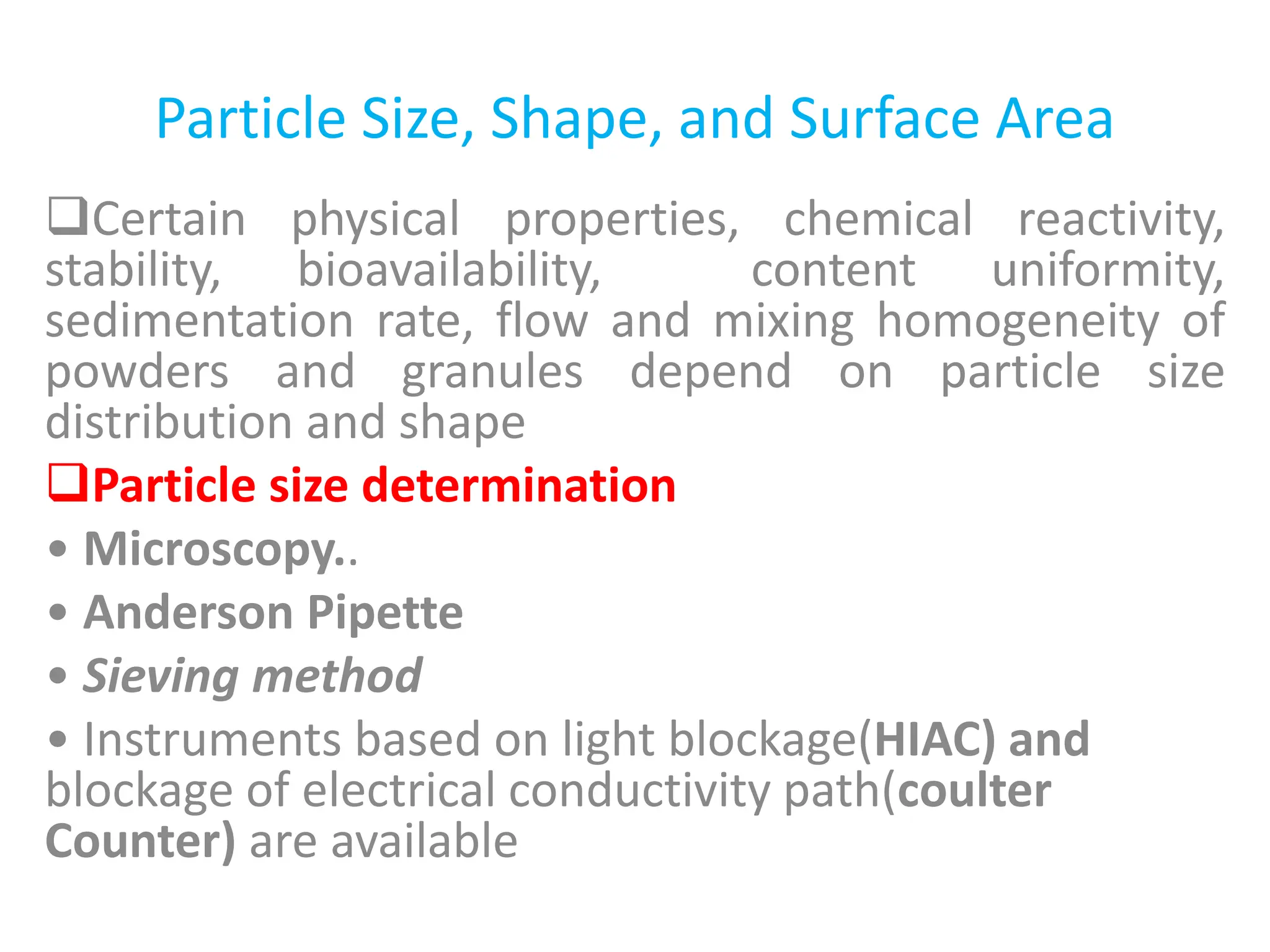
Particle Size, Shape, and Surface Area
Certain physical properties, chemical reactivity,
stability, bioavailability, content uniformity,
sedimentation rate, flow and mixing homogeneity of
powders and granules depend on particle size
distribution and shape
Particle size determination
• Microscopy..
• Anderson Pipette
• Sieving method
• Instruments based on light blockage(HIAC) and
blockage of electrical conductivity path(coulter
Counter) are available
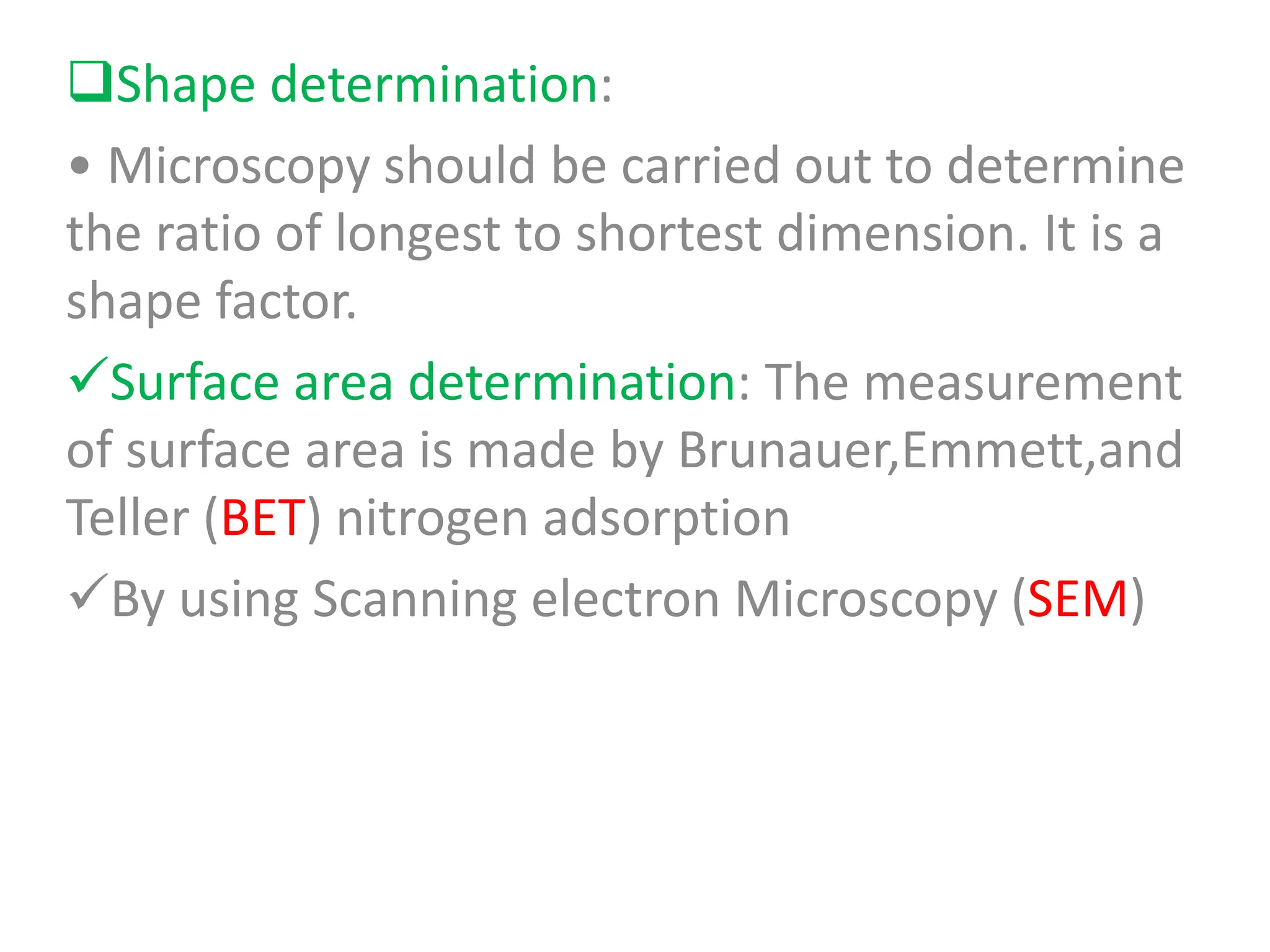
Shape determination:
• Microscopy should be carried out to determine
the ratio of longest to shortest dimension. It is a
shape factor.
Surface area determination: The measurement
of surface area is made by Brunauer,Emmett,and
Teller (BET) nitrogen adsorption
By using Scanning electron Microscopy (SEM)
Bulk characterization
Crystallinity and polymorphism:
Habit is the description of the outer appearance of
a crystal. A single internal-structure for a
compound can have several different habits,
depending on the environment for growing
crystals.
Different habits of crystals are given below.
Platy
Needle or Acicular
Tabular
Equant or Massive
Bladed
Prismatic
Fig. 1
Internal Structure
Crystalline state
In this state of matter atoms or molecules are
arranged in highly ordered form and is associated
with three-dimensional array.
Amorphous forms
In this forms the solids do not have any fixed internal
structure. They have atoms or molecules randomly
placed as in a liquid.
e.g. Amorphous Novobiocin (prepared by rapid
precipitation, lyophillization or rapid cooling of
molten liquids )
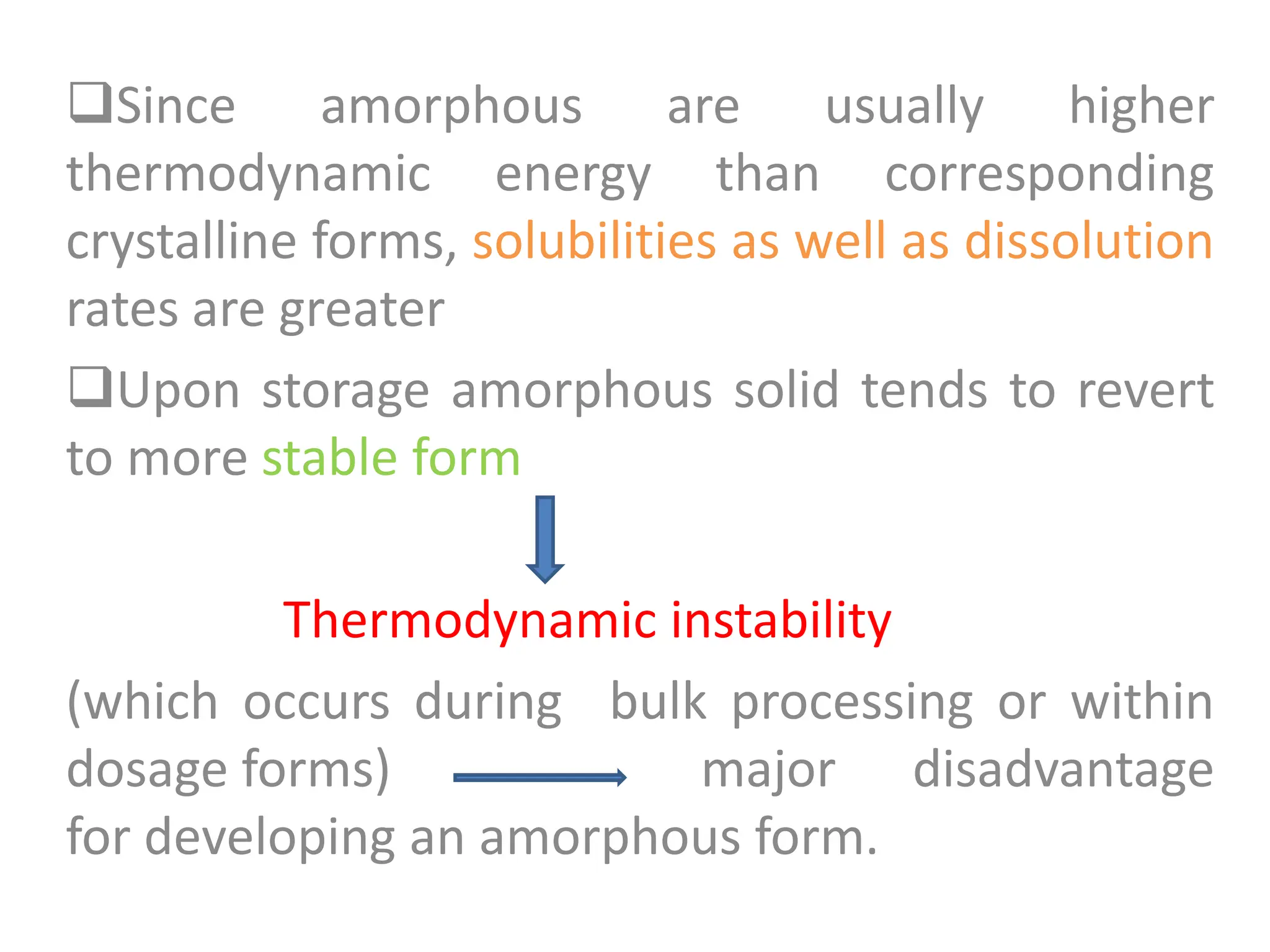
Since amorphous are usually higher
thermodynamic energy than corresponding
crystalline forms, solubilities as well as dissolution
rates are greater
Upon storage amorphous solid tends to revert
to more stable form
Thermodynamic instability
(which occurs during bulk processing or within
dosage forms) major disadvantage
for developing an amorphous form.
Preparation
Amorphous forms are prepared by rapid
precipitation, lyophillization or rapid cooling of
molten liquids
Glass transition temperature, Tg
Tg is a characteristics temperatuer of amorphous
form. Below Tg the amorphous form will be brittle
and is described as glassy state. Above Tg the solid
becomes plastic or rubbery. So Tg is the minimum
temperature at which the solid becomes
amorphous (plastic) from glassy state.
Application:
Tg can be reduced by addition of plasticizers.
Plasticizer molecules, either disturb or distort
the molecular arrangements, thus they
reduce the Tg.
During milling, all the solids must remain
below Tg.
Amorphous novobiocin is more soluble and
has higher bioavailability than its crystalline
form.
Molecular Adducts
During the process of crystallization, some
compounds have a tendency to trap the solvent
molecules.
Non-Stoichiometric inclusion compounds (or adducts)
In these crystals solvent molecules are entrapped
within the crystal lattice and the number of solvent
molecules are not included in stoichiometric number.
Usually this adduct is undesirable owing to its lack of
reproducibility & should be avoided for development
Depending on the shape they are of three types
:-
(1) Channel
When the crystal contains continuous channels in
which the solvent molecule can be included. e.g .
Urea forms channel.
(2) Layers:- Here solvent molecules are
entrapped in between layers of crystals.
(3) Clathrates(Cage):- Solvent molecules are
entrapped within the cavity of the crystal from all
sides.
Stoichiometric inclusion compounds (or stoichiometric adducts)
This molecular complex has incorporated the crystallizing solvent
molecules into specific sites within the crystal lattice and has
stoichiometric number of solvent molecules complexed.
When the incorporated solvent is water, the complex is called
hydrates and when the solvent is other than water, the complex
is called solvates.
Depending on the ratio of water molecules within a complex
the following nomenclature is followed.
Anhydrous : 1 mole compound + 0 mole water
Hemihydrate: 1 mole compound + ½ mole water
Monohydrate: 1 mole compound + 1 mole water
Dihydrate : 1 mole compound + 2 moles water
Identification of possible hydrate compounds
is important since aqueous solubilities can be
significantly less than their anhydrous form
Conversion of an anhydrous compound to a
hydrate with in the dosage form may reduce the
dissolution rate & extent of absorption
Crystallinity
Conversion of an anhydrous compound to a
hydrate with in the dosage form may reduce the
dissolution rate & extent of absorption
,.houra.,,hourn anhydrous compound to a
hydrate within the dosage form
may reduce the dissolution rate &
extent of drug absorption in the
dosage form may reduce the
dissolution rate & extent of drug
absorption
Hours
POLYMORPHISM
When crystals exists in more than one internal structure (i.e.
packing pattern) the various crystalline forms are called
polymorphs and the phenomenon is known as
polymorphism.
Depending on the thermodynamic stability, the polymorphs
are divided into
stable,
metastable
unstable.
Unstable form has a tendency to transform into stable form.
Metastable forms in dry state will remain stable, but if
melted or dissolved will form stable polymorph.
Characteristics of polymorphs
Characteristics Stable polymorph Metastable
polymorph
Unstable
polymorph
Packing of
molecules in crystal
lattice
Tightly packed Less tightly packed Loosely packed
Melting point Highest Moderate Lowest
Rate of dissolution Lowest Moderate Highest
Polymorphism and bioavailability
Many drugs are hydrophobic and have very limited
solubility in water. If the drug remains in several
polymorphic forms then the stable one will
produce the slowest rate of dissolution and it may
show minimum bioavailability.
For highly water soluble drugs, polymorphism does
not show any problem in dissolution rate
Example: Chloramphenicol palmitate has three
polymorphs α (stable), β (metastable) and γ
(unstable).
When chloramphenicol palmitate suspension is
prepared from α or β polymorph it is found that
bioavailabilty is higher with the metastable form.
Example
aspirin: Two polymorphs of can be obtained by
recrystallization of aspirin from 95% ethanol or n-
hexane. The polymorph obtained from n-hexane is
found to have greater solubility in water than the
polymorph obtained from ethanol.
Types of polymorphs
1. Enatiotropic (one polymorphs can be reversibly
changed into another by varying temp &
pressure) (e.g sulfur)
2. Monotropic(one polymorphic form is unstable
at all temp & pressure) e.g -glyceryl stearate
During preformulation study ,it is importamt to
identify stable polymorphs at room temp and
determine whether polymorphic transition is
possible within the temp range used for
stability study and during processing(drying,
milling etc.)
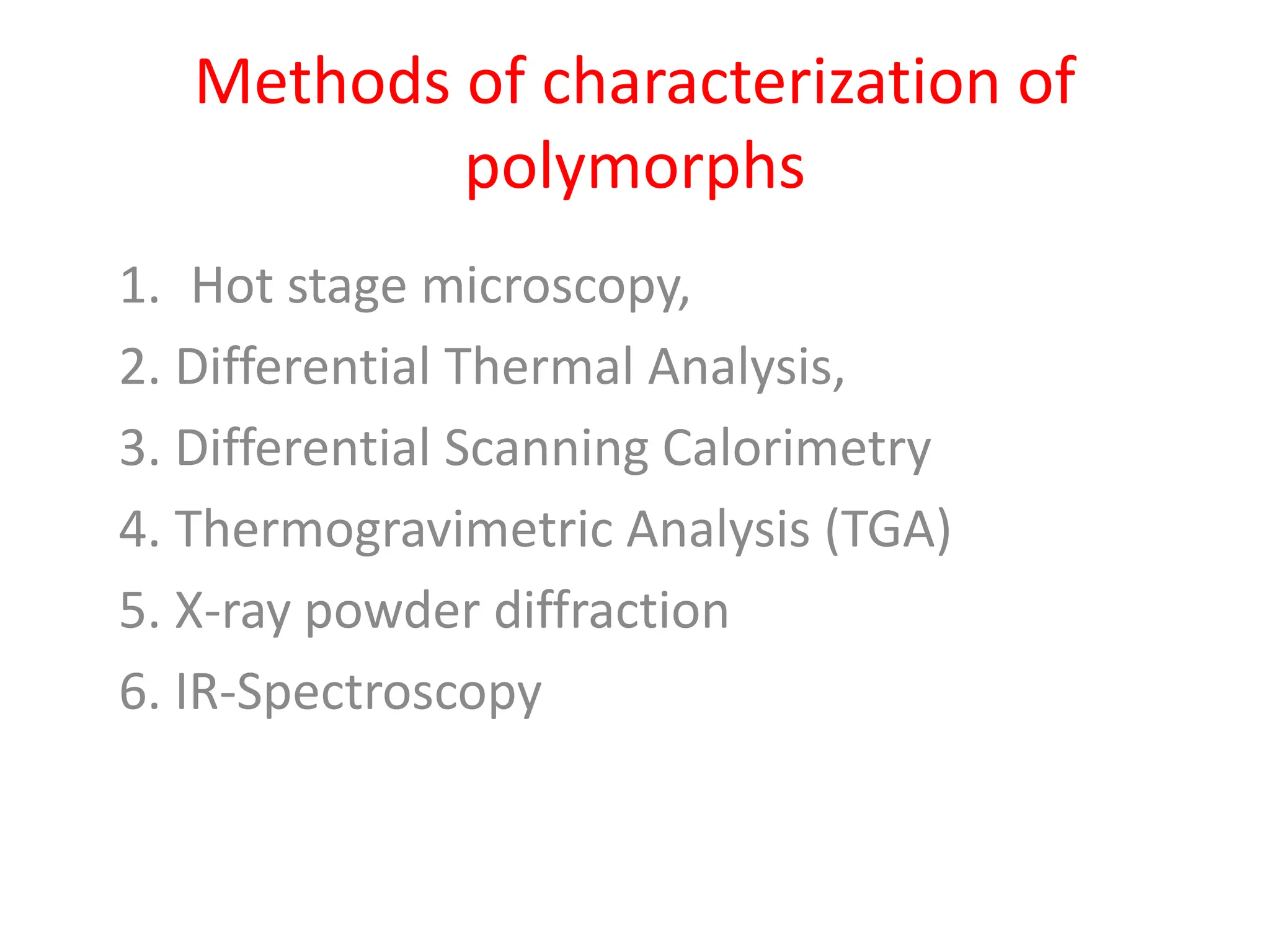
Methods of characterization of
polymorphs
1. Hot stage microscopy,
2. Differential Thermal Analysis,
3. Differential Scanning Calorimetry
4. Thermogravimetric Analysis (TGA)
5. X-ray powder diffraction
6. IR-Spectroscopy

preformulation study ralated to pharmaceuticals

  • 1.
  • 2.
    Introduction: Preformulation testing isconsidered as the first step before rational development of the dosage form with a drug molecule. It involves the exploitation of biopharmaceuticals principles in selecting the right excipient, right composition, right processing steps, and right packaging materials So, the Preformulation testing is considered the fundamental aspect of developing robust formulations and can be considered as a learning process before actually developing the dosage forms
  • 4.
    Disciplines Medicinal Chemistry andPharmacology Pre-formulation Research Formulation development Process R&D Analytical R&D Toxicology and drug metabolism
  • 5.
    Definition: Preformulation study isdefined as the stage of research and development in which Preformulation scientist characterize physical and chemical properties of a drug molecule in order to develop safe, effective and stable dosage form
  • 6.
    When??? • If thedrug shows sufficient activity in animals & is to be evaluated in humans. Focus…… • On physicochemical properties of a new compound which may affect the drug performance &development of efficacious dosage form.
  • 7.
    Objectives: The preformulation investigationsconfirm that there are no significant barriers to the compound’s development as a marketed drug. The formulation scientist uses these informations to develop dosage forms.
  • 8.
    Goals of Preformulation: Togenerate useful information to the formulator to design an optimum drug delivery system.  To establish the necessary physicochemical parameters of new drug substances. To determine kinetic rate profile. To establish physical characteristics. To establish compatibility with common excipients
  • 10.
    Preformulation parameters Methodused Organoleptic Properties Colour and odour determination Crystallinity & Polymorphism X-ray Diffraction Studies Fine Particle Characterization Microscopic Method Solubility Profile Equilibrium Solubility Method Analytical Method Development UV Spectroscopic Method, HPLC Method Ionization Constant, pKa Determination of Spectral Shifts by UV Spectroscopy Partition Coefficient Using octanol / water Bulk Density Tapping Method Powder Flow Properties % Compressibility Determination, Angle of Repose Compatibility With Excipient DSC Stability Solution and Solid State Stability Stability Indicating Method Development Forced Degradation Studies
  • 11.
    Principal area ofpreformulation research I.Organoleptic properties Purity of API & excipient Particle size,shape,surface area II.Bulk characterization • Crystalinity & polymorphism • Hygroscopicity • Fine particle characterization • Bulk density • Powder flow properties III. Solubility analysis • Ionization constant-pKa • pH solubility profile • Common ion effect • Thermal effect • Solubilization • Partition coefficient • Dissolution IV. Stability analysis • Stability in toxicology formulation • Solution stability • pH rate profile • Solid state stability • Bulk stability • compatibity
  • 12.
    Organoleptic properties It refersto the evaluation of drugs by properties like colour, odour, taste An active ingredient must be palatable as well as have a good aroma in case it’s not the case then additives like flavours or coating can be done to mask out the taste or hide the intense smell which is otherwise not acceptable. For example: Pungent or sulphur smelling ingredients must be covered with an acceptable odorous compound similarly bland or bitter drugs can be masked for taste.
  • 13.
    Purity of APIand excipient These solid drugs are pure organic compounds that exist as either crystalline or amorphous. The purity of the chemical substance is considered as its essential quality to comply with various Pharmacopoeial tests including therapeutic efficacy. Melting point of a chemical substance is considered its intrinsic property which can be used as an indicator of purity of that substance. As an example, a pure crystalline API can be identified by its unique and very sharp melting temperature determined by capillary method. Apart from that method, purity of an API can be determined by HPLC, TLC, DSC, or GC. In chromatographic methods, reference standard of an API is considered 100% pure and unknown samples are compared against that reference standard
  • 14.
    Impurities found incommon excipient Excipient Impurity Lactose Aldehydes Benzyl alcohol Benzaldehyde Polyethylene glycol Aldehydes, peroxides, organic acids Microcrystalline cellulose Lignin, hemicelluloses, water Starch Formaldehyde Talc Heavy metals Stearate lubricants Alkaline residues
  • 15.
    Particle Size, Shape,and Surface Area Certain physical properties, chemical reactivity, stability, bioavailability, content uniformity, sedimentation rate, flow and mixing homogeneity of powders and granules depend on particle size distribution and shape Particle size determination • Microscopy.. • Anderson Pipette • Sieving method • Instruments based on light blockage(HIAC) and blockage of electrical conductivity path(coulter Counter) are available
  • 16.
    Shape determination: • Microscopyshould be carried out to determine the ratio of longest to shortest dimension. It is a shape factor. Surface area determination: The measurement of surface area is made by Brunauer,Emmett,and Teller (BET) nitrogen adsorption By using Scanning electron Microscopy (SEM)
  • 17.
  • 18.
    Habit is thedescription of the outer appearance of a crystal. A single internal-structure for a compound can have several different habits, depending on the environment for growing crystals. Different habits of crystals are given below. Platy Needle or Acicular Tabular Equant or Massive Bladed Prismatic Fig. 1
  • 19.
    Internal Structure Crystalline state Inthis state of matter atoms or molecules are arranged in highly ordered form and is associated with three-dimensional array. Amorphous forms In this forms the solids do not have any fixed internal structure. They have atoms or molecules randomly placed as in a liquid. e.g. Amorphous Novobiocin (prepared by rapid precipitation, lyophillization or rapid cooling of molten liquids )
  • 20.
    Since amorphous areusually higher thermodynamic energy than corresponding crystalline forms, solubilities as well as dissolution rates are greater Upon storage amorphous solid tends to revert to more stable form Thermodynamic instability (which occurs during bulk processing or within dosage forms) major disadvantage for developing an amorphous form.
  • 21.
    Preparation Amorphous forms areprepared by rapid precipitation, lyophillization or rapid cooling of molten liquids Glass transition temperature, Tg Tg is a characteristics temperatuer of amorphous form. Below Tg the amorphous form will be brittle and is described as glassy state. Above Tg the solid becomes plastic or rubbery. So Tg is the minimum temperature at which the solid becomes amorphous (plastic) from glassy state.
  • 22.
    Application: Tg can bereduced by addition of plasticizers. Plasticizer molecules, either disturb or distort the molecular arrangements, thus they reduce the Tg. During milling, all the solids must remain below Tg. Amorphous novobiocin is more soluble and has higher bioavailability than its crystalline form.
  • 23.
    Molecular Adducts During theprocess of crystallization, some compounds have a tendency to trap the solvent molecules. Non-Stoichiometric inclusion compounds (or adducts) In these crystals solvent molecules are entrapped within the crystal lattice and the number of solvent molecules are not included in stoichiometric number. Usually this adduct is undesirable owing to its lack of reproducibility & should be avoided for development
  • 24.
    Depending on theshape they are of three types :- (1) Channel When the crystal contains continuous channels in which the solvent molecule can be included. e.g . Urea forms channel. (2) Layers:- Here solvent molecules are entrapped in between layers of crystals. (3) Clathrates(Cage):- Solvent molecules are entrapped within the cavity of the crystal from all sides.
  • 25.
    Stoichiometric inclusion compounds(or stoichiometric adducts) This molecular complex has incorporated the crystallizing solvent molecules into specific sites within the crystal lattice and has stoichiometric number of solvent molecules complexed. When the incorporated solvent is water, the complex is called hydrates and when the solvent is other than water, the complex is called solvates. Depending on the ratio of water molecules within a complex the following nomenclature is followed. Anhydrous : 1 mole compound + 0 mole water Hemihydrate: 1 mole compound + ½ mole water Monohydrate: 1 mole compound + 1 mole water Dihydrate : 1 mole compound + 2 moles water
  • 26.
    Identification of possiblehydrate compounds is important since aqueous solubilities can be significantly less than their anhydrous form Conversion of an anhydrous compound to a hydrate with in the dosage form may reduce the dissolution rate & extent of absorption
  • 27.
    Crystallinity Conversion of ananhydrous compound to a hydrate with in the dosage form may reduce the dissolution rate & extent of absorption ,.houra.,,hourn anhydrous compound to a hydrate within the dosage form may reduce the dissolution rate & extent of drug absorption in the dosage form may reduce the dissolution rate & extent of drug absorption Hours
  • 28.
    POLYMORPHISM When crystals existsin more than one internal structure (i.e. packing pattern) the various crystalline forms are called polymorphs and the phenomenon is known as polymorphism. Depending on the thermodynamic stability, the polymorphs are divided into stable, metastable unstable. Unstable form has a tendency to transform into stable form. Metastable forms in dry state will remain stable, but if melted or dissolved will form stable polymorph.
  • 29.
    Characteristics of polymorphs CharacteristicsStable polymorph Metastable polymorph Unstable polymorph Packing of molecules in crystal lattice Tightly packed Less tightly packed Loosely packed Melting point Highest Moderate Lowest Rate of dissolution Lowest Moderate Highest
  • 30.
    Polymorphism and bioavailability Manydrugs are hydrophobic and have very limited solubility in water. If the drug remains in several polymorphic forms then the stable one will produce the slowest rate of dissolution and it may show minimum bioavailability. For highly water soluble drugs, polymorphism does not show any problem in dissolution rate
  • 31.
    Example: Chloramphenicol palmitatehas three polymorphs α (stable), β (metastable) and γ (unstable). When chloramphenicol palmitate suspension is prepared from α or β polymorph it is found that bioavailabilty is higher with the metastable form. Example aspirin: Two polymorphs of can be obtained by recrystallization of aspirin from 95% ethanol or n- hexane. The polymorph obtained from n-hexane is found to have greater solubility in water than the polymorph obtained from ethanol.
  • 32.
    Types of polymorphs 1.Enatiotropic (one polymorphs can be reversibly changed into another by varying temp & pressure) (e.g sulfur) 2. Monotropic(one polymorphic form is unstable at all temp & pressure) e.g -glyceryl stearate During preformulation study ,it is importamt to identify stable polymorphs at room temp and determine whether polymorphic transition is possible within the temp range used for stability study and during processing(drying, milling etc.)
  • 33.
    Methods of characterizationof polymorphs 1. Hot stage microscopy, 2. Differential Thermal Analysis, 3. Differential Scanning Calorimetry 4. Thermogravimetric Analysis (TGA) 5. X-ray powder diffraction 6. IR-Spectroscopy