GROUP 1
CHRONIC HYPERTENSION IN PREGNANCY AND
PRE- ECLAMPSIA
1/11/2024 1
CHRONIC HYPERTENSION IN PREGNANCY.
• It is defined as hypertension present before pregnancy or before 20
weeks of gestation.
• Chronic hypertension is present in up to 5% of pregnant women.
1/11/2024 2
Chronic Hypertension
• Pre-existing hypertension of any cause,
• Hypertension before 20 weeks in the absence of gestation
• If hypertension persists beyond 12 weeks after delivery
• Overall incidence is 2-4%.
• No proteinuria
1/11/2024 3
Risk factors of chronic hypertensive disease
• Age (>40 years)Duration of hypertension(>15 years)
•Level of blood pressure (>160/110 mm hg)
• Presence of any medical disorder (collagen vascular disease e.g-
lupus)
• Presence of thrombophilias.
1/11/2024 4
Effect of chronic hypertension on pregnancy
-maternal
• Superimposed pre- eclampsia
• eclampsia
-fetal
• Intrauterine growth retardation
• Intrauterine fetal death
1/11/2024 5
Prenatal care for chronic hypertensives-
• Electrocardiogram should be obtained in women with long standing
hypertension.
• Baseline laboratory tests
-urinalysis, urine culture, and serum creatinie, glucose and electrolytes.
-Tests will rule out renal disease and identify comorbidities such as
diabetes mellitus
1/11/2024 6
The common cause of chronic hypertension
1) Essential hypertension
2) Chronic renal disease
3) Coarctation of aorta
4) Endocrine disorders (DM, pheochromocytoma)
5) Connective tissue disease (SLE)
1/11/2024 7
Treatment
• General and medical treatment
• As pre-eclampsia regarding the following
1) Rest
2) antihypertensives
3) observation
1/11/2024 8
• Review medication and inform the patient of the risks involved with
some medications.
• Those on angiontension-converting enzymes (ACE) inhibitors or
angiotensin-II receptor antagonists (AIIRAS) should be switched from
these as soon as possible, as there is increased risk of congenital
abnormalities if these drugs are taken during pregnancy
1/11/2024 9
• Ideally this will have been done at a pre-pregnancy counselling
session; however, if not, it should be done as early as possible in the
pregnanacy.
• Diuretics should be avoided, as they can reduce the blood flow in the
placenta.
1/11/2024 10
Finding Suggestive of Secondary Hypertension
Any of the following findings are suggestive of secondary hypertension
• Resistance hypertension
• Hypokalemia (potassium level less than 3.0mEqL)
• Elevated serum creatinine level (greater than 1.1mg/Dl)
• Strong family history of kidney disease
1/11/2024 11
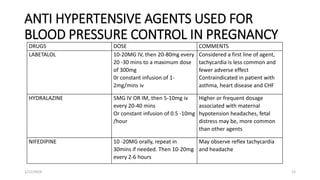
ANTI HYPERTENSIVE AGENTS USED FOR
BLOOD PRESSURE CONTROL IN PREGNANCY
DRUGS DOSE COMMENTS
LABETALOL 10-20MG IV, then 20-80mg every
20 -30 mins to a maximum dose
of 300mg
0r constant infusion of 1-
2mg/mins iv
Considered a first line of agent,
tachycardia is less common and
fewer adverse effect
Contraindicated in patient with
asthma, heart disease and CHF
HYDRALAZINE 5MG IV OR IM, then 5-10mg iv
every 20-40 mins
Or constant infusion of 0.5 -10mg
/hour
Higher or frequent dosage
associated with maternal
hypotension headaches, fetal
distress may be, more common
than other agents
NIFEDIPINE 10 -20MG orally, repeat in
30mins if needed. Then 10-20mg
every 2-6 hours
May observe reflex tachycardia
and headache
1/11/2024 12
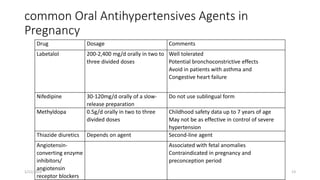
common Oral Antihypertensives Agents in
Pregnancy
Drug Dosage Comments
Labetalol 200-2,400 mg/d orally in two to
three divided doses
Well tolerated
Potential bronchoconstrictive effects
Avoid in patients with asthma and
Congestive heart failure
Nifedipine 30-120mg/d orally of a slow-
release preparation
Do not use sublingual form
Methyldopa 0.5g/d orally in two to three
divided doses
Childhood safety data up to 7 years of age
May not be as effective in control of severe
hypertension
Thiazide diuretics Depends on agent Second-line agent
Angiotensin-
converting enzyme
inhibitors/
angiotensin
receptor blockers
Associated with fetal anomalies
Contraindicated in pregnancy and
preconception period
1/11/2024 13
PRE-ECLAMPSIA
1/11/2024 14
• What is Pre-eclampsia?
Pre-eclampsia is a multi-system disorder of unknown etiology
characterized by development of hypertension to the extent of
140/90 mmHg or more with Proteinuria after the 20th weeks of
pregnancy in a previously normotensive & non-proteinuric
individual
1/11/2024 15
1/11/2024 16
Diagnostic criteria of Pre-eclampsia
Grossly there are 3 criteria:
1) Hypertension: The raise of BP should be evident at least on
2 occasions at least 6 hours apart.
2) Oedema: Development of bilateral pitting Oedema & Rapid
development of weight gain.
3) Proteinuria: Presence of total protein >0.3 mg in 24 hrs urine
or ≥++(1 gm/L) on at least two random catch urine samples
tasted ≥ 4 hrs apart
1/11/2024 17
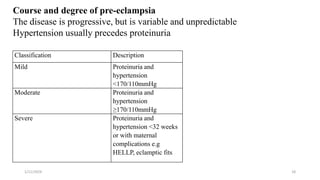
Classification Description
Mild Proteinuria and
hypertension
˂170/110mmHg
Moderate Proteinuria and
hypertension
≥170/110mmHg
Severe Proteinuria and
hypertension ˂32 weeks
or with maternal
complications e.g
HELLP, eclamptic fits
Course and degree of pre-eclampsia
The disease is progressive, but is variable and unpredictable
Hypertension usually precedes proteinuria
1/11/2024 18
Risk Factors
• Preeclampsia in a previous pregnancy.
• Being pregnant with more than one baby.
• Chronic high blood pressure (hypertension)
• Type 1 or type 2 diabetes before pregnancy.
• Kidney disease.
• Autoimmune disorders.
• Use of in vitro fertilization
1/11/2024 19
Symptoms
• Mild Symptoms:
a) Slightly swelling over the ankles
b) Gradually the swelling may extent to face, abdominal wall, vulva or even
the whole body.
• Alarming Symptoms:
a) Headache
b) Disturbed sleep
c) Diminished urine output ≤ 400ml/24 hrs
d) Blurring or Dimness of vision
e) Epigastric pain
1/11/2024 20
Signs
a) Abnormal weight gain.
b) Rise of blood pressure.
c) Oedema.
d) Signs of chronic placental insufficiency (Scanty Liquor or
IUGR)
e) Pulmonary Oedema
1/11/2024 21
complications
MATERNAL
• Cardiovascular system
- Generalised vasoconstriction and decreased circulating volume
- Left ventricular failure
-Increased vascular permeability and oedema
1/11/2024 22
Nervous system
- Headache, visual abnormalities, vomiting, confusion, hyper-reflexia
due to altered cerebral perfusion.
- Cerebral haemorrhage due to severe systolic hypertension
- Convulsions due to cerebral irritability
Respiratory system
- Generalised oedema with enhanced upper airway oedema
- Non-cardiac pulmonary oedema due to capillary leak
1/11/2024 23
Renal system
• Glomerular capillary endotheliosis and microthrombi
• Reduced glomerular filtration rate
• Reduced urea clearance and increased serum uric acid - marker of
severity
• Proteinuria and hypoproteinaemia
• Oliguria and acute renal failure
Liver
• Abnormal liver function tests
• Subcapsular haemorrhage and rupture
1/11/2024 24
Haematology
• Altered coagulation - increased turnover of fibrinogen, fibrin and
platelets
• Thrombocytopenia and impaired platelet function
• Disseminated intravascular coagulation
• HELLP syndrome (haemolysis, elevated liver enzymes, low platelets)
FETAL
• Decreased placental perfusion
• Placental ischaemia and infarction
• Small for dates
• Placental abruption
• Preterm labour
1/11/2024 25
Investigations of Pre-eclampsia
 Urine Examination:
a) Heat coagulation test to detect proteinuria
b) Urine R/M/E
c) 24 hrs urine collection
Blood Examination:
a) Serum uric acid level: >4.5 mg/dl indicates PE
b) S. Creatinine
c) LFT
d) Coagulation profile
e) BUN
C) Ultrasonography
1/11/2024 26
Management
• General Management
a) Urgent Hospitalization
b) Adequate rest
c) Protein & Fluid restricted diet
1/11/2024 27
Specific management
a) Anti hypertensive drug : Oral- Nifedipine, α-methyl dopa, Parenteral
Labetalol
b) Sedatives: Tab Diazepam 5mg at H/S
c) Maintaining a progress chart –
• Check BP regularly
• Maintain fluid intake-output chart
• Urine RE to exclude proteinuria
• Ophthalmic examination
• Fetal wellbeing assessment
1/11/2024 28
Obstetric Management: Obstetric management depends upon following
factors-
• Severity of Pre-Eclampsia
• Duration of pregnancy
• Response to treatment
a) If the maternal condition & response to treatment is satisfactory:
• Pregnancy may be continued up to term & after term termination of
pregnancy will be done accordingly.
b) If the maternal condition & response to treatment is not satisfactory:
• The choice of treatment is Immediate termination of pregnancy
irrespective of fetal outcome
1/11/2024 29
Care of the patient during puerperium:
1) Close observation of the patient for at least 48 hrs
2) Anti hypertensive drug should be continued if
DBP ≥ 100mmHg.
3) Patient should be kept in hospital till the BP is brought down
to a safe level & proteinuria disappears.
1/11/2024 30
• Magnesium sulphate should be used in moderate
to severe cases as prophylaxis against eclampsia.
• Magnesium inhibits synaptic transmission at the neuromuscular
junction, causes vasodilatation, and has a central anticonvulsant
effect at the NMDA receptor.
• A loading dose of 4 g (in 100 mL saline) is given over 30 min, followed
by a maintenance dose of 1 g h–1.
1/11/2024 31
ANAESTHESIA MANAGEMENT
* Investigation:
- CBC
- Renal function test
- Coagulation profile
- Recent platelet count
1/11/2024 32
Monitoring
• Basic Parameters:
-Non-invasive BP
-Urine output
-Pulse oximetry
-Capnography
-Fetal monitoring
•Additional Parameters
-Intra-arterial BP
-PCWP
-CVP
1/11/2024 33
1. Normal Vaginal Delivery: Main aim is
- To establish & maintain hemodynamic stability (control hypertension
& avoid hypotension)
- To provide excellent labor analgesia
- To prevent complications of pre eclampsia Intracerebral haemorrhage
Renal failure Pulmonary Edema Eclampsia
- To be able to rapidly provide anaesthesia for C/S
1/11/2024 34
• a)Controlled IV analgesia:
- Fentanyl
Loading dose: 1 mcg/kg
Maintenance dose: 25-50 mcg every 20 min
• b) Regional Anaesthesia: Epidural Block-Guidelines-
-CBC and Coagulation profile
-Baseline BP
- Continue anticonvulsive therapy
- Crytalloid and albumin to increase CVP
1/11/2024 35
* Advantage of Epidural Block:
- Hypertensive response to pain is attenuated by epidural block
- Decreased levels of catecholamine which facilitates BP control
- May improve intervillous blood flow and stable cardiac output
- Can also be used in Caesarean section
1/11/2024 36
a) Regional Anaesthesia
*Give aspiration prophylaxis
* Availability of blood and blood products
* Pre-hydration
* Oxygen administration: 6lt/min
* Epidural Block: 8-10 ml of 1.5-2% lignocaine or 0.5% Bupivacaine with
25-50 mcg of Fentanyl and the block should be raised to a minimum
level of T4
1/11/2024 37
Sub-arachnoid Block
* 5-10mg of 0.5% bupivacaine with 20 mcg of Fentanyl
* If hypotension occurs treat with Inj Ephedrine
* Avoid ergot alkaloids once baby is extracted
* Pot-op pain relief with epidural Fentanyl infusion of 10-25 mcg or
Morphine 4 mg
1/11/2024 38
* Platelet count and regional anaesthesia
• Prior to placing regional block in a preeclamptic it is recommended to
check the platelet count.
• No concrete evidence at to the lowest safe platelet count for regional
anaesthesia in preeclampsia
• Any clinical evidence of DIC would contraindicate regional
anaesthesia.
1/11/2024 39
General Anaesthesia
• When to Induce???
-Coagulopathy
- Fetal distress requiring emergency LSCS
- Patient refusal
1/11/2024 40
Hazards of GA
• Upper airway oedema: careful airway assessment is required.
• Difficulty in cord visualization
• Worsening of mallampatti grading
• Difficulty in laryngoscopy and intubation:
Maternal BP should be stabilized and seizure prophylaxis should be
given in view of response to laryngoscopy and intubation. Labetalol &
NTG are commonly used acutely
1/11/2024 41
- Fentanyl (2.5 mcg/kg), alfentanil (10 mcg/kg), lidocaine may be given
to blunt response
- MgSo4 therapy interfering with DMR and NDMR
- Impaired hepatic/renal blood flow affecting drug metabolism and
clearance
- - High risk of Aspiration
1/11/2024 42
* How to Induce??
• Prior to induction aspiration prophylaxis is administered: 30 ml of 0.3
M of Sodium Citrate 30 min before induction
• IV lines
• Monitors
• Failed intubation kit
• Working suctions
• All drugs- GA, anti-hypertensives, anti-convulsive
1/11/2024 43
* Pre-oxygenate the patient
* Pre-medicate
* Induction: Rapid sequence induction using Thiopentone 4-5mg/kg
and Succinylcholine 1- 1.5 mg/kg
* Intubation: sellicks manuever is maintained till the cuff of
endotracheal tube is inflated. Small size cuffed endotracheal tube is
used 6.0-6.5 ID
* Maintained With: N2O:O2 (50:50) and a volatile agent preferably
Isoflurane.
1/11/2024 44
•If the patient is on MgSo4 therapy then neuromuscular blocked must
be monitored with peripheral nerve stimulator and dose should be
titrated accordingly
•Avoid ergot alkaloids
•Extubation response to be pre-treated with lignocaine or beta
blockers like esmolol
•Continue anti-convulsive therapy in post op period.
•Semiconscious patient with cerebral lesions should be ventilated
electively.
1/11/2024 45
Regional Vs General Anaesthesia
• Epidural anaesthesia would probably be preferred by many
anaesthesiologists in a severely preeclamptic pt. in a non-urgent
setting.
• For urgent cases it is reassuring to know that spinal is also safe.
• This allows us to avoid general anaesthesia with the potential for
encountering a swollen, difficult airway and/or labile hypertension
1/11/2024 46
• General anaesthesia is a well-known hazard in obstetric anaesthesia:
• 16X more likely to result in anaesthetic-related maternal mortality
• Mostly due to airway/respiratory complications
1/11/2024 47
Conclusion
1/11/2024 48
* Preeclampsia is a multisystem disorder.
* Management is supportive, delivery is the only definitive.
* Preeclampsia patients: High risk for difficult intubation.
* Hypertensive response to laryngoscopy may lead to intracranial
haemorrhage.
1/11/2024 49
• Spinal Anaesthesia not contraindicated in severe Preeclampsia.
• Eclampsia can be prevented by prophylactic MgSO4 therapy.
• Eclamptic patients should be monitored for at least 24 hrs. Post-
partum.
• Magnesium sulfate is now proven as the best medication to prevent
and treat preeclampsia.
• Epidural analgesia for labour pain management & regional
anaesthesia for C/S have many beneficial effects & are preferred.
1/11/2024 50
Take Home Message
• Pre-eclampsia is one of the commonest pregnancy related
disease.
• Early diagnosis is very important to avoid complications.
• Expectant management is safe in some cases.
• Teamwork is necessary to ensure the success of the
treatment
1/11/2024 51

PRE-ECLAMPSIA.pptx

  • 1.
    GROUP 1 CHRONIC HYPERTENSIONIN PREGNANCY AND PRE- ECLAMPSIA 1/11/2024 1
  • 2.
    CHRONIC HYPERTENSION INPREGNANCY. • It is defined as hypertension present before pregnancy or before 20 weeks of gestation. • Chronic hypertension is present in up to 5% of pregnant women. 1/11/2024 2
  • 3.
    Chronic Hypertension • Pre-existinghypertension of any cause, • Hypertension before 20 weeks in the absence of gestation • If hypertension persists beyond 12 weeks after delivery • Overall incidence is 2-4%. • No proteinuria 1/11/2024 3
  • 4.
    Risk factors ofchronic hypertensive disease • Age (>40 years)Duration of hypertension(>15 years) •Level of blood pressure (>160/110 mm hg) • Presence of any medical disorder (collagen vascular disease e.g- lupus) • Presence of thrombophilias. 1/11/2024 4
  • 5.
    Effect of chronichypertension on pregnancy -maternal • Superimposed pre- eclampsia • eclampsia -fetal • Intrauterine growth retardation • Intrauterine fetal death 1/11/2024 5
  • 6.
    Prenatal care forchronic hypertensives- • Electrocardiogram should be obtained in women with long standing hypertension. • Baseline laboratory tests -urinalysis, urine culture, and serum creatinie, glucose and electrolytes. -Tests will rule out renal disease and identify comorbidities such as diabetes mellitus 1/11/2024 6
  • 7.
    The common causeof chronic hypertension 1) Essential hypertension 2) Chronic renal disease 3) Coarctation of aorta 4) Endocrine disorders (DM, pheochromocytoma) 5) Connective tissue disease (SLE) 1/11/2024 7
  • 8.
    Treatment • General andmedical treatment • As pre-eclampsia regarding the following 1) Rest 2) antihypertensives 3) observation 1/11/2024 8
  • 9.
    • Review medicationand inform the patient of the risks involved with some medications. • Those on angiontension-converting enzymes (ACE) inhibitors or angiotensin-II receptor antagonists (AIIRAS) should be switched from these as soon as possible, as there is increased risk of congenital abnormalities if these drugs are taken during pregnancy 1/11/2024 9
  • 10.
    • Ideally thiswill have been done at a pre-pregnancy counselling session; however, if not, it should be done as early as possible in the pregnanacy. • Diuretics should be avoided, as they can reduce the blood flow in the placenta. 1/11/2024 10
  • 11.
    Finding Suggestive ofSecondary Hypertension Any of the following findings are suggestive of secondary hypertension • Resistance hypertension • Hypokalemia (potassium level less than 3.0mEqL) • Elevated serum creatinine level (greater than 1.1mg/Dl) • Strong family history of kidney disease 1/11/2024 11
  • 12.
    ANTI HYPERTENSIVE AGENTSUSED FOR BLOOD PRESSURE CONTROL IN PREGNANCY DRUGS DOSE COMMENTS LABETALOL 10-20MG IV, then 20-80mg every 20 -30 mins to a maximum dose of 300mg 0r constant infusion of 1- 2mg/mins iv Considered a first line of agent, tachycardia is less common and fewer adverse effect Contraindicated in patient with asthma, heart disease and CHF HYDRALAZINE 5MG IV OR IM, then 5-10mg iv every 20-40 mins Or constant infusion of 0.5 -10mg /hour Higher or frequent dosage associated with maternal hypotension headaches, fetal distress may be, more common than other agents NIFEDIPINE 10 -20MG orally, repeat in 30mins if needed. Then 10-20mg every 2-6 hours May observe reflex tachycardia and headache 1/11/2024 12
  • 13.
    common Oral AntihypertensivesAgents in Pregnancy Drug Dosage Comments Labetalol 200-2,400 mg/d orally in two to three divided doses Well tolerated Potential bronchoconstrictive effects Avoid in patients with asthma and Congestive heart failure Nifedipine 30-120mg/d orally of a slow- release preparation Do not use sublingual form Methyldopa 0.5g/d orally in two to three divided doses Childhood safety data up to 7 years of age May not be as effective in control of severe hypertension Thiazide diuretics Depends on agent Second-line agent Angiotensin- converting enzyme inhibitors/ angiotensin receptor blockers Associated with fetal anomalies Contraindicated in pregnancy and preconception period 1/11/2024 13
  • 14.
  • 15.
    • What isPre-eclampsia? Pre-eclampsia is a multi-system disorder of unknown etiology characterized by development of hypertension to the extent of 140/90 mmHg or more with Proteinuria after the 20th weeks of pregnancy in a previously normotensive & non-proteinuric individual 1/11/2024 15
  • 16.
  • 17.
    Diagnostic criteria ofPre-eclampsia Grossly there are 3 criteria: 1) Hypertension: The raise of BP should be evident at least on 2 occasions at least 6 hours apart. 2) Oedema: Development of bilateral pitting Oedema & Rapid development of weight gain. 3) Proteinuria: Presence of total protein >0.3 mg in 24 hrs urine or ≥++(1 gm/L) on at least two random catch urine samples tasted ≥ 4 hrs apart 1/11/2024 17
  • 18.
    Classification Description Mild Proteinuriaand hypertension ˂170/110mmHg Moderate Proteinuria and hypertension ≥170/110mmHg Severe Proteinuria and hypertension ˂32 weeks or with maternal complications e.g HELLP, eclamptic fits Course and degree of pre-eclampsia The disease is progressive, but is variable and unpredictable Hypertension usually precedes proteinuria 1/11/2024 18
  • 19.
    Risk Factors • Preeclampsiain a previous pregnancy. • Being pregnant with more than one baby. • Chronic high blood pressure (hypertension) • Type 1 or type 2 diabetes before pregnancy. • Kidney disease. • Autoimmune disorders. • Use of in vitro fertilization 1/11/2024 19
  • 20.
    Symptoms • Mild Symptoms: a)Slightly swelling over the ankles b) Gradually the swelling may extent to face, abdominal wall, vulva or even the whole body. • Alarming Symptoms: a) Headache b) Disturbed sleep c) Diminished urine output ≤ 400ml/24 hrs d) Blurring or Dimness of vision e) Epigastric pain 1/11/2024 20
  • 21.
    Signs a) Abnormal weightgain. b) Rise of blood pressure. c) Oedema. d) Signs of chronic placental insufficiency (Scanty Liquor or IUGR) e) Pulmonary Oedema 1/11/2024 21
  • 22.
    complications MATERNAL • Cardiovascular system -Generalised vasoconstriction and decreased circulating volume - Left ventricular failure -Increased vascular permeability and oedema 1/11/2024 22
  • 23.
    Nervous system - Headache,visual abnormalities, vomiting, confusion, hyper-reflexia due to altered cerebral perfusion. - Cerebral haemorrhage due to severe systolic hypertension - Convulsions due to cerebral irritability Respiratory system - Generalised oedema with enhanced upper airway oedema - Non-cardiac pulmonary oedema due to capillary leak 1/11/2024 23
  • 24.
    Renal system • Glomerularcapillary endotheliosis and microthrombi • Reduced glomerular filtration rate • Reduced urea clearance and increased serum uric acid - marker of severity • Proteinuria and hypoproteinaemia • Oliguria and acute renal failure Liver • Abnormal liver function tests • Subcapsular haemorrhage and rupture 1/11/2024 24
  • 25.
    Haematology • Altered coagulation- increased turnover of fibrinogen, fibrin and platelets • Thrombocytopenia and impaired platelet function • Disseminated intravascular coagulation • HELLP syndrome (haemolysis, elevated liver enzymes, low platelets) FETAL • Decreased placental perfusion • Placental ischaemia and infarction • Small for dates • Placental abruption • Preterm labour 1/11/2024 25
  • 26.
    Investigations of Pre-eclampsia Urine Examination: a) Heat coagulation test to detect proteinuria b) Urine R/M/E c) 24 hrs urine collection Blood Examination: a) Serum uric acid level: >4.5 mg/dl indicates PE b) S. Creatinine c) LFT d) Coagulation profile e) BUN C) Ultrasonography 1/11/2024 26
  • 27.
    Management • General Management a)Urgent Hospitalization b) Adequate rest c) Protein & Fluid restricted diet 1/11/2024 27
  • 28.
    Specific management a) Antihypertensive drug : Oral- Nifedipine, α-methyl dopa, Parenteral Labetalol b) Sedatives: Tab Diazepam 5mg at H/S c) Maintaining a progress chart – • Check BP regularly • Maintain fluid intake-output chart • Urine RE to exclude proteinuria • Ophthalmic examination • Fetal wellbeing assessment 1/11/2024 28
  • 29.
    Obstetric Management: Obstetricmanagement depends upon following factors- • Severity of Pre-Eclampsia • Duration of pregnancy • Response to treatment a) If the maternal condition & response to treatment is satisfactory: • Pregnancy may be continued up to term & after term termination of pregnancy will be done accordingly. b) If the maternal condition & response to treatment is not satisfactory: • The choice of treatment is Immediate termination of pregnancy irrespective of fetal outcome 1/11/2024 29
  • 30.
    Care of thepatient during puerperium: 1) Close observation of the patient for at least 48 hrs 2) Anti hypertensive drug should be continued if DBP ≥ 100mmHg. 3) Patient should be kept in hospital till the BP is brought down to a safe level & proteinuria disappears. 1/11/2024 30
  • 31.
    • Magnesium sulphateshould be used in moderate to severe cases as prophylaxis against eclampsia. • Magnesium inhibits synaptic transmission at the neuromuscular junction, causes vasodilatation, and has a central anticonvulsant effect at the NMDA receptor. • A loading dose of 4 g (in 100 mL saline) is given over 30 min, followed by a maintenance dose of 1 g h–1. 1/11/2024 31
  • 32.
    ANAESTHESIA MANAGEMENT * Investigation: -CBC - Renal function test - Coagulation profile - Recent platelet count 1/11/2024 32
  • 33.
    Monitoring • Basic Parameters: -Non-invasiveBP -Urine output -Pulse oximetry -Capnography -Fetal monitoring •Additional Parameters -Intra-arterial BP -PCWP -CVP 1/11/2024 33
  • 34.
    1. Normal VaginalDelivery: Main aim is - To establish & maintain hemodynamic stability (control hypertension & avoid hypotension) - To provide excellent labor analgesia - To prevent complications of pre eclampsia Intracerebral haemorrhage Renal failure Pulmonary Edema Eclampsia - To be able to rapidly provide anaesthesia for C/S 1/11/2024 34
  • 35.
    • a)Controlled IVanalgesia: - Fentanyl Loading dose: 1 mcg/kg Maintenance dose: 25-50 mcg every 20 min • b) Regional Anaesthesia: Epidural Block-Guidelines- -CBC and Coagulation profile -Baseline BP - Continue anticonvulsive therapy - Crytalloid and albumin to increase CVP 1/11/2024 35
  • 36.
    * Advantage ofEpidural Block: - Hypertensive response to pain is attenuated by epidural block - Decreased levels of catecholamine which facilitates BP control - May improve intervillous blood flow and stable cardiac output - Can also be used in Caesarean section 1/11/2024 36
  • 37.
    a) Regional Anaesthesia *Giveaspiration prophylaxis * Availability of blood and blood products * Pre-hydration * Oxygen administration: 6lt/min * Epidural Block: 8-10 ml of 1.5-2% lignocaine or 0.5% Bupivacaine with 25-50 mcg of Fentanyl and the block should be raised to a minimum level of T4 1/11/2024 37
  • 38.
    Sub-arachnoid Block * 5-10mgof 0.5% bupivacaine with 20 mcg of Fentanyl * If hypotension occurs treat with Inj Ephedrine * Avoid ergot alkaloids once baby is extracted * Pot-op pain relief with epidural Fentanyl infusion of 10-25 mcg or Morphine 4 mg 1/11/2024 38
  • 39.
    * Platelet countand regional anaesthesia • Prior to placing regional block in a preeclamptic it is recommended to check the platelet count. • No concrete evidence at to the lowest safe platelet count for regional anaesthesia in preeclampsia • Any clinical evidence of DIC would contraindicate regional anaesthesia. 1/11/2024 39
  • 40.
    General Anaesthesia • Whento Induce??? -Coagulopathy - Fetal distress requiring emergency LSCS - Patient refusal 1/11/2024 40
  • 41.
    Hazards of GA •Upper airway oedema: careful airway assessment is required. • Difficulty in cord visualization • Worsening of mallampatti grading • Difficulty in laryngoscopy and intubation: Maternal BP should be stabilized and seizure prophylaxis should be given in view of response to laryngoscopy and intubation. Labetalol & NTG are commonly used acutely 1/11/2024 41
  • 42.
    - Fentanyl (2.5mcg/kg), alfentanil (10 mcg/kg), lidocaine may be given to blunt response - MgSo4 therapy interfering with DMR and NDMR - Impaired hepatic/renal blood flow affecting drug metabolism and clearance - - High risk of Aspiration 1/11/2024 42
  • 43.
    * How toInduce?? • Prior to induction aspiration prophylaxis is administered: 30 ml of 0.3 M of Sodium Citrate 30 min before induction • IV lines • Monitors • Failed intubation kit • Working suctions • All drugs- GA, anti-hypertensives, anti-convulsive 1/11/2024 43
  • 44.
    * Pre-oxygenate thepatient * Pre-medicate * Induction: Rapid sequence induction using Thiopentone 4-5mg/kg and Succinylcholine 1- 1.5 mg/kg * Intubation: sellicks manuever is maintained till the cuff of endotracheal tube is inflated. Small size cuffed endotracheal tube is used 6.0-6.5 ID * Maintained With: N2O:O2 (50:50) and a volatile agent preferably Isoflurane. 1/11/2024 44
  • 45.
    •If the patientis on MgSo4 therapy then neuromuscular blocked must be monitored with peripheral nerve stimulator and dose should be titrated accordingly •Avoid ergot alkaloids •Extubation response to be pre-treated with lignocaine or beta blockers like esmolol •Continue anti-convulsive therapy in post op period. •Semiconscious patient with cerebral lesions should be ventilated electively. 1/11/2024 45
  • 46.
    Regional Vs GeneralAnaesthesia • Epidural anaesthesia would probably be preferred by many anaesthesiologists in a severely preeclamptic pt. in a non-urgent setting. • For urgent cases it is reassuring to know that spinal is also safe. • This allows us to avoid general anaesthesia with the potential for encountering a swollen, difficult airway and/or labile hypertension 1/11/2024 46
  • 47.
    • General anaesthesiais a well-known hazard in obstetric anaesthesia: • 16X more likely to result in anaesthetic-related maternal mortality • Mostly due to airway/respiratory complications 1/11/2024 47
  • 48.
  • 49.
    * Preeclampsia isa multisystem disorder. * Management is supportive, delivery is the only definitive. * Preeclampsia patients: High risk for difficult intubation. * Hypertensive response to laryngoscopy may lead to intracranial haemorrhage. 1/11/2024 49
  • 50.
    • Spinal Anaesthesianot contraindicated in severe Preeclampsia. • Eclampsia can be prevented by prophylactic MgSO4 therapy. • Eclamptic patients should be monitored for at least 24 hrs. Post- partum. • Magnesium sulfate is now proven as the best medication to prevent and treat preeclampsia. • Epidural analgesia for labour pain management & regional anaesthesia for C/S have many beneficial effects & are preferred. 1/11/2024 50
  • 51.
    Take Home Message •Pre-eclampsia is one of the commonest pregnancy related disease. • Early diagnosis is very important to avoid complications. • Expectant management is safe in some cases. • Teamwork is necessary to ensure the success of the treatment 1/11/2024 51