Predicting local atomic structures from X-ray absorption
spectroscopy using theory and machine learning
Deyu Lu
Center for Functional Nanomaterials, Brookhaven National Laboratory
AIMS Workshop at NIST
August 1, 2019
Experiments supplemented by theory and data analytics
Exp
measurement
Evolution of local
structures and
electronic states,
mechanisms
Structure models
properties
Prior knowledge
Simulations
energy
validation
Constructive
theory
interpretation
in situ exp
database ML workflow
Nat. Comm., 6, 7583 (2015)
• Time consuming
• Human labor
intensive
Smart experiments enabled by theory and data analytics
Exp
measurement
Evolution of local
structures and
electronic states,
mechanisms
Property
descriptors
Theory &
Computation
energy data analytics
validation
Real-time
characterization
interpretation
interactive high
throughput in
situ exp database ML workflow
feedback
optimization
automation
Nat. Comm., 6, 7583 (2015)
Motivation: Solve the inverse problem
Quantum
Mechanical Laws
Atomistic
Structure
Electronic
Structure
the forward problem
y = f (x)x y
Structure
Descriptors
Electronic
Structure
the inverse problem, often ill-conditioned
x' ⊂ x
x' = !f −1
(y')
y' ⊂ y
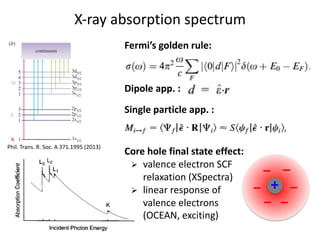
X-ray absorption spectrum
Fermi’s golden rule:
Dipole app. :
Single particle app. :
Phil. Trans. R. Soc. A 371.1995 (2013)
Core hole final state effect:
Ø valence electron SCF
relaxation (XSpectra)
Ø linear response of
valence electrons
(OCEAN, exciting)
− + −
−
− −
−
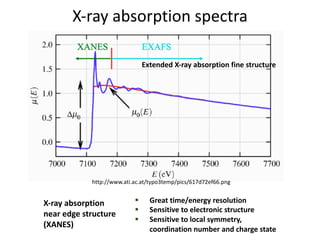
X-ray absorption spectra
§ Great time/energy resolution
§ Sensitive to electronic structure
§ Sensitive to local symmetry,
coordination number and charge state
Extended X-ray absorption fine structure
X-ray absorption
near edge structure
(XANES)
http://www.ati.ac.at/typo3temp/pics/617d72ef66.png
Decipher the spectra-structure relationship
Exp core-level
spectra
Weights of the ref.
spectra
Linear combination
fitting with exp refs.
Ti4+ with 4,5 and 6 CNs
energy
Phys. Rev. B, 56 1809, 1997
Nat. Comm., 6, 7583 (2015)
Empirical fingerprints
Phys. Rev. B, 56 1809, 1997
Ti K-edge
XANES
Fe K-edge
XANES
Geochim. Cosmochim. Acta 69, 4315, 2005
Spectral descriptor generation
• Requires prior knowledge
• Subject to human bias
• Strong emphasis on pre-edge
• Difficult to capture more subtle
features
Transferability
• Structure-spectral relationship
is system dependent
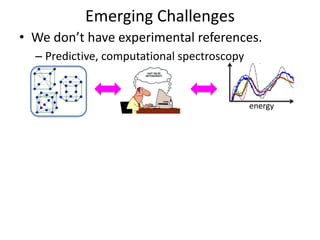
• We don’t have experimental references.
– Predictive, computational spectroscopy
Emerging Challenges
energy
Photoelectrochemical water splitting
photoelectrochemical water
splitting cell
band alignment
Topics in Catalysis 61.9-11 (2018): 1043-1076.
Water splitting over ZnO nanowires
• Wide band gap (3.2 eV), high carrier
mobility
• Seed-mediated growth from aqueous
solution
• Supports water splitting
• Photocorrosion
J. Phys. Chem. C 2013, 117, 13396−13402
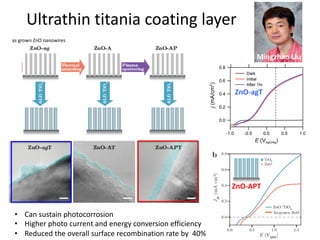
Ultrathin titania coating layer
• Can sustain photocorrosion
• Higher photo current and energy conversion efficiency
• Reduced the overall surface recombination rate by 40%
ZnO-agT
ZnO-APT
as grown ZnO nanowires
Mingzhao Liu
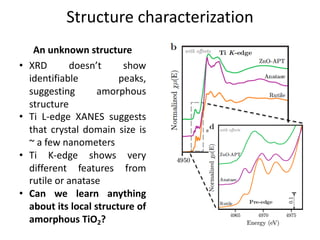
Structure characterization
An unknown structure
• XRD doesn’t show
identifiable peaks,
suggesting amorphous
structure
• Ti L-edge XANES suggests
that crystal domain size is
~ a few nanometers
• Ti K-edge shows very
different features from
rutile or anatase
• Can we learn anything
about its local structure of
amorphous TiO2?
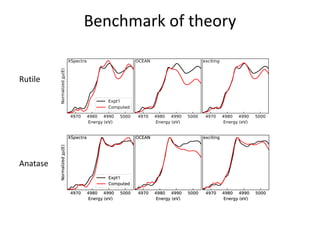
Benchmark of theory
Rutile
Anatase
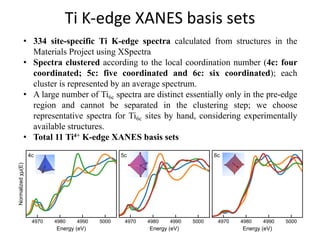
Ti K-edge XANES basis sets
4970 4980 4990 5000
(nergy (e9)
Normalizedχµ(()
4c
4970 4980 4990 5000
(nergy (e9)
5c
4970 4980 4990 5000
(nergy (e9)
6c
• 334 site-specific Ti K-edge spectra calculated from structures in the
Materials Project using XSpectra
• Spectra clustered according to the local coordination number (4c: four
coordinated; 5c: five coordinated and 6c: six coordinated); each
cluster is represented by an average spectrum.
• A large number of Ti6c spectra are distinct essentially only in the pre-edge
region and cannot be separated in the clustering step; we choose
representative spectra for Ti6c sites by hand, considering experimentally
available structures.
• Total 11 Ti4+ K-edge XANES basis sets
Local structure distribution
amorphous model: 50% Ti5c,
47% Ti6c, and 3% Ti7c
Basis set (best fit): 21.8% Ti4c,
15.8% Ti5c and 62.4% Ti6c atoms
Conclusion
• The quality of ALD titania coatings over ZnO nanowires is strongly
correlated to the post-processing procedures performed on the NWs,
including thermal annealing and plasma sputtering.
• Ti L-edge XANES studies suggest that the titania shell is highly amorphous
with crystalline domains limited to a size of 1 nm or smaller.
• Ti K-edge XANES studies at high spectral resolution indicate that the
titania shell over ZnO has a significantly different structure from those of
crystalline TiO2.
• Two different first-principle computational approaches to analyze the Ti
K-edge data arrive at the same conclusion that the experimental
spectrum can be satisfactorily fitted only by introducing a large fraction
(40~50%) of undercoordinated Ti atoms.
• Trends in the intensity ratio between the white line doublet in the Ti K-
edge spectra measured for different post-processing procedures point to a
lower oxidation state in the titania shell due to the plasma sputtering of
the ZnO cores.
D. Yan, M. Topsakal, S. Selcuk, J. L. Lyons, W. Zhang, Q. Wu, I. Waluyo, E. Stavitski, K. Attenkofer, S.
Yoo, M. S. Hybertsen, DL, D. J. Stacchiola and M. Liu,, Nano Lett. 19:6, 3457-3463 (2019)
energy
• We don’t have experimental references.
– Predictive, computational spectroscopy
• Vast chemical and configurational space.
– Database and machine learning
– Avoid human bias
Emerging Challenges
energy
3D metal nanoparticle structure
determination from XANES
Anatoly Frenkel Janis Timoshenko
§ Challenge: None of the traditional methods
can determine MNP structures on-the-fly.
§ Can we find good structure descriptors?
Frenkel, J. Synch. Radiat. 6, 293 (1999)
Frenkel, Hills, and Nuzzo, J. Phys. Chem. B,
105, 12689 (2001)
Nano particle size can be determined from
average coordination numbers.
Pt L3-edge XANES: not enough data
0.9 nm
2.9 nm
EXP
Theory
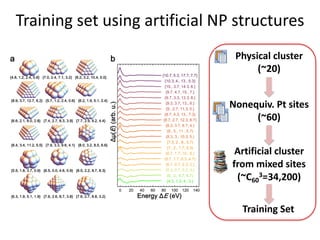
Training set using artificial NP structures
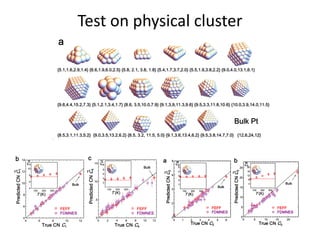
Physical cluster
(~20)
Artificial cluster
from mixed sites
(~C60
3=34,200)
Training Set
Nonequiv. Pt sites
(~60)
Determine average coordination
number from machine learning
Feature
site specific Pt
L3-edge XANES
Target
average (C1~C4)
artificial neural network Prediction
NP size/shape
Test on physical cluster
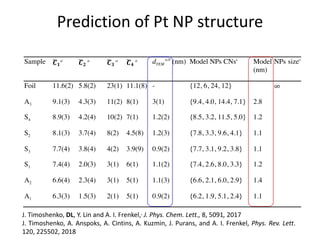
Prediction of Pt NP structure
Sample !!
a
!!
a
!!
a
!!
a dTEM
a,b
(nm) Model NPs CNsc
Model NPs sizec
(nm)
Foil 11.6(2) 5.8(2) 23(1) 11.1(8) - {12, 6, 24, 12} ∞
A3 9.1(3) 4.3(3) 11(2) 8(1) 3(1) {9.4, 4.0, 14.4, 7.1} 2.8
S4 8.9(3) 4.2(4) 10(2) 7(1) 1.2(2) {8.5, 3.2, 11.5, 5.0} 1.2
S2 8.1(3) 3.7(4) 8(2) 4.5(8) 1.2(3) {7.8, 3.3, 9.6, 4.1} 1.1
S3 7.7(4) 3.8(4) 4(2) 3.9(9) 0.9(2) {7.7, 3.1, 9.2, 3.8} 1.1
S1 7.4(4) 2.0(3) 3(1) 6(1) 1.1(2) {7.4, 2.6, 8.0, 3.3} 1.2
A2 6.6(4) 2.3(4) 3(1) 5(1) 1.1(3) {6.6, 2.1, 6.0, 2.9} 1.4
A1 6.3(3) 1.5(3) 2(1) 5(1) 0.9(2) {6.2, 1.9, 5.1, 2.4} 1.1
J. Timoshenko, DL, Y. Lin and A. I. Frenkel,, J. Phys. Chem. Lett., 8, 5091, 2017
J. Timoshenko, A. Anspoks, A. Cintins, A. Kuzmin, J. Purans, and A. I. Frenkel, Phys. Rev. Lett.
120, 225502, 2018
Summary
Ø Real time interpretation of core-level spectra is an emerging
challenge in operando measurements that requires correlating
operando measured spectral features to key local structure motifs,
i.e. solving the inverse problem, since standard fingerprints do not
exist.
Ø Ab initio X-ray absorption near edge structure (XANES) modeling is
a good complement of extend X-ray absorption fine structure
(EXAFS), for structural refinement.
Ø Our method enables the inverse modeling, where the unknown
structural motifs are deciphered from the experimental spectra.
Ø We illustrate our approach by 3D structure determination of metal
nanoparticles using neural network.
Ø Combination of theory, database and data analytics tools can have
a huge impact on materials discovery.
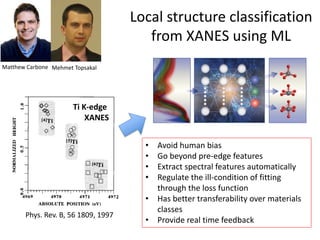
Local structure classification
from XANES using ML
Phys. Rev. B, 56 1809, 1997
Ti K-edge
XANES
• Avoid human bias
• Go beyond pre-edge features
• Extract spectral features automatically
• Regulate the ill-condition of fitting
through the loss function
• Has better transferability over materials
classes
• Provide real time feedback
Matthew Carbone Mehmet Topsakal
Machine learning workflow
Tetrahedral
T4
Square
Pyramidal
S5
Octahedral
O6
Ti K-edge
FEFF database
Sci. Data 5, 180151 (2018); npj Comput. Mater. 4, 12 (2018); Inorg. Chem. 37, 5575 (1998).
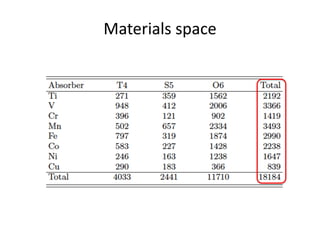
Materials space
Raw spectra and PCA
analysis
Tetrahedral
T4
Square
Pyramidal
S5
Octahedral
O6
Accuracy
P: precision; R: recall
T4
S5
O6
Conclusion
• XANES encodes important information about the local chemical
environment of an absorbing atom (e.g. coordination number,
symmetry and oxidation state).
• Extract such information is akin to solving a challenging inverse
problem
• The robustness and fidelity of the machine learning method are
demonstrated by an average 86% accuracy across the wide
chemical space of oxides in eight 3d transition metal families using
FEFF spectra database
• Spectral features beyond the pre-edge region play an important
role in the local structure classification problem, especially for late
3d transition metal elements.
• This study is a precursor to a potentially very powerful tool for real
time structure refinement using experimental XANES.
Carbone, Yoo, Topsakal and D.L. Phys. Rev. Mater, 3, 033604 (2019). Editor’s Suggestion.
Acknowledgment
This research used resources of the Center for Functional Nanomaterials, which is a U.S. DOE Office of Science Facility,
at Brookhaven National Laboratory under Contract No. DE-SC0012704. MC is supported by Computational Sciences
Graduate Fellowship (DOE CSGF) under Grant No. DE-FG02-97ER25308.
Experiment
• Anatoly Frenkel (BNL / SBU)
• Mingzhao Liu (BNL)
• Dario Stacchiola (BNL)
• Klaus Attenkhofer (ALBA)
• Eli Stavitski (BNL)
Theory
• Matt Carbone (Columbia)
• Mehmet Topsakal (BNL)
• Sencer Selcuk (Google)
• Mark Hybertsen (BNL)
• Xiaohui Qu (BNL)
• John Vinson (NIST)
Machine Learning
• Shinjae Yoo (BNL)
• Yuewei Lin (BNL)

Predicting local atomic structures from X-ray absorption spectroscopy using theory and machine learning

  • 1.
    Predicting local atomicstructures from X-ray absorption spectroscopy using theory and machine learning Deyu Lu Center for Functional Nanomaterials, Brookhaven National Laboratory AIMS Workshop at NIST August 1, 2019
  • 2.
    Experiments supplemented bytheory and data analytics Exp measurement Evolution of local structures and electronic states, mechanisms Structure models properties Prior knowledge Simulations energy validation Constructive theory interpretation in situ exp database ML workflow Nat. Comm., 6, 7583 (2015) • Time consuming • Human labor intensive
  • 3.
    Smart experiments enabledby theory and data analytics Exp measurement Evolution of local structures and electronic states, mechanisms Property descriptors Theory & Computation energy data analytics validation Real-time characterization interpretation interactive high throughput in situ exp database ML workflow feedback optimization automation Nat. Comm., 6, 7583 (2015)
  • 4.
    Motivation: Solve theinverse problem Quantum Mechanical Laws Atomistic Structure Electronic Structure the forward problem y = f (x)x y Structure Descriptors Electronic Structure the inverse problem, often ill-conditioned x' ⊂ x x' = !f −1 (y') y' ⊂ y
  • 5.
    X-ray absorption spectrum Fermi’sgolden rule: Dipole app. : Single particle app. : Phil. Trans. R. Soc. A 371.1995 (2013) Core hole final state effect: Ø valence electron SCF relaxation (XSpectra) Ø linear response of valence electrons (OCEAN, exciting) − + − − − − −
  • 6.
    X-ray absorption spectra §Great time/energy resolution § Sensitive to electronic structure § Sensitive to local symmetry, coordination number and charge state Extended X-ray absorption fine structure X-ray absorption near edge structure (XANES) http://www.ati.ac.at/typo3temp/pics/617d72ef66.png
  • 7.
    Decipher the spectra-structurerelationship Exp core-level spectra Weights of the ref. spectra Linear combination fitting with exp refs. Ti4+ with 4,5 and 6 CNs energy Phys. Rev. B, 56 1809, 1997 Nat. Comm., 6, 7583 (2015)
  • 8.
    Empirical fingerprints Phys. Rev.B, 56 1809, 1997 Ti K-edge XANES Fe K-edge XANES Geochim. Cosmochim. Acta 69, 4315, 2005 Spectral descriptor generation • Requires prior knowledge • Subject to human bias • Strong emphasis on pre-edge • Difficult to capture more subtle features Transferability • Structure-spectral relationship is system dependent
  • 9.
    • We don’thave experimental references. – Predictive, computational spectroscopy Emerging Challenges energy
  • 10.
    Photoelectrochemical water splitting photoelectrochemicalwater splitting cell band alignment Topics in Catalysis 61.9-11 (2018): 1043-1076.
  • 11.
    Water splitting overZnO nanowires • Wide band gap (3.2 eV), high carrier mobility • Seed-mediated growth from aqueous solution • Supports water splitting • Photocorrosion J. Phys. Chem. C 2013, 117, 13396−13402
  • 12.
    Ultrathin titania coatinglayer • Can sustain photocorrosion • Higher photo current and energy conversion efficiency • Reduced the overall surface recombination rate by 40% ZnO-agT ZnO-APT as grown ZnO nanowires Mingzhao Liu
  • 13.
    Structure characterization An unknownstructure • XRD doesn’t show identifiable peaks, suggesting amorphous structure • Ti L-edge XANES suggests that crystal domain size is ~ a few nanometers • Ti K-edge shows very different features from rutile or anatase • Can we learn anything about its local structure of amorphous TiO2?
  • 14.
  • 15.
    Ti K-edge XANESbasis sets 4970 4980 4990 5000 (nergy (e9) Normalizedχµ(() 4c 4970 4980 4990 5000 (nergy (e9) 5c 4970 4980 4990 5000 (nergy (e9) 6c • 334 site-specific Ti K-edge spectra calculated from structures in the Materials Project using XSpectra • Spectra clustered according to the local coordination number (4c: four coordinated; 5c: five coordinated and 6c: six coordinated); each cluster is represented by an average spectrum. • A large number of Ti6c spectra are distinct essentially only in the pre-edge region and cannot be separated in the clustering step; we choose representative spectra for Ti6c sites by hand, considering experimentally available structures. • Total 11 Ti4+ K-edge XANES basis sets
  • 16.
    Local structure distribution amorphousmodel: 50% Ti5c, 47% Ti6c, and 3% Ti7c Basis set (best fit): 21.8% Ti4c, 15.8% Ti5c and 62.4% Ti6c atoms
  • 17.
    Conclusion • The qualityof ALD titania coatings over ZnO nanowires is strongly correlated to the post-processing procedures performed on the NWs, including thermal annealing and plasma sputtering. • Ti L-edge XANES studies suggest that the titania shell is highly amorphous with crystalline domains limited to a size of 1 nm or smaller. • Ti K-edge XANES studies at high spectral resolution indicate that the titania shell over ZnO has a significantly different structure from those of crystalline TiO2. • Two different first-principle computational approaches to analyze the Ti K-edge data arrive at the same conclusion that the experimental spectrum can be satisfactorily fitted only by introducing a large fraction (40~50%) of undercoordinated Ti atoms. • Trends in the intensity ratio between the white line doublet in the Ti K- edge spectra measured for different post-processing procedures point to a lower oxidation state in the titania shell due to the plasma sputtering of the ZnO cores. D. Yan, M. Topsakal, S. Selcuk, J. L. Lyons, W. Zhang, Q. Wu, I. Waluyo, E. Stavitski, K. Attenkofer, S. Yoo, M. S. Hybertsen, DL, D. J. Stacchiola and M. Liu,, Nano Lett. 19:6, 3457-3463 (2019)
  • 18.
    energy • We don’thave experimental references. – Predictive, computational spectroscopy • Vast chemical and configurational space. – Database and machine learning – Avoid human bias Emerging Challenges energy
  • 19.
    3D metal nanoparticlestructure determination from XANES Anatoly Frenkel Janis Timoshenko § Challenge: None of the traditional methods can determine MNP structures on-the-fly. § Can we find good structure descriptors? Frenkel, J. Synch. Radiat. 6, 293 (1999) Frenkel, Hills, and Nuzzo, J. Phys. Chem. B, 105, 12689 (2001) Nano particle size can be determined from average coordination numbers.
  • 20.
    Pt L3-edge XANES:not enough data 0.9 nm 2.9 nm EXP Theory
  • 21.
    Training set usingartificial NP structures Physical cluster (~20) Artificial cluster from mixed sites (~C60 3=34,200) Training Set Nonequiv. Pt sites (~60)
  • 22.
    Determine average coordination numberfrom machine learning Feature site specific Pt L3-edge XANES Target average (C1~C4) artificial neural network Prediction NP size/shape
  • 23.
  • 24.
    Prediction of PtNP structure Sample !! a !! a !! a !! a dTEM a,b (nm) Model NPs CNsc Model NPs sizec (nm) Foil 11.6(2) 5.8(2) 23(1) 11.1(8) - {12, 6, 24, 12} ∞ A3 9.1(3) 4.3(3) 11(2) 8(1) 3(1) {9.4, 4.0, 14.4, 7.1} 2.8 S4 8.9(3) 4.2(4) 10(2) 7(1) 1.2(2) {8.5, 3.2, 11.5, 5.0} 1.2 S2 8.1(3) 3.7(4) 8(2) 4.5(8) 1.2(3) {7.8, 3.3, 9.6, 4.1} 1.1 S3 7.7(4) 3.8(4) 4(2) 3.9(9) 0.9(2) {7.7, 3.1, 9.2, 3.8} 1.1 S1 7.4(4) 2.0(3) 3(1) 6(1) 1.1(2) {7.4, 2.6, 8.0, 3.3} 1.2 A2 6.6(4) 2.3(4) 3(1) 5(1) 1.1(3) {6.6, 2.1, 6.0, 2.9} 1.4 A1 6.3(3) 1.5(3) 2(1) 5(1) 0.9(2) {6.2, 1.9, 5.1, 2.4} 1.1 J. Timoshenko, DL, Y. Lin and A. I. Frenkel,, J. Phys. Chem. Lett., 8, 5091, 2017 J. Timoshenko, A. Anspoks, A. Cintins, A. Kuzmin, J. Purans, and A. I. Frenkel, Phys. Rev. Lett. 120, 225502, 2018
  • 25.
    Summary Ø Real timeinterpretation of core-level spectra is an emerging challenge in operando measurements that requires correlating operando measured spectral features to key local structure motifs, i.e. solving the inverse problem, since standard fingerprints do not exist. Ø Ab initio X-ray absorption near edge structure (XANES) modeling is a good complement of extend X-ray absorption fine structure (EXAFS), for structural refinement. Ø Our method enables the inverse modeling, where the unknown structural motifs are deciphered from the experimental spectra. Ø We illustrate our approach by 3D structure determination of metal nanoparticles using neural network. Ø Combination of theory, database and data analytics tools can have a huge impact on materials discovery.
  • 26.
    Local structure classification fromXANES using ML Phys. Rev. B, 56 1809, 1997 Ti K-edge XANES • Avoid human bias • Go beyond pre-edge features • Extract spectral features automatically • Regulate the ill-condition of fitting through the loss function • Has better transferability over materials classes • Provide real time feedback Matthew Carbone Mehmet Topsakal
  • 27.
    Machine learning workflow Tetrahedral T4 Square Pyramidal S5 Octahedral O6 TiK-edge FEFF database Sci. Data 5, 180151 (2018); npj Comput. Mater. 4, 12 (2018); Inorg. Chem. 37, 5575 (1998).
  • 28.
  • 29.
    Raw spectra andPCA analysis Tetrahedral T4 Square Pyramidal S5 Octahedral O6
  • 30.
  • 31.
    Conclusion • XANES encodesimportant information about the local chemical environment of an absorbing atom (e.g. coordination number, symmetry and oxidation state). • Extract such information is akin to solving a challenging inverse problem • The robustness and fidelity of the machine learning method are demonstrated by an average 86% accuracy across the wide chemical space of oxides in eight 3d transition metal families using FEFF spectra database • Spectral features beyond the pre-edge region play an important role in the local structure classification problem, especially for late 3d transition metal elements. • This study is a precursor to a potentially very powerful tool for real time structure refinement using experimental XANES. Carbone, Yoo, Topsakal and D.L. Phys. Rev. Mater, 3, 033604 (2019). Editor’s Suggestion.
  • 32.
    Acknowledgment This research usedresources of the Center for Functional Nanomaterials, which is a U.S. DOE Office of Science Facility, at Brookhaven National Laboratory under Contract No. DE-SC0012704. MC is supported by Computational Sciences Graduate Fellowship (DOE CSGF) under Grant No. DE-FG02-97ER25308. Experiment • Anatoly Frenkel (BNL / SBU) • Mingzhao Liu (BNL) • Dario Stacchiola (BNL) • Klaus Attenkhofer (ALBA) • Eli Stavitski (BNL) Theory • Matt Carbone (Columbia) • Mehmet Topsakal (BNL) • Sencer Selcuk (Google) • Mark Hybertsen (BNL) • Xiaohui Qu (BNL) • John Vinson (NIST) Machine Learning • Shinjae Yoo (BNL) • Yuewei Lin (BNL)